Extending TESS flare frequency distributions with CHEOPS: Power-law versus lognormal
Pith reviewed 2026-05-18 06:44 UTC · model grok-4.3
The pith
Bolometric-energy flare frequency distributions on M dwarfs deviate from a pure power law and are best described by a truncated power law with a break at 1.8 × 10^35 erg due to limited sampling of high-energy events.
A machine-rendered reading of the paper's core claim, the machinery that carries it, and where it could break.
Core claim
By detecting and decomposing 5620 flares, applying injection-recovery corrections for detection efficiency and energy bias, and scaling the distributions to a common bolometric energy scale, the study demonstrates that equivalent-duration FFDs remain consistent with a power law while bolometric-energy FFDs show a break. The best statistical model is a truncated power law with the truncation occurring at 1.8 × 10^35 erg; right-tail-stabilised Kolmogorov-Smirnov and exceedance tests attribute the departure from a single power law to the fact that current data simply do not contain enough events above that energy threshold.
What carries the argument
The bias-corrected, multi-instrument combined flare frequency distribution spanning six orders of magnitude in bolometric energy, constructed after injection-recovery tests and equivalent-duration to bolometric-energy scaling.
If this is right
- Low-energy flattening previously reported in flare frequency distributions is produced by observational biases and disappears once injection-recovery corrections and multi-sensitivity datasets are applied.
- Present-day instruments cannot reliably sample or characterise flares above 10^35 erg, the regime most relevant for exoplanetary atmospheric erosion.
- The upcoming PLATO mission will have the photometric precision and cadence needed to populate both the low-energy and high-energy ends of the distribution in a single survey.
Where Pith is reading between the lines
- If larger high-energy samples eventually restore a single power-law shape, flare-generation mechanisms may remain scale-free over a wider dynamic range than current data suggest.
- Habitability models that adopt a lognormal tail will under-estimate the cumulative impact of the rarest flares once observational incompleteness is removed.
- Extending the same injection-recovery and multi-mission stacking approach to other stellar types could reveal whether the truncation energy depends on stellar mass or rotation.
Load-bearing premise
The flare injection-recovery procedure and energy scaling between equivalent duration and bolometric energy fully and accurately correct detection biases and energy estimation errors across the entire six-order-of-magnitude range, particularly for the high-energy tail where sampling is sparse.
What would settle it
A future catalog containing a statistically significant number of flares with bolometric energies well above 10^35 erg that continues to follow the same power-law slope measured at lower energies without truncation or flattening.
Figures


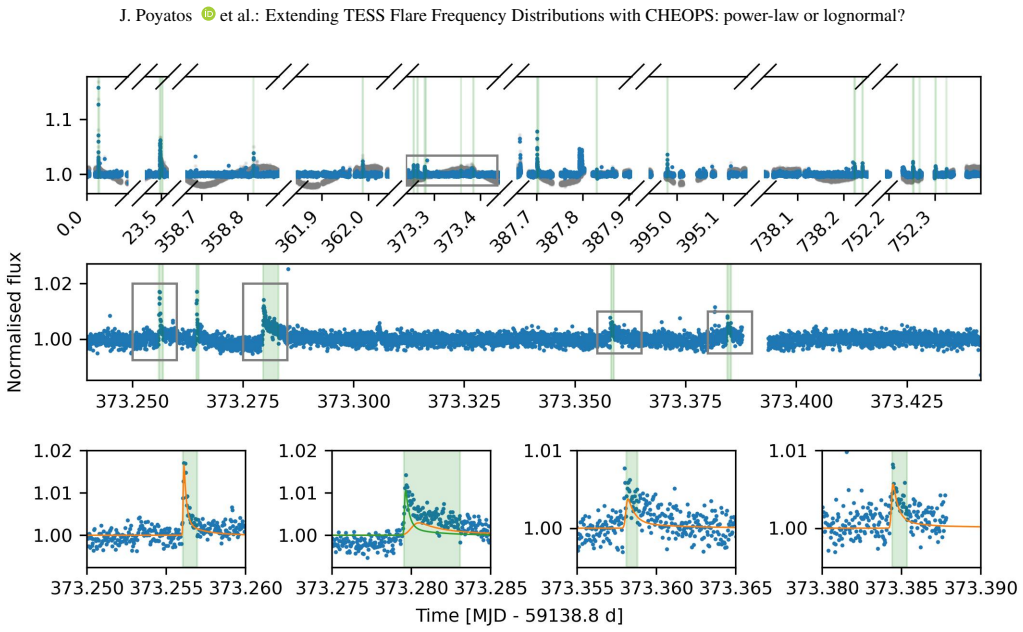


read the original abstract
Stellar flares are intense bursts of radiation caused by magnetic reconnection on active stars. They are especially frequent on M dwarfs, where they can significantly influence the habitability of orbiting planets. Flare frequency distributions (FFDs) are typically modelled as power laws. However, recent studies challenge this assumption and propose alternatives such as lognormal laws that imply different flare generation mechanisms and planetary impacts. This study investigates which statistical distribution best describes flare occurrences on M dwarfs, considering both equivalent duration (ED), directly measured from light-curve photometry, and bolometric energy, relevant for physical interpretation and habitability. We analysed 110 M dwarfs observed with TESS and CHEOPS, detecting 5620 flares. We decomposed complex events, corrected for detection biases in recovery rate and energy estimation, and scaled the FFDs to construct a combined distribution spanning six orders of magnitude in bolometric energy. We find that ED-based FFDs follow a power law, reflecting intrinsic photometric flare occurrence. However, bolometric-energy-based FFDs deviate from a pure power law. They are better described by a lognormal distribution, although the best fit is a truncated power law with a break at $1.8 \times 10^{35}$ erg. Using right-tail-stabilised Kolmogorov-Smirnov and exceedance tests, we attribute this deviation to limited sampling of the most energetic events. Our results show that the low-energy flattening, previously interpreted as lognormal behaviour, arises from observational biases and can be corrected through flare injection-recovery and combining observations with different sensitivities. Current instruments cannot reliably sample flares above $10^{35}$ erg, the most relevant for exoplanetary atmospheres. The upcoming PLATO mission will be able to investigate both regimes.
Editorial analysis
A structured set of objections, weighed in public.
Referee Report
Summary. The manuscript analyzes flare frequency distributions (FFDs) from 110 M dwarfs observed with TESS and CHEOPS, detecting 5620 flares. It concludes that equivalent-duration (ED)-based FFDs follow a power law, while bolometric-energy-based FFDs deviate from a pure power law and are better described by a lognormal distribution or a truncated power law with a break at 1.8 × 10^35 erg. The deviation is attributed to limited sampling of the most energetic events, after applying injection-recovery corrections for detection biases and energy estimation and combining datasets spanning six orders of magnitude in bolometric energy. The low-energy flattening is interpreted as bias-driven and correctable, with current instruments unable to reliably sample flares above 10^35 erg.
Significance. If the bias corrections hold, the work is significant for resolving aspects of the power-law versus lognormal debate in stellar flares, with implications for flare generation mechanisms and exoplanet habitability. The large combined sample and use of right-tail-stabilised Kolmogorov-Smirnov and exceedance tests provide a concrete statistical basis for attributing the rollover to sampling limits rather than intrinsic lognormal behavior. Credit is due for the explicit decomposition of complex events, the scaling to a combined distribution, and the forward-looking statement on PLATO capabilities.
major comments (2)
- [Methods (injection-recovery and energy scaling)] Methods section on injection-recovery procedure: The claim that the high-energy rollover (break at 1.8 × 10^35 erg) reflects limited sampling rather than residual bias depends on the injection-recovery pipeline fully and accurately correcting detection efficiencies and energy errors across the entire range, especially in the sparse high-ED tail. The abstract and methods description provide no quantitative details on the number of injected high-energy events, their recovery fractions, or any size-dependent systematic errors in the ED-to-bolometric scaling (e.g., assumptions on flare temperature and area). If recovery efficiency is underestimated for the rarest events, the apparent truncation could be an artifact; additional validation (e.g., recovery-rate curves binned by energy) is required to support the central conclusion.
- [Results (FFD fits and break energy)] Results section on FFD fits: The truncated power-law fit reports a break energy of 1.8 × 10^35 erg, but no uncertainties on this value or full details of the bolometric conversion are given. This is load-bearing for the claim that 'current instruments cannot reliably sample flares above 10^35 erg' and the recommendation for PLATO; without error bars or sensitivity tests on the scaling assumptions, the precise location of the break and its physical interpretation remain difficult to assess.
minor comments (2)
- [Abstract] Abstract: The statement that ED-based FFDs 'follow a power law' and bolometric ones 'deviate' would be strengthened by reporting the fitted power-law index and its uncertainty for the ED case.
- [Figures] Figure clarity: Ensure that any plots of the combined FFD (spanning six orders of magnitude) clearly distinguish the TESS-only, CHEOPS-only, and merged data points, with error bars shown.
Simulated Author's Rebuttal
We thank the referee for their thorough and constructive review, which highlights important aspects of our methods and results that require clarification. We address each major comment below and will incorporate revisions to strengthen the manuscript.
read point-by-point responses
-
Referee: Methods section on injection-recovery procedure: The claim that the high-energy rollover (break at 1.8 × 10^35 erg) reflects limited sampling rather than residual bias depends on the injection-recovery pipeline fully and accurately correcting detection efficiencies and energy errors across the entire range, especially in the sparse high-ED tail. The abstract and methods description provide no quantitative details on the number of injected high-energy events, their recovery fractions, or any size-dependent systematic errors in the ED-to-bolometric scaling (e.g., assumptions on flare temperature and area). If recovery efficiency is underestimated for the rarest events, the apparent truncation could be an artifact; additional validation (e.g., recovery-rate curves binned by energy) is required to support the central conclusion.
Authors: We agree that quantitative details on the injection-recovery tests are essential to substantiate the attribution of the high-energy rollover to sampling limits. The current manuscript summarizes the overall correction procedure but does not tabulate the specific numbers of injected high-energy events or present binned recovery fractions. In the revised version we will add these details, including recovery-rate curves as a function of energy, and explicitly discuss potential size-dependent systematics in the ED-to-bolometric scaling arising from assumed flare temperatures and areas. Sensitivity tests on these assumptions will also be included to demonstrate that the location of the break remains robust. revision: yes
-
Referee: Results section on FFD fits: The truncated power-law fit reports a break energy of 1.8 × 10^35 erg, but no uncertainties on this value or full details of the bolometric conversion are given. This is load-bearing for the claim that 'current instruments cannot reliably sample flares above 10^35 erg' and the recommendation for PLATO; without error bars or sensitivity tests on the scaling assumptions, the precise location of the break and its physical interpretation remain difficult to assess.
Authors: We acknowledge that the absence of uncertainties on the fitted break energy and expanded details on the bolometric conversion limits the reader's ability to evaluate the robustness of the result. In the revision we will report the formal uncertainty on the break energy obtained from the truncated power-law fit and provide a more complete description of the bolometric scaling, including the adopted flare temperature and area assumptions together with sensitivity tests. These additions will directly support the interpretation that current instruments cannot reliably sample flares above ~10^35 erg. revision: yes
Circularity Check
Fitted break energy and bias-corrected FFDs do not reduce to self-definition or self-citation
full rationale
The paper detects flares, applies injection-recovery to correct detection biases and energy estimation, scales ED to bolometric energy, and then fits power-law, lognormal, and truncated power-law models directly to the resulting empirical distributions. The reported break at 1.8e35 erg is obtained by fitting the truncated model to the combined TESS+CHEOPS data rather than being predicted from first principles or defined in terms of the fit itself. Attribution of the high-energy deviation to limited sampling relies on right-tail-stabilised KS and exceedance tests applied to the observed counts. No load-bearing step equates the central claim to a quantity constructed from the paper's own fitted parameters or prior self-citations; the analysis remains an empirical comparison of distribution families on bias-corrected observations.
Axiom & Free-Parameter Ledger
free parameters (1)
- break energy =
1.8e35 erg
axioms (1)
- standard math Kolmogorov-Smirnov and exceedance tests are appropriate for comparing power-law, lognormal, and truncated-power-law models on right-tail-stabilised samples
Lean theorems connected to this paper
-
IndisputableMonolith/Cost/FunctionalEquation.leanwashburn_uniqueness_aczel unclear?
unclearRelation between the paper passage and the cited Recognition theorem.
We find that ED-based FFDs closely follow a power-law distribution... bolometric-energy-based FFDs deviate... best fit is a truncated power law with a break at around 10^33 erg
What do these tags mean?
- matches
- The paper's claim is directly supported by a theorem in the formal canon.
- supports
- The theorem supports part of the paper's argument, but the paper may add assumptions or extra steps.
- extends
- The paper goes beyond the formal theorem; the theorem is a base layer rather than the whole result.
- uses
- The paper appears to rely on the theorem as machinery.
- contradicts
- The paper's claim conflicts with a theorem or certificate in the canon.
- unclear
- Pith found a possible connection, but the passage is too broad, indirect, or ambiguous to say the theorem truly supports the claim.
Reference graph
Works this paper leans on
-
[1]
1974, IEEE Transactions on Automatic Control, 19, 716
Akaike, H. 1974, IEEE Transactions on Automatic Control, 19, 716
work page 1974
-
[2]
M., Mathioudakis, M., Van Doorsselaere, T., & Kowalski, A
Anfinogentov, S., Nakariakov, V . M., Mathioudakis, M., Van Doorsselaere, T., & Kowalski, A. F. 2013, ApJ, 773, 156
work page 2013
-
[3]
Aschwanden, M. J. & Güdel, M. 2021, ApJ, 910, 41
work page 2021
-
[4]
Aschwanden, M. J., Tarbell, T. D., Nightingale, R. W., et al. 2000, ApJ, 535, 1047
work page 2000
-
[5]
Astudillo-Defru, N., Delfosse, X., Bonfils, X., et al. 2017, A&A, 600, A13
work page 2017
- [6]
-
[7]
Berger, V . L., Hinkle, J. T., Tucker, M. A., et al. 2024, MNRAS, 532, 4436
work page 2024
-
[8]
2025, A&A, 699, A90 Boro Saikia, S., Marvin, C
Bicz, K., Falewicz, R., Heinzel, P., et al. 2025, A&A, 699, A90 Boro Saikia, S., Marvin, C. J., Jeffers, S. V ., et al. 2018, A&A, 616, A108
work page 2025
-
[9]
Bruno, G., Pagano, I., Scandariato, G., et al. 2024, A&A, 686, A239
work page 2024
- [10]
-
[11]
Davenport, J. R. A. 2016, ApJ, 829, 23
work page 2016
-
[12]
Davenport, J. R. A., Hawley, S. L., Hebb, L., et al. 2014, ApJ, 797, 122
work page 2014
-
[13]
Feinstein, A. D., Seligman, D. Z., France, K., Gagné, J., & Kowalski, A. 2024, AJ, 168, 60
work page 2024
-
[14]
Fortier, A., Simon, A. E., Broeg, C., et al. 2024, A&A, 687, A302 Gaia Collaboration, Vallenari, A., Brown, A. G. A., et al. 2023, A&A, 674, A1
work page 2024
-
[15]
Gao, D.-Y ., Liu, H.-G., Yang, M., & Zhou, J.-L. 2022, AJ, 164, 213 Günther, M. N., Zhan, Z., Seager, S., et al. 2020, AJ, 159, 60
work page 2022
-
[16]
Howard, W. S., Corbett, H., Law, N. M., et al. 2020, ApJ, 902, 115
work page 2020
-
[17]
Howard, W. S., Corbett, H., Law, N. M., et al. 2019, ApJ, 881, 9
work page 2019
-
[18]
Howard, W. S. & MacGregor, M. A. 2022, ApJ, 926, 204
work page 2022
- [19]
-
[20]
2021, The Journal of Open Source Software, 6, 2845
Ilin, E. 2021, The Journal of Open Source Software, 6, 2845
work page 2021
-
[21]
Ilin, E., Schmidt, S. J., Poppenhäger, K., et al. 2021, A&A, 645, A42
work page 2021
-
[22]
Jackman, J. A. G., Shkolnik, E. L., Million, C., et al. 2023, MNRAS, 519, 3564
work page 2023
-
[23]
Jackman, J. A. G., Wheatley, P. J., Acton, J. S., et al. 2021, MNRAS, 504, 3246
work page 2021
-
[24]
Jenkins, J. M., Twicken, J. D., McCauliff, S., et al. 2016, in Society of Photo- Optical Instrumentation Engineers (SPIE) Conference Series, V ol. 9913, Soft- ware and Cyberinfrastructure for Astronomy IV , ed. G. Chiozzi & J. C. Guz- man, 99133E
work page 2016
- [25]
-
[26]
Kowalski, A. F. 2024, Living Reviews in Solar Physics, 21, 1
work page 2024
-
[27]
Kowalski, A. F., Hawley, S. L., Holtzman, J. A., Wisniewski, J. P., & Hilton, E. J. 2010, ApJ, 714, L98
work page 2010
-
[28]
M., Fors, O., Ratzloff, J., et al
Law, N. M., Fors, O., Ratzloff, J., et al. 2015, PASP, 127, 234
work page 2015
-
[29]
Longcope, D. W. & Noonan, E. J. 2000, ApJ, 542, 1088
work page 2000
-
[30]
J., Ilin, E., Oshagh, M., et al
Maas, A. J., Ilin, E., Oshagh, M., et al. 2022, A&A, 668, A111
work page 2022
- [31]
-
[32]
E., Bruno, G., Gomes-Júnior, A
Morgado, B. E., Bruno, G., Gomes-Júnior, A. R., et al. 2022, A&A, 664, L15
work page 2022
-
[33]
Nardiello, D., Malavolta, L., Desidera, S., et al. 2022, A&A, 664, A163
work page 2022
- [34]
-
[35]
Pietras, M., Falewicz, R., Siarkowski, M., Bicz, K., & Pre ´s, P. 2022, ApJ, 935, 143
work page 2022
-
[36]
Poyatos, J., Fors, O., Gómez Cama, J. M., & Ribas, I. 2025, A&A, 699, A242
work page 2025
-
[37]
S., Kumar, V ., Srivastava Mudit, K., et al
Rajpurohit, A. S., Kumar, V ., Srivastava Mudit, K., et al. 2025, arXiv e-prints, arXiv:2510.02693
- [38]
-
[39]
Ribas, I., Reiners, A., Zechmeister, M., et al. 2023, A&A, 670, A139
work page 2023
-
[40]
Rimmer, P. B., Xu, J., Thompson, S. J., et al. 2018, Science Advances, 4, eaar3302
work page 2018
-
[41]
F., Dominique, M., Seaton, D., Stegen, K., & White, A
Ryan, D. F., Dominique, M., Seaton, D., Stegen, K., & White, A. 2016, A&A, 592, A133
work page 2016
-
[42]
2022, Physics, 5, 11 Schöfer, P., Jeffers, S
Sakurai, T. 2022, Physics, 5, 11 Schöfer, P., Jeffers, S. V ., Reiners, A., et al. 2019, A&A, 623, A44
work page 2022
-
[43]
M., Meadows, V ., Kasting, J., & Hawley, S
Segura, A., Walkowicz, L. M., Meadows, V ., Kasting, J., & Hawley, S. 2010, Astrobiology, 10, 751
work page 2010
-
[44]
Seli, B., Vida, K., Moór, A., Pál, A., & Oláh, K. 2021, A&A, 650, A138
work page 2021
- [45]
- [46]
-
[47]
A., Segura, A., Meadows, V ., Hawley, S., & Davenport, J
Tilley, M. A., Segura, A., Meadows, V ., Hawley, S., & Davenport, J. 2019, As- trobiology, 19, 64 Tovar Mendoza, G., Davenport, J. R. A., Agol, E., Jackman, J. A. G., & Hawley, S. L. 2022, AJ, 164, 17
work page 2019
- [48]
-
[49]
Verbeeck, C., Kraaikamp, E., Ryan, D. F., & Podladchikova, O. 2019, ApJ, 884, 50
work page 2019
-
[50]
Vuong, Q. H. 1989, Econometrica, 57, 307
work page 1989
- [51]
- [52]
-
[53]
2018, ApJ, 859, 87 Article number, page 12 of 16 J
Yang, H., Liu, J., Qiao, E., et al. 2018, ApJ, 859, 87 Article number, page 12 of 16 J. Poyatos et al.: Extending TESS Flare Frequency Distributions with CHEOPS: power-law or lognormal? Appendix A: Target table Table A.1: Full table of targets, stellar parameters, and flare counts. Target TIC ID Spectral type Gmag Teff [K] Dist [pc] Radius [R⊙] V sin i [k...
work page 2018
discussion (0)
Sign in with ORCID, Apple, or X to comment. Anyone can read and Pith papers without signing in.