Data-Boosted Optimization for AC Optimal Power Flow: Interior-Point and Spatial Branching Methods
Pith reviewed 2026-05-18 06:12 UTC · model grok-4.3
The pith
Historical data boosts convergence for both local and global AC-OPF solvers
A machine-rendered reading of the paper's core claim, the machinery that carries it, and where it could break.
Core claim
Data-boosted variants of interior-point methods and spatial branching for AC-OPF leverage historical operating data for initialization and region restriction, respectively, yielding consistent gains in convergence speed and computation time. Interior-point methods exhibit robustness by often locating globally optimal solutions in instances with multiple local optima, whereas spatial branching remains computationally demanding even after the enhancements.
What carries the argument
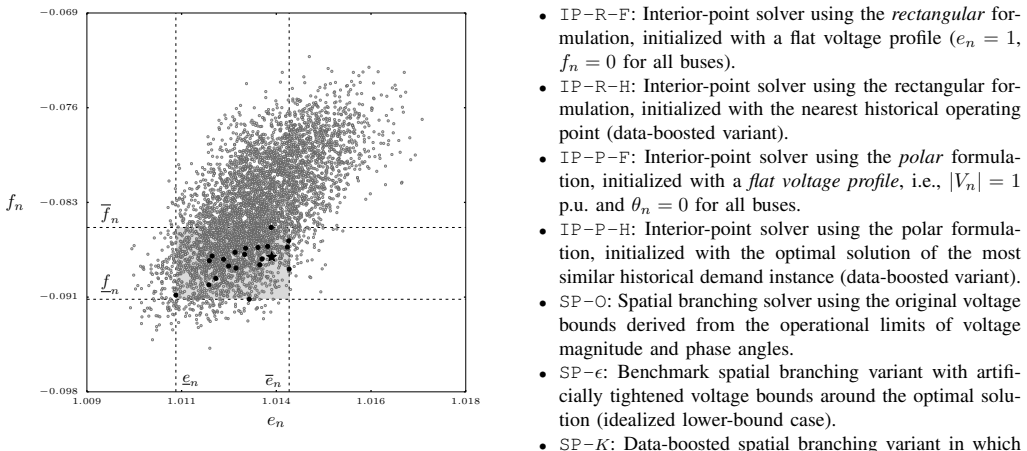
Data-boosted initialization for interior-point methods combined with data-driven restriction of the search region for spatial branching in the AC Optimal Power Flow problem.
Load-bearing premise
Historical operating data is available and representative of the networks, so that using it for initialization or region restriction neither excludes the global optimum nor biases the reported gains.
What would settle it
Running the data-boosted solvers on a new network configuration where the historical data set does not contain the global optimum point or produces no speedup would show whether the performance claims hold without that data match.
Figures
read the original abstract
The AC Optimal Power Flow (AC-OPF) problem is a non-convex, NP-hard optimization task essential for secure and economic power system operation. While interior-point methods are widely used due to their computational efficiency, spatial branching techniques offer global optimality guarantees at significantly higher computational cost. In this work, we propose data-boosted variants of both approaches that leverage historical operating data to enhance performance. Specifically, data are used to guide initialization in interior-point methods and to restrict the search region in spatial branching. This unified perspective enables a systematic assessment of how learning can accelerate both local and global optimization strategies. We conduct an extensive empirical study across networks of varying sizes under both standard conditions and modified configurations designed to induce local optima. Our results show that data-boosted strategies consistently improve convergence and reduce computation times for both approaches. However, spatial branching remains computationally demanding even with data-driven enhancements, while interior-point methods exhibit remarkable robustness, often converging to globally optimal solutions, even in challenging instances with multiple local optima. These findings highlight the practical effectiveness of modern interior-point solvers and suggest that global optimization methods for AC-OPF still face significant scalability challenges, even when augmented with data-driven guidance.
Editorial analysis
A structured set of objections, weighed in public.
Referee Report
Summary. The manuscript proposes data-boosted variants of interior-point methods (IPM) and spatial branching for the non-convex AC Optimal Power Flow (AC-OPF) problem. Historical operating data are used to guide initialization for IPM and to restrict the feasible region for spatial branching. An extensive empirical study is reported across networks of varying sizes under both standard conditions and modified configurations designed to induce multiple local optima, claiming that the data-boosted strategies consistently improve convergence and reduce computation times for both approaches, with IPM exhibiting robustness in reaching globally optimal solutions while spatial branching remains computationally demanding.
Significance. If the empirical results and the assumption that data-derived restrictions preserve the global optimum hold, the work would provide a useful unified assessment of how learning can accelerate both local and global solvers for AC-OPF. It would highlight the practical robustness of modern IPM implementations and the remaining scalability barriers for global methods, offering guidance for solver choice in power-system applications. The systematic comparison under challenging modified instances adds value beyond standard test cases.
major comments (1)
- Abstract and spatial-branching method description: the central claim that data-boosted region restriction improves performance without sacrificing global optimality lacks any explicit verification that the data-derived bounds contain the true global solution. This is load-bearing for the reported improvements and optimality statements, especially in the modified test cases explicitly constructed to induce multiple local optima; historical data from standard conditions may not cover these configurations, and any global optimum lying outside the restricted region would render the comparisons non-equivalent to the unrestricted problem.
minor comments (1)
- The abstract would benefit from at least one or two concrete quantitative metrics (e.g., average speed-up factors or success rates) rather than solely qualitative statements such as 'consistently improve' and 'remarkable robustness'.
Simulated Author's Rebuttal
We thank the referee for the thorough review and valuable feedback. The major comment raises an important point about verifying that data-derived bounds preserve the global optimum. We address this directly below and will incorporate explicit checks in the revision.
read point-by-point responses
-
Referee: Abstract and spatial-branching method description: the central claim that data-boosted region restriction improves performance without sacrificing global optimality lacks any explicit verification that the data-derived bounds contain the true global solution. This is load-bearing for the reported improvements and optimality statements, especially in the modified test cases explicitly constructed to induce multiple local optima; historical data from standard conditions may not cover these configurations, and any global optimum lying outside the restricted region would render the comparisons non-equivalent to the unrestricted problem.
Authors: We agree that explicit verification is essential for the claims regarding global optimality preservation. In the original experiments, the data-boosted spatial branching consistently recovered the same objective values as the unrestricted global solver across all instances, including the modified test cases. However, we did not include a dedicated verification step documenting that the known global solutions lie inside the data-derived bounds. In the revised manuscript we will add a new subsection (or appendix) that reports, for each network and configuration, the distance between the unrestricted global solution and the data-derived bounds, confirming containment. For the modified instances we will also clarify the procedure used to generate or select the historical data to ensure relevance to the altered operating conditions. This will make the equivalence of the restricted and unrestricted problems explicit. revision: yes
Circularity Check
No significant circularity in empirical data-driven evaluation
full rationale
The paper proposes data-boosted variants of interior-point and spatial branching methods for AC-OPF, using historical operating data for initialization and feasible-region restriction, then reports empirical results on convergence and computation times across test networks. No derivation chain, first-principles prediction, or fitted parameter is presented that reduces by construction to the same inputs or self-citations; performance claims rest on direct experimental measurement rather than algebraic equivalence or load-bearing self-reference. The approach is therefore self-contained against external benchmarks with no circular steps.
Axiom & Free-Parameter Ledger
Lean theorems connected to this paper
-
IndisputableMonolith/Cost/FunctionalEquation.leanwashburn_uniqueness_aczel unclear?
unclearRelation between the paper passage and the cited Recognition theorem.
data-boosted variants that leverage historical operating data to enhance performance by guiding initialization in interior-point methods or constraining the search region in spatial branching
-
IndisputableMonolith/Foundation/RealityFromDistinction.leanreality_from_one_distinction unclear?
unclearRelation between the paper passage and the cited Recognition theorem.
SP-K: Data-boosted spatial branching variant in which voltage bounds are learned from the K nearest historical operating points
What do these tags mean?
- matches
- The paper's claim is directly supported by a theorem in the formal canon.
- supports
- The theorem supports part of the paper's argument, but the paper may add assumptions or extra steps.
- extends
- The paper goes beyond the formal theorem; the theorem is a base layer rather than the whole result.
- uses
- The paper appears to rely on the theorem as machinery.
- contradicts
- The paper's claim conflicts with a theorem or certificate in the canon.
- unclear
- Pith found a possible connection, but the passage is too broad, indirect, or ambiguous to say the theorem truly supports the claim.
Reference graph
Works this paper leans on
-
[1]
Optimal power flow formulations and their impacts on the performance of solution methods,
B. Sereeter, C. Vuik, C. Witteveen, and P. Palensky, “Optimal power flow formulations and their impacts on the performance of solution methods,” in2019 IEEE Power & Energy Society General Meeting (PESGM). IEEE, 2019, pp. 1–5
work page 2019
-
[2]
Y . Tang, K. Dvijotham, and S. Low, “Real-time optimal power flow,” IEEE Transactions on Smart Grid, vol. 8, no. 6, pp. 2963–2973, 2017
work page 2017
-
[3]
Solutions of dc opf are never ac feasible,
K. Baker, “Solutions of dc opf are never ac feasible,” inProceedings of the Twelfth ACM International Conference on Future Energy Systems, 2021, pp. 264–268
work page 2021
-
[4]
A survey of relaxations and approximations of the power flow equations,
D. K. Molzahn, I. A. Hiskenset al., “A survey of relaxations and approximations of the power flow equations,”Foundations and Trends® in Electric Energy Systems, vol. 4, no. 1-2, pp. 1–221, 2019
work page 2019
-
[5]
Empirical investigation of non-convexities in optimal power flow problems,
M. R. Narimani, D. K. Molzahn, D. Wu, and M. L. Crow, “Empirical investigation of non-convexities in optimal power flow problems,” in 2018 Annual American Control Conference (ACC). IEEE, 2018, pp. 3847–3854
work page 2018
-
[6]
Experiments with the interior-point method for solving large scale optimal power flow problems,
F. Capitanescu and L. Wehenkel, “Experiments with the interior-point method for solving large scale optimal power flow problems,”Electric Power Systems Research, vol. 95, pp. 276–283, 2013
work page 2013
-
[7]
Learning and optimization for efficient and optimal oper- ations in sustainable power systems,
L. Zhang, “Learning and optimization for efficient and optimal oper- ations in sustainable power systems,” Ph.D. dissertation, University of Washington, 2024
work page 2024
-
[8]
J. Kardos, D. Kourounis, O. Schenk, and R. Zimmerman, “Complete results for a numerical evaluation of interior point solvers for large- scale optimal power flow problems,”arXiv preprint arXiv:1807.03964, 2018
-
[9]
Lo- cal solutions of the Optimal Power Flow problem,
W. A. Bukhsh, A. Grothey, K. I. M. McKinnon, and P. A. Trodden, “Lo- cal solutions of the Optimal Power Flow problem,”IEEE Transactions on Power Systems, vol. 28, no. 4, pp. 4780–4788, 2013
work page 2013
-
[10]
Bound tightening for the alternating current optimal power flow problem,
C. Chen, A. Atamt ¨urk, and S. S. Oren, “Bound tightening for the alternating current optimal power flow problem,”IEEE Transactions on Power Systems, vol. 31, no. 5, pp. 3729–3736, 2015
work page 2015
-
[11]
Scalable global optimization for AC-OPF via quadratic convex relaxation and branch-and-bound,
M. Iranpour and M. R. Narimani, “Scalable global optimization for AC-OPF via quadratic convex relaxation and branch-and-bound,”arXiv preprint arXiv:2505.18435, 2025
-
[12]
Data-driven optimal power flow: A physics-informed machine learning approach,
X. Lei, Z. Yang, J. Yu, J. Zhao, Q. Gao, and H. Yu, “Data-driven optimal power flow: A physics-informed machine learning approach,” IEEE Transactions on Power Systems, vol. 36, no. 1, pp. 346–354, 2020
work page 2020
-
[13]
Inter- pretable machine learning for dc optimal power flow with feasibility guarantees,
A. Stratigakos, S. Pineda, J. M. Morales, and G. Kariniotakis, “Inter- pretable machine learning for dc optimal power flow with feasibility guarantees,”IEEE Transactions on Power Systems, vol. 39, no. 3, pp. 5126–5137, 2023
work page 2023
-
[14]
Beyond the neural fog: Interpretable learning for ac optimal power flow,
S. Pineda, J. P ´erez-Ruiz, and J. M. Morales, “Beyond the neural fog: Interpretable learning for ac optimal power flow,”IEEE Transactions on Power Systems, 2025
work page 2025
-
[15]
Review of Machine Learning techniques for Optimal Power Flow,
H. Khaloie, M. Dolanyi, J.-F. Toubeau, and F. Vall ´ee, “Review of Machine Learning techniques for Optimal Power Flow,”Applied Energy, vol. 388, p. 125637, 2025
work page 2025
-
[16]
Deepopf: A deep neural network approach for security-constrained dc optimal power flow,
X. Pan, T. Zhao, M. Chen, and S. Zhang, “Deepopf: A deep neural network approach for security-constrained dc optimal power flow,”IEEE Transactions on Power Systems, vol. 36, no. 3, pp. 1725–1735, 2020
work page 2020
-
[17]
Ac power flow feasibility restoration via a state estimation-based post-processing algorithm,
B. Taheri and D. K. Molzahn, “Ac power flow feasibility restoration via a state estimation-based post-processing algorithm,”Electric Power Systems Research, vol. 235, p. 110642, 2024
work page 2024
-
[18]
Learn- ing to accelerate globally optimal solutions to the ac optimal power flow problem,
F. Cengil, H. Nagarajan, R. Bent, S. Eksioglu, and B. Eksioglu, “Learn- ing to accelerate globally optimal solutions to the ac optimal power flow problem,”Electric power systems research, vol. 212, p. 108275, 2022
work page 2022
-
[19]
Data-driven probabilistic constraint elimina- tion for accelerated optimal power flow,
C. Crozier and K. Baker, “Data-driven probabilistic constraint elimina- tion for accelerated optimal power flow,” in2022 IEEE Power & Energy Society General Meeting (PESGM). IEEE, 2022, pp. 1–5
work page 2022
-
[20]
A. S. Nair, S. Abhyankar, S. Peles, and P. Ranganathan, “Computational and numerical analysis of ac optimal power flow formulations on large- scale power grids,”Electric power systems research, vol. 202, p. 107594, 2022
work page 2022
-
[21]
Mathematical programming formulations for the alternating current optimal power flow problem,
D. Bienstock, M. Escobar, C. Gentile, and L. Liberti, “Mathematical programming formulations for the alternating current optimal power flow problem,”4OR, vol. 18, no. 3, pp. 249–292, 2020
work page 2020
-
[22]
Ye,Interior point algorithms: theory and analysis
Y . Ye,Interior point algorithms: theory and analysis. John Wiley & Sons, 2011
work page 2011
-
[23]
A simplicial branch-and-bound algorithm for solving quadratically constrained quadratic programs,
J. Linderoth, “A simplicial branch-and-bound algorithm for solving quadratically constrained quadratic programs,”Mathematical program- ming, vol. 103, no. 2, pp. 251–282, 2005
work page 2005
-
[24]
R. D. Zimmerman, C. E. Murillo-S ´anchez, and R. J. Thomas, “Mat- power: Steady-state operations, planning, and analysis tools for power systems research and education,”IEEE Transactions on power systems, vol. 26, no. 1, pp. 12–19, 2010
work page 2010
-
[25]
OASYS research group, “Ipvssp4opf,” https://github.com/groupoasys/IPvsSP4OPF, 2025, accessed: 2025- 10-10
work page 2025
discussion (0)
Sign in with ORCID, Apple, or X to comment. Anyone can read and Pith papers without signing in.