REVIEW 3 major objections 5 minor 56 references
What Questions Should Robots Be Able to Answer? A Dataset of User Questions for Explainable Robotics
T0 review · 3 major / 5 minor · reviewed 2026-08-04 · deepseek-v4-flash
Pith's one-line read A new dataset of 1,893 user questions maps what people want to ask household robots.
desk verdict Valuable dataset with a solid design, but the reported numbers don't add up—fix the counts before it's treated as canonical. read the letter →
The pith
A machine-rendered reading of the paper's core claim, the machinery that carries it, and where it could break.
The reading
What carries the argument
The carry load of the argument is the dataset itself together with its two-level coding scheme: 1,893 user questions hierarchically organized into 12 main categories and 70 subcategories, each defined with examples. The collection protocol pairs video and text stimuli of robot household tasks with a structured prompt that asks participants to write questions the robot should be able to answer and to rate each question's importance on a 5-point scale. Statistical inference on importance rankings uses a linear mixed-effects model with participant and stimulus as random intercepts, allowing within-participant and within-stimulus correlation to be accounted for.
What would settle it
Run a longitudinal field study where participants live with an actual household robot for several weeks and their spontaneous questions are logged as they ask them, then compare the distribution and importance ratings to the 12-category taxonomy; if the category frequencies or the importance ordering diverge substantially for the same tasks, the dataset's transferability breaks down.
Extended reading notes
Core claim
The paper's central claim is that the space of questions users want household robots to answer is much broader than the why-questions typically studied in explainable AI, and that this space can be systematically mapped. By eliciting questions from 100 participants across 15 video and 7 text stimuli of real robot task executions, the authors construct a hierarchical taxonomy with 12 main categories and 70 subcategories. The most frequently asked categories are execution-details (21.4%), what-abilities (12.6%), and self/task-assessment (10.7%). However, importance ratings from the same participants rank potential-issues questions (hypothetical difficulties and correctness assurance) as most i
Load-bearing premise
The questions people write while watching short video clips or reading text summaries are assumed to be essentially the same questions they would actually ask a real household robot during repeated, everyday interaction.
Editorial extensions
If this is right
- Robot developers can use the taxonomy to decide which data a robot must log during task execution, since answering questions about environment state, execution details, or capabilities each requires different recorded information.
- Question-answering and explanation modules should prioritize questions about potential issues and correctness assurance over the why-questions that have dominated XAI research, based on the importance rankings.
- The dataset can serve as a benchmark for evaluating robot question-answering systems, offering a ground-truth set of user-generated questions with importance weights.
- The difference in question types between novices and experienced users implies that adaptive question-answering systems may need to tailor their scope and defaults to user expertise.
- The divergence between question frequency and importance within categories suggests that rare but highly important questions may deserve proactive explanation features rather than being overlooked.
Reading between the lines
- The importance ranking could be converted into a weighted evaluation metric for generative question-answering systems, penalizing failure on high-importance categories more heavily.
- The taxonomy may transfer beyond household robots to other service or collaborative robots, but validating that transfer would require similar elicitation in those domains.
- The smaller gap between video and text elicitation results hints that users ask different questions about a robot's past activity versus live action; this could inform whether a robot should give periodic summaries or only respond on request.
- A natural next step would be to collect paired user answers alongside questions to disambiguate intent, which the authors themselves note as a limitation and future direction.
Editorial analysis
A structured set of objections, weighed in public.
Referee Report
Summary. The paper introduces a dataset of 1,893 user questions for household robots, elicited from 100 Prolific participants in response to 15 video and 7 text stimuli depicting everyday robot tasks. The questions were coded inductively into a two-level hierarchy of 12 categories and 70 subcategories. The authors report importance ratings for each question, use a linear mixed-effects model to compare importance across categories, and examine how question types and importance scores relate to participants' robot experience and attitudes. They claim that potential-issue questions receive the highest importance ratings, that why-questions rank relatively low, and that robotics novices ask different question types than more experienced users.
Significance. If the dataset is internally consistent and the public artifacts match the manuscript, this would be a valuable empirical resource for XAI and HRI: it provides a structured, publicly available corpus with a codebook, inter-annotator agreement (Cohen's kappa = .77 on a 100-question subset), and a reproducible analysis pipeline. The finding that users prioritize hypothetical-scenario and correctness-assurance questions over the why-questions dominant in much XAI literature is practically useful for prioritizing logging and explanation functionality. However, the current manuscript contains multiple internal numeric inconsistencies in the central dataset-size claim and related descriptive statistics; these must be resolved before the dataset can be treated as a canonical resource.
major comments (3)
- [§1, §3.3, §4, Figure 2, Figure 3] The central claim that the dataset contains 1,893 questions is not supported by the manuscript's own numbers. Section 4 reports 2,052 collected and 143 excluded, which gives 1,909, not 1,893. The per-category sample sizes in Figure 3 sum to 1,948 (120+190+126+245+83+157+52+417+106+209+125+118), and these counts match the subcategory counts in Figure 2. If each question belongs to exactly one category, the categorized dataset should contain 1,948 rows. The abstract, Section 3.3, and Section 4 thus give three different totals. Please reconcile these numbers and verify against the released GitHub/HuggingFace dataset, since the reuse value of the dataset depends on knowing exactly which questions are included.
- [Abstract vs. §1; §3.2] The top-category percentages are inconsistent between the abstract and the introduction: the abstract reports execution-details 21.4%, capabilities 12.6%, performance 10.7%, while Section 1 reports 22.5%, 12.7%, and 11.3%. These do not correspond to the same denominator (e.g., the Figure 2/3 counts give 417/1948 = 21.4%, but 417/1893 = 22.0%). Additionally, the abstract says 7 text stimuli while Section 3.2 says 'we wrote six text reports'; Section 3.1 implies a pool of 22 stimuli (15 videos + 7 texts). Please correct these inconsistencies, as they affect both the summary statistics and the reproducibility of the stimulus set.
- [§4.3, Figure 5] The contribution statement claims that users with different robot experience 'ask different questions,' but this is supported only by descriptive percentage differences in Figure 5 with no inferential test. The text reports, for example, that low-experience participants asked execution-details questions 23.3% of the time versus 15.7% for high-experience participants, without a significance test or effect-size estimate. If this is a central finding of RQ3, please add an appropriate statistical analysis (e.g., a mixed-effects model or permutation test on category proportions) or explicitly label the observation as descriptive and temper the contribution claim.
minor comments (5)
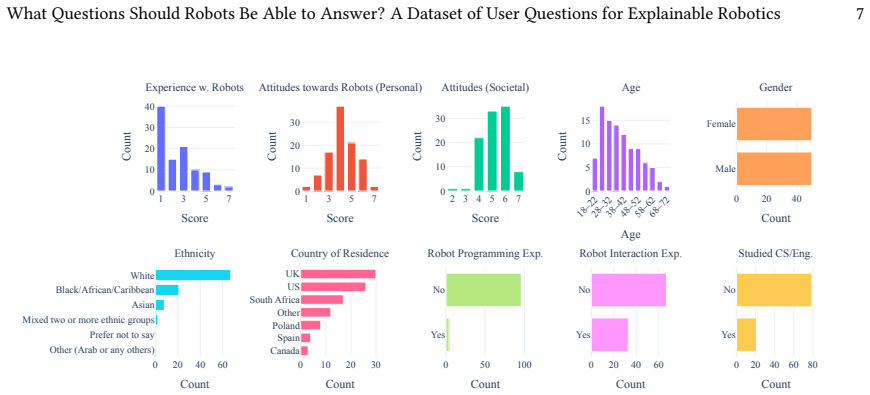
- [§3.4, §4.3] The robot-experience variable is described in Section 4.3 as a 1–5 scale, but Figure 1 and Figure 5 describe it as a 1–7 Likert scale. Please make the scale consistent everywhere, including in the regression interpretation.
- [§3.4] The reliability subsection says the second annotator re-annotated '100 sentences ... balanced across categories, i.e., contained 8 samples per category.' With 12 categories, 8 samples per category gives 96, not 100. Please clarify how the 100-question sample was constructed and whether the balance statement is exact.
- [Figure 3] The x-axis label reads '0 (not at all important), 5 (extremely important),' but the text and Methods say the scale is 1 (Not at all important) to 5 (extremely important). Please correct the axis label.
- [§4.2] The list of pairwise contrasts reports corrected p-values only. For transparency, please also report the raw p-values or state explicitly that the reported values are Holm–Bonferroni-adjusted.
- [§5.1] The comparison of text- vs. video-elicited questions (36% vs. 16% execution-details) is informative, but it would be helpful to report whether this difference is statistically tested or is purely descriptive.
Circularity Check
No circular derivation; the dataset and importance rankings are empirically self-contained.
full rationale
This is a dataset-collection and descriptive-statistics paper; there is no formal derivation chain whose conclusions could be equivalent to its own inputs. The taxonomy was explicitly coded inductively from the newly collected questions: 'the questions were coded by the first author of this paper in an inductive, bottom-up manner. No pre-defined (top-down) codes were used.' The importance ranking comes from a linear mixed-effects model fit to the participants' own importance ratings, so it is a summary of those ratings rather than a prediction from fitted parameters. Earlier self-citations ([51], [53]) are used only to situate the study and explicitly do not constrain the coding: 'While these taxonomies provide us with insights into the HRI contexts in which questions are asked, in this work, we present a dataset of concrete natural language questions...' Therefore no step reduces by construction or by self-citation to the paper's inputs. Note: the internal count inconsistencies (2,052−143=1,909 vs. the stated 1,893, and Figure 3 category n's summing to 1,948) are a correctness/reproducibility concern, not circularity.
Assumptions & free parameters
assumptions (5)
- domain assumption Questions elicited by prompted video/text stimuli approximate the questions users would ask a real household robot in natural interaction.
- domain assumption Prolific participants who are fluent in English are representative enough of household-robot users for the reported importance rankings and group differences.
- domain assumption The inductive coding by the first author, with a second annotator checking 100 questions, produces a valid and reproducible taxonomy.
- domain assumption Self-reported 1-5 importance ratings measure how important it is for a robot to be able to answer a question.
- standard math The linear mixed-effects model with random intercepts for participant and stimulus yields valid standard errors for category comparisons.
Cite this review
Pith. "Pith review of What Questions Should Robots Be Able to Answer? A Dataset of User Questions for Explainable Robotics." pith.science (2026). https://pith.science/paper/LQSEZ52C
@misc{pith2026251016435,
  author       = {Pith},
  title        = {Pith review of: What Questions Should Robots Be Able to Answer? A Dataset of User Questions for Explainable Robotics},
  year         = {2026},
  howpublished = {\url{https://pith.science/paper/LQSEZ52C}},
  note         = {Machine review of arXiv:2510.16435}
}
read the original abstract
With the growing use of large language models and conversational interfaces in human-robot interaction, robots' ability to answer user questions is more important than ever. We therefore introduce a dataset of 1,893 user questions for household robots, collected from 100 participants and organized into 12 categories and 70 subcategories. Most work in explainable robotics focuses on why-questions. In contrast, our dataset provides a wide variety of questions, from questions about simple execution details to questions about how the robot would act in hypothetical scenarios -- thus giving roboticists valuable insights into what questions their robot needs to be able to answer. To collect the dataset, we created 15 video stimuli and 7 text stimuli, depicting robots performing varied household tasks. We then asked participants on Prolific what questions they would want to ask the robot in each portrayed situation. In the final dataset, the most frequent categories are questions about task execution details (21.4%), the robot's capabilities (12.6%), and performance assessments (10.7%). Although questions about how robots would handle potentially difficult scenarios and ensure correct behavior are less frequent, users rank them as the most important for robots to be able to answer. Moreover, we find that users who identify as novices in robotics ask different questions than more experienced users. Novices are more likely to inquire about simple facts, such as what the robot did or the current state of the environment. As robots enter environments shared with humans and language becomes central to giving instructions and interaction, this dataset provides a valuable foundation for (i) identifying the information robots need to log and expose to conversational interfaces, (ii) benchmarking question-answering modules, and (iii) designing explanation strategies that align with user expectations.
Figures


Figures from the paper (2 more)


Reference graph
Works this paper leans on
-
[1]
Josh Achiam, Steven Adler, Sandhini Agarwal, Lama Ahmad, Ilge Akkaya, Florencia Leoni Aleman, Diogo Almeida, Janko Altenschmidt, Sam Altman, Shyamal Anadkat, et al. 2023. GPT-4 Technical Report.arXiv preprint arXiv:2303.08774(2023)
arXiv 2023
-
[2]
Amina Adadi and Mohammed Berrada. 2018. Peeking Inside the Black-Box: A Survey on Explainable Artificial Intelligence (XAI).IEEE Access6 (2018), 52138–52160
2018
-
[3]
Sule Anjomshoae, Amro Najjar, Davide Calvaresi, and Kary Främling. 2019. Explainable Agents and Robots: Results from a Systematic Literature Review. InInternational Conference on Autonomous Agents and Multiagent Systems (AAMAS). IFAAMAS, 1078–1088
2019
-
[4]
Martim Brandão, Gerard Canal, Senka Krivić, and Daniele Magazzeni. 2021. Towards Providing Explanations for Robot Motion Planning. In International Conference on Robotics and Automation (ICRA). IEEE, 3927–3933
2021
-
[5]
Vanessa Buhrmester, David Münch, and Michael Arens. 2021. Analysis of Explainers of Black Box Deep Neural Networks for Computer Vision: A Survey.Machine Learning and Knowledge Extraction3 (2021), 966–989
2021
-
[6]
Michael Cashmore, Anna Collins, Benjamin Krarup, Senka Krivic, Daniele Magazzeni, and David Smith. 2019. Towards Explainable AI Planning as a Service. InICAPS Workshop XAIP
2019
-
[7]
Mattila, and Lisa E
Sungwoo Choi, Anna S. Mattila, and Lisa E. Bolton. 2021. To Err Is Human(-oid): How Do Consumers React to Robot Service Failure and Recovery? Journal of Service Research24, 3 (2021), 354–371
2021
-
[8]
Gheorghe Comanici, Eric Bieber, Mike Schaekermann, Ice Pasupat, Noveen Sachdeva, Inderjit Dhillon, Marcel Blistein, Ori Ram, Dan Zhang, Evan Rosen, et al. 2025. Gemini 2.5: Pushing the Frontier with Advanced Reasoning, Multimodality, Long Context, and Next Generation Agentic Capabilities.arXiv preprint arXiv:2507.06261(2025)
arXiv 2025
Show all 56 references
-
[9]
Finale Doshi-Velez and Been Kim. 2017. Towards a Rigorous Science of Interpretable Machine Learning.arXiv preprint arXiv:1702.08608(2017)
2017 arXiv
-
[10]
Upol Ehsan and Mark O. Riedl. 2020. Human-Centered Explainable AI: Towards a Reflective Sociotechnical Approach. InHCI International - Late Breaking Papers. Springer
2020
-
[11]
Malin Eiband, Hanna Schneider, Mark Bilandzic, Julian Fazekas-Con, Mareike Haug, and Heinrich Hussmann. 2018. Bringing transparency design into practice. InConference on Intelligent User Interfaces. ACM
2018
-
[12]
Connor Esterwood and Lionel P Robert. 2022. Having the Right Attitude: How Attitude Impacts Trust Repair in Human—Robot Interaction. In ACM/IEEE International Conference on Human-Robot Interaction (HRI). IEEE, 332–341
2022
-
[13]
Kerstin Fischer, Hanna Mareike Weigelin, and Leon Bodenhagen. 2018. Increasing trust in human–robot medical interactions: effects of transparency and adaptability.Paladyn, Journal of Behavioral Robotics9, 1 (2018), 95–109. 20 Wachowiak et al
2018
-
[14]
Maria Fox, Derek Long, and Daniele Magazzeni. 2017. Explainable Planning. InWorkshop on Explainable Planning at the International Joint Conference on Artificial Intelligence (IJCAI)
2017
-
[15]
Zipeng Fu, Tony Z Zhao, and Chelsea Finn. 2024. Mobile ALOHA: Learning Bimanual Mobile Manipulation Using Low-Cost Whole-Body Teleoperation. In8th Annual Conference on Robot Learning (CoRL)
2024
-
[16]
Ferran Gebellí, Lavinia Hriscu, Raquel Ros, Séverin Lemaignan, Alberto Sanfeliu, and Anaís Garrell. 2025. Personalised Explainable Robots Using LLMs. InACM/IEEE International Conference on Human-Robot Interaction (HRI). IEEE, 1304–1308
2025
-
[17]
Ferran Gebellí, Raquel Ros, Séverin Lemaignan, and Anaís Garrell. 2024. Co-Designing Explainable Robots: A Participatory Design Approach for HRI. InIEEE International Conference on Robot and Human Interactive Communication (ROMAN). IEEE, 1564–1570
2024
-
[18]
Juan Angel Gonzalez-Aguirre, Ricardo Osorio-Oliveros, Karen L Rodríguez-Hernández, Javier Lizárraga-Iturralde, Ruben Morales Menendez, Ricardo A Ramirez-Mendoza, Mauricio Adolfo Ramirez-Moreno, and Jorge de Jesus Lozoya-Santos. 2021. Service Robots: Trends and Technology. Appl...
2021
-
[19]
Daya Guo, Dejian Yang, Haowei Zhang, Junxiao Song, Ruoyu Zhang, Runxin Xu, Qihao Zhu, Shirong Ma, Peiyi Wang, Xiao Bi, et al . 2025. Deepseek-R1: Incentivizing Reasoning Capability in LLMs via Reinforcement Learning.arXiv preprint arXiv:2501.12948(2025)
2025 arXiv
-
[20]
Sture Holm. 1979. A Simple Sequentially Rejective Multiple Test Procedure.Scandinavian Journal of Statistics6, 2 (1979), 65–70
1979
-
[21]
Lei Huang, Weijiang Yu, Weitao Ma, Weihong Zhong, Zhangyin Feng, Haotian Wang, Qianglong Chen, Weihua Peng, Xiaocheng Feng, Bing Qin, et al. 2025. A Survey on Hallucination in Large Language Models: Principles, Taxonomy, Challenges, and Open Questions.Transactions on Informati...
2025
-
[22]
Physical Intelligence, Kevin Black, Noah Brown, James Darpinian, Karan Dhabalia, Danny Driess, Adnan Esmail, Michael Equi, Chelsea Finn, Niccolo Fusai, et al. 2025. A Vision-Language-Action Model with Open-World Generalization.arXiv preprint arXiv:2504.16054(2025)
2025 arXiv
-
[23]
Dinesh Babu Jayagopi, Samira Sheiki, David Klotz, Johannes Wienke, Jean-Marc Odobez, Sebastien Wrede, Vasil Khalidov, Laurent Nyugen, Britta Wrede, and Daniel Gatica-Perez. 2013. The Vernissage Corpus: A Conversational Human-Robot-Interaction Dataset. InACM/IEEE International ...
2013
-
[24]
2024.Preferences for AI Explanations: Considering the Role of User and Robot Characteristics
Hana Kopecka. 2024.Preferences for AI Explanations: Considering the Role of User and Robot Characteristics. Ph. D. Dissertation. King’s College London
2024
-
[25]
Hana Kopecka and Jose Such. 2020. Explainable AI for Cultural Minds. InWorkshop on Dialogue, Explanation and Argumentation for Human–Agent Interaction
2020
-
[26]
Hana Kopecka, Jose Such, and Michael Luck. 2024. Preferences for AI Explanations Based on Cognitive Style and Socio-Cultural Factors.Proceedings of the ACM on Human-Computer Interaction8, CSCW1 (2024), 1–32
2024
-
[27]
Mika Koverola, Anton Kunnari, Jukka Sundvall, and Michael Laakasuo. 2022. General Attitudes Towards Robots Scale (GAToRS): A New Instrument for Social Surveys.International Journal of Social Robotics14, 7 (2022), 1559–1581
2022
-
[28]
Richard Landis and Gary G
J. Richard Landis and Gary G. Koch. 1977. The Measurement of Observer Agreement for Categorical Data.Biometrics33, 1 (1977)
1977
-
[29]
Gregory LeMasurier, Christian Tagliamonte, Jacob Breen, Daniel Maccaline, and Holly A Yanco. 2024. Templated vs. Generative: Explaining Robot Failures. In2024 33rd IEEE International Conference on Robot and Human Interactive Communication (ROMAN). IEEE, 1346–1353
2024
-
[30]
Mary J Lindstrom and Douglas M Bates. 1988. Newton—Raphson and EM algorithms for Linear Mixed-Effects Models for Repeated-Measures Data. J. Amer. Statist. Assoc.83, 404 (1988), 1014–1022
1988
-
[31]
Lukin, Claire Bonial, Matthew Marge, Taylor A
Stephanie M. Lukin, Claire Bonial, Matthew Marge, Taylor A. Hudson, Cory J. Hayes, Kimberly Pollard, Anthony Baker, Ashley N. Foots, Ron Artstein, Felix Gervits, Mitchell Abrams, Cassidy Henry, Lucia Donatelli, Anton Leuski, Susan G. Hill, David Traum, and Clare Voss. 2024. SC...
2024
-
[32]
Joseph B Lyons, Izz aldin Hamdan, and Thy Q Vo. 2023. Explanations and Trust: What Happens to Trust When a Robot Partner Does Something Unexpected?Computers in Human Behavior138 (2023), 107473
2023
-
[33]
1982.Vision: A computational investigation into the human representation and processing of visual information
David Marr. 1982.Vision: A computational investigation into the human representation and processing of visual information
1982
-
[34]
Deborah L McGuinness, Alyssa Glass, Michael Wolverton, and Paulo Pinheiro Da Silva. 2007. A Categorization of Explanation Questions for Task Processing Systems. InExaCt. 42–48
2007
-
[35]
Tim Miller. 2019. Explanation in Artificial Intelligence: Insights from the Social Sciences.Artificial intelligence267 (2019)
2019
-
[36]
1982.Introduction to linear regression analysis
DC Montgomery and EA Peck. 1982.Introduction to linear regression analysis. John Wiley & Sons, New York
1982
-
[37]
Henrik Mucha, Sebastian Robert, Rüdiger Breitschwerdt, and Michael Fellmann. 2020. Towards Participatory Design Spaces for Explainable AI Interfaces in Expert Domains. InGerman Conference on AI
2020
-
[38]
Sara Nielsen, Mikael B Skov, Karl Damkjær Hansen, and Aleksandra Kaszowska. 2023. Using User-Generated YouTube Videos to Understand Unguided Interactions with Robots in Public Places.ACM Transactions on Human-Robot Interaction12, 1 (2023), 1–40
2023
-
[39]
Geoff Norman. 2010. Likert Scales, Levels of Measurement and the “Laws” of Statistics.Advances in health sciences education15, 5 (2010), 625–632
2010
-
[40]
Syed Ali Raza, Jonathan Vitale, Meg Tonkin, Benjamin Johnston, Richard Billingsley, Sarita Herse, and Mary-Anne Williams. 2022. An In-the-Wild Study to Find Type of Questions People Ask to a Social Robot Providing Question-Answering Service.Intelligent Service Robotics15, 3 (2...
2022
-
[41]
Skipper Seabold and Josef Perktold. 2010. statsmodels: Econometric and Statistical Modeling with Python. InPython in Science Conference. What Questions Should Robots Be Able to Answer? A Dataset of User Questions for Explainable Robotics 21
2010
-
[42]
Rossitza Setchi, Maryam Banitalebi Dehkordi, and Juwairiya Siraj Khan. 2020. Explainable robotics in human-robot interactions.Procedia Computer Science176 (2020), 3057–3066
2020
-
[43]
David Sobrín-Hidalgo, Miguel A González-Santamarta, Ángel M Guerrero-Higueras, Francisco J Rodríguez-Lera, and Vicente Matellán-Olivera
-
[44]
C Spearman. 1904. The Proof and Measurement of Association between Two Things.The American Journal of Psychology15, 1 (1904), 72–101
1904
-
[45]
Christian Tagliamonte, Daniel Maccaline, Gregory LeMasurier, and Holly A Yanco. 2024. A Generalizable Architecture for Explaining Robot Failures Using Behavior Trees and Large Language Models. InCompanion of the ACM/IEEE International Conference on Human-Robot Interaction (HRI...
2024
-
[46]
Gemini Robotics Team, Saminda Abeyruwan, Joshua Ainslie, Jean-Baptiste Alayrac, Montserrat Gonzalez Arenas, Travis Armstrong, Ashwin Balakrishna, Robert Baruch, Maria Bauza, Michiel Blokzijl, et al . 2025. Gemini Robotics: Bringing AI into the Physical World.arXiv preprint arX...
2025 arXiv
-
[47]
Katie Trainum, Rachel Tunis, Bo Xie, and Elliott Hauser. 2023. Robots in Assisted Living Facilities: Scoping Review.JMIR Aging6, 1 (2023), e42652
2023
-
[48]
UK AI Security Institute. 2024. Should AI Systems Behave Like People? https://www.aisi.gov.uk/work/should-ai-systems-behave-like-people Accessed 2025-09-16
2024
-
[49]
Oliphant, Matt Haberland, Tyler Reddy, David Cournapeau, Evgeni Burovski, Pearu Peterson, Warren Weckesser, Jonathan Bright, Stéfan J
Pauli Virtanen, Ralf Gommers, Travis E. Oliphant, Matt Haberland, Tyler Reddy, David Cournapeau, Evgeni Burovski, Pearu Peterson, Warren Weckesser, Jonathan Bright, Stéfan J. van der Walt, Matthew Brett, Joshua Wilson, K. Jarrod Millman, Nikolay Mayorov, Andrew R. J. Nelson, E...
2020
-
[50]
Lennart Wachowiak, Oya Celiktutan, Andrew Coles, and Gerard Canal. 2023. A Survey of Evaluation Methods and Metrics for Explanations in Human–Robot Interaction (HRI). InExplainable Robotics Workshop at IEEE International Conference on Robotics and Automation (ICRA)
2023
-
[51]
Lennart Wachowiak, Andrew Coles, Gerard Canal, and Oya Celiktutan. 2024. A Taxonomy of Explanation Types and Need Indicators in Human– Agent Collaborations.International Journal of Social Robotics16, 7 (2024), 1681–1692
2024
-
[52]
Lennart Wachowiak, Andrew Coles, Oya Celiktutan, and Gerard Canal. 2024. Are Large Language Models Aligned with People’s Social Intuitions for Human–Robot Interactions?. InIEEE/RSJ International Conference on Intelligent Robots and Systems (IROS). IEEE, 2520–2527
2024
-
[53]
Lennart Wachowiak, Andrew Fenn, Haris Kamran, Andrew Coles, Oya Celiktutan, and Gerard Canal. 2024. When do People Want an Explanation from a Robot?. InACM/IEEE International Conference on Human-Robot Interaction (HRI). 752–761
2024
-
[54]
Pynadath, and Susan G
Ning Wang, David V. Pynadath, and Susan G. Hill. 2016. The Impact of POMDP-Generated Explanations on Trust and Performance in Human-Robot Teams. InInternational Conference on Autonomous Agents and Multiagent Systems (AAMAS). IFAAMAS, 997–1005
2016
-
[55]
Pynadath, and Susan G
Ning Wang, David V. Pynadath, and Susan G. Hill. 2016. Trust Calibration within a Human–Robot Team: Comparing Automatically Generated Explanations. InInternational Conference on Human-Robot Interaction (HRI). 109–116. A Online Resources We made the data and code available on G...
2016
-
[2024]
Explaining Autonomy: Enhancing Human-Robot Interaction through Explanation Generation with Large Language Models.arXiv preprint arXiv:2402.04206(2024)
2024 arXiv
Reviewed August 4, 2026 · model on record in the stance chip above.
Discussion (0). Sign in to comment.