ALPINE: Closed-Loop Adaptive Privacy Budget Allocation for Mobile Edge Crowdsensing
Pith reviewed 2026-05-18 06:20 UTC · model grok-4.3
The pith
ALPINE achieves a better privacy-utility trade-off in mobile edge crowdsensing through closed-loop adaptive privacy budget allocation using a TD3 policy.
A machine-rendered reading of the paper's core claim, the machinery that carries it, and where it could break.
Core claim
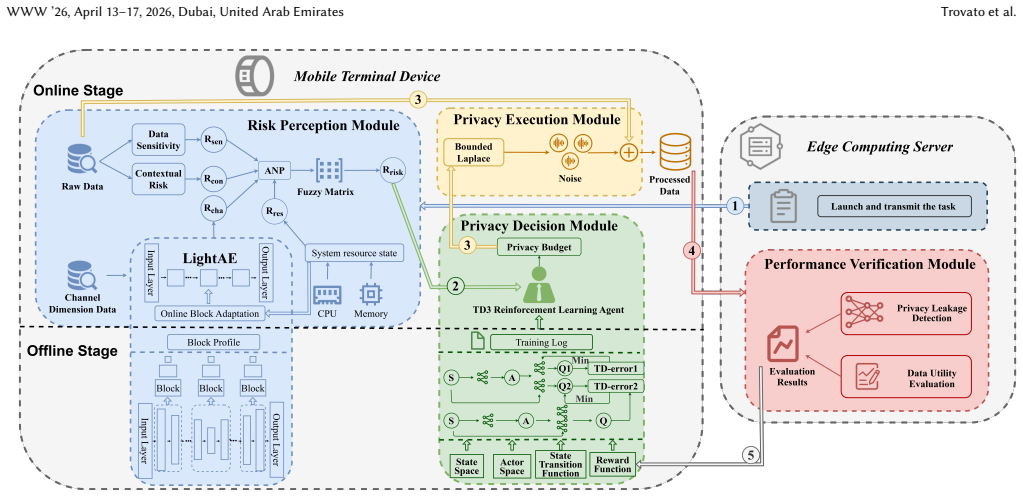
ALPINE performs multi-dimensional risk perception on terminal devices by jointly modeling channel, semantic, contextual, and resource risks, and maps the resulting risk state to a privacy budget through an offline-trained TD3 policy. The selected budget drives local differential privacy perturbation, while edge-side privacy-utility evaluation provides feedback for policy switching and periodic refinement, forming a terminal-edge collaborative control loop for real-time, risk-adaptive privacy protection with low online overhead.
What carries the argument
The offline-trained TD3 policy that maps multi-dimensional risk states to privacy budgets within a terminal-edge feedback loop for adaptive allocation.
If this is right
- ALPINE achieves a better privacy-utility trade-off than representative baselines on multiple real-world datasets.
- It reduces the effectiveness of membership inference, property inference, and reconstruction attacks.
- It preserves robust downstream task performance under dynamic risk conditions.
- ALPINE introduces only modest runtime overhead on resource-constrained devices.
Where Pith is reading between the lines
- The framework could extend to other edge computing applications involving continuous data collection under varying risks.
- Periodic policy refinement might allow adaptation to evolving threat landscapes without full retraining.
- Testing the system in live deployments with diverse device types would validate its generalizability beyond the evaluated datasets.
Load-bearing premise
The offline-trained TD3 policy, learned on simulated or historical risk states, will continue to select appropriate budgets when deployed on live devices facing previously unseen combinations of channel, semantic, and resource conditions.
What would settle it
Observing a significant drop in utility or privacy protection when the system encounters new risk state combinations not seen during offline training would falsify the central claim.
Figures


read the original abstract
Mobile edge crowdsensing (MECS) enables large-scale real-time sensing services, but its continuous data collection and transmission pipeline exposes terminal devices to dynamic privacy risks. Existing privacy protection schemes in MECS typically rely on static configurations or coarse-grained adaptation, making them difficult to balance privacy, data utility, and device overhead under changing channel conditions, data sensitivity, and resource availability. To address this problem, we propose ALPINE, a lightweight closed-loop framework for adaptive privacy budget allocation in MECS. ALPINE performs multi-dimensional risk perception on terminal devices by jointly modeling channel, semantic, contextual, and resource risks, and maps the resulting risk state to a privacy budget through an offline-trained TD3 policy. The selected budget is then used to drive local differential privacy perturbation before data transmission, while edge-side privacy-utility evaluation provides feedback for policy switching and periodic refinement. In this way, ALPINE forms a terminal-edge collaborative control loop that enables real-time, risk-adaptive privacy protection with low online overhead. Extensive experiments on multiple real-world datasets show that ALPINE achieves a better privacy-utility trade-off than representative baselines, reduces the effectiveness of membership inference, property inference, and reconstruction attacks, and preserves robust downstream task performance under dynamic risk conditions. Prototype deployment further demonstrates that ALPINE introduces only modest runtime overhead on resource-constrained devices.
Editorial analysis
A structured set of objections, weighed in public.
Referee Report
Summary. The paper proposes ALPINE, a lightweight closed-loop framework for adaptive privacy budget allocation in mobile edge crowdsensing. It performs multi-dimensional risk perception (channel, semantic, contextual, resource) on terminal devices, maps the risk state to a privacy budget via an offline-trained TD3 policy, applies local differential privacy perturbation, and uses edge-side privacy-utility feedback for policy switching and periodic refinement. Experiments on real-world datasets claim improved privacy-utility trade-offs, reduced effectiveness of membership inference, property inference, and reconstruction attacks, robust downstream task performance under dynamic risks, and modest runtime overhead on resource-constrained devices.
Significance. If the empirical claims hold, ALPINE offers a practical advance over static or coarse-grained privacy schemes in MECS by enabling real-time, risk-adaptive protection through terminal-edge collaboration with low online overhead. The integration of TD3 for budget allocation and closed-loop feedback is a clear strength, but the assessment is limited by the absence of quantitative results, error bars, or ablation details in the provided text.
major comments (2)
- [Abstract] Abstract: the central claims of better privacy-utility trade-offs and attack resistance rest on high-level assertions without any reported quantitative metrics, confidence intervals, or ablation results, making it impossible to verify the magnitude or statistical significance of the reported improvements.
- [Method (TD3 policy and risk state mapping)] TD3 policy training and deployment description: the load-bearing assumption that the offline-trained TD3 policy generalizes to previously unseen joint combinations of channel, semantic, contextual, and resource risk states is not supported by evidence on training distribution coverage or out-of-distribution testing; without this, the closed-loop adaptation claims cannot be substantiated under live conditions.
minor comments (3)
- [Risk perception module] Provide explicit definitions and normalization ranges for each component of the multi-dimensional risk state vector.
- [Prototype deployment] Include runtime overhead measurements with specific device models and comparison to baselines in the prototype deployment section.
- [Experiments] Add a table or figure showing per-dataset numerical results (e.g., utility loss, attack success rates) with error bars for ALPINE versus baselines.
Simulated Author's Rebuttal
We thank the referee for the constructive comments on our manuscript. We appreciate the feedback and have carefully considered each point. Below, we provide point-by-point responses and indicate the revisions we plan to make.
read point-by-point responses
-
Referee: [Abstract] Abstract: the central claims of better privacy-utility trade-offs and attack resistance rest on high-level assertions without any reported quantitative metrics, confidence intervals, or ablation results, making it impossible to verify the magnitude or statistical significance of the reported improvements.
Authors: We agree with the referee that the abstract would be strengthened by including specific quantitative metrics to support the claims. In the revised version, we will update the abstract to report key results from our experiments, including specific improvements in privacy-utility trade-offs (e.g., percentage gains over baselines), reductions in attack success rates for membership inference, property inference, and reconstruction attacks, along with any available confidence intervals or statistical significance indicators. This will make the central claims more verifiable. revision: yes
-
Referee: [Method (TD3 policy and risk state mapping)] TD3 policy training and deployment description: the load-bearing assumption that the offline-trained TD3 policy generalizes to previously unseen joint combinations of channel, semantic, contextual, and resource risk states is not supported by evidence on training distribution coverage or out-of-distribution testing; without this, the closed-loop adaptation claims cannot be substantiated under live conditions.
Authors: We acknowledge that the current manuscript does not explicitly detail the coverage of the training distribution or provide dedicated out-of-distribution testing results for the TD3 policy. To address this, we will add a new subsection or expand the experimental section to describe the diversity of risk state combinations used in training (drawn from real-world datasets) and include results from out-of-distribution evaluations to demonstrate generalization. This will better substantiate the closed-loop adaptation claims. revision: yes
Circularity Check
No circularity: ALPINE applies standard offline TD3 training to risk-to-budget mapping with separate evaluation
full rationale
The derivation chain consists of multi-dimensional risk modeling followed by an offline-trained TD3 policy (a known RL algorithm) that outputs privacy budgets, with edge feedback used only for post-deployment switching and refinement. Training occurs on simulated/historical states and evaluation uses held-out or real-world datasets, so the policy output is not equivalent to its inputs by construction. No self-definitional steps, no fitted parameters renamed as predictions, and no load-bearing self-citations that reduce the central claim to unverified premises. The framework is self-contained against external benchmarks as described in the abstract and reader's assessment.
Axiom & Free-Parameter Ledger
axioms (1)
- domain assumption Multi-dimensional risk state can be accurately perceived and mapped to a scalar privacy budget by an offline-trained policy.
Lean theorems connected to this paper
-
IndisputableMonolith/Foundation/RealityFromDistinction.leanreality_from_one_distinction unclear?
unclearRelation between the paper passage and the cited Recognition theorem.
TD3 algorithm to offline-train the actor network to learn a mapping from environmental risk to privacy budget... reward function that balances privacy gains, data utility and energy cost
-
IndisputableMonolith/Cost/FunctionalEquation.leanwashburn_uniqueness_aczel unclear?
unclearRelation between the paper passage and the cited Recognition theorem.
Bounded Laplace (BLP) Mechanism... b=Δ/ε
What do these tags mean?
- matches
- The paper's claim is directly supported by a theorem in the formal canon.
- supports
- The theorem supports part of the paper's argument, but the paper may add assumptions or extra steps.
- extends
- The paper goes beyond the formal theorem; the theorem is a base layer rather than the whole result.
- uses
- The paper appears to rely on the theorem as machinery.
- contradicts
- The paper's claim conflicts with a theorem or certificate in the canon.
- unclear
- Pith found a possible connection, but the passage is too broad, indirect, or ambiguous to say the theorem truly supports the claim.
Reference graph
Works this paper leans on
-
[1]
Saeed Ahmed, YoungDoo Lee, Seung-Ho Hyun, and Insoo Koo. 2019. Mitigating the impacts of covert cyber attacks in smart grids via reconstruction of mea- surement data utilizing deep denoising autoencoders.Energies12, 16 (2019), 3091
work page 2019
- [2]
-
[3]
Zainab Alwaisi, Tanesh Kumar, Erkki Harjula, and Simone Soderi. 2024. Securing constrained IoT systems: A lightweight machine learning approach for anomaly detection and prevention.Internet of Things28 (2024), 101398. doi:10.1016/j.iot. 2024.101398
-
[4]
Anuj Bhardwaj, Raza Hasan, Shakeel Ahmad, and Salman Mahmood. 2024. Dia- betic Patient Readmission Predictive Analysis: A Comparative Study of Machine Learning Models of Hospital Readmissions. In2024 2nd International Conference on Computing and Data Analytics (ICCDA). IEEE, 1–6
work page 2024
-
[5]
Rui Bi, Meng Zhao, Zhijun Ying, Yiming Tian, and Jianhua Xiong. 2024. Achieving dynamic privacy measurement and protection based on reinforcement learning for mobile edge crowdsensing of IoT.Digital Communications and Networks10, 2 (2024), 380–388
work page 2024
-
[6]
George EP Box, Gwilym M Jenkins, Gregory C Reinsel, and Greta M Ljung. 2015. Time series analysis: forecasting and control. John Wiley & Sons
work page 2015
-
[7]
Mahawaga Arachchige Pathum Chamikara, Peter Bertok, Dongxi Liu, Seyit Camtepe, and Ibrahim Khalil. 2020. Efficient privacy preservation of big data for accurate data mining.Information Sciences527 (2020), 420–443
work page 2020
-
[8]
Rachel Cummings and David Durfee. 2020. Individual sensitivity preprocessing for data privacy. InProceedings of the Fourteenth Annual ACM-SIAM Symposium on Discrete Algorithms. SIAM, 528–547
work page 2020
-
[9]
Yogesh D Deshpande and SR Rahman. 2023. Edge-based real-time sensor data processing for anomaly detection in industrial IoT applications.Research Journal of Computer Systems and Engineering4, 2 (2023), 16–30
work page 2023
-
[10]
Cynthia Dwork, Aaron Roth, et al. 2014. The algorithmic foundations of differ- ential privacy.Foundations and Trends®in Theoretical Computer Science9, 3–4 (2014), 211–407
work page 2014
-
[11]
Shiyuan Feng, Ying Feng, George Z. Li, Zhao Song, David P. Woodruff, and Lichen Zhang. 2025. On Differential Privacy for Adaptively Solving Search Problems via Sketching. arXiv:2506.05503
-
[12]
Matt Fredrikson, Somesh Jha, and Thomas Ristenpart. 2015. Model Inversion Attacks that Exploit Confidence Information and Basic Countermeasures. In Proceedings of the 22nd ACM SIGSAC Conference on Computer and Communica- tions Security(Denver, Colorado, USA)(CCS ’15). Association for Computing Machinery, New York, NY, USA, 1322–1333. doi:10.1145/2810103.2813677
-
[13]
Scott Fujimoto, Herke van Hoof, and David Meger. 2018. Addressing Func- tion Approximation Error in Actor-Critic Methods. InProceedings of the 35th International Conference on Machine Learning (Proceedings of Machine Learning Research, Vol. 80), Jennifer Dy and Andreas Krause (Eds.). PMLR, 1587–1596. https://proceedings.mlr.press/v80/fujimoto18a.html
work page 2018
-
[14]
Karan Ganju, Qi Wang, Wei Yang, Carl A. Gunter, and Nikita Borisov. 2018. Property Inference Attacks on Fully Connected Neural Networks using Per- mutation Invariant Representations. InProceedings of the 2018 ACM SIGSAC Conference on Computer and Communications Security(Toronto, Canada)(CCS ’18). Association for Computing Machinery, New York, NY, USA, 619...
-
[15]
Ming Gao, Fu Xiao, Weiran Liu, Wentao Guo, Yangtao Huang, Yajie Liu, and Jin- song Han. 2023. Expelliarmus: Command Cancellation Attacks on Smartphones Using Electromagnetic Interference. InProceedings of the IEEE Conference on Computer Communications (INFOCOM). 1–10. doi:10.1109/INFOCOM53939.2023. 10228859
-
[16]
Quan Geng and Pramod Viswanath. 2016. Optimal Noise Adding Mechanisms for Approximate Differential Privacy.IEEE Transactions on Information Theory 62, 2 (2016), 952–969. doi:10.1109/TIT.2015.2504972
-
[17]
Tuomas Haarnoja, Aurick Zhou, Pieter Abbeel, and Sergey Levine. 2018. Soft Actor-Critic: Off-Policy Maximum Entropy Deep Reinforcement Learning with a Stochastic Actor. InProceedings of the 35th International Conference on Machine Learning (Proceedings of Machine Learning Research, Vol. 80), Jennifer Dy and Andreas Krause (Eds.). PMLR, 1861–1870. https://...
work page 2018
-
[18]
Song Han, Jeff Pool, John Tran, and William Dally. 2015. Learning both Weights and Connections for Efficient Neural Network. InAdvances in Neural Information Processing Systems, C. Cortes, N. Lawrence, D. Lee, M. Sugiyama, and R. Garnett (Eds.), Vol. 28. Curran Associates, Inc. https://proceedings.neurips.cc/paper_ files/paper/2015/file/ae0eb3eed39d2bcef4...
work page 2015
-
[19]
Geoffrey Hinton, Oriol Vinyals, and Jeff Dean. 2015. Distilling the Knowledge in a Neural Network. arXiv:1503.02531 [stat.ML] https://arxiv.org/abs/1503.02531
work page internal anchor Pith review Pith/arXiv arXiv 2015
-
[20]
Jiahui Hu, Jiacheng Du, Zhibo Wang, Xiaoyi Pang, Yajie Zhou, Peng Sun, and Kui Ren. 2024. Does differential privacy really protect federated learning from gradient leakage attacks?IEEE Transactions on Mobile Computing23, 12 (2024), 12635–12649
work page 2024
-
[21]
Weizhe Hua, Yuan Zhou, Christopher M De Sa, Zhiru Zhang, and G Edward Suh
-
[22]
Channel gating neural networks.Advances in neural information processing systems32 (2019)
work page 2019
-
[23]
Kyle Hundman, Valentino Constantinou, Christopher Laporte, Ian Colwell, and Tom Soderstrom. 2018. Detecting spacecraft anomalies using lstms and nonpara- metric dynamic thresholding. InProceedings of the 24th ACM SIGKDD interna- tional conference on knowledge discovery & data mining. 387–395
work page 2018
-
[24]
Md Ruman Islam, Raja Hasnain Anwar, Spyridon Mastorakis, and Muham- mad Taqi Raza. 2024. Characterizing Encrypted Application Traffic Through Cellular Radio Interface Protocol. In2024 IEEE 21st International Conference on Mobile Ad-Hoc and Smart Systems (MASS). IEEE, 321–329
work page 2024
-
[25]
Chenying Jin, Xiang Feng, and Huiqun Yu. 2025. Embracing Multiheterogene- ity and Privacy Security Simultaneously: A Dynamic Privacy-Aware Federated Reinforcement Learning Approach.IEEE Transactions on Neural Networks and Learning Systems36, 5 (2025), 8772–8786. doi:10.1109/TNNLS.2024.3427789
-
[26]
Bogdan Kulynych, Juan F Gomez, Georgios Kaissis, Flavio du Pin Calmon, and Carmela Troncoso. 2024. Attack-aware noise calibration for differential privacy. Advances in Neural Information Processing Systems37 (2024), 134868–134901
work page 2024
-
[27]
Ninghui Li, Tiancheng Li, and Suresh Venkatasubramanian. 2007. t-Closeness: Privacy Beyond k-Anonymity and l-Diversity. In2007 IEEE 23rd International Conference on Data Engineering. 106–115. doi:10.1109/ICDE.2007.367856
-
[28]
Pengzhi Li, Yan Pei, and Jianqiang Li. 2023. A comprehensive survey on design and application of autoencoder in deep learning.Applied Soft Computing138 (2023), 110176. doi:10.1016/j.asoc.2023.110176
-
[29]
Zhuohang Li, Andrew Lowy, Jing Liu, Toshiaki Koike-Akino, Kieran Parsons, Bradley Malin, and Ye Wang. 2024. Analyzing inference privacy risks through gra- dients in machine learning. InProceedings of the 2024 on ACM SIGSAC Conference WWW ’26, April 13–17, 2026, Dubai, United Arab Emirates Trovato et al. on Computer and Communications Security. 3466–3480
work page 2024
-
[30]
Zhetao Li, Xiyu Zeng, Yong Xiao, Chengxin Li, Wentai Wu, and Haolin Liu. 2025. Pattern-Sensitive Local Differential Privacy for Finite-Range Time-Series Data in Mobile Crowdsensing.IEEE Transactions on Mobile Computing24, 1 (2025), 1–14. doi:10.1109/TMC.2024.3445973
-
[31]
Timothy P Lillicrap, Jonathan J Hunt, Alexander Pritzel, Nicolas Heess, Tom Erez, Yuval Tassa, David Silver, and Daan Wierstra. 2015. Continuous control with deep reinforcement learning.arXiv preprint arXiv:1509.02971(2015)
work page internal anchor Pith review Pith/arXiv arXiv 2015
-
[32]
Fei Tony Liu, Kai Ming Ting, and Zhi-Hua Zhou. 2008. Isolation forest. In2008 eighth ieee international conference on data mining. IEEE, 413–422
work page 2008
-
[33]
Vincent B Liu, Laura Y Sue, and Yingnian Wu. 2024. Comparison of machine learning models for predicting 30-day readmission rates for patients with diabetes. Journal of Medical Artificial Intelligence7 (2024)
work page 2024
-
[34]
Yong Liu, Tengge Hu, Haoran Zhang, Haixu Wu, Shiyu Wang, Lintao Ma, and Mingsheng Long. 2023. itransformer: Inverted transformers are effective for time series forecasting.arXiv preprint arXiv:2310.06625(2023)
work page internal anchor Pith review Pith/arXiv arXiv 2023
-
[35]
Donghao Luo and Xue Wang. 2024. Moderntcn: A modern pure convolution structure for general time series analysis. InThe twelfth international conference on learning representations. 1–43
work page 2024
-
[36]
Pankaj Malhotra, Lovekesh Vig, Gautam Shroff, Puneet Agarwal, et al. 2015. Long short term memory networks for anomaly detection in time series. InProceedings, Vol. 89. 94
work page 2015
-
[37]
Frank D McSherry. 2009. Privacy integrated queries: an extensible platform for privacy-preserving data analysis. InProceedings of the 2009 ACM SIGMOD International Conference on Management of data. 19–30
work page 2009
-
[38]
Khalid Mohiuddin, Huda Fatima, Mohiuddin Ali Khan, Mohammad Abdul Khaleel, Osman A. Nasr, and Samreen Shahwar. 2022. Mobile learning evolution and emerging computing paradigms: An edge-based cloud architecture for reduced latencies and quick response time.Array16 (2022), 100259. doi:10.1016/j.array. 2022.100259
-
[39]
Ke Pan and Kaiyuan Feng. 2023. Differential privacy-enabled multi-party learning with dynamic privacy budget allocating strategy.Electronics12, 3 (2023), 658
work page 2023
-
[40]
Danijela D Protić. 2018. Review of KDD Cup ‘99, NSL-KDD and Kyoto 2006+ datasets.Vojnotehnički glasnik/Military Technical Courier66, 3 (2018), 580–596
work page 2018
-
[41]
Protection Regulation. 2018. General data protection regulation.Intouch25 (2018), 1–5
work page 2018
-
[42]
Haoyu Ren, Darko Anicic, and Thomas A. Runkler. 2022. Towards Semantic Management of On-Device Applications in Industrial IoT.ACM Trans. Internet Technol.22, 4, Article 102 (Nov. 2022), 30 pages. doi:10.1145/3510820
-
[43]
Wager, Weisong Shi, Timothy Dittrich, Carol Miller, and Kishore Gopalakrishnan
Javad Roostaei, Yongli Z. Wager, Weisong Shi, Timothy Dittrich, Carol Miller, and Kishore Gopalakrishnan. 2023. IoT-based edge computing (IoTEC) for improved environmental monitoring.Sustainable Computing: Informatics and Systems38 (2023), 100870. doi:10.1016/j.suscom.2023.100870
-
[44]
2005.Fuzzy logic with engineering applications
Timothy J Ross. 2005.Fuzzy logic with engineering applications. John Wiley & Sons
work page 2005
-
[45]
Thomas L. Saaty. 1990. How to make a decision: The analytic hierarchy process. European Journal of Operational Research48, 1 (1990), 9–26. doi:10.1016/0377- 2217(90)90057-I Desicion making by the analytic hierarchy process: Theory and applications
-
[46]
Thomas L. Saaty. 2004. Fundamentals of the analytic network process — Dependence and feedback in decision-making with a single network.Jour- nal of Systems Science and Systems Engineering13, 2 (April 2004), 129–157. doi:10.1007/s11518-006-0158-y
-
[47]
Michael Schmid, David Rath, and Ulrike Diebold. 2022. Why and how Savitzky– Golay filters should be replaced.ACS Measurement Science Au2, 2 (2022), 185–196
work page 2022
-
[48]
Bernhard Schölkopf, John C Platt, John Shawe-Taylor, Alex J Smola, and Robert C Williamson. 2001. Estimating the support of a high-dimensional distribution. Neural computation13, 7 (2001), 1443–1471
work page 2001
-
[49]
Sheng Shen, Tianqing Zhu, Di Wu, Wei Wang, and Wanlei Zhou. 2022. From distributed machine learning to federated learning: In the view of data privacy and security.Concurrency and Computation: Practice and Experience34, 16 (2022), e6002
work page 2022
-
[50]
Reza Shokri, Marco Stronati, Congzheng Song, and Vitaly Shmatikov. 2017. Mem- bership Inference Attacks Against Machine Learning Models. In2017 IEEE Sym- posium on Security and Privacy (SP). 3–18. doi:10.1109/SP.2017.41
-
[51]
Lisha Shuai, Jiamin Zhang, Yu Cao, Min Zhang, and Xiaolong Yang. 2022. R-DP: A risk-adaptive privacy protection scheme for mobile crowdsensing in industrial internet of things.IET Information Security16, 5 (2022), 373–389
work page 2022
-
[52]
Djordje Slijepčević, Maximilian Henzl, Lukas Daniel Klausner, Tobias Dam, Peter Kieseberg, and Matthias Zeppelzauer. 2021. k-Anonymity in practice: How generalisation and suppression affect machine learning classifiers.Computers & Security111 (2021), 102488. doi:10.1016/j.cose.2021.102488
-
[53]
Ya Su, Youjian Zhao, Chenhao Niu, Rong Liu, Wei Sun, and Dan Pei. 2019. Robust anomaly detection for multivariate time series through stochastic recurrent neural network. InProceedings of the 25th ACM SIGKDD international conference on knowledge discovery & data mining. 2828–2837
work page 2019
- [54]
-
[55]
Zemin Sun, Geng Sun, Long He, Fang Mei, Shuang Liang, and Yanheng Liu
-
[56]
InIEEE INFOCOM 2024-IEEE Conference on Computer Communications
A two time-scale joint optimization approach for uav-assisted mec. InIEEE INFOCOM 2024-IEEE Conference on Computer Communications. IEEE, 91–100
work page 2024
-
[57]
LATANYA SWEENEY. 2002. k-ANONYMITY: A MODEL FOR PROTECTING PRIVACY.International Journal of Uncertainty, Fuzziness and Knowledge-Based Systems10, 05 (2002), 557–570. arXiv:https://doi.org/10.1142/S0218488502001648 doi:10.1142/S0218488502001648
-
[58]
Richard Yu, Renchao Xie, Azzedine Boukerche, Tao Huang, and Yunjie Liu
Qinqin Tang, F. Richard Yu, Renchao Xie, Azzedine Boukerche, Tao Huang, and Yunjie Liu. 2022. Internet of Intelligence: A Survey on the Enabling Technologies, Applications, and Challenges.IEEE Communications Surveys & Tutorials24, 3 (2022), 1394–1434. doi:10.1109/COMST.2022.3175453
-
[59]
Mengyuan Wang, Hongbo Jiang, Peng Peng, Youhuan Li, and Wenbin Huang
-
[60]
InIEEE INFOCOM 2024 - IEEE Conference on Computer Com- munications
Toward Accurate Butterfly Counting with Edge Privacy Preserving in Bipartite Networks. InIEEE INFOCOM 2024 - IEEE Conference on Computer Com- munications. 2289–2298. doi:10.1109/INFOCOM52122.2024.10621436
-
[61]
Yongfeng Wang, Zheng Yan, Wei Feng, and Shushu Liu. 2020. Privacy protection in mobile crowd sensing: a survey.World Wide Web23, 1 (2020), 421–452
work page 2020
-
[62]
Dingzhu Wen, Yong Zhou, Xiaoyang Li, Yuanming Shi, Kaibin Huang, and Khaled B. Letaief. 2024. A Survey on Integrated Sensing, Communication, and Computation.IEEE Communications Surveys & Tutorials(2024), 1–1. doi:10.1109/COMST.2024.3521498
-
[63]
Honghui Xu, Wei Li, Shaoen Wu, Liang Zhao, and Zhipeng Cai. 2024. APOLLO: Differential Private Online Multi-Sensor Data Prediction with Certified Perfor- mance. In2024 IEEE International Conference on Data Mining (ICDM). 530–539. doi:10.1109/ICDM59182.2024.00060
-
[64]
2010.Distributed Optimization and Games: A Tutorial Overview
Bo Yang and Mikael Johansson. 2010.Distributed Optimization and Games: A Tutorial Overview. Springer London, London, 109–148. doi:10.1007/978-0-85729- 033-5_4
-
[65]
Yaoqi Yang, Bangning Zhang, Daoxing Guo, Hongyang Du, Zehui Xiong, Dusit Niyato, and Zhu Han. 2024. Generative AI for Secure and Privacy-Preserving Mobile Crowdsensing.IEEE Wireless Communications31, 6 (2024), 29–38. doi:10. 1109/MWC.004.2400017
work page 2024
-
[66]
Obaidat, Shuchen Li, Pengfei Wang, and Kuei-Fang Hsiao
Ruiyun Yu, Ann Move Oguti, Mohammad S. Obaidat, Shuchen Li, Pengfei Wang, and Kuei-Fang Hsiao. 2023. Blockchain-based solutions for mobile crowdsensing: A comprehensive survey.Computer Science Review50 (2023), 100589. doi:10. 1016/j.cosrev.2023.100589
-
[67]
Nemer Alberto Zaguir, Guilherme Henrique de Magalhães, and Mauro de Mesquita Spinola. 2024. Challenges and Enablers for GDPR Compliance: System- atic Literature Review and Future Research Directions.IEEE Access12 (2024), 81608–81630. doi:10.1109/ACCESS.2024.3406724
-
[68]
Qinglong Zhang, Rui Han, Gaofeng Xin, Chi Harold Liu, Guoren Wang, and Lydia Y. Chen. 2022. Lightweight and Accurate DNN-Based Anomaly Detection at Edge.IEEE Transactions on Parallel and Distributed Systems33, 11 (2022), 2927–2942. doi:10.1109/TPDS.2021.3137631
-
[69]
Qiong Zhang, Taochun Wang, Yuan Tao, Nuo Xu, Fulong Chen, and Dong Xie. 2024. Location privacy protection method based on differential pri- vacy in crowdsensing task allocation.Ad Hoc Networks158 (2024), 103464. doi:10.1016/j.adhoc.2024.103464
-
[70]
Guangxu Zhu, Zhonghao Lyu, Xiang Jiao, Peixi Liu, Mingzhe Chen, Jie Xu, Shuguang Cui, and Ping Zhang. 2023. Pushing AI to wireless network edge: An overview on integrated sensing, communication, and computation towards 6G. Science China Information Sciences66, 3 (2023), 130301. ALPINE: A Lightweight and Adaptive Privacy-Decision Agent Framework for Dynami...
work page 2023
discussion (0)
Sign in with ORCID, Apple, or X to comment. Anyone can read and Pith papers without signing in.