REVIEW 3 major objections 5 minor 4 cited by
Predicting charmed-strange molecular tetraquarks with $K^{(*)}$ and $T$-doublet charmed or anticharmed meson
T0 review · 3 major / 5 minor · reviewed 2026-08-04 · deepseek-v4-flash
Pith's one-line read The authors argue that the exotic X1(2900) is a mixed K–Dbar1 and K*–Dbar1 molecular tetraquark, and predict a family of charmed-strange partner states.
desk verdict Solid incremental OBE calculation; the X1(2900) match is a tuned coupled-channel effect, and the partner 'family' is really a channel-by-channel cutoff survey. read the letter →
The pith
A machine-rendered reading of the paper's core claim, the machinery that carries it, and where it could break.
The reading
What carries the argument
The load-bearing object is the one-boson-exchange (OBE) potential for a kaon (or K*) interacting with an excited anticharmed meson in the T-doublet (D1(2420) and D2*(2460)), with light sigma, pi, eta, rho, and omega exchanges and a monopole form factor. The coupled-channel Schrödinger equation with S–D wave mixing is solved numerically for each spin-parity sector. Two identities do the real work: the off-diagonal pion-exchange term that couples K–Dbar1 to K*–Dbar1 (the single-channel potential has no pion exchange, which is why coupled channels are essential), and the G-parity rule that relates the anticharmed interactions to the charmed ones by flipping the sign of pi and omega exchange. Th
What would settle it
Look for the predicted 0(2-) and 0(1-) partners in the D-K and D*-K invariant-mass spectra of B-meson decays: if no near-threshold peaks appear at the predicted positions, the coupled-channel binding claim is wrong. A lattice computation of the K–Dbar1 and K*–Dbar1 scattering phase shifts that shows no bound-state pole would also falsify it.
Extended reading notes
Core claim
The central claim is that X1(2900) is a charmed-strange molecular tetraquark with quantum numbers I(JP)=0(1-), formed by the coupled K–Dbar1, K*–Dbar1, and K*–Dbar2* channels. In the single-channel approximation the K–Dbar1 interaction, built from sigma, rho, and omega exchanges, is too weak to bind. Once the K*–Dbar1 transition is included, the off-diagonal pion exchange provides the missing attraction, and a loosely bound state appears for a cutoff of about 1.07 GeV, reproducing the measured mass of 2904 MeV. The wavefunction is dominated by K–Dbar1 (about 83%) with a 20% K*–Dbar1 component, which is why the authors stress X1(2900) is not a pure K–Dbar1 molecule. From the same dynamics the
Load-bearing premise
The calculation's strength is set by an adjustable cutoff parameter; the authors choose its value to match X1(2900) at about 1.07 GeV, and the partner predictions assume larger values (up to 1.86 GeV) that nothing else in the paper independently fixes.
Editorial extensions
If this is right
- X1(2900) should reveal a K*–Dbar1 component of roughly 20% in its decay and production properties, distinguishing the molecule from a pure K–Dbar1 state.
- A 2- partner near the K–Dbar2* threshold and K*–Dbar1 states with 0- and 1- should exist in the anticharmed sector, giving experiments a concrete search list.
- The charmed-sector analogs—K*–D1 states with 0-, 1-, 2- and K*–D2* states with 1-, 2-, 3-—should form at slightly different thresholds and test the G-parity connection.
- If the states are real, they will show up as narrow near-threshold peaks in B-meson decay invariant-mass spectra, similar to how X1(2900) was found.
- The dominance of the K–Dbar1 component means the partner masses are controlled by the K–Dbar1 threshold, so their absolute positions are predictable within the model's uncertainty.
Reading between the lines
- If the coupled-channel pion-exchange mechanism is as general as asserted, analogous mixtures should appear in other systems where a diagonal channel lacks pion exchange but a coupled channel provides it—for example, bottom analogs with K and B1 mesons, which could be predicted the same way.
- The cutoff-dependence is the main vulnerability: the partner states at Lambda around 1.4–1.9 GeV are less constrained than X1(2900) itself, so their masses are less certain than their quantum-number assignments.
- A targeted lattice QCD calculation of K*–Dbar1 scattering near threshold would break the degeneracy between this molecule picture and alternative interpretations of X1(2900), such as a compact tetraquark or a kinematic effect.
- The predicted 0(2-) state, if found, would be a clean discriminator because it sits very close to the K–Dbar2* threshold with a distinctive coupled-channel signature.
Editorial analysis
A structured set of objections, weighed in public.
Referee Report
Summary. The paper studies charmed-strange molecular tetraquark candidates composed of a K(∗) meson and a T-doublet (anti-)charmed meson (D1/D2*) in the one-boson-exchange model, including S-D wave mixing and coupled-channel effects. The authors claim that the LHCb X1(2900) resonance is a coupled K Dbar1 / K* Dbar1 / K* Dbar2* molecular state with I(J^P)=0(1^-), with about 83% K Dbar1 and 19% K* Dbar1 probability at a cutoff Λ≈1.07 GeV. They then predict a series of partner states in the K* Dbar1 and K(*) Dbar2* systems, and extend the analysis via the G-parity rule to the K(*) D1 / K(*) D2* systems, proposing several Tc-bar-s type candidates. The central identification is achieved only after coupled channels are added and Λ is tuned to reproduce the measured X1(2900) mass; the partner predictions require a range of different cutoffs up to about 1.86 GeV.
Significance. If the central claim were robust, the paper would provide a useful molecular interpretation of X1(2900) and a concrete partner spectrum that could be tested at LHCb and Belle II. The paper has clear strengths: it presents a systematic derivation of OBE potentials for a complicated set of channels with explicit operator matrices, includes both S-D mixing and coupled-channel dynamics, and extends the framework to Tc-bar-s systems via the G-parity rule. However, the significance is substantially curtailed by the fact that the X1(2900) identification is a tuned result, not a parameter-free prediction, and the partner states are not obtained at a single common cutoff. The paper would be much stronger if the entire spectrum were recomputed at one fixed, justified cutoff with an honest accounting of the regulator dependence.
major comments (3)
- [Sec. II.B.1, Eq. (2.14), Fig. 3] The identification of X1(2900) is a fit rather than a prediction. The monopole cutoff Λ is scanned from 0.8 to 2.0 GeV, a bound state first appears near Λ=1.02 GeV, and the value Λ≈1.07 GeV is selected because it produces a mass of 2904 MeV, matching the central value of X1(2900). This is stated as 'coincides with the central value', but by construction the mass is a function of the chosen regulator. The paper should explicitly label Λ=1.07 GeV as a calibrated parameter, discuss the resulting uncertainty band from the experimental mass uncertainty, and avoid language that implies a parameter-free prediction.
- [Sec. II.B.2, Tables II-III, Fig. 4] The claimed partner family is not a prediction of a single model with a single cutoff. The X1(2900) state is calibrated at Λ≈1.07 GeV, yet the coupled K Dbar2* / K* Dbar1 / K* Dbar2* 0(2-) state binds only for Λ>1.86 GeV, the K* Dbar1 0(1-) coupled state requires Λ≥1.11 GeV, and the K* Dbar2* 0(2-) state requires Λ≥1.40-1.56 GeV. At Λ=1.07 GeV several of these states have no bound solution. Moreover, the paper's own criterion in Sec. II.B for a 'promising molecular candidate' is a cutoff close to 1.0 GeV, which is violated by most of the partner predictions. To support the claim that the model predicts a family of charmed-strange molecular tetraquarks, the authors must recompute all partner states at a common cutoff (or a common physically motivated Λ range) and show they survive.
- [Sec. II.B, Tables I-III] The central conclusion that X1(2900) is a molecular state depends sensitively on the choice of included channels and on the off-diagonal pion-exchange mechanism. Single-channel and S-D mixing analyses give no bound state, and binding appears only after K* Dbar1 and K* Dbar2* channels are added. The paper does not test the sensitivity of this conclusion to the channel set (e.g., whether other nearby thresholds mix in) or to the monopole form-factor shape. Since the entire X1 interpretation rests on this coupled-channel enhancement, a robustness check with different form factors or with an expanded channel basis is needed before the interpretation can be considered established.
minor comments (5)
- [Sec. II.A.3] Typo: 'exchange of a serious of light mesons' should read 'a series of light mesons'.
- [Fig. 3] The horizontal axis label 'M (MeV)' could be confused with a mass variable; clarify that it is the bound-state mass. The threshold value for K Dbar1 would help the reader see the 13 MeV binding directly.
- [Tables II-III] The tables list threshold Λ values where binding begins, but the text often describes only selected rows. It would aid reproducibility to state the numerical method (e.g., number of grid points, boundary conditions) used to solve the coupled-channel Schrödinger equation.
- [References] Some references are given with future-dated volumes (e.g., Ref. [15], 'Front. Phys. (Beijing) 21, 016300 (2026)'). Please check that all citations are complete and correctly dated.
- [Sec. III.D] The claim that K* D2* systems with I(J^P)=0(1^-,2^-,3^-) support bound states for 'reasonably chosen values of the cutoff' should be accompanied by a clear statement of whether these values are consistent with the calibrated Λ≈1.07 GeV used for X1(2900).
Circularity Check
X1(2900) mass is reproduced by choosing Λ≈1.07 GeV, and partner states appear only when Λ is allowed to float up to ~1.86 GeV; the molecular identification and partner family are therefore partly fitted rather than parameter-free predictions.
-
fitted input called prediction
[Sec. II.B.1, after Fig. 3]
"we scan the cutoffparameter Λ from 0.8 to 2.0 GeV to search for the loosely bound states ... As shown in Fig. 3, the mass of the coupled K ¯D1/K∗ ¯D1/K∗ ¯D∗ 2 bound state with I(J P)=0(1 −) is calculated to be 2904 MeV for Λ≈1.07 GeV, which coincides with the central value of the experimentally measured mass of the X 1(2900)"
The X1(2900) mass is not independently predicted: Fig. 3 shows a monotonic mass-versus-Λ curve, and the paper scans Λ and selects the value ≈1.07 GeV that places the bound state at the experimental mass. The claimed 'coincidence' is thus enforced by the choice of the free regulator, so the identification of X1(2900) as this molecular state reduces to fitting the input mass. The channel probabilities quoted afterward are outputs of that tuned Λ, not independent confirmation.
-
fitted input called prediction
[Abstract and Sec. II.B.2 (Fig. 4, Tables II-III)]
"Furthermore, we predict several partner states of the X 1(2900) in the K ∗ ¯D1 and K (∗) ¯D∗ 2 systems. ... When the cutoff parameter is fixed to be larger than 1.86 GeV, a loosely bound state is predicted."
The partner states are presented as predictions of the same framework, but each bound state is obtained at a different, independently chosen cutoff: the coupled K ¯D∗ 2/K∗ ¯D1/K∗ ¯D∗ 2 0(2−) state needs Λ>1.86 GeV, the K∗ ¯D1 0(1−) coupled state binds at Λ=1.11 GeV, and the K∗ ¯D∗ 2 0(2−) state needs Λ=1.40–1.56 GeV. At the calibrated value Λ≈1.07 GeV used for X1(2900), most of these states have no bound solution. Thus the partner family is not a single-parameter prediction of one calibrated model; it is generated by letting the free cutoff float per channel until binding appears.
full rationale
The paper contains a genuine OBE coupled-channel calculation with explicit Lagrangians, form factors, and Schrödinger-equation solutions; the central derivation is not equivalent to its inputs by definition, and there is no load-bearing self-citation chain (the cited coupling constants are ultimately traced to the quark model and hidden-gauge arguments, not to an unverified uniqueness theorem by the same authors). However, the paper's central identification of X1(2900) is tuned: the free cutoff Λ is scanned, and the value Λ≈1.07 GeV is selected precisely so that the computed mass equals the experimental X1(2900) mass. The word 'coincides' in the paper describes an agreement that is produced by the fit, not a parameter-free prediction. Moreover, the claimed partner states are found only after allowing Λ to vary independently over a wide range (up to 1.86 GeV), so the predicted family is not a consequence of a single calibrated Hamiltonian. These features make the X1(2900) interpretation and the partner-state predictions partially circular in the sense that the free regulator is chosen, channel by channel, to produce the desired bound states. The composition of the X1(2900) state and the qualitative role of coupled channels remain nontrivial outputs, which is why the score is 6 rather than 8 or 10.
Assumptions & free parameters
free parameters (1)
- Monopole form-factor cutoff Lambda =
1.07 GeV for X1(2900); critical values 0.95-1.86 GeV for candidate states
assumptions (5)
- domain assumption OBE potentials are derived in the Breit approximation (Eq. 2.12) with static polarization vectors and no recoil corrections.
- ad hoc to paper The monopole form factor F_M(q, m_E) with a free cutoff Lambda regularizes the potential.
- ad hoc to paper A loosely bound state with Lambda close to 1.0 GeV is a promising molecular candidate; states needing larger Lambda are downgraded.
- domain assumption The G-parity rule of Ref. [95] relates K(*)D1/D2* interactions to K(*)Dbar1/Dbar2* interactions by flipping the sign of pion and omega exchange.
- domain assumption The effective Lagrangians of Eqs. (2.6)-(2.9) follow from heavy quark symmetry, chiral symmetry, and hidden local symmetry.
Cite this review
Pith. "Pith review of Predicting charmed-strange molecular tetraquarks with $K^{(*)}$ and $T$-doublet charmed or anticharmed meson." pith.science (2026). https://pith.science/paper/3OEPXJQK
@misc{pith2026251017244,
  author       = {Pith},
  title        = {Pith review of: Predicting charmed-strange molecular tetraquarks with $K^(*)$ and $T$-doublet charmed or anticharmed meson},
  year         = {2026},
  howpublished = {\url{https://pith.science/paper/3OEPXJQK}},
  note         = {Machine review of arXiv:2510.17244}
}
abstract
In this work, we first present a systematic investigation of the $T_{\bar{c}\bar{s}}$-type charmed-strange molecular tetraquark candidates composed of a $K^{(*)}$ meson and a $T$-doublet anticharmed meson using the one-boson-exchange model, which exhibit exotic flavor content $\bar{c}\bar{s} q q$. Our results suggest that the $K^* \bar D_1$ states with $I(J^P)=0(0^-,\,1^-)$ and the $K^* \bar D_2^*$ states with $I(J^P)=0(1^-,\,2^-)$ represent the most promising candidates of the $T_{\bar{c}\bar{s}}$-type charmed-strange molecular tetraquarks, while the coupled $K \bar D_1 / K^* \bar D_1 / K^* \bar D_2^*$ system with $I(J^P)=0(1^-)$ and the coupled $K \bar D_2^* / K^* \bar D_1 / K^* \bar D_2^*$ system with $I(J^P)=0(2^-)$ can only be regarded as the possible candidates of the $T_{\bar{c}\bar{s}}$-type charmed-strange molecular tetraquarks. We further extend our analysis to the $K^{(*)} {D}_1/K^{(*)} {D}_2^*$ systems, where our results suggest a series of $T_{c \bar s}$-type charmed-strange molecular tetraquark candidates. These findings provide a comprehensive picture of the molecular spectrum in the charmed-strange tetraquark sector composed of $S$-wave kaons and (anti-)charmed mesons in the $T$-doublet and can be tested in future experimental studies.
Figures


Figures from the paper (3 more)



Forward citations
Cited by 4 Pith papers
-
Exotic $T^*_{csJ}$ and $T^*_{c\bar{s}J}$ states and coupled-channel scattering at the $SU(3)$ flavour symmetric point from lattice QCD
First lattice QCD calculation at the SU(3) flavour symmetric point finds poles in exotic charm-light meson scattering amplitudes, linking a J^P=0+ resonance to experimental T*cs0(2870)^0 and T*c s-bar0(2900) states an...
-
Five-flavor molecular pentaquarks in the $\Xi_b^{(\prime,\,*)} \bar D^{(*)}$ and $\Xi_c^{(\prime,\,*)} B^{(*)}$ systems
One-boson-exchange calculations predict multiple loosely bound five-flavor molecular pentaquarks in Ξb('*)D-bar(*) and Ξc('*)B(*) systems with I=0 and listed J^P quantum numbers.
-
Mass spectra and electromagnetic characteristics of the $K^{(*)}\bar D^{(*)}$ and $K^{(*)}{D}^{(*)}$ molecular tetraquarks from the coupled-channel dynamics
Using coupled-channel one-boson-exchange dynamics the authors predict several K(*) bar D(*) and K(*) D(*) molecular tetraquark candidates and their electromagnetic properties.
-
Five-flavor molecular pentaquarks in the $\Xi_b^{(\prime,\,*)} \bar D^{(*)}$ and $\Xi_c^{(\prime,\,*)} B^{(*)}$ systems
The study predicts several five-flavor molecular pentaquarks such as Ξ_b D̄ and Ξ_c B with I(J^P)=0(1/2^-) and related states, showing spin splittings from spin-dependent forces and channel couplings.
Reference graph
Works this paper leans on
-
[1]
For theK (∗) ¯Tsystems with ¯T=( ¯D1, ¯D∗ 2), the flavor wave functions are constructed from the direct product of the fla- vor wave functions of two constituent hadrons
Flavor and spin-orbital wave functions for the K (∗) ¯D1/K(∗) ¯D∗ 2 systems We begin by classifying the charmed-strange tetraquark systems composed of theK (∗) and ¯D1/ ¯D∗ 2 hadrons, construct- ing their flavor and spin-orbital wave functions, which are es- sential for the subsequent calculation of the isospin factors and the operator matrix elements of ...
-
[2]
A summary and conclusions are given in Sec. IV. II.T ¯c¯s-TYPE MOLECULAR CANDIDA TES FROM THE K(∗) ¯D1/K(∗) ¯D∗ 2 INTERACTIONS In this section, we first analyze the effective interactions between theK (∗) and ¯D1/ ¯D∗ 2 mesons using the OBE model, which has been widely employed to investigate the inter- actions between the hadrons [1]. Within this framewo...
-
[3]
(2.6)-(2.9), we now de- rive the effective interactions in the coordinate space between theK (∗) and ¯D1/ ¯D∗ 2 hadrons within the OBE model
Effective interactions for the K (∗) ¯D1/K(∗) ¯D∗ 2 systems After establishing the effective Lagrangians and cor- responding coupling constants describing the ¯T ¯TEand K(∗)K(∗)Einteraction vertices in Eqs. (2.6)-(2.9), we now de- rive the effective interactions in the coordinate space between theK (∗) and ¯D1/ ¯D∗ 2 hadrons within the OBE model. The 4 ef...
-
[4]
Effective Lagrangians The construction of the OBE model begins with defining the effective Lagrangians that govern the coupling between the constituent hadronsK (∗)/ ¯D1/ ¯D∗ 2 and the exchanged light mesonsE(E=σ/P/V). In the flavor SU(3) space, the stan- dard forms of the pseudoscalar meson matrixPand the vector meson matrixV µ are given as [97–101] P= ...
-
[5]
Liu, An overview ofXYZnew particles, Chin
X. Liu, An overview ofXYZnew particles, Chin. Sci. Bull. 59, 3815 (2014)
2014
-
[6]
This is motivated by the fact that the proximity of theX 1(2900) mass to theK ¯D1 threshold, lying approximately 13 MeV below it (See Fig
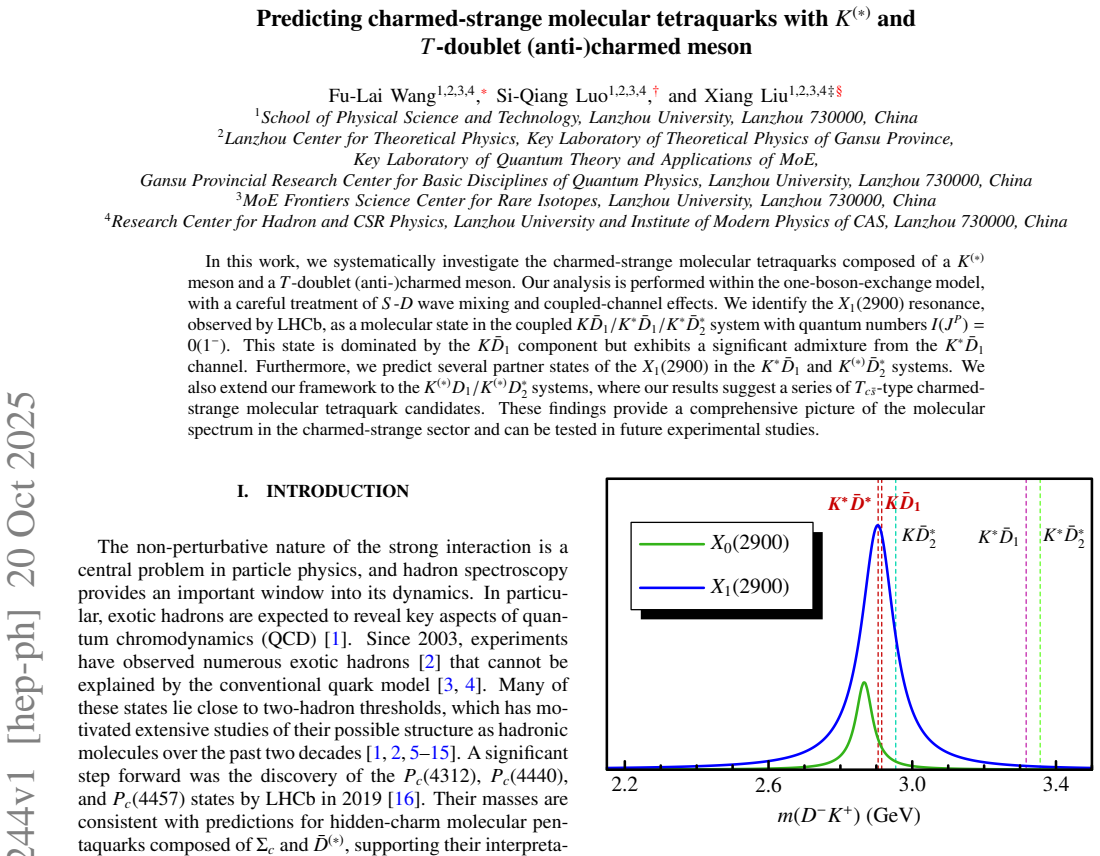
Can the X 1(2900)be identified as a charmed-strange molecular tetraquark? In the following discussion, we systematically investigate the possibility of a charmed-strange molecular tetraquark can- didate formed by theKmeson and the ¯D1 meson, which may be related to the experimentally observedX 1(2900) [24, 25]. This is motivated by the fact that the proxi...
-
[7]
Fig. 3 shows the bound state properties includ- ing the mass, the RMS radius, and the probabilities of var- ious components as functions of the cutoff Λfor the cou- pledK ¯D1/K∗ ¯D1/K∗ ¯D∗ 2 system withI(J P)=0(1 −). We find that when the cutoffparameter is around 1.02 GeV , the cou- pledK ¯D1/K∗ ¯D1/K∗ ¯D∗ 2 system withI(J P)=0(1 −) can form a loosely bo...
-
[8]
This interpretation naturally motivates a system- atic exploration of its partner states in theK ∗ ¯D1 andK (∗) ¯D∗ 2 systems
Exploring the partner states of the observed X 1(2900)in the K∗ ¯D1 and K(∗) ¯D∗ 2 systems Based on the preceding discussion, it is concluded that the observedX 1(2900) can be interpreted as a charmed-strange molecular tetraquark, wherein coupled-channel effects play a crucial role. This interpretation naturally motivates a system- atic exploration of its...
Show all 128 references
-
[9]
H. X. Chen, W. Chen, X. Liu, and S. L. Zhu, The hidden- charm pentaquark and tetraquark states, Phys. Rep.639, 1 (2016)
2016
-
[10]
Brambilla, S
N. Brambilla, S. Eidelman, C. Hanhart, A. Nefediev, C. P. Shen, C. E. Thomas, A. Vairo, and C. Z. Yuan, TheXYZ states: Experimental and theoretical status and perspectives, Phys. Rep.873, 1 (2020)
2020
-
[11]
Gell-Mann, A Schematic Model of Baryons and Mesons, Phys
M. Gell-Mann, A Schematic Model of Baryons and Mesons, Phys. Lett.8, 214 (1964)
1964
-
[12]
Zweig, An SU(3) model for strong interaction symmetry and its breaking
G. Zweig, An SU(3) model for strong interaction symmetry and its breaking. Version 1, CERN-TH-401
-
[13]
H. X. Chen, W. Chen, X. Liu, Y . R. Liu, and S. L. Zhu, An updated review of the new hadron states, Rept. Prog. Phys.86, 026201 (2023)
2023
-
[14]
Hosaka, T
A. Hosaka, T. Iijima, K. Miyabayashi, Y . Sakai, and S. Yasui, Exotic hadrons with heavy flavors:X,Y,Z, and related states, Prog. Theor. Exp. Phys.2016, 062C01 (2016)
2016
-
[15]
J. M. Richard, Exotic hadrons: review and perspectives, Few Body Syst.57, 1185-1212 (2016)
2016
-
[16]
R. F. Lebed, R. E. Mitchell, and E. S. Swanson, Heavy-Quark QCD Exotica, Prog. Part. Nucl. Phys.93, 143-194 (2017)
2017
-
[17]
S. L. Olsen, T. Skwarnicki, and D. Zieminska, Nonstan- dard heavy mesons and baryons: Experimental evidence, Rev. Mod. Phys.90, 015003 (2018)
2018
-
[18]
F. K. Guo, C. Hanhart, U. G. Meißner, Q. Wang, Q. Zhao, and B. S. Zou, Hadronic molecules, Rev. Mod. Phys.90, 015004 (2018)
2018
-
[19]
Y . R. Liu, H. X. Chen, W. Chen, X. Liu, and S. L. Zhu, Pen- taquark and tetraquark states, Prog. Part. Nucl. Phys.107, 237 (2019)
2019
-
[20]
L. Meng, B. Wang, G. J. Wang, and S. L. Zhu, Chiral per- turbation theory for heavy hadrons and chiral effective field theory for heavy hadronic molecules, Phys. Rept.1019, 1-149 (2023)
2023
-
[21]
X. Q. Li and X. Liu, A possible global group structure for exotic states, Eur. Phys. J. C74, 3198 (2014)
2014
-
[22]
M. Z. Liu, Y . W. Pan, Z. W. Liu, T. W. Wu, J. X. Lu, and L. S. Geng, Three ways to decipher the nature of exotic hadrons: Multiplets, three-body hadronic molecules, and cor- relation functions, Phys. Rept.1108, 1-108 (2025)
2025
-
[23]
Z. G. Wang, Review of the QCD sum rules for exotic states, Front. Phys. (Beijing)21, 016300 (2026)
2026
-
[24]
Aaijet al.[LHCb], Observation of a narrow pentaquark state,P c(4312)+, and of two-peak structure of theP c(4450)+, Phys
R. Aaijet al.[LHCb], Observation of a narrow pentaquark state,P c(4312)+, and of two-peak structure of theP c(4450)+, Phys. Rev. Lett.122, 222001 (2019)
2019
-
[25]
J. J. Wu, R. Molina, E. Oset, and B. S. Zou, Prediction of narrowN∗ andΛ∗ resonances with hidden charm above 4 GeV , Phys. Rev. Lett.105, 232001 (2010)
2010
-
[26]
W. L. Wang, F. Huang, Z. Y . Zhang, and B. S. Zou,Σ c ¯Dand Λc ¯Dstates in a chiral quark model, Phys. Rev. C84, 015203 (2011)
2011
-
[27]
Z. C. Yang, Z. F. Sun, J. He, X. Liu, and S. L. Zhu, The possible hidden-charm molecular baryons composed of anti- charmed meson and charmed baryon, Chin. Phys. C36, 6 (2012)
2012
-
[28]
J. J. Wu, T.-S. H. Lee, and B. S. Zou, Nucleon resonances with hidden charm in coupled-channel Models, Phys. Rev. C 85, 044002 (2012)
2012
-
[29]
H. X. Chen, W. Chen, R. R. Dong, and N. Su,X 0(2900) and X1(2900): Hadronic molecules or compact tetraquarks, Chin. Phys. Lett.37, 101201 (2020)
2020
-
[30]
R. Chen, X. Liu, X. Q. Li, and S. L. Zhu, Identifying ex- otic hidden-charm pentaquarks, Phys. Rev. Lett.115, 132002 12 (2015)
2015
-
[31]
Karliner and J
M. Karliner and J. L. Rosner, New exotic meson and baryon resonances from doubly-heavy hadronic molecules, Phys. Rev. Lett.115, 122001 (2015)
2015
-
[32]
Aaijet al.[LHCb], A model-independent study of reso- nant structure inB +→D +D−K+ decays, Phys
R. Aaijet al.[LHCb], A model-independent study of reso- nant structure inB +→D +D−K+ decays, Phys. Rev. Lett.125, 242001 (2020)
2020
-
[33]
On the other hand, Ref
suggested it could be a virtual state. On the other hand, Ref. [40], using similar interactions but a different approach, did find a molecular interpretation viable. Notably, these stud- ies did not systematically include theσexchange or coupled- channel effects. Theσexchange ...
2025 arXiv
-
[34]
Aaijet al.[LHCb], Amplitude analysis of theB + → D+D−K+ decay, Phys
R. Aaijet al.[LHCb], Amplitude analysis of theB + → D+D−K+ decay, Phys. Rev. D102, 112003 (2020)
2020
-
[35]
Aaijet al.[LHCb], Observation of new charmonium or charmoniumlike states inB +→D ∗±D∓K+ decays, Phys
R. Aaijet al.[LHCb], Observation of new charmonium or charmoniumlike states inB +→D ∗±D∓K+ decays, Phys. Rev. Lett.133, 131902 (2024)
2024
-
[36]
Molina and E
R. Molina and E. Oset, Molecular picture for theX 0(2866) as aD ∗ ¯K∗ JP =0 + state and related 1 +,2 + states, Phys. Lett. B 811, 135870 (2020);837, 137645(E) (2023)
2020
-
[37]
M. Z. Liu, J. J. Xie, and L. S. Geng,X 0(2866) as aD ∗ ¯K∗ molecular state, Phys. Rev. D102, 091502 (2020)
2020
-
[38]
M. W. Hu, X. Y . Lao, P. Ling, and Q. Wang,X0(2900) and its heavy quark spin partners in molecular picture, Chin. Phys. C 45, 021003 (2021)
2021
-
[39]
S. Y . Kong, J. T. Zhu, D. Song, and J. He, Heavy-strange me- son molecules and possible candidatesD ∗ s0(2317),D s1(2460), andX 0(2900), Phys. Rev. D104, 094012 (2021)
2021
-
[40]
S. S. Agaev, K. Azizi, and H. Sundu, New scalar resonance X0(2900) as a molecule: Mass and width, J. Phys. G48, 085012 (2021)
2021
-
[41]
He and D
J. He and D. Y . Chen, Molecular picture forX 0(2900) and X1(2900), Chin. Phys. C45, 063102 (2021)
2021
-
[42]
Wang and S
B. Wang and S. L. Zhu, How to understand theX(2900)?, Eur. Phys. J. C82, 419 (2022)
2022
-
[43]
L. R. Dai, R. Molina, and E. Oset, Looking for the exotic X0(2866) and itsJ P =1 + partner in the ¯B0 →D (∗)+K−K(∗)0 reactions, Phys. Rev. D105, 096022 (2022)
2022
-
[44]
Y . K. Chen, W. L. Wu, L. Meng, and S. L. Zhu, Unified de- scription of theQs¯q¯qmolecular bound states, molecular res- onances, and compact tetraquark states in the quark potential model, Phys. Rev. D109, 014010 (2024)
2024
-
[45]
Z. M. Ding, Q. Huang, and J. He,X 0(2900) andχ c0(3930) in processB +→D +D−K+, Eur. Phys. J. C84, 822 (2024)
2024
-
[46]
Z. M. Ding, Q. Huang, and J. He, Roles of ¯D∗K∗ andD ∗ ¯D molecular states in decayB+→D∗+D−K+, arXiv:2508.12686
-
[47]
X. K. Dong and B. S. Zou, Prediction of possibleDK 1 bound states, Eur. Phys. J. A57, 139 (2021)
2021
-
[48]
J. J. Qi, Z. Y . Wang, Z. F. Zhang, and X. H. Guo, Studying the ¯D1Kmolecule in the Bethe–Salpeter equation approach, Eur. Phys. J. C81, 639 (2021)
2021
-
[49]
H. Chen, H. R. Qi, and H. Q. Zheng,X 1(2900) as a ¯D1K molecule, Eur. Phys. J. C81, 812 (2021)
2021
-
[50]
X. G. He, W. Wang, and R. Zhu, Open-charm tetraquark Xc and open-bottom tetraquarkX b, Eur. Phys. J. C80, 1026 (2020)
2020
-
[51]
J. R. Zhang, Open-charm tetraquark candidate: Note on X0(2900), Phys. Rev. D103, 054019 (2021)
2021
-
[52]
X. H. Liu, M. J. Yan, H. W. Ke, G. Li, and J. J. Xie, Triangle singularity as the origin ofX 0(2900) andX 1(2900) observed in B+→D +D−K+, Eur. Phys. J. C80, 1178 (2020)
2020
-
[53]
Z. G. Wang, Analysis of theX 0(2900) as the scalar tetraquark state via the QCD sum rules, Int. J. Mod. Phys. A35(2020) no.30, 2050187
2020
-
[54]
T. J. Burns and E. S. Swanson, Kinematical cusp and res- onance interpretations of theX(2900), Phys. Lett. B813, 136057 (2021)
2021
-
[55]
G. J. Wang, L. Meng, L. Y . Xiao, M. Oka, and S. L. Zhu, Mass spectrum and strong decays of tetraquark ¯c¯sqqstates, Eur. Phys. J. C81, 188 (2021)
2021
-
[56]
G. Yang, J. Ping, and J. Segovia,sQ¯q¯q(q=u,d;Q=c,b) tetraquarks in the chiral quark model, Phys. Rev. D103, 074011 (2021)
2021
-
[57]
T. Guo, J. Li, J. Zhao, and L. He, Mass spectra and decays of open-heavy tetraquark states, Phys. Rev. D105, 054018 (2022)
2022
-
[58]
S. S. Agaev, K. Azizi, and H. Sundu, Is the resonance X0(2900) a ground-state or radially excited scalar tetraquark [ud][¯c¯s]?, Phys. Rev. D106, 014019 (2022)
2022
-
[59]
J. Wei, Y . H. Wang, C. S. An, and C. R. Deng, Color flux-tube nature of the statesT cs(2900) andT a c¯s(2900), Phys. Rev. D106, 096023 (2022)
2022
-
[60]
F. X. Liu, R. H. Ni, X. H. Zhong, and Q. Zhao, Charmed- strange tetraquarks and their decays in the potential quark model, Phys. Rev. D107, 096020 (2023)
2023
-
[61]
Sundu, S
H. Sundu, S. S. Agaev, and K. Azizi, Axial-vector and pseu- doscalar tetraquarks [ud][¯c¯s], Eur. Phys. J. C83, 198 (2023)
2023
-
[62]
P. G. Ortega, D. R. Entem, F. Fernandez, and J. Segovia, NovelT cs andT c¯s candidates in a constituent-quark-model- based meson-meson coupled-channels calculation, Phys. Rev. D108, 094035 (2023)
2023
-
[63]
B. Wang, K. Chen, L. Meng, and S. L. Zhu, Spectrum of the molecular tetraquarks: Unraveling theT cs0(2900) and T a c¯s0(2900), Phys. Rev. D109, 034027 (2024)
2024
-
[64]
J. Z. Wang, Z. Y . Lin, B. Wang, L. Meng, and S. L. Zhu, Double pole structures ofX 1(2900) as theP-wave ¯D∗K∗ reso- nances, Phys. Rev. D110, 114003 (2024)
2024
-
[65]
Navaset al.[Particle Data Group], Review of particle physics, Phys
S. Navaset al.[Particle Data Group], Review of particle physics, Phys. Rev. D110, 030001 (2024)
2024
-
[66]
J. A. Mars ´e-Valera, V . K. Magas, and A. Ramos, Double- strangeness molecular-type pentaquarks from coupled- channel dynamics, Phys. Rev. Lett.130, 9 (2023)
2023
-
[67]
Aubertet al.[BaBar], Observation of a narrow meson de- caying toD + sπ0 at a mass of 2.32 GeV/c2, Phys
B. Aubertet al.[BaBar], Observation of a narrow meson de- caying toD + sπ0 at a mass of 2.32 GeV/c2, Phys. Rev. Lett.90, 242001 (2003)
2003
-
[68]
Bessonet al.[CLEO], Observation of a narrow resonance of mass 2.46 GeV/c 2 decaying toD ∗+ s π0 and confirmation of theD ∗ sJ(2317) state, Phys
D. Bessonet al.[CLEO], Observation of a narrow resonance of mass 2.46 GeV/c 2 decaying toD ∗+ s π0 and confirmation of theD ∗ sJ(2317) state, Phys. Rev. D68, 032002 (2003);75, 119908(E) (2007)
2003
-
[69]
Barnes, F
T. Barnes, F. E. Close, and H. J. Lipkin, Implications of aDK molecule at 2.32 GeV , Phys. Rev. D68, 054006 (2003)
2003
-
[70]
Y . Q. Chen and X. Q. Li, A comprehensive four-quark in- terpretation ofD s(2317),D s(2457) andD s(2632), Phys. Rev. Lett.93, 232001 (2004)
2004
-
[71]
F. K. Guo, P. N. Shen, H. C. Chiang, R. G. Ping, and B. S. Zou, Dynamically generated 0+ heavy mesons in a heavy chiral uni- tary approach, Phys. Lett. B641, 278-285 (2006)
2006
-
[72]
F. K. Guo, P. N. Shen, and H. C. Chiang, Dynamically gener- ated 1+ heavy mesons, Phys. Lett. B647, 133-139 (2007)
2007
-
[73]
Faessler, T
A. Faessler, T. Gutsche, V . E. Lyubovitskij, and Y . L. Ma,D∗K molecular structure of theD s1(2460) meson, Phys. Rev. D76, 114008 (2007)
2007
-
[74]
Z. G. Wang, Structure of the axial-vector mesonD s1(2460), J. Phys. G34, 753-765 (2007)
2007
-
[75]
Gamermann, E
D. Gamermann, E. Oset, D. Strottman, and M. J. Vicente Va- cas, Dynamically generated open and hidden charm meson systems, Phys. Rev. D76, 074016 (2007)
2007
-
[76]
Zhang, Q
D. Zhang, Q. Y . Zhao, and Q. Y . Zhang, A Study ofS-wave DKinteractions in the chiral SU(3) quark model, Chin. Phys. Lett.26, 091201 (2009). 13
2009
-
[77]
Z. X. Xie, G. Q. Feng, and X. H. Guo, AnalyzingD∗+ s0 (2317) in theDKmolecule picture in the Beth-Salpeter approach, Phys. Rev. D81, 036014 (2010)
2010
-
[78]
Wang and X
P. Wang and X. G. Wang, Study on 0+ states with open charm in unitarized heavy meson chiral approach, Phys. Rev. D86, 014030 (2012);[Phys. Rev. D 86, 039903 (2012)]
2012
-
[79]
G. Q. Feng, X. H. Guo, and Z. H. Zhang, Studying theD ∗K molecular structure ofD + s (2460) in the Bethe-Salpeter ap- proach, Eur. Phys. J. C72, 2033 (2012)
-
[80]
G. Q. Feng and X. H. Guo,DKmolecule in the Bethe-Salpeter equation approach in the heavy quark limit, Phys. Rev. D86, 036004 (2012)
2012
-
[81]
L. Liu, K. Orginos, F. K. Guo, C. Hanhart, and U. G. Meißner, Interactions of charmed mesons with light pseudoscalar mesons from lattice QCD and implications on the nature of theD∗ s0(2317), Phys. Rev. D87, 014508 (2013)
2013
-
[82]
F. S. Navarra, M. Nielsen, E. Oset, and T. Sekihara, Testing the molecular nature ofD ∗ s0(2317) andD ∗ 0(2400) in semileptonic Bs andBdecays, Phys. Rev. D92, 014031 (2015)
2015
-
[83]
Mart ´ınez Torres, E
A. Mart ´ınez Torres, E. Oset, S. Prelovsek, and A. Ramos, Re- analysis of lattice QCD spectra leading to theD ∗ s0(2317) and D∗ s1(2460), JHEP05, 153 (2015)
2015
-
[84]
Z. H. Guo, U. G. Meißner, and D. L. Yao, New insights into theD ∗ s0(2317) and other charm scalar mesons, Phys. Rev. D 92, 094008 (2015)
2015
-
[85]
P. G. Ortega, J. Segovia, D. R. Entem, and F. Fernandez, Molecular components inP-wave charmed-strange mesons, Phys. Rev. D94, 074037 (2016)
2016
-
[86]
Albaladejo, D
M. Albaladejo, D. Jido, J. Nieves, and E. Oset,D ∗ s0(2317) and DKscattering inBdecays from BaBar and LHCb data, Eur. Phys. J. C76, 300 (2016)
2016
-
[87]
G. S. Bali, S. Collins, A. Cox, and A. Sch ¨afer, Masses and decay constants of theD ∗ s0(2317) andD s1(2460) fromN f = 2 lattice QCD close to the physical point, Phys. Rev. D96, 074501 (2017)
2017
-
[88]
Albaladejo, P
M. Albaladejo, P. Fernandez-Soler, J. Nieves, and P. G. Or- tega, Contribution of constituent quark modelc¯sstates to the dynamics of theD ∗ s0(2317) andD s1(2460) resonances, Eur. Phys. J. C78, 722 (2018)
2018
-
[89]
G. K. C. Cheunget al.[Hadron Spectrum],DK I=0,D ¯K I=0,1 scattering and theD ∗ s0(2317) from lattice QCD, JHEP 02, 100 (2021)
2021
-
[90]
F. K. Guo, Resolving the mysteries of the positive-parity charm mesons, Chin. Sci. Bull.67, 4344-4355 (2022)
2022
-
[91]
W. Hao, Y . Lu, and B. S. Zou, Coupled channel effects for the charmed-strange mesons, Phys. Rev. D106, 074014 (2022)
2022
-
[92]
Z. Yang, G. J. Wang, J. J. Wu, M. Oka, and S. L. Zhu, Novel coupled channel framework connecting the quark model and lattice QCD for the near-thresholdD s states, Phys. Rev. Lett. 128, 112001 (2022)
2022
-
[93]
Chen and Q
R. Chen and Q. Huang, From the isovector molecular expla- nation of the newlyT a0(++) c¯s (2900) to possible charmed-strange molecular pentaquarks, arXiv:2208.10196
-
[94]
T. C. Wu and L. S. Geng, Theoretical investigation of the molecular nature ofD∗ s0(2317) andD s1(2460) and the possibil- ity of observing theD ¯DKbound stateK c¯c(4180) in inclusive e+e−→c¯ccollisions, Phys. Rev. D108, 014015 (2023)
2023
-
[95]
Ikeno, G
N. Ikeno, G. Toledo, and E. Oset, Model independent analysis of femtoscopic correlation functions: An application to the D∗ s0(2317), Phys. Lett. B847, 138281 (2023)
2023
-
[96]
Z. W. Liu, J. X. Lu, and L. S. Geng, Study of theDKinterac- tion with femtoscopic correlation functions, Phys. Rev. D107, 074019 (2023)
2023
-
[97]
Z. L. Li, X. Y . Tan, Z. F. Zhang, Z. Y . Wang, and X. H. Guo, InvestigatingS-wave bound states composed of two pseu- doscalar mesons*, Chin. Phys. C47, 013102 (2023)
2023
-
[98]
Gil-Dom´ınguez and R
F. Gil-Dom´ınguez and R. Molina, Quark mass dependence of theD ∗ s0(2317) andD s1(2460) resonances, Phys. Rev. D109, 096002 (2024)
2024
-
[99]
J. D. E. Yeoet al.[Hadron Spectrum],DK/Dπscattering and an exotic virtual bound state at the SU(3) flavour symmetric point from lattice QCD, JHEP07, 012 (2024)
2024
-
[100]
H. J. Kim and H. C. Kim,D ∗ s0(2317) andB ∗ s0 as molecular states, PTEP2024, 073D01 (2024)
2024
-
[101]
H. P. Li, W. H. Liang, C. W. Xiao, J. J. Xie, and E. Oset, Deter- mination of the binding andDKprobability of theD ∗ s0(2317) from the ( ¯D ¯K)− mass distributions inΛ b→Λ c( ¯D ¯K)− decays, Eur. Phys. J. C85, 616 (2025)
2025
-
[102]
Z. Zhou, G. L. Yu, Z. G. Wang, and J. Lu, Analysis of the hadronic moleculesDK,D ∗K,DK ∗ and their bottom analogs with QCD sum rules, arXiv:2508.00402
-
[103]
Klempt, F
E. Klempt, F. Bradamante, A. Martin, and J. M. Richard, Antinucleon nucleon interaction at low energy: Scattering and protonium, Phys. Rept.368, 119-316 (2002)
2002
-
[104]
H. Y . Cheng and K. C. Yang, Charmless hadronicBdecays into a tensor meson, Phys. Rev. D83, 034001 (2011)
2011
-
[105]
Casalbuoni, A
R. Casalbuoni, A. Deandrea, N. Di Bartolomeo, R. Gatto, F. Feruglio, and G. Nardulli, Light vector resonances in the effective chiral Lagrangian for heavy mesons, Phys. Lett. B 292, 371 (1992)
1992
-
[106]
T. M. Yan, H. Y . Cheng, C. Y . Cheung, G. L. Lin, Y . C. Lin, and H. L. Yu, Heavy quark symmetry and chiral dynamics, Phys. Rev. D46, 1148 (1992); [Phys. Rev. D55, 5851E (1997)]
1992
-
[107]
Casalbuoni, A
R. Casalbuoni, A. Deandrea, N. Di Bartolomeo, R. Gatto, F. Feruglio, and G. Nardulli, Phenomenology of heavy meson chiral Lagrangians, Phys. Rep.281, 145 (1997)
1997
-
[108]
Bando, T
M. Bando, T. Kugo, and K. Yamawaki, Nonlinear Realization and Hidden Local Symmetries, Phys. Rept.164, 217 (1988)
1988
-
[109]
Harada and K
M. Harada and K. Yamawaki, Hidden local symmetry at loop: A New perspective of composite gauge boson and chiral phase transition, Phys. Rept.381, 1 (2003)
2003
-
[110]
G. J. Ding, AreY(4260) andZ + 2 (4250)D 1DorD 0D∗ hadronic molecules? Phys. Rev. D79, 014001 (2009)
2009
-
[111]
F. L. Wang, S. Q. Luo, R. Q. Qian, and X. Liu, Spectroscopic properties of double-strangeness molecular tetraquarks, Phys. Rev. D110, 114041 (2024)
2024
-
[112]
D. O. Riska and G. E. Brown, Nucleon resonance transition couplings to vector mesons, Nucl. Phys.A 679, 577 (2001)
2001
-
[113]
F. L. Wang, R. Chen, Z. W. Liu, and X. Liu, Possible triple- charm molecular pentaquarks fromΞ ccD1/ΞccD∗ 2 interactions, Phys. Rev. D99, 054021 (2019)
2019
-
[114]
F. L. Wang and X. Liu, Exotic double-charm molecular states with hidden or open strangeness and around 4.5∼4.7 GeV , Phys. Rev. D102, 094006 (2020)
2020
-
[115]
F. L. Wang, R. Chen, Z. W. Liu, and X. Liu, Probing new types ofP c states inspired by the interaction betweenS−wave charmed baryon and anti-charmed meson in a ¯Tdoublet, Phys. Rev. C101, 025201 (2020)
2020
-
[116]
F. L. Wang and X. Liu, Investigating new type of doubly charmed molecular tetraquarks composed of charmed mesons in theHandTdoublets, Phys. Rev. D104, 094030 (2021)
2021
-
[117]
F. L. Wang, X. D. Yang, R. Chen, and X. Liu, Correlation of the hidden-charm molecular tetraquarks and the charmonium- like structures existing in theB→XYZ+Kprocess, Phys. Rev. D104, 094010 (2021)
2021
-
[118]
X. D. Yang, F. L. Wang, Z. W. Liu, and X. Liu, Newly ob- servedX(4630): a new charmoniumlike molecule, Eur. Phys. 14 J. C81, 807 (2021)
2021
-
[119]
F. L. Wang, R. Chen, and X. Liu, A new group of doubly charmed molecule withT-doublet charmed meson pair, Phys. Lett. B835, 137502 (2022)
2022
-
[120]
F. L. Wang and X. Liu, Higher molecularP Λ/Σ ψs pentaquarks arising from theΞ (′,∗) c ¯D1/Ξ(′,∗) c ¯D∗ 2 interactions, Phys. Rev. D 108, 054028 (2023)
2023
-
[121]
Z. P. Wang, F. L. Wang, G. J. Wang, and X. Liu, Probing exoticJ PC resonances from deeply bound charmoniumlike molecules: Insights for identifying exotic hadrons, Phys. Rev. D110, L051501 (2024)
2024
-
[122]
L. C. Sheng, J. Y . Huo, R. Chen, F. L. Wang, and X. Liu, Exploring the mass spectrum and electromagnetic property of theΞ ccK(∗) andΞ cc ¯K(∗) molecules, Phys. Rev. D110, 054044 (2024)
2024
-
[123]
Molina, T
R. Molina, T. Branz, and E. Oset, A new interpretation for the D∗ s2(2573) and the prediction of novel exotic charmed mesons, Phys. Rev. D82, 014010 (2010)
2010
-
[124]
Isola, M
C. Isola, M. Ladisa, G. Nardulli, and P. Santorelli, Charming penguins inB→K ∗π,K(ρ,ω,ϕ) decays, Phys. Rev. D68, 114001 (2003)
2003
-
[125]
V . B. Berestetsky, E. M. Lifshitz, and L. P. Pitaevsky, Quantum Electrodynamics, Pergamon Press, 1982, ISBN 978-0-7506- 3371-0
1982
-
[126]
N. A. Tornqvist, On deusons or deuteron-like meson-meson bound-states, Nuovo Cim. Soc. Ital. Fis.107A, 2471 (1994)
1994
-
[127]
N. A. Tornqvist, From the deuteron to deusons, an analysis of deuteron-like meson-meson bound states, Z. Phys. C61, 525 (1994)
1994
-
[128]
R. Chen, A. Hosaka, and X. Liu, Heavy molecules and one- σ/ω-exchange model, Phys. Rev. D96, 116012 (2017)
2017
Reviewed August 4, 2026 · model on record in the stance chip above.
Discussion (0). Sign in to comment.