REVIEW 3 major objections 6 minor 60 references
Cross-Domain Multi-Person Human Activity Recognition via Near-Field Wi-Fi Sensing
T0 review · 3 major / 6 minor · reviewed 2026-08-04 · deepseek-v4-flash
Pith's one-line read WiAnchor claims that multi-person Wi-Fi activity recognition can be made practical by exploiting the near-field domination effect, where each person's own device's link to the access point is dominated by that person's motions, and that a t
desk verdict Useful new dataset and a plausible training recipe for a niche Wi-Fi sensing problem, but the physical assumption gets thin exactly where the absent-category numbers matter. read the letter →
The pith
A machine-rendered reading of the paper's core claim, the machinery that carries it, and where it could break.
The reading
What carries the argument
The near-field domination effect: because the power of channel variation on a UE-AP link scales roughly as (L_U,S_i)^-4 in the distance from the subject to its own UE, the CSI variation on that link is dominated by that subject's motion, making each link a dedicated sensor. The training machinery is the WiAnchor loss composition: a time-information embedding that encodes irregular packet arrival intervals into sinusoidal features; an inter-class margin enlarging loss (L_FE) applied in pre-training and fine-tuning; an anchor-matching loss (L_AC) that aligns target-domain feature cluster centers to source-domain cluster centers using cosine similarity; and a composite decision rule that adds t
What would settle it
Place a subject's UE 0.2 m from them and run the standard protocol to measure WiAnchor's cross-domain accuracy; then repeat the exact same data collection and evaluation with the UE 1 m away under otherwise identical conditions. The near-field domination model predicts the accuracy for categories without fine-tuning samples should drop sharply because other subjects' contributions are no longer negligible; if it does not drop, the proposed mechanism is not what is carrying the accuracy.
Extended reading notes
Core claim
The paper's central discovery is that the near-field domination effect—a subject's motion dominates the CSI variation on the link between that subject's own Wi-Fi device and the access point—makes multi-person activity recognition practical with ordinary Wi-Fi, and that a three-part training framework (pre-training with inter-class margin enlargement, fine-tuning with anchor matching against source cluster centers, and inference combining logits with anchor similarity) lets a model adapt to a new person using only a handful of samples and none at all for some activity categories. On a newly collected dataset of 64,823 samples from 56 subjects in six environments, the framework attains an ave
Load-bearing premise
The load-bearing premise is that a Wi-Fi link between an access point and a person's phone is dominated by that person's own motions when they are within about 20 cm of the phone; if the phone is farther away, or a wall or body blocks the near-field path, the link no longer isolates that person and the reported cross-domain accuracy should not transfer.
Editorial extensions
If this is right
- With the near-field domination effect, each person's own Wi-Fi device provides a dedicated sensing link, so multi-person HAR is possible with commercial off-the-shelf Wi-Fi under normal traffic, with no hardware modifications.
- WiAnchor's cross-domain adaptation needs only about 10 fine-tuning samples per available activity category to reach peak performance, far fewer than the 30 samples per category that standard fine-tuning requires in the paper's experiments.
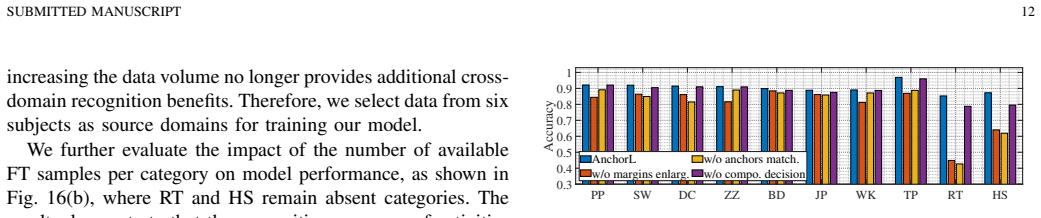
- Activity categories with no fine-tuning samples at all (rotating, handshaking) are recognized at an average of about 86.3% accuracy, a 56.8-point improvement over fine-tuning without them, so dangerous or impractical activities need not be recollected for each new user.
- The framework is insensitive to network architecture: similar accuracy is achieved with GRU and CNN backbones and across hidden sizes, so it can ride on whatever model is convenient.
- Overall cross-domain accuracy across all 56 target subjects is about 90.4%, with categories that had fine-tuning samples at about 91.4%.
Reading between the lines
- A testable extension: the anchor-matching idea—aligning target features to source cluster centers rather than to individual samples—could transfer to other cross-domain sensing tasks (vital signs, keystroke or pose inference) where per-subject calibration data is incomplete.
- If the near-field domination effect is the real driver, then any short-range personal radio link (BLE, UWB, future ISAC bands) that sits within the subject's near field should show the same per-person separability; a cheap experiment is replicating the protocol with a different radio.
- The composite inference (logits plus feature-similarity to anchors) suggests that even when a classifier is frozen, an explicit nearest-center lookup can recover accuracy for unseen classes; this could be a lightweight plug-in for other few-shot or open-set Wi-Fi recognition systems.
- The paper's own privacy caveat—APs could infer activities without consent—points to a design test: add a data-poisoning defense at the UE and measure how much WiAnchor's accuracy degrades.
Editorial analysis
A structured set of objections, weighed in public.
Referee Report
Summary. The paper proposes WiAnchor, a training framework for cross-domain multi-person human activity recognition (HAR) from Wi-Fi CSI under near-field domination. The method has three components: a time-information embedding for irregular native-traffic packet arrivals; a pre-training stage that enlarges inter-class feature margins; and a fine-tuning stage that aligns target-domain features to source-domain anchors, followed by composite inference combining logits and anchor similarity. The authors also introduce NFS-Fi, a dataset of about 65,000 samples from 56 subjects, 6 environments, and 10 activities collected under default Wi-Fi traffic. They report 90.4% overall cross-domain accuracy, 91.4% for categories with fine-tuning samples, and 86.3% for two categories (RT and HS) for which no fine-tuning samples are provided. Ablation studies indicate that each component contributes to performance.
Significance. If the reported results hold, this is a useful contribution: it provides a public multi-subject near-field Wi-Fi sensing dataset with native traffic, a domain-adaptation method that handles missing categories, and a thorough ablation showing the anchor-matching mechanism is important (removing it drops absent-category accuracy to 52.3%). The dataset release and the systematic evaluation across 56 subjects are concrete strengths. However, the central physical premise—near-field domination per link—is only weakly validated for the activities used in the headline claim, and the experimental reporting lacks key reproducibility details. The contribution is incremental over the authors' prior MUSE-Fi concept, but the training framework and dataset are new and potentially valuable to the Wi-Fi sensing community.
major comments (3)
- [II-B, Eq. (5), Fig. 2, IV-A] The central physical premise is Eq. (5): each UE-AP link is dominated by the nearby subject, so P_i >> P_j. This is validated only with seated subjects performing a sweeping motion (Fig. 2). The evaluation dataset includes WK, JP, RT, and HS, where a subject may move away from a fixed UE (placed 'approximately 20 cm in front') or another person may enter the near field (HS). The manuscript does not specify how the 20 cm separation was maintained during these activities, nor does it provide per-sample distance or body-blockage annotations. If the near-field condition fails for these activities, the per-link single-subject abstraction is invalid and the 86.3% absent-category accuracy may not transfer. Please clarify the geometry per activity or provide distance/blockage analysis to support Eq. (5) for all ten activities.
- [V-A, Eqs. (9), (11), (13), (16)] The loss functions depend on six weighting parameters (lambda_11, lambda_12, lambda_21, lambda_22, lambda_23, lambda_3), none of which are reported. In addition, the six source subjects are randomly selected without a stated seed, and all accuracies are reported as single averages without variance, confidence intervals, or number of repeats. Consequently, the headline 90.4%/86.3% results cannot be reproduced or statistically assessed. Please report the hyperparameter values, seeds, and per-subject or repeated-run statistics (e.g., mean and standard deviation across runs).
- [V-A] The evaluation protocol states: 'data from 6 randomly selected subjects, excluding the target subject and the environment where that subject is recorded, serve as the source domain.' This wording is ambiguous: does 'the environment where that subject is recorded' refer to all environments in which the target subject appears, so that source and target environments are disjoint? If source data include samples from the same environment as the target, then the reported accuracy could partly reflect environment familiarity rather than subject adaptation. Please clarify the exact exclusion rule and its implication for the cross-domain claim.
minor comments (6)
- [References [33] and [61]] References [33] and [61] are identical (both cite 'Poison to Cure: Privacy-preserving Wi-Fi Multi-User Sensing via Data Poisoning'). Please deduplicate.
- [Eq. (6)] The time-embedding formula uses T^{2j/D} but the symbols T and D are not defined clearly. State explicitly that T is the activity duration and D the embedding dimension, and clarify the range of j.
- [Fig. 14(b)] The x-axis is labeled 'Subject index' but the figure shows accuracy per subject. Consider labeling it 'Subject ID' and adding a caption note that subjects are ordered by ID.
- [Table I] The 'Sampling' column for NFS-Fi lists 'Native Traffic' while other datasets list rates in Hz. This is not a like-for-like comparison; consider adding a note explaining that native traffic is irregular and give the average packet rate.
- [Algorithm 1] Line 4 writes 'ℵC_i ← ℵ' and 'ℵC_i ← ℵ', which is unclear as a cluster-center assignment. Please denote the cluster-center computation explicitly (e.g., using a mean operator over the batch).
- [IV-A] The dataset description does not specify how many concurrent participants performed each activity, nor whether participants moved during WK/JP/RT while the UE remained fixed. Please provide this detail, as it directly relates to the near-field validation concern in the major comments.
Circularity Check
No significant circularity: the 90.4%/86.3% results are held-out measurements, and the near-field premise, though drawing on the authors' prior MUSE-Fi work, is independently derived and directly validated.
full rationale
The paper's central claim is an empirical evaluation result, not a derivation whose output is built into its inputs. The cross-domain accuracies (overall ~90.4%; categories without FT samples ~86.3%) come from leave-one-subject-out evaluation (Section V-A: one subject's data as target, six other subjects from a different environment as source), so they are measured on held-out subjects rather than being forced by a fitted parameter or by an equation equivalent to the conclusion. The near-field domination effect (Eq. 5) is derived from a standard path-loss model with σ≈4 [49] and is directly validated by the experiment in Fig. 2, which shows that only the link of the moving subject exhibits phase fluctuation. Although the effect and the ~0.2 m near-field distance are attributed in part to the authors' prior work MUSE-Fi [30], the current paper supplies its own theoretical derivation and measurement, so the self-citation is supporting rather than load-bearing. The time-embedding Eq. (6) is a sinusoidal embedding resembling Transformer positional encoding, but this is an adaptation rather than a renaming of a known empirical pattern, and it does not make the headline accuracy circular. The most plausible weakness is physical, not logical: Fig. 2 validates near-field domination only for seated subjects with UEs fixed 20 cm in front, while the evaluation includes mobile/interactive activities (WK, JP, RT, HS) in which the body-UE distance can exceed ~20 cm; this is a generalization/validity risk, not a circular-reasoning defect, and the paper does not report per-sample distance/blockage annotations or error bars. Therefore no circular step is established; at most the presence of self-citations for the near-field concept justifies a low non-zero score.
Assumptions & free parameters
free parameters (6)
- lambda_11, lambda_12 =
not reported
- lambda_21, lambda_22 =
not reported
- lambda_23 =
not reported
- lambda_3 =
not reported
- FT samples per available category =
10
- Anchor subset size =
30 per category
assumptions (4)
- domain assumption Near-field domination: each subject's UE-AP link is dominated by that subject's motion (Eq. 5, Section II-B).
- domain assumption Path-loss exponent sigma approximately 4, with subjects far from the AP and moving at similar speeds (Section II-B).
- domain assumption Subject-specific interference is category-invariant, so filtering learned on available categories transfers to absent categories (Sections II-C2 and III-C).
- domain assumption Sinusoidal time-difference embedding captures the irregular sampling pattern of native-traffic CSI (Section III-A).
Cite this review
Pith. "Pith review of Cross-Domain Multi-Person Human Activity Recognition via Near-Field Wi-Fi Sensing." pith.science (2026). https://pith.science/paper/4DXZ3FSQ
@misc{pith2026251017816,
  author       = {Pith},
  title        = {Pith review of: Cross-Domain Multi-Person Human Activity Recognition via Near-Field Wi-Fi Sensing},
  year         = {2026},
  howpublished = {\url{https://pith.science/paper/4DXZ3FSQ}},
  note         = {Machine review of arXiv:2510.17816}
}
read the original abstract
Wi-Fi-based human activity recognition (HAR) provides substantial convenience and has emerged as a thriving research field, yet the coarse spatial resolution inherent to Wi-Fi significantly hinders its ability to distinguish multiple subjects. By exploiting the near-field domination effect, establishing a dedicated sensing link for each subject through their personal Wi-Fi device offers a promising solution for multi-person HAR under native traffic. However, due to the subject-specific characteristics and irregular patterns of near-field signals, HAR neural network models require fine-tuning (FT) for cross-domain adaptation, which becomes particularly challenging with certain categories unavailable. In this paper, we propose WiAnchor, a novel training framework for efficient cross-domain adaptation in the presence of incomplete activity categories. This framework processes Wi-Fi signals embedded with irregular time information in three steps: during pre-training, we enlarge inter-class feature margins to enhance the separability of activities; in the FT stage, we innovate an anchor matching mechanism for cross-domain adaptation, filtering subject-specific interference informed by incomplete activity categories, rather than attempting to extract complete features from them; finally, the recognition of input samples is further improved based on their feature-level similarity with anchors. We construct a comprehensive dataset to thoroughly evaluate WiAnchor, achieving over 90% cross-domain accuracy with absent activity categories.
Figures


Figures from the paper (13 more)



Reference graph
Works this paper leans on
-
[1]
Enabling Ubiquitous Wi-Fi Sensing with Beamforming Reports,
C. Wu, X. Huang, J. Huang, and G. Xing, “Enabling Ubiquitous Wi-Fi Sensing with Beamforming Reports,” inProc. of 37th ACM SIGCOMM, 2023, pp. 20–32
2023
-
[2]
Wireless sensing for human activity: A survey,
J. Liu, H. Liu, Y . Chen, Y . Wang, and C. Wang, “Wireless sensing for human activity: A survey,”IEEE Commun. Surv. Tutor., vol. 22, no. 3, pp. 1629–1645, 2020
2020
-
[3]
WiFi Sensing with Channel State Information: A Survey,
Y . Ma, G. Zhou, and S. Wang, “WiFi Sensing with Channel State Information: A Survey,”ACM Computing Surveys (CSUR), vol. 52, no. 3, pp. 1–36, 2019
2019
-
[4]
ISACoT: Integrating Sensing with Data Traffic for Ubiquitous IoT Devices,
Z. Chen, T. Zheng, C. Hu, H. Cao, Y . Yang, H. Jiang, and J. Luo, “ISACoT: Integrating Sensing with Data Traffic for Ubiquitous IoT Devices,”IEEE Communications Magazine, vol. 61, no. 5, pp. 98–104, 2023
2023
-
[5]
Widar2.0: Passive Human Tracking with a Single Wi-Fi Link,
K. Qian, C. Wu, Y . Zhang, G. Zhang, Z. Yang, and Y . Liu, “Widar2.0: Passive Human Tracking with a Single Wi-Fi Link,” inProc. of the 16th ACM MobiSys, 2018, pp. 350–361
2018
-
[6]
mD-Track: Leveraging Multi- Dimensionality for Passive Indoor Wi-Fi Tracking,
Y . Xie, J. Xiong, M. Li, and K. Jamieson, “mD-Track: Leveraging Multi- Dimensionality for Passive Indoor Wi-Fi Tracking,” inProc. of the 25th ACM MobiCom, 2019, pp. 8:1–16
2019
-
[7]
Towards Environment Independent Device Free Human Activity Recognition,
W. Jiang, C. Miao, F. Ma, S. Yao, Y . Wang, Y . Yuan, H. Xue, C. Song, X. Ma, D. Koutsonikolas, W. Xu, and L. Su, “Towards Environment Independent Device Free Human Activity Recognition,” inProc. of the 24th ACM MobiCom, 2018, pp. 289–304
2018
-
[8]
Widar3.0: Zero-effort Cross-domain Gesture Recognition with Wi- Fi,
Y . Zhang, Y . Zheng, K. Qian, G. Zhang, Y . Liu, C. Wu, and Z. Yang, “Widar3.0: Zero-effort Cross-domain Gesture Recognition with Wi- Fi,”IEEE Transactions on Pattern Analysis and Machine Intelligence, vol. 44, no. 11, pp. 8671–8688, 2021
2021
Show all 60 references
-
[9]
WiMANS: A Benchmark Dataset for WiFi-based Multi-user Activity Sensing,
S. Huang, K. Li, D. You, Y . Chen, A. Lin, S. Liu, X. Li, and J. A. McCann, “WiMANS: A Benchmark Dataset for WiFi-based Multi-user Activity Sensing,” inProc. of the 18th ECCV, 2024, pp. 72–91
2024
-
[10]
Wi-Flex: Reflex Detection with Commodity WiFi,
M. Torun and Y . Mostofi, “Wi-Flex: Reflex Detection with Commodity WiFi,”Proc. of the ACM IMWUT, vol. 7, no. 3, pp. 1–27, 2023
2023
-
[11]
PhaseBeat: Exploiting CSI Phase Data for Vital Sign Monitoring with Commodity WiFi Devices,
X. Wang, C. Yang, and S. Mao, “PhaseBeat: Exploiting CSI Phase Data for Vital Sign Monitoring with Commodity WiFi Devices,” inProc. of the 37th IEEE ICDCS, 2017, pp. 1230–1239
2017
-
[12]
Experience: Cross- technology Radio Respiratory Monitoring Performance Study,
P. Hillyard, A. Luong, A. S. Abrar, N. Patwari, K. Sundar, R. Far- ney, J. Burch, C. Porucznik, and S. H. Pollard, “Experience: Cross- technology Radio Respiratory Monitoring Performance Study,” inProc. of the 24th ACM MobiCom, 2018, pp. 487–496
2018
-
[13]
FarSense: Pushing the Range Limit of WiFi-based Respiration Sensing with CSI Ratio of Two Antennas,
Y . Zeng, D. Wu, J. Xiong, E. Yi, R. Gao, and D. Zhang, “FarSense: Pushing the Range Limit of WiFi-based Respiration Sensing with CSI Ratio of Two Antennas,”Proc. of the ACM IMWUT, vol. 3, no. 3, pp. 1–26, 2019
2019
-
[14]
Eliminating the Barriers: Demystifying Wi- Fi Baseband Design and Introducing the PicoScenes Wi-Fi Sensing Platform,
Z. Jiang, T. H. Luan, X. Ren, D. Lv, H. Hao, J. Wang, K. Zhao, W. Xi, Y . Xu, and R. Li, “Eliminating the Barriers: Demystifying Wi- Fi Baseband Design and Introducing the PicoScenes Wi-Fi Sensing Platform,”IEEE Internet of Things Journal, pp. 1–21, 2021
2021
-
[15]
Vr-fi: Positioning and recog- nizing hand gestures via vr-embedded wi-fi sensing,
H. Wang, X. Li, J. Li, H. Zhu, and J. Luo, “Vr-fi: Positioning and recog- nizing hand gestures via vr-embedded wi-fi sensing,”IEEE Transactions on Mobile Computing, 2025
2025
-
[16]
RT-Fall: A Real-Time and Contactless Fall Detection System with Commodity WiFi Devices,
H. Wang, D. Zhang, Y . Wang, J. Ma, Y . Wang, and S. Li, “RT-Fall: A Real-Time and Contactless Fall Detection System with Commodity WiFi Devices,”IEEE Transactions on Mobile Computing, vol. 16, no. 2, pp. 511–526, 2016
2016
-
[17]
WiFi-NC: WiFi Over Narrow Channels,
K. Chintalapudi, B. Radunovic, V . Balan, M. Buettener, S. Yerramalli, V . Navda, and R. Ramjee, “WiFi-NC: WiFi Over Narrow Channels,” in Proc. of the 9th USENIX NSDI, 2012, pp. 43–56
2012
-
[18]
An Energy Efficient Channel Bonding and Transmit Power Control Approach for WiFi Networks,
Y . Luo and K.-W. Chin, “An Energy Efficient Channel Bonding and Transmit Power Control Approach for WiFi Networks,”IEEE Transac- tions on Vehicular Technology, vol. 70, no. 8, pp. 8251–8263, 2021
2021
-
[19]
MultiSense: Enabling Multi-Person Respiration Sensing with Commodity WiFi,
Zeng, Youwei and Wu, Dan and Xiong, Jie and Liu, Jinyi and Liu, Zhaopeng and Zhang, Daqing, “MultiSense: Enabling Multi-Person Respiration Sensing with Commodity WiFi,” inProc. of the 22nd ACM UbiComp, 2020, pp. 102:1–29
2020
-
[20]
Tracking from One Side: Multi-person Passive Tracking with WiFi Magnitude Measurements,
C. R. Karanam, B. Korany, and Y . Mostofi, “Tracking from One Side: Multi-person Passive Tracking with WiFi Magnitude Measurements,” in Proc. of the 18th ACM/IEEE IPSN, 2019, pp. 181–192
2019
-
[21]
SiWiS: Fine-grained Human Detection Using Single WiFi Device,
K. Song, Q. Wang, S. Zhang, and H. Zeng, “SiWiS: Fine-grained Human Detection Using Single WiFi Device,” inProc. of the 30th ACM MobiCom, 2024, pp. 1439–1454
2024
-
[22]
Precise Power Delay Profiling with Com- modity Wi-Fi,
Y . Xie, Z. Li, and M. Li, “Precise Power Delay Profiling with Com- modity Wi-Fi,” inProc. of the 21st ACM MobiCom, 2015, pp. 53–64
2015
-
[23]
Decimeter-Level Localization with a Single WiFi Access Point,
D. Vasisht, S. Kumar, and D. Katabi, “Decimeter-Level Localization with a Single WiFi Access Point,” inProc. of the 13th USENIX NSDI, 2016, pp. 165–178
2016
-
[24]
UWB-Fi: Pushing Wi-Fi towards Ultra-wideband for Fine-Granularity Sensing,
X. Li, H. Wang, Z. Chen, Z. Jiang, and J. Luo, “UWB-Fi: Pushing Wi-Fi towards Ultra-wideband for Fine-Granularity Sensing,” inProc. of the 22nd ACM MobiSys, 2024, pp. 42–55
2024
-
[25]
MultiTrack: Multi-user Tracking and Activity Recognition using Commodity WiFi,
S. Tan, L. Zhang, Z. Wang, and J. Yang, “MultiTrack: Multi-user Tracking and Activity Recognition using Commodity WiFi,” inProc. of the 37th ACM CHI, 2019, pp. 1–12
2019
-
[26]
GoPose: 3D Human Pose Estimation Using WiFi,
Y . Ren, Z. Wang, Y . Wang, S. Tan, Y . Chen, and J. Yang, “GoPose: 3D Human Pose Estimation Using WiFi,”Proc. of the 24th ACM UbiComp, vol. 6, no. 2, pp. 1–25, 2022
2022
-
[27]
Password-stealing Without Hacking: Wi-Fi Enabled Practical Keystroke Eavesdropping,
J. Hu, H. Wang, T. Zheng, J. Hu, Z. Chen, H. Jiang, and J. Luo, “Password-stealing Without Hacking: Wi-Fi Enabled Practical Keystroke Eavesdropping,” inProc. of the 30th ACM CCS, 2023, pp. 239–252
2023
-
[28]
MuKI-Fi: Multi-person Keystroke Inference with BFI-enabled Wi-Fi Sensing,
H. Wang, J. Hu, T. Zheng, J. Hu, Z. Chen, H. Jiang, Y . Zheng, and J. Luo, “MuKI-Fi: Multi-person Keystroke Inference with BFI-enabled Wi-Fi Sensing,”IEEE Transactions on Mobile Computing, 2024
2024
-
[29]
Near-field Integrated Sensing and Communica- tion: Opportunities and Challenges,
J. Cong, C. You, J. Li, L. Chen, B. Zheng, Y . Liu, W. Wu, Y . Gong, S. Jin, and R. Zhang, “Near-field Integrated Sensing and Communica- tion: Opportunities and Challenges,”IEEE Wireless Communications, 2024
2024
-
[30]
MUSE-Fi: Contactless MUti-person SEnsing Exploiting Near-field Wi-Fi Channel Variation,
J. Hu, T. Zheng, Z. Chen, H. Wang, and J. Luo, “MUSE-Fi: Contactless MUti-person SEnsing Exploiting Near-field Wi-Fi Channel Variation,” inProc. of the 29th ACM MobiCom, 2023, pp. 75:1–15
2023
-
[31]
Towards 3D Human Pose Construction Using WiFi,
W. Jiang, H. Xue, C. Miao, W. Shiyang, L. Sen, C. Tian, S. Murali, H. Hu, Z. Sun, and L. Su, “Towards 3D Human Pose Construction Using WiFi,” inProc. of the 26th ACM MobiCom, 2020, pp. 23:1–14
2020
-
[32]
Cross-Domain Continual Learning for Edge Intelligence in Wireless ISAC Networks,
J. Hu, X. Li, Z. Su, and J. Luo, “Cross-Domain Continual Learning for Edge Intelligence in Wireless ISAC Networks,”IEEE Trans. Wireless Commun., 2025, early access
2025
-
[34]
A Survey on Behavior Recognition Using WiFi Channel State Information,
S. Yousefi, H. Narui, S. Dayal, S. Ermon, and S. Valaee, “A Survey on Behavior Recognition Using WiFi Channel State Information,”IEEE Communications Magazine, vol. 55, no. 10, pp. 98–104, 2017
2017
-
[35]
FallDeFi: Ubiquitous Fall Detection Using Commodity Wi-Fi Devices,
S. Palipana, D. Rojas, P. Agrawal, and D. Pesch, “FallDeFi: Ubiquitous Fall Detection Using Commodity Wi-Fi Devices,”Proc. of the ACM IMWUT, vol. 1, no. 4, pp. 1–25, 2018
2018
-
[36]
SignFi: Sign Language Recognition Using WiFi,
Y . Ma, G. Zhou, S. Wang, H. Zhao, and W. Jung, “SignFi: Sign Language Recognition Using WiFi,”Proc. of the ACM IMWUT, vol. 2, no. 1, pp. 1–21, 2018
2018
-
[37]
Wiar: A Public Dataset for WiFi-based Activity Recognition,
L. Guo, L. Wang, C. Lin, J. Liu, B. Lu, J. Fang, Z. Liu, Z. Shan, J. Yang, and S. Guo, “Wiar: A Public Dataset for WiFi-based Activity Recognition,”IEEE Access, vol. 7, pp. 154 935–154 945, 2019
2019
-
[38]
Dataset: Channel State Information for Different Activities, Participants and Days,
J. K. Brinke and N. Meratnia, “Dataset: Channel State Information for Different Activities, Participants and Days,” inProc. of the 2nd Workshop on Data Acquisition to Analysis, 2019, pp. 61–64
2019
-
[39]
A Dataset for Wi-Fi-based Human Activity Recognition in Line-of-Sight and Non- Line-of-Sight Indoor Environments,
A. Baha’A, M. M. Almazari, R. Alazrai, and M. I. Daoud, “A Dataset for Wi-Fi-based Human Activity Recognition in Line-of-Sight and Non- Line-of-Sight Indoor Environments,”Data in Brief, vol. 33, p. 106534, 2020
2020
-
[40]
WiGR: A Practical Wi-Fi-based Gesture Recognition System with A Lightweight Few-shot Network,
P. Hu, C. Tang, K. Yin, and X. Zhang, “WiGR: A Practical Wi-Fi-based Gesture Recognition System with A Lightweight Few-shot Network,” Applied Sciences, vol. 11, no. 8, p. 3329, 2021
2021
-
[41]
OPERAnet, A Multimodal Activity Recognition Dataset Acquired from Radio Frequency and Vision-based Sensors,
M. J. Bocus, W. Li, S. Vishwakarma, R. Kou, C. Tang, K. Woodbridge, I. Craddock, R. McConville, R. Santos-Rodriguez, K. Chettyet al., “OPERAnet, A Multimodal Activity Recognition Dataset Acquired from Radio Frequency and Vision-based Sensors,”Scientific Data, vol. 9, no. 1, p....
2022
-
[42]
EfficientFi: Toward Large-scale Lightweight WiFi Sensing via CSI Compression,
J. Yang, X. Chen, H. Zou, D. Wang, Q. Xu, and L. Xie, “EfficientFi: Toward Large-scale Lightweight WiFi Sensing via CSI Compression,” IEEE Internet of Things Journal, vol. 9, no. 15, pp. 13 086–13 095, 2022. SUBMITTED MANUSCRIPT 14
2022
-
[43]
MM-Fi: Multi-modal Non-intrusive 4D Human Dataset for Versatile Wireless Sensing,
J. Yang, H. Huang, Y . Zhou, X. Chen, Y . Xu, S. Yuan, H. Zou, C. X. Lu, and L. Xie, “MM-Fi: Multi-modal Non-intrusive 4D Human Dataset for Versatile Wireless Sensing,”Advances in Neural Information Processing Systems, vol. 36, pp. 18 756–18 768, 2023
2023
-
[44]
Finding the Missing Data: A BERT-inspired Approach Against Package Loss in Wireless Sensing,
Z. Zhao, T. Chen, F. Meng, H. Li, X. Li, and G. Zhu, “Finding the Missing Data: A BERT-inspired Approach Against Package Loss in Wireless Sensing,” inProc. of the 43rd IEEE INFOCOM WKSHPS, 2024, pp. 1–6
2024
-
[45]
XRF55: A Radio Frequency Dataset for Human Indoor Action Analysis,
F. Wang, Y . Lv, M. Zhu, H. Ding, and J. Han, “XRF55: A Radio Frequency Dataset for Human Indoor Action Analysis,”Proc. of the ACM IMWUT, vol. 8, no. 1, pp. 1–34, 2024
2024
-
[46]
XRF V2: A Dataset for Action Summarization with Wi-Fi Signals, and IMUs in Phones, Watches, Earbuds, and Glasses,
B. Lan, P. Li, J. Yin, Y . Song, G. Wang, H. Ding, J. Han, and F. Wang, “XRF V2: A Dataset for Action Summarization with Wi-Fi Signals, and IMUs in Phones, Watches, Earbuds, and Glasses,”arXiv preprint arXiv:2501.19034, 2025
2025 arXiv
-
[47]
3D Tracking via Body Radio Reflections,
F. Adib, Z. Kabelac, D. Katabi, and R. C. Miller, “3D Tracking via Body Radio Reflections,” inProc. of the 11th USENIX NSDI, 2014, pp. 317–329
2014
-
[48]
D. H. Johnson and D. E. Dudgeon,Array Signal Processing: Concepts and Techniques. Simon & Schuster, Inc., 1992
1992
-
[49]
T. S. Rappaport,Wireless Communications: Principles and Practice. Cambridge University Press, 2024
2024
-
[50]
Towards Robust Gesture Recognition by Characterizing the Sensing Quality of WiFi Signals,
R. Gao, W. Li, Y . Xie, E. Yi, L. Wang, D. Wu, and D. Zhang, “Towards Robust Gesture Recognition by Characterizing the Sensing Quality of WiFi Signals,”Proc. of the ACM IMWUT, vol. 6, no. 1, pp. 1–26, 2022
2022
-
[51]
Understand- ing WiFi Signal Frequency Features for Position-independent Gesture Sensing,
K. Niu, F. Zhang, X. Wang, Q. Lv, H. Luo, and D. Zhang, “Understand- ing WiFi Signal Frequency Features for Position-independent Gesture Sensing,”IEEE Transactions on Mobile Computing, vol. 21, no. 11, pp. 4156–4171, 2021
2021
-
[52]
WiSR: Wireless Domain Generalization based on Style Randomization,
S. Liu, Z. Chen, M. Wu, C. Liu, and L. Chen, “WiSR: Wireless Domain Generalization based on Style Randomization,”IEEE Transactions on Mobile Computing, vol. 23, no. 5, pp. 4520–4532, 2023
2023
-
[53]
AirFi: Empowering WiFi-based Passive Human Gesture Recognition to Unseen Environment via Domain Generalization,
D. Wang, J. Yang, W. Cui, L. Xie, and S. Sun, “AirFi: Empowering WiFi-based Passive Human Gesture Recognition to Unseen Environment via Domain Generalization,”IEEE Transactions on Mobile Computing, vol. 23, no. 2, pp. 1156–1168, 2022
2022
-
[54]
Performance Evaluation of Classification Algorithms by k- fold and Leave-one-out Cross Validation,
T.-T. Wong, “Performance Evaluation of Classification Algorithms by k- fold and Leave-one-out Cross Validation,”Pattern Recognition, vol. 48, no. 9, pp. 2839–2846, 2015
2015
-
[55]
Attention is All You Need,
A. Vaswani, N. Shazeer, N. Parmar, J. Uszkoreit, L. Jones, A. N. Gomez, L. Kaiser, and I. Polosukhin, “Attention is All You Need,” inProc. of the 31st ACM NIPS, 2017, p. 6000–6010
2017
-
[56]
Convolutional Sequence to Sequence Learning,
J. Gehring, M. Auli, D. Grangier, D. Yarats, and Y . N. Dauphin, “Convolutional Sequence to Sequence Learning,” inProc. of the 34th ICML, 2017, pp. 1243–1252
2017
-
[57]
An Empirical Investigation of Catastrophic Forgetting in Gradient-based Neural Networks,
I. J. Goodfellow, M. Mirza, D. Xiao, A. Courville, and Y . Bengio, “An Empirical Investigation of Catastrophic Forgetting in Gradient-based Neural Networks,”arXiv preprint arXiv:1312.6211, 2013
2013 arXiv
-
[58]
Sphereface: Deep Hypersphere Embedding for Face Recognition,
W. Liu, Y . Wen, Z. Yu, M. Li, B. Raj, and L. Song, “Sphereface: Deep Hypersphere Embedding for Face Recognition,” inProc. of the 30th IEEE/CVF CVPR, 2017, pp. 212–220
2017
-
[59]
Deep Long- tailed Learning: A Survey,
Y . Zhang, B. Kang, B. Hooi, S. Yan, and J. Feng, “Deep Long- tailed Learning: A Survey,”IEEE Transactions on Pattern Analysis and Machine Intelligence, vol. 45, no. 9, pp. 10 795–10 816, 2023
2023
-
[60]
Adversarial Robustness under Long-tailed Distribution,
T. Wu, Z. Liu, Q. Huang, Y . Wang, and D. Lin, “Adversarial Robustness under Long-tailed Distribution,” inProc. of the 34th IEEE/CVF CVPR, 2021, pp. 8659–8668
2021
-
[61]
Poison to Cure: Privacy-preserving Wi-Fi Multi-User Sensing via Data Poisoning,
J. Hu, X. Li, J. Gan, and J. Luo, “Poison to Cure: Privacy-preserving Wi-Fi Multi-User Sensing via Data Poisoning,” inProc. of the 31st ACM MobiCom, 2025
2025
Reviewed August 4, 2026 · model on record in the stance chip above.
Discussion (0). Continue with ORCID to comment.