Reaching maximum efficiency in quantum Stirling engines using multilayer graphene
Pith reviewed 2026-05-18 05:23 UTC · model grok-4.3
The pith
Multilayer graphene, particularly AB bilayer, reaches Carnot efficiency in quantum Stirling engines over broad parameter ranges.
A machine-rendered reading of the paper's core claim, the machinery that carries it, and where it could break.
Core claim
All three graphene stackings can reach Carnot efficiency in quantum Stirling cycles, with the AB-stacked bilayer doing so across the broadest window of magnetic fields and temperatures while still yielding finite work output; the monolayer is restricted to narrow regimes and the trilayer exhibits smoother performance with sizable work.
What carries the argument
Performance maps of the useful work times efficiency (ηW) calculated from the Landau-level spectra of each graphene stacking under perpendicular magnetic fields.
If this is right
- AB bilayer achieves Carnot efficiency over the widest range of conditions while maintaining finite work.
- Monolayer graphene shows highly constrained regimes but can access all four operational modes of the Stirling cycle.
- Trilayer graphene displays smoother trends and sizable ηW values.
- Optimum performance occurs at low magnetic fields and moderately low temperatures for all stackings.
Where Pith is reading between the lines
- These findings imply that AB bilayer graphene could serve as a robust platform for experimental tests of quantum heat engines at the nanoscale.
- Similar analyses might be applied to other two-dimensional materials with tunable Landau levels to identify even better candidates.
- The identification of broad operating windows suggests that device imperfections may still allow near-Carnot performance in practice.
Load-bearing premise
The graphene systems are assumed to follow ideal quantum thermodynamic cycles without significant losses from defects, electron interactions, or non-ideal magnetic field effects.
What would settle it
An experiment fabricating an AB bilayer graphene quantum Stirling engine and measuring its efficiency and work output at low magnetic fields and moderate temperatures; if efficiency falls well below Carnot while work remains finite, the broad-window claim would be falsified.
Figures


read the original abstract
In this work, quantum Stirling engines based on monolayer, AB-stacked bilayer, and ABC-stacked trilayer graphene under perpendicular magnetic fields are analyzed. Performance maps of the useful work \((\eta W)\) reveal a robust optimum at low magnetic fields and moderately low temperatures, with all stackings capable of reaching Carnot efficiency under suitable configurations. The AB bilayer achieves this across the broadest parameter window while sustaining finite work, the monolayer exhibits highly constrained regimes, and the trilayer shows smoother trends with sizable \(\eta W\). These results identify multilayer graphene, particularly the AB bilayer, as a promising platform for efficient Stirling engines, while also highlighting the versatility of the monolayer in realizing all four operational regimes of the Stirling cycle.
Editorial analysis
A structured set of objections, weighed in public.
Referee Report
Summary. The manuscript analyzes quantum Stirling engines based on the Landau-level spectra of monolayer, AB-stacked bilayer, and ABC-stacked trilayer graphene in a perpendicular magnetic field. Numerical performance maps of the product ηW are presented for the idealized four-stroke cycle (two isothermal, two isochoric legs with perfect regeneration). The central result is that each stacking admits finite regions of the (B, T_hot, T_cold) parameter space where the cycle efficiency equals the Carnot value while the extracted work remains nonzero; the AB bilayer occupies the largest such region, the monolayer is most constrained, and the trilayer exhibits smoother trends.
Significance. If the underlying free-energy calculations and cycle evaluations are correct, the work identifies multilayer graphene—especially the AB bilayer—as a material platform whose stacking-dependent density of states naturally produces broad windows of Carnot-limited operation with finite power. This supplies concrete, falsifiable predictions for the magnetic-field and temperature ranges that experimental realizations should target.
major comments (2)
- [§4.2, Eq. (18)] §4.2, Eq. (18): the expression for the work output W during the isothermal expansion leg is written as an integral over the density of states; however, the subsequent numerical evaluation appears to replace the integral by a discrete sum over Landau levels without stating the cutoff criterion or convergence test. This choice directly controls whether the reported Carnot-attaining windows remain finite or shrink to zero measure.
- [Fig. 5] Fig. 5 (AB-bilayer panel): the boundary of the Carnot region is plotted as a sharp contour, yet the text does not report the numerical tolerance used to declare η = η_C. A tolerance of 10^{-3} versus 10^{-6} would materially alter the claimed width of the “broadest parameter window.”
minor comments (3)
- [Abstract] The abstract introduces the symbol ηW without prior definition; the main text should state explicitly that this is the product of efficiency and extracted work before any performance maps are shown.
- [§2–3] Notation for the two temperatures alternates between T_h/T_c and T_hot/T_cold across sections 2 and 3; a single consistent pair should be adopted.
- [Fig. 3] The caption of Fig. 3 does not specify the number of Landau levels retained in the partition-function sum; this information is needed to reproduce the plotted curves.
Simulated Author's Rebuttal
We thank the referee for the careful reading of our manuscript and the constructive comments. We address each major point below and have incorporated clarifications to improve numerical transparency and reproducibility.
read point-by-point responses
-
Referee: §4.2, Eq. (18): the expression for the work output W during the isothermal expansion leg is written as an integral over the density of states; however, the subsequent numerical evaluation appears to replace the integral by a discrete sum over Landau levels without stating the cutoff criterion or convergence test. This choice directly controls whether the reported Carnot-attaining windows remain finite or shrink to zero measure.
Authors: We appreciate the referee highlighting this implementation detail. The density of states for graphene in a magnetic field consists of discrete Landau levels, so the integral is evaluated as a sum over these levels. In the revised manuscript we have added an explicit statement in §4.2 specifying the cutoff: all levels with energy E_N ≤ 10 k_B T_hot are retained, with a typical maximum index N_max ≈ 500–2000 depending on B and T. Convergence tests (doubling N_max) alter η and W by less than 0.1 % for the parameter ranges shown. These tests confirm that the finite-measure Carnot windows are robust and not sensitive to the truncation. revision: yes
-
Referee: Fig. 5 (AB-bilayer panel): the boundary of the Carnot region is plotted as a sharp contour, yet the text does not report the numerical tolerance used to declare η = η_C. A tolerance of 10^{-3} versus 10^{-6} would materially alter the claimed width of the “broadest parameter window.”
Authors: We agree that the tolerance criterion must be stated. In the revised manuscript we have added to the caption of Fig. 5 and to the surrounding text that the Carnot region is defined by the condition |η − η_C| < 10^{-5}. This threshold is well below the numerical precision of our free-energy and work calculations (typically 10^{-4} or better). With this tolerance the AB-bilayer window remains the largest, consistent with its density-of-states features; the relative ordering of the three stackings is unchanged. revision: yes
Circularity Check
No significant circularity detected
full rationale
The derivation computes partition functions and free energies directly from the Landau-level spectra of each graphene stacking, then evaluates the four legs of the ideal quantum Stirling cycle (isothermal and isochoric) to obtain efficiency and work. These steps are self-contained numerical evaluations of standard thermodynamic relations applied to the distinct density-of-states features; no parameter is fitted to a target efficiency, no prediction reduces to a prior fit by construction, and no load-bearing claim rests on self-citation chains. The abstract and skeptic analysis confirm that Carnot attainment in finite windows follows naturally from the spectra without internal reduction.
Axiom & Free-Parameter Ledger
axioms (1)
- domain assumption Graphene layers in perpendicular magnetic field follow standard Landau level spectrum for thermodynamic calculations
Reference graph
Works this paper leans on
-
[1]
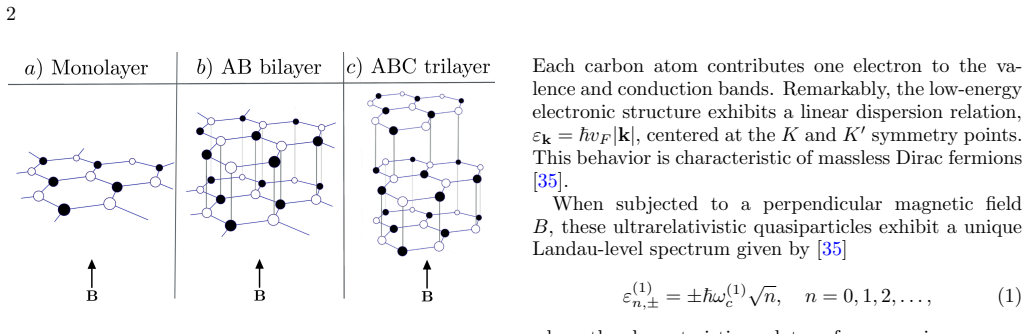
Landau Level Spectrum of Monolayer Graphene Monolayer graphene is a single layer ofsp 2-hybridized carbon atoms arranged in a two-dimensional honeycomb lattice. The primitive unit cell of this structure contains two inequivalent sites, A and B, corresponding to the filled and empty circles in Fig. 1(a). The correspond- ing reciprocal lattice is also honey...
-
[2]
Landau Level Spectrum of AB-Stacked Bilayer Graphene In AB-stacked bilayer graphene, shown in Fig. 1(b), the low-energy excitations correspond to massive chiral quasiparticles, whose pseudospin is locked to the momen- tum orientation due to the interlayer coupling. Under the application of a perpendicular magnetic fieldB, their cor- responding Landau leve...
-
[3]
Landau Level Spectrum of ABC-Stacked Trilayer Graphene In ABC-stacked (rhombohedral) trilayer graphene, shown in Fig. 1(c), the low-energy bands follow a cubic dispersionE∝k 3, in contrast to the linear and quadratic cases discussed previously. Under a perpendicular mag- netic fieldB, the Landau levels are given by [51] ε(3) n,± =±ℏω (3) c p n(n−1)(n−2), ...
-
[4]
5, con- sists of four strokes: two isothermal and two isomagnetic processes
Quantum Stirling Cycle The quantum Stirling cycle, illustrated in Fig. 5, con- sists of four strokes: two isothermal and two isomagnetic processes. In this framework, the perpendicular magnetic fieldBacts as the external control parameter, while the working substance is assumed to remain in thermal equi- librium with the reservoirs during all stages of th...
-
[5]
S. Vinjanampathy and J. Anders, Quantum thermody- namics, Contemporary Physics57, 545 (2016)
work page 2016
-
[6]
Kosloff, Quantum thermodynamics: A dynamical viewpoint, Entropy15, 2100 (2013)
R. Kosloff, Quantum thermodynamics: A dynamical viewpoint, Entropy15, 2100 (2013)
work page 2013
-
[7]
S. Deffner and S. Campbell,Quantum Thermodynamics: An Introduction to the Thermodynamics of Quantum In- formation(Morgan & Claypool Publishers, 2019)
work page 2019
-
[8]
J. Millen and A. Xuereb, Perspective on quantum ther- modynamics, New J. Phys.18, 011002 (2016)
work page 2016
- [9]
- [10]
-
[11]
N. M. Myers, O. Abah, and S. Deffner, Quantum thermo- dynamic devices: From theoretical proposals to experi- mental reality, AVS Quantum Science4, 027101 (2022)
work page 2022
-
[12]
G. L. Zanin, T. Haffner, M. A. A. Talarico, E. I. Duzzioni, P. H. Souto Ribeiro, G. T. Landi, and L. C. Celeri, Ex- perimental quantum thermodynamics with linear optics, Braz. J. Phys.49, 783 (2019)
work page 2019
-
[13]
C. H. S. Vieira, J. L. D. de Oliveira, J. F. G. Santos, P. R. Dieguez, and R. M. Serra, Exploring quantum thermody- namics with NMR, J. Magn. Reson. Open16-17, 100105 (2023)
work page 2023
-
[14]
G. De Chiara, G. Landi, A. Hewgill, B. Reid, A. Ferraro, A. J. Roncaglia, and M. Antezza, Reconciliation of quan- tum local master equations with thermodynamics, New J. Phys.20, 113024 (2018)
work page 2018
-
[15]
B. Castorene, F. J. Pe˜ na, A. Norambuena, S. E. Ulloa, C. Araya, and P. Vargas, Entropy, entanglement, and susceptibility of three qubits near quantum criticality, Phys. Rev. E111, 034118 (2025)
work page 2025
-
[16]
G. Ford and R. O’Connell, Entropy of a quan- tum oscillator coupled to a heat bath and implica- tions for quantum thermodynamics, PHYSICA E-LOW- DIMENSIONAL SYSTEMS & NANOSTRUCTURES 29, 82 (2005), international Conference on Frontiers of Quantum and Mesoscopic Thermodynamics (FQMT04), Prague, CZECH REPUBLIC, JUL 26-29, 2004
work page 2005
-
[17]
P. Liuzzo-Scorpo, L. A. Correa, R. Schmidt, and G. Adesso, Thermodynamics of quantum feedback cool- ing, ENTROPY18, 48 (2016)
work page 2016
-
[18]
C. Syros, Quantum thermodynamics -: H-theorem and the second law, LETTERS IN MATHEMATICAL PHYSICS50, 29 (1999)
work page 1999
-
[19]
F. Brandao, M. Horodecki, N. Ng, J. Oppenheim, and S. Wehner, The second laws of quantum thermodynam- ics, PROCEEDINGS OF THE NATIONAL ACADEMY OF SCIENCES OF THE UNITED STATES OF AMER- ICA112, 3275 (2015)
work page 2015
-
[20]
H. Saygin and A. Sisman, Quantum degeneracy effect on the work output from a Stirling cycle, J. Appl. Phys.90, 3086 (2001)
work page 2001
-
[21]
A. Sisman and H. Saygin, Efficiency analysis of a Stirling power cycle under quantum degeneracy conditions, Phys. Scr.63, 263 (2001)
work page 2001
-
[22]
C. Cruz, H.-R. Rastegar-Sedehi, M. F. Anka, T. R. de Oliveira, and M. Reis, Quantum Stirling engine based on dinuclear metal complexes, Quantum Science and Technology8, 035010 (2023)
work page 2023
-
[23]
S. H. Raja, S. Maniscalco, G.-S. Paraoanu, J. P. Pekola, and N. Lo Gullo, Finite-time quantum Stirling heat en- gine, New J. Phys.23, 033034 (2021)
work page 2021
-
[24]
S. Cakmak and H. R. R. Sedehi, Construction of a quan- tum Stirling engine cycle tuned by dynamic-angle spin- ning, Phys. Scr.98, 105921 (2023)
work page 2023
-
[25]
B. Castorene, F. J. Pena, A. Norambuena, S. E. Ul- loa, C. Araya, and P. Vargas, Effects of magnetic anisotropy on three-qubit antiferromagnetic thermal ma- 13 chines, Phys. Rev. E110, 044135 (2024)
work page 2024
-
[26]
Y. Yin, L. Chen, and F. Wu, Performance of quantum stirling heat engine with numerous copies of extreme rela- tivistic particles confined in 1d potential well, PHYSICA A-STATISTICAL MECHANICS AND ITS APPLICA- TIONS503, 58 (2018)
work page 2018
-
[27]
N. Papadatos, Quantum stirling heat engine with squeezed thermal reservoir, CHINESE PHYSICS B32, 100702 (2023)
work page 2023
-
[28]
F. Wu, L. Chen, F. Sun, C. Wu, and Y. Zhu, Perfor- mance and optimization criteria for forward and reverse quantum stirling cycles, ENERGY CONVERSION AND MANAGEMENT39, 733 (1998)
work page 1998
-
[29]
H.-R. Rastegar-Sedehi, N. Papadatos, and C. Cruz, Uni- versal quantum stirling-like engine under squeezed ther- mal baths, EUROPEAN PHYSICAL JOURNAL PLUS 140, 199 (2025)
work page 2025
- [30]
-
[31]
S. Xia, M. Lv, Y. Pan, J. Chen, and S. Su, Performance improvement of a fractional quantum stirling heat en- gine, JOURNAL OF APPLIED PHYSICS135, 034302 (2024)
work page 2024
-
[32]
P. D. Li, G. Y. Ding, J. Q. Zhang, Q. Yuan, S. Q. Dai, T. H. Cui, F. Zhou, L. Chen, Q. Zhong, H. Jing, S. K. Ozdemir, and M. Feng, Experimental demonstration of single-spin Stirling engine cycles with enhanced efficiency, Phys. Rev. A111, L010203 (2025)
work page 2025
- [33]
-
[34]
S. Chatterjee, A. Koner, S. Chatterjee, and C. Kumar, Temperature-dependent maximization of work and effi- ciency in a degeneracy-assisted quantum stirling heat en- gine, Phys. Rev. E103, 062109 (2021)
work page 2021
-
[35]
H. W. Zhang, X. L. Huang, and S. L. Wu, Quantum heat engine with identical particles and level degeneracy, IN- TERNATIONAL JOURNAL OF MODERN PHYSICS B38, 10.1142/S0217979224501091 (2024)
-
[36]
S. Koyanagi and Y. Tanimura, Thermodynamic quan- tum fokker-planck equations and their application to thermostatic stirling engine, JOURNAL OF CHEMICAL PHYSICS161, 112501 (2024)
work page 2024
-
[37]
F. J. Pe˜ na, O. Negrete, G. Alvarado-Barrios, D. Zam- brano, A. Gonz´ alez, A. S. Nunez, P. A. Orellana, and P. Vargas, Magnetic Otto engine for an electron in a quantum dot: Classical and quantum approach, Entropy 21, 512 (2019)
work page 2019
-
[38]
Deffner, Efficiency of harmonic quantum Otto engines at maximal power, Entropy20, 875 (2018)
S. Deffner, Efficiency of harmonic quantum Otto engines at maximal power, Entropy20, 875 (2018)
work page 2018
-
[39]
A. H. Castro Neto, F. Guinea, N. M. Peres, K. S. Novoselov, and A. K. Geim, The electronic properties of graphene, Rev. Mod. Phys.81, 109 (2009)
work page 2009
-
[40]
M. O. Goerbig, Electronic properties of graphene in a strong magnetic field, Rev. Mod. Phys.83, 1193 (2011)
work page 2011
-
[41]
E. McCann and V. I. Fal’ko, Landau-level degeneracy and quantum Hall effect in a graphite bilayer, Phys. Rev. Lett.96, 086805 (2006)
work page 2006
- [42]
-
[43]
S. Yuan, R. Rold´ an, and M. I. Katsnelson, Landau level spectrum of ABA- and ABC-stacked trilayer graphene, Phys. Rev. B84, 125455 (2011)
work page 2011
-
[44]
A. Mani, S. Pal, and C. Benjamin, Designing a highly efficient graphene quantum spin heat engine, Scientific Reports9, 6018 (2019)
work page 2019
-
[45]
A. Singh and C. Benjamin, Magic angle twisted bilayer graphene as a highly efficient quantum Otto engine, Phys. Rev. B104, 125445 (2021)
work page 2021
-
[46]
N. M. Myers, F. J. Pe˜ na, N. Cort´ es, and P. Vargas, Mul- tilayer graphene as an endoreversible Otto engine, Nano- materials13, 1548 (2023)
work page 2023
-
[47]
M. Koshino and T. Ando, Magneto-optical properties of multilayer graphene, Phys. Rev. B77, 115313 (2008)
work page 2008
-
[48]
M. Nakamura and L. Hirasawa, Electric transport and magnetic properties in multilayer graphene, Phys. Rev. B77, 045429 (2008)
work page 2008
-
[49]
V. Ghai, S. Pashazadeh, H. Ruan, and R. Kadar, Orientation of graphene nanosheets in magnetic fields, PROGRESS IN MATERIALS SCIENCE143, 101251 (2024)
work page 2024
-
[50]
F. P. Riffo, S. Vizcaya, E. Menendez-Proupin, J. M. Flo- rez, L. Chico, and E. S. Morell, Behavior of localized states in double twisted ABC trilayer graphene, Carbon 222, 118952 (2024)
work page 2024
-
[51]
P. Rickhaus, M. Weiss, L. Marot, and C. Schoenenberger, Quantum Hall effect in graphene with superconducting electrodes, Nano Lett.12, 1942 (2012)
work page 1942
- [52]
-
[53]
D. Valenzuela, S. Hernandez-Ortiz, M. Loewe, and A. Raya, Graphene transparency in weak magnetic fields, JOURNAL OF PHYSICS A-MATHEMATICAL AND THEORETICAL48, 065402 (2015)
work page 2015
-
[54]
F. Peng, Magnetic moment of phonons in graphene in- duced by a magnetic field, PHYSICA B-CONDENSED MATTER406, 2107 (2011)
work page 2011
-
[55]
W. Bao, L. Jing, J. Velasco Jr, Y. Lee, G. Liu, D. Tran, B. Standley, M. Aykol, S. Cronin, D. Smirnov,et al., Stacking-dependent band gap and quantum transport in trilayer graphene, Nat. Phys.7, 948 (2011)
work page 2011
-
[56]
M. Josefsson, A. Svilans, A. M. Burke, E. A. Hoffmann, S. Fahlvik, C. Thelander, M. Leijnse, and H. Linke, A quantum-dot heat engine operating close to the ther- modynamic efficiency limits, Nature Nanotechnology13, 920 (2018)
work page 2018
-
[57]
M. Josefsson and M. Leijnse, Double quantum-dot engine fueled by entanglement between electron spins, Phys. Rev. B101, 081408 (2020)
work page 2020
-
[58]
P. A. Erdman, F. Mazza, R. Bosisio, G. Benenti, R. Fazio, and F. Taddei, Thermoelectric properties of an interacting quantum dot based heat engine, Phys. Rev. B95, 245432 (2017)
work page 2017
-
[59]
M. Josefsson, A. Svilans, H. Linke, and M. Leijnse, Opti- mal power and efficiency of single quantum dot heat en- gines: Theory and experiment, Phys. Rev. B99, 235432 (2019)
work page 2019
-
[60]
O. Arroyo-Gascon, R. Fernandez-Perea, E. S. Morell, C. Cabrillo, and L. Chico, Universality of moir´ e physics in collapsed chiral carbon nanotubes, Carbon205, 394 (2023)
work page 2023
-
[61]
N. G. Kalugin, L. Jing, E. Suarez Morell, G. C. Dyer, L. Wickey, M. Ovezmyradov, A. D. Grine, M. C. Wanke, 14 E. A. Shaner, C. N. Lau, L. E. F. Foa Torres, M. V. Fis- tul, and K. B. Efetov, Photoelectric polarization-sensitive broadband photoresponse from interface junction states in graphene, 2D MATERIALS4, 015002 (2017)
work page 2017
-
[62]
M. Pelc, E. Suarez Morell, L. Brey, and L. Chico, Elec- tronic conductance of twisted bilayer nanoribbon flakes, JOURNAL OF PHYSICAL CHEMISTRY C119, 10076 (2015)
work page 2015
-
[63]
E. Suarez Morell and L. E. F. Foa Torres, Radiation effects on the electronic properties of bilayer graphene, Phys. Rev. B86, 125449 (2012)
work page 2012
-
[64]
M. Esposito, R. Kawai, K. Lindenberg, and C. Van den Broeck, Quantum-dot Carnot engine at maximum power, Phys. Rev. E81, 041106 (2010)
work page 2010
- [65]
-
[66]
J. Du, W. Shen, X. Zhang, S. Su, and J. Chen, Quantum- dot heat engines with irreversible heat transfer, Phys. Rev. Research2, 013259 (2020)
work page 2020
-
[67]
F. J. Pe˜ na, D. Zambrano, O. Negrete, G. De Chiara, P. A. Orellana, and P. Vargas, Quasistatic and quantum- adiabatic Otto engine for a two-dimensional material: The case of a graphene quantum dot, Phys. Rev. E101, 012116 (2020)
work page 2020
-
[68]
M. Koshino and T. Ando, Quantum Hall effect in graphene, INTERNATIONAL JOURNAL OF MOD- ERN PHYSICS B21, 1140 (2007)
work page 2007
-
[69]
Jellal, Integer quantum Hall effect in graphene, Phys
A. Jellal, Integer quantum Hall effect in graphene, Phys. Lett. A380, 1514 (2016)
work page 2016
-
[70]
H.-R. Rastegar-Sedehi and C. Cruz, Exploring entangle- ment effects in a quantum Stirling heat engine, Phys. Scr. 99, 125936 (2024)
work page 2024
-
[71]
B. Castorene, V. G. de Paula, F. J. Pena, C. Cruz, M. Reis, and P. Vargas, Quantum level-crossing induced by anisotropy in spin-1 heisenberg dimers: Applications to quantum stirling engines, ADVANCED QUANTUM TECHNOLOGIES 10.1002/qute.202500204 (2025)
-
[72]
H. R. Rastegar-Sedehi and C. Cruz, Entangled quantum stirling heat engine based on two particles heisenberg model with dzyaloshinskii-moriya interaction, FRON- TIERS IN PHYSICS13, 1512998 (2025)
work page 2025
-
[73]
G. Behrendt and S. Deffner, Endoreversible stirling cy- cles: Plasma engines at maximal power, ENTROPY27, 807 (2025)
work page 2025
discussion (0)
Sign in with ORCID, Apple, or X to comment. Anyone can read and Pith papers without signing in.