Probing Hidden Symmetry and Altermagnetism with Sub-Picometer Sensitivity via Nonlinear Transport
Pith reviewed 2026-05-18 05:26 UTC · model grok-4.3
The pith
Nonlinear transport detects a 0.1 picometer lattice distortion that transforms a conventional antiferromagnet into an altermagnet below 48 K.
A machine-rendered reading of the paper's core claim, the machinery that carries it, and where it could break.
Core claim
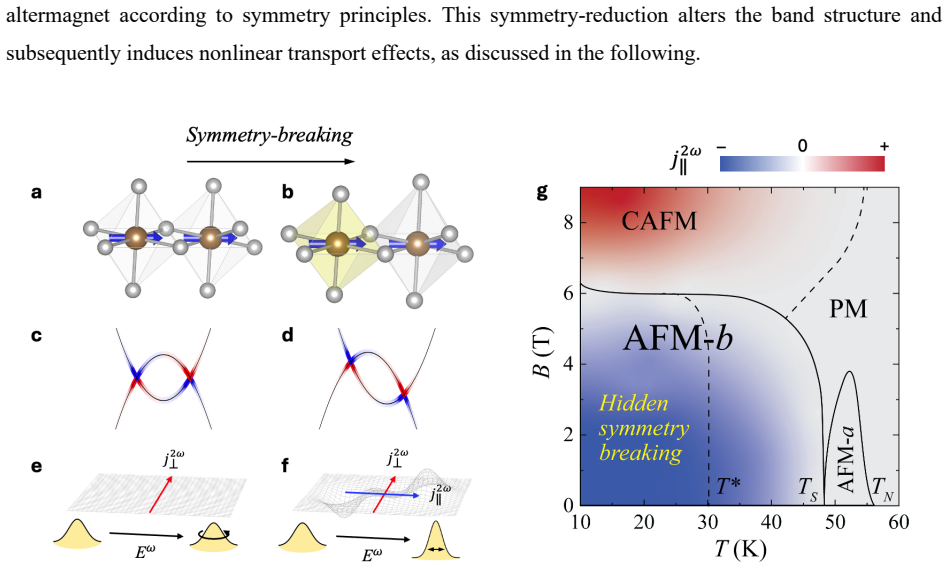
Below the structural transition temperature TS of 48 K, where the antiferromagnetic moments reorient along the b-axis, a lower-symmetry phase appears in Ca3Ru2O7. This phase is revealed by the onset of longitudinal nonlinear resistance along the b-axis, which directly evidences the simultaneous breaking of translational and time-reversal symmetries. The data, backed by density functional theory calculations, point to a subtle lattice distortion of about 0.1 pm as the origin of this phase, which conventional diffraction cannot resolve. The nonlinear transport signals suggest that the material has become an altermagnet, with the response strengthened by the large quantum metric associated with
What carries the argument
Longitudinal nonlinear resistance along the b-axis, which acts as a signature of the combined symmetry breaking that defines the altermagnetic phase arising from the sub-picometer lattice distortion.
Load-bearing premise
The nonlinear transport signals below TS originate from the intrinsic lower-symmetry altermagnetic phase induced by the lattice distortion, and not from extrinsic sources such as magnetic domain walls or experimental artifacts.
What would settle it
Observing the same NLR signal in a sample engineered to lack the magnetic reorientation at TS, or failing to detect any NLR in high-quality samples where the distortion is independently confirmed absent, would indicate that the signals do not reliably track the proposed symmetry breaking.
Figures


read the original abstract
X-ray and neutron diffraction are foundational tools for determining crystal structures, but their resolution limits can lead to misassignments, especially in materials with subtle distortions or competing phases. Here, we demonstrate the use of nonlinear transport as a complementary approach to uncover hidden crystal symmetries, using the strongly correlated Ca$_3$Ru$_2$O$_7$ as a case study. Below 48 K (T$_S$), where the magnetic moments of the antiferromagnetic phase reorient from the a- to the b-axis, leading to a pseudogap opening, our measurements, with support of DFT, reveal a previously overlooked lower-symmetry phase. This is manifested by the emergence of longitudinal nonlinear resistance (NLR) along the b-axis below T$_S$, providing direct evidence of combined translational and time-reversal symmetry breaking. This response also suggests a transformation from a conventional antiferromagnet into an altermagnet. The lower-symmetry phase arises from a subtle lattice distortion (~0.1 pm) associated with the magnetic transition at T$_S$, below the detection limit of conventional diffraction. Moreover, this NLR below T$_S$ is accompanied by a nonlinear Hall effect, both of which are enhanced by the large quantum metric associated with Weyl chains near the Fermi surface. Our findings demonstrate nonlinear transport as a sensitive probe of hidden symmetry breaking and altermagnetism, complementing and extending beyond the reach of traditional diffraction and spectroscopic techniques.
Editorial analysis
A structured set of objections, weighed in public.
Referee Report
Summary. The paper reports nonlinear transport measurements on the strongly correlated antiferromagnet Ca3Ru2O7. It claims that below T_S = 48 K, where magnetic moments reorient from the a- to b-axis and a pseudogap opens, a previously undetected lower-symmetry phase emerges due to a ~0.1 pm lattice distortion. This phase is said to break combined translational and time-reversal symmetry, transforming the system into an altermagnet. The key signatures are the onset of longitudinal nonlinear resistance (NLR) along the b-axis and an accompanying nonlinear Hall effect, both enhanced by the quantum metric of Weyl chains near the Fermi surface. DFT calculations are invoked to support the distortion and symmetry analysis, positioning nonlinear transport as a sub-picometer-sensitive probe complementary to diffraction.
Significance. If the interpretive link between the observed NLR and intrinsic altermagnetic symmetry breaking holds after artifact exclusion, the result would demonstrate nonlinear transport as a sensitive tool for detecting hidden symmetry breaking and subtle structural distortions in correlated magnets, potentially extending the reach of conventional diffraction methods. The approach could be broadly applicable to other materials with competing phases or altermagnetic candidates.
major comments (2)
- [Abstract] Abstract and main text (strongest claim paragraph): The assertion that b-axis NLR below T_S constitutes 'direct evidence' of combined translational + TR symmetry breaking in an altermagnetic phase induced by the ~0.1 pm distortion is load-bearing for the central claim. However, the manuscript provides no explicit experimental tests, modeling, or symmetry analysis to exclude extrinsic sources such as domain walls between reoriented AFM domains, inhomogeneous current flow at contacts, or heating-induced nonlinearities. Without these, the attribution remains interpretive rather than demonstrated.
- [DFT support] DFT support section: The manuscript invokes DFT to corroborate the lattice distortion and altermagnetic character, but does not demonstrate that the calculations quantitatively predict the observed NLR magnitude, polarity, or temperature onset independently of the transport data. This leaves open the possibility that the modeling parameters are tuned to the transport observations, weakening the claim of a parameter-free or falsifiable link between the 0.1 pm distortion and the nonlinear signals.
minor comments (2)
- [Abstract] The abstract and introduction would benefit from clearer statements of the error bars, raw data traces, and exclusion criteria used for the NLR measurements to allow readers to assess robustness directly.
- [Methods/Results] Notation for the nonlinear resistance and Hall signals should be defined consistently with standard conventions in the field (e.g., distinguishing second-harmonic components explicitly) to improve readability for non-specialists.
Simulated Author's Rebuttal
We thank the referee for the careful and constructive review of our manuscript. We address each major comment in detail below, providing clarifications on our existing evidence while outlining specific revisions to strengthen the presentation and address concerns about artifact exclusion and the independence of the DFT analysis.
read point-by-point responses
-
Referee: [Abstract] Abstract and main text (strongest claim paragraph): The assertion that b-axis NLR below T_S constitutes 'direct evidence' of combined translational + TR symmetry breaking in an altermagnetic phase induced by the ~0.1 pm distortion is load-bearing for the central claim. However, the manuscript provides no explicit experimental tests, modeling, or symmetry analysis to exclude extrinsic sources such as domain walls between reoriented AFM domains, inhomogeneous current flow at contacts, or heating-induced nonlinearities. Without these, the attribution remains interpretive rather than demonstrated.
Authors: We appreciate the referee's call for more explicit exclusion of extrinsic effects. The manuscript already ties the NLR onset sharply to T_S, restricts it to the b-axis (matching the symmetry lowering), and correlates it with the nonlinear Hall effect enhanced by the quantum metric of Weyl chains. DFT symmetry analysis further supports that the ~0.1 pm distortion enables the combined translational and time-reversal symmetry breaking required for altermagnetism. To make this more robust, we will add a dedicated subsection in the revised manuscript that explicitly discusses and bounds potential artifacts: current-dependent measurements to limit Joule heating, symmetry arguments showing domain walls between reoriented AFM domains cannot account for the observed NLR polarity or quantum-metric enhancement, and checks confirming homogeneous current distribution at the contacts. These additions will render the intrinsic attribution more explicit without altering the central conclusions. revision: yes
-
Referee: [DFT support] DFT support section: The manuscript invokes DFT to corroborate the lattice distortion and altermagnetic character, but does not demonstrate that the calculations quantitatively predict the observed NLR magnitude, polarity, or temperature onset independently of the transport data. This leaves open the possibility that the modeling parameters are tuned to the transport observations, weakening the claim of a parameter-free or falsifiable link between the 0.1 pm distortion and the nonlinear signals.
Authors: We thank the referee for raising this point on the independence of the theoretical support. The DFT calculations employed standard functionals and relaxation protocols chosen prior to and independently of the transport measurements; their main results are the predicted ~0.1 pm distortion and the associated symmetry reduction that permits altermagnetic order and quantum-metric-driven nonlinear responses. The temperature scale is anchored to the experimentally known magnetic reorientation at T_S rather than fitted to the NLR data. A fully quantitative first-principles prediction of NLR magnitude remains computationally demanding, but the calculations provide a falsifiable symmetry-based mechanism. In revision we will expand the methods and results sections to document the computational parameters in greater detail, explicitly state their independence from transport observations, and clarify the qualitative nature of the magnitude comparison while retaining the symmetry predictions as the core link. revision: partial
Circularity Check
No significant circularity: experimental NLR observation interpreted via standard symmetry analysis and external DFT support
full rationale
The paper's central chain rests on direct experimental detection of longitudinal NLR and nonlinear Hall signals below TS, linked to a magnetic reorientation and a proposed ~0.1 pm lattice distortion. This is supported by DFT calculations whose role is to confirm the existence of the distortion and associated symmetry lowering, not to fit transport parameters. The interpretation that NLR signals combined translational + TR symmetry breaking (and thereby altermagnetism) follows from the established definition of altermagnetism in the broader literature rather than from any self-referential loop or fitted-input prediction within the manuscript. No equations, self-citations, or ansatzes are shown to reduce the claimed evidence to the input data by construction. The derivation therefore remains self-contained against external benchmarks.
Axiom & Free-Parameter Ledger
axioms (1)
- domain assumption DFT calculations accurately capture the electronic structure and quantum metric near the Fermi surface in Ca3Ru2O7
Lean theorems connected to this paper
-
IndisputableMonolith/Foundation/AlexanderDuality.leanalexander_duality_circle_linking unclear?
unclearRelation between the paper passage and the cited Recognition theorem.
emergence of longitudinal nonlinear resistance (NLR) along the b-axis below TS, providing direct evidence of combined translational and time-reversal symmetry breaking... subtle lattice distortion (~0.1 pm)
-
IndisputableMonolith/Cost/FunctionalEquation.leanwashburn_uniqueness_aczel unclear?
unclearRelation between the paper passage and the cited Recognition theorem.
Weyl chains... quantum metric dipole (QMD)... Table 1 Symmetry constrained second-order conductivity tensors
What do these tags mean?
- matches
- The paper's claim is directly supported by a theorem in the formal canon.
- supports
- The theorem supports part of the paper's argument, but the paper may add assumptions or extra steps.
- extends
- The paper goes beyond the formal theorem; the theorem is a base layer rather than the whole result.
- uses
- The paper appears to rely on the theorem as machinery.
- contradicts
- The paper's claim conflicts with a theorem or certificate in the canon.
- unclear
- Pith found a possible connection, but the passage is too broad, indirect, or ambiguous to say the theorem truly supports the claim.
Reference graph
Works this paper leans on
-
[1]
Vojta, M. Quantum phase transitions. Reports on Progress in Physics 66, 2069 (2003)
work page 2069
-
[2]
Liu, J. et al. Nearly massless Dirac fermions hosted by Sb square net in BaMnSb2. Sci Rep 6, 30525 (2016)
work page 2016
-
[3]
Cordier, G. & Schäfer, H. Darstellung und Kristallstruktur von BaMnSb2, SrMnBi2 und BaMnBi2 / Preparation and Crystal Structure of BaMnSb2, SrMnBi2 and BaMnBi2. Zeitschrift für Naturforschung B 32, 383–386 (1977)
work page 1977
-
[4]
Liu, J. Y. et al. Spin-valley locking and bulk quantum Hall effect in a noncentrosymmetric Dirac semimetal BaMnSb2. Nature Communications 12, 4062 (2021)
work page 2021
-
[5]
Min, L. et al. Strong room-temperature bulk nonlinear Hall effect in a spin-valley locked Dirac material. Nature Communications 14, 364 (2023)
work page 2023
-
[6]
Ma, Q. et al. Observation of the nonlinear Hall effect under time-reversal-symmetric conditions. Nature 565, 337–342 (2019)
work page 2019
-
[7]
Kumar, D. et al. Room-temperature nonlinear Hall effect and wireless radiofrequency rectification in Weyl semimetal TaIrTe4. Nature Nanotechnology 16, 421–425 (2021)
work page 2021
- [8]
-
[9]
Ho, S.-C. et al. Hall effects in artificially corrugated bilayer graphene without breaking time-reversal symmetry. Nature Electronics 4, 116–125 (2021)
work page 2021
-
[10]
Dzsaber, S. et al. Giant spontaneous Hall effect in a nonmagnetic Weyl–Kondo semimetal. Proceedings of the National Academy of Sciences 118, e2013386118 (2021)
work page 2021
-
[11]
He, P. et al. Quantum frequency doubling in the topological insulator Bi2Se3. Nature Communications 12, 698 (2021)
work page 2021
-
[12]
Zhang, C.-L., Liang, T., Kaneko, Y., Nagaosa, N. & Tokura, Y. Giant Berry curvature dipole density in a ferroelectric Weyl semimetal. npj Quantum Mater. 7, 1–6 (2022)
work page 2022
-
[13]
Lu, X. F. et al. Nonlinear transport and radio frequency rectification in BiTeBr at room temperature. Nature Communications 15, 245 (2024)
work page 2024
- [14]
-
[15]
Cao, G., Balicas, L., Xin, Y., Crow, J. E. & Nelson, C. S. Quantum oscillations, colossal magnetoresistance, and the magnetoelastic interaction in bilayered Ca3Ru2O7. Phys. Rev. B 67, 184405 (2003)
work page 2003
-
[16]
Cao, G. et al. Tunneling magnetoresistance and quantum oscillations in bilayered Ca3Ru2O7. Phys. Rev. B 67, 060406 (2003)
work page 2003
-
[17]
Lin, X. N., Zhou, Z. X., Durairaj, V., Schlottmann, P. & Cao, G. Colossal Magnetoresistance by Avoiding a Ferromagnetic State in the Mott System Ca3Ru2O7. Phys. Rev. Lett. 95, 017203 (2005)
work page 2005
-
[18]
Faure, Q. et al. Magnetic structure and field dependence of the cycloid phase mediating the spin reorientation transition in Ca3Ru2O7. Phys. Rev. Res. 5, 013040 (2023)
work page 2023
-
[19]
Sokolov, D. A. et al. Metamagnetic texture in a polar antiferromagnet. Nat. Phys. 15, 671–677 (2019)
work page 2019
-
[20]
Marković, I. et al. Electronically driven spin-reorientation transition of the correlated polar metal Ca3Ru2O7. Proceedings of the National Academy of Sciences 117, 15524–15529 (2020)
work page 2020
-
[21]
Xing, H. et al. Existence of electron and hole pockets and partial gap opening in the correlated semimetal Ca3Ru2O7. Phys. Rev. B 97, 041113 (2018)
work page 2018
-
[22]
Horio, M. et al. Electronic reconstruction forming a C2-symmetric Dirac semimetal in Ca3Ru2O7. npj Quantum Mater. 6, 1–7 (2021)
work page 2021
-
[23]
Wang, H. (Hugo) et al. Strong electron-phonon coupling driven pseudogap modulation and density-wave fluctuations in a correlated polar metal. Nat Commun 14, 5769 (2023)
work page 2023
-
[24]
León, A. M., González, J. W. & Rosner, H. Ca3Ru2O7: Interplay among degrees of freedom and the role of the exchange correlation. Phys. Rev. Mater. 8, 024411 (2024)
work page 2024
- [25]
-
[26]
Puggioni, D., Horio, M., Chang, J. & Rondinelli, J. M. Cooperative interactions govern the fermiology of the polar metal Ca3Ru2O7. Phys. Rev. Res. 2, 023141 (2020)
work page 2020
-
[27]
Šmejkal, L., Sinova, J. & Jungwirth, T. Emerging Research Landscape of Altermagnetism. Phys. Rev. X 12, 040501 (2022)
work page 2022
-
[28]
Editorial: Altermagnetism—A New Punch Line of Fundamental Magnetism
Mazin, I. Editorial: Altermagnetism—A New Punch Line of Fundamental Magnetism. Phys. Rev. X 12, 040002 (2022)
work page 2022
- [29]
-
[30]
Gao, Y., Yang, S. A. & Niu, Q. Field Induced Positional Shift of Bloch Electrons and Its Dynamical Implications. Phys. Rev. Lett. 112, 166601 (2014)
work page 2014
-
[31]
Gao, A. et al. Quantum metric nonlinear Hall effect in a topological antiferromagnetic heterostructure. Science 381, 181–186 (2023)
work page 2023
-
[32]
Wang, N. et al. Quantum-metric-induced nonlinear transport in a topological antiferromagnet. Nature 621, 487–492 (2023)
work page 2023
- [33]
- [34]
-
[35]
Yoshida, Y. et al. Crystal and magnetic structure of Ca3Ru2O7. Phys. Rev. B 72, 054412 (2005)
work page 2005
-
[36]
Fobes, D., Peng, J., Qu, Z., Liu, T. J. & Mao, Z. Q. Magnetic phase transitions and bulk spin- valve effect tuned by in-plane field orientation in Ca3Ru2O7. Phys. Rev. B 84, 014406 (2011)
work page 2011
-
[37]
Sodemann, I. & Fu, L. Quantum Nonlinear Hall Effect Induced by Berry Curvature Dipole in Time-Reversal Invariant Materials. Phys. Rev. Lett. 115, 216806 (2015)
work page 2015
-
[38]
Das, L. et al. Two-carrier Magnetoresistance: Applications to Ca3Ru 2O7. J. Phys. Soc. Jpn. 90, 054702 (2021)
work page 2021
-
[39]
Puls, C. P. et al. Structural and metal-insulator transitions in ionic liquid-gated Ca3Ru2O7 surface. Applied Physics Letters 104, 253503 (2014)
work page 2014
-
[40]
Ishizuka, H. & Nagaosa, N. Anomalous electrical magnetochiral effect by chiral spin-cluster scattering. Nature Communications 11, 2986 (2020)
work page 2020
-
[41]
Atencia, R. B., Liu, S., Loh, K. P. & Culcer, D. Room-Temperature Disorder-Driven Nonlinear Transport in Topological Materials. Preprint at https://arxiv.org/abs/2506.13869 (2025)
-
[42]
Liu, S. et al. Room-temperature nonlinear transport and microwave rectification in antiferromagnetic MnBi2Te4 films. Communications Physics 7, 413 (2024)
work page 2024
- [43]
-
[44]
Huang, B. et al. Electrical control of 2D magnetism in bilayer CrI3. Nature Nanotechnology 13, 544–548 (2018)
work page 2018
-
[45]
Gao, A. et al. Layer Hall effect in a 2D topological axion antiferromagnet. Nature 595, 521–525 (2021)
work page 2021
-
[46]
Baumberger, F. et al. Nested Fermi Surface and Electronic Instability in Ca3Ru2O7. Phys. Rev. Lett. 96, 107601 (2006)
work page 2006
-
[47]
Fedchenko, O. et al. Observation of time-reversal symmetry breaking in the band structure of altermagnetic RuO2. Science Advances 10, eadj4883 (2024)
work page 2024
-
[48]
Reimers, S. et al. Direct observation of altermagnetic band splitting in CrSb thin films. Nature Communications 15, 2116 (2024)
work page 2024
-
[49]
Liu, J. et al. Absence of Altermagnetic Spin Splitting Character in Rutile Oxide RuO2. Phys. Rev. Lett. 133, 176401 (2024)
work page 2024
-
[50]
Krempaský, J. et al. Altermagnetic lifting of Kramers spin degeneracy. Nature 626, 517–522 (2024)
work page 2024
-
[51]
Zhu, Y.-P. et al. Observation of plaid-like spin splitting in a noncoplanar antiferromagnet. Nature 626, 523–528 (2024)
work page 2024
-
[52]
Jiang, B. et al. A metallic room-temperature d-wave altermagnet. Nat. Phys. 21, 754–759 (2025)
work page 2025
-
[53]
Min, L. et al. Colossal room-temperature non-reciprocal Hall effect. Nature Materials 23, 1671– 1677 (2024)
work page 2024
discussion (0)
Sign in with ORCID, Apple, or X to comment. Anyone can read and Pith papers without signing in.