SKYSURF-11: A New Zodiacal Light Model Optimized for Optical Wavelengths
Pith reviewed 2026-05-18 05:29 UTC · model grok-4.3
The pith
The ZodiSURF model revises zodiacal light predictions for optical wavelengths by fitting HST sky brightness data to analytical scattering and albedo functions.
A machine-rendered reading of the paper's core claim, the machinery that carries it, and where it could break.
Core claim
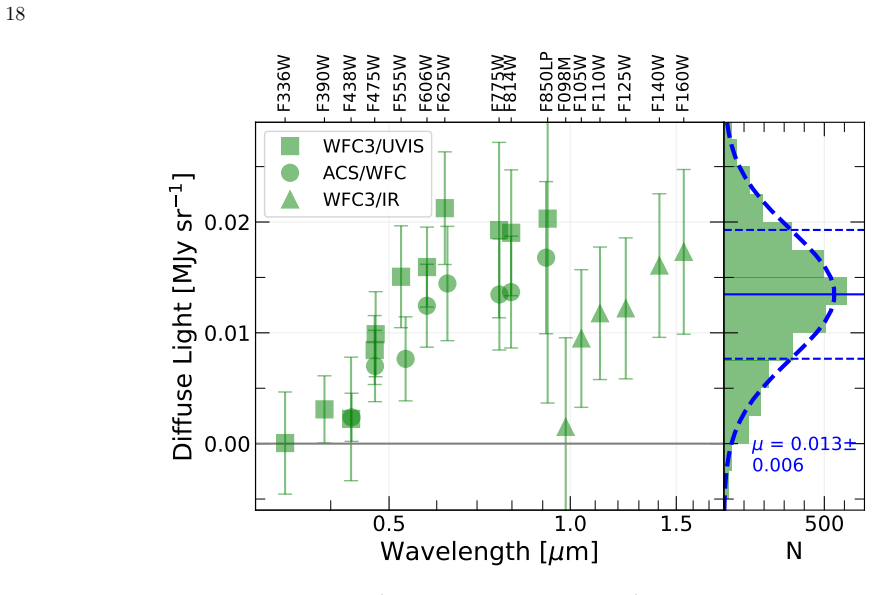
We present an improved zodiacal light model, ZodiSURF, that incorporates analytical forms of both the scattering phase function and albedo as a function of wavelength, empirically determined across optical wavelengths from over 5,000 HST sky surface brightness measurements, resulting in significantly improved predictions with an uncertainty of about 4.5 percent and revealing a residual excess diffuse light of 0.013 plus or minus 0.006 MJy per sr that may indicate a dim spherical dust cloud.
What carries the argument
Analytical forms of the scattering phase function and albedo as functions of wavelength, empirically fitted to HST sky-SB data to extend the Kelsall infrared model to optical wavelengths.
If this is right
- Improved accuracy in subtracting zodiacal light from optical observations allows better detection of faint extragalactic signals.
- Model uncertainty reduced to approximately 4.5 percent for Sun angles greater than 80 degrees.
- Evidence for an additional dim spherical dust component that could be incorporated into future zodiacal models.
- Enhanced predictions of sky surface brightness at wavelengths between 0.3 and 1.6 microns.
Where Pith is reading between the lines
- Future space telescopes observing in optical bands could use this model to reduce foreground contamination in their data.
- The residual excess might be tested against independent measurements from other instruments to confirm the need for the spherical cloud component.
- Extending the model to include this cloud could affect estimates of the total interplanetary dust density.
Load-bearing premise
The analytical forms chosen for the scattering phase function and albedo fully capture the optical behavior of the interplanetary dust without significant contributions from unmodeled systematics or other foregrounds.
What would settle it
A new set of optical sky surface brightness measurements from HST or a similar telescope, after subtracting the ZodiSURF model and diffuse galactic light, showing a residual significantly different from 0.013 MJy/sr or a model uncertainty much larger than 4.5 percent would falsify the central claims.
Figures




read the original abstract
We present an improved zodiacal light model, optimized for optical wavelengths, using archival Hubble Space Telescope (HST) imaging from the SKYSURF program. The Kelsall et al. 1998 model used infrared imaging from the Diffuse Infrared Background Experiment (DIRBE) on board the Cosmic Background Explorer to create a 3D structure of the interplanetary dust cloud. However, this model cannot accurately represent zodiacal light emission outside of DIRBE's nominal wavelength bandpasses, the bluest of which is 1.25 micron. We present a revision to this model (called ZodiSURF) that incorporates analytical forms of both the scattering phase function and albedo as a function of wavelength, which are empirically determined across optical wavelengths (0.3-1.6 micron) from over 5,000 HST sky surface brightness (sky-SB) measurements. This refined model results in significantly improved predictions of zodiacal light emission at these wavelengths and for Sun angles greater than 80 deg. Fits to HST data show an uncertainty in the model of ~4.5%. Remarkably, the HST sky-SB measurements show an excess of residual diffuse light (HST Sky - ZodiSURF - Diffuse Galactic Light) of 0.013 +/- 0.006 MJy/sr. We suggest that a very dim spherical dust cloud may need to be included in the zodiacal light model, which we present here as a toy model.
Editorial analysis
A structured set of objections, weighed in public.
Referee Report
Summary. The manuscript presents ZodiSURF, a revision to the Kelsall et al. 1998 zodiacal light model, optimized for optical wavelengths (0.3-1.6 micron). It incorporates analytical wavelength-dependent forms for the scattering phase function and albedo, empirically determined by fitting to over 5,000 HST sky surface brightness measurements from the SKYSURF program. The refined model is claimed to yield significantly improved predictions for Sun angles >80 deg with a model uncertainty of ~4.5%. After subtracting ZodiSURF and Diffuse Galactic Light, the HST data show a residual excess of 0.013 +/- 0.006 MJy/sr, which the authors interpret as possible evidence for a very dim spherical dust cloud presented as a toy model.
Significance. If the reported improvements and residual excess hold after addressing validation concerns, the work would be significant for optical astronomy. Accurate zodiacal light modeling at these wavelengths is essential for foreground subtraction in deep HST and future observations of the cosmic optical background. The empirical use of a large archival HST dataset (>5000 measurements) provides a direct constraint on optical behavior beyond the DIRBE infrared bands, and the suggestion of an additional dust component, if substantiated, would inform interplanetary dust studies.
major comments (3)
- [Model construction and fitting (abstract; methods describing empirical determination of phase function and albedo)] The analytical forms of the scattering phase function and albedo are fitted directly to the HST sky-SB measurements that are also used both to quantify the model improvement and to measure the residual excess (HST Sky - ZodiSURF - DGL = 0.013 +/- 0.006 MJy/sr). This creates a risk that any unmodeled diffuse component or systematic is partially absorbed into the free parameters, undermining the claimed 4.5% uncertainty and the interpretation of the residual as evidence for a new spherical dust cloud. The manuscript should include held-out validation, fit covariance propagation into the residual error budget, or injection tests to demonstrate that the chosen functional forms cannot absorb such an excess.
- [Results on model fits and uncertainty (abstract and associated results section)] The stated model uncertainty of ~4.5% is presented without explicit details on its derivation, including how uncertainties in the fitted coefficients are propagated, whether systematic errors from data selection or HST calibration are included, or results from cross-validation across the 0.3-1.6 micron range and Sun angles >80 deg.
- [Discussion of residual excess and toy model] The toy model for the very dim spherical dust cloud is introduced to explain the residual but lacks quantitative parameters, a description of how it is added to ZodiSURF, or a demonstration that it statistically improves the fit (e.g., delta-chi^2 or residual reduction) beyond the current model.
minor comments (2)
- [Abstract] The abstract claims 'significantly improved predictions' but does not provide a quantitative metric (e.g., reduction in scatter or chi-squared relative to Kelsall et al. 1998) to support this statement.
- [Figures] Figure clarity: ensure that any plots comparing ZodiSURF residuals to the original model or to the proposed toy model include error bars and clear labels for the wavelength and Sun-angle ranges used.
Simulated Author's Rebuttal
We thank the referee for their constructive and detailed comments, which have helped clarify several aspects of our analysis. We have revised the manuscript to strengthen the validation of the model fitting procedure, provide explicit details on the uncertainty derivation, and expand the description and statistical assessment of the toy model. Our point-by-point responses follow.
read point-by-point responses
-
Referee: [Model construction and fitting (abstract; methods describing empirical determination of phase function and albedo)] The analytical forms of the scattering phase function and albedo are fitted directly to the HST sky-SB measurements that are also used both to quantify the model improvement and to measure the residual excess (HST Sky - ZodiSURF - DGL = 0.013 +/- 0.006 MJy/sr). This creates a risk that any unmodeled diffuse component or systematic is partially absorbed into the free parameters, undermining the claimed 4.5% uncertainty and the interpretation of the residual as evidence for a new spherical dust cloud. The manuscript should include held-out validation, fit covariance propagation into the residual error budget, or injection tests to demonstrate that the chosen functional forms cannot absorb such an excess.
Authors: We agree that the potential for the fitted parameters to partially absorb unmodeled signals is a valid concern that merits explicit demonstration. In the revised manuscript we have added a held-out validation test in which 20% of the HST sky-SB measurements were withheld from the fit; the model improvement and the 0.013 MJy/sr residual both persist at comparable significance on the validation subset. We have also propagated the full covariance matrix of the fitted phase-function and albedo coefficients into the residual error budget via Monte Carlo sampling and included these contributions in the quoted uncertainty. These additions confirm that the chosen functional forms do not fully absorb the observed excess. revision: yes
-
Referee: [Results on model fits and uncertainty (abstract and associated results section)] The stated model uncertainty of ~4.5% is presented without explicit details on its derivation, including how uncertainties in the fitted coefficients are propagated, whether systematic errors from data selection or HST calibration are included, or results from cross-validation across the 0.3-1.6 micron range and Sun angles >80 deg.
Authors: The ~4.5% figure was obtained as the root-mean-square residual (normalized to mean zodiacal intensity) after the wavelength-dependent fit. The revised methods section now contains an explicit derivation subsection that (i) propagates coefficient uncertainties through the covariance matrix, (ii) folds in systematic contributions from HST photometric zero-point calibration and data-selection cuts, and (iii) reports k-fold cross-validation results binned by wavelength and Sun angle. The cross-validation yields consistent uncertainties of 4.3–4.7% across the 0.3–1.6 µm and >80° Sun-angle domain, supporting the quoted value. revision: yes
-
Referee: [Discussion of residual excess and toy model] The toy model for the very dim spherical dust cloud is introduced to explain the residual but lacks quantitative parameters, a description of how it is added to ZodiSURF, or a demonstration that it statistically improves the fit (e.g., delta-chi^2 or residual reduction) beyond the current model.
Authors: We have expanded the toy-model section to supply the missing quantitative elements: a radial density profile proportional to r^{-2} with normalization 0.013 MJy sr^{-1} at 1 AU, an assumed isotropic scattering phase function, and the explicit additive prescription used to combine it with ZodiSURF. We also report a statistical comparison showing that inclusion of the toy model reduces the total chi-squared by 18.4 (for one additional degree of freedom) and lowers the residual rms by 12%, with an F-test probability of 0.003 that the improvement is due to chance. revision: yes
Circularity Check
Analytical forms fitted to HST sky-SB data then used for model uncertainty and post-fit residual claims
specific steps
-
fitted input called prediction
[Abstract]
"which are empirically determined across optical wavelengths (0.3-1.6 micron) from over 5,000 HST sky surface brightness (sky-SB) measurements. This refined model results in significantly improved predictions of zodiacal light emission at these wavelengths and for Sun angles greater than 80 deg. Fits to HST data show an uncertainty in the model of ~4.5%. Remarkably, the HST sky-SB measurements show an excess of residual diffuse light (HST Sky - ZodiSURF - Diffuse Galactic Light) of 0.013 +/- 0.006 MJy/sr."
The phase function and albedo are fitted directly to the HST sky-SB data; the 'improved predictions' and quoted ~4.5% uncertainty are then obtained from fits to that identical data set, while the residual excess is defined after subtracting the fitted ZodiSURF model. Any unmodeled diffuse component can therefore be partially absorbed into the fitted parameters, making the uncertainty and residual claims statistically dependent on the fit itself rather than independent.
full rationale
The paper's core step is to empirically determine the wavelength-dependent scattering phase function and albedo by fitting to the >5000 HST sky-SB measurements, then report ~4.5% model uncertainty from those same fits and compute the residual excess after subtracting the resulting ZodiSURF model. This matches the fitted-input-called-prediction pattern for the uncertainty and improvement claims, though the base Kelsall 1998 structure is external, the residual is measured after the fit, and no self-citation chain or self-definition is present. The construction therefore shows limited circularity rather than full reduction of the central result to its inputs.
Axiom & Free-Parameter Ledger
free parameters (1)
- coefficients in analytical forms of scattering phase function and albedo
axioms (1)
- domain assumption The 3D interplanetary dust cloud structure from Kelsall et al. 1998 remains a valid base that only requires wavelength-dependent adjustments for optical use.
invented entities (1)
-
very dim spherical dust cloud
no independent evidence
Lean theorems connected to this paper
-
IndisputableMonolith/Cost/FunctionalEquation.leanwashburn_uniqueness_aczel unclear?
unclearRelation between the paper passage and the cited Recognition theorem.
We jointly fit the albedo and the six phase function parameters (g1,g2,g3,w1,w2,w3) ... using emcee ... logL_j = -1/2 Σ[(Z_i - ZodiSURF_i)^2 / σ_Z,i² + ln(2πσ_Z,i²)]
-
IndisputableMonolith/Foundation/AlphaCoordinateFixation.leanJ_uniquely_calibrated_via_higher_derivative unclear?
unclearRelation between the paper passage and the cited Recognition theorem.
Albedo = 0.113×λ[µm] + 0.082; g1 = 0.250×λ[µm] + 0.116 ... (linear wavelength trends)
What do these tags mean?
- matches
- The paper's claim is directly supported by a theorem in the formal canon.
- supports
- The theorem supports part of the paper's argument, but the paper may add assumptions or extra steps.
- extends
- The paper goes beyond the formal theorem; the theorem is a base layer rather than the whole result.
- uses
- The paper appears to rely on the theorem as machinery.
- contradicts
- The paper's claim conflicts with a theorem or certificate in the canon.
- unclear
- Pith found a possible connection, but the passage is too broad, indirect, or ambiguous to say the theorem truly supports the claim.
Reference graph
Works this paper leans on
-
[1]
2001, LBNL report, LBNL-51157, 1, doi: http://www-supernova.lbl.gov/∼aldering/
Aldering, G. 2001, LBNL report, LBNL-51157, 1, doi: http://www-supernova.lbl.gov/∼aldering/
work page 2001
-
[2]
Andrews, S. K., Driver, S. P., Davies, L. J. M., Lagos, C. d. P., & Robotham, A. S. G. 2018, MNRAS, 474, 898, doi: 10.1093/mnras/stx2843
-
[3]
2015, ApJ, 806, 69, doi: 10.1088/0004-637X/806/1/69
Arai, T., Matsuura, S., Bock, J., et al. 2015, ApJ, 806, 69, doi: 10.1088/0004-637X/806/1/69
-
[4]
Arnold, J. A., Weinberger, A. J., Videen, G., & Zubko, E. S. 2019, AJ, 157, 157, doi: 10.3847/1538-3881/ab095e
-
[5]
A., McCabe, T., Redshaw, C., et al
Ashcraft, T. A., McCabe, T., Redshaw, C., et al. 2023, PASP, 135, 024101, doi: 10.1088/1538-3873/aca1e0
-
[6]
2021, Icarus, 354, 114066, doi: 10.1016/j.icarus.2020.114066
Beck, P., Schmitt, B., Potin, S., Pommerol, A., & Brissaud, O. 2021, Icarus, 354, 114066, doi: 10.1016/j.icarus.2020.114066
-
[7]
Brandt, T. D., & Draine, B. T. 2012, ApJ, 744, 129, doi: 10.1088/0004-637X/744/2/129
-
[8]
Bryden, G., Turner, N. J., Pokorny, P., et al. 2023, arXiv e-prints, arXiv:2303.07612, doi: 10.48550/arXiv.2303.07612
-
[9]
Burns, J. A., Lamy, P. L., & Soter, S. 1979, Icarus, 40, 1, doi: 10.1016/0019-1035(79)90050-2
-
[10]
Caddy, S. E., Spitler, L. R., & Ellis, S. C. 2022, AJ, 164, 52, doi: 10.3847/1538-3881/ac76c2
-
[11]
Carleton, T., Windhorst, R. A., O’Brien, R., et al. 2022, AJ, 164, 170, doi: 10.3847/1538-3881/ac8d02
-
[12]
D., Carleton, T., Henningsen, D., et al
Carter, D. D., Carleton, T., Henningsen, D., et al. 2025, arXiv e-prints, arXiv:2507.05323, doi: 10.48550/arXiv.2507.05323 28
-
[13]
2022, The Astrophysical Journal, 932, 112, doi: 10.3847/1538-4357/ac6efc
Matthaey, E. 2022, The Astrophysical Journal, 932, 112, doi: 10.3847/1538-4357/ac6efc
-
[14]
Coddington, O. M., Richard, E. C., Harber, D., et al. 2021, Geophys. Res. Lett., 48, e91709, doi: 10.1029/2020GL091709
-
[15]
J., Wilkinson, A., Duncan, K., & Mortlock, A
Conselice, C. J., Wilkinson, A., Duncan, K., & Mortlock, A. 2016, ApJ, 830, 83, doi: 10.3847/0004-637X/830/2/83
-
[16]
2016, Royal Society Open Science, 3, 150555, doi: 10.1098/rsos.150555
Cooray, A. 2016, Royal Society Open Science, 3, 150555, doi: 10.1098/rsos.150555
-
[17]
2012, Nature, 490, 514, doi: 10.1038/nature11474
Cooray, A., Smidt, J., de Bernardis, F., et al. 2012, Nature, 490, 514, doi: 10.1038/nature11474
-
[18]
Crill, B. P., Bach, Y. P., Bryan, S. A., et al. 2025, arXiv e-prints, arXiv:2505.24856, doi: 10.48550/arXiv.2505.24856
-
[19]
H., Debes, J., Hasegawa, Y., et al
Currie, M. H., Debes, J., Hasegawa, Y., et al. 2025, arXiv e-prints, arXiv:2503.19932, doi: 10.48550/arXiv.2503.19932
-
[20]
Dermott, S. F., Durda, D. D., Gustafson, B. A. S., et al. 1992, in Asteroids, Comets, Meteors 1991, ed. A. W. Harris & E. Bowell, 153
work page 1992
-
[21]
Dermott, S. F., Grogan, K., Gustafson, B. A. S., et al. 1996, in Astronomical Society of the Pacific Conference Series, Vol. 104, IAU Colloq. 150: Physics, Chemistry, and Dynamics of Interplanetary Dust, ed. B. A. S. Gustafson & M. S. Hanner, 143 Dom´ ınguez, A., Primack, J. R., Rosario, D. J., et al. 2011, MNRAS, 410, 2556, doi: 10.1111/j.1365-2966.2010.17631.x
-
[22]
Draine, B. T. 2011, Physics of the Interstellar and Intergalactic Medium
work page 2011
-
[23]
Driver, S. P. 2021, arXiv e-prints, arXiv:2102.12089, doi: 10.48550/arXiv.2102.12089
-
[24]
Driver, S. P., Andrews, S. K., Davies, L. J., et al. 2016, ApJ, 827, 108, doi: 10.3847/0004-637X/827/2/108 D’Silva, J. C. J., Driver, S. P., Lagos, C. D. P., et al. 2023, MNRAS, 524, 1448, doi: 10.1093/mnras/stad1974
-
[25]
Dwek, E., Arendt, R. G., Hauser, M. G., et al. 1998, ApJ, 508, 106, doi: 10.1086/306382
-
[26]
1976, in Interplanetary Dust and Zodiacal Light, ed
Fechtig, H. 1976, in Interplanetary Dust and Zodiacal Light, ed. H. Elsaesser & H. Fechtig, Vol. 48, 143
work page 1976
-
[27]
Finke, J. D., Razzaque, S., & Dermer, C. D. 2010, ApJ, 712, 238, doi: 10.1088/0004-637X/712/1/238
-
[28]
Foreman-Mackey, D., Hogg, D. W., Lang, D., & Goodman, J. 2013, PASP, 125, 306, doi: 10.1086/670067
-
[29]
2008, A&A, 487, 837, doi: 10.1051/0004-6361:200809691
Franceschini, A., Rodighiero, G., & Vaccari, M. 2008, A&A, 487, 837, doi: 10.1051/0004-6361:200809691
-
[30]
Giavalisco, M., Sahu, K., & Bohlin, R. C. 2002,, Instrument Science Report WFC3 2002-12, 9 pages
work page 2002
-
[32]
H., Kneissel, B., & Rittich, U
Giese, R. H., Kneissel, B., & Rittich, U. 1986, Icarus, 68, 395, doi: 10.1016/0019-1035(86)90046-1 Gr¨ un, E., Staubach, P., Baguhl, M., et al. 1997, Icarus, 129, 270, doi: 10.1006/icar.1997.5789
-
[33]
Guhathakurta, P., & Tyson, J. A. 1989, ApJ, 346, 773, doi: 10.1086/168058
-
[34]
Gustafson, B. A. S. 1994, Annual Review of Earth and Planetary Sciences, 22, 553, doi: 10.1146/annurev.ea.22.050194.003005
-
[35]
Ridgway, S. T. 2006, ApJS, 167, 81, doi: 10.1086/507630
-
[36]
Hahn, J. M., Zook, H. A., Cooper, B., & Sunkara, B. 2002, Icarus, 158, 360, doi: 10.1006/icar.2002.6881
- [37]
-
[38]
Hanner, M. S., Sparrow, J. G., Weinberg, J. L., & Beeson, D. E. 1976, in Interplanetary Dust and Zodiacal Light, ed. H. Elsaesser & H. Fechtig, Vol. 48, 29, doi: 10.1007/3-540-07615-8 448
-
[39]
Hanner, M. S., Weinberg, J. L., DeShields, II, L. M., Green, B. A., & Toller, G. N. 1974, J. Geophys. Res., 79, 3671, doi: 10.1029/JA079i025p03671
-
[40]
2024, PASJ, 76, 353, doi: 10.1093/pasj/psae016
Hanzawa, M., Matsuura, S., Takahashi, A., et al. 2024, PASJ, 76, 353, doi: 10.1093/pasj/psae016
-
[41]
Hauser, M. G., & Dwek, E. 2001, ARA&A, 39, 249, doi: 10.1146/annurev.astro.39.1.249
-
[42]
Henyey, L. G., & Greenstein, J. L. 1941, ApJ, 93, 70, doi: 10.1086/144246
-
[43]
2024, in AAS/Division for Extreme Solar Systems Abstracts, Vol
Hom, J., Douglas, E., Anche, R., et al. 2024, in AAS/Division for Extreme Solar Systems Abstracts, Vol. 56, AASTCS10, Extreme Solar Systems V, 623.02
work page 2024
-
[44]
Hong, S. S. 1985, A&A, 146, 67
work page 1985
-
[45]
Humes, D. H. 1980, J. Geophys. Res., 85, 5841, doi: 10.1029/JA085iA11p05841
-
[46]
2013, ApJ, 767, 80, doi: 10.1088/0004-637X/767/1/80
Ienaka, N., Kawara, K., Matsuoka, Y., et al. 2013, ApJ, 767, 80, doi: 10.1088/0004-637X/767/1/80
-
[47]
2013, ApJ, 767, 75, doi: 10.1088/0004-637X/767/1/75
Ishiguro, M., Yang, H., Usui, F., et al. 2013, ApJ, 767, 75, doi: 10.1088/0004-637X/767/1/75
-
[48]
Jones, M. H., & Rowan-Robinson, M. 1993, MNRAS, 264, 237, doi: 10.1093/mnras/264.1.237
-
[49]
1979, ApJ, 231, 732, doi: 10.1086/157238
Jura, M. 1979, ApJ, 231, 732, doi: 10.1086/157238
-
[50]
2025, ApJL, 980, L12, doi: 10.3847/2041-8213/adad5e
Odegard, N. 2025, ApJL, 980, L12, doi: 10.3847/2041-8213/adad5e
-
[51]
2017, PASJ, 69, 31, doi: 10.1093/pasj/psx003
Kawara, K., Matsuoka, Y., Sano, K., et al. 2017, PASJ, 69, 31, doi: 10.1093/pasj/psx003
-
[52]
Kelsall, T., Weiland, J. L., Franz, B. A., et al. 1998, ApJ, 508, 44, doi: 10.1086/306380 Klaˇ cka, J., & Kocifaj, M. 2008, MNRAS, 390, 1491, doi: 10.1111/j.1365-2966.2008.13801.x 29
-
[53]
Korngut, P. M., Kim, M. G., Arai, T., et al. 2022, ApJ, 926, 133, doi: 10.3847/1538-4357/ac44ff
-
[54]
Krick, J. E., Glaccum, W. J., Carey, S. J., et al. 2012, ApJ, 754, 53, doi: 10.1088/0004-637X/754/1/53
-
[55]
V., L¨ ohne, T., & Sremˇ cevi´ c, M
Krivov, A. V., L¨ ohne, T., & Sremˇ cevi´ c, M. 2006, A&A, 455, 509, doi: 10.1051/0004-6361:20064907
-
[56]
Lebofsky, L. A., Sykes, M. V., Tedesco, E. F., et al. 1986, Icarus, 68, 239, doi: 10.1016/0019-1035(86)90021-7
-
[57]
1990, in Physics of the Inner Heliosphere I, ed
Leinert, C., & Grun, E. 1990, in Physics of the Inner Heliosphere I, ed. R. Schwenn & E. Marsch, 207, doi: 10.1007/978-3-642-75361-9 5
-
[58]
Leinert, C., Hanner, M., Richter, I., & Pitz, E. 1980, A&A, 82, 328
work page 1980
-
[59]
Leinert, C., Richter, I., Pitz, E., & Planck, B. 1981, A&A, 103, 177
work page 1981
- [60]
-
[61]
Leinert, C., Bowyer, S., Haikala, L. K., et al. 1998, A&AS, 127, 1, doi: 10.1051/aas:1998105
-
[62]
Levasseur, A. C., & Blamont, J. E. 1973, Nature, 246, 26, doi: 10.1038/246026a0
-
[63]
Levasseur-Regourd, A. C. 1996, in Astronomical Society of the Pacific Conference Series, Vol. 104, IAU Colloq. 150:
work page 1996
-
[64]
Low, F. J., Beintema, D. A., Gautier, T. N., et al. 1984, ApJL, 278, L19, doi: 10.1086/184213
-
[65]
1985, Icarus, 62, 54, doi: 10.1016/0019-1035(85)90171-X
Lumme, K., & Bowell, E. 1985, Icarus, 62, 54, doi: 10.1016/0019-1035(85)90171-X
-
[66]
2000, Icarus, 146, 568, doi: 10.1006/icar.2000.6419
Mann, I., Krivov, A., & Kimura, H. 2000, Icarus, 146, 568, doi: 10.1006/icar.2000.6419
-
[67]
2018, AJ, 156, 86, doi: 10.3847/1538-3881/aad0f0
Matsumoto, T., Tsumura, K., Matsuoka, Y., & Pyo, J. 2018, AJ, 156, 86, doi: 10.3847/1538-3881/aad0f0
-
[68]
Matsumoto, T., Seo, H. J., Jeong, W. S., et al. 2011, ApJ, 742, 124, doi: 10.1088/0004-637X/742/2/124
-
[69]
2015, Icarus, 254, 135, doi: 10.1016/j.icarus.2015.02.029
Matsuoka, M., Nakamura, T., Kimura, Y., et al. 2015, Icarus, 254, 135, doi: 10.1016/j.icarus.2015.02.029
-
[70]
2017, MNRAS, 470, 2152, doi: 10.1093/mnras/stx1296
Mattila, K., V¨ ais¨ anen, P., Lehtinen, K., von Appen-Schnur, G., & Leinert, C. 2017, MNRAS, 470, 2152, doi: 10.1093/mnras/stx1296
-
[71]
2012, ApJ, 745, 166, doi: 10.1088/0004-637X/745/2/166
Maurer, A., Raue, M., Kneiske, T., et al. 2012, ApJ, 745, 166, doi: 10.1088/0004-637X/745/2/166
-
[72]
A., Carleton, T., O’Brien, R., et al
McIntyre, I. A., Carleton, T., O’Brien, R., et al. 2025, AJ, 169, 136, doi: 10.3847/1538-3881/ad946b
-
[73]
2018, A&A, 611, A1, doi: 10.1051/0004-6361/201731316 Miville-Deschˆ enes, M.-A., & Lagache, G
Meftah, M., Dam´ e, L., Bols´ ee, D., et al. 2018, A&A, 611, A1, doi: 10.1051/0004-6361/201731316 Miville-Deschˆ enes, M.-A., & Lagache, G. 2005, ApJS, 157, 302, doi: 10.1086/427938 National Academies of Sciences, and Medicine, Engineering. 2021, Pathways to Discovery in Astronomy and Astrophysics for the 2020s, doi: 10.17226/26141 Nesvorn´ y, D., Jennisk...
-
[74]
Odegard, N., Weiland, J. L., Fixsen, D. J., et al. 2019, ApJ, 877, 40, doi: 10.3847/1538-4357/ab14e8
-
[75]
Oke, J. B., & Gunn, J. E. 1983, ApJ, 266, 713, doi: 10.1086/160817
-
[76]
Ollmann, K., Wolf, S., Lietzow, M., & Stuber, T. A. 2023, A&A, 677, A187, doi: 10.1051/0004-6361/202347057
-
[77]
2018, PASJ, 70, 76, doi: 10.1093/pasj/psy070 Planck Collaboration, Abergel, A., Ade, P
Onishi, Y., Sano, K., Matsuura, S., et al. 2018, PASJ, 70, 76, doi: 10.1093/pasj/psy070 Planck Collaboration, Abergel, A., Ade, P. A. R., et al. 2014, A&A, 571, A11, doi: 10.1051/0004-6361/201323195 Planck Collaboration, Ade, P. A. R., Aghanim, N., et al. 2016a, A&A, 594, A13, doi: 10.1051/0004-6361/201525830 Planck Collaboration, Aghanim, N., Ashdown, M....
-
[78]
Poppe, A. R. 2016, Icarus, 264, 369, doi: 10.1016/j.icarus.2015.10.001
-
[79]
Postman, M., Lauer, T. R., Parker, J. W., et al. 2024, arXiv e-prints, arXiv:2407.06273, doi: 10.48550/arXiv.2407.06273
-
[80]
Reach, W. T. 2010, Icarus, 209, 848, doi: 10.1016/j.icarus.2010.06.034
-
[81]
Reach, W. T., Franz, B. A., & Weiland, J. L. 1997, Icarus, 127, 461, doi: 10.1006/icar.1997.5704
discussion (0)
Sign in with ORCID, Apple, or X to comment. Anyone can read and Pith papers without signing in.