Dislocation-point defect interaction on plasticity across the length scale in SrTiO3
Pith reviewed 2026-05-18 04:59 UTC · model grok-4.3
The pith
0.5 wt% Nb doping suppresses room-temperature plasticity in SrTiO3 by creating Sr vacancies that hinder dislocations.
A machine-rendered reading of the paper's core claim, the machinery that carries it, and where it could break.
Core claim
Donor Nb doping suppresses room-temperature plasticity in single-crystal SrTiO3 by inhibiting dislocation nucleation, multiplication, and mobility, as shown by higher pop-in stresses, increased lattice friction, reduced creep rates, discrete slip traces, and roughly 50 percent higher yield stress, with Sr vacancies identified as the dominant obstacle in contrast to oxygen vacancies promoted by Fe doping.
What carries the argument
Dislocation-point defect interactions, where Sr vacancies introduced by Nb donor doping raise barriers to dislocation nucleation and motion.
If this is right
- Nanoindentation shows higher pop-in stresses and lattice friction stress with Nb doping.
- Creep rates decrease, indicating slower dislocation motion.
- Mesoscale Brinell tests reveal discrete, widely spaced slip traces from harder dislocation multiplication.
- Bulk compression yields approximately 50 percent higher yield stress in 0.5 wt% Nb-doped crystals.
- The length-scale approach confirms the same suppression of nucleation, multiplication, and motion in Nb-doped material.
Where Pith is reading between the lines
- The same defect-chemistry control of plasticity could be tested in other perovskite oxides used in electronics or energy devices.
- Varying the Nb concentration systematically might reveal a threshold where Sr-vacancy effects begin to dominate.
- The multi-scale indentation plus compression protocol could be applied to map dislocation behavior in thin films or polycrystalline versions of the same material.
Load-bearing premise
That plasticity differences between Nb-doped and Fe-doped samples come only from their distinct vacancy types rather than from uncontrolled differences in how the crystals were grown or tested.
What would settle it
Direct measurement of dislocation velocity or yield stress in SrTiO3 samples that contain Sr vacancies created without niobium doping, to check whether the suppression effect appears independently of the dopant species.
Figures
read the original abstract
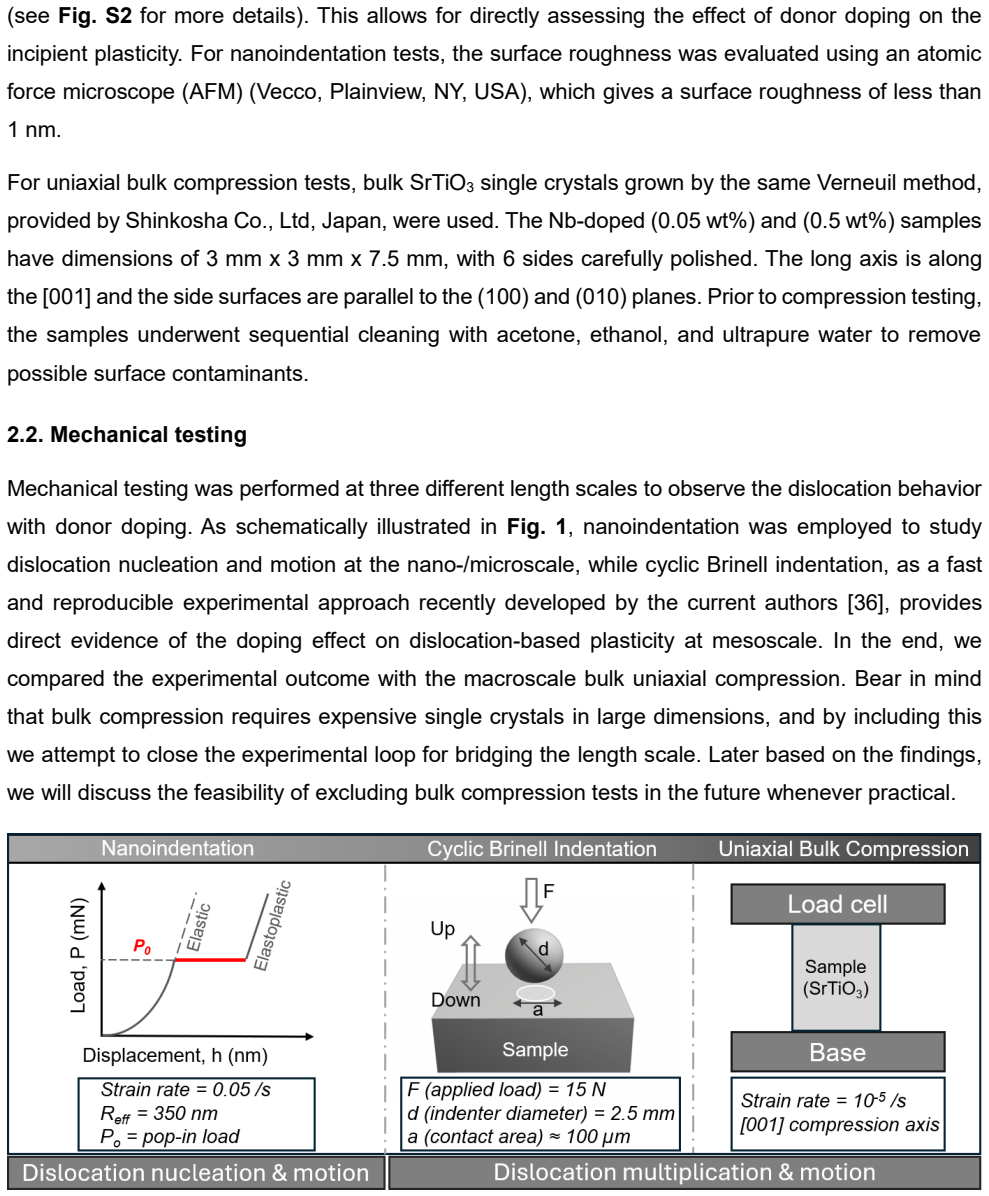
Point defect engineering is widely used to tailor the electronic and transport properties of complex oxides, yet its influence on dislocation plasticity remains poorly understood. Here, we establish how donor (Nb) doping modifies dislocation nucleation, multiplication, and mobility in single-crystal SrTiO3 by bridging nano-, meso-, and macroscale deformation. Using a combinatorial approach involving nanoindentation, cyclic Brinell indentation, and bulk uniaxial compression, we show that 0.5 wt% Nb doping consistently suppresses room-temperature plasticity. Nanoindentation reveals increased pop-in stresses, increased lattice friction stress, and reduced creep rates, indicating inhibited dislocation nucleation and motion with Nb doping. Mesoscale Brinell indentation exhibits discrete, widely spaced slip traces reflecting more difficult dislocation multiplication. Bulk uniaxial compression confirms ~50% higher yield stress in Nb-doped (0.5 wt%) SrTiO3 samples. Comparison with Fe-doped SrTiO3 (equivalent doping concentration) isolates the role of defect chemistry: oxygen vacancies promote incipient plasticity, whereas Sr vacancies dominate in Nb-doped SrTiO3, strongly hindering dislocation motion. This length-scale bridging approach consistently reveals suppressed dislocation nucleation, multiplication, and motion in the 0.5 wt% Nb-doped samples. These insights underline the importance of dislocation-defect chemistry on the mechanical behavior of functional oxides.
Editorial analysis
A structured set of objections, weighed in public.
Referee Report
Summary. The manuscript reports a multi-scale experimental investigation of how 0.5 wt% Nb donor doping affects dislocation nucleation, multiplication, and mobility in single-crystal SrTiO3. Nanoindentation shows increased pop-in stresses, higher lattice friction stress, and reduced creep rates; cyclic Brinell indentation reveals discrete, widely spaced slip traces; and bulk uniaxial compression demonstrates ~50% higher yield stress relative to undoped material. Comparison to Fe-doped SrTiO3 at equivalent nominal doping concentration is used to attribute the plasticity suppression to Sr vacancies (Nb-doped) versus oxygen vacancies (Fe-doped).
Significance. If the defect-chemistry isolation holds, the work offers direct, length-scale-bridging evidence that point-defect type can strongly modulate room-temperature plasticity in a model perovskite oxide. The purely experimental, parameter-free character of the measurements (pop-in statistics, friction stress, creep rates, slip-trace spacing, and yield stress) and the internal consistency across nano-, meso-, and macro-scale tests constitute a clear strength.
major comments (1)
- [Abstract] Abstract (comparison paragraph) and corresponding discussion: the claim that plasticity differences arise specifically from Sr vacancies versus oxygen vacancies at matched effective concentrations is load-bearing for the central interpretation. No carrier-density, vacancy-concentration, or post-growth annealing data are supplied to confirm that the 0.5 wt% Nb and Fe-doped crystals possess equivalent defect densities or incorporation efficiencies; without such controls the observed differences cannot be unambiguously attributed to defect chemistry rather than uncontrolled sample-to-sample variation.
Simulated Author's Rebuttal
We thank the referee for the positive evaluation of our multi-scale experimental approach and for the constructive major comment. We address the concern regarding the Nb- versus Fe-doped comparison below and indicate the revisions that will be incorporated.
read point-by-point responses
-
Referee: [Abstract] Abstract (comparison paragraph) and corresponding discussion: the claim that plasticity differences arise specifically from Sr vacancies versus oxygen vacancies at matched effective concentrations is load-bearing for the central interpretation. No carrier-density, vacancy-concentration, or post-growth annealing data are supplied to confirm that the 0.5 wt% Nb and Fe-doped crystals possess equivalent defect densities or incorporation efficiencies; without such controls the observed differences cannot be unambiguously attributed to defect chemistry rather than uncontrolled sample-to-sample variation.
Authors: We thank the referee for identifying this critical point. The manuscript compares the two doped crystals at the same nominal doping concentration (0.5 wt%), as stated in the abstract, methods, and discussion. In SrTiO3, the defect chemistry is well documented in the literature: Nb^{5+} on the Ti site acts as a donor compensated by Sr vacancies, whereas Fe^{3+} acts as an acceptor compensated by oxygen vacancies. Our central claim rests on this established chemistry together with the internal consistency of the experimental trends (pop-in stress, friction stress, creep rate, slip-trace spacing, and yield stress) across length scales. We nevertheless agree that explicit confirmation of effective defect densities would strengthen the attribution. In the revised manuscript we will (i) state the nominal concentrations more explicitly in the abstract and discussion, (ii) add a short paragraph summarizing the expected vacancy concentrations from prior defect-chemistry studies on equivalently doped SrTiO3, and (iii) note the absence of new carrier-density or annealing data in the present work while referencing the standard incorporation efficiencies. These changes will be highlighted in the revised version. revision: yes
Circularity Check
No circularity: purely experimental study with direct measurements
full rationale
The manuscript reports empirical observations from nanoindentation, cyclic Brinell indentation, and bulk uniaxial compression on SrTiO3 crystals, comparing Nb-doped and Fe-doped samples at nominally equivalent concentrations. No equations, fitted parameters, or derivation chains appear in the provided text; outcomes such as pop-in stresses, yield stresses, and slip traces are presented as direct measurements rather than predictions derived from inputs. The comparison isolating defect chemistry (Sr vacancies vs. oxygen vacancies) rests on an unverified assumption about effective concentrations, but this is an empirical premise, not a self-definitional or fitted-input reduction. The study is self-contained against external benchmarks via multi-scale testing and does not invoke self-citations or ansatzes that collapse the central claims.
Axiom & Free-Parameter Ledger
axioms (1)
- domain assumption Pop-in events in nanoindentation correspond to dislocation nucleation and lattice friction stress can be extracted from them.
Reference graph
Works this paper leans on
-
[1]
O.N. Tufte, P.W. Chapman, Electron Mobility in Semiconducting Strontium Titanate, Physical Review 155(3) (1967) 796-802
work page 1967
-
[2]
S. Kobayashi, Y . Mizumukai, T. Ohnishi, N. Shibata, Y . Ikuhara, T. Yamamoto, High Electron Mobility of Nb-Doped SrTiO3 Films Stemming from Rod-Type Sr Vacancy Clusters, ACS Nano 9(11) (2015) 10769- 10777
work page 2015
- [3]
-
[4]
U. Balachandran, N. Eror, Oxygen non -stoichiometry of tantalum-doped SrTiO3, Journal of the Less Common Metals 85 (1982) 11-19
work page 1982
-
[5]
N.G. Eror, U. Balachandran, Self-compensation in lanthanum-doped strontium titanate, Journal of Solid State Chemistry 40(1) (1981) 85-91
work page 1981
- [6]
-
[7]
A. Tkach, J. Resende, K.V. Saravanan, M.E. Costa, P. Diaz -Chao, E. Guilmeau, O. Okhay, P.M. Vilarinho, Abnormal Grain Growth as a Method To Enhance the Thermoelectric Performance of Nb-Doped Strontium Titanate Ceramics, ACS Sustainable Chemistry & Engineering 6(12) (2018) 15988-15994
work page 2018
- [8]
-
[9]
J.H. Haeni, P. Irvin, W. Chang, R. Uecker, P. Reiche, Y .L. Li, S. Choudhury, W. Tian, M.E. Hawley, B. Craigo, A.K. Tagantsev, X.Q. Pan, S.K. Streiffer, L.Q. Chen, S.W. Kirchoefer, J. Levy, D.G. Schlom, Room- temperature ferroelectricity in strained SrTiO3, Nature 430(7001) (2004) 758-761
work page 2004
-
[10]
M. Höfling, X. Zhou, L.M. Riemer, E. Bruder, B. Liu, L. Zhou, P.B. Groszewicz, F. Zhuo, B.-X. Xu, K. Durst, X. Tan, D. Damjanovic, J. Koruza, J. Rödel, Control of polarization in bulk ferroelectrics by mechanical dislocation imprint, Science 372(6545) (2021) 961-964
work page 2021
- [11]
- [12]
-
[13]
S. Hameed, D. Pelc, Z.W. Anderson, A. Klein, R.J. Spieker, L. Yue, B. Das, J. Ramberger, M. Lukas, Y . Liu, M.J. Krogstad, R. Osborn, Y . Li, C. Leighton, R.M. Fernandes, M. Greven, Enhanced superconductivity and ferroelectric quantum criticality in plastically deformed strontium ti tanate, Nature Materials 21(1) (2022) 54-61
work page 2022
-
[14]
A.E. Paladino, L.G. Rubin, J.S. Waugh, Oxygen ion diffusion in single crystal SrTiO 3, Journal of Physics and Chemistry of Solids 26(2) (1965) 391-397
work page 1965
-
[15]
L.C. Walters, R.E. Grace, Diffusion of point defec ts in strontium titanate, Journal of Physics and Chemistry of Solids 28(2) (1967) 245-248. 23
work page 1967
- [17]
- [18]
-
[19]
S. Kobayashi, Y . Ikuhara, T. Mizoguchi, Lattice expansion and local lattice distortion in Nb - and La- doped SrTiO 3 single crystals investi gated by x -ray diffraction and first -principles calculations, Physical Review B 98(13) (2018)
work page 2018
-
[20]
S.Y . Chung, S.J.L. Kang, V.P. Dravid, Effect of Sintering Atmosphere on Grain Boundary Segregation and Grain Growth in Niobium ‐Doped SrTiO3, Journal of the American Ceramic Society 85(11) (2004) 2805-2810
work page 2004
-
[21]
X. Fang, K. Ding, S. Janocha, C. Minnert, W. Rheinheimer, T. Frömling, K. Durst, A. Nakamura, J. Rödel, Nanoscale to microscale reversal in room -temperature plasticity in SrTiO 3 by tuning defect concentration, Scripta Materialia 188 (2020) 228-232
work page 2020
-
[22]
D. Brunner, S. Taeri-Baghbadrani, W. Sigle, M. Rühle, Surprising Results of a Study on the Plasticity in Strontium Titanate, Journal of the American Ceramic Society 84(5) (2001) 1161-1163
work page 2001
-
[23]
K.-H. Yang, N.-J. Ho, H.-Y . Lu, Plastic Deformation of 〈001〉 Single-Crystal SrTiO3 by Compression at Room Temperature, Journal of the American Ceramic Society 94(9) (2011) 3104-3111
work page 2011
-
[24]
E.A. Patterson, M. Major, W. Donner, K. Durst, K.G. Webber, J. Rödel, Tempera ture-Dependent Deformation and Dislocation Density in SrTiO 3 (001) Single Crystals, Journal of the American Ceramic Society 99(10) (2016) 3411-3420
work page 2016
-
[25]
A. Nakamura, K. Yasufuku, Y . Furushima, K. Toyoura, K.P.D. Lagerlöf, K. Matsunaga, Room - temperature plastic deformation of strontium titanate crystals grown from different chemical compositions, Crystals 7(11) (2017) 351
work page 2017
- [26]
-
[27]
X. Fang, J. Zhang, A. Frisch, O. Preuß, C. Okafor, M. Setvin, W. Lu, Room‐temperature bulk plasticity and tunable dislocation densities in KTaO3, Journal of the American Ceramic Society 107(11) (2024) 7054- 7061
work page 2024
- [28]
-
[29]
J.J. Gilman, W.G. Johnston, Dislocations in Lithium Fluoride Crystals, 1962, pp. 147-222
work page 1962
-
[30]
A.F. Mark, M. Castillo -Rodriguez, W. Sigle, Unexpected plasticity of potassium niobate during compression between room temperature and 900°C, Journal of the European Ceramic Society 36(11) (2016) 2781-2793. 24
work page 2016
- [31]
-
[32]
X. Fang, L. Porz, K. Ding, A. Nakamura, Bridging the gap between bulk compression and indentation test on room-temperature plasticity in oxides: case study on SrTiO3, Crystals 10(10) (2020) 933
work page 2020
-
[33]
C.D. Fincher, D. Ojeda, Y . Zhang, G.M. Pharr, M. Pharr, Mechanical properties of metallic lithium: from nano to bulk scales, Acta Materialia 186 (2020) 215-222
work page 2020
-
[34]
N.H. Chan, R. Sharma, D.M. Smyth, Nonstoichiometry in SrTiO 3, Journal of the Electrochemical Society 128(8) (1981) 1762
work page 1981
-
[35]
X. Fang, W. Lu, J. Zhang, C. Minnert, J. Hou, S. Bruns, U. Kunz, A. Nakamura, K. Durst, J. Rödel, Harvesting room-temperature plasticity in ceramics by mechanically seeded dislocations, Materials Today (2024)
work page 2024
- [36]
-
[37]
A. Nakamura, X. Fang, A. Matsubara, E. Tochigi, Y . Oshima, T. Saito, T. Yokoi, Y . Ikuh ara, K. Matsunaga, Photoindentation: A New Route to Understanding Dislocation Behavior in Light, Nano Letters 21(5) (2021) 1962-1967
work page 2021
-
[38]
Y . Gaillard, C. Tromas, J. Woirgard, Quantitative analysis of dislocation pile -ups nucleated during nanoindentation in MgO, Acta Materialia 54(5) (2006) 1409-1417
work page 2006
-
[39]
F. Javaid, K.E. Johanns, E.A. Patterson, K. Durst, Temperature dependence of indentation size effect, dislocation pile ‐ups, and lattice friction in (001) strontium titanate, Journal of the American Cerami c Society 101(1) (2018) 356-364
work page 2018
- [40]
-
[41]
X. Fang, H. Bishara, K. Ding, H. Tsybenko, L. Porz, M. H öfling, E. Bruder, Y . Li, G. Dehm, K. Durst, Nanoindentation pop-in in oxides at room temperature: Dislocation activation or crack formation?, Journal of the American Ceramic Society 104(9) (2021) 4728-4741
work page 2021
-
[42]
Johnson, Contact Mechanics, Cambridge University Press, Cambridge, London, 1985
K.L. Johnson, Contact Mechanics, Cambridge University Press, Cambridge, London, 1985
work page 1985
- [43]
-
[44]
C. Wang, Y . Lai, J. Huang, T. Nieh, Creep of nanocrystalline nickel: A direct comparison between uniaxial and nanoindentation creep, Scripta Materialia 62(4) (2010) 175-178
work page 2010
-
[45]
T. Kolodiazhnyi, A. Petric, The Applicability of Sr-deficient n-type SrTiO3 for SOFC Anodes, Journal of electroceramics 15 (2005) 5-11
work page 2005
-
[46]
M.J. Akhtar, Z.-U.-N. Akhtar, R.A. Jackson, C.R.A. Catlow, Computer Simulation Studies of Strontium Titanate, Journal of the American Ceramic Society 78(2) (1995) 421-428. 25
work page 1995
-
[47]
J.D. Eshelby, C.W.A. Newey, P.L. Pratt, A.B. Lidiard, Charged dislocations and the strength of ionic crystals, The Philosophical Magazine: A Journal of Theoretical Experimental and Applied Physics 3(25) (1958) 75-89
work page 1958
-
[48]
X. Fang, Mechanical tailoring of dislocations in ceramics at room temperature: A perspective, Journal of the American Ceramic Society 107(3) (2023) 1425-1447
work page 2023
- [49]
- [50]
- [51]
- [52]
-
[53]
P. Gao, R. Ishikawa, B. Feng, A. Kumamoto, N. Shibata, Y . Ikuhara, Atomic-scale structure relaxation, chemistry and charge distribution of dislocation cores in SrTiO3, Ultramicroscopy 184 (2018) 217-224
work page 2018
- [54]
-
[55]
D. Marrocchelli, L. Sun, B. Yildiz, Dislocations in SrTiO3: Easy To Reduce but Not so Fast for Oxygen Transport, Journal of the American Chemical Society 137(14) (2015) 4735-4748
work page 2015
-
[56]
Whitworth, Charged dislocations in ionic crystals, Advances in Physics 24(2) (1975) 203-304
R. Whitworth, Charged dislocations in ionic crystals, Advances in Physics 24(2) (1975) 203-304
work page 1975
- [57]
- [58]
-
[59]
R.A. De Souza, Oxygen Diffusion in SrTiO 3 and Related Perovskite Oxides, Advanced Functional Materials 25(40) (2015) 6326-6342
work page 2015
-
[60]
X. Wang, Z. Wang, Q. Hu, C. Zhang, D. Wang, L. Li, Room temperature multiferroic properties of Fe- doped nonstoichiometric SrTiO3 ceramics at both A and B sites, Solid State Communications 289 (2019) 22-26
work page 2019
-
[61]
A.-H. Jeon, Y . Zhao, Z. Gao, J.-Y. Suh, H.J. Ryu, H.S. Kim, U. Ramamurty, J.-i. Jang, Stochastic nature of incipient plasticity in a body-centered cubic medium-entropy alloy, Acta Materialia 278 (2024) 120244
work page 2024
-
[62]
R.D. Shannon, Revised effective ionic radii and systematic studies of interatomic distances in halides and chalcogenides, Acta Crystallographica Section A 32(5) (1976) 751-767
work page 1976
-
[63]
R. Waser, Bulk Conductivity and Defect Chemistry of Acceptor -Doped Strontium Titanate in the Quenched State, Journal of the American Ceramic Society 74(8) (1991) 1934-1940. 26
work page 1991
-
[64]
J.-J. Wang, H.-B. Huang, T.J.M. Bayer, A. Moballegh, Y . Cao, A. Klein, E.C. Dickey, D.L. Irving, C.A. Randall, L.-Q. Chen, Defect chemistry and resistance degradation in Fe-doped SrTiO3 single crystal, Acta Materialia 108 (2016) 229-240
work page 2016
-
[65]
J.K. Mason, A.C. Lund, C.A. Schuh, Determining the activation energy and volume for the onset of plasticity during nanoindentation, Physical Review B 73(5) (2006) 054102
work page 2006
-
[66]
J. Hinterberg, T. Zacherle, R. De Souza, Activation volume tensor for oxygen -vacancy migration in strained CeO2 electrolytes, Physical review letters 110(20) (2013) 205901
work page 2013
-
[67]
A. Cottrell, Effect of solute atoms on the behavior of dislocations, Report of a Conference on Strength of Solids, The Physical Society London London, UK, 1948, pp. 30-36
work page 1948
-
[68]
L. Sun, D. Marrocchelli, B. Yildiz, Edge dislocation slows down oxide ion diffusion in doped CeO 2 by segregation of charged defects, Nature Communications 6(1) (2015) 6294
work page 2015
-
[69]
M.V. Swain, B.R. Lawn, A Study of Dislocation Arrays at Spherical Indentations in LiF as a Function of Indentation Stress and Strain, physica status solidi (b) 35(2) (1969) 909-923
work page 1969
- [70]
-
[71]
H. Saka, K. Noda, T. Imura, Direct observation of dislocation multiplication in Iron at low temperatures by HVEM, Transactions of the Iron and Steel Institute of Japan 13(5) (1973) 318-324
work page 1973
- [72]
-
[73]
J.N. Baker, P.C. Bowes, J.S. Harris, D.L. Irving, Mechanisms governing metal vacancy formation in BaTiO3 and SrTiO3, Journal of Applied Physics 124(11) (2018). Supplementary information for Donor doping-regulated dislocation plasticity across the length scale in SrTiO3 Chukwudalu Okafor1*, Kohei Takahara2, Svetlana Korneychuk 1,3,4, Isabel Huck 5, Sebasti...
work page 2018
-
[74]
J. Bednorz, H. Scheel, Flame-fusion growth of SrTiO3, Journal of Crystal Growth 41(1) (1977) 5 - 12
work page 1977
-
[75]
H.J. Scheel, J.G. Bednorz, P . Dill, Crystal growth of strontium titanate SrTiO3, Ferroelectrics 13(1) (1976) 507-509
work page 1976
-
[76]
R. Waser, Bulk Conductivity and Defect Chemistry of Acceptor -Doped Strontium Titanate in the Quenched State, Journal of the American Ceramic Society 74(8) (1991) 1934-1940
work page 1991
-
[77]
R. Meyer, A.F. Zurhelle, R.A. De Souza, R. Waser, F. Gunkel, Dynamics of the metal -insulator transition of donor-doped SrTiO3, Physical Review B 94(11) (2016) 115408
work page 2016
-
[78]
R.A. De Souza, Oxygen Diffusion in SrTiO3 and Related Perovskite Oxides, Advanced Functional Materials 25(40) (2015) 6326-6342
work page 2015
discussion (0)
Sign in with ORCID, Apple, or X to comment. Anyone can read and Pith papers without signing in.