Helical phases and Bogoliubov Fermi surfaces probed by superconducting diode effects
Pith reviewed 2026-05-18 04:47 UTC · model grok-4.3
The pith
Superconducting diode efficiency approaches its maximum at the Lifshitz transition where Bogoliubov Fermi surfaces emerge in helical phases.
A machine-rendered reading of the paper's core claim, the machinery that carries it, and where it could break.
Core claim
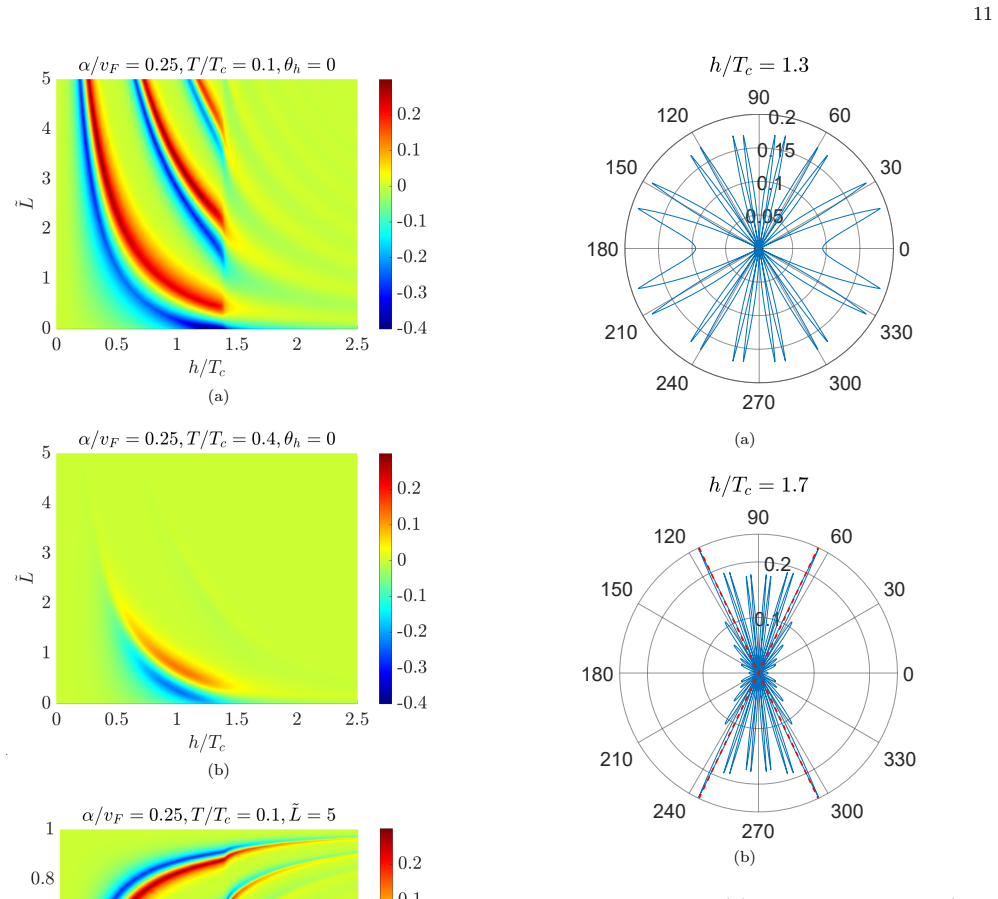
For the bulk system, the diode efficiency can nominally approach its maximal value at the critical endpoint of the first-order Lifshitz transition between weak and strong helical phases featuring finite-momentum Cooper pairs, the latter marked by the emergence of Bogoliubov Fermi surfaces. In a Josephson junction, finite-momentum pairing in the superconducting leads is the dominant mechanism behind the Josephson diode effect in short junctions, whereas in long junctions it is primarily governed by the Zeeman field in the normal region, with the onset of Bogoliubov Fermi surfaces producing sharp suppression and anisotropy in the current.
What carries the argument
the critical endpoint of the first-order Lifshitz transition between weak and strong helical phases, where finite-momentum Cooper pairs produce Bogoliubov Fermi surfaces that control diode efficiency and junction anisotropy
If this is right
- Bulk diode efficiency reaches near its theoretical maximum at the specific magnetic field marking the Lifshitz transition endpoint.
- Short Josephson junctions show a diode effect driven primarily by finite-momentum pairing in the leads.
- Long junctions exhibit oscillations of diode efficiency sign with magnetic field at low fields, enabling tunability.
- At higher fields the Josephson current develops strong anisotropy and suppression when flow is aligned with Bogoliubov Fermi surface momenta.
Where Pith is reading between the lines
- The predicted anisotropy could detect Bogoliubov Fermi surfaces in materials that lack a measurable diode effect.
- Sweeping field while monitoring diode efficiency might locate the helical phase boundary more directly than spectroscopic probes.
- The same Lifshitz endpoint behavior could appear in other noncentrosymmetric setups with different spin-orbit forms.
Load-bearing premise
The system is assumed to be perfectly clean with no impurities, and the quasiclassical Eilenberger formalism is assumed to remain valid through both helical phases and at their transition point.
What would settle it
An experiment that sweeps in-plane magnetic field and finds no sharp peak in diode efficiency near the predicted Lifshitz transition field, or that measures Josephson current without the expected directional suppression aligned to Bogoliubov Fermi surface momenta, would contradict the central claim.
Figures



read the original abstract
Noncentrosymmetric superconductors (NCSs) with Rashba spin-orbit coupling (SOC) and in-plane magnetic fields have emerged as natural platforms for realizing both the bulk superconducting diode effect (SDE) and the Josephson diode effect (JDE) - phenomena characterized by unequal critical currents in opposite directions due to the simultaneous breaking of time-reversal and inversion symmetries. Using the quasiclassical Eilenberger formalism, we systematically investigate both the bulk SDE and the JDE in a clean NCS with Rashba SOC and in-plane magnetic fields. For the bulk system, we find that the diode efficiency can nominally approach its maximal value at the critical endpoint of the first-order Lifshitz transition between weak and strong helical phases featuring finite-momentum Cooper pairs, the latter marked by the emergence of Bogolyubov Fermi surfaces (BFSs). In a Josephson junction, we show that finite-momentum pairing in the superconducting leads is the dominant mechanism behind the JDE in short junctions, whereas in long junctions it is primarily governed by the Zeeman field in the normal region. In the long-junction regime, the diode efficiency additionally oscillates between positive and negative values as a function of magnetic field at low fields, providing a route toward a highly tunable Josephson diode. At higher fields, the onset of BFSs in the strong helical phase leads to a sharp suppression of both the JDE and the Josephson current when the current direction is aligned with momenta along the BFS, resulting in strong anisotropy. We propose that this anisotropy in the Josephson current offers an alternative method for detecting BFSs, applicable to systems with or without a JDE.
Editorial analysis
A structured set of objections, weighed in public.
Referee Report
Summary. The manuscript uses the quasiclassical Eilenberger formalism to study the bulk superconducting diode effect (SDE) and the Josephson diode effect (JDE) in clean noncentrosymmetric superconductors with Rashba SOC and in-plane Zeeman fields. It claims that the bulk diode efficiency approaches its maximal value at the critical endpoint of a first-order Lifshitz transition separating weak and strong helical phases with finite-momentum pairing, the latter signaled by the appearance of Bogoliubov Fermi surfaces. In Josephson junctions the work distinguishes dominant mechanisms (finite-momentum pairing in short junctions versus Zeeman field in long junctions), reports low-field oscillations of the diode efficiency, and identifies strong anisotropy and suppression of the Josephson current once BFSs appear, proposing the anisotropy as an alternative probe for BFSs.
Significance. If the central claims hold, the work would be significant for providing concrete, parameter-based predictions that connect helical phases and Bogoliubov Fermi surfaces to measurable diode efficiencies and anisotropies. The systematic treatment with Rashba strength and Zeeman field as free parameters, together with the distinction between short- and long-junction regimes, offers clear experimental routes for detecting exotic pairing states and for realizing tunable Josephson diodes. The clean-limit Eilenberger approach is a reproducible starting point, though its quantitative reliability at the Lifshitz endpoint remains to be verified.
major comments (1)
- [Abstract and bulk SDE section] Abstract and the section presenting the bulk SDE results: the claim that diode efficiency nominally reaches its maximum at the critical endpoint of the first-order Lifshitz transition (marked by emergence of BFSs) is load-bearing for the paper's main result. At this point the gap closes along nodal directions, the spectrum becomes gapless, and the density of states diverges; the standard clean-limit Eilenberger treatment (linearization around the Fermi surface and Matsubara integration) can miss non-analytic contributions or require additional regularization that is not shown or justified in the derivation.
minor comments (2)
- The abstract uses the qualifier 'nominally approach its maximal value'; an explicit definition of diode efficiency (including its formula) and the numerical values obtained near the transition would improve clarity and allow readers to assess how close to the theoretical maximum the computed efficiency actually gets.
- Notation for the 'weak' and 'strong' helical phases is introduced without a concise reminder of their defining characteristics (e.g., momentum of Cooper pairs or presence/absence of BFSs); adding a short definitional sentence in the introduction or model section would aid accessibility.
Simulated Author's Rebuttal
We are grateful to the referee for the detailed review and valuable feedback on our manuscript. We address the major comment below and have revised the manuscript accordingly to improve clarity and address concerns about the formalism at the critical point.
read point-by-point responses
-
Referee: [Abstract and bulk SDE section] Abstract and the section presenting the bulk SDE results: the claim that diode efficiency nominally reaches its maximum at the critical endpoint of the first-order Lifshitz transition (marked by emergence of BFSs) is load-bearing for the paper's main result. At this point the gap closes along nodal directions, the spectrum becomes gapless, and the density of states diverges; the standard clean-limit Eilenberger treatment (linearization around the Fermi surface and Matsubara integration) can miss non-analytic contributions or require additional regularization that is not shown or justified in the derivation.
Authors: We appreciate the referee's concern regarding the applicability of the quasiclassical Eilenberger formalism precisely at the Lifshitz transition endpoint. In our calculations, the diode efficiency is computed for parameters where the superconducting gap remains finite, and we find that it approaches its theoretical maximum value of 1 as the system approaches the critical endpoint from the weak helical phase. At the exact endpoint, the gap closes along certain directions, rendering the system gapless with a diverging density of states. We acknowledge that the standard Eilenberger approach, based on linearization around the Fermi surface and Matsubara summation, assumes a gapped spectrum and may require additional regularization or careful treatment of non-analytic terms in the gapless regime, which we have not explicitly derived in the manuscript. To address this, we will revise the abstract and the relevant section to emphasize that the maximum efficiency is approached asymptotically near the transition rather than exactly attained at the endpoint. We will also add a discussion paragraph on the limitations of the formalism at the critical point and suggest that future work could employ full microscopic calculations to verify the behavior exactly at the transition. This clarification strengthens the presentation without altering the core findings. revision: yes
Circularity Check
No significant circularity; derivation self-contained from standard Eilenberger setup
full rationale
The paper applies the standard quasiclassical Eilenberger formalism to a clean NCS with Rashba SOC and in-plane Zeeman field as external inputs. The central result on diode efficiency reaching a nominal maximum at the Lifshitz endpoint is obtained by solving the resulting equations for the current-phase relation and critical currents across the weak-to-strong helical transition; no parameter is fitted to the diode efficiency itself, no prediction is statistically forced by a subset of the same data, and no load-bearing uniqueness theorem or ansatz is imported via self-citation. The derivation therefore remains independent of its target observables.
Axiom & Free-Parameter Ledger
free parameters (2)
- Rashba SOC strength
- Zeeman field strength
axioms (2)
- domain assumption Quasiclassical Eilenberger formalism remains valid across the weak-to-strong helical transition and at the Lifshitz endpoint.
- domain assumption Clean limit (no impurity scattering) applies to the modeled NCS.
Lean theorems connected to this paper
-
IndisputableMonolith/Cost/FunctionalEquation.leanwashburn_uniqueness_aczel unclear?
unclearRelation between the paper passage and the cited Recognition theorem.
Using the quasiclassical Eilenberger formalism, we systematically investigate both the bulk SDE and the JDE... the diode efficiency can nominally approach its maximal value at the critical endpoint of the first-order Lifshitz transition
-
IndisputableMonolith/Foundation/AlexanderDuality.leanalexander_duality_circle_linking unclear?
unclearRelation between the paper passage and the cited Recognition theorem.
the onset of BFSs in the strong helical phase leads to a sharp suppression... resulting in strong anisotropy
What do these tags mean?
- matches
- The paper's claim is directly supported by a theorem in the formal canon.
- supports
- The theorem supports part of the paper's argument, but the paper may add assumptions or extra steps.
- extends
- The paper goes beyond the formal theorem; the theorem is a base layer rather than the whole result.
- uses
- The paper appears to rely on the theorem as machinery.
- contradicts
- The paper's claim conflicts with a theorem or certificate in the canon.
- unclear
- Pith found a possible connection, but the passage is too broad, indirect, or ambiguous to say the theorem truly supports the claim.
Reference graph
Works this paper leans on
-
[1]
Bulk superconductor To solve the Eilenberger equation, it proves convenient to make gauge transformation ˜gλ =e −iτzQλ·rgλeiτzQλ·r,(13) which transforms Eq. (8) to −ivF ˆk·∇˜gλ = [(iωn − ˆ∆λ)τz,˜gλ],(14) where ˆ∆λ =e −iτzQλ·r ˆ∆eiτzQλ·r = 0 ∆ λ(r) ∆∗ λ(r) 0 ,(15) where ∆ λ(r) = ∆ qeiqλ·r,q λ ≡q−2Q λ. The homoge- neous solution is given by ˜gs λ(r) = 1 Ωλ ...
-
[2]
SNS junction Now we consider the SNS junction case with phase differenceϕ. We neglect the inverse proximity effect and assume ∆(r) = ∆qei[q·(r+ L 2 ˆx)−ϕ/2], x <−L/2 ∆qei[q·(r− L 2 ˆx)+ϕ/2], x > L/2 0,|x|< L/2 (17) where ∆ q >0. The value ofqand ∆ q is determined numerically for the bulk superconductor at equilibrium (see Sec. III A). As in the bulk...
-
[3]
Single-band properties In an SNS junction, discrete levels of Andreev bound state are formed in the normal metal due to the Andreev reflection [155]. In the strong spin-orbit coupling limit, as the two helical bands decouple, the Andreev levels of each band do not mix and can be treated separately. For a single bandλ, its structure as a function of ˜ω, ˜q...
-
[4]
Multi-band properties and JDE From the symmetry point of view, both time-reversal (TR) and inversion symmetry breaking are necessary for the existence of JDE. In the setup considered in this work, the presence of Rashba SOC breaks the inver- sion symmetry and leads to the splitting of the heli- cal bands, which is reflected in the different band DOS Nλ =N...
-
[5]
[156], are crucial for the existence of JDE [61, 69, 83, 157], as shown below. In a long junction, as discussed earlier, the total cur- rent at small field can be approximated as I1D tot = X λ (1 +λ˜α)I1D(qλ, ϕλ) (38) ≈ X λ (1 +λ˜α)I1D(0, ϕλ + ˜qλ). The main effect of a weak magnetic field in a long junc- tion is thus to introduce a relative phase shift b...
-
[6]
E. Bauer and M. Sigrist,Non-centrosymmetric su- perconductors: introduction and overview, Vol. 847 (Springer Science & Business Media, 2012)
work page 2012
-
[7]
M. Smidman, M. Salamon, H. Yuan, and D. Agter- berg, Superconductivity and spin–orbit coupling in non-centrosymmetric materials: a review, Reports on Progress in Physics80, 036501 (2017)
work page 2017
- [8]
-
[9]
N. Nagaosa and Y. Yanase, Nonreciprocal Transport and Optical Phenomena in Quantum Materials, Annual Review of Condensed Matter Physics15, 63 (2024), publisher: Annual Reviews
work page 2024
-
[10]
J. Ma, R. Zhan, and X. Lin, Superconducting diode effects: Mechanisms, materials and applications, Ad- vanced Physics Researchn/a, 2400180 (2025)
work page 2025
-
[11]
V. Mineev and K. Samokhin, Helical phases in super- conductors, Journal of Experimental and Theoretical Physics78, 401 (1994), place: United States INIS Ref- erence Number: 26032477
work page 1994
-
[12]
L. P. Gor’kov and E. I. Rashba, Superconducting 2d sys- tem with lifted spin degeneracy: Mixed singlet-triplet state, Phys. Rev. Lett.87, 037004 (2001)
work page 2001
-
[13]
V. Barzykin and L. P. Gor’kov, Inhomogeneous stripe phase revisited for surface superconductivity, Phys. Rev. Lett.89, 227002 (2002)
work page 2002
-
[14]
P. A. Frigeri, D. F. Agterberg, A. Koga, and M. Sigrist, Superconductivity without inversion symmetry: MnSi versus CePt3Si, Phys. Rev. Lett.92, 097001 (2004)
work page 2004
-
[15]
O. V. Dimitrova and M. V. Feigel’man, Phase diagram of a surface superconductor in parallel magnetic field, Journal of Experimental and Theoretical Physics Let- ters78, 637 (2003)
work page 2003
-
[16]
D. F. Agterberg and R. P. Kaur, Magnetic-field-induced helical and stripe phases in Rashba superconductors, Physical Review B75, 064511 (2007), publisher: Amer- ican Physical Society
work page 2007
-
[17]
O. Dimitrova and M. V. Feigel’man, Theory of a two- dimensional superconductor with broken inversion sym- metry, Phys. Rev. B76, 014522 (2007)
work page 2007
-
[18]
L. S. Levitov, Y. V. Nazarov, and G. M. Eliashberg, Magnetostatics of superconductors without an inversion center, JETP Lett. (Engl. Transl.); (United States)41:9 (1985), institution: L. D. Landau Institute of Theoreti- cal Physics, Academy of Sciences of the USSR
work page 1985
-
[19]
V. M. Edelstein, The Ginzburg - Landau equation for superconductors of polar symmetry, Journal of Physics: Condensed Matter8, 339 (1996)
work page 1996
- [20]
-
[21]
N. F. Q. Yuan and L. Fu, Supercurrent diode effect and finite-momentum superconductors, Proceedings of the National Academy of Sciences119, e2119548119 (2022), publisher: Proceedings of the National Academy of Sci- ences
work page 2022
-
[22]
S. Ili´ c and F. S. Bergeret, Theory of the supercurrent diode effect in rashba superconductors with arbitrary disorder, Phys. Rev. Lett.128, 177001 (2022)
work page 2022
- [23]
- [24]
-
[25]
I. Bankier, L. Attias, A. Levchenko, and M. Khodas, Superconducting diode effect in Ising superconductors, Phys. Rev. B111, L180505 (2025)
work page 2025
-
[26]
A. Q. Chen, M. J. Park, S. T. Gill, Y. Xiao, D. Reig-i Plessis, G. J. MacDougall, M. J. Gilbert, and N. Mason, Finite momentum Cooper pairing in three-dimensional topological insulator Josephson junctions, Nature Com- munications9, 3478 (2018)
work page 2018
-
[27]
S. Hart, H. Ren, M. Kosowsky, G. Ben-Shach, P. Leub- ner, C. Br¨ une, H. Buhmann, L. W. Molenkamp, B. I. Halperin, and A. Yacoby, Controlled finite momentum pairing and spatially varying order parameter in proxim- itized hgte quantum wells, Nature Physics13, 87 (2017)
work page 2017
-
[28]
K. Michaeli, A. C. Potter, and P. A. Lee, Supercon- ducting and ferromagnetic phases in srtio 3/laalo3 ox- ide interface structures: Possibility of finite momentum pairing, Phys. Rev. Lett.108, 117003 (2012)
work page 2012
-
[29]
P. Fulde and R. A. Ferrell, Superconductivity in a strong spin-exchange field, Phys. Rev.135, A550 (1964)
work page 1964
-
[30]
A. I. Larkin, Inhomogeneous state of superconductors, Sov. Phys. JETP20, 762 (1965)
work page 1965
-
[31]
D. F. Agterberg, J. S. Davis, S. D. Edkins, E. Fradkin, D. J. Van Harlingen, S. A. Kivelson, P. A. Lee, L. Radz- ihovsky, J. M. Tranquada, and Y. Wang, The physics of pair-density waves: Cuprate superconductors and be- yond, Annual Review of Condensed Matter Physics11, 231 (2020)
work page 2020
-
[32]
V. M. Edelstein, Magnetoelectric Effect in Polar Super- conductors, Physical Review Letters75, 2004 (1995), publisher: American Physical Society
work page 2004
-
[33]
C. Timm, A. P. Schnyder, D. F. Agterberg, and P. M. R. Brydon, Inflated nodes and surface states in super- conducting half-heusler compounds, Phys. Rev. B96, 094526 (2017)
work page 2017
-
[34]
N. F. Q. Yuan and L. Fu, Zeeman-induced gapless su- perconductivity with a partial Fermi surface, Physical Review B97, 115139 (2018), publisher: American Phys- ical Society
work page 2018
-
[35]
J. M. Link, I. Boettcher, and I. F. Herbut,$d$-wave superconductivity and Bogoliubov-Fermi surfaces in Rarita-Schwinger-Weyl semimetals, Physical Review B 101, 184503 (2020), publisher: American Physical So- ciety
work page 2020
-
[36]
D. Shaffer, J. Kang, F. J. Burnell, and R. M. Fernandes, Crystalline nodal topological superconductivity and bo- golyubov fermi surfaces in monolayer NbSe2, Phys. Rev. B101, 224503 (2020)
work page 2020
-
[37]
A. Akbari and P. Thalmeier, Fermi surface segmentation in the helical state of a Rashba superconductor, Physical Review Research4, 023096 (2022), publisher: American Physical Society
work page 2022
-
[38]
S. Banerjee, S. Ikegaya, and A. P. Schnyder, Anomalous Fano factor as a signature of Bogoliubov Fermi surfaces, Physical Review Research4, L042049 (2022), publisher: 14 American Physical Society
work page 2022
-
[39]
S. S. Babkin, A. P. Higginbotham, and M. Serbyn, Proximity-induced gapless superconductivity in two- dimensional Rashba semiconductor in magnetic field, SciPost Physics16, 115 (2024)
work page 2024
-
[40]
J. H. Mateos, L. Tosi, A. Braggio, F. Taddei, and L. Ar- rachea, Nonlocal thermoelectricity in quantum wires as a signature of Bogoliubov-Fermi points, Physical Re- view B110, 075415 (2024), publisher: American Phys- ical Society
work page 2024
-
[41]
T. Sano, T. Sato, A. Sasaki, S. Ikegaya, S. Kobayashi, and Y. Asano, Thermoelectric effect in a superconduc- tor with Bogoliubov Fermi surfaces, Physical Review B 111, 174503 (2025), publisher: American Physical So- ciety
work page 2025
-
[42]
M. Wei, L. Xiang, F. Xu, B. Wang, and J. Wang, Unconventional Hall effect in gapless superconductors: Transverse supercurrent converted from normal current, Phys. Rev. Lett.135, 166304 (2025)
work page 2025
-
[43]
B. Zhai, B. Li, Y. Wen, F. Wu, and J. He, Prediction of ferroelectric superconductors with reversible supercon- ducting diode effect, Phys. Rev. B106, L140505 (2022)
work page 2022
-
[44]
F. Ando, Y. Miyasaka, T. Li, J. Ishizuka, T. Arakawa, Y. Shiota, T. Moriyama, Y. Yanase, and T. Ono, Ob- servation of superconducting diode effect, Nature584, 373 (2020), number: 7821 Publisher: Nature Publishing Group
work page 2020
-
[45]
J.-X. Lin, P. Siriviboon, H. D. Scammell, S. Liu, D. Rhodes, K. Watanabe, T. Taniguchi, J. Hone, M. S. Scheurer, and J. I. A. Li, Zero-field superconducting diode effect in small-twist-angle trilayer graphene, Na- ture Physics , 1 (2022), publisher: Nature Publishing Group
work page 2022
-
[46]
L. Bauriedl, C. B¨ auml, L. Fuchs, C. Baumgartner, N. Paulik, J. M. Bauer, K.-Q. Lin, J. M. Lupton, T. Taniguchi, K. Watanabe, C. Strunk, and N. Paradiso, Supercurrent diode effect and magnetochiral anisotropy in few-layer NbSe 2, Nature Communications13, 4266 (2022), number: 1 Publisher: Nature Publishing Group
work page 2022
-
[47]
R. Kealhofer, H. Jeong, A. Rashidi, L. Balents, and S. Stemmer, Anomalous superconducting diode effect in a polar superconductor, Physical Review B107, L100504 (2023), publisher: American Physical Society
work page 2023
-
[48]
Z. Geng, A. Hijano, S. Ili´ c, M. Ilyn, I. Maasilta, A. Monfardini, M. Spies, E. Strambini, P. Virtanen, M. Calvo,et al., Superconductor-ferromagnet hybrids for non-reciprocal electronics and detectors, Supercon- ductor Science and Technology36, 123001 (2023)
work page 2023
-
[49]
J. Yun, S. Son, J. Shin, G. Park, K. Zhang, Y. J. Shin, J.-G. Park, and D. Kim, Magnetic proximity-induced superconducting diode effect and infinite magnetoresis- tance in a van der Waals heterostructure, Physical Re- view Research5, L022064 (2023), publisher: American Physical Society
work page 2023
-
[50]
T. Le, Z. Pan, Z. Xu, J. Liu, J. Wang, Z. Lou, X. Yang, Z. Wang, Y. Yao, C. Wu, and X. Lin, Superconduct- ing diode effect and interference patterns in kagome CsV3Sb5, Nature , 1 (2024), publisher: Nature Pub- lishing Group
work page 2024
-
[51]
T. Asaba, M. Naritsuka, H. Asaeda, Y. Kosuge, S. Ikemori, S. Suetsugu, Y. Kasahara, Y. Kohsaka, T. Terashima, A. Daido, Y. Yanase, and Y. Matsuda, Evidence for a finite-momentum Cooper pair in tricolor d-wave superconducting superlattices, Nature Commu- nications15, 3861 (2024), publisher: Nature Publishing Group
work page 2024
-
[52]
N. J. Zhang, J.-X. Lin, D. V. Chichinadze, Y. Wang, K. Watanabe, T. Taniguchi, L. Fu, and J. I. A. Li, Angle-resolved transport non-reciprocity and sponta- neous symmetry breaking in twisted trilayer graphene, Nature Materials23, 356 (2024)
work page 2024
-
[53]
F. Liu, Y. M. Itahashi, S. Aoki, Y. Dong, Z. Wang, N. Ogawa, T. Ideue, and Y. Iwasa, Superconducting diode effect under time-reversal symmetry, Science Ad- vances10, eado1502 (2024), publisher: American Asso- ciation for the Advancement of Science
work page 2024
-
[54]
Z. Wan, G. Qiu, H. Ren, Q. Qian, Y. Li, D. Xu, J. Zhou, J. Zhou, B. Zhou, L. Wang, T.-H. Yang, Z. Sofer, Y. Huang, K. L. Wang, and X. Duan, Unconventional superconductivity in chiral molecule–TaS 2 hybrid su- perlattices, Nature632, 69 (2024)
work page 2024
-
[55]
J. Ingla-Ayn´ es, Y. Hou, S. Wang, E.-D. Chu, O. A. Mukhanov, P. Wei, and J. S. Moodera, Efficient super- conducting diodes and rectifiers for quantum circuitry, Nature Electronics8, 411 (2025)
work page 2025
-
[56]
Y. Hou, F. Nichele, H. Chi, A. Lodesani, Y. Wu, M. F. Ritter, D. Z. Haxell, M. Davydova, S. Ili´ c, O. Glezakou- Elbert, A. Varambally, F. S. Bergeret, A. Kamra, L. Fu, P. A. Lee, and J. S. Moodera, Ubiquitous superconduct- ing diode effect in superconductor thin films, Phys. Rev. Lett.131, 027001 (2023)
work page 2023
-
[57]
P. J. W. Moll and V. B. Geshkenbein, Evolution of su- perconducting diodes, Nature Physics , 1 (2023), pub- lisher: Nature Publishing Group
work page 2023
-
[58]
M. Davydova, S. Prembabu, and L. Fu, Universal Josephson diode effect, Science Advances8, eabo0309 (2022), publisher: American Association for the Ad- vancement of Science
work page 2022
- [59]
-
[60]
X.-P. Zhang, Fabry-Perot superconducting diode, Phys- ical Review B109, 184513 (2024), publisher: American Physical Society
work page 2024
- [61]
-
[62]
K. Yang and D. F. Agterberg, Josephson Effect in Fulde- Ferrell-Larkin-Ovchinnikov Superconductors, Physical Review Letters84, 4970 (2000), publisher: American Physical Society
work page 2000
-
[63]
R. P. Kaur, D. F. Agterberg, and M. Sigrist, Helical Vor- tex Phase in the Noncentrosymmetric CePt3Si, Physical Review Letters94, 137002 (2005), publisher: American Physical Society
work page 2005
-
[64]
A. Buzdin, Direct coupling between magnetism and su- perconducting current in the josephsonφ 0 junction, Phys. Rev. Lett.101, 107005 (2008)
work page 2008
- [65]
-
[66]
J. S. Meyer and M. Houzet, Josephson diode effect in a ballistic single-channel nanowire, Applied Physics Let- ters125, 022603 (2024). 15
work page 2024
-
[67]
M. Roig, P. Kotetes, and B. M. Andersen, Super- conducting diodes from magnetization gradients, Phys. Rev. B109, 144503 (2024)
work page 2024
-
[68]
A. Zazunov, J. Rech, T. Jonckheere, B. Gr´ emaud, T. Martin, and R. Egger, Nonreciprocal charge trans- port and subharmonic structure in voltage-biased josephson diodes, Phys. Rev. B109, 024504 (2024)
work page 2024
-
[69]
A. S. Osin, A. Levchenko, and M. Khodas, Anoma- lous Josephson diode effect in superconducting multilay- ers, Physical Review B109, 184512 (2024), publisher: American Physical Society
work page 2024
-
[70]
A. A. Reynoso, G. Usaj, C. A. Balseiro, D. Feinberg, and M. Avignon, Anomalous Josephson Current in Junc- tions with Spin Polarizing Quantum Point Contacts, Physical Review Letters101, 107001 (2008), publisher: American Physical Society
work page 2008
-
[71]
A. Zazunov, R. Egger, T. Jonckheere, and T. Martin, Anomalous Josephson Current through a Spin-Orbit Coupled Quantum Dot, Physical Review Letters103, 147004 (2009), publisher: American Physical Society
work page 2009
-
[72]
A. A. Reynoso, G. Usaj, C. A. Balseiro, D. Feinberg, and M. Avignon, Spin-orbit-induced chirality of An- dreev states in Josephson junctions, Physical Review B86, 214519 (2012), publisher: American Physical So- ciety
work page 2012
-
[73]
T. Yokoyama, M. Eto, and Y. V. Nazarov, Joseph- son current through semiconductor nanowire with spin– orbit interaction in magnetic field, Journal of the Phys- ical Society of Japan82, 054703 (2013)
work page 2013
-
[74]
T. Yokoyama, M. Eto, and Y. V. Nazarov, Anomalous Josephson effect induced by spin-orbit interaction and Zeeman effect in semiconductor nanowires, Physical Re- view B89, 195407 (2014), publisher: American Physical Society
work page 2014
-
[75]
K. N. Nesterov, M. Houzet, and J. S. Meyer, Anoma- lous Josephson effect in semiconducting nanowires as a signature of the topologically nontrivial phase, Physi- cal Review B93, 174502 (2016), publisher: American Physical Society
work page 2016
-
[76]
B. Pekerten, J. D. Pakizer, B. Hawn, and A. Matos- Abiague, Anisotropic topological superconductivity in Josephson junctions, Physical Review B105, 054504 (2022), publisher: American Physical Society
work page 2022
-
[77]
D. Wang, Q.-H. Wang, and C. Wu, Symme- try Constraints on Direct-Current Josephson Diodes 10.48550/arXiv.2209.12646 (2022), arXiv:2209.12646 [cond-mat]
- [78]
-
[79]
Q. Cheng and Q.-F. Sun, Josephson diode based on conventional superconductors and a chiral quantum dot, Physical Review B107, 184511 (2023), publisher: American Physical Society
work page 2023
- [80]
discussion (0)
Sign in with ORCID, Apple, or X to comment. Anyone can read and Pith papers without signing in.