Singular Value-based Atmospheric Tomography with Fourier Domain Regularization (SAFR)
Pith reviewed 2026-05-18 04:53 UTC · model grok-4.3
The pith
The SAFR algorithm reconstructs atmospheric turbulence profiles faster and with less memory by using FFT and pre-computed SVD components for MCAO systems.
A machine-rendered reading of the paper's core claim, the machinery that carries it, and where it could break.
Core claim
The SAFR algorithm achieves efficient atmospheric tomography by applying singular value decomposition regularized in the Fourier domain, implemented via FFT and pre-computed elements to deliver lower memory requirements than matrix-vector multiplication approaches in MCAO setups.
What carries the argument
The FFT-based implementation of SVD with Fourier domain regularization, where pre-computation handles demanding operations to enable fast and memory-efficient reconstruction.
Load-bearing premise
That the COMPASS simulation results with an MCAO setup similar to MORFEO accurately predict the algorithm's behavior during actual ELT operations.
What would settle it
Running SAFR on real wavefront sensor data from an operational adaptive optics system on the ELT and comparing its speed, memory use, and accuracy to matrix-vector multiplication methods would test the performance claims.
Figures
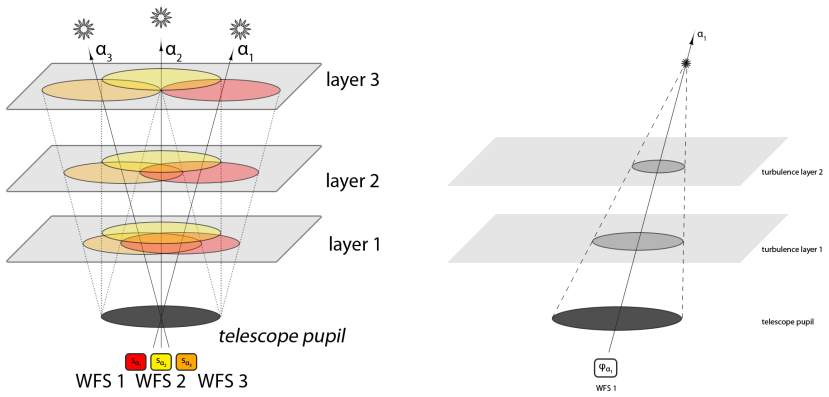


read the original abstract
Atmospheric tomography, the problem of reconstructing atmospheric turbulence profiles from wavefront sensor measurements, is an integral part of many adaptive optics systems. It is used to enhance the image quality of ground-based telescopes, such as for the Multiconjugate Adaptive Optics Relay For ELT Observations (MORFEO) instrument on the Extremely Large Telescope (ELT). To solve this problem, a singular-value decomposition (SVD) based approach has been proposed before. In this paper, we focus on the numerical implementation of the SVD-based Atmospheric Tomography with Fourier Domain Regularization Algorithm (SAFR) and its performance for Multi-Conjugate Adaptive Optics (MCAO) systems. The key features of the SAFR algorithm are the utilization of the FFT and the pre-computation of computationally demanding parts. Together, this yields a fast algorithm with less memory requirements than commonly used Matrix Vector Multiplication (MVM) approaches. We evaluate the performance of SAFR regarding reconstruction quality and computational expense in numerical experiments using the simulation environment COMPASS, in which we use an MCAO setup resembling the physical parameters of the MORFEO instrument of the ELT.
Editorial analysis
A structured set of objections, weighed in public.
Referee Report
Summary. The manuscript presents the SAFR algorithm for solving the atmospheric tomography problem in multi-conjugate adaptive optics systems such as MORFEO on the ELT. It combines singular-value decomposition with Fourier-domain regularization and implements the solver using the FFT together with pre-computation of expensive operations, claiming both reduced runtime and lower memory footprint relative to conventional matrix-vector multiplication (MVM) approaches. Performance is assessed via numerical experiments in the COMPASS simulator configured with an MCAO setup whose parameters resemble those of the MORFEO instrument.
Significance. If the reported speed and memory advantages hold under realistic hardware constraints, the method could provide a practical route to real-time atmospheric tomography for extremely large telescopes, where latency and memory limits are critical. The combination of FFT-based operations and pre-computation is a standard technique; demonstrating measurable gains in this specific context would be of direct interest to the adaptive-optics instrumentation community.
major comments (2)
- [Numerical Experiments] Numerical Experiments section: The central performance claims (faster execution and lower memory than MVM) rest on COMPASS simulations with MORFEO-like parameters. The manuscript does not verify that the simulation reproduces real ELT hardware memory-access patterns, cache behavior, or data-transfer overheads; any systematic mismatch would undermine the reported computational advantage.
- [Abstract] Abstract and evaluation: Quantitative results for reconstruction quality (e.g., RMS wavefront error, Strehl ratio) and computational metrics (wall-clock time, memory footprint) with direct side-by-side comparison to MVM baselines are not supplied, preventing assessment of whether the claimed improvements are realized.
minor comments (2)
- Define all acronyms at first use (MCAO, ELT, MVM, FFT, SVD) and ensure consistent notation for the regularization parameter throughout the text.
- [Numerical Experiments] Add a brief statement on the assumed noise model and turbulence profile statistics used in the COMPASS runs to allow reproducibility.
Simulated Author's Rebuttal
We thank the referee for the detailed and constructive review of our manuscript on the SAFR algorithm. We address the two major comments point by point below, providing clarifications on the simulation approach and committing to enhancements in the presentation of quantitative results.
read point-by-point responses
-
Referee: [Numerical Experiments] Numerical Experiments section: The central performance claims (faster execution and lower memory than MVM) rest on COMPASS simulations with MORFEO-like parameters. The manuscript does not verify that the simulation reproduces real ELT hardware memory-access patterns, cache behavior, or data-transfer overheads; any systematic mismatch would undermine the reported computational advantage.
Authors: We acknowledge that COMPASS provides a high-fidelity but abstracted model of the computational workload rather than a cycle-accurate emulation of specific ELT hardware memory hierarchies or interconnect latencies. Our performance claims are grounded in measured operation counts, FFT-based complexity, and wall-clock timings within this standardized simulator, which is the accepted practice for algorithmic comparisons in the adaptive-optics literature. To strengthen the manuscript we will insert an explicit limitations paragraph in the Numerical Experiments section that discusses the gap between simulated and target-hardware behavior and notes that the reported gains are expected to translate under similar memory-bandwidth constraints. revision: partial
-
Referee: [Abstract] Abstract and evaluation: Quantitative results for reconstruction quality (e.g., RMS wavefront error, Strehl ratio) and computational metrics (wall-clock time, memory footprint) with direct side-by-side comparison to MVM baselines are not supplied, preventing assessment of whether the claimed improvements are realized.
Authors: The Numerical Experiments section already contains direct side-by-side comparisons of both reconstruction quality metrics (RMS wavefront error and Strehl ratio) and computational metrics (execution time and memory footprint) against MVM baselines for the MORFEO-like MCAO configuration. To make these results immediately visible to readers, we will revise the abstract to include the key quantitative values and the relative improvements over MVM. revision: yes
Circularity Check
SAFR derivation is a direct algorithmic construction with no circular reductions
full rationale
The paper presents SAFR as a numerical implementation of an SVD-based atmospheric tomography method augmented with Fourier domain regularization. Its central claims rest on explicit design choices: utilization of the FFT and pre-computation of demanding operations to achieve speed and lower memory footprint versus standard MVM. These are constructive engineering decisions, not quantities derived from or equivalent to fitted parameters, self-referential definitions, or prior results that the paper itself supplies. Evaluation occurs via COMPASS simulations with MORFEO-like MCAO parameters, supplying external empirical checks rather than a closed loop in which outputs are forced by construction. No load-bearing step reduces to its own inputs; any reference to a prior SVD approach is background and does not substitute for the present implementation details. The derivation chain is therefore self-contained.
Axiom & Free-Parameter Ledger
Lean theorems connected to this paper
-
IndisputableMonolith/Cost/FunctionalEquation.leanwashburn_uniqueness_aczel unclear?
unclearRelation between the paper passage and the cited Recognition theorem.
The key features of the SAFR algorithm are the utilization of the FFT and the pre-computation of computationally demanding parts... Φ_α,δ = IDFT2_L · B · DFT2_G · Ψ_δ
-
IndisputableMonolith/Foundation/AlphaCoordinateFixation.leancostAlphaLog_high_calibrated_iff unclear?
unclearRelation between the paper passage and the cited Recognition theorem.
we use a Tikhonov type filter of the form g_Tikh_α(s) := s/(s² + α)
What do these tags mean?
- matches
- The paper's claim is directly supported by a theorem in the formal canon.
- supports
- The theorem supports part of the paper's argument, but the paper may add assumptions or extra steps.
- extends
- The paper goes beyond the formal theorem; the theorem is a base layer rather than the whole result.
- uses
- The paper appears to rely on the theorem as machinery.
- contradicts
- The paper's claim conflicts with a theorem or certificate in the canon.
- unclear
- Pith found a possible connection, but the passage is too broad, indirect, or ambiguous to say the theorem truly supports the claim.
Reference graph
Works this paper leans on
-
[1]
New Reconstruction Approaches in Adaptive Optics for Extremely Large Telescopes
G. Auzinger. “New Reconstruction Approaches in Adaptive Optics for Extremely Large Telescopes”. PhD thesis. Johannes Kepler University Linz, 2017
work page 2017
-
[2]
The ill-conditioned nature of the limited angle tomography problem
M. Davison. “The ill-conditioned nature of the limited angle tomography problem”. In: SIAM J. Appl. Math.43 (1938), pp. 428–448
work page 1938
-
[3]
MAORY: A Multi-conjugate Adaptive Optics RelaY for the E-ELT
E. Diolaiti et al. “MAORY: A Multi-conjugate Adaptive Optics RelaY for the E-ELT”. In: Messenger(2010), 28–9
work page 2010
-
[4]
A modular pipelined implementation of large fast Fourier transforms
A. El-Khashab and E. Swartzlander. “A modular pipelined implementation of large fast Fourier transforms”. In:Conference Record of the Thirty-Sixth Asilomar Conference on Signals, Systems and Computers, 2002.Vol. 2. 2002, 995–999 vol.2.doi:10.1109/ACSSC. 2002.1196933
-
[5]
Inverse problems in astronomical optics
B. L. Ellerbroeck and C. R. Vogel. “Inverse problems in astronomical optics”. In:Inverse Problems25.6 (2009), p. 063001
work page 2009
-
[6]
B. Ellerbroek, L. Gilles, and C. Vogel. “A Computationally Efficient Wavefront Recon- structor for Simulation or Multi-Conjugate Adaptive Optics on Giant Telescopes”. In:Pro- ceedings of the SPIE. Ed. by P. L. Wizinowich and D. Bonaccini. Vol. 4839. Society of Photo-Optical Instrumentation Engineers (SPIE) Conference Series. 2003, pp. 989–1000. doi:10.111...
-
[7]
Numerical simulations of multiconjugate adaptive optics wavefront reconstruction on giant telescopes
B. L. Ellerbroek, L. Gilles, and C. R. Vogel. “Numerical simulations of multiconjugate adaptive optics wavefront reconstruction on giant telescopes”. In:Appl. Optics42 (2003), pp. 4811–4818
work page 2003
-
[8]
B. L. Ellerbroek and C. R. Vogel. “Simulations of closed-loop wavefront reconstruction for multiconjugate adaptive optics on giant telescopes”. In:Astronomical Adaptive Optics Systems and Applications. Ed. by R. K. Tyson and M. Lloyd-Hart. Vol. 5169. International Society for Optics and Photonics. SPIE, 2003, pp. 206 –217.doi:10.1117/12.506580
-
[9]
H. W. Engl, M. Hanke, and A. Neubauer.Regularization of inverse problems.English. Dordrecht: Kluwer Academic Publishers, 1996, pp. viii + 321.isbn: 0-7923-4157-0
work page 1996
-
[10]
An H 1 -Kaczmarz reconstructor for atmo- spheric tomography
M. Eslitzbichler, C. Pechstein, and R. Ramlau. “An H 1 -Kaczmarz reconstructor for atmo- spheric tomography”. In:Journal of Inverse and Ill-Posed Problems21 (June 2013).doi: 10.1515/jip-2013-0007. 19
-
[11]
ESO.Online description of OCTOPUS. Tech. rep. Accessed: 2025-03-31.url:http://www. eso.org/sci/facilities/develop/ao/tecno/octopus.html
work page 2025
-
[12]
F. Ferreira, D. Gratadour, A. Sevin, and N. Doucet. “COMPASS: An Efficient GPU-based Simulation Software for Adaptive Optics Systems”. In:2018 International Conference on High Performance Computing and Simulation (HPCS). IEEE, July 2018, pp. 180–187.doi: 10.1109/HPCS.2018.00043
-
[13]
Least-square fitting a wave-front distortion estimate to an array of phase- difference measurements
D. L. Fried. “Least-square fitting a wave-front distortion estimate to an array of phase- difference measurements”. In:J. Opt. Soc. Am.67.3 (Mar. 1977), pp. 370–375.doi:10. 1364/JOSA.67.000370
work page 1977
-
[14]
Optimal wave-front reconstruction strategies for multi conjugate adaptive optics
T. Fusco, J.-M. Conan, G. Rousset, L. M. Mugnier, and V. Michau. “Optimal wave-front reconstruction strategies for multi conjugate adaptive optics”. In:J. Opt. Soc. Am. A18 (2001), pp. 2527–2538
work page 2001
-
[15]
Tomography for multiconjugate adaptive optics systems using laser guide stars
D. T. Gavel. “Tomography for multiconjugate adaptive optics systems using laser guide stars”. In:Advancements in Adaptive Optics. Ed. by D. B. Calia, B. L. Ellerbroek, and R. Ragazzoni. Vol. 5490. International Society for Optics and Photonics. SPIE, 2004, pp. 1356 –1373.doi:10.1117/12.552402
-
[16]
The method of the approximate inverse for atmo- spheric tomography
D. Gerth, B. N. Hahn, and R. Ramlau. “The method of the approximate inverse for atmo- spheric tomography”. In:Inverse Problems31.6 (May 2015), p. 065002.doi:10.1088/0266- 5611/31/6/065002
-
[17]
Split atmospheric tomography using laser and natural guide stars
L. Gilles and B. L. Ellerbroeck. “Split atmospheric tomography using laser and natural guide stars”. In:J. Opt. Soc. Am.25 (2008), pp. 2427–2435
work page 2008
-
[18]
L. Gilles, B. Ellerbroek, and C. Vogel. “A comparison of Multigrid V-cycle versus Fourier Domain Preconditioning for Laser Guide Star Atmospheric Tomography”. In:Adaptive Op- tics: Analysis and Methods/Computational Optical Sensing and Imaging/Information Pho- tonics/Signal Recovery and Synthesis Topical Meetings on CD-ROM, OSA Technical Digest (CD). Opti...
work page 2007
-
[19]
Layer-Oriented Multigrid Wavefront Reconstruction Algorithms for Multi-Conjugate Adaptive Optics
L. Gilles, B. Ellerbroek, and C. Vogel. “Layer-Oriented Multigrid Wavefront Reconstruction Algorithms for Multi-Conjugate Adaptive Optics”. In:Proceedings of the SPIE. Ed. by P. L. Wizinowich and D. Bonaccini. Vol. 4839. Society of Photo-Optical Instrumentation Engineers (SPIE) Conference Series. 2003, pp. 1011–1022.doi:10.1117/12.459347
-
[20]
Preconditioned conjugate gradient wave- front reconstructors for multiconjugate adaptive optics
L. Gilles, B. L. Ellerbroek, and C. R. Vogel. “Preconditioned conjugate gradient wave- front reconstructors for multiconjugate adaptive optics”. In:Applied Optics42.26 (2003), pp. 5233–5250
work page 2003
-
[21]
Multigrid preconditioned conjugate-gradient method for large-scale wave-front reconstruction
L. Gilles, C. R. Vogel, and B. L. Ellerbroeck. “Multigrid preconditioned conjugate-gradient method for large-scale wave-front reconstruction”. In:J. Opt. Soc. Am. A19 (2002), pp. 1817–1822
work page 2002
-
[22]
A Pipeline Fast Fourier Transform
H. Groginsky and G. Works. “A Pipeline Fast Fourier Transform”. In:IEEE Transactions on ComputersC-19.11 (1970), pp. 1015–1019.doi:10.1109/T-C.1970.222826
-
[23]
A frame decomposition of the atmospheric tomography oper- ator
S. Hubmer and R. Ramlau. “A frame decomposition of the atmospheric tomography oper- ator”. In:Inverse Problems36.9 (2020), p. 094001.doi:10.1088/1361-6420/aba4fe
-
[24]
Frame Decompositions of Bounded Linear Operators in Hilbert Spaces with Applications in Tomography
S. Hubmer and R. Ramlau. “Frame Decompositions of Bounded Linear Operators in Hilbert Spaces with Applications in Tomography”. In:Inverse Problems37.5 (2021), p. 055001.doi: 10.1088/1361-6420/abe5b8
-
[25]
Characterizations of Adjoint Sobolev Embedding Operators with Applications in Inverse Problems
S. Hubmer, E. Sherina, and R. Ramlau. “Characterizations of Adjoint Sobolev Embedding Operators with Applications in Inverse Problems”. In:Electronic Transactions on Numerical Analysis59 (2023). Gold OA, pp. 116–144.doi:10.1553/etna_vol59s116. 20
-
[26]
Parallel pipeline fast fourier transformer
J. Johnston. “Parallel pipeline fast fourier transformer”. In:IEE Proceedings F (Commu- nications, Radar and Signal Processing)130 (6 1983), pp. 564–572.doi:10.1049/ip- f- 1.1983.0088
work page doi:10.1049/ip- 1983
-
[27]
J. Kolb, H. Gonzalez, C. Juan, and R. Tamai.Relevant Atmospheric Parameters for E-ELT AO Analysis and Simulations. ESO-258292 Issue, Technical report ESO, 2015
work page 2015
-
[28]
A. N. Kolmogorov.The local structure of turbulence in incompressible viscous fluid for very large reynolds numbers. In Dokl. Akad. Nauk SSSR volume 30, pages 299–303. 1941
work page 1941
-
[29]
Adaptive optics simulations for the European Extremely Large Telescope
M. Le Louarn, C. V´ erinaud, V. Korkiakoski, N. Hubin, and E. Marchetti. “Adaptive optics simulations for the European Extremely Large Telescope”. In:SPIE Astronomical Tele- scopes+ Instrumentation. International Society for Optics and Photonics. 2006, pp. 627234– 627234
work page 2006
-
[30]
Natterer.The Mathematics of Computerized Tomography
F. Natterer.The Mathematics of Computerized Tomography. Philadelphia, PA: Society for Industrial and Applied Mathematics, 2001.doi:10.1137/1.9780898719284
-
[31]
A Singular-Value-Type Decomposition for the Atmospheric Tomography Operator
A. Neubauer and R. Ramlau. “A Singular-Value-Type Decomposition for the Atmospheric Tomography Operator”. In:SIAM Journal on Applied Mathematics77.3 (2017), pp. 838– 853.doi:10.1137/16M108135X
-
[32]
A new temporal control approach for SCAO systems
M. Poettinger, R. Ramlau, and G. Auzinger. “A new temporal control approach for SCAO systems”. In:Inverse Problems36 (2019), p. 015002
work page 2019
-
[33]
Fast wave-front reconstruction in large adaptive optics systems with use of the Fourier transform
L. A. Poyneer, D. T. Gavel, and J. M. Brase. “Fast wave-front reconstruction in large adaptive optics systems with use of the Fourier transform”. In:Journal of the Optical Society of America A19.10 (Oct. 2002), p. 2100.issn: 1520-8532.doi:10.1364/JOSAA.19.002100
-
[34]
Fourier transform-wavefront reconstruction for the pyramid wavefront sensor
F. Quir´ os-Pacheco, C. Correia, and S. Esposito. “Fourier transform-wavefront reconstruction for the pyramid wavefront sensor”. In: AO4ELT (2010), p. 07005.doi:10.1051/ao4elt/ 201007005
-
[35]
Optimal mirror deformation for multi conju- gate adaptive optics systems
S. Raffetseder, R. Ramlau, and M. Yudytskiy. “Optimal mirror deformation for multi conju- gate adaptive optics systems”. In:Inverse Problems32.2 (2016), p. 025009.doi:10.1088/ 0266-5611/32/2/025009
work page 2016
-
[36]
Efficient iterative tip/tilt reconstruction for atmospheric tomography
R. Ramlau, A. Obereder, M. Rosensteiner, and D. Saxenhuber. “Efficient iterative tip/tilt reconstruction for atmospheric tomography”. In:Inverse Problems in Science and Engineer- ing22.8 (2014), pp. 1345–1366.doi:10.1080/17415977.2013.873534
-
[37]
An efficient solution to the atmospheric turbulence to- mography problem using Kaczmarz iteration
R. Ramlau and M. Rosensteiner. “An efficient solution to the atmospheric turbulence to- mography problem using Kaczmarz iteration”. In:Inverse Problems28 (2012), p. 095004
work page 2012
-
[38]
R. Ramlau and G. Teschke. “Regularization of Sobolev Embedding Operators and Appli- cations to Medical Imaging and Meteorological Data. Part I: Regularization of Sobolev Embedding Operators”. In:Sampling Theory in Signal and Image Processing3.2 (2004), pp. 175–195
work page 2004
-
[39]
An augmented wavelet reconstructor for atmospheric tomog- raphy
R. Ramlau and B. Stadler. “An augmented wavelet reconstructor for atmospheric tomog- raphy”. In:Electron. Trans. Numer. Anal.54 (2021), pp. 256–275.doi:10.1553/etna_ vol54s256
-
[40]
R. Ramlau and B. Stadler. “On some analytic properties of the atmospheric tomography operator: Non-Uniqueness and reconstructability issues”. In:Inverse Problems and Imaging 19.4 (2025), pp. 715–733.issn: 1930-8345.doi:10.3934/ipi.2024051
-
[41]
Roddier.Adaptive Optics in Astronomy
F. Roddier.Adaptive Optics in Astronomy. Cambridge University Press, 1999
work page 1999
-
[42]
V The Effects of Atmospheric Turbulence in Optical Astronomy
F. Roddier. “V The Effects of Atmospheric Turbulence in Optical Astronomy”. In: ed. by E. Wolf. Vol. 19. Progress in Optics. Elsevier, 1981, pp. 281–376.doi:https://doi.org/ 10.1016/S0079-6638(08)70204-X. 21
-
[43]
Cumulative Reconstructor: fast wavefront reconstruction algorithm for Extremely Large Telescopes
M. Rosensteiner. “Cumulative Reconstructor: fast wavefront reconstruction algorithm for Extremely Large Telescopes”. In:J. Opt. Soc. Am. A28 (2011), pp. 2132–2138
work page 2011
-
[44]
Wavefront reconstruction for extremely large telescopes via CuRe with domain decomposition
M. Rosensteiner. “Wavefront reconstruction for extremely large telescopes via CuRe with domain decomposition”. In:J. Opt. Soc. Am. A29 (2012), pp. 2328–2336
work page 2012
-
[45]
The Kaczmarz algorithm for multi-conjugate adaptive optics with laser guide stars
M. Rosensteiner and R. Ramlau. “The Kaczmarz algorithm for multi-conjugate adaptive optics with laser guide stars”. In:J. Opt. Soc. Am.30 (2013), pp. 1680–1686
work page 2013
-
[46]
D. Saxenhuber. “Gradient-based reconstruction algorithms for atmospheric tomography in Adaptive Optics systems for Extremely Large Telescopes”. 2016
work page 2016
-
[47]
A Gradient-based method for atmospheric tomography
D. Saxenhuber and R. Ramlau. “A Gradient-based method for atmospheric tomography”. In:Inverse Problems and Imaging10.3 (2016), pp. 781–805.doi:10.3934/ipi.2016022
-
[48]
Comparison of methods for the reduction of reconstructed layers in atmospheric tomography
D. Saxenhuber, G. Auzinger, M. L. Louarn, and T. Helin. “Comparison of methods for the reduction of reconstructed layers in atmospheric tomography”. In:Appl. Opt.56.10 (Apr. 2017), pp. 2621–2629.doi:10.1364/AO.56.002621
-
[49]
I. Shatokhina, A. Obereder, M. Rosensteiner, and R. Ramlau. “Preprocessed cumulative reconstructor with domain decomposition: a fast wavefront reconstruction method for pyra- mid wavefront sensor”. In:Applied Optics52.12 (Apr. 2013), p. 2640.issn: 2155-3165.doi: 10.1364/AO.52.002640
-
[50]
Real-time computing methods for astronomical adaptive optics
B. Stadler. “Real-time computing methods for astronomical adaptive optics”. PhD thesis. Johannes Kepler Universit¨ at Linz, 2021
work page 2021
-
[51]
Parallel implementation of an iterative solver for atmospheric tomography
B. Stadler, R. Biasi, M. Manetti, and R. Ramlau. “Parallel implementation of an iterative solver for atmospheric tomography”. In:2021 21st International Conference on Computa- tional Science and Its Applications (ICCSA). 2021, pp. 123–132.doi:10.1109/ICCSA54496. 2021.00026
-
[52]
B. Stadler and R. Ramlau. “Performance of an iterative wavelet reconstructor for the Multi- conjugate Adaptive Optics RelaY of the Extremely Large Telescope”. In:Journal of As- tronomical Telescopes, Instruments, and Systems8.2 (2022), p. 021503.doi:10.1117/1. JATIS.8.2.021503
work page doi:10.1117/1 2022
-
[53]
Fractal iterative method for fast atmospheric tomography on extremely large telescopes
M. Tallon et al. “Fractal iterative method for fast atmospheric tomography on extremely large telescopes”. In:Adaptive Optics Systems II, no. 7736 in Proc. SPIE. 2010, pp. 77360X– 77360X–10
work page 2010
-
[54]
Performances of MCAO on the E-ELT using the fractal iterative method for fast atmospheric tomography
M. Tallon et al. “Performances of MCAO on the E-ELT using the fractal iterative method for fast atmospheric tomography”. In:Second International Conference on Adaptive Optics for Extremely Large Telescopes. 2011, p. 63
work page 2011
-
[55]
Fast minimum variance wavefront reconstruction for extremely large telescopes
E. Thi´ ebaut and M.Tallon. “Fast minimum variance wavefront reconstruction for extremely large telescopes”. In:J. opt. Soc. Am. A27 (2010), pp. 1046–1059
work page 2010
-
[56]
Isoplanatism in a multiconjugate adaptive optics system
A. Tokovinin, M. L. Louarn, and M. Sarazin. “Isoplanatism in a multiconjugate adaptive optics system”. In:J. Opt. Soc. Am. A17.10 (2000), pp. 1819–1827.doi:10.1364/JOSAA. 17.001819
-
[57]
C. Vogel and Q. Yang. “Fast optimal wavefront reconstruction for multi-conjugate adaptive optics using the Fourier domain preconditioned conjugate gradient algorithm”. In:Optics Express15 (2006), pp. 7487–7498
work page 2006
-
[58]
Multigrid algorithm for least-squares wavefront reconstruction
C. R. Vogel and Q. Yang. “Multigrid algorithm for least-squares wavefront reconstruction”. In:Applied Optics45.4 (Feb. 2006), p. 705.issn: 1539-4522.doi:10.1364/AO.45.000705
-
[59]
Realization of the Frame Decomposition of the Atmospheric Tomography Operator
L. Weissinger. “Realization of the Frame Decomposition of the Atmospheric Tomography Operator”. MA thesis. JKU Linz, 2021.url:https : / / lisss . jku . at / permalink / f / n2r1to/ULI_alma5185824070003340. 22
work page 2021
-
[60]
Singular value and frame decomposition-based reconstruction for atmospheric tomography
L. Weissinger, S. Hubmer, B. Stadler, and R. Ramlau. “Singular value and frame decomposition-based reconstruction for atmospheric tomography”. In:Inverse Problems on Large Scales. Ed. by B. Mejri, R. Ramlau, and O. Scherzer. Berlin, Boston: De Gruyter, 2025, pp. 151–180.isbn: 9783111357270.doi:doi:10.1515/9783111357270-008
-
[61]
Fourier domain preconditioned conjugate gradient algorithm for atmospheric tomography
Q. Yang, C. R. Vogel, and B. L. Ellerbroek. “Fourier domain preconditioned conjugate gradient algorithm for atmospheric tomography”. In:Appl. Optics45 (2006), pp. 5281– 5293
work page 2006
-
[62]
Wavelet methods in adaptive optics
M. Yudytskiy. “Wavelet methods in adaptive optics”. PhD thesis. Johannes Kepler Univer- sity Linz, Austria, 2014
work page 2014
-
[63]
A frequency dependent preconditioned wavelet method for atmospheric tomography
M. Yudytskiy, T. Helin, and R. Ramlau. “A frequency dependent preconditioned wavelet method for atmospheric tomography”. In:Proceedings of the Third AO4ELT Conference, S. Esposito and L. Fini, eds., Firenze. 2013.doi:10.12839/AO4ELT3.13433
-
[64]
Finite element-wavelet hybrid algorithm for at- mospheric tomography
M. Yudytskiy, T. Helin, and R. Ramlau. “Finite element-wavelet hybrid algorithm for at- mospheric tomography”. In:J. Opt. Soc. Am. A31 (2014), pp. 550–560. 23
work page 2014
discussion (0)
Sign in with ORCID, Apple, or X to comment. Anyone can read and Pith papers without signing in.