REVIEW 5 major objections 5 minor 53 references
Enhanced Evolutionary Multi-Objective Deep Reinforcement Learning for Reliable and Efficient Wireless Rechargeable Sensor Networks
T0 review · 5 major / 5 minor · reviewed 2026-08-04 · deepseek-v4-flash
Pith's one-line read An LSTM-enhanced multi-objective deep reinforcement learning algorithm is claimed to solve the trade-off between node survival and charging energy efficiency in wireless rechargeable sensor networks, lifting survival by nearly 3% over the s
desk verdict A readable, incremental extension of the same group's EMODRL framework; the idea is coherent, but the empirical case rests on internal baselines and unquantified reward weights. read the letter →
The pith
A machine-rendered reading of the paper's core claim, the machinery that carries it, and where it could break.
The reading
What carries the argument
The central object is EMOPPO-TML, a PPO-based evolutionary multi-objective DRL algorithm built on three mechanisms. (1) An LSTM-based policy network captures temporal dependencies in node energy levels and charger positions. (2) An MLP-based prospective increment model takes a weight-policy pair (w, F(π)) as input and predicts the incremental objective change ΔF, letting task selection prefer promising mutations. (3) A time-varying Pareto policy evaluation score E_val = αH + (1−α)D combines hypervolume H and a sparsity/distance measure D, with α increasing over generations to shift from exploration to exploitation. The vector-valued reward r(t) = [r1(t), r2(t)] decomposes survival and effici
What would settle it
A direct falsifier would be a hardware field test — or high-fidelity measured channel data — in which the predicted received power α/(d+β)^2 and the linear movement-cost model are checked against actual measurements; if realized charging efficiency or movement costs differ substantially across the operating range, the simulation-driven 3%, 10%, and 25% claims lose their foundation. A sharper algorithmic falsifier: remove the threshold-based recharging rule and let the policy learn ξ_t; if the 10% LSTM energy-efficiency advantage disappears, the gain is partly rule-based rather than due to temp
Extended reading notes
Core claim
The central claim is that the multi-objective mobile-charger path-planning problem, which the paper proves NP-hard by reduction to the traveling salesman problem, can be solved in practice by modeling it as a multi-objective Markov decision process and evolving a population of PPO agents, each assigned a different objective-weight vector. Each agent's policy network is augmented with an LSTM layer so that charging decisions reflect the history of energy states; an MLP 'prospective increment' model predicts how much a candidate weight-policy pair would improve the objectives; and a time-varying evaluation score, balancing hypervolume coverage and sparsity with a generation-dependent coefficie
Load-bearing premise
The paper's central claim rests on the assumption that its simulated environment and the proxy rewards in Eq. (18) faithfully represent real wireless charging physics and operator objectives; if the Friis-based power model, linear movement energy, or the never-quantified reward weights misrepresent field conditions, the reported survival and efficiency gains are simulation artifacts.
Editorial extensions
If this is right
- Mobile-charger routing can be treated as a multi-objective learning problem, giving operators a Pareto archive of policies to choose from based on current mission priorities.
- LSTM memory in the policy network appears to cut the energy-efficiency penalty from long-horizon decisions by about 10% relative to memoryless PPO.
- The MLP prospective increment model converts blind evolutionary task selection into prediction-guided selection, which the authors link to faster convergence (25%).
- The time-varying Pareto evaluation shifts automatically from exploration to exploitation, which the paper says improves stability under dynamic and doubled energy-consumption patterns.
- Each of the three components is a separable improvement: the ablation chain I-P, I-PL, I-PLT shows measurable gains at every step.
Reading between the lines
- Editorial inference: the headline percentages (3%, 10%, 25%) are computed inside the authors' simulation, and the reward weights a, b, c in Eq. (18) are never specified; re-running the comparison after sweeping those weights would show whether the Pareto front is an artifact of the proxy reward.
- Editorial inference: because the charger's self-recharging decision ξ_t is replaced by a hand-set emergency threshold plus a distance condition, part of the 'learned' policy is actually a rule; learning ξ_t would reveal how much of the energy-efficiency gain comes from LSTM temporal modeling rather than from the threshold rule.
- Editorial inference: if the approach generalizes, the same three-component recipe — recurrent memory, a forward-gain surrogate, and adaptive Pareto evaluation — could be applied to other multi-objective sequential decision problems such as UAV trajectory planning or energy-harvesting sensor scheduling, but the paper itself only demonstrates it on this simulated WRSN scenario.
Editorial analysis
A structured set of objections, weighed in public.
Referee Report
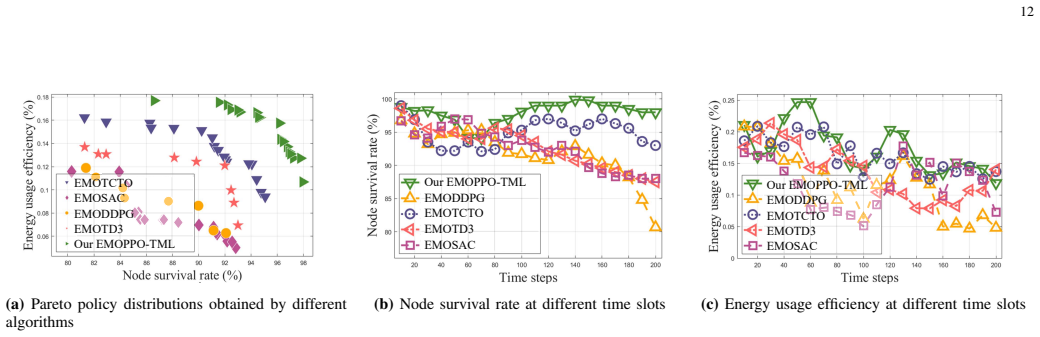
Summary. The paper studies a wireless rechargeable sensor network (WRSN) with a mobile charger and a recharging pile. It formulates a multi-objective optimization problem (Eq. 13) that maximizes average node survival rate (f1, Eq. 10) and average energy usage efficiency (f2, Eq. 12) over time slots, and argues NP-hardness via a TSP reduction. The proposed algorithm, EMOPPO-TML, extends the authors' earlier EMODRL framework [37] with three ingredients: an LSTM-based PPO policy network, an MLP-based prospective increment model for task selection, and a time-varying Pareto policy evaluation method. The paper reports simulation results claiming that EMOPPO-TML outperforms four re-implemented baselines (EMOTCTO, EMODDPG, EMOTD3, EMOSAC), with a nearly 3% higher node survival rate than EMOTCTO, a 10% energy-efficiency improvement from LSTM integration, and 25% faster convergence.
Significance. If the performance claims are validated, the paper would provide a useful incremental contribution: an application of evolutionary multi-objective DRL to WRSN charging, with LSTM and MLP augmentations that improve temporal decision-making. The algorithms are specified in enough detail to be reimplemented, and the complexity analysis is a useful addition. However, the current evidence is not yet sufficient to establish the central claim of superior Pareto-optimal performance. The load-bearing issues are the unquantified and unvalidated proxy reward function, the absence of any seed statistics or convergence curves, and the fact that all baselines are internal variants of the same framework. These are fixable with additional experiments and analysis, so the result is potentially sound but not yet demonstrated.
major comments (5)
- [V.A.3, Eq. (18)] The vector reward r(t) in Eq. (18) is the only objective optimized by the PPO update in Eq. (21), but the weights a, b, c and the auxiliary terms r_bound, r_charge are never reported, and no evidence is given that maximizing this proxy corresponds to maximizing f1 (Eq. 10) and f2 (Eq. 12). The Pareto archive and the claimed gains (3% survival-rate, 10% energy efficiency, 25% convergence) may therefore be artifacts of reward shaping. Please report all parameter values, provide a sensitivity analysis over them, and demonstrate that non-dominated sets in proxy space coincide with non-dominated sets in (f1, f2) space.
- [VI.B, Figs. 4-8] All performance comparisons appear to be based on single simulation runs: no error bars, seed counts, confidence intervals, or significance tests are reported. In particular, the abstract's claim of 25% faster convergence is not supported by any convergence curve or quantitative measurement. Multi-seed results with statistical summaries are required before the quantitative superiority claims can be assessed.
- [VI.A.3] All four baselines are constructed by inserting different RL cores into the same EMORL/multi-task skeleton, and EMOTCTO [33] is itself an adapted version of the authors' earlier framework [37]. No independent published WRSN charging-scheduling or path-planning method is compared. Thus, the claim of 'outperforms existing approaches' is not tested against the broader literature. Please add at least one recent non-DRL or DRL WRSN method from the literature with original (or independently reproduced) results, or explicitly scope the claims to internal framework variants.
- [V.B.5, Algorithm 5] The evaluation formula is internally inconsistent: the text states E_val = αH + (1−α)D, while Algorithm 5 line 11 returns R ← H − αD. Moreover, the distance metric D is accumulated as λ_t Dist_i + (1−λ_t)/Closeness_i (line 9), which is not defined as a single scalar. Without a unique and unambiguous definition, the time-varying Pareto evaluation method is not reproducible, and the ablation results for I-PLT cannot be interpreted.
- [V.A.2, Eq. (16)] The action space (16) omits the recharging decision ξ_t, which is listed as a decision variable in problem (13). It is replaced by an unspecified 'predefined emergency threshold' and a rule that returns the charger to the pile when 'the distance is sufficiently small' (Section V.A.2). Since ξ_t is part of the stated optimization problem and directly affects energy efficiency, the threshold values must be reported and the heuristic must be justified, or ξ_t should be included in the action space.
minor comments (5)
- [VI.B.1] The proposed algorithm is referred to as 'EMODRL-TML' in the first sentence; should be 'EMOPPO-TML' for consistency.
- [Fig. 5 caption] The caption says 'obtained by different baselines' but the figure includes 'Our EMOPPO-TML'; please rephrase to avoid ambiguity.
- [VI.A.2] 'One LSTM layer with 574,976 neurons' is not a plausible neuron count; likely 574,976 parameters. Please correct.
- [Eq. (18)] The term E_charge(t)/E_sum(t) in r2 is undefined if E_sum(t)=0; add a small positive constant or a safeguard.
- [Theorem 1] The NP-hardness proof is sketched via a TSP reduction but the polynomial-time construction from TSP instances to the WRSN problem is not formalized; please provide explicit mapping details or a reference to a complete reduction.
Circularity Check
No significant circularity: claimed gains are empirical, not definitionally forced.
full rationale
The paper's derivation chain is not circular. The objectives f1 (Eq. 10) and f2 (Eq. 12) are defined from network quantities (survival count and received vs. expended energy) independently of the algorithm; the MOMDP reward (Eq. 18) is explicitly a shaped proxy, and the paper does not claim r(t) is identical to (f1,f2). The Pareto archive is updated by non-dominated selection on objective vectors F(pi) in Algorithms 1 and 3, so the reported Pareto front is not just the reward function relabeled. The three headline improvements (3% survival gain, 10% energy-efficiency gain, 25% faster convergence) are outputs of the simulations and ablations in Section VI, not consequences of the definitions. The EMODRL skeleton is imported from the authors' prior work [37], and the LSTM policy cites [41] with overlapping authorship, but the performance claims are not carried by these citations alone; they are measured against controlled baselines and ablations. Whether those baselines are sufficiently external is a correctness/external-validity issue, not a circular reduction. Two non-circular flaws are flagged for completeness: the unquantified reward weights a,b,c in Eq. (18) weaken the surrogate-objective link, and the text's E_val = alpha*H + (1-alpha)*D in Section V.B.5 contradicts Algorithm 5's R <- H - alpha*D. Neither makes the purported result equal to its input by construction.
Assumptions & free parameters
free parameters (6)
- reward shaping weights a, b, c =
not reported
- time-varying evaluation coefficient α(t) =
not reported (text says 'α increases over iterations')
- time-varying decay factor λ_t =
not reported
- charger return-to-pile thresholds =
not reported
- sensor energy consumption rate δ_i range =
not reported
- MLP prospective increment model architecture =
not reported
assumptions (6)
- domain assumption Friis/WISP distance-squared power transfer (Eqs. 1-3)
- domain assumption Inductive-coupling charging-pile efficiency (Eq. 4)
- standard math PPO clipped surrogate objective + GAE and linear scalarization (Eqs. 19-21)
- standard math TSP is NP-hard and ordering over T fixed charging locations reduces to a TSP-like problem (Theorem 1)
- ad hoc to paper The purpose-built simulator (Section VI.A) faithfully represents real WRSN dynamics
- ad hoc to paper Proxy rewards (Eq. 18) are aligned with the stated objectives f1/f2 (Eqs. 10, 12)
invented entities (1)
-
MLP-based prospective increment model M_i
Cite this review
Pith. "Pith review of Enhanced Evolutionary Multi-Objective Deep Reinforcement Learning for Reliable and Efficient Wireless Rechargeable Sensor Networks." pith.science (2026). https://pith.science/paper/7UTCISXZ
@misc{pith2026251021127,
  author       = {Pith},
  title        = {Pith review of: Enhanced Evolutionary Multi-Objective Deep Reinforcement Learning for Reliable and Efficient Wireless Rechargeable Sensor Networks},
  year         = {2026},
  howpublished = {\url{https://pith.science/paper/7UTCISXZ}},
  note         = {Machine review of arXiv:2510.21127}
}
read the original abstract
Despite rapid advancements in sensor networks, conventional battery-powered sensor networks suffer from limited operational lifespans and frequent maintenance requirements that severely constrain their deployment in remote and inaccessible environments. As such, wireless rechargeable sensor networks (WRSNs) with mobile charging capabilities offer a promising solution to extend network lifetime. However, WRSNs face critical challenges from the inherent trade-off between maximizing the node survival rates and maximizing charging energy efficiency under dynamic operational conditions. In this paper, we investigate a typical scenario where mobile chargers move and charge the sensor, thereby maintaining the network connectivity while minimizing the energy waste. Specifically, we formulate a multi-objective optimization problem that simultaneously maximizes the network node survival rate and mobile charger energy usage efficiency across multiple time slots, which presents NP-hard computational complexity with long-term temporal dependencies that make traditional optimization approaches ineffective. To address these challenges, we propose an enhanced evolutionary multi-objective deep reinforcement learning algorithm, which integrates a long short-term memory (LSTM)-based policy network for temporal pattern recognition, a multilayer perceptron-based prospective increment model for future state prediction, and a time-varying Pareto policy evaluation method for dynamic preference adaptation. Extensive simulation results demonstrate that the proposed algorithm significantly outperforms existing approaches in balancing node survival rate and energy efficiency while generating diverse Pareto-optimal solutions. Moreover, the LSTM-enhanced policy network converges 25% faster than conventional networks, with the time-varying evaluation method effectively adapting to dynamic conditions.
Figures


Figures from the paper (5 more)


Reference graph
Works this paper leans on
-
[37]
Collaborative ground-space communications via evolutionary multi-objective deep reinforcement learning,
J. Li, G. Sun, Q. Wu, D. Niyato, J. Kang, A. Jamalipour, and V . C. M. Leung, “Collaborative ground-space communications via evolutionary multi-objective deep reinforcement learning,”IEEE J. Sel. Areas Com- mun., vol. 42, no. 12, pp. 3395–3411, 2024
2024
-
[33]
Evolutionary multi-objective reinforcement learning based trajectory control and task offloading in UA V-assisted mobile edge computing,
F. Song, H. Xing, X. Wang, S. Luo, P. Dai, Z. Xiao, and B. Zhao, “Evolutionary multi-objective reinforcement learning based trajectory control and task offloading in UA V-assisted mobile edge computing,” IEEE Trans. Mob. Comput., vol. 22, no. 12, pp. 7387–7405, 2023
2023
-
[1]
Directional mobile charger scheduling strategy based on adaptive dual-threshold,
H. Yao, C. Xiao, Y . Yang, and O. Postolache, “Directional mobile charger scheduling strategy based on adaptive dual-threshold,”Proc. IEEE J.Sens, vol. 24, no. 11, pp. 18 467–18 478, 2024
2024
-
[2]
Multi-objective uplink data transmission optimization for edge computing in UA V-assistant mobile wireless sensor networks,
J. Li, G. Sun, S. Liang, Y . Wang, and A. Wang, “Multi-objective uplink data transmission optimization for edge computing in UA V-assistant mobile wireless sensor networks,”J. Syst. Archit., vol. 132, p. 102744, 2022
2022
-
[3]
Energy harvesting in wireless sensor networks: A taxonomic survey,
J. Singh, R. Kaur, and D. Singh, “Energy harvesting in wireless sensor networks: A taxonomic survey,”Proc. Wiley IJER, vol. 45, no. 1, pp. 118–140, 2021
2021
-
[4]
Mobile charging strategy for wireless rechargeable sensor networks,
T. Chen, J. Chen, X. Gao, and T. Chen, “Mobile charging strategy for wireless rechargeable sensor networks,”Sensors, vol. 22, no. 1, p. 359, 2022
2022
-
[5]
Energy harvesting techniques for wireless sensor networks: A systematic literature review,
B. Y . L. Avila, C. A. G. Vazquez, O. P. Baluja, D. T. Cotfas, and P. A. Cotfas, “Energy harvesting techniques for wireless sensor networks: A systematic literature review,”Proc. Elsevier Energy Strategy Reviews, vol. 57, p. 101617, 2025
2025
-
[6]
Charging strategy and scheduling algorithm for directional wireless power transfer in wrsns,
Y . Yu and Q. Cheng, “Charging strategy and scheduling algorithm for directional wireless power transfer in wrsns,”Proc. Elsevier AEJ, vol. 61, no. 10, pp. 8315–8324, 2022
2022
Show all 53 references
-
[7]
An on-demand charging for connected target coverage in WRSNs using fuzzy logic and Q-learning,
P. L. Nguyen, L. V . Quan, A. D. Nguyen, T. Nguyen, and K. Nguyen, “An on-demand charging for connected target coverage in WRSNs using fuzzy logic and Q-learning,”Sensors, vol. 21, no. 16, p. 5520, 2021
2021
-
[8]
Poised: Probabilistic on-demand charging scheduling for isac-assisted wrsns with multiple mobile charging vehicles,
M. U. F. Qaisar, W. Yuan, P. Bellavista, F. Liu, G. Han, R. S. Zakariyya, and A. Ahmed, “Poised: Probabilistic on-demand charging scheduling for isac-assisted wrsns with multiple mobile charging vehicles,”IEEE Trans. Mob. Comput., vol. 23, no. 12, pp. 10 818–10 834, 2024
2024
-
[9]
Adaptive mobile chargers scheduling scheme based on AHP-MCDM for WRSN,
K. Makanda, A. Hawbani, X. Wang, A. Naji, A. Y . Al-Dubai, L. Zhao, and S. H. Alsamhi, “Adaptive mobile chargers scheduling scheme based on AHP-MCDM for WRSN,”IEEE Trans. Sustain. Comput., vol. 10, no. 1, pp. 57–69, 2025
2025
-
[10]
Coverage and connectivity aware energy charging mechanism using mobile charger for WRSNs,
Y . Kan, C. Chang, C. Kuo, and D. S. Roy, “Coverage and connectivity aware energy charging mechanism using mobile charger for WRSNs,” IEEE Syst. J., vol. 16, no. 3, pp. 3993–4004, 2022
2022
-
[11]
Joint en- ergy loss and time span minimization for energy-redistribution-assisted charging of WRSNs with a mobile charger,
Z. Gao, Y . Chen, L. Fan, H. Wang, S. C. Huang, and H. Wu, “Joint en- ergy loss and time span minimization for energy-redistribution-assisted charging of WRSNs with a mobile charger,”IEEE Internet Things J., vol. 10, no. 5, pp. 4636–4651, 2023
2023
-
[12]
A periodic multinode charging and data collection scheme with optimal traveling path in WRSNs,
Z. Lyu, Z. Wei, X. Wang, Y . Fan, C. Xia, and L. Shi, “A periodic multinode charging and data collection scheme with optimal traveling path in WRSNs,”IEEE Syst. J., vol. 14, no. 3, pp. 3518–3529, 2020
2020
-
[13]
Energy re- distribution assisted charging of WRSNS with multiple mobile chargers having multiple base stations,
Y . Chen, H. Wang, D. Chen, Y . Jiang, Z. Gao, and J. Cao, “Energy re- distribution assisted charging of WRSNS with multiple mobile chargers having multiple base stations,”Ad Hoc Networks, vol. 148, p. 103213, 2023
2023
-
[14]
Bus network assisted drone scheduling for sustainable charging of wireless rechargeable sensor network,
Y . Jin, J. Xu, S. Wu, L. Xu, D. Yang, and K. Xia, “Bus network assisted drone scheduling for sustainable charging of wireless rechargeable sensor network,”J. Syst. Archit., vol. 116, p. 102059, 2021
2021
-
[15]
Energy-efficient directional charging strategy for wireless rechargeable sensor networks,
D. Lee, C. Lee, G. Jang, W. Na, and S. Cho, “Energy-efficient directional charging strategy for wireless rechargeable sensor networks,”IEEE Internet Things J., vol. 9, no. 19, pp. 19 034–19 048, 2022
2022
-
[16]
A deep reinforcement learning approach for online mobile charging scheduling with optimal quality of sensing coverage in wireless rechargeable sensor networks,
J. Li, H. Wang, C. Jiang, and W. Xiao, “A deep reinforcement learning approach for online mobile charging scheduling with optimal quality of sensing coverage in wireless rechargeable sensor networks,”Proc. Elsevier Ad Hoc Netw, vol. 156, p. 103431, 2024
2024
-
[17]
Multi-node charging planning algorithm with an energy-limited WCE in WRSNs,
Z. Lyu, Z. Wei, Y . Lu, X. Wang, M. Li, C. Xia, and J. Han, “Multi-node charging planning algorithm with an energy-limited WCE in WRSNs,” IEEE Access, vol. 7, pp. 47 154–47 170, 2019
2019
-
[18]
The path planning scheme for joint charging and data collection in WRSNs: A multi-objective optimization method,
Z. Wei, C. Xia, X. Yuan, R. Sun, Z. Lyu, L. Shi, and J. Ji, “The path planning scheme for joint charging and data collection in WRSNs: A multi-objective optimization method,”J. Netw. Comput. Appl., vol. 156, p. 102565, 2020
2020
-
[19]
Towards maximizing coverage of targets for wrsns by multiple chargers scheduling,
H. Xue, H. Chen, Z. Ni, X. Liu, and F. Xia, “Towards maximizing coverage of targets for wrsns by multiple chargers scheduling,”IEEE Trans. Mob. Comput., vol. 23, no. 10, pp. 9959–9970, 2024
2024
-
[20]
Scheduling of erd-assisted charging of a WRSN using a directional mobile charger,
Z. Gao, C. Liu, and Y . Chen, “Scheduling of erd-assisted charging of a WRSN using a directional mobile charger,”IEEE Trans. Mob. Comput., vol. 23, no. 6, pp. 6681–6696, 2024
2024
-
[21]
Joint resource management for energy-efficient UA V- assisted SWIPT-MEC: A deep reinforcement learning approach,
Y . Chen, H. Kang, J. Li, G. Sun, B. Wang, J. Wang, C. Liang, S. Liang, and D. Niyato, “Joint resource management for energy-efficient UA V- assisted SWIPT-MEC: A deep reinforcement learning approach,”IEEE Internet Things J., vol. 12, pp. 31 448–31 465, 2025
2025
-
[22]
Deep reinforce- ment learning-based dynamic charging–recycling scheme for wireless rechargeable sensor networks,
L. Li, Y . Feng, N. Liu, Y . Li, and J. Zhang, “Deep reinforce- ment learning-based dynamic charging–recycling scheme for wireless rechargeable sensor networks,”Proc. IEEE J.Sens, vol. 24, no. 9, pp. 15 457–15 471, 2024
2024
-
[23]
An improved deep Q-network approach for charging sequence scheduling with optimal mobile charging cost and charging efficiency in wireless rechargeable sensor networks,
C. Jiang, W. Chen, J. Wang, Z. Wang, and W. Xiao, “An improved deep Q-network approach for charging sequence scheduling with optimal mobile charging cost and charging efficiency in wireless rechargeable sensor networks,”Ad Hoc Networks, vol. 157, p. 103458, 2024
2024
-
[24]
Spatio-temporal optimization for charging scheduling in wireless rechargeable sensor networks,
Y . Hong, Y . Yang, C. Luo, D. Li, Y . Lu, and Z. Chen, “Spatio-temporal optimization for charging scheduling in wireless rechargeable sensor networks,”Proc. IEEE IoT-J, vol. 11, no. 2, pp. 3056–3067, 2023
2023
-
[25]
A survey on mobile charging techniques in wireless rechargeable sensor networks,
A. Kaswan, P. K. Jana, and S. K. Das, “A survey on mobile charging techniques in wireless rechargeable sensor networks,”IEEE Communi- cations Surveys & Tutorials, vol. 24, no. 3, pp. 1750–1779, 2022
2022
-
[26]
Multi-objective aerial IRS-assisted ISAC optimization via generative AI-enhanced deep reinforcement learning,
W. Xie, G. Sun, J. Wang, H. Du, J. Kang, K. Huang, and V . C. M. Leung, “Multi-objective aerial IRS-assisted ISAC optimization via generative AI-enhanced deep reinforcement learning,”CoRR, vol. abs/2502.10687, 2025
2025 arXiv
-
[27]
Optimal charging in wireless rechargeable sensor networks,
L. Fu, P. Cheng, Y . Gu, J. Chen, and T. He, “Optimal charging in wireless rechargeable sensor networks,”IEEE Trans. V eh. Technol., vol. 65, no. 1, pp. 278–291, 2016. 15
2016
-
[28]
A many-objective optimization charging scheme for wireless rechargeable sensor networks via mobile charging vehicles,
J. Li, G. Sun, A. Wang, M. Lei, S. Liang, H. Kang, and Y . Liu, “A many-objective optimization charging scheme for wireless rechargeable sensor networks via mobile charging vehicles,”Comput. Networks, vol. 215, p. 109196, 2022
2022
-
[29]
Review of inductively coupled power transfer for electric vehicle charging,
A. F. A. Aziz, M. F. Romlie, and Z. Baharudin, “Review of inductively coupled power transfer for electric vehicle charging,”Proc. Wiley IET Power Electronics, vol. 12, no. 14, pp. 3611–3623, 2019
2019
-
[30]
RLC: A reinforcement learning-based charging algorithm for mobile devices,
T. Liu, B. Wu, W. Xu, X. Cao, J. Peng, and H. Wu, “RLC: A reinforcement learning-based charging algorithm for mobile devices,” ACM Trans. Sens. Networks, vol. 17, no. 4, pp. 36:1–36:23, 2021
2021
-
[31]
UA V- enabled secure data collection and energy transfer in IoT via diffusion- model-enhanced deep reinforcement learning,
S. Liang, M. Yin, W. Xie, Z. Sun, J. Li, J. Wang, and H. Du, “UA V- enabled secure data collection and energy transfer in IoT via diffusion- model-enhanced deep reinforcement learning,”IEEE Internet Things J., vol. 12, pp. 13 455–13 468, 2025
2025
-
[32]
Multi- objective sparse synthesis optimization of concentric circular antenna array via hybrid evolutionary computation approach,
J. Li, G. Sun, A. Wang, X. Zheng, Z. Chen, S. Liang, and Y . Liu, “Multi- objective sparse synthesis optimization of concentric circular antenna array via hybrid evolutionary computation approach,”Expert Systems with Applications, vol. 231, p. 120771
-
[34]
Uav- enabled collaborative beamforming via multi-agent deep reinforcement learning,
S. Liu, G. Sun, J. Li, S. Liang, Q. Wu, P. Wang, and D. Niyato, “Uav- enabled collaborative beamforming via multi-agent deep reinforcement learning,”IEEE Trans. Mob. Comput., vol. 23, pp. 13 015–13 032, 2024
2024
-
[35]
Enhancing evolutionary multitasking for high-dimensional feature selection through task rele- vance evaluation and knowledge transfer,
W. Yu, H. Kang, J. Xu, J. Li, H. Li, and G. Sun, “Enhancing evolutionary multitasking for high-dimensional feature selection through task rele- vance evaluation and knowledge transfer,”Knowledge-Based Systems, p. 114076, 2025
2025
-
[36]
Joint task offloading and resource allocation in aerial-terrestrial UA V networks with edge and fog computing for post-disaster rescue,
G. Sun, L. He, Z. Sun, Q. Wu, S. Liang, J. Li, D. Niyato, and V . C. M. Leung, “Joint task offloading and resource allocation in aerial-terrestrial UA V networks with edge and fog computing for post-disaster rescue,” IEEE Trans. Mob. Comput., vol. 23, pp. 8582–8600, 2024
2024
-
[38]
Task delay and energy consumption minimization for low-altitude MEC via evolutionary multi-objective deep reinforcement learning,
G. Sun, W. Ma, J. Li, Z. Sun, J. Wang, D. Niyato, and S. Mao, “Task delay and energy consumption minimization for low-altitude MEC via evolutionary multi-objective deep reinforcement learning,”CoRR, 2025
2025
-
[39]
Age of information optimization in laser-charged UA V-assisted IoT networks: A multi-agent deep reinforcement learning method,
G. Sun, L. Zhang, J. Li, J. Wu, J. Wang, Z. Sun, C. Zhao, and V . C. M. Leung, “Age of information optimization in laser-charged UA V-assisted IoT networks: A multi-agent deep reinforcement learning method,” CoRR, vol. abs/2507.08429, 2025
2025 arXiv
-
[40]
Multi- objective sparse synthesis optimization of concentric circular antenna array via hybrid evolutionary computation approach,
J. Li, G. Sun, A. Wang, X. Zheng, Z. Chen, S. Liang, and Y . Liu, “Multi- objective sparse synthesis optimization of concentric circular antenna array via hybrid evolutionary computation approach,”Expert Syst. Appl., vol. 231, p. 120771, 2023
2023
-
[41]
Aerial reliable collaborative communications for terrestrial mobile users via evolutionary multi-objective deep reinforcement learning,
G. Sun, J. Xiao, J. Li, J. Wang, J. Kang, D. Niyato, and S. Mao, “Aerial reliable collaborative communications for terrestrial mobile users via evolutionary multi-objective deep reinforcement learning,”IEEE Trans. Mob. Comput., vol. 24, no. 7, pp. 5731–5748, 2025
2025
-
[42]
Information-aware driven dynamic LEO-RAN slicing algorithm joint with communication, computing, and caching,
G. Chen, S. Qi, F. Shen, Q. Zeng, and Y . Zhang, “Information-aware driven dynamic LEO-RAN slicing algorithm joint with communication, computing, and caching,”IEEE J. Sel. Areas Commun., vol. 42, no. 5, pp. 1044–1062, 2024
2024
-
[43]
Reliable and energy-efficient communications via collaborative beamforming for UA V networks,
X. Zheng, G. Sun, J. Li, S. Liang, Q. Wu, M. Yin, D. Niyato, and V . C. M. Leung, “Reliable and energy-efficient communications via collaborative beamforming for UA V networks,”IEEE Trans. Wirel. Commun., vol. 23, pp. 13 235–13 251, 2024
2024
-
[44]
Generative AI for lyapunov optimization theory in UA V-based low- altitude economy networking,
Z. Liu, D. Niyato, J. Wang, G. Sun, L. Huang, Z. Gao, and X. Wang, “Generative AI for lyapunov optimization theory in UA V-based low- altitude economy networking,”CoRR, vol. abs/2501.15928, 2025
2025 arXiv
-
[45]
Exploring multi-agent dynamics for generative AI and large language models in mobile edge networks,
X. Zheng, G. Sun, J. Li, J. Wang, D. Niyato, D. I. Kim, and P. Zhang, “Exploring multi-agent dynamics for generative AI and large language models in mobile edge networks,”IEEE Wireless Communications, 2025
2025
-
[46]
Time-varying multi-objective smart home appliances scheduling using fuzzy adaptive dynamic SPEA2 algorithm,
V . K. Maurya and S. J. Nanda, “Time-varying multi-objective smart home appliances scheduling using fuzzy adaptive dynamic SPEA2 algorithm,”Eng. Appl. Artif. Intell., vol. 121, p. 105944, 2023
2023
-
[47]
Euclidean distance estimation in incomplete datasets,
D. P. P. Mesquita, J. P. P. Gomes, A. H. S. J ´unior, and J. S. Nobre, “Euclidean distance estimation in incomplete datasets,”Neurocomputing, vol. 248, pp. 11–18, 2017
2017
-
[48]
Gaussian kernel opti- mization for pattern classification,
J. Wang, H. Lu, K. N. Plataniotis, and J. Lu, “Gaussian kernel opti- mization for pattern classification,”Pattern Recognit., vol. 42, no. 7, pp. 1237–1247, 2009
2009
-
[49]
Dynamic task planning for multi-arm apple-harvesting robots using LSTM-PPO reinforcement learning algorithm,
Z. Guo, H. Fu, J. Wu, W. Han, W. Huang, W. Zheng, and T. Li, “Dynamic task planning for multi-arm apple-harvesting robots using LSTM-PPO reinforcement learning algorithm,”Agriculture, vol. 15, no. 6, p. 588, 2025
2025
-
[50]
Charging UA V deployment for improving charging performance of wireless rechargeable sensor networks via joint optimization approach,
S. Liang, Z. Fang, G. Sun, C. Lin, J. Li, S. Li, and A. Wang, “Charging UA V deployment for improving charging performance of wireless rechargeable sensor networks via joint optimization approach,” Comput. Networks, vol. 201, p. 108573, 2021
2021
-
[51]
An improved DDPG algorithm based on evolution-guided transfer in reinforcement learning,
X. Bai and H. Wang, “An improved DDPG algorithm based on evolution-guided transfer in reinforcement learning,” inProc. IOP J.Phys.Comf.Ser, vol. 2711, no. 1, 2024, p. 012016
2024
-
[52]
Chaos-based reinforcement learning with TD3,
T. Matsuki, Y . Sakemi, and K. Aihara, “Chaos-based reinforcement learning with TD3,”arXiv preprint arXiv:2405.09086, 2024
2024
-
[53]
UA V 3D online track planning based on improved SAC algorithm,
Y . Zhou, J. Shu, H. Hao, H. Song, and X. Lai, “UA V 3D online track planning based on improved SAC algorithm,”Journal of the Brazilian Society of Mechanical Sciences and Engineering, vol. 46, no. 1, p. 12, 2024
2024
Reviewed August 4, 2026 · model on record in the stance chip above.
Discussion (0). Sign in to comment.