Magnesium Isotopic Detection in Cool Stars: Tracing Nucleosynthetic Signatures from MgH Features
Pith reviewed 2026-05-18 04:55 UTC · model grok-4.3
The pith
Seven MgH wavelength regions reliably extract magnesium isotopic ratios across M to G type stars.
A machine-rendered reading of the paper's core claim, the machinery that carries it, and where it could break.
Core claim
Spectrum synthesis of seven selected MgH band regions yields reproducible magnesium isotope ratios in cool stars from M to G types. The ratios measured for eight stars correlate strongly with europium abundances, consistent with 24Mg production by hydrostatic alpha-capture preceding the r-process, while barium shows no comparable correlation with 25Mg or 26Mg despite shared s-process origins.
What carries the argument
The spectrum synthesis pipeline that isolates isotopic shifts within chosen MgH wavelength regions.
If this is right
- The seven regions give consistent isotope ratios across dwarf and giant stars of different temperatures.
- 24Mg abundances track europium as expected from massive-star production sites.
- 25Mg and 26Mg lack correlation with barium, indicating separate nucleosynthetic channels.
- The selected regions supply a reproducible method for future measurements of magnesium isotopes in cool stars.
Where Pith is reading between the lines
- Applying the same seven regions to large spectroscopic surveys could tighten constraints on magnesium contributions from supernovae versus AGB stars in Galactic chemical-evolution models.
- The method could be extended to stars outside the current temperature and gravity range to test whether the regions remain clean at still lower or higher effective temperatures.
- The observed Eu–24Mg link might help separate contributions from different supernova progenitor masses in chemical-evolution simulations.
Load-bearing premise
Spectrum synthesis models correctly separate isotopic shifts in the selected MgH features without important unmodeled blending or systematic atmospheric-structure errors that change across the M-to-G range.
What would settle it
New high-resolution spectra of one of the three reference stars that return magnesium isotope ratios differing from the values reported here when the same seven regions are used.
Figures


read the original abstract
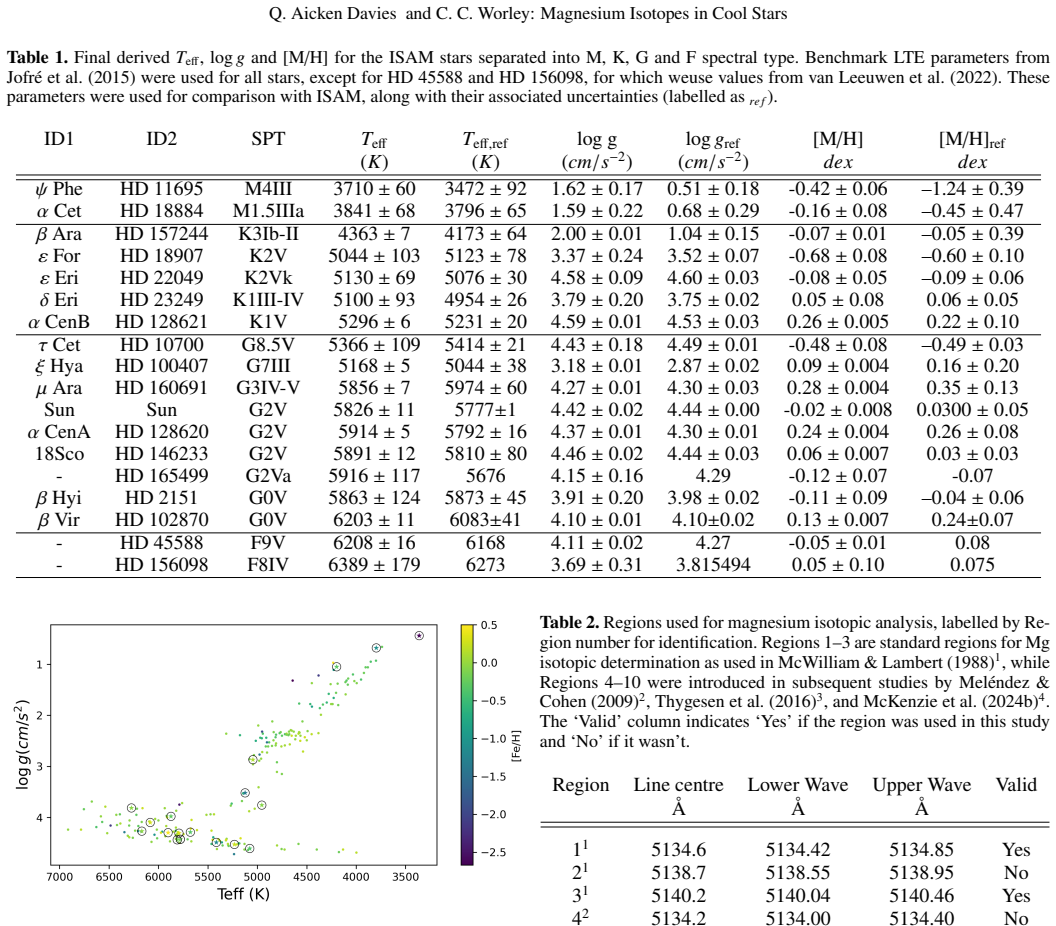
Magnesium (Mg) isotopic ratios offer valuable insights into stellar nucleosynthesis and Galactic chemical evolution, particularly in distinguishing contributions from supernovae and asymptotic giant branch (AGB) stars. These isotopes are accessible via MgH molecular features in cool stellar atmospheres, though their measurement remains challenging across spectral types. We assess the reliability of MgH spectral regions for extracting magnesium isotopic ratios ($^{24}$Mg, $^{25}$Mg, $^{26}$Mg) in stars from M to G types and evaluate consistency with nucleosynthetic expectations. Using spectrum synthesis, we applied an analysis pipeline, validated by three well-studied reference stars, to a sample of five additional dwarf and giant stars. Individual MgH band regions were analysed for sensitivity to isotopic variation. Europium (Eu) and barium (Ba) abundances were also measured to explore correlations with Mg isotopic ratios as r- and s-process proxies. Of ten previously studied MgH wavelength regions, we identify seven as most reliable for isotopic analysis; others showed limited sensitivity across stellar types. Derived Mg isotope ratios ($^{24}$Mg, $^{25}$Mg, $^{26}$Mg) include: HD 11695-81:7:12; HD 18884-81:7:12; HD 18907-69:9:23; HD 22049-71:16:13; HD 23249-66:13:22; HD 128621-67:17:16; HD 10700-78:10:12; HD 100407-65:10:25. Comparison of Eu abundances with Mg isotopes reveals strong correlations, particularly with ($^{24}$Mg, which is predominantly produced by hydrostatic $\alpha$-capture in massive stars, a process preceding the r-process responsible for Eu. In contrast, Ba shows no significant correlation with $^{25}$Mg or $^{26}$Mg, despite their shared s-process origin. Our results demonstrate that selected MgH regions can reliably measure Mg isotopes in cool stars, providing a reproducible framework for future studies of stellar nucleosynthesis and Galactic chemical evolution.
Editorial analysis
A structured set of objections, weighed in public.
Referee Report
Summary. The paper claims to have developed a spectrum synthesis pipeline for measuring magnesium isotopic ratios (24Mg:25Mg:26Mg) from MgH features in cool stars (M to G types). The pipeline is validated on three reference stars and then applied to five additional targets, identifying seven of ten previously studied MgH wavelength regions as reliable for isotopic analysis. Specific ratios are reported for eight stars (e.g., HD 11695 as 81:7:12), and correlations are explored between these ratios and Eu/Ba abundances as r- and s-process proxies, concluding that selected MgH regions provide a reproducible framework for nucleosynthesis and Galactic chemical evolution studies.
Significance. If the results hold, this work would supply a practical, reproducible method for extracting Mg isotopic ratios in cool stars, enabling better tracing of contributions from supernovae and AGB stars in stellar nucleosynthesis and Galactic chemical evolution. The reported correlations with Eu (particularly for 24Mg) could strengthen links between alpha-capture and r-process elements if quantitatively supported.
major comments (2)
- [Abstract] Abstract: The reported isotope ratios (e.g., HD 11695-81:7:12, HD 18907-69:9:23) are given without quantitative error bars, blending assessments, or sensitivity tests to Teff, log g, or [Fe/H]. This is load-bearing for the central claim that seven MgH regions are reliable across M-to-G types, because unmodeled blending or 1D/LTE atmospheric mismatches could introduce undetected systematic biases that vary with stellar parameters.
- [Validation] Validation section (inferred from abstract description): The pipeline validation on three reference stars is presented only through qualitative consistency statements, without reported quantitative metrics such as fit residuals, chi-squared values, or direct comparisons to literature isotopic ratios with uncertainties. This weakens the foundation for applying the pipeline to the target sample and asserting reliability.
minor comments (2)
- [Abstract] The isotope ratio notation (e.g., 81:7:12) should be explicitly defined as percentages or fractional abundances in the text or a table for clarity and reproducibility.
- [Results] The abstract mentions analysis of individual MgH band regions for isotopic sensitivity but does not specify which seven regions were selected or the criteria used; a table listing the regions and their performance metrics would improve transparency.
Simulated Author's Rebuttal
We thank the referee for their thoughtful and constructive report. The comments highlight important areas where the presentation of uncertainties and validation metrics can be strengthened to better support our claims regarding the reliability of the MgH regions. We address each major comment below and will revise the manuscript accordingly.
read point-by-point responses
-
Referee: [Abstract] Abstract: The reported isotope ratios (e.g., HD 11695-81:7:12, HD 18907-69:9:23) are given without quantitative error bars, blending assessments, or sensitivity tests to Teff, log g, or [Fe/H]. This is load-bearing for the central claim that seven MgH regions are reliable across M-to-G types, because unmodeled blending or 1D/LTE atmospheric mismatches could introduce undetected systematic biases that vary with stellar parameters.
Authors: We agree that the abstract would benefit from explicit mention of uncertainties and sensitivity considerations to bolster the reliability claim. While the full analysis in the manuscript employs spectrum synthesis with careful selection of regions to minimize blending (as detailed in the methods and results sections), we did not include quantitative error bars or parameter sensitivity tests in the abstract summary. In the revised manuscript, we will add estimated uncertainties derived from the fitting procedure (e.g., based on chi-squared minimization and Monte Carlo perturbations) and briefly note the outcomes of sensitivity tests to Teff, log g, and [Fe/H] for the selected regions. This will directly address potential systematic biases and strengthen the central claim without altering the reported ratios or conclusions. revision: yes
-
Referee: [Validation] Validation section (inferred from abstract description): The pipeline validation on three reference stars is presented only through qualitative consistency statements, without reported quantitative metrics such as fit residuals, chi-squared values, or direct comparisons to literature isotopic ratios with uncertainties. This weakens the foundation for applying the pipeline to the target sample and asserting reliability.
Authors: The validation on the three reference stars was based on direct comparison of our derived isotopic ratios to published literature values, confirming consistency within the ranges expected from prior studies. However, we acknowledge that the current presentation relies primarily on qualitative statements rather than quantitative fit metrics. To strengthen this foundation, the revised manuscript will include tabulated comparisons with literature values and uncertainties, along with example chi-squared statistics and residual assessments for the reference star fits. These additions will provide a more rigorous quantitative basis for extending the pipeline to the additional targets while preserving the existing validation approach. revision: yes
Circularity Check
No circularity: isotopic ratios derived from direct spectral fitting to observations
full rationale
The paper's central results consist of magnesium isotopic ratios extracted by applying spectrum synthesis to observed stellar spectra in selected MgH regions, after validation on three reference stars and sensitivity checks across seven additional targets. These ratios (e.g., 81:7:12 for HD 11695) are obtained by fitting the data rather than by any equation or self-citation that redefines the output in terms of the authors' own prior normalizations or fits. The selection of seven reliable regions out of ten is based on empirical sensitivity to isotopic variation within the current sample, not on a self-referential definition or imported uniqueness theorem. External correlations with Eu and Ba abundances are likewise measured independently. The derivation chain therefore remains self-contained against the observed spectra and standard synthesis methods.
Axiom & Free-Parameter Ledger
free parameters (1)
- isotopic fractions
axioms (1)
- domain assumption Local thermodynamic equilibrium holds in the line-forming layers of the program stars
Lean theorems connected to this paper
-
IndisputableMonolith/Foundation/RealityFromDistinction.leanreality_from_one_distinction unclear?
unclearRelation between the paper passage and the cited Recognition theorem.
We applied an analysis pipeline using spectrum synthesis to derive isotopic ratios, validated using three well-studied reference stars... Of ten previously studied MgH wavelength regions, we identify seven as most reliable
What do these tags mean?
- matches
- The paper's claim is directly supported by a theorem in the formal canon.
- supports
- The theorem supports part of the paper's argument, but the paper may add assumptions or extra steps.
- extends
- The paper goes beyond the formal theorem; the theorem is a base layer rather than the whole result.
- uses
- The paper appears to rely on the theorem as machinery.
- contradicts
- The paper's claim conflicts with a theorem or certificate in the canon.
- unclear
- Pith found a possible connection, but the passage is too broad, indirect, or ambiguous to say the theorem truly supports the claim.
Reference graph
Works this paper leans on
-
[1]
1985, Astronomy and Astrophysics, 151, 189, aDS Bibcode: 1985A&A...151..189B
Barbuy, B. 1985, Astronomy and Astrophysics, 151, 189, aDS Bibcode: 1985A&A...151..189B
work page 1985
-
[2]
1987, Astronomy and Astrophysics, 172, 251, aDS Bibcode: 1987A&A...172..251B
Barbuy, B. 1987, Astronomy and Astrophysics, 172, 251, aDS Bibcode: 1987A&A...172..251B
work page 1987
-
[3]
2014, Astronomy & Astrophysics, 569, A111, publisher: EDP Sciences
Blanco-Cuaresma, S., Soubiran, C., Heiter, U., & Jofré, P. 2014, Astronomy & Astrophysics, 569, A111, publisher: EDP Sciences
work page 2014
-
[4]
Buder, S., Sharma, S., Kos, J., et al. 2021, Monthly Notices of the Royal Astronomical Society, 506, 150, publisher: OUP ADS Bibcode: 2021MN- RAS.506..150B
work page 2021
-
[5]
Cowan, G. 1998 De Bièvre, P. & Barnes, I. L. 1985, International Journal of Mass Spectrometry and Ion Processes, 65, 211
work page 1998
-
[6]
Gay, P. L. & Lambert, D. L. 2000, The Astrophysical Journal, 533, 260, pub- lisher: IOP Publishing
work page 2000
- [7]
-
[8]
2023, Astronomy & Astrophysics, 670, A19, publisher: EDP Sciences
Golovin, A., Reffert, S., Just, A., et al. 2023, Astronomy & Astrophysics, 670, A19, publisher: EDP Sciences
work page 2023
-
[9]
Gray, D. F. 2005, The Observation and Analysis of Stellar Photospheres, 3rd edn. (Cambridge: Cambridge University Press)
work page 2005
-
[10]
Grevesse, N., Asplund, M., & Sauval, A. J. 2007, Space Science Reviews, 130, 105, aDS Bibcode: 2007SSRv..130..105G
work page 2007
-
[11]
d., Recio-Blanco, A., & Prantzos, N
Guiglion, G., Laverny, P. d., Recio-Blanco, A., & Prantzos, N. 2018, Astronomy & Astrophysics, 619, A143, publisher: EDP Sciences
work page 2018
-
[12]
Harris, C. R., Millman, K. J., Walt, S. J. v. d., et al. 2020, Nature, 585, 357, publisher: Springer Science and Business Media LLC
work page 2020
-
[13]
Hearnshaw, J. B. 1986, Astrophysics and Space Science, 118, 79, publisher: Springer ADS Bibcode: 1986Ap&SS.118...79H
work page 1986
-
[14]
Hearnshaw, J. B., Barnes, S. I., Kershaw, G. M., et al. 2002, Experimental As- tronomy, 13, 59
work page 2002
-
[15]
2015, Astronomy and Astrophysics, 582, A49, aDS Bibcode: 2015A&A...582A..49H
Heiter, U., Jofré, P., Gustafsson, B., et al. 2015, Astronomy and Astrophysics, 582, A49, aDS Bibcode: 2015A&A...582A..49H
work page 2015
-
[16]
2021, Astronomy & Astrophysics, 645, A106, publisher: EDP Sciences
Heiter, U., Lind, K., Bergemann, M., et al. 2021, Astronomy & Astrophysics, 645, A106, publisher: EDP Sciences
work page 2021
-
[17]
Hinkel, N. R., Timmes, F. X., Young, P. A., Pagano, M. D., & Turnbull, M. C. 2014, The Astronomical Journal, 148, 54, publisher: IOP ADS Bibcode: 2014AJ....148...54H
work page 2014
-
[18]
Hunter, J. D. 2007, Computing in Science & Engineering, 9, 90, publisher: IEEE COMPUTER SOC
work page 2007
-
[19]
Iliadis, C. 2007, Nuclear Physics of Stars, publication Title: Nuclear Physics of Stars ADS Bibcode: 2007nps..book.....I Jofré, P., Heiter, U., Soubiran, C., et al. 2015, Astronomy & Astrophysics, 582, A81, publisher: EDP Sciences
work page 2007
-
[20]
Karakas, A. I. & Lattanzio, J. C. 2003, Mg and Al Yields from Low and Inter- mediate Mass AGB stars, arXiv:astro-ph/0305011
work page internal anchor Pith review Pith/arXiv arXiv 2003
-
[21]
Kobayashi, C., Karakas, A. I., & Lugaro, M. 2020, The Astrophysical Journal, 900, 179, publisher: IOP ADS Bibcode: 2020ApJ...900..179K
work page 2020
-
[22]
McWilliam, A. & Lambert, D. L. 1985, 17, 841, conference Name: Bulletin of the American Astronomical Society ADS Bibcode: 1985BAAS...17..841M
work page 1985
-
[23]
McWilliam, A. & Lambert, D. L. 1988, Monthly Notices of the Royal Astro- nomical Society, 230, 573, aDS Bibcode: 1988MNRAS.230..573M Meléndez, J. & Cohen, J. G. 2009, The Astrophysical Journal, 699, 2017, pub- lisher: The American Astronomical Society
work page 1988
-
[24]
Pavlenko, Y . V ., Harris, G. J., Tennyson, J., et al. 2008, Monthly Notices of the Royal Astronomical Society, 386, 1338
work page 2008
-
[25]
Shayesteh, A., Henderson, R. D. E., Le Roy, R. J., & Bernath, P. F. 2007, The Journal of Physical Chemistry. A, 111, 12495
work page 2007
-
[26]
2012, Astrophysics Source Code Library, ascl:1202.009, aDS Bibcode: 2012ascl.soft02009S
Sneden, C., Bean, J., Ivans, I., Lucatello, S., & Sobeck, J. 2012, Astrophysics Source Code Library, ascl:1202.009, aDS Bibcode: 2012ascl.soft02009S
work page 2012
-
[27]
Sneden, C., Lucatello, S., Ram, R. S., Brooke, J. S. A., & Bernath, P. 2014, The Astrophysical Journal Supplement Series, 214, 26, publisher: The American Astronomical Society
work page 2014
-
[28]
Soubiran, C., Creevey, O. L., Lagarde, N., et al. 2024, Astronomy and Astro- physics, 682, A145, aDS Bibcode: 2024A&A...682A.145S team, T. p. d. 2020, pandas-dev/pandas: Pandas
work page 2024
-
[29]
O., Sbordone, L., Ludwig, H.-G., et al
Thygesen, A. O., Sbordone, L., Ludwig, H.-G., et al. 2016, Astronomy & Astro- physics, 588, A66, publisher: EDP Sciences van Leeuwen, F., de Bruijne, J., Babusiaux, C., et al. 2022, Gaia DR3 documen- tation, Tech. rep., publication Title: Gaia DR3 documentation ADS Bibcode: 2022gdr3.reptE....V
work page 2016
-
[30]
Vangioni, E. & Olive, K. A. 2019, Monthly Notices of the Royal Astronomical Society, 484, 3561
work page 2019
-
[31]
Yong, D., Aoki, W., & Lambert, D. L. 2006, The Astrophysical Journal, 638, 1018, aDS Bibcode: 2006ApJ...638.1018Y
work page 2006
-
[32]
Yong, D., Lambert, D. L., & Allende Prieto, C. 2004, The Astrophysical Journal, 603, 697, aDS Bibcode: 2004ApJ...603..697Y
work page 2004
-
[33]
Yong, D., Lambert, D. L., & Ivans, I. I. 2003, The Astrophysical Journal, 599, 1357, aDS Bibcode: 2003ApJ...599.1357Y Article number, page 10 of 10
work page 2003
discussion (0)
Sign in with ORCID, Apple, or X to comment. Anyone can read and Pith papers without signing in.