Residual Diffusion Bridge Model for Image Restoration
Pith reviewed 2026-05-18 04:34 UTC · model grok-4.3
The pith
Diffusion bridges restore only degraded image regions by modulating noise with distribution residuals.
A machine-rendered reading of the paper's core claim, the machinery that carries it, and where it could break.
Core claim
By reformulating the SDEs of generalized diffusion bridges and deriving their analytical forward and reverse process formulas, the residual diffusion bridge model uses residuals between paired distributions to modulate noise, enabling adaptive restoration of degraded regions while preserving intact ones, and positions existing bridge models as special cases of RDBM.
What carries the argument
Residual modulation of noise injection and removal inside the analytically derived forward and reverse processes of the generalized diffusion bridge.
If this is right
- Existing bridge models reduce to special cases of the residual formulation.
- Noise modulation allows restoration to target only degraded regions without affecting intact ones.
- Analytical formulas yield exact expressions for both forward and reverse processes.
- The approach yields state-of-the-art quantitative and qualitative results across diverse restoration tasks.
Where Pith is reading between the lines
- The selective noise mechanism could lower unnecessary computation by skipping operations on already-correct pixels.
- The same residual idea might transfer to restoration tasks in video or volumetric data where some regions remain pristine.
- Empirical checks on real mixed-degradation photographs would directly test whether intact-region preservation holds outside controlled benchmarks.
Load-bearing premise
Residuals computed from the paired degraded and target distributions can be reliably estimated or accessed during inference to modulate noise without introducing new distortions or requiring oracle-level knowledge of the clean image.
What would settle it
Test the model on images containing clearly separated degraded and intact regions and measure whether intact regions remain pixel-for-pixel identical to the input while degraded regions show measurable improvement over global-noise baselines.
Figures




read the original abstract
Diffusion bridge models establish probabilistic paths between arbitrary paired distributions and exhibit great potential for universal image restoration. Most existing methods merely treat them as simple variants of stochastic interpolants, lacking a unified analytical perspective. Besides, they indiscriminately reconstruct images through global noise injection and removal, inevitably distorting undegraded regions due to imperfect reconstruction. To address these challenges, we propose the Residual Diffusion Bridge Model (RDBM). Specifically, we theoretically reformulate the stochastic differential equations of generalized diffusion bridge and derive the analytical formulas of its forward and reverse processes. Crucially, we leverage the residuals from given distributions to modulate the noise injection and removal, enabling adaptive restoration of degraded regions while preserving intact others. Moreover, we unravel the fundamental mathematical essence of existing bridge models, all of which are special cases of RDBM and empirically demonstrate the optimality of our proposed models. Extensive experiments are conducted to demonstrate the state-of-the-art performance of our method both qualitatively and quantitatively across diverse image restoration tasks. Code is publicly available at https://github.com/MiliLab/RDBM.
Editorial analysis
A structured set of objections, weighed in public.
Referee Report
Summary. The paper proposes the Residual Diffusion Bridge Model (RDBM) for universal image restoration. It claims to reformulate the SDEs of generalized diffusion bridges, derive closed-form analytical expressions for the forward and reverse processes, introduce residual-based modulation of noise injection and removal to enable adaptive restoration (stronger correction in degraded regions, preservation in intact ones), demonstrate that prior bridge models are special cases of RDBM, and report state-of-the-art empirical results across multiple restoration tasks with publicly released code.
Significance. If the SDE reformulations and residual modulation are rigorously derived and the inference procedure avoids oracle dependence on the clean target, the work would supply a unified analytical lens on diffusion-bridge methods and a practical mechanism for region-adaptive restoration that improves upon global noise baselines. The public code release strengthens reproducibility of the reported benchmarks.
major comments (2)
- [§3.2] §3.2 (Residual-modulated reverse SDE): The central adaptive-restoration claim depends on modulating the reverse process by the residual between degraded and target distributions, yet the manuscript does not specify the inference-time procedure for obtaining this residual from a single degraded observation. If the residual must be estimated from the degraded input alone or from the model’s own iterates, the paper should quantify how estimation error propagates into distortion of preserved regions; without this, the claimed advantage over indiscriminate baselines remains unverified.
- [§4.1] §4.1 (Special-case reduction): The assertion that existing bridge models are recovered as special cases of RDBM is load-bearing for the unification narrative. The reduction steps should be shown explicitly (e.g., by setting the residual-modulation coefficient to a constant or zero) and verified against the original SDEs of those models; the current text leaves the algebraic steps implicit.
minor comments (2)
- [§3.1] Notation for the residual term r(x,y) is introduced without an explicit definition of the distributions from which it is sampled; a short clarifying sentence or equation would improve readability.
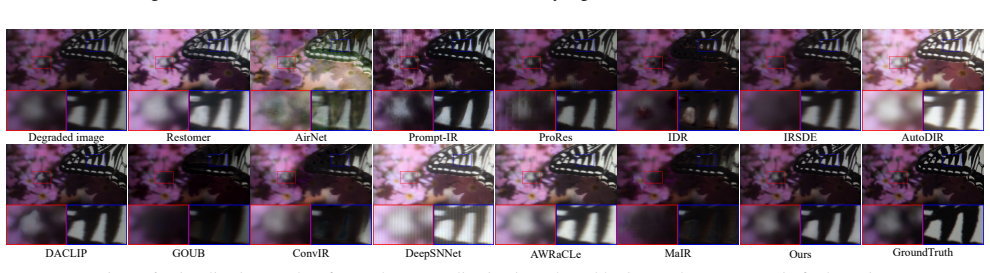
- [Figure 2] Figure 2 caption states “qualitative comparison” but does not indicate whether the displayed images are from the same test split used in the quantitative tables; consistency should be confirmed.
Simulated Author's Rebuttal
We thank the referee for the detailed and constructive feedback. We address each major comment below and will revise the manuscript to provide the requested clarifications and explicit derivations.
read point-by-point responses
-
Referee: [§3.2] §3.2 (Residual-modulated reverse SDE): The central adaptive-restoration claim depends on modulating the reverse process by the residual between degraded and target distributions, yet the manuscript does not specify the inference-time procedure for obtaining this residual from a single degraded observation. If the residual must be estimated from the degraded input alone or from the model’s own iterates, the paper should quantify how estimation error propagates into distortion of preserved regions; without this, the claimed advantage over indiscriminate baselines remains unverified.
Authors: We acknowledge the need for greater clarity on the inference procedure. In the revised manuscript we will explicitly state that, at inference, the residual is computed iteratively as the difference between the model’s current estimate of the clean image and the given degraded observation. This uses only the single input and the model’s own iterates, without oracle access to the target. We will also add a short error-propagation analysis together with new quantitative experiments that measure preservation of intact regions (PSNR/SSIM on masked non-degraded patches) and compare against global-noise baselines, thereby verifying the claimed adaptive advantage. revision: yes
-
Referee: [§4.1] §4.1 (Special-case reduction): The assertion that existing bridge models are recovered as special cases of RDBM is load-bearing for the unification narrative. The reduction steps should be shown explicitly (e.g., by setting the residual-modulation coefficient to a constant or zero) and verified against the original SDEs of those models; the current text leaves the algebraic steps implicit.
Authors: We agree that the special-case reductions should be shown algebraically rather than left implicit. In the revision we will expand §4.1 (and add an appendix if space is limited) with the explicit derivations: setting the residual-modulation coefficient to zero recovers the standard generalized diffusion-bridge SDE; setting it to a positive constant recovers the other cited bridge formulations. Each reduction will be verified by direct substitution back into the forward and reverse SDEs of the original models. revision: yes
Circularity Check
No circularity: RDBM derivation and unification rest on independent SDE reformulation
full rationale
The paper's core contribution is a theoretical reformulation of generalized diffusion-bridge SDEs followed by derivation of closed-form forward and reverse processes. This mathematical step is self-contained and does not reduce to a redefinition or fitted parameter. The claim that prior bridge models are special cases follows directly from the generalized equations rather than from self-citation or ansatz smuggling. Residual modulation is introduced as an application of the derived processes, not as a quantity that is fitted and then relabeled as a prediction. No load-bearing uniqueness theorem or self-citation chain is invoked for the central results. Empirical benchmarks on restoration tasks supply an external check independent of the derivation. The inference-time residual estimation issue raised by the skeptic is a modeling assumption, not a circularity in the claimed derivation chain.
Axiom & Free-Parameter Ledger
axioms (1)
- domain assumption Generalized diffusion bridge models admit closed-form forward and reverse SDEs whose solutions can be derived analytically.
invented entities (1)
-
Residual Diffusion Bridge Model (RDBM)
no independent evidence
Reference graph
Works this paper leans on
-
[1]
Stochastic Interpolants: A Unifying Framework for Flows and Diffusions
Michael S Albergo, Nicholas M Boffi, and Eric Vanden- Eijnden. Stochastic interpolants: A unifying framework for flows and diffusions.arXiv preprint arXiv:2303.08797,
work page internal anchor Pith review Pith/arXiv arXiv
-
[2]
Dense-haze: A benchmark for image dehazing with dense-haze and haze-free images
Codruta O Ancuti, Cosmin Ancuti, Mateu Sbert, and Radu Timofte. Dense-haze: A benchmark for image dehazing with dense-haze and haze-free images. InICIP, pages 1014–1018. IEEE, 2019. 5, 23
work page 2019
-
[3]
Ancuti, Cosmin Ancuti, and Radu Timo- fte
Codruta O. Ancuti, Cosmin Ancuti, and Radu Timo- fte. NH-HAZE: an image dehazing benchmark with non- homogeneous hazy and haze-free images. InCVPR Work- shops, 2020. 5, 23
work page 2020
-
[4]
Not just streaks: Towards ground truth for single image deraining
Yunhao Ba, Howard Zhang, Ethan Yang, Akira Suzuki, Arnold Pfahnl, Chethan Chinder Chandrappa, Celso de Melo, Suya You, Stefano Soatto, Alex Wong, and Achuta Kadambi. Not just streaks: Towards ground truth for single image deraining. InECCV, 2022. 5, 23
work page 2022
-
[5]
Cold diffusion: Inverting arbitrary im- age transforms without noise.NeurIPS, 36:41259–41282,
Arpit Bansal, Eitan Borgnia, Hong-Min Chu, Jie Li, Hamid Kazemi, Furong Huang, Micah Goldblum, Jonas Geiping, and Tom Goldstein. Cold diffusion: Inverting arbitrary im- age transforms without noise.NeurIPS, 36:41259–41282,
-
[6]
Wei-Ting Chen, Hao-Yu Fang, Cheng-Lin Hsieh, Cheng-Che Tsai, I Chen, Jian-Jiun Ding, Sy-Yen Kuo, et al. All snow re- moved: Single image desnowing algorithm using hierarchi- cal dual-tree complex wavelet representation and contradict channel loss. InICCV, pages 4196–4205, 2021. 5, 23
work page 2021
-
[7]
Towards unified deep image deraining: A survey and a new benchmark.IEEE TPAMI, 2025
Xiang Chen, Jinshan Pan, Jiangxin Dong, and Jinhui Tang. Towards unified deep image deraining: A survey and a new benchmark.IEEE TPAMI, 2025. 1
work page 2025
-
[8]
Parallel diffusion models of operator and image for blind inverse problems
Hyungjin Chung, Jeongsol Kim, Sehui Kim, and Jong Chul Ye. Parallel diffusion models of operator and image for blind inverse problems. InCVPR, pages 6059–6069, 2023. 1
work page 2023
-
[9]
Diffusion pos- terior sampling for general noisy inverse problems
Hyungjin Chung, Jeongsol Kim, Michael Thompson Mc- cann, Marc Louis Klasky, and Jong Chul Ye. Diffusion pos- terior sampling for general noisy inverse problems. InICLR,
-
[10]
Christophe De Vleeschouwer Cosmin Ancuti, Codruta O. Ancuti. D-hazy: A dataset to evaluate quantitatively de- hazing algorithms. InICIP, 2016. 5, 23
work page 2016
-
[11]
Revitalizing convolutional network for image restoration
Yuning Cui, Wenqi Ren, Xiaochun Cao, and Alois Knoll. Revitalizing convolutional network for image restoration. IEEE TPAMI, 46(12):9423–9438, 2024. 5, 6, 7, 8, 28
work page 2024
-
[12]
Deepsn-net: Deep semi-smooth newton driven net- work for blind image restoration.IEEE TPAMI, 2025
Xin Deng, Chenxiao Zhang, Lai Jiang, Jingyuan Xia, and Mai Xu. Deepsn-net: Deep semi-smooth newton driven net- work for blind image restoration.IEEE TPAMI, 2025. 5, 6, 7, 8, 28
work page 2025
-
[13]
Bhawna Goyal, Ayush Dogra, Dawa Chyophel Lepcha, Vishal Goyal, Ahmed Alkhayyat, Jasgurpreet Singh Chohan, and Vinay Kukreja. Recent advances in image dehazing: Formal analysis to automated approaches.Information Fu- sion, 104:102151, 2024. 1
work page 2024
-
[14]
Martin Heusel, Hubert Ramsauer, Thomas Unterthiner, Bernhard Nessler, and Sepp Hochreiter. Gans trained by a two time-scale update rule converge to a local nash equilib- rium.NeurIPS, 30, 2017. 8
work page 2017
-
[15]
Denoising diffu- sion probabilistic models.NeurIPS, 33:6840–6851, 2020
Jonathan Ho, Ajay Jain, and Pieter Abbeel. Denoising diffu- sion probabilistic models.NeurIPS, 33:6840–6851, 2020. 1, 2
work page 2020
-
[16]
Scope of va- lidity of psnr in image/video quality assessment.Electron
Quan Huynh-Thu and Mohammed Ghanbari. Scope of va- lidity of psnr in image/video quality assessment.Electron. Lett., 44(13):800–801, 2008. 5
work page 2008
-
[17]
Image-to-image translation with conditional adver- sarial networks
Phillip Isola, Jun-Yan Zhu, Tinghui Zhou, and Alexei A Efros. Image-to-image translation with conditional adver- sarial networks. InCVPR, pages 1125–1134, 2017. 8
work page 2017
-
[18]
Junjun Jiang, Zengyuan Zuo, Gang Wu, Kui Jiang, and Xianming Liu. A survey on all-in-one image restoration: Taxonomy, evaluation and future trends.arXiv preprint arXiv:2410.15067, 2024. 1
-
[19]
Multi-scale progressive fusion network for single image deraining
Kui Jiang, Zhongyuan Wang, Peng Yi, Chen Chen, Baojin Huang, Yimin Luo, Jiayi Ma, and Junjun Jiang. Multi-scale progressive fusion network for single image deraining. In CVPR, 2020. 5, 23
work page 2020
-
[20]
Autodir: Automatic all-in-one image restoration with latent diffusion
Yitong Jiang, Zhaoyang Zhang, Tianfan Xue, and Jinwei Gu. Autodir: Automatic all-in-one image restoration with latent diffusion. InECCV, pages 340–359. Springer, 2024. 5, 6, 7, 8, 28
work page 2024
-
[21]
Progressive growing of gans for improved quality, stability, and variation
Tero Karras, Timo Aila, Samuli Laine, and Jaakko Lehtinen. Progressive growing of gans for improved quality, stability, and variation. InICLR, 2018. 8
work page 2018
-
[22]
Elucidating the design space of diffusion-based generative models.NeurIPS, 35:26565–26577, 2022
Tero Karras, Miika Aittala, Timo Aila, and Samuli Laine. Elucidating the design space of diffusion-based generative models.NeurIPS, 35:26565–26577, 2022. 1
work page 2022
-
[23]
Analyzing and improving the training dynamics of diffusion models
Tero Karras, Miika Aittala, Jaakko Lehtinen, Janne Hellsten, Timo Aila, and Samuli Laine. Analyzing and improving the training dynamics of diffusion models. InCVPR, pages 24174–24184, 2024. 2
work page 2024
-
[24]
Frequency- aware event-based video deblurring for real-world motion blur
Taewoo Kim, Hoonhee Cho, and Kuk-Jin Yoon. Frequency- aware event-based video deblurring for real-world motion blur. InCVPR, pages 24966–24976, 2024. 1
work page 2024
-
[25]
Auto-encoding varia- tional{Bayes}
Diederik P Kingma and Max Welling. Auto-encoding varia- tional{Bayes}. InICLR, 2014. 4
work page 2014
-
[26]
Chulwoo Lee, Chul Lee, and Chang-Su Kim. Contrast en- hancement based on layered difference representation of 2d histograms.IEEE TIP, 22(12):5372–5384, 2013. 5, 23
work page 2013
-
[27]
Benchmarking single- image dehazing and beyond.IEEE TIP, 28(1):492–505,
Boyi Li, Wenqi Ren, Dengpan Fu, Dacheng Tao, Dan Feng, Wenjun Zeng, and Zhangyang Wang. Benchmarking single- image dehazing and beyond.IEEE TIP, 28(1):492–505,
-
[28]
All-in-one image restoration for unknown cor- ruption
Boyun Li, Xiao Liu, Peng Hu, Zhongqin Wu, Jiancheng Lv, and Xi Peng. All-in-one image restoration for unknown cor- ruption. InCVPR, pages 17452–17462, 2022. 5, 6, 7, 8, 28
work page 2022
-
[29]
Bbdm: Image- to-image translation with brownian bridge diffusion models
Bo Li, Kaitao Xue, Bin Liu, and Yu-Kun Lai. Bbdm: Image- to-image translation with brownian bridge diffusion models. InCVPR, pages 1952–1961, 2023. 2, 4, 8, 21
work page 1952
-
[30]
Mair: A locality-and continuity- preserving mamba for image restoration
Boyun Li, Haiyu Zhao, Wenxin Wang, Peng Hu, Yuan- biao Gou, and Xi Peng. Mair: A locality-and continuity- preserving mamba for image restoration. InCVPR, pages 7491–7501, 2025. 5, 6, 7, 8, 28
work page 2025
-
[31]
Wei Li, Qiming Zhang, Jing Zhang, Zhen Huang, Xinmei Tian, and Dacheng Tao. Toward real-world single image deraining: A new benchmark and beyond.arXiv preprint arXiv:2206.05514, 2022. 5, 23 9
-
[32]
Flow matching for generative mod- eling
Yaron Lipman, Ricky TQ Chen, Heli Ben-Hamu, Maximil- ian Nickel, and Matt Le. Flow matching for generative mod- eling. InICLR, 2023. 2, 4, 21
work page 2023
-
[33]
Image inpainting for ir- regular holes using partial convolutions
Guilin Liu, Fitsum A Reda, Kevin J Shih, Ting-Chun Wang, Andrew Tao, and Bryan Catanzaro. Image inpainting for ir- regular holes using partial convolutions. InECCV, pages 85–100, 2018. 8
work page 2018
-
[34]
I2sb: image-to-image schrodinger bridge
Guan-Horng Liu, Arash Vahdat, De-An Huang, Evange- los A Theodorou, Weili Nie, and Anima Anandkumar. I2sb: image-to-image schrodinger bridge. InICML, pages 22042– 22062, 2023. 2, 4, 8, 21
work page 2023
-
[35]
Jiaying Liu, Xu Dejia, Wenhan Yang, Minhao Fan, and Haofeng Huang. Benchmarking low-light image enhance- ment and beyond.International Journal of Computer Vision, 129:1153–1184, 2021. 5, 23
work page 2021
-
[36]
Residual denoising diffu- sion models
Jiawei Liu, Qiang Wang, Huijie Fan, Yinong Wang, Yan- dong Tang, and Liangqiong Qu. Residual denoising diffu- sion models. InCVPR, pages 2773–2783, 2024. 1, 2, 8
work page 2024
-
[37]
Flow straight and fast: Learning to generate and transfer data with rectified flow
Xingchao Liu, Chengyue Gong, et al. Flow straight and fast: Learning to generate and transfer data with rectified flow. In ICLR, 2022. 2, 4, 8, 21
work page 2022
-
[38]
Desnownet: Context-aware deep network for snow removal.IEEE TIP, 27(6):3064–3073, 2018
Yun-Fu Liu, Da-Wei Jaw, Shih-Chia Huang, and Jenq-Neng Hwang. Desnownet: Context-aware deep network for snow removal.IEEE TIP, 27(6):3064–3073, 2018. 5, 23
work page 2018
-
[39]
Weijian Luo, Tianyang Hu, Shifeng Zhang, Jiacheng Sun, Zhenguo Li, and Zhihua Zhang. Diff-instruct: A universal approach for transferring knowledge from pre-trained diffu- sion models.NeurIPS, 36:76525–76546, 2023. 1
work page 2023
-
[40]
Image restoration with mean-reverting stochastic differential equations
Ziwei Luo, Fredrik K Gustafsson, Zheng Zhao, and Jens Sj¨olund. Image restoration with mean-reverting stochastic differential equations. InICML, pages 23045–23066, 2023. 1, 2, 4, 5, 6, 7, 8, 28
work page 2023
-
[41]
Controlling vision-language models for multi-task image restoration
Ziwei Luo, Fredrik K Gustafsson, Zheng Zhao, Jens Sj¨olund, and Thomas B Sch ¨on. Controlling vision-language models for multi-task image restoration. InICLR, 2024. 5, 6, 7, 8, 28
work page 2024
-
[42]
Ziwei Luo, Fredrik Gustafsson, Zheng Zhao, Jens Sj ¨olund, and Thomas Sch ¨on. Taming diffusion models for image restoration: a review.Philosophical Transactions A, 383 (2299):20240358, 2025. 1
work page 2025
-
[43]
Prores: Exploring degradation-aware visual prompt for universal image restora- tion.CoRR, 2023
Jiaqi Ma, Tianheng Cheng, Guoli Wang, Qian Zhang, Xinggang Wang, and Lefei Zhang. Prores: Exploring degradation-aware visual prompt for universal image restora- tion.CoRR, 2023. 5, 6, 7, 8, 28
work page 2023
-
[44]
Perceptual quality assessment for multi-exposure image fusion.IEEE TIP, 24 (11):3345–3356, 2015
Kede Ma, Kai Zeng, and Zhou Wang. Perceptual quality assessment for multi-exposure image fusion.IEEE TIP, 24 (11):3345–3356, 2015. 5, 23
work page 2015
-
[45]
Efficient diffusion models: A com- prehensive survey from principles to practices.IEEE TPAMI,
Zhiyuan Ma, Yuzhu Zhang, Guoli Jia, Liangliang Zhao, Yichao Ma, Mingjie Ma, Gaofeng Liu, Kaiyan Zhang, Ning Ding, Jianjun Li, et al. Efficient diffusion models: A com- prehensive survey from principles to practices.IEEE TPAMI,
-
[46]
Restorex-ai: A contrastive approach towards guid- ing image restoration via explainable ai systems
Aboli Marathe, Pushkar Jain, Rahee Walambe, and Ketan Kotecha. Restorex-ai: A contrastive approach towards guid- ing image restoration via explainable ai systems. InCVPR, pages 3030–3039, 2022. 1
work page 2022
-
[47]
Anish Mittal, Rajiv Soundararajan, and Alan C Bovik. Mak- ing a “completely blind” image quality analyzer.IEEE Trans. Signal Process., 20(3):209–212, 2012. 7
work page 2012
-
[48]
Deep multi-scale convolutional neural network for dynamic scene deblurring
Seungjun Nah, Tae Hyun Kim, and Kyoung Mu Lee. Deep multi-scale convolutional neural network for dynamic scene deblurring. InCVPR, pages 3883–3891, 2017. 5, 23
work page 2017
-
[49]
Pytorch: An imperative style, high-performance deep learning library
Adam Paszke, Sam Gross, Francisco Massa, Adam Lerer, James Bradbury, Gregory Chanan, Trevor Killeen, Zem- ing Lin, Natalia Gimelshein, Luca Antiga, et al. Pytorch: An imperative style, high-performance deep learning library. NeurIPS, 32, 2019. 5
work page 2019
-
[50]
Promptir: Prompting for all-in- one image restoration.NeurIPS, 36:71275–71293, 2023
Vaishnav Potlapalli, Syed Waqas Zamir, Salman H Khan, and Fahad Shahbaz Khan. Promptir: Prompting for all-in- one image restoration.NeurIPS, 36:71275–71293, 2023. 5, 6, 7, 8, 28
work page 2023
-
[51]
Attentive generative adversarial network for rain- drop removal from a single image
Rui Qian, Robby T Tan, Wenhan Yang, Jiajun Su, and Jiay- ing Liu. Attentive generative adversarial network for rain- drop removal from a single image. InCVPR, pages 2482– 2491, 2018. 5, 23
work page 2018
-
[52]
Awracle: All- weather image restoration using visual in-context learning
Sudarshan Rajagopalan and Vishal M Patel. Awracle: All- weather image restoration using visual in-context learning. InAAAI, pages 6675–6683, 2025. 5, 6, 7, 8, 28
work page 2025
-
[53]
Real-world blur dataset for learning and benchmarking de- blurring algorithms
Jaesung Rim, Haeyun Lee, Jucheol Won, and Sunghyun Cho. Real-world blur dataset for learning and benchmarking de- blurring algorithms. InECCV, 2020. 5, 23
work page 2020
-
[54]
Hannes Risken. Fokker-planck equation. InThe Fokker- Planck equation: methods of solution and applications, pages 63–95. Springer, 1989. 13
work page 1989
-
[55]
L Chris G Rogers and David Williams.Diffusions, Markov processes, and martingales. Cambridge university press,
-
[56]
U-net: Convolutional networks for biomedical image segmentation
Olaf Ronneberger, Philipp Fischer, and Thomas Brox. U-net: Convolutional networks for biomedical image segmentation. InMICCAI, pages 234–241. Springer, 2015. 5
work page 2015
-
[57]
Cambridge University Press, 2019
Simo S ¨arkk¨a and Arno Solin.Applied stochastic differential equations. Cambridge University Press, 2019. 2
work page 2019
-
[58]
Zhenning Shi, Chen Xu, Changsheng Dong, Bin Pan, Along He, Tao Li, Huazhu Fu, et al. Resfusion: Denoising dif- fusion probabilistic models for image restoration based on prior residual noise.NeurIPS, 37:130664–130693, 2024. 2
work page 2024
-
[59]
Learning to gener- ate images with perceptual similarity metrics
Jake Snell, Karl Ridgeway, Renjie Liao, Brett D Roads, Michael C Mozer, and Richard S Zemel. Learning to gener- ate images with perceptual similarity metrics. InICIP, pages 4277–4281. IEEE, 2017. 5
work page 2017
-
[60]
Deep unsupervised learning using nonequilibrium thermodynamics
Jascha Sohl-Dickstein, Eric Weiss, Niru Maheswaranathan, and Surya Ganguli. Deep unsupervised learning using nonequilibrium thermodynamics. InICML, pages 2256–
-
[61]
Denois- ing diffusion implicit models
Jiaming Song, Chenlin Meng, and Stefano Ermon. Denois- ing diffusion implicit models. InICLR, 2021. 1, 2
work page 2021
-
[62]
Score-based generative modeling through stochastic differential equa- tions
Yang Song, Jascha Sohl-Dickstein, Diederik P Kingma, Ab- hishek Kumar, Stefano Ermon, and Ben Poole. Score-based generative modeling through stochastic differential equa- tions. InICLR, 2020. 2, 8, 20
work page 2020
-
[63]
A cross trans- former for image denoising.Information Fusion, 102: 102043, 2024
Chunwei Tian, Menghua Zheng, Wangmeng Zuo, Shichao Zhang, Yanning Zhang, and Chia-Wen Lin. A cross trans- former for image denoising.Information Fusion, 102: 102043, 2024. 1 10
work page 2024
-
[64]
Hebaixu Wang, Jing Zhang, Haonan Guo, Di Wang, Jiayi Ma, and Bo Du. Dgsolver: Diffusion generalist solver with universal posterior sampling for image restoration.arXiv preprint arXiv:2504.21487, 2025. 1
-
[65]
Liyan Wang, Weixiang Zhou, Cong Wang, Kin-Man Lam, Zhixun Su, and Jinshan Pan. Deep learning-driven ultra- high-definition image restoration: A survey.arXiv preprint arXiv:2505.16161, 2025. 1
-
[66]
Shuhang Wang, Jin Zheng, Hai-Miao Hu, and Bo Li. Nat- uralness preserved enhancement algorithm for non-uniform illumination images.IEEE TIP, 22(9):3538–3548, 2013. 5, 23
work page 2013
-
[67]
Zhou Wang, Alan C Bovik, Hamid R Sheikh, and Eero P Simoncelli. Image quality assessment: from error visibility to structural similarity.IEEE TIP, 13(4):600–612, 2004. 5
work page 2004
-
[68]
Deep Retinex Decomposition for Low-Light Enhancement
Chen Wei, Wenjing Wang, Wenhan Yang, and Jiaying Liu. Deep retinex decomposition for low-light enhancement. arXiv preprint arXiv:1808.04560, 2018. 5, 23
work page internal anchor Pith review Pith/arXiv arXiv 2018
-
[69]
De- blurring via stochastic refinement
Jay Whang, Mauricio Delbracio, Hossein Talebi, Chitwan Saharia, Alexandros G Dimakis, and Peyman Milanfar. De- blurring via stochastic refinement. InCVPR, pages 16293– 16303, 2022. 2
work page 2022
-
[70]
Seesr: Towards semantics-aware real-world image super-resolution
Rongyuan Wu, Tao Yang, Lingchen Sun, Zhengqiang Zhang, Shuai Li, and Lei Zhang. Seesr: Towards semantics-aware real-world image super-resolution. InCVPR, pages 25456– 25467, 2024. 1
work page 2024
-
[71]
Diffir: Efficient diffusion model for image restoration
Bin Xia, Yulun Zhang, Shiyin Wang, Yitong Wang, Xing- long Wu, Yapeng Tian, Wenming Yang, and Luc Van Gool. Diffir: Efficient diffusion model for image restoration. In ICCV, pages 13095–13105, 2023. 1, 2
work page 2023
-
[72]
Deep joint rain detection and removal from a single image
Wenhan Yang, Robby T Tan, Jiashi Feng, Jiaying Liu, Zong- ming Guo, and Shuicheng Yan. Deep joint rain detection and removal from a single image. InCVPR, pages 1357–1366,
-
[73]
Image restoration through generalized ornstein-uhlenbeck bridge
Conghan Yue, Zhengwei Peng, Junlong Ma, Shiyan Du, Pengxu Wei, and Dongyu Zhang. Image restoration through generalized ornstein-uhlenbeck bridge. InICML, pages 58068–58089, 2024. 2, 4, 5, 6, 7, 8, 21, 28
work page 2024
-
[74]
Effi- cient diffusion model for image restoration by residual shift- ing.IEEE TPAMI, 2024
Zongsheng Yue, Jianyi Wang, and Chen Change Loy. Effi- cient diffusion model for image restoration by residual shift- ing.IEEE TPAMI, 2024. 2
work page 2024
-
[75]
Learning enriched features for real image restoration and enhancement
Syed Waqas Zamir, Aditya Arora, Salman Khan, Munawar Hayat, Fahad Shahbaz Khan, Ming-Hsuan Yang, and Ling Shao. Learning enriched features for real image restoration and enhancement. InECCV, pages 492–511. Springer, 2020. 2
work page 2020
-
[76]
Restormer: Efficient transformer for high-resolution image restoration
Syed Waqas Zamir, Aditya Arora, Salman Khan, Mu- nawar Hayat, Fahad Shahbaz Khan, and Ming-Hsuan Yang. Restormer: Efficient transformer for high-resolution image restoration. InCVPR, pages 5728–5739, 2022. 5, 6, 7, 8, 28
work page 2022
-
[77]
Improving diffusion inverse problem solving with decoupled noise annealing
Bingliang Zhang, Wenda Chu, Julius Berner, Chenlin Meng, Anima Anandkumar, and Yang Song. Improving diffusion inverse problem solving with decoupled noise annealing. In CVPR, pages 20895–20905, 2025. 1
work page 2025
-
[78]
Density-aware single image de-raining using a multi-stream dense network
He Zhang and Vishal M Patel. Density-aware single image de-raining using a multi-stream dense network. InCVPR, pages 695–704, 2018. 5, 23
work page 2018
-
[79]
Fast haze removal for nighttime image using maximum reflectance prior
Jing Zhang, Yang Cao, Shuai Fang, Yu Kang, and Chang Wen Chen. Fast haze removal for nighttime image using maximum reflectance prior. InCVPR, pages 7418–7426,
-
[80]
Ingredient-oriented multi- degradation learning for image restoration
Jinghao Zhang, Jie Huang, Mingde Yao, Zizheng Yang, Hu Yu, Man Zhou, and Feng Zhao. Ingredient-oriented multi- degradation learning for image restoration. InCVPR, pages 5825–5835, 2023. 5, 6, 7, 8, 28
work page 2023
discussion (0)
Sign in with ORCID, Apple, or X to comment. Anyone can read and Pith papers without signing in.