REVIEW 2 minor
Decoupled Solution for Composite Sparse-plus-Smooth Inverse Problems
T0 review · 0 major / 2 minor · reviewed 2026-05-25 · grok-4.3
Pith's one-line read A composite sparse-plus-smooth inverse problem reduces to optimization over the sparse component alone plus one linear solve.
desk verdict The paper delivers a clean decoupling for atomic-plus-quadratic regularization that turns the joint problem into an optimization over the sparse component plus one linear solve. read the letter →
The pith
A machine-rendered reading of the paper's core claim, the machinery that carries it, and where it could break.
The reading
What carries the argument
Reduction of the composite variational problem to a Banach-space optimization subproblem followed by a linear solve for the Hilbert-space component.
What would settle it
A numerical counterexample in which the pair obtained from the reduced procedure fails to minimize the original joint objective, or where the joint minimizer does not match the decoupled solution.
Extended reading notes
Core claim
We show how this composite optimization problem can be reduced to an optimization problem over the Banach space component only up to a linear problem. This reveals a decoupling between the two components, allowing for a new composite representer theorem. It naturally induces a decoupled numerical procedure to solve the composite optimization problem.
Load-bearing premise
The observed data arise from a linear operator applied to the exact sum of the two components, each penalized by its own independent regularizer.
Editorial extensions
If this is right
- The solution for the smooth component is obtained by solving a linear system once the sparse component is known.
- A finite-dimensional representer theorem applies to the sparse component in the reduced problem.
- The decoupled procedure yields significant computational savings in reconstruction tasks such as deconvolution.
- The framework applies to any linear inverse problem with this composite structure.
Reading between the lines
- Similar decoupling might be possible when the smooth regularizer is replaced by other convex penalties.
- The approach could be combined with existing atomic-norm solvers without modification.
- In applications with large data, the linear solve step may become the bottleneck if the Hilbert space dimension is high.
Signed reviews
Editorial analysis
A structured set of objections, weighed in public.
Referee Report
Summary. The paper considers composite linear inverse problems in which the unknown signal is exactly the sum of two components, one regularized by an atomic norm in a Banach space (promoting sparsity) and the other by a quadratic norm in a Hilbert space (promoting smoothness). It claims that the joint variational problem over the pair of components reduces to an optimization problem over the Banach-space variable alone, with the Hilbert-space variable recovered by solving a single linear problem. This decoupling yields a composite representer theorem and induces a decoupled numerical algorithm. The result is illustrated on a composite deconvolution problem recovering Diracs over a smooth background, where the approach is reported to yield significant computational speedup.
Significance. If the reduction and theorem hold, the work supplies a clean theoretical decoupling for a practically relevant class of mixed-norm inverse problems, together with an immediately usable algorithmic consequence. The explicit composite representer theorem and the linear-recovery step are concrete strengths that could be cited in subsequent work on Banach-Hilbert composite regularization.
minor comments (2)
- The abstract and introduction would benefit from an explicit statement of the precise assumptions on the forward operator (e.g., boundedness, injectivity on the relevant subspaces) that guarantee well-posedness of the linear subproblem; this is standard in the field and would make the scope of the theorem immediately clear.
- Notation for the two spaces and their norms is introduced gradually; a single consolidated notation table or paragraph at the beginning of §2 would improve readability for readers unfamiliar with atomic-norm literature.
Simulated Author's Rebuttal
We thank the referee for the positive summary, recognition of the significance of the decoupling and composite representer theorem, and the recommendation of minor revision. No specific major comments were raised in the report.
Circularity Check
No significant circularity in derivation chain
full rationale
The central result is a mathematical reduction showing that the joint variational problem over the pair of components decouples to an optimization solely over the atomic-norm (Banach) variable, with the quadratic (Hilbert) variable recovered by solving one linear problem. This follows directly from the problem structure (linear inverse problem, signal exactly equal to sum of two components, independent regularizers) as stated in the abstract and is presented as a derivation rather than a quantity defined in terms of fitted parameters or self-referential equations. No load-bearing self-citations, ansatzes smuggled via prior work, or renaming of known results are evident; the modeling premise is definitional for the problem class. The derivation is therefore self-contained against external benchmarks.
Assumptions & free parameters
assumptions (2)
- domain assumption The unknown signal is exactly the sum of two components each regularized by a distinct norm.
- domain assumption The forward operator defines a linear inverse problem.
Cite this review
Pith. "Pith review of Decoupled Solution for Composite Sparse-plus-Smooth Inverse Problems." pith.science (2026). https://pith.science/paper/PENI4LY7
@misc{pith2026251023322,
  author       = {Pith},
  title        = {Pith review of: Decoupled Solution for Composite Sparse-plus-Smooth Inverse Problems},
  year         = {2026},
  howpublished = {\url{https://pith.science/paper/PENI4LY7}},
  note         = {Machine review of arXiv:2510.23322}
}
read the original abstract
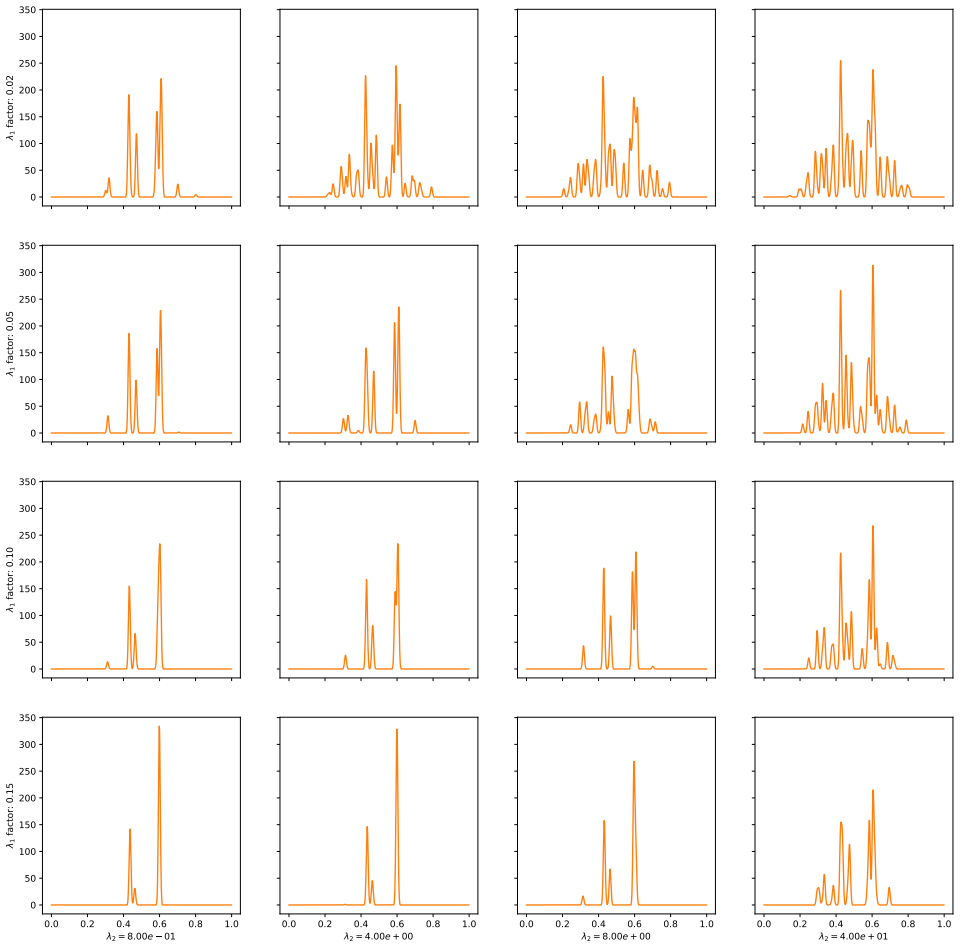
We consider composite linear inverse problems where the signal to recover is modeled as a sum of two functions. We study a variational framework formulated as an optimization problem over the pairs of components using two regularization terms, each of them acting on a different part of the solution. The specificity of our work is to study the case where one component is regularized with an atomic norm over a Banach space, which is known to promote sparse reconstruction, while the other is regularized with a quadratic norm over a Hilbert space, which promotes smooth solution. We show how this composite optimization problem can be reduced to an optimization problem over the Banach space component only up to a linear problem. This reveals a decoupling between the two components, allowing for a new composite representer theorem. It naturally induces a decoupled numerical procedure to solve the composite optimization problem. We exemplify our main result with a composite deconvolution problem of Dirac recovery over a smooth background. In this setting, we illustrate the relevance of a composite model and show a significant temporal gain on signal reconstruction, which results from our decoupled algorithmic approach.
Figures


Figures from the paper (9 more)



Reviewed May 25, 2026 · model on record in the stance chip above.
Discussion (0). Continue with ORCID to comment.