Observation of a pronounced Hebel-Slichter peak in the spin-lattice relaxation rate and implications for gap and pairing symmetry in LaNiGa₂
Pith reviewed 2026-05-18 02:43 UTC · model grok-4.3
The pith
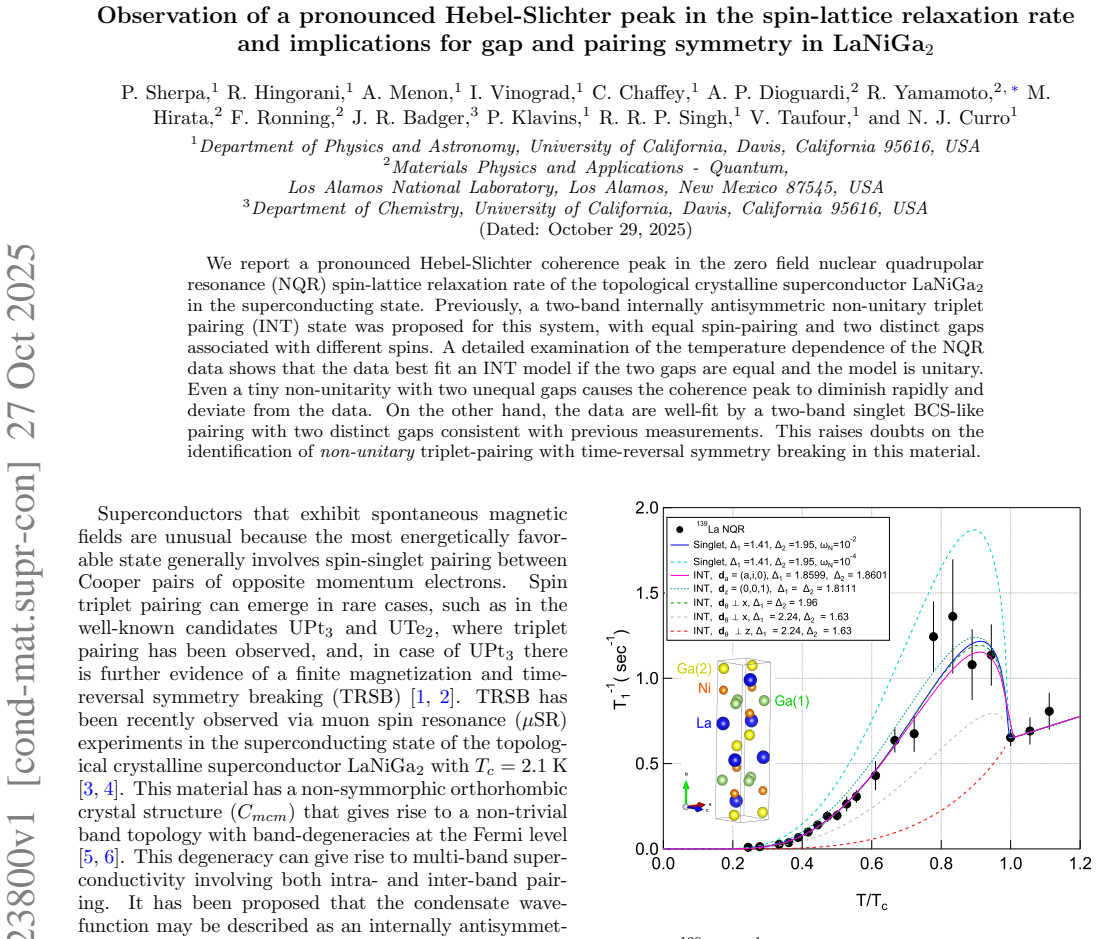
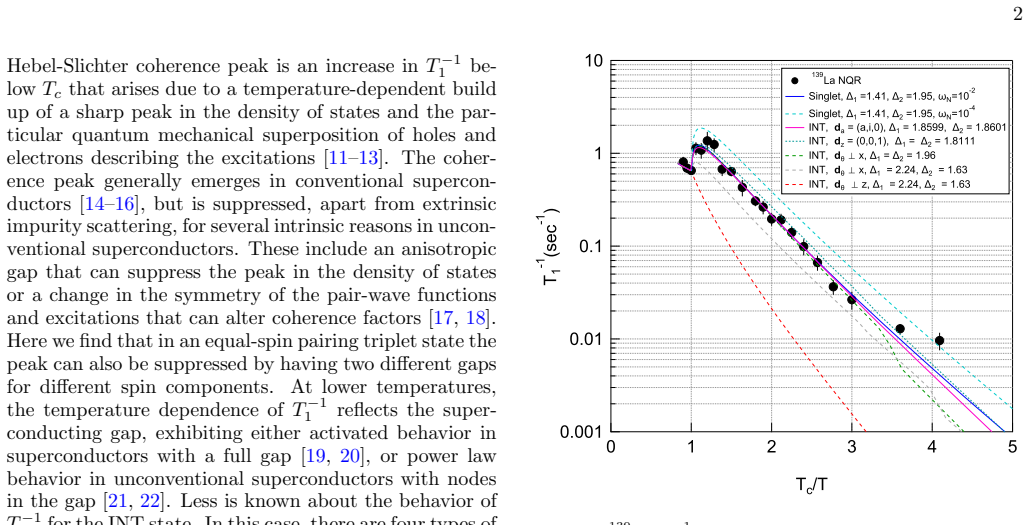
NQR data in LaNiGa2 show a Hebel-Slichter peak that fits two-band singlet pairing with distinct gaps better than non-unitary triplet pairing.
A machine-rendered reading of the paper's core claim, the machinery that carries it, and where it could break.
Core claim
The NQR spin-lattice relaxation rate exhibits a pronounced Hebel-Slichter coherence peak that is well described by a two-band singlet BCS-like pairing with two distinct gaps consistent with previous measurements, while even tiny non-unitarity in a triplet model with unequal gaps causes the peak to diminish rapidly and deviate from the observed data.
What carries the argument
The Hebel-Slichter coherence peak in the zero-field NQR spin-lattice relaxation rate, which is sensitive to superconducting coherence factors and used to test gap magnitudes and singlet versus triplet pairing symmetry through temperature-dependent fits.
If this is right
- The pairing in LaNiGa2 is consistent with two-band singlet superconductivity rather than non-unitary triplet pairing.
- Time-reversal symmetry breaking is not supported by the relaxation rate data.
- The two gaps are distinct in magnitude but the state remains unitary.
- Earlier proposals identifying LaNiGa2 as a non-unitary triplet superconductor with time-reversal symmetry breaking require re-examination.
Where Pith is reading between the lines
- The material may lack the topological features previously linked to the non-unitary triplet state.
- Muon spin relaxation or Kerr rotation measurements could test for the absence of spontaneous fields expected in the triplet scenario.
- The same coherence-peak analysis could be applied to related nickel-based or topological candidate superconductors to refine pairing assignments.
Load-bearing premise
The temperature dependence of the NQR relaxation rate is dominated by the superconducting gap structure and coherence factors, with negligible contributions from impurity scattering or other relaxation channels.
What would settle it
A direct observation of spontaneous internal magnetic fields below the transition temperature via muon spin relaxation, persisting under conditions where the singlet model fits the NQR peak, would challenge the conclusion that the data favor singlet pairing.
Figures

read the original abstract
We report a pronounced Hebel-Slichter coherence peak in the zero field nuclear quadrupolar resonance (NQR) spin-lattice relaxation rate of the topological crystalline superconductor LaNiGa$_2$ in the superconducting state. Previously, a two-band internally antisymmetric non-unitary triplet pairing (INT) state was proposed for this system, with equal spin-pairing and two distinct gaps associated with different spins. A detailed examination of the temperature dependence of the NQR data shows that the data best fit an INT model if the two gaps are equal and the model is unitary. Even a tiny non-unitarity with two unequal gaps causes the coherence peak to diminish rapidly and deviate from the data. On the other hand, the data are well-fit by a two-band singlet BCS-like pairing with two distinct gaps consistent with previous measurements. This raises doubts on the identification of non-unitary triplet-pairing with time-reversal symmetry breaking in this material.
Editorial analysis
A structured set of objections, weighed in public.
Referee Report
Summary. The manuscript reports observation of a pronounced Hebel-Slichter peak in the zero-field NQR spin-lattice relaxation rate 1/T1(T) of LaNiGa2 below Tc. It compares the temperature dependence to phenomenological models and concludes that the data are well described by a two-band singlet BCS-like state with two distinct gaps, while even small non-unitarity in the previously proposed internally antisymmetric non-unitary triplet (INT) state rapidly suppresses the peak and deviates from experiment. This is used to question the identification of non-unitary triplet pairing with time-reversal symmetry breaking in the material.
Significance. If the model discrimination is robust, the result would be significant for resolving the pairing symmetry of LaNiGa2, a candidate topological crystalline superconductor. The new NQR data and explicit comparison of coherence factors across singlet and triplet scenarios provide a concrete experimental handle on non-unitarity effects. Credit is due for the clear experimental observation of the peak and for testing the INT proposal against fresh measurements; however, the strength of the conclusion hinges on the validity of the underlying relaxation model.
major comments (2)
- Abstract and implied model-comparison section: the central claim that 'even a tiny non-unitarity with two unequal gaps causes the coherence peak to diminish rapidly and deviate from the data' is load-bearing for ruling out the INT state. The manuscript provides no explicit values for the non-unitarity parameter, no calculated suppression factor, and no comparison of deviations against experimental error bars or full temperature curves, making it impossible to verify whether the reported preference for the singlet model is robust or partly by construction from gap magnitudes and spectral weights.
- Relaxation-rate modeling (throughout the model fits): the temperature dependence of 1/T1 is assumed to arise exclusively from quasiparticle excitations whose density of states and coherence factors are set by the gap structure. No quantitative bounds are placed on possible impurity scattering (Dynes broadening) or spin-fluctuation contributions that could suppress or mimic the peak height; this assumption is load-bearing for the model discrimination and requires either explicit estimates or sample-variation tests to support.
minor comments (2)
- Abstract: the statement that the two gaps are 'consistent with previous measurements' should cite the specific prior works and quote the gap values used in the present fits.
- Figure presentation: experimental 1/T1(T) points should include error bars and the full temperature range down to the lowest measured T to allow readers to judge fit quality and the position of the peak.
Simulated Author's Rebuttal
We thank the referee for their careful reading of our manuscript and for the constructive comments. We address each major comment below and indicate the revisions we will make to improve clarity and robustness.
read point-by-point responses
-
Referee: Abstract and implied model-comparison section: the central claim that 'even a tiny non-unitarity with two unequal gaps causes the coherence peak to diminish rapidly and deviate from the data' is load-bearing for ruling out the INT state. The manuscript provides no explicit values for the non-unitarity parameter, no calculated suppression factor, and no comparison of deviations against experimental error bars or full temperature curves, making it impossible to verify whether the reported preference for the singlet model is robust or partly by construction from gap magnitudes and spectral weights.
Authors: We agree that additional quantitative detail on the non-unitarity parameter would make the model comparison more transparent and verifiable. In the revised manuscript we will report the specific values of the non-unitarity parameter (the relative magnitude of the imaginary component of the gap) employed in the calculations, together with the resulting suppression factors for the Hebel-Slichter peak height. We will also overlay the full temperature-dependent model curves for several small non-unitarity strengths against the experimental data, including error bars, so that readers can directly assess the magnitude of the deviations. revision: yes
-
Referee: Relaxation-rate modeling (throughout the model fits): the temperature dependence of 1/T1 is assumed to arise exclusively from quasiparticle excitations whose density of states and coherence factors are set by the gap structure. No quantitative bounds are placed on possible impurity scattering (Dynes broadening) or spin-fluctuation contributions that could suppress or mimic the peak height; this assumption is load-bearing for the model discrimination and requires either explicit estimates or sample-variation tests to support.
Authors: The analysis follows the conventional quasiparticle framework used for NQR relaxation in multiband superconductors. To address the concern we will add a dedicated paragraph that provides explicit estimates of Dynes broadening using representative values from the literature on related nickel-based compounds and demonstrates that moderate broadening does not remove the pronounced peak seen in the data. We will also briefly discuss the absence of strong spin-fluctuation signatures above Tc. Sample-to-sample variation tests lie outside the scope of the present work, which reports high-quality data from a single well-characterized crystal; we will note this limitation explicitly. revision: partial
Circularity Check
NQR relaxation-rate data independently discriminates singlet vs non-unitary triplet models
full rationale
The paper reports new zero-field NQR 1/T1(T) measurements on LaNiGa2 that exhibit a clear Hebel-Slichter peak. Standard coherence-factor expressions for two-band singlet and INT triplet states are evaluated with adjustable gap magnitudes and relative weights; the singlet parametrization reproduces both the peak height and its temperature position while even weakly non-unitary INT states suppress the peak. Because the input data are fresh experimental points independent of the prior INT proposal, and because the model comparison rests on the well-known BCS coherence-factor formulas rather than on any self-derived or self-cited uniqueness theorem, the discrimination does not reduce to a fit-by-construction or to a self-citation chain. No ansatz is smuggled, no known result is merely renamed, and the central claim therefore retains independent empirical content.
Axiom & Free-Parameter Ledger
free parameters (2)
- two distinct gap magnitudes
- relative spectral weights of the two bands
axioms (2)
- domain assumption BCS coherence factors govern the spin-lattice relaxation rate in the superconducting state
- domain assumption The NQR signal arises from a single crystallographic site with no significant impurity or vortex contributions below Tc
Lean theorems connected to this paper
-
IndisputableMonolith/Foundation/RealityFromDistinction.leanreality_from_one_distinction unclear?
unclearRelation between the paper passage and the cited Recognition theorem.
The data are well-fit by a two-band singlet BCS-like pairing with two distinct gaps... Even a tiny non-unitarity with two unequal gaps causes the coherence peak to diminish rapidly
What do these tags mean?
- matches
- The paper's claim is directly supported by a theorem in the formal canon.
- supports
- The theorem supports part of the paper's argument, but the paper may add assumptions or extra steps.
- extends
- The paper goes beyond the formal theorem; the theorem is a base layer rather than the whole result.
- uses
- The paper appears to rely on the theorem as machinery.
- contradicts
- The paper's claim conflicts with a theorem or certificate in the canon.
- unclear
- Pith found a possible connection, but the passage is too broad, indirect, or ambiguous to say the theorem truly supports the claim.
Reference graph
Works this paper leans on
-
[1]
Quantum Fluctuations in Narrow-band Systems
In this case, the scattering rates between the quasipar- ticles are dramatically suppressed if the two gaps have different values because energy cannot be conserved in the process. The nuclear resonance frequency is set to ℏωN /kBTc = 10 −4 and 10 −6 in the cases ofd a and dθ, respectively, with no additional broadening included. When the two gaps are equ...
-
[2]
S. Ran, C. Eckberg, Q.-P. Ding, Y. Furukawa, T. Metz, S. R. Saha, I.-L. Liu, M. Zic, H. Kim, J. Paglione, and N. P. Butch, Nearly ferromagnetic spin-triplet supercon- ductivity, Science365, 684 (2019)
work page 2019
-
[3]
E. R. Schemm, W. J. Gannon, C. M. Wishne, W. P. Halperin, and A. Kapitulnik, Observation of broken time- reversal symmetry in the heavy-fermion superconductor UPt3, Science345, 190 (2014)
work page 2014
-
[4]
A. D. Hillier, J. Quintanilla, B. Mazidian, J. F. Annett, and R. Cywinski, Nonunitary triplet pairing in the cen- trosymmetric superconductor LaNiGa2, Phys. Rev. Lett. 109, 097001 (2012)
work page 2012
-
[5]
S. K. Ghosh, M. Smidman, T. Shang, J. F. Annett, A. D. Hillier, J. Quintanilla, and H. Yuan, Recent progress on superconductors with time-reversal symmetry breaking, J. Phys. Condens. Matter33, 033001 (2020)
work page 2020
-
[6]
J. R. Badger, Y. Quan, M. C. Staab, S. Sumita, A. Rossi, K. P. Devlin, K. Neubauer, D. S. Shulman, J. C. Fet- tinger, P. Klavins, S. M. Kauzlarich, D. Aoki, I. M. Vishik, W. E. Pickett, and V. Taufour, Dirac lines and loop at the fermi level in the time-reversal symme- try breaking superconductor LaNiGa 2, Communications Physics5, 22 (2022)
work page 2022
-
[7]
Y. Quan, V. Taufour, and W. E. Pickett, Nonsymmor- phic band sticking in a topological superconductor, Phys. Rev. B105, 064517 (2022)
work page 2022
-
[8]
S. K. Ghosh, G. Csire, P. Whittlesea, J. F. Annett, M. Gradhand, B. ´Ujfalussy, and J. Quintanilla, Quantita- tive theory of triplet pairing in the unconventional super- conductor LaNiGa2, Phys. Rev. B101, 100506 (2020)
work page 2020
-
[9]
Z. F. Weng, J. L. Zhang, M. Smidman, T. Shang, J. Quin- tanilla, J. F. Annett, M. Nicklas, G. M. Pang, L. Jiao, W. B. Jiang, Y. Chen, F. Steglich, and H. Q. Yuan, Two-gap superconductivity in LaNiGa 2 with nonunitary triplet pairing and even parity gap symmetry, Phys. Rev. Lett.117, 027001 (2016)
work page 2016
-
[10]
S. Ghimire, K. R. Joshi, E. H. Krenkel, M. A. Tanatar, Y. Shi, M. Ko´ nczykowski, R. Grasset, V. Taufour, P. P. Orth, M. S. Scheurer, and R. Prozorov, Electron irra- diation reveals robust fully gapped superconductivity in LaNiGa2, Phys. Rev. B109, 024515 (2024)
work page 2024
- [11]
-
[12]
L. C. Hebel and C. P. Slichter, Nuclear relaxation in su- perconducting aluminum, Phys. Rev.107, 901 (1957)
work page 1957
-
[13]
L. C. Hebel and C. P. Slichter, Nuclear spin relaxation in normal and superconducting aluminum, Phys. Rev.113, 1504 (1959)
work page 1959
-
[14]
D. Arovas and C. Wu,Lecture Notes on Superconductiv- ity (A Work in Progress), edited by unknown (unknown, 2019)
work page 2019
-
[15]
D. E. MacLaughlin, Solid state physics (1976) pp. 1–68
work page 1976
-
[16]
R. F. Kiefl, W. A. MacFarlane, K. H. Chow, S. Dun- siger, T. L. Duty, T. M. S. Johnston, J. W. Schneider, J. Sonier, L. Brard, R. M. Strongin, J. E. Fischer, and A. B. Smith, Coherence peak and superconducting en- ergy gap in Rb 3C60 observed by muon spin relaxation, Phys. Rev. Lett.70, 3987 (1993)
work page 1993
-
[17]
H. Kotegawa, K. Ishida, Y. Kitaoka, T. Muranaka, and J. Akimitsu, Evidence for strong-couplings-wave super- conductivity in MgB2: 11B NMR study, Phys. Rev. Lett. 87, 127001 (2001)
work page 2001
-
[18]
B. W. Statt, Anisotropic gap and quasiparticle-damping effects on NMR measurements of high-temperature su- perconductors, Phys. Rev. B42, 6805 (1990)
work page 1990
-
[19]
Brandow, Characteristic features of the exotic super- conductors, Phys
B. Brandow, Characteristic features of the exotic super- conductors, Phys. Rep.296, 1 (1998)
work page 1998
- [20]
-
[21]
Q.-P. Ding, P. Wiecki, V. K. Anand, N. S. Sangeetha, Y. Lee, D. C. Johnston, and Y. Furukawa, Volovik effect and Fermi-liquid behavior in the s-wave superconductor CaPd2As2: As75 NMR-NQR measurements, Phys. Rev. B93, 140502 (2016)
work page 2016
-
[22]
T. Imai, T. Shimizu, T. Tsuda, H. Yasuoka, T. Taka- 6 batake, Y. Nakazawa, and M. Ishikawa, Nuclear spin- lattice relaxation of 63,65Cu at the Cu(2) sites of the high Tc superconductor YBa2Cu3O7−δ, J. Phys. Soc. Jpn.57, 1771 (1988)
work page 1988
- [23]
-
[24]
K. K. Tanaka, M. Ichioka, and S. Onari, Site-selective NMR for odd-frequency Cooper pairs around vortex in chiralp-wave superconductors, Phys. Rev. B93, 094507 (2016)
work page 2016
-
[25]
K. K. Tanaka, M. Ichioka, and S. Onari, Local NMR relaxation ratesT −1 1 andT −1 2 depending on thed-vector symmetry in the vortex state of chiral and helicalp-wave superconductors, Phys. Rev. B97, 134507 (2018)
work page 2018
-
[26]
See Supplemental Material at URL-will-be-inserted-by- publisher
-
[27]
P. Sherpa, I. Vinograd, Y. Shi, S. A. Sreedhar, C. Chaf- fey, T. Kissikov, M.-C. Jung, A. S. Botana, A. P. Dio- guardi, R. Yamamoto, M. Hirata, G. Conti, S. Nemsak, J. R. Badger, P. Klavins, I. Vishik, V. Taufour, and N. J. Curro, Absence of strong magnetic fluctuations or inter- actions in the normal state of LaNiGa 2, Phys. Rev. B 109, 125113 (2024)
work page 2024
-
[28]
R. Balian and N. Werthamer, Superconductivity with pairs in a relative p-wave, Phys. Rev.131, 1 (1963)
work page 1963
-
[29]
P. W. Anderson and P. Morel, Generalized Bardeen Cooper Schrieffer states and the proposed low temper- ature phase of liquid 3He, Phys. Rev.123, 1911 (1961)
work page 1911
-
[30]
J. F. Annett, Symmetry of the order parameter for high-temperature superconductivity, Adv. Phys.39, 83 (1990)
work page 1990
-
[31]
Ramires, Nonunitary superconductivity in complex quantum materials, J
A. Ramires, Nonunitary superconductivity in complex quantum materials, J. Phys. Condens. Matter34, 304001 (2022)
work page 2022
-
[32]
Coleman,Introduction to Many Body Physics(Cam- bridge University Press, 2015)
P. Coleman,Introduction to Many Body Physics(Cam- bridge University Press, 2015)
work page 2015
-
[33]
M. Shimizu, H. Amanuma, K. Hachitani, H. Fukazawa, Y. Kohori, T. Namiki, C. Sekine, and I. Shirotani, 75As-NQR studies of superconducting filled skutteru- dites PrRu4As12 and LaRu4As12, J. Phys. Soc. Jpn.76, 104705 (2007)
work page 2007
-
[34]
Q.-P. Ding, K. Nishine, Y. Kawamura, J. Hayashi, C. Sekine, and Y. Furukawa, Suppression of ferromag- netic spin fluctuations in the filled skutterudite super- conductor SrOs4As12 revealed by As75 NMR-NQR mea- surements, Phys. Rev. B100, 054516 (2019)
work page 2019
- [35]
-
[36]
H. Takahashi, S. Kitagawa, K. Ishida, M. Kawaguchi, A. Ikeda, S. Yonezawa, and Y. Maeno, S-wave supercon- ductivity in the Dirac line-nodal material CaSb2, J. Phys. Soc. Jpn.90, 073702 (2021)
work page 2021
-
[37]
Y. Masuda and A. G. Redfield, Nuclear spin-lattice re- laxation in superconducting aluminum, Phys. Rev.125, 159 (1962)
work page 1962
discussion (0)
Sign in with ORCID, Apple, or X to comment. Anyone can read and Pith papers without signing in.