REVIEW 4 major objections 5 minor 32 references
Decentralized Causal Discovery using Judo Calculus
T0 review · 4 major / 5 minor · reviewed 2026-08-04 · deepseek-v4-flash
Pith's one-line read This paper claims that causal discovery can be decentralized: learn one graph per regime, then keep only edges that survive across regimes — a rule it derives from sheaf-theoretic 'local truth' and validates with faster, more accurate exper
desk verdict The topos packaging is a coat of paint over stability selection, and the load-bearing sheaf derivation is mathematically wrong; the experiments are internally inconsistent, so I would not trust this as a result. read the letter →
The pith
A machine-rendered reading of the paper's core claim, the machinery that carries it, and where it could break.
The reading
What carries the argument
The central object is the Lawvere–Tierney modal operator j acting on the subobject classifier of a sheaf topos Sh_J(C); it selects which regimes are relevant and defines j-stability as truth on a cover that glues across overlapping charts. Operationally, the carrying identity is Disc_j(U) = ∧_i Disc_j(V_i): the global j-stable graph is the edgewise intersection of per-regime graphs. The paper also uses nerve invariants (f0, f1, f2 of the skeleton) as regularizers in its score-based variants.
What would settle it
Find a 3-variable counterexample to the identity Disc_j(U)=∧_i Disc_j(V_i): two CI theories whose pointwise least I-maps intersect to a graph that is not the least I-map of the intersection theory. If such graphs exist, the cover-glueing identity fails. Empirically, generate a synthetic DAG with a spurious edge present in every regime with the same sign; the intersection aggregator will retain it, contradicting the claimed false-positive control.
Extended reading notes
Core claim
The paper proposes that causal claims be treated as local truths: a claim (e.g., 'X causes Y' or a conditional independence) must be proven on a j-cover of regimes — a family of charts chosen by a Lawvere–Tierney modal operator j — and then glued into a j-stable statement. It defines j-stable intervention probabilities as monotone aggregations over regimes, three judo rules as local counterparts of the classical do-calculus rules, and 'sheafified' versions of score-based, constraint-based, and gradient-based discovery in which per-regime graphs are computed independently and aggregated by a support threshold (intersection or k-of-E). The claimed result is that this decentralized procedure ma
Load-bearing premise
The entire derivation rests on the claim that the 'least I-map' functor Ψ preserves meets (edgewise intersections), asserted in the appendix's universal-property proof; left adjoints preserve joins, not meets, so if this step fails the intersection aggregation has no theoretical support. The paper also assumes without demonstration that true edges recur across regimes while spurious edges do not.
Editorial extensions
If this is right
- Running discovery independently on each regime and keeping edges that appear on every chart (or all-but-k) filters out regime-idiosyncratic edges, improving precision and structural Hamming distance on the paper's synthetic and Sachs benchmarks.
- The method's map-reduce structure turns one pooled run into E independent per-regime runs plus a cheap Boolean fold, so wall-clock time drops roughly with the number of workers on CPU benchmarks.
- The j-backdoor rule allows evaluation of regime-local adjustment formulas aggregated over the cover, yielding do-queries certified on the chosen regimes without committing to a single global model.
- Support thresholds (π) can be selected by validation log-likelihood on held-out regimes, giving a tuning rule that the paper shows lands on a plateau where j-stable variants dominate pooled baselines.
Reading between the lines
- If the meet-preservation gap in the proof is repaired, the same aggregation can serve as a privacy-preserving distributed discovery protocol, since only per-regime adjacency matrices need to be shared.
- The paper's own bagging analogy implies the method's advantage depends on true edges having higher recurrence rates than false edges across regimes; datasets with heavily overlapping regime-specific mechanisms would be a harder test.
- A natural stress test is to construct regimes where a spurious edge appears consistently with the same sign in every chart; the intersection aggregator would keep it, exposing where sign-aware or orientation-aware gluing is needed.
- The 'all-but-k' aggregator can be read as a robust-to-one-region rule; for policy or medical settings, k should encode minority-group protections rather than being chosen purely by validation likelihood.
Editorial analysis
A structured set of objections, weighed in public.
Referee Report
Summary. The paper proposes 'judo calculus,' an intuitionistic, sheaf-theoretic framework for decentralized causal discovery. The central claim is that causal claims can be certified locally on a cover of regimes and glued via a j-stability rule, yielding algorithms that learn per-regime graphs and aggregate them by intersection or support thresholds. The paper describes j-stable variants of GES, ψ-FCI, and DCDI, and reports experiments on synthetic and real data claiming improved structural accuracy and computational efficiency over pooled baselines. The theoretical development is mostly relegated to the appendix and to companion papers; the operational core is the support-aggregation rule formalized in Section 4.
Significance. If the central claim were established, the idea of decomposing causal discovery into independent per-regime subproblems and gluing the results would be valuable both computationally and statistically, and the paper's template for 'sheafifying' standard algorithms (GES, FCI, DCDI) is potentially useful. The paper also makes a serious attempt to connect a topos-theoretic modal logic to a concrete algorithmic pipeline, which is unusual and potentially generative. However, the formal derivation in Appendix A.5 that underwrites the intersection/support aggregation contains a fundamental error, and the experimental evidence is internally inconsistent and largely preliminary, with no released code. As it stands, the paper does not establish its advertised formal theory or its empirical claims.
major comments (4)
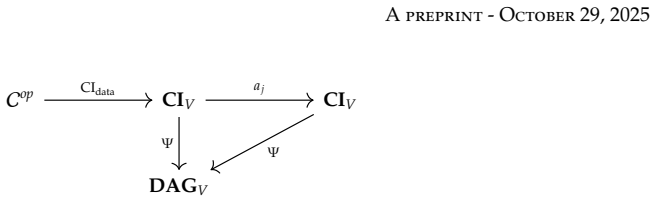
- [Appendix A.5, 'Universality and gluing' theorem] The cover-calculus identity Disc_j(U) = ∧_i Disc_j(V_i) is the theoretical justification for the intersection/support aggregation used throughout the paper. The proof claims 'Ψ is left adjoint in a poset and preserves existing meets.' Two errors: (1) The claimed adjunction Ψ ⊣ Φ fails already for V={X,Y}: with S={X⊥Y} and G=X→Y, Ψ(S) is the empty graph, so Ψ(S) ≤ G but S ⊄ Φ(G), violating the bi-implication. (2) Even if Ψ were a left adjoint, left adjoints preserve joins, not meets; the stated identity requires meet preservation. Without this identity, the formal link from the sheaf-theoretic framework to the operational intersection aggregation is broken.
- [Tables 6, 7, and 8, Section 5.2] The same condition (α=0.005, synthetic DAG) is reported with contradictory results. Table 7 gives pooled F1=0.286/SHD=10 and j-stable intersection F1=0.333/SHD=4, while Table 6 gives pooled F1=0.167/SHD=20 and j-stable intersection F1=0.250/SHD=6; Table 8 repeats the Table 6 numbers. The pooled SHD differs by a factor of two between tables. This internal inconsistency makes the empirical comparison unreliable and prevents verification of the claimed improvement.
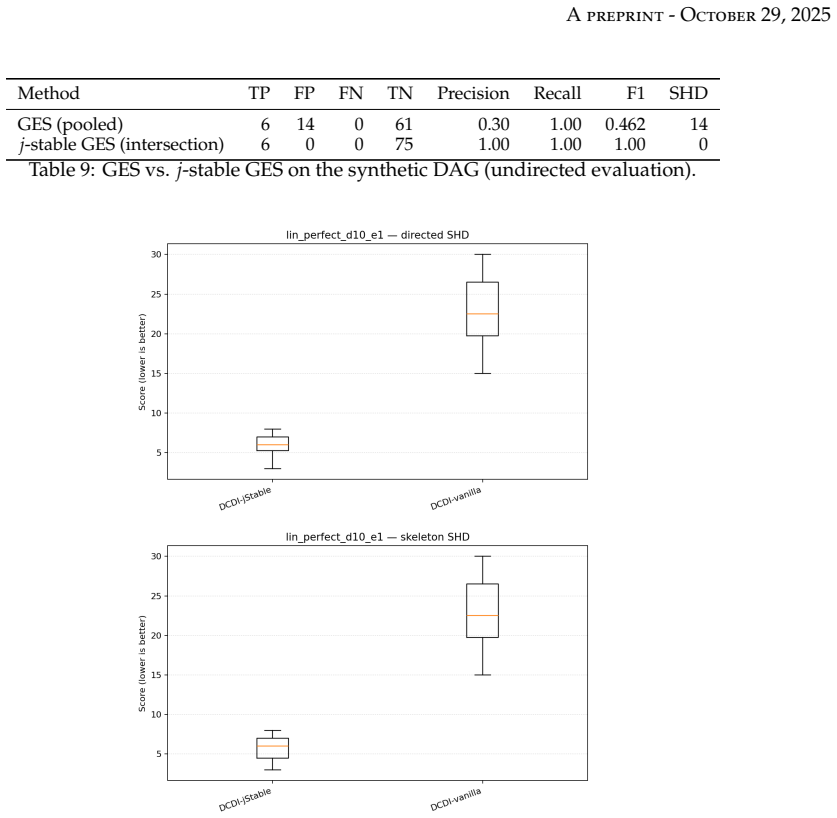
- [Table 9, Section 5.3] The reported j-stable GES result is a perfect F1=1.00 and SHD=0 on a single synthetic graph, with no variance, no multiple seeds, and no cross-validation. This is anecdotal. The accompanying text claims that 'j-stable GES removes spurious edges and exactly matches the true undirected skeleton,' but no evidence of replication or robustness is provided. The empirical case for the method cannot rest on one perfect run.
- [Section 4, 'Why this realizes j-stability'; Section 5.1] The paper defines j-stability operationally as support aggregation and then presents the aggregation as justified by the theory, but the theoretical derivation in A.5 does not go through (see above). In addition, the key premise in §5.1 that 'true edges recur across regimes while spurious edges do not' is asserted without formal statement or empirical verification; the diagnostic promised in §4.1 (separation of true vs. false edge support distributions) is never reported. The argument is thus circular relative to the failed derivation: the operational rule is stipulated to be the content of j-stability, and the experiments then validate that same rule.
minor comments (5)
- [Global] There are many typos and inconsistent notations: 'leke Moerdijk' instead of 'le Moerdijk' in several places; 'Intutionistic' in the reference to the companion paper; the method is called both 'PSI-FCI' and 'ψ-FCI'; 'CausalLearn' is referenced without a URL or version.
- [Section 4.1 / Table 5] Table 5 is a template with dotted entries, not a results table. It should either be filled or removed.
- [Section 5.2] The default experimental settings state R=10 regimes, but Tables 6–8 describe a '3-regime dataset.' The relationship between these settings and the reported tables is unclear.
- [Section 3.17 and A.16] The aggregator axioms (A1)–(A4) are introduced in A.16 but referenced earlier in §3.17 as 'matching the KJ boxed modality' before the modality is defined. Numbered cross-references such as '§2.16' do not match the actual section numbering.
- [Appendix A.13] The transition from j-stability to do-calculus is left as 'a detailed translation... can be added in an appendix.' As written, the paper's central claim to formalize j-do-calculus is supported only by a promissory note.
Circularity Check
j-stability is defined to be the support/intersection aggregator, so the 'cover calculus' theorem restates the algorithm's rule; formal j-do-calculus details are deferred to self-cited companion papers, and the empirical rationale is stability selection relabeled in sheaf language.
-
self definitional
[Appendix A.5 ('Cover calculus (gluing)') and Section 4 ('Why this realizes j-stability')]
"Because Ψ is left adjoint in a poset and preserves existing meets, Discj(U)= Ψ(∩_i CIj(V_i)) = ∧_i Ψ(CIj(V_i)) = ∧_i Discj(V_i). ... Algorithmic reading (what our code computes): ... Graph route: output ∧_i Ĝ_i (edgewise intersection)."
The theorem's conclusion is exactly the operational rule implemented in the paper: j-stable discovery over a cover is edgewise intersection/support aggregation. The only derivation step is the assertion that Ψ preserves meets, which is precisely the property needed to make Disc_j = Ψ∘CI_j commute with the cover meet; no independent argument establishes it. Section 4 already defines the implemented j-stable graph as 'Intersection A∩ certifies edges that hold on all charts (cover-wise truth), hence correspond to forced edges under j,' so the formal 'prediction' is the definition restated as a theorem.
-
renaming known result
[Section 5.1 'Why j-stable discovery works: an ensemble view (bagging & boosting)']
"Bagging in disguise. For each regime e∈E we fit a base learner A to get a directed graph A(e)... We bag these hypotheses via the frequency map Fij = 1/|E| Σ_e h(e)ij ∈[0,1]... The π-stable skeleton keeps {i,j} if max(Fi→j,Fj→i)≥π; we orient by a tiny margin rule Mij≥δ..."
The paper's own account of why the method works is that it is bagging/stability selection over per-regime graphs. The 'j-stability' formalism is stipulated to be this same frequency-threshold/support aggregation, so the empirical explanation (true edges recur, spurious edges flicker) is the known stability-selection assumption, not a consequence of the sheaf axioms. The topos terminology renames the aggregator rather than deriving or predicting it.
1 more flagged steps
-
self citation load bearing
[Section 2.4 'The j-stable do-operator (practical form)']
"We refer the reader to our previous paper for a more rigorous categorical framework for j-do-calculus [Mahadevan, 2025b]. ... Formal details appear in the companion theory paper."
The paper's headline formalism — j-do-calculus / 'judo calculus' — is not fully defined in this text; its 'more rigorous' categorical semantics are explicitly delegated to a companion paper by the same author. Since the abstract claims judo calculus is 'formally defined' here, the central theoretical premise rests on a self-citation to unverified companion work, even though the operational support-threshold algorithm is implemented and benchmarked independently.
full rationale
The central circularity is that the theory's key derived object — j-stable discovery over a cover — is stipulated to be exactly the operational support/intersection aggregator. Appendix A.5's cover calculus concludes Disc_j(U) = ∧_i Disc_j(V_i), and the paper's own 'algorithmic reading' identifies this with the code's edgewise intersection; Section 4 then equates j-stability with 'holds on all charts.' Thus the claimed derivation of the k-of-E/intersection aggregation reduces to its definition, with the asserted meet-preservation of Ψ doing all the work. The empirical results are not logically forced — they are real benchmark comparisons — so the paper is not fully circular; but the topos-theoretic contribution is largely a relabeling of stability selection/bagging, as the paper itself says in §5.1. In addition, formal j-do-calculus semantics are deferred to self-cited companion papers. Score 5 reflects partial circularity: one central predicted rule reduces by construction, but the experimental efficiency/accuracy claims retain independent empirical content.
Assumptions & free parameters
free parameters (10)
- stability threshold π =
π ∈ {0.3, 0.6} defaults; selected by validation likelihood
- sparsity/top-K or τ for DCDI =
top-2 parents per node (PISA), top-K to match edge budget
- λtop, λ△ =
λtop ∈ [0.05, 0.3], λ△ ∈ [0.01, 0.2]
- λj, λsheaf =
λj ∈ [0.05, 0.2], λsheaf ∈ [0.02, 0.1]; λj ∈ [10^-2, 10^-1] for DCDI
- CI significance α =
swept {0.005, 0.01, 0.02} for ψ-FCI
- aggregator Agg =
Fisher/Stouffer/mean/Tippett
- all-but-k tolerance k =
k=1 and k=E-1 used
- orientation margin δ =
small, unspecified
- UMAP k-NN k and overlap threshold q =
k ∈ [10, 30], q ∈ (0,1]
- number of charts K and edge threshold τβ in interference demo =
τβ = 0.2, K unspecified
assumptions (6)
- standard math The category of (co)presheaves on a small category forms a topos; Grothendieck topologies correspond to Lawvere-Tierney topologies
- domain assumption Causal claims can be interpreted as truth in the internal logic of a sheaf topos over a site of regimes; local truth on a J-cover glues to global truth
- domain assumption True edges reappear consistently across regimes while spurious edges flicker; perfect interventions cut all incoming edges of the target
- domain assumption Per-chart learners are consistent, and local edge errors are independent with per-edge FP/FN rates < 1/2
- ad hoc to paper Ψ, the left adjoint to d-separation, preserves meets (intersections)
- ad hoc to paper Aggregators satisfying axioms (A1)-(A4) suffice for finite-sample J-soundness
invented entities (3)
-
j-stable intervention probability P_J
-
π-stable skeleton / edge frequency map F
-
Empirical sheafification bCI_J_P
Cite this review
Pith. "Pith review of Decentralized Causal Discovery using Judo Calculus." pith.science (2026). https://pith.science/paper/KKXR3NBL
@misc{pith2026251023942,
  author       = {Pith},
  title        = {Pith review of: Decentralized Causal Discovery using Judo Calculus},
  year         = {2026},
  howpublished = {\url{https://pith.science/paper/KKXR3NBL}},
  note         = {Machine review of arXiv:2510.23942}
}
read the original abstract
We describe a theory and implementation of an intuitionistic decentralized framework for causal discovery using judo calculus, which is formally defined as j-stable causal inference using j-do-calculus in a topos of sheaves. In real-world applications -- from biology to medicine and social science -- causal effects depend on regime (age, country, dose, genotype, or lab protocol). Our proposed judo calculus formalizes this context dependence formally as local truth: a causal claim is proven true on a cover of regimes, not everywhere at once. The Lawvere-Tierney modal operator j chooses which regimes are relevant; j-stability means the claim holds constructively and consistently across that family. We describe an algorithmic and implementation framework for judo calculus, combining it with standard score-based, constraint-based, and gradient-based causal discovery methods. We describe experimental results on a range of domains, from synthetic to real-world datasets from biology and economics. Our experimental results show the computational efficiency gained by the decentralized nature of sheaf-theoretic causal discovery, as well as improved performance over classical causal discovery methods.
Figures


Figures from the paper (18 more)





Reference graph
Works this paper leans on
-
[1]
J. L. Bell. Toposes and Local Set Theories. Dover, 1988
1988
-
[2]
Brouillard, Philippe and Lachapelle, S\' e bastien and Lacoste, Alexandre and Lacoste-Julien, Simon and Drouin, Alexandre Differentiable causal discovery from interventional data NeurIPS 2020
2020
-
[3]
Brouillard, Philippe and Lachapelle, S\' e bastien and Lacoste, Alexandre and Lacoste-Julien The Landscape of Causal Discovery Data: Grounding Causal Discovery in Real-World Applications Arxiv, 2025, url=https://arxiv.org/abs/2412.01953
arXiv 2025
-
[4]
David Maxwell Chickering Optimal Structure Identification with Greedy Equivalence Search Journal of Machine Learning Research, 2002 Volume 3, 507-554
2002
-
[5]
Disintegration and bayesian inversion via string diagrams
Kenta Cho and Bart Jacobs. Disintegration and bayesian inversion via string diagrams. Mathematical Structures in Computer Science, 29 0 (7): 0 938–971, March 2019. ISSN 1469-8072. doi:10.1017/s0960129518000488. URL http://dx.doi.org/10.1017/S0960129518000488
-
[6]
Evangelista JE, Clarke DJB, Xie Z, Lachmann A, Jeon M, Chen K, Jagodnik KM, Jenkins SL, Kuleshov MV, Wojciechowicz ML, Schürer SC, Medvedovic M, Ma'ayan A SigCom LINCS: data and metadata search engine for a million gene expression signatures. Nucleic Acids Res. 2022 Jul 5;50(W1):W697-W709. doi: 10.1093/nar/gkac328. PMID: 35524556; PMCID: PMC9252724
-
[7]
Causal theories: A categorical perspective on bayesian networks
Brendan Fong. Causal theories: A categorical perspective on bayesian networks. Master's thesis, Oxford University, 2012
2012
-
[8]
Patrick Forré and Joris M. Mooij. Markov properties for graphical models with cycles and latent variables, 2017
2017
Show all 32 references
-
[9]
A synthetic approach to markov kernels, conditional independence and theorems on sufficient statistics
Tobias Fritz. A synthetic approach to markov kernels, conditional independence and theorems on sufficient statistics. Advances in Mathematics, 370: 0 107239, August 2020. ISSN 0001-8708. doi:10.1016/j.aim.2020.107239. URL http://dx.doi.org/10.1016/j.aim.2020.107239
2020
-
[10]
The d-separation criterion in categorical probability
Tobias Fritz and Andreas Klingler. The d-separation criterion in categorical probability. Journal of Machine Learning Research, 24 0 (46): 0 1--49, 2023. URL http://jmlr.org/papers/v24/22-0916.html
2023
-
[11]
An axiomatic theory of counterfactuals
David Galles and Judea Pearl. An axiomatic theory of counterfactuals. Foundations of Science, 3: 0 151--182, 1988
1988
-
[12]
A categorical approach to probability theory
Mich \`e le Giry. A categorical approach to probability theory. In B. Banaschewski, editor, Categorical Aspects of Topology and Analysis, pages 68--85, Berlin, Heidelberg, 1982. Springer Berlin Heidelberg. ISBN 978-3-540-39041-1
1982
-
[13]
Topoi: The Categorial Analysis of Logic
Robert Goldblatt. Topoi: The Categorial Analysis of Logic. Dover Press, 2006
2006
-
[14]
Causal de finetti: on the identification of invariant causal structure in exchangeable data
Siyuan Guo, Viktor T\' o th, Bernhard Sch\" o lkopf, and Ferenc Husz\' a r. Causal de finetti: on the identification of invariant causal structure in exchangeable data. In Proceedings of the 37th International Conference on Neural Information Processing Systems, NIPS '23, Red ...
2023
-
[15]
Imbens and Donald B
Guido W. Imbens and Donald B. Rubin. Causal Inference for Statistics, Social, and Biomedical Sciences: An Introduction. Cambridge University Press, USA, 2015. ISBN 0521885884
2015
-
[16]
Jaber, Amin and Kocaoglu, Murat and Shanmugam, Karthikeyan and Bareinboim, Elias NeurIPS 2020
2020
-
[17]
Introduction to Coalgebra: Towards Mathematics of States and Observation, volume 59 of Cambridge Tracts in Theoretical Computer Science
Bart Jacobs. Introduction to Coalgebra: Towards Mathematics of States and Observation, volume 59 of Cambridge Tracts in Theoretical Computer Science. Cambridge University Press, 2016. ISBN 9781316823187. doi:10.1017/CBO9781316823187. URL https://doi.org/10.1017/CBO9781316823187
2016 doi
-
[18]
Causal inference by string diagram surgery, 2018
Bart Jacobs, Aleks Kissinger, and Fabio Zanasi. Causal inference by string diagram surgery, 2018. URL https://arxiv.org/abs/1811.08338
2018 arXiv
-
[19]
Sheaves in Geometry and Logic a First Introduction to Topos Theory
Saunders Mac Lane and Moerdijk. Sheaves in Geometry and Logic a First Introduction to Topos Theory. Springer New York, New York, NY, 1992. ISBN 9781461209270 1461209277. URL http://link.springer.com/book/10.1007/978-1-4612-0927-0
1992 doi
-
[20]
Categories for the Working Mathematician
Saunders MacLane. Categories for the Working Mathematician. Springer-Verlag, New York, 1971. Graduate Texts in Mathematics, Vol. 5
1971
-
[21]
Universal causality
Sridhar Mahadevan. Universal causality. Entropy, 25 0 (4): 0 574, 2023. doi:10.3390/E25040574. URL https://doi.org/10.3390/e25040574
2023 doi
-
[22]
Universal causal inference in a topos
Sridhar Mahadevan. Universal causal inference in a topos. In Advances in Neural Information Processing Systems, Proceedings of the Thirty Ninth Annual Conference on Neural Information Processing Systems, San Diego, California, December 2-7, 2025, 2025 a
2025
-
[23]
Intutionistic j -Do-Calculus in Topos Causal Models eprint= 2510.17944 , archivePrefix= arXiv , primaryClass= cs.LO , url= https://arxiv.org/abs/2510.17944
Sridhar Mahadevan. Intutionistic j -Do-Calculus in Topos Causal Models eprint= 2510.17944 , archivePrefix= arXiv , primaryClass= cs.LO , url= https://arxiv.org/abs/2510.17944
-
[24]
Higher algebraic k-theory of causality
Sridhar Mahadevan. Higher algebraic k-theory of causality. Entropy, 27 0 (5), 2025 b . ISSN 1099-4300. doi:10.3390/e27050531. URL https://www.mdpi.com/1099-4300/27/5/531
2025 doi
-
[25]
Learning independent causal mechanisms
Giambattista Parascandolo, Mateo Rojas - Carulla, Niki Kilbertus, and Bernhard Sch \" o lkopf. Learning independent causal mechanisms. CoRR, abs/1712.00961, 2017. URL http://arxiv.org/abs/1712.00961
2017 arXiv
-
[26]
Probabilistic reasoning in intelligent systems - networks of plausible inference
Judea Pearl. Probabilistic reasoning in intelligent systems - networks of plausible inference. Morgan Kaufmann series in representation and reasoning. Morgan Kaufmann, 1989
1989
-
[27]
Causality: Models, Reasoning and Inference
Judea Pearl. Causality: Models, Reasoning and Inference. Cambridge University Press, USA, 2nd edition, 2009. ISBN 052189560X
2009
-
[28]
E. Riehl. Category Theory in Context. Aurora: Dover Modern Math Originals. Dover Publications, 2017. ISBN 9780486820804. URL https://books.google.com/books?id=6B9MDgAAQBAJ
2017
-
[29]
Lauffenburger and Garry P
Karen Sachs and Omar Perez and Dana Pe'er and Douglas A. Lauffenburger and Garry P. Nolan Causal Protein-Signaling Networks Derived from Multiparameter Single-Cell Data Science, vol. 308, No. 5721, pages 523-529, 2023
2023
-
[30]
Causation, Prediction, and Search, Second Edition
Peter Spirtes, Clark Glymour, and Richard Scheines. Causation, Prediction, and Search, Second Edition. Adaptive computation and machine learning. MIT Press, 2000. ISBN 978-0-262-19440-2
2000
-
[31]
Zigler Causal Health impacts of power plant emission controls under modeled and uncertain physical process interference Arxiv, 2023 URL https://arxiv.org/abs/2306.05665
Nathan B Wikle and Corwin M. Zigler Causal Health impacts of power plant emission controls under modeled and uncertain physical process interference Arxiv, 2023 URL https://arxiv.org/abs/2306.05665
2023 arXiv
-
[32]
A survey on causal discovery: Theory and practice, 2023
Alessio Zanga and Fabio Stella. A survey on causal discovery: Theory and practice, 2023. URL https://arxiv.org/abs/2305.10032
2023 arXiv
Reviewed August 4, 2026 · model on record in the stance chip above.
Discussion (0). Continue with ORCID to comment.