REVIEW 43 references
A kernel-based stochastic approximation framework for contextual optimization
T0 review · reviewed 2026-08-04 · deepseek-v4-flash
Pith's one-line read A single black-box kernel recursion can estimate, differentiate, and optimize CoVaR and CoES without any fitted model.
desk verdict Genuinely unifying and internally consistent, but the CoVaR/CoES motivation depends on a uniform-density assumption that can fail exactly in the tail regime. read the letter →
The pith
A machine-rendered reading of the paper's core claim, the machinery that carries it, and where it could break.
The reading
What carries the argument
The load-bearing object is the kernel-smoothed root-finding system: replacing conditional quantities such as P{Y≤λ|X=ν} by E[K((ν−X)/h)m(...)]/h converts zero-probability conditioning into averages over the joint distribution that a simulator can draw from. Coupled with simultaneous perturbation for gradients, this yields the single two-timescale recursion (14)–(16), where the fast β-timescale solves the measure and gradient equations for a slowly varying θ and the slow α-timescale performs projected gradient descent. The supporting machinery is the Lyapunov argument for the coupled ODE and the contraction inequalities driven by Assumption 1(f), which convert bias–variance trade-offs into th
What would settle it
Take a known data-generation model where Y|X has a density that vanishes at the target conditional quantile, e.g., Y = g(X)+ε with ε having a triangular density whose mode lies exactly at the chosen quantile, and run KBSA with the paper's recommended parameter rates. Compare the empirical MSE of θ_n and of the estimated measure to the predicted n^{−1/5} curve; Assumption 1(f) is violated, so the MSE should plateau or decay more slowly, refuting the claim that the bound holds under only the stated assumptions.
Extended reading notes
Core claim
The central claim is that the implicit system E[m_j(θ,Y,λ_1,...,λ_j)|X=ν]=0 for j=1,...,p, together with E[q(θ,X,ν)]=0, can be solved online by kernel-weighted stochastic approximation without ever observing the zero-probability conditioning event. A standard kernel-smoothing identity converts the conditional expectation into the h→0 limit of an unconditional expectation against the kernel weight h^{-1}K((ν−X)/h), so the measure estimates and gradient estimates become roots of the same smoothed system. The paper argues that the fast recursions asymptotically track ν(θ_n), λ(θ_n), and their gradients for a frozen θ_n, while the slow recursion behaves like projected gradient descent on ḡ(θ)=g(
Load-bearing premise
The whole argument rests on Assumption 1(f): at every parameter vector visited, the derivative of each smoothed link-function expectation with respect to its own measure — in the CoVaR case, the conditional density of Y given X at the conditional quantile — must be uniformly negative (bounded away from zero), even during early iterations when the estimated quantile is far from the true one; if that fails, the contraction recurrences, the Lyapunov argument, and the rates all c
Editorial extensions
If this is right
- A single black-box simulator — just paired samples of covariate and outcome, no density or parametric model — suffices to solve contextual stochastic programs whose objectives are conditional expectations, conditional quantiles, CoVaR, or CoES.
- The per-iteration cost of KBSA is two output-pair evaluations, independent of the decision dimension d, because gradients are formed by simultaneous perturbation; the method only needs two timescales no matter how many contextual measures enter the objective.
- The parameter choices a=1, b=4/5, c=h=1/10 give a finite-time MSE of order n^{-1/5}; using higher-order kernels improves the optimization rate to n^{-r/(4r+2)} and gives standalone measure and gradient estimation rates n^{-r/(2r+1)} and n^{-r/(3r+2)}.
- For multivariate conditioning events with a diagonal bandwidth matrix, the optimization rate becomes n^{-1/(m+4)}, with the same structural bounds.
- When the same recursions are run with α_n≡0, they become standalone estimators for the contextual measure and its gradient at a fixed θ, with rates n^{-2/5} for measures and n^{-1/4} for gradients at r=2.
Reading between the lines
- The framework's practical reach is bounded by a condition the paper does not test directly: at every iterate, the conditional density of Y given X must stay bounded away from zero near the estimated conditional quantile. Since tail quantiles (ψ, φ near 1) live where densities are usually small, a practitioner should check sensitivity of the final θ to the bandwidth and step sizes in the tail regio
- The unified root-finding view suggests the same two-timescale kernel construction could be applied to other implicit conditional quantities — expectiles, conditional distortion risk measures, or conditional entropic risk — by changing only the link functions, provided the required monotonicity holds.
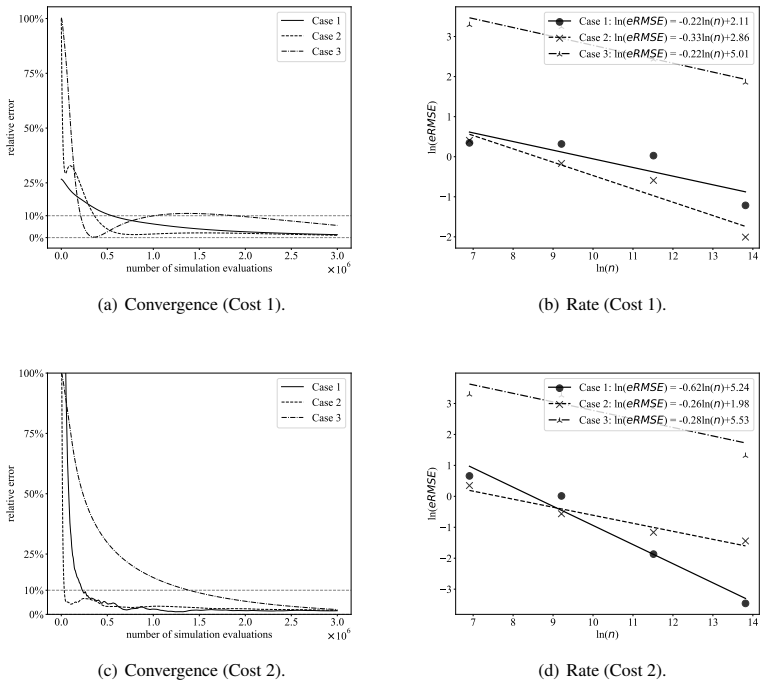
- A testable extension: the rate bound predicts the slope of log-MSE versus log-iterations. In the paper's own experiments the observed slopes are close to but below the predicted −1/5, which suggests an independent benchmark with known conditional densities could separate the finite-sample bias term from the asymptotic rate.
- Because the smoothed system defines the measures only in the limit h→0, the finite-h bias is additive with the optimization error. This suggests designing an adaptive bandwidth schedule that decreases faster for the gradient recursion than for the measure recursion, as the paper's rates already dictate, to improve finite-sample performance.
Editorial analysis
A structured set of objections, weighed in public.
Circularity Check
No significant circularity; central derivations rely on external ODE/kernel theory and are validated against known benchmarks.
full rationale
The paper's core results (Proposition 1, Theorems 1–2, Corollary 1) are proved from Assumptions 1–5 using the Kushner–Yin ODE method, Bochner's lemma/Parzen kernel theory (eq. 6), Spall's simultaneous perturbation, and standard finite-time SA recurrences. These are external mathematical tools, not inputs that presuppose the conclusions. The rate bounds (Theorem 2, Corollary 1) are derived by analyzing the specific recursions (14)–(16) with the aid of Lemma 11, which is attributed to Cao et al. (2023); however, Lemma 11 is a general deterministic contraction-recurrence inequality, not the paper's target rate result, and the final rate follows from the paper's own recurrence derivations in Appendix C. Lemma 7, also attributed to Cao et al. (2023), is a kernel bias expansion; it is auxiliary and does not by itself imply convergence or rates. The parameter choices in the numerical experiments are guided by the theory and then validated against known true solutions, which is external confirmation rather than circularity. Assumption 1(f) is a strong regularity condition; for CoVaR it requires a uniform positive conditional density along the transient path, but it is an assumption, not a conclusion of the proof. Its potential failure is a limitation or correctness risk, not a circular step. There is no fitted input renamed as a prediction, and no self-citation chain is load-bearing for the main theorems. The self-citations are minor and not central, so the circularity score is low.
Assumptions & free parameters
free parameters (3)
- Kernel bandwidth schedule h_n =
h_n = n^{-1/10} (optimization), n^{-1/5} or n^{-1/8} (estimation), 0.08n^{-1/5} (portfolio test)
- Perturbation schedule c_n =
c_n = 4n^{-1/10}, 2n^{-1/10}, 0.5n^{-1/10}, n^{-1/10}, 8n^{-1/10}, 3n^{-1/8} depending on test case
- Step-size schedules and constant multipliers for recursions (14)-(16) =
α_n = 1/(n+10^4); β_n/β̄_n/β_{1,n}/β̄_{1,n} = 1,2,5,25 n^{-4/5}; 3/(n+1), 50/(n+1) in portfolio test
assumptions (9)
- domain assumption Assumptions 1(a),(e),(i): f, q̄, m̄_j three-times continuously differentiable with uniformly bounded derivatives; f(·,θ) and m̄_j(·,·,·,·) are Schwartz functions
- domain assumption Assumptions 1(b), 1(d), 1(f): f ≥ ε and strict monotonicity ∂q̄/∂ν ≤ −ε_q, ∂m̄_j/∂λ_j ≤ −ε_m uniformly in neighborhoods of the iterates
- domain assumption Assumption 2: SP directions Δ_n i.i.d. Bernoulli ±1
- domain assumption Assumption 3: α_n = o(β_n), β_n = o(c_n²h_n²), Σ β_n²/(c_nh_n)² < ∞
- standard math Assumption 4: kernel conditions (symmetric bounded density, Lipschitz, K ≥ ε near 0, Fourier integrability, lim_{u→0}(1−k̂(u))/u² = k* < ∞)
- domain assumption Assumption 5: polynomial schedules; Hessian of ḡ bounded below by ε_ρ; unique ODE equilibrium θ* in int Θ
- standard math Bochner's lemma / Parzen kernel identity (eq. 6): lim_{h→0} E[(1/h)K((ν−X)/h)m] = f(ν,θ) E[m | X = ν]
- standard math Kushner-Yin ODE method (Theorem 2.1, Ch. 5.2)
- domain assumption Lemmas 7 and 11 'due to Cao et al. (2023)'
Cite this review
Pith. "Pith review of A kernel-based stochastic approximation framework for contextual optimization." pith.science (2026). https://pith.science/paper/EUYVPY4J
@misc{pith2026251024033,
  author       = {Pith},
  title        = {Pith review of: A kernel-based stochastic approximation framework for contextual optimization},
  year         = {2026},
  howpublished = {\url{https://pith.science/paper/EUYVPY4J}},
  note         = {Machine review of arXiv:2510.24033}
}
read the original abstract
We present a kernel-based stochastic approximation (KBSA) framework for solving contextual stochastic optimization problems with differentiable objective functions. The framework only relies on system output estimates and can be applied to address a large class of contextual measures, including conditional expectations, conditional quantiles, CoVaR, and conditional expected shortfalls.Under appropriate conditions, we show the strong convergence of KBSA and characterize its finite-time performance in terms of bounds on the mean squared errors of the sequences of iterates produced. In addition, we discuss variants of the framework, including a version based on high-order kernels for further enhancing the convergence rate of the method and an extension of KBSA for handling contextual measures involving multiple conditioning events.Simulation experiments are also carried out to illustrate the framework.
Figures

Reference graph
Works this paper leans on
-
[1]
write newline
" write newline "" before.all 'output.state := FUNCTION n.dashify 't := "" t empty not t #1 #1 substring "-" = t #1 #2 substring "--" = not "--" * t #2 global.max substring 't := t #1 #1 substring "-" = "-" * t #2 global.max substring 't := while if t #1 #1 substring * t #2 global.max substring 't := if while FUNCTION word.in bbl.in ":" * " " * FUNCTION f...
-
[2]
The Review of Financial Studies 30(1):2--47
Acharya VV, Pedersen LH, Philippon T, Richardson M (2017) Measuring systemic risk. The Review of Financial Studies 30(1):2--47
2017
-
[3]
Federal Reserve Bank of New York Staff Report ://dx.doi.org/10.2139/ssrn.1269446
Adrian T, Brunnermeier MK (2008) CoVaR . Federal Reserve Bank of New York Staff Report ://dx.doi.org/10.2139/ssrn.1269446
-
[4]
Operations Research 67(1):90--108
Ban GY, Rudin C (2019) The big data newsvendor: Practical insights from machine learning. Operations Research 67(1):90--108
2019
-
[5]
Management Science 66(3):1025--1044
Bertsimas D, Kallus N (2020) From predictive to prescriptive analytics. Management Science 66(3):1025--1044
2020
-
[6]
IIE Transactions 33(3):245--258
Bhatnagar S, Fu MC, Marcus SI, Bhatnagar S (2001) Two-timescale algorithms for simulation optimization of hidden Markov models . IIE Transactions 33(3):245--258
2001
-
[7]
ACM Transactions on Modeling and Computer Simulation (TOMACS) 13(2):180--209
Bhatnagar S, Fu MC, Marcus SI, Wang IJ (2003) Two-timescale simultaneous perturbation stochastic approximation using deterministic perturbation sequences. ACM Transactions on Modeling and Computer Simulation (TOMACS) 13(2):180--209
2003
-
[8]
International Journal of Forecasting 39(1):391--404
Bianchi ML, De Luca G, Rivieccio G (2023) Non-Gaussian models for CoVaR estimation . International Journal of Forecasting 39(1):391--404
2023
Show all 43 references
-
[9]
Systems & Control Letters 29(5):291--294
Borkar VS (1997) Stochastic approximation with two time scales. Systems & Control Letters 29(5):291--294
1997
-
[10]
Borkar VS (2009) Stochastic approximation: A dynamical systems viewpoint , volume 48 (Springer)
2009
-
[11]
Available at SSRN 4583631
Cao H, Hu JQ, Hu J (2023) Black-box CoVaR and its gradient estimation . Available at SSRN 4583631
2023
-
[12]
Automatica 174:112140
Cao H, Hu JQ, Lian T, Yang X (2025) Infinitesimal perturbation analysis (IPA) derivative estimation with unknown parameters . Automatica 174:112140
2025
-
[13]
SIAM Journal on Control and Optimization 59(4):2798--2819
Doan TT (2021) Finite-time analysis and restarting scheme for linear two-time-scale stochastic approximation. SIAM Journal on Control and Optimization 59(4):2798--2819
2021
-
[14]
IEEE Transactions on Automatic Control 68(8):4695--4705
Doan TT (2022) Nonlinear two-time-scale stochastic approximation: Convergence and finite-time performance . IEEE Transactions on Automatic Control 68(8):4695--4705
2022
-
[15]
IEEE Transactions on Automatic Control
Doan TT (2025) Fast nonlinear two-time-scale stochastic approximation: Achieving O (1/k) finite-sample complexity . IEEE Transactions on Automatic Control
2025
-
[16]
Statistics & Probability Letters 13(3):235--243
Fan J, Hu TC (1992) Bias correction and higher order kernel functions. Statistics & Probability Letters 13(3):235--243
1992
-
[17]
Biometrika 85(3):645--660
Fan J, Yao Q (1998) Efficient estimation of conditional variance functions in stochastic regression. Biometrika 85(3):645--660
1998
-
[18]
Journal of Econometrics 191(1):196--216
Fan Y, Liu R (2016) A direct approach to inference in nonparametric and semiparametric quantile models. Journal of Econometrics 191(1):196--216
2016
-
[19]
Glasserman P (2004) Monte Carlo methods in financial engineering, volume 53 (Springer)
2004
-
[20]
arXiv preprint arXiv:2401.00364
Haque SU, Khodadadian S, Maguluri ST (2023) Tight finite time bounds of two-time-scale linear stochastic approximation with markovian noise. arXiv preprint arXiv:2401.00364
2023 arXiv
-
[21]
a rdle W, M \
H \"a rdle W, M \"u ller M (1997) Multivariate and semiparametric kernel regression. Technical report, SFB 373 Discussion Paper
1997
-
[22]
Operations Research 73(2):1143--1150
Hu J, Fu MC (2025) Technical Note—On the convergence rate of stochastic approximation for gradient-based stochastic optimization . Operations Research 73(2):1143--1150
2025
-
[23]
INFORMS Journal on Computing 34(6):2889--2907, ://dx.doi.org/10.1287/ijoc.2022.1214
Hu J, Peng Y, Zhang G, Zhang Q (2022) A stochastic approximation method for simulation-based quantile optimization. INFORMS Journal on Computing 34(6):2889--2907, ://dx.doi.org/10.1287/ijoc.2022.1214
2022
-
[24]
Operations Research 73(3):1535--1557
Hu J, Song M, Fu MC (2025) Quantile optimization via multiple-timescale local search for black-box functions. Operations Research 73(3):1535--1557
2025
-
[25]
Operations Research 72(6):2337--2357
Huang W, Lin N, Hong LJ (2024) Monte Carlo estimation of CoVaR . Operations Research 72(6):2337--2357
2024
-
[26]
Management Science 69(4):1975--1994
Kallus N, Mao X (2023) Stochastic optimization forests. Management Science 69(4):1975--1994
2023
-
[27]
The European Journal of Finance 24(11):944--975
Karimalis EN, Nomikos NK (2018) Measuring systemic risk in the European banking sector: A copula CoVaR approach . The European Journal of Finance 24(11):944--975
2018
-
[28]
The Annals of Applied Probability 14(2):796--819
Konda VR, Tsitsiklis JN (2004) Convergence rate of linear two-time-scale stochastic approximation. The Annals of Applied Probability 14(2):796--819
2004
-
[29]
Kushner HJ, Yin GG (2003) Stochastic approximation and recursive algorithms and applications (Springer), ISBN 0387008942
2003
-
[30]
arXiv preprint arXiv:2411.12995
Li Z, Peng Y (2024) Eliminating ratio bias for gradient-based simulated parameter estimation. arXiv preprint arXiv:2411.12995
2024
-
[31]
The Annals of Applied Probability 16(3):1671--1702
Mokkadem A, Pelletier M (2006) Convergence rate and averaging of nonlinear two-time-scale stochastic approximation algorithms. The Annals of Applied Probability 16(3):1671--1702
2006
-
[32]
The Annals of Mathematical Statistics 33(3):1065--1076
Parzen E (1962) On estimation of a probability density function and mode. The Annals of Mathematical Statistics 33(3):1065--1076
1962
-
[33]
Management Science 68(3):1639--1658
Qi M, Cao Y, Shen ZJ (2022) Distributionally robust conditional quantile prediction with fixed design. Management Science 68(3):1639--1658
2022
-
[34]
European Journal of Operational Research 320(2):271--289
Sadana U, Chenreddy A, Delage E, Forel A, Frejinger E, Vidal T (2025) A survey of contextual optimization methods for decision-making under uncertainty. European Journal of Operational Research 320(2):271--289
2025
-
[35]
Journal of the American Statistical Association 72(358):420--423
Schucany W, Sommers JP (1977) Improvement of kernel type density estimators. Journal of the American Statistical Association 72(358):420--423
1977
-
[36]
The Annals of Statistics 6(1):177--184
Silverman BW (1978) Weak and strong uniform consistency of the kernel estimate of a density and its derivatives. The Annals of Statistics 6(1):177--184
1978
-
[37]
IEEE Transactions on Automatic Control 37(3):332--341
Spall JC (1992) Multivariate stochastic approximation using a simultaneous perturbation gradient approximation. IEEE Transactions on Automatic Control 37(3):332--341
1992
-
[38]
Proceedings of the 2003 American Control Conference, 2003., volume 5, 4426--4431 (IEEE)
Tadic VB, Meyn SP (2003) Asymptotic properties of two time-scale stochastic approximation algorithms with constant step sizes. Proceedings of the 2003 American Control Conference, 2003., volume 5, 4426--4431 (IEEE)
2003
-
[39]
arXiv preprint arXiv:2503.12747
Wang Y, Zhang X (2025) Statistical inference for weighted sample average approximation in contextual stochastic optimization. arXiv preprint arXiv:2503.12747
2025
-
[40]
Advances in Neural Information Processing Systems 33:17617--17628
Wu YF, Zhang W, Xu P, Gu Q (2020) A finite-time analysis of two time-scale actor-critic methods. Advances in Neural Information Processing Systems 33:17617--17628
2020
-
[41]
Proceedings of the 56th Annual Meeting of the Association for Computational Linguistics, 1970--1979
Xu Y, Cohen SB (2018) Stock movement prediction from tweets and historical prices. Proceedings of the 56th Annual Meeting of the Association for Computational Linguistics, 1970--1979
2018
-
[42]
Yin GG, Zhang Q (2005) Discrete-time Markov chains: Two-time-scale methods and applications (Springer)
2005
-
[43]
Management Science 70(4):2315--2329
Zhang L, Yang J, Gao R (2024) Optimal robust policy for feature-based newsvendor. Management Science 70(4):2315--2329
2024
Reviewed August 4, 2026 · model on record in the stance chip above.
Discussion (0). Sign in to comment.