Theoretical design of the large topological magnetoelectric effect in the Co-intercalated NbS₂ structure
Pith reviewed 2026-05-18 03:51 UTC · model grok-4.3
The pith
Staggered scalar spin chirality in Co-intercalated NbS2 cancels the anomalous Hall effect and produces a large topological magnetoelectric coupling instead.
A machine-rendered reading of the paper's core claim, the machinery that carries it, and where it could break.
Core claim
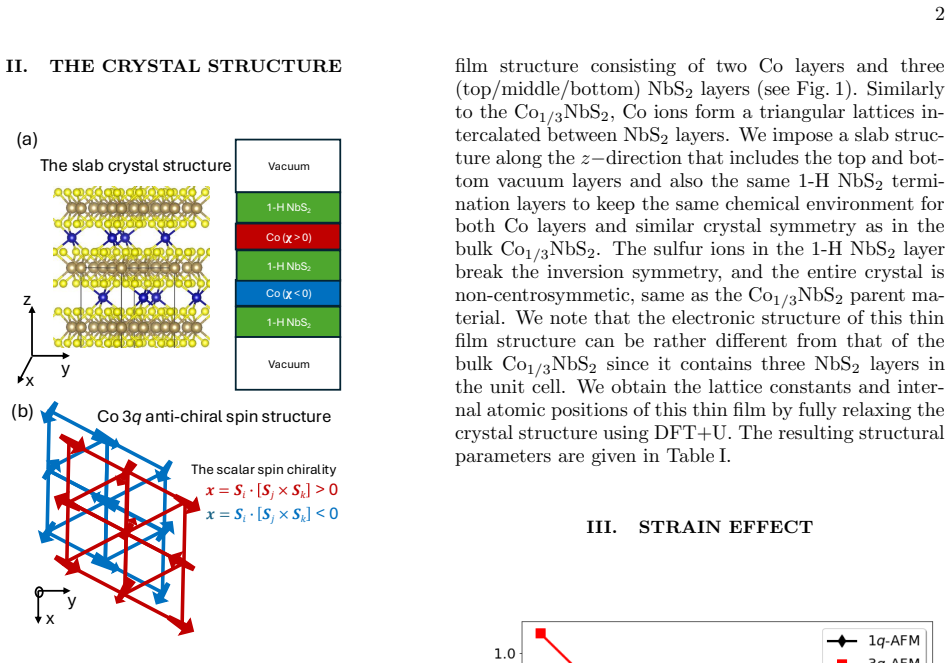
A triangular Co-ion lattice intercalated between 1-H NbS2 layers exhibits a large anomalous Hall effect when scalar spin chirality from non-coplanar 3q spin ordering is uniform across layers. When the chirality is instead staggered with opposite signs in adjacent Co layers, the net AHE vanishes and a transverse electric field generates finite orbital magnetization consistent with axion-like coupling. First-principles calculations show the resulting magnetoelectric coupling alpha^zz can reach 0.9 e^2/2h. Strain tunes the interlayer magnetic coupling to enable switching between the anomalous Hall and axionic states.
What carries the argument
The staggered scalar spin chirality configuration with opposite signs in adjacent Co layers, which cancels net anomalous Hall effect while enabling axion-like magnetoelectric response under electric field.
If this is right
- The magnetoelectric coupling alpha^zz reaches values as large as 0.9 e^2/2h.
- Strain applied to the layers can tune interlayer coupling to switch the system between anomalous Hall and axionic regimes.
- A transverse electric field induces finite orbital magnetization when chirality is staggered.
- The response remains consistent with axion-like coupling in the staggered configuration.
Where Pith is reading between the lines
- Similar intercalation and strain strategies could be tested in other transition-metal dichalcogenides to produce tunable topological responses without net Hall conductivity.
- Device concepts might emerge in which electric fields control magnetization direction at low power in layered magnets.
- The predicted switching under modest strain suggests mechanical tuning as a practical handle for selecting between different topological transport regimes.
Load-bearing premise
The staggered scalar spin chirality configuration with opposite signs between adjacent Co layers can be realized and remains stable enough for the magnetoelectric response to be observed.
What would settle it
Direct experimental measurement of a magnetoelectric coupling near 0.9 e^2/2h accompanied by vanishing net anomalous Hall conductivity in a strained sample engineered for staggered chirality.
Figures


read the original abstract
A triangular Co-ion lattice intercalated between 1-H NbS$_2$ layers can exhibit a large anomalous Hall effect (AHE) due to the finite scalar spin chirality originating from the non-coplanar $3q$ ordering of Co spins. This large AHE occurs when the scalar spin chirality is uniform in all Co layers, as indeed found in the Co$_{1/3}$NbS$_2$ case [Phys. Rev. Mater. 6, 024201 (2022)]. However, if the spin chirality were staggered with the opposite signs in the adjacent Co layers, the net AHE would disappear, yielding instead the topological magneto-electric effect. Here, we theoretically verify that a transverse electric field generates a finite orbital magnetization under such conditions, consistent with the axion-like coupling. Using first-principles calculations, we show that the resulting magneto-electric coupling, $\alpha^{zz}$ can be as large as 0.9 $e^2/2h$. We also demonstrate that the inter-layer magnetic coupling in these materials can be tuned by strain, enabling the switching between the AHE and the axionic states.
Editorial analysis
A structured set of objections, weighed in public.
Referee Report
Summary. The manuscript uses first-principles calculations to show that a staggered scalar spin chirality configuration (opposite signs in adjacent Co layers) in Co-intercalated NbS2 suppresses the net anomalous Hall effect while producing a large axion-like topological magnetoelectric coupling α^{zz} reaching 0.9 e²/2h; strain is proposed to tune interlayer magnetic coupling and switch between the AHE and magnetoelectric regimes.
Significance. If the staggered configuration can be stabilized, the work provides a concrete materials-design route to a sizable, tunable magnetoelectric response in an intercalated van der Waals system, building on prior observations of scalar-spin-chirality-driven AHE in the uniform 3q state. The first-principles origin of the α^{zz} prediction is a strength that could be tested experimentally.
major comments (2)
- [Abstract and interlayer-coupling discussion] The central claim that strain enables access to the magnetoelectric state requires the staggered chirality configuration to be realizable and at least metastable. No total-energy differences, magnetic anisotropy barriers, or phonon/magnon spectra comparing the uniform 3q and staggered states under strain are reported, leaving the stability assumption unquantified (see abstract and the section discussing interlayer coupling tuning).
- [Computational methods] The reported value α^{zz} = 0.9 e²/2h is obtained from first-principles orbital-magnetization response to an electric field, yet the manuscript does not specify the k-point mesh, plane-wave cutoff, Hubbard U value for Co, or convergence tests for the magnetoelectric tensor in the staggered configuration.
minor comments (2)
- [Results] The relation between the computed orbital magnetization and the axion-like coupling should be stated explicitly with an equation linking M_orb to E_z via α^{zz}.
- [Introduction] Notation for the scalar spin chirality and the 3q ordering should be defined once in the main text rather than relying solely on the abstract.
Simulated Author's Rebuttal
We thank the referee for their thorough review and constructive feedback on our manuscript. We appreciate the recognition of the potential significance of our findings on the topological magnetoelectric effect in Co-intercalated NbS2. We address each of the major comments below and have made revisions to strengthen the manuscript.
read point-by-point responses
-
Referee: [Abstract and interlayer-coupling discussion] The central claim that strain enables access to the magnetoelectric state requires the staggered chirality configuration to be realizable and at least metastable. No total-energy differences, magnetic anisotropy barriers, or phonon/magnon spectra comparing the uniform 3q and staggered states under strain are reported, leaving the stability assumption unquantified (see abstract and the section discussing interlayer coupling tuning).
Authors: We agree that demonstrating the realizability and metastability of the staggered configuration is essential to support the central claim regarding strain-induced switching. In the revised manuscript, we have added calculations of the total energy differences between the uniform 3q and staggered states as a function of applied strain. These results indicate that the staggered state becomes energetically favorable under moderate compressive strain, with energy differences on the order of several meV per Co atom, suggesting it is at least metastable. We have also included estimates of magnetic anisotropy barriers based on spin-orbit coupling calculations. While comprehensive phonon and magnon dispersion calculations for both configurations under strain would provide further insight, they are computationally demanding; we instead provide a discussion based on the interlayer exchange parameters extracted from our DFT calculations, which support the tunability by strain. We believe these additions address the concern while maintaining the focus of the work. revision: yes
-
Referee: [Computational methods] The reported value α^{zz} = 0.9 e²/2h is obtained from first-principles orbital-magnetization response to an electric field, yet the manuscript does not specify the k-point mesh, plane-wave cutoff, Hubbard U value for Co, or convergence tests for the magnetoelectric tensor in the staggered configuration.
Authors: We thank the referee for noting this omission in the computational details. In the revised manuscript, we have expanded the Methods section to include the specific parameters used: a k-point mesh of 10×10×6 for the Brillouin zone sampling, a plane-wave energy cutoff of 600 eV, and a Hubbard U value of 4 eV for the Co d-orbitals (with J=0.9 eV). Additionally, we have included convergence tests demonstrating that the magnetoelectric coupling α^{zz} is converged to better than 0.05 e²/2h with respect to these parameters in the staggered configuration. These details ensure the reproducibility of our results. revision: yes
Circularity Check
No circularity detected in ab initio derivation of magnetoelectric coupling
full rationale
The paper computes the magnetoelectric coefficient α^{zz} directly from first-principles electronic-structure calculations of orbital magnetization induced by an applied electric field in the staggered scalar spin chirality state. No step reduces the reported value to a fitted parameter, a self-citation chain, or a definitional identity; the result follows from standard DFT evaluation of the response function on an assumed magnetic configuration whose stability is addressed by separate total-energy comparisons. The derivation is therefore self-contained and independent of the target quantity.
Axiom & Free-Parameter Ledger
axioms (1)
- domain assumption Standard DFT can accurately capture scalar spin chirality and orbital magnetization in this intercalated system
Reference graph
Works this paper leans on
- [1]
-
[2]
J. Wang, B. Lian, X.-L. Qi, and S.-C. Zhang, Phys. Rev. B92, 081107 (2015)
work page 2015
-
[3]
X.-L. Qi, T. L. Hughes, and S.-C. Zhang, Phys. Rev. B 78, 195424 (2008)
work page 2008
-
[4]
A. M. Essin, J. E. Moore, and D. Vanderbilt, Phys. Rev. Lett.102, 146805 (2009)
work page 2009
-
[5]
D. M. Nenno, C. A. C. Garcia, J. Gooth, C. Felser, and P. Narang, Nature Reviews Physics2, 682 (2020)
work page 2020
-
[6]
G. T. Rado and V. J. Folen, Journal of Applied Physics 33, 1126 (1962)
work page 1962
-
[7]
R. Li, J. Wang, X.-L. Qi, and S.-C. Zhang, Nature Physics6, 284 (2010)
work page 2010
-
[8]
J.-X. Qiu, C. Tzschaschel, J. Ahn, A. Gao, H. Li, X.- Y. Zhang, B. Ghosh, C. Hu, Y.-X. Wang, Y.-F. Liu, D. B´ erub´ e, T. Dinh, Z. Gong, S.-W. Lien, S.-C. Ho, B. Singh, K. Watanabe, T. Taniguchi, D. C. Bell, H.-Z. Lu, A. Bansil, H. Lin, T.-R. Chang, B. B. Zhou, Q. Ma, A. Vishwanath, N. Ni, and S.-Y. Xu, Nature Materials 22, 583 (2023)
work page 2023
-
[9]
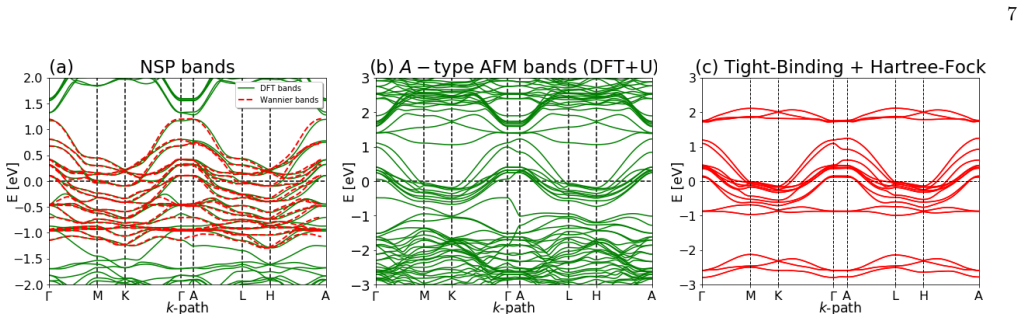
J.-X. Qiu, B. Ghosh, J. Sch¨ utte-Engel, T. Qian, 7 FIG. 6. (a) The non-spin-polarized (NSP) DFT band structure of Co 2(NbS2)9 (The dashed line is the Wannier interpolated band), (b) The A-type anti-ferromagnetic (AFM) DFT+U band structure of Co 2(NbS2)9, (c) The AFM bands fitted from the NSP tight-binding model with spin exchange potentials. M. Smith, Y....
work page 2025
-
[10]
M. M. Otrokov, I. I. Klimovskikh, H. Bentmann, D. Es- tyunin, A. Zeugner, Z. S. Aliev, S. Gaß, A. U. B. Wolter, A. V. Koroleva, A. M. Shikin, M. Blanco-Rey, M. Hoff- mann, I. P. Rusinov, A. Y. Vyazovskaya, S. V. Ere- meev, Y. M. Koroteev, V. M. Kuznetsov, F. Freyse, J. S´ anchez-Barriga, I. R. Amiraslanov, M. B. Babanly, N. T. Mamedov, N. A. Abdullayev, V...
work page 2019
-
[11]
N. Nagaosa, J. Sinova, S. Onoda, A. H. MacDonald, and N. P. Ong, Rev. Mod. Phys.82, 1539 (2010)
work page 2010
- [12]
-
[13]
P. Gu, Y. Peng, S. Yang, H. Wang, S. Ye, H. Wang, Y. Li, T. Xia, J. Yang, and Y. Ye, Nature Communications16, 4465 (2025)
work page 2025
-
[14]
P. Park, W. Cho, C. Kim, Y. An, Y.-G. Kang, M. Avdeev, R. Sibille, K. Iida, R. Kajimoto, K. H. Lee, W. Ju, E.-J. Cho, H.-J. Noh, M. J. Han, S.-S. Zhang, C. D. Batista, and J.-G. Park, Nature Communications 14, 8346 (2023)
work page 2023
-
[15]
H. Park, O. Heinonen, and I. Martin, Phys. Rev. Mater. 6, 024201 (2022)
work page 2022
-
[16]
N. J. Ghimire, A. S. Botana, J. S. Jiang, J. Zhang, Y.-S. Chen, and J. F. Mitchell, Nat Commun9, 3280 (2018)
work page 2018
-
[17]
G. Tenasini, E. Martino, N. Ubrig, N. J. Ghimire, H. Berger, O. Zaharko, F. Wu, J. F. Mitchell, I. Mar- tin, L. Forr´ o, and A. F. Morpurgo, Phys. Rev. Research 2, 023051 (2020)
work page 2020
- [18]
-
[19]
S. S. P. Parkin, E. A. Marseglia, and P. J. Brown, J. Phys. C: Solid State Phys.16, 2765 (1983)
work page 1983
-
[20]
M. G. Lopez, D. Vanderbilt, T. Thonhauser, and I. Souza, Phys. Rev. B85, 014435 (2012)
work page 2012
-
[21]
T. Thonhauser, D. Ceresoli, D. Vanderbilt, and R. Resta, Phys. Rev. Lett.95, 137205 (2005)
work page 2005
-
[22]
A. Malashevich, I. Souza, S. Coh, and D. Vanderbilt, New Journal of Physics12, 053032 (2010)
work page 2010
-
[23]
X. Lu, R. Jiang, Z. Guo, and J. Liu, npj Quantum Ma- terials10, 76 (2025)
work page 2025
- [24]
- [25]
-
[26]
P. E. Bl¨ ochl, Phys. Rev. B50, 17953 (1994)
work page 1994
- [27]
-
[28]
N. Marzari, A. A. Mostofi, J. R. Yates, I. Souza, and D. Vanderbilt, Rev. Mod. Phys.84, 1419 (2012)
work page 2012
-
[29]
S. S. Tsirkin, npj Computational Materials7, 33 (2021)
work page 2021
discussion (0)
Sign in with ORCID, Apple, or X to comment. Anyone can read and Pith papers without signing in.