REVIEW 2 major objections 4 minor 2 cited by
Quantum Nonlocality under Latency Constraints
T0 review · 2 major / 4 minor · reviewed 2026-08-04 · deepseek-v4-flash
Pith's one-line read The paper argues that the classical–quantum gap in Bell-type correlation tasks is not fixed but depends on the time parties are allowed to communicate, formalized through latency-constrained games that extend Bell scenarios.
desk verdict A genuinely useful framework paper that generalizes Bell scenarios to partial communication; the F⊊Q result needs a citation or proof for its self-testing step, but the value separation holds via a cited route. read the letter →
The pith
A machine-rendered reading of the paper's core claim, the machinery that carries it, and where it could break.
The reading
What carries the argument
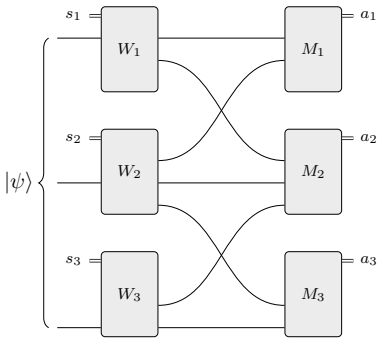
The load-bearing object is the latency-constrained game: a predicate, an input distribution, and a connectivity graph (or, in multi-step games, a latency function ℓ(i,j) counting time steps for a signal from i to j). The graph fixes each party's past light cone and which transmissions fit before the deadline. Classical strategies are deterministic maps on those light cones, mixed by shared randomness; quantum strategies are shared states, input-dependent isometries that move quantum registers along edges, and final measurements. Forwarding strategies are the subclass where only classical inputs are forwarded; their strict weakness (F⊊Q) is proven by self-testing the CHSH correlations and mon
What would settle it
A three-node experiment with v1 and v2 close together and v3 far away: implement the distributed CHSH strategy while sweeping the latency constraint t. If the observed quantum winning probability jumps from 3/4 to cos²(π/8) exactly when t exceeds d/c, the latency-constrained prediction is confirmed; if it stays at 3/4 until t exceeds d/c plus the local processing time, the zero-time assumption fails.
Extended reading notes
Core claim
The paper's central claim: classical and quantum correlations obey a family of bounds indexed by the time parties may communicate, not a single Bell region. A latency-constrained game is a nonlocal game plus a directed connectivity graph; classical strategies are mixtures of deterministic functions on each party's past light cone, while quantum strategies use shared entanglement, input-dependent isometries that send quantum registers along edges, and final measurements. For the distributed CHSH game (standard Bell test), the classical value is 3/4 and the quantum value is cos²(π/8) once v1 and v2 exchange one message; for the extended CHSH game, forwarding-only quantum strategies are stuck a
Load-bearing premise
The paper assumes local operations consume zero time, so the latency budget consists entirely of communication time; if realistic gate, measurement, or classical-processing times are comparable to the light-travel delays, the effective communication windows and all predicted thresholds and game values must be revised.
Editorial extensions
If this is right
- Standard Bell inequalities are recovered as the zero-latency case; the new inequalities for partially communicating parties are natural generalizations, and the classical–quantum gap is a step function of the allowed time.
- For the distributed CHSH game, a single round of communication between two of three parties suffices to push the quantum value to cos²(π/8), whereas the classical value stays at 3/4; the quantum violation switches on exactly when the latency crosses the communication threshold.
- For the extended CHSH game, forwarding strategies—pre-shared entanglement plus shared inputs—cannot beat 3/4, while general quantum strategies reach cos²(π/8); real-time quantum communication is therefore essential, not just entanglement.
- For any SISO game, the threshold times τc(α) and τq(α) define a provable time advantage: if τq(α)<τc(α), quantum resources reach a given success probability in strictly fewer time steps than classical ones.
- The constructions extend to n+m-party distributed CHSH games and to the distributed magic square game, where unit winning probability is achieved with a single communication round.
Reading between the lines
- If real local gates, measurements, and classical processing take non-negligible time, all the sharp thresholds (d/c, 2d/c, d'/c) and values such as cos²(π/8) would shift; the framework's structure would survive, but experimental implementations must budget processing time inside the latency window.
- The F⊊Q separation suggests that future quantum-network experiments for latency-constrained tasks should implement actual transmission of quantum registers (or teleportation) within the deadline, rather than only distributing entanglement and forwarding classical inputs.
- The numerical gap for the perturbed XOR game at one-round latencies (lower bound 0.41770, forwarding value 0.42419) leaves open whether the true single-round quantum value reaches the aggregated upper bound 0.42896; this would decide whether back-and-forth communication ever strictly helps quantum strategies.
- The same latency-constrained formulation could be extended to moving or relativistically accelerated parties, where light cones themselves define the connectivity structure and Bell-type bounds become causal-structure questions in curved spacetime.
Editorial analysis
A structured set of objections, weighed in public.
Referee Report
Summary. The paper introduces latency-constrained (LC) games, a generalization of nonlocal games in which a directed graph specifies which parties may exchange information within a single communication round, and a multi-step variant with a latency function. The central conceptual claim is that the classical–quantum gap in Bell-type correlation bounds is not a constant but a function of the available latency: when a subset of parties can communicate, new classical bounds arise and quantum strategies can violate them. The main technical results are: (i) a distributed CHSH game where classical and no-communication quantum values are 3/4 but a single round of communication between two parties allows a quantum value of cos²(π/8); (ii) a distributed magic square game won with certainty using one round of communication; (iii) Theorem 10, asserting F ⊊ Q (forwarding strategies are strictly weaker than general LC quantum strategies) and Proposition 11, giving ωq = cos²(π/8) > ωf = 3/4 for the extended CHSH game; and (iv) aggregation results and numerical see-saw/NPA-type bounds for SISO games, including a physical isosceles-triangle layout plotted as a function of latency.
Significance. If the results are correct, this is a valuable and original framework that extends Bell nonlocality in a physically motivated direction. The explicit single-round quantum strategy for the distributed CHSH game is elegant and the logical-qubit encoding is clearly presented. The paper is commendably transparent: the zero-local-operation-time assumption is flagged repeatedly, the numerical lower bounds are honestly reported as see-saw results with known convergence caveats, and the code is made available. The separation F ⊊ Q, if rigorously established, is a clean structural result that justifies the new quantum-strategy definition. The potential applications to latency-sensitive decision problems are suggestive and add motivation. However, the flagship separation rests on a self-testing assertion that is stated without proof or citation, and the exact upper bound in the distributed CHSH example is justified only by an informal aggregation argument. These issues are load-bearing and need to be fixed before the central claims can be considered fully established.
major comments (2)
- [Theorem 10, Eq. (2.9)] The proof of F ⊊ Q relies on the assertion that an optimal CHSH marginal behavior self-tests the full tripartite state in the strong form (V1⊗I⊗V3)(Π1,a1(s1)⊗I⊗Π3,a3(s3)|ψ⟩) = (P1,a1(s1)⊗P3,a3(s3)|Φ+⟩)⊗|ξ⟩. This statement is not proved and no citation is given. Standard CHSH self-testing theorems, as usually stated, certify the state and measurements jointly under an isometry applied to the whole state, not the post-measurement vector with a single common junk state |ξ⟩ for all a1,a3. If the reduced state on B1B3 is mixed, one needs a robust extension that preserves the tensor-product junk form. Since the subsequent contradiction — that party 2's output is independent of party 1's output — depends exactly on this decomposition, the separation F ⊊ Q and Proposition 11 are not rigorously established as written. Please provide a self-contained proof or a precise citation to a theorem that d
- [Section 2.3.1, distributed CHSH upper bound] The proof that ωq = cos²(π/8) for the distributed CHSH game uses an informal aggregation argument: v1 and v2 are replaced by one party with input (s1,s2) and output (a1,a2), and it is claimed that this party is 'effectively playing the usual CHSH game with v3'. Because the winning predicate also requires a1 = a2, the aggregated party's output is a two-bit pair, not a CHSH bit, so the reduction is not immediate. A rigorous argument can be supplied, for example by classical post-processing: after the pair's joint operation, map an outcome (b,b) to b and every outcome (b,b') with b≠b' to a fixed bit; this cannot decrease the winning probability and yields a valid CHSH strategy. This would justify ωq ≤ cos²(π/8). As written, however, the exact upper bound is a proof sketch. Since this is the flagship quantitative example, the argument should be made precise.
minor comments (4)
- [Section 4.2.1, graph (3) explanation] The sentence explaining why the algebraic bound is achievable on graph (3) says that v1 and v3 output 0 and 'v2 producing its output depending on the full input (s1,s2,s3) which as been communicated to him by v1 and v2'. With the graph v1⇆v3⇆v2, v2 does not receive s1. It should be v3, who is connected to both v1 and v2, that produces the input-dependent output, while v1 and v2 output fixed values. The claim itself is correct, but the text as written is confusing.
- [Table 5, note (*)] The footnote notes that the generalized see-saw converges to quantum strategies that achieve lower winning probabilities than forwarding strategies. This is logically possible because the see-saw lower bound is not known to be tight, but the phrasing may suggest an inconsistency with ωf ≤ ωq. It would help to state explicitly that the see-saw result is a valid but loose lower bound, and that the observed value below ωf simply reflects convergence to a local optimum.
- [Sections 1, 3.2, 3.4] The assumption that local operations consume zero time is explicitly and repeatedly flagged, which is good. However, in the discussion of the HFT scenario (Section 5) the 0.188–3.9 ms window is presented as directly applicable; a reminder that this window is pure communication time, excluding local measurement and processing, would sharpen the conditional nature of the application.
- [Proposition 23] The proof of the quantum aggregation proposition is concise but would be easier to follow with an explicit timing diagram or a short description of how the round-trip inequality ℓ(i,v0)+ℓ(v0,i)≤τ is used for each party's input and output. The current proof states it verbally; a figure or explicit step-by-step timing would improve clarity.
Circularity Check
No circularity: central LC-game values rest on explicit strategies and external CHSH/Toner/NPA bounds; the uncited self-testing step in Eq. (2.9) is a correctness gap, not a circular reduction.
full rationale
Every claimed value in the paper is either backed by an explicit strategy construction or bounded using independent, external results. The distributed CHSH value cos^2(pi/8) is achieved by an explicit logical-qubit strategy and upper-bounded by aggregating v1,v2 and invoking the standard CHSH quantum value; the classical value 3/4 is obtained by enumeration/aggregation. Theorem 10's F⊊Q proof invokes a CHSH self-testing statement in Eq. (2.9) without proof or citation, and Proposition 11 uses Toner's 1-extension theorem [30]. These are imported external mathematical facts, not re-descriptions of the paper's own fitted quantities; the missing proof/citation for Eq. (2.9) is a rigor/correctness risk, not circularity. The numerical sections use see-saw lower bounds and NPA upper bounds, while hand-picked XOR-game coefficients and perturbation matrices are existence demonstrations rather than fitted predictions. Self-citations in the paper ([4], [5], [62]) appear only in motivation and application discussion, especially the HFT example, and are not load-bearing for the mathematical claims. Overall, the derivation chain is self-contained in the sense that no prediction is equivalent by construction to an input or to a self-citation chain.
Assumptions & free parameters
free parameters (2)
- Random XOR game coefficients β̂_{s1,s2,s3} =
0.438, 0.580, 0.610, -0.502, 0.520, -0.724, -0.466, -0.220
- Perturbation parameter λ and perturbation matrix η =
λ = 0.25; η given in Table 4
assumptions (4)
- domain assumption Local operations consume zero time.
- domain assumption Discrete rational time grids are without loss of generality.
- domain assumption Quantum strategies can be represented by isometries followed by projective measurements, with teleportation sufficient for communication.
- domain assumption CHSH correlations self-test the maximally entangled state and the associated measurements.
Cite this review
Pith. "Pith review of Quantum Nonlocality under Latency Constraints." pith.science (2026). https://pith.science/paper/5DYLIT6H
@misc{pith2026251026349,
  author       = {Pith},
  title        = {Pith review of: Quantum Nonlocality under Latency Constraints},
  year         = {2026},
  howpublished = {\url{https://pith.science/paper/5DYLIT6H}},
  note         = {Machine review of arXiv:2510.26349}
}
read the original abstract
Bell inequalities are bounds on the correlations between different parties obeying a local hidden variable theory. Here, "local" refers to spacetime locality: the parties cannot communicate their inputs because they must produce their outputs faster than the speed-of-light delay between them. In other words, the parties must satisfy a certain latency constraint. In this work, we explicitly incorporate spacetime locality into the formulation of Bell inequalities by imposing such a latency constraint. When the latency constraint is sufficiently tight such that no parties can communicate, this becomes a standard Bell scenario. When the latency constraint is relaxed such that a subset of the parties can communicate, we no longer have a Bell scenario, but we can again find a divide between classical and quantum behaviors. Hence, we observe that the classical-quantum gap should actually be a function of time. To study these more general scenarios, we introduce the mathematical framework of latency-constrained games, which models time-evolving input and output processes for spatially separated parties subject to finite communication speeds. This framework allows us to systematically study the weirdness of quantum mechanics in the "low-latency regime" where the speed-of-light delay is non-negligible. Latency-constrained games can describe real-time decision-making in real-world settings that are latency-sensitive, such as high-frequency trading and distributed systems, and can reveal the utility of quantum correlations in these settings.
Figures


Figures from the paper (13 more)


Forward citations
Cited by 2 Pith papers
-
Entanglement improves coordination in distributed systems
For a two-server queue with paired arrivals and a convex baseline-throughput function, entanglement-assisted routing can Pareto-dominate every classical communication-free routing strategy.
-
Quantum Telepathy: A Quantum Technology with Near-Term Applications
Quantum telepathy—using entanglement to beat Bell inequalities in communication-restricted coordination—is reviewed as a near-term quantum technology, but the paper is an overview of the authors' prior results rather ...
Reference graph
Works this paper leans on
-
[1]
On the Einstein Podolsky Rosen paradox.Physics Physique Fizika, 1(3):195, 1964
John S Bell. On the Einstein Podolsky Rosen paradox.Physics Physique Fizika, 1(3):195, 1964
1964
-
[2]
Violation of Bell’s inequality under strict Einstein locality conditions.Physical Review Letters, 81(23):5039, 1998
Gregor Weihs, Thomas Jennewein, Christoph Simon, Harald Weinfurter, and Anton Zeilinger. Violation of Bell’s inequality under strict Einstein locality conditions.Physical Review Letters, 81(23):5039, 1998
1998
-
[3]
Adam Brandenburger and Pierfrancesco La Mura. Team decision problems with classical and quantum signals.Philosophical Transactions of the Royal Society A: Mathematical, Physical and Engineering Sciences, 374(2058):20150096, 2016
-
[4]
Systems and methods for coordinating decisions between non-communicating parties, December 17 2020
Mario Szegedy, Dawei Ding, and Yaoyun Shi. Systems and methods for coordinating decisions between non-communicating parties, December 17 2020. US Patent 11676104B2
2020
-
[5]
Coordinating decisions via quantum telepathy.arXiv preprint arXiv:2407.21723, 2024
Dawei Ding and Liang Jiang. Coordinating decisions via quantum telepathy.arXiv preprint arXiv:2407.21723, 2024
arXiv 2024
-
[6]
Patience and finance.https://www.bis.org/review/r100909e.pdf, 2010
Andrew Haldane. Patience and finance.https://www.bis.org/review/r100909e.pdf, 2010. Online; accessed 16 February 2024
2010
-
[7]
Entanglement improves coordination in distributed systems
Francisco Ferreira da Silva and Stephanie Wehner. Entanglement improves coordination in distributed systems. InProceedings of the 2nd Workshop on Quantum Networks and Distributed Quantum Computing, pages 14–20, 2025
2025
-
[8]
Quantum-assisted loan balancing in communication-constrained wide-area physical networks, November 24 2016
Adam Brandenburger and Pierfrancesco La Mura. Quantum-assisted loan balancing in communication-constrained wide-area physical networks, November 24 2016. US Patent 10056983B2
2016
Show all 69 references
-
[9]
Quantum load balancing in ad hoc networks.Quantum Information Processing, 16(6):148, 2017
Masoud Hasanpour, Shahin Shariat, Payam Barnaghi, Seyed Amir Hoseinitabatabaei, Seiamak Vahid, and Rahim Tafazolli. Quantum load balancing in ad hoc networks.Quantum Information Processing, 16(6):148, 2017
2017
-
[10]
Quantum strategies for rendezvous and domination tasks on graphs with mobile agents.Physical Review A, 109(4):042201, 2024
Giuseppe Viola and Piotr Mironowicz. Quantum strategies for rendezvous and domination tasks on graphs with mobile agents.Physical Review A, 109(4):042201, 2024
2024
-
[11]
Causal and compositional structure of unitary transfor- mations.Quantum, 5:511, 2021
Robin Lorenz and Jonathan Barrett. Causal and compositional structure of unitary transfor- mations.Quantum, 5:511, 2021
2021
-
[12]
Causal and localizable quantum operations.Physical Review A, 64(5):052309, 2001
David Beckman, Daniel Gottesman, Michael A Nielsen, and John Preskill. Causal and localizable quantum operations.Physical Review A, 64(5):052309, 2001
2001
-
[13]
Bacon and B
D. Bacon and B. F. Toner. Bell inequalities with auxiliary communication.Phys. Rev. Lett., 90:157904, Apr 2003
2003
-
[14]
Bell inequalities with communication assistance.Phys
Katherine Maxwell and Eric Chitambar. Bell inequalities with communication assistance.Phys. Rev. A, 89:042108, Apr 2014
2014
-
[15]
M. G. M. Moreno, Samuraí Brito, Ranieri V. Nery, and Rafael Chaves. Device-independent secret sharing and a stronger form of Bell nonlocality.Phys. Rev. A, 101:052339, May 2020. 52
2020
-
[16]
Chaves, R
R. Chaves, R. Kueng, J. B. Brask, and D. Gross. Unifying framework for relaxations of the causal assumptions inBell ’s theorem.Phys. Rev. Lett., 114:140403, Apr 2015
2015
-
[17]
Bell scenarios with communication.Journal of Physics A: Mathematical and Theoretical, 50(9):094001, 2017
Jonatan Bohr Brask and Rafael Chaves. Bell scenarios with communication.Journal of Physics A: Mathematical and Theoretical, 50(9):094001, 2017
2017
-
[18]
Carlos Vieira, Carlos de Gois, Pedro Lauand, Lucas E. A. Porto, Sébastien Designolle, and Marco Túlio Quintino. Can outcome communication explain Bell nonlocality?, 2025
2025
-
[19]
Multistage games and Bell scenarios with communication.Phys
George Moreno, Ranieri Nery, Alberto Palhares, and Rafael Chaves. Multistage games and Bell scenarios with communication.Phys. Rev. A, 102:042412, Oct 2020
2020
-
[20]
Bell nonlocality in networks.Reports on Progress in Physics, 85(5):056001, 2022
Armin Tavakoli, Alejandro Pozas-Kerstjens, Ming-Xing Luo, and Marc-Olivier Renou. Bell nonlocality in networks.Reports on Progress in Physics, 85(5):056001, 2022
2022
-
[21]
Nonlinear Bell inequalities tailored for quantum networks.Phys
Denis Rosset, Cyril Branciard, Tomer Jack Barnea, Gilles Pütz, Nicolas Brunner, and Nicolas Gisin. Nonlinear Bell inequalities tailored for quantum networks.Phys. Rev. Lett., 116:010403, Jan 2016
2016
-
[22]
Full network nonlocality.Phys
Alejandro Pozas-Kerstjens, Nicolas Gisin, and Armin Tavakoli. Full network nonlocality.Phys. Rev. Lett., 128:010403, Jan 2022
2022
-
[23]
Bell-type inequalities to detect truen-body nonseparability.Phys
Daniel Collins, Nicolas Gisin, Sandu Popescu, David Roberts, and Valerio Scarani. Bell-type inequalities to detect truen-body nonseparability.Phys. Rev. Lett., 88:170405, Apr 2002
2002
-
[24]
Distinguishing three-body from two-body nonseparability by a Bell-type inequality.Phys
George Svetlichny. Distinguishing three-body from two-body nonseparability by a Bell-type inequality.Phys. Rev. D, 35:3066–3069, May 1987
1987
-
[25]
Toward a general theory of quantum games
Gus Gutoski and John Watrous. Toward a general theory of quantum games. InProceedings of the thirty-ninth annual ACM symposium on Theory of computing, pages 565–574, 2007
2007
-
[26]
The range of quantum probability.Journal of Mathematical Physics, 27(6):1556–1565, 1986
Itamar Pitowsky. The range of quantum probability.Journal of Mathematical Physics, 27(6):1556–1565, 1986
1986
-
[27]
Identifyingnonconvexityinthesetsoflimited-dimension quantum correlations.Phys
JohnMatthewDonohueandElieWolfe. Identifyingnonconvexityinthesetsoflimited-dimension quantum correlations.Phys. Rev. A, 92:062120, Dec 2015
2015
-
[28]
Bell nonlocality.Reviews of modern physics, 86(2):419–478, 2014
Nicolas Brunner, Daniel Cavalcanti, Stefano Pironio, Valerio Scarani, and Stephanie Wehner. Bell nonlocality.Reviews of modern physics, 86(2):419–478, 2014
2014
-
[29]
Extending and characterizing quantum magic games.arXiv:1209.3819, 2012
Alex Arkhipov. Extending and characterizing quantum magic games.arXiv:1209.3819, 2012
2012 arXiv
-
[30]
Monogamy of non-local quantum correlations.Proceedings of the Royal Society A: Mathematical, Physical and Engineering Sciences, 465(2101):59–69, 2009
Ben Toner. Monogamy of non-local quantum correlations.Proceedings of the Royal Society A: Mathematical, Physical and Engineering Sciences, 465(2101):59–69, 2009
2009
-
[31]
Lifting Bell inequalities.Journal of Mathematical Physics, 46(6):062112, 06 2005
Stefano Pironio. Lifting Bell inequalities.Journal of Mathematical Physics, 46(6):062112, 06 2005
2005
-
[32]
Continuous input nonlocal games.Natural computing, 12(1):5–8, 2013
Netanel Aharon, Shai Machnes, Benni Reznik, Jonathan Silman, and Lev Vaidman. Continuous input nonlocal games.Natural computing, 12(1):5–8, 2013. 53
2013
-
[33]
Entangled games are hard to approximate.SIAM Journal on Computing, 40(3):848–877, 2011
Julia Kempe, Hirotada Kobayashi, Keiji Matsumoto, Ben Toner, and Thomas Vidick. Entangled games are hard to approximate.SIAM Journal on Computing, 40(3):848–877, 2011
2011
-
[34]
Classical verification of quantum proofs
Zhengfeng Ji. Classical verification of quantum proofs. InProceedings of the Forty-Eighth Annual ACM Symposium on Theory of Computing, STOC ’16, page 885–898, New York, NY, USA, 2016. Association for Computing Machinery
2016
-
[35]
MIP*= RE
Zhengfeng Ji, Anand Natarajan, Thomas Vidick, John Wright, and Henry Yuen. MIP*= RE. arXiv:2001.04383, 2020
2001 arXiv
-
[36]
Bell inequalities and entanglement.arXiv preprint quant-ph/0107093, 2001
Reinhard F Werner and Michael M Wolf. Bell inequalities and entanglement.arXiv preprint quant-ph/0107093, 2001
2001 arXiv
-
[37]
Bounding the set of quantum correlations
Miguel Navascués, Stefano Pironio, and Antonio Acín. Bounding the set of quantum correlations. Physical Review Letters, 98(1):010401, 2007
2007
-
[38]
A convergent hierarchy of semidefinite programs characterizing the set of quantum correlations.New J
Miguel Navascués, Stefano Pironio, and Antonio Acín. A convergent hierarchy of semidefinite programs characterizing the set of quantum correlations.New J. Phys., 10(7):073013, July 2008
2008
-
[39]
Statepolynomials: positivity, optimization and nonlinear Bell inequalities.Mathematical Programming, 207(1):645–691, 2024
IgorKlep, VictorMagron, JurijVolčič, andJieWang. Statepolynomials: positivity, optimization and nonlinear Bell inequalities.Mathematical Programming, 207(1):645–691, 2024
2024
-
[40]
Quantum circuit architecture
Giulio Chiribella, Giacomo Mauro D’Ariano, and Paolo Perinotti. Quantum circuit architecture. Phys. Rev. Lett., 101(6):060401, 2008
2008
-
[41]
Theoretical framework for quantum networks.Phys
Giulio Chiribella, Giacomo Mauro D’Ariano, and Paolo Perinotti. Theoretical framework for quantum networks.Phys. Rev. A, 80(2):022339, 2009
2009
-
[42]
Higher-order quantum operations, 2025
Philip Taranto, Simon Milz, Mio Murao, Marco Túlio Quintino, and Kavan Modi. Higher-order quantum operations, 2025
2025
-
[43]
Completely positive linear maps on complex matrices.Lin
Man-Duen Choi. Completely positive linear maps on complex matrices.Lin. Algebra Appl., 10(3):285–290, 1975
1975
-
[44]
Jamiołkowski
A. Jamiołkowski. Linear transformations which preserve trace and positive semidefiniteness of operators.Rep. Math. Phys., 3(4):275–278, 1972
1972
-
[45]
Miller and Yaoyun Shi
Carl A. Miller and Yaoyun Shi. Optimal robust self-testing by binary nonlocal XOR games. In Simone Severini and Fernando Brandao, editors,8th Conference on the Theory of Quantum Computation, Communication and Cryptography (TQC 2013), volume 22 ofLeibniz Interna- tional Proceed...
2013
-
[46]
Strengthening the bell theorem: conditions to falsify local realism in an experiment.arXiv preprint quant- ph/9910058, 1999
Marek Zukowski, Dagomir Kaszlikowski, Adam Baturo, and Jan-Åke Larsson. Strengthening the bell theorem: conditions to falsify local realism in an experiment.arXiv preprint quant- ph/9910058, 1999
1999
-
[47]
Violations of local realism by two entangled n-dimensional systems are stronger than for two qubits.Physical Review Letters, 85(21):4418, 2000
Dagomir Kaszlikowski, Piotr Gnaciński, Marek Żukowski, Wieslaw Miklaszewski, and Anton Zeilinger. Violations of local realism by two entangled n-dimensional systems are stronger than for two qubits.Physical Review Letters, 85(21):4418, 2000. 54
2000
-
[48]
Consequences and limits of nonlocal strategies
Richard Cleve, Peter Hoyer, Benjamin Toner, and John Watrous. Consequences and limits of nonlocal strategies. InProceedings. 19th IEEE Annual Conference on Computational Complexity, 2004., pages 236–249. IEEE, 2004
2004
-
[49]
Randomness versus nonlocality and entan- glement.Phys
Antonio Acín, Serge Massar, and Stefano Pironio. Randomness versus nonlocality and entan- glement.Phys. Rev. Lett., 108:100402, Mar 2012
2012
-
[50]
Loophole-free Bell inequality violation using electron spins separated by 1.3 kilometres.Nature, 526(7575):682–686, 2015
Bas Hensen, Hannes Bernien, Anaïs E Dréau, Andreas Reiserer, Norbert Kalb, Machiel S Blok, Just Ruitenberg, Raymond FL Vermeulen, Raymond N Schouten, Carlos Abellán, et al. Loophole-free Bell inequality violation using electron spins separated by 1.3 kilometres.Nature, 526(757...
2015
-
[51]
Strong loophole-free test of local realism.Physical review letters, 115(25):250402, 2015
Lynden K Shalm, Evan Meyer-Scott, Bradley G Christensen, Peter Bierhorst, Michael A Wayne, Martin J Stevens, Thomas Gerrits, Scott Glancy, Deny R Hamel, Michael S Allman, et al. Strong loophole-free test of local realism.Physical review letters, 115(25):250402, 2015
2015
-
[52]
Significant-loophole-free test of Bell’s theorem with entangled photons.Physical review letters, 115(25):250401, 2015
Marissa Giustina, Marijn AM Versteegh, Sören Wengerowsky, Johannes Handsteiner, Armin Hochrainer, Kevin Phelan, Fabian Steinlechner, Johannes Kofler, Jan-Åke Larsson, Carlos Abellán, et al. Significant-loophole-free test of Bell’s theorem with entangled photons.Physical review...
2015
-
[53]
Quantum memories: emerging applications and recent advances.Journal of modern optics, 63(20):2005–2028, 2016
Khabat Heshami, Duncan G England, Peter C Humphreys, Philip J Bustard, Victor M Acosta, Joshua Nunn, and Benjamin J Sussman. Quantum memories: emerging applications and recent advances.Journal of modern optics, 63(20):2005–2028, 2016
2005
-
[54]
The black hole information problem
Joseph Polchinski. The black hole information problem. InNew Frontiers in Fields and Strings: TASI 2015 Proceedings of the 2015 Theoretical Advanced Study Institute in Elementary Particle Physics, pages 353–397. World Scientific, 2017
2015
-
[55]
Nonlinear Bell inequalities tailored for quantum networks.Physical review letters, 116(1):010403, 2016
Denis Rosset, Cyril Branciard, Tomer Jack Barnea, Gilles Pütz, Nicolas Brunner, and Nicolas Gisin. Nonlinear Bell inequalities tailored for quantum networks.Physical review letters, 116(1):010403, 2016
2016
-
[56]
Belief-invariant and quantum equilibria in games of incomplete information.Theoretical Computer Science, 895:151–177, 2021
Vincenzo Auletta, Diodato Ferraioli, Ashutosh Rai, Giannicola Scarpa, and Andreas Winter. Belief-invariant and quantum equilibria in games of incomplete information.Theoretical Computer Science, 895:151–177, 2021
2021
-
[57]
Nonlocality and conflicting interest games.Physical review letters, 114(2):020401, 2015
Anna Pappa, Niraj Kumar, Thomas Lawson, Miklos Santha, Shengyu Zhang, Eleni Diamanti, and Iordanis Kerenidis. Nonlocality and conflicting interest games.Physical review letters, 114(2):020401, 2015
2015
-
[58]
Three-player conflicting interest games and nonlocality.Quantum Information Processing, 16(8):186, 2017
Katarzyna Bolonek-Lasoń. Three-player conflicting interest games and nonlocality.Quantum Information Processing, 16(8):186, 2017
2017
-
[59]
Quantum games: a review of the history, current state, and interpretation.arXiv preprint arXiv:1803.07919, 2018
Faisal Shah Khan, Neal Solmeyer, Radhakrishnan Balu, and Travis Humble. Quantum games: a review of the history, current state, and interpretation.arXiv preprint arXiv:1803.07919, 2018
2018 arXiv
-
[60]
Improving social welfare in non- cooperative games with different types of quantum resources.Quantum, 8:1376, 2024
Alastair A Abbott, Mehdi Mhalla, and Pierre Pocreau. Improving social welfare in non- cooperative games with different types of quantum resources.Quantum, 8:1376, 2024. 55
2024
-
[61]
Robust self-testing of Bell inequalities tilted for maximal loophole-free nonlocality, 2024
Nicolas Gigena, Ekta Panwar, Giovanni Scala, Mateus Araújo, Máté Farkas, and Anubhav Chaturvedi. Robust self-testing of Bell inequalities tilted for maximal loophole-free nonlocality, 2024
2024
-
[62]
Algorithms for optimizing Bell inequalities with photon loss
Dawei Ding, Yuqing Li, Mingze Xu, and Xinyu Xu. Algorithms for optimizing Bell inequalities with photon loss. In preparation
-
[63]
Bounding large-scale Bell inequalities.Physical Review A, 111(5):052442, 2025
Luke Mortimer. Bounding large-scale Bell inequalities.Physical Review A, 111(5):052442, 2025
2025
-
[64]
Quantum XOR games.ACM Trans
Oded Regev and Thomas Vidick. Quantum XOR games.ACM Trans. Comput. Theory, 7(4), August 2015
2015
-
[65]
Quantum games and quantum strategies
Jens Eisert, Martin Wilkens, and Maciej Lewenstein. Quantum games and quantum strategies. Phys. Rev. Lett., 83:3077–3080, Oct 1999
1999
-
[66]
Nonlocality and conflicting interest games.Phys
Anna Pappa, Niraj Kumar, Thomas Lawson, Miklos Santha, Shengyu Zhang, Eleni Diamanti, and Iordanis Kerenidis. Nonlocality and conflicting interest games.Phys. Rev. Lett., 114:020401, Jan 2015
2015
-
[67]
Clauser, Michael A
John F. Clauser, Michael A. Horne, Abner Shimony, and Richard A. Holt. Proposed experiment to test local hidden-variable theories.Phys. Rev. Lett., 23:880–884, Oct 1969
1969
-
[68]
The MOSEK optimization toolbox for MATLAB manual
MOSEK ApS. The MOSEK optimization toolbox for MATLAB manual. Version 10.1.https: //www.mosek.com/. A Nonlocal Games In this section, we give a brief introduction to nonlocal games. A nonlocal game typically involves multiple parties that cannot communicate with each other. Thi...
-
[69]
Then they can win this game with probabilitycos2 π 8
The three-party XOR game then reduces to a CHSH game betweenv1 and v3. Then they can win this game with probabilitycos2 π 8. When the latency constraint is relaxed such thatt∈ [d/c,d′/c), we can aggregatev1,v 2 and the winning probability is given by pagg win = 1 8 ∑ s1,s2,s3 ...
Reviewed August 4, 2026 · model on record in the stance chip above.
Discussion (0). Sign in to comment.