Learning viscoplastic constitutive behavior from experiments: II. Dynamic indentation
Pith reviewed 2026-05-18 03:03 UTC · model grok-4.3
The pith
A constrained inverse problem method identifies viscoplastic constitutive behavior from dynamic indentation experiments.
A machine-rendered reading of the paper's core claim, the machinery that carries it, and where it could break.
Core claim
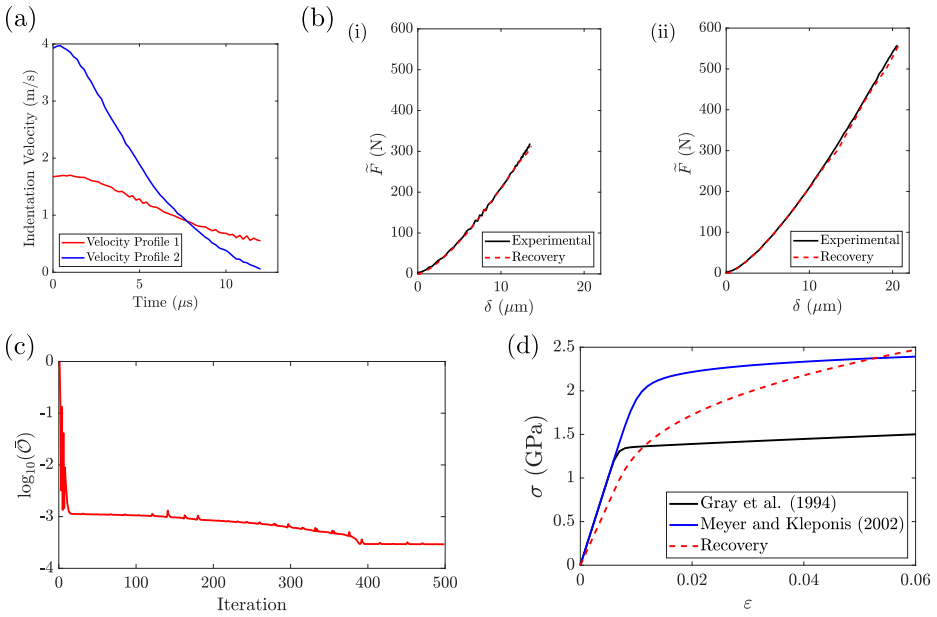
The constitutive behavior of viscoplastic materials is recovered by solving an indirect inverse problem constrained by the balance laws, where the forward problem is a boundary value problem corresponding to the dynamic indentation experiment, sensitivities are obtained via the adjoint method, and contact is incorporated through a Lagrange multiplier and slack variable.
What carries the argument
Adjoint-method computation of objective sensitivities with respect to the constitutive representation inside a dynamic boundary-value problem that includes nonholonomic contact constraints.
If this is right
- The method recovers constitutive models from full-field experimental data without presupposing a specific functional form.
- Balance laws are enforced exactly throughout the identification process.
- Contact conditions are handled rigorously, extending the approach to surface-loading experiments.
- The procedure is demonstrated on both synthetic data and real measurements from armor steel and aluminum alloy.
Where Pith is reading between the lines
- The framework could be applied to other high-rate contact problems such as ballistic impact or machining.
- Recovered models may improve finite-element predictions of deformation and failure in structural components.
- Integration with additional full-field diagnostics like digital image correlation at higher frame rates would further constrain the inverse solution.
Load-bearing premise
The chosen parameterization of the constitutive behavior is flexible enough to capture the true material response.
What would settle it
Independent uniaxial or other standardized tests performed on the same steel and aluminum specimens, compared directly against the stress-strain response predicted by the recovered model.
Figures




read the original abstract
We continue the development of a method to accurately and efficiently identify the constitutive behavior of complex materials through full-field observations that we started in Akerson, Rajan and Bhattacharya (2024). We formulate the problem of inferring constitutive relations from experiments as an indirect inverse problem that is constrained by the balance laws. Specifically, we seek to find a constitutive behavior that minimizes the difference between the experimental observation and the corresponding quantities computed with the model, while enforcing the balance laws. We formulate the forward problem as a boundary value problem corresponding to the experiment, and compute the sensitivity of the objective with respect to the model using the adjoint method. In this paper, we extend the approach to include contact and study dynamic indentation. Contact is a nonholonomic constraint, and we introduce a Lagrange multiplier and a slack variable to address it. We demonstrate the method on synthetic data before applying it to experimental observations on rolled homogeneous armor steel and a polycrystalline aluminum alloy.
Editorial analysis
A structured set of objections, weighed in public.
Referee Report
Summary. The manuscript extends the authors' prior adjoint-constrained inverse-problem framework for inferring viscoplastic constitutive relations from full-field observations. Contact in dynamic indentation is treated as a nonholonomic constraint by introducing a Lagrange multiplier and slack variable. The forward problem is solved as a boundary-value problem, sensitivities are obtained via the adjoint method, and the constitutive behavior is recovered by minimizing the data misfit while enforcing balance laws. The approach is first validated on synthetic data and then applied to experimental dynamic indentation results for rolled homogeneous armor steel and a polycrystalline aluminum alloy.
Significance. If the recovered models satisfy the contact constraint to high precision and reproduce the observed fields while obeying balance laws, the work would provide a practical, physics-constrained route to data-driven constitutive identification under dynamic contact conditions. The adjoint formulation and the handling of the nonholonomic constraint are technically attractive features that could reduce reliance on assumed functional forms in high-strain-rate materials characterization.
major comments (2)
- [Formulation of the inverse problem] Formulation of the inverse problem (abstract and the paragraph describing the indirect inverse problem): the central claim that the method recovers the constitutive behavior of the experimental materials requires that the chosen parameterization (basis or network) be rich enough to represent the true viscoplastic response. The manuscript should explicitly state the function space searched by the optimizer and either demonstrate that the true response lies inside it or discuss the consequences if it does not; otherwise the experimental results on steel and aluminum are best interpreted as projections onto that space rather than the physically correct law.
- [Synthetic data demonstration] Synthetic data demonstration section: the paper must clarify whether the constitutive laws used to generate the synthetic data belong to the same function space as the parameterization employed in the inverse problem. If the synthetic cases are generated in-space, successful recovery only verifies internal consistency and does not address the risk of biased recovery when the true response lies outside the search space, which directly affects in the experimental applications.
minor comments (1)
- [Abstract] The abstract would benefit from a concise statement of the specific parameterization adopted for the viscoplastic relation and the principal quantitative findings on the two experimental materials.
Simulated Author's Rebuttal
We thank the referee for the careful reading and constructive comments on our manuscript. We address each major comment below and indicate planned revisions to clarify the function space and its implications.
read point-by-point responses
-
Referee: Formulation of the inverse problem (abstract and the paragraph describing the indirect inverse problem): the central claim that the method recovers the constitutive behavior of the experimental materials requires that the chosen parameterization (basis or network) be rich enough to represent the true viscoplastic response. The manuscript should explicitly state the function space searched by the optimizer and either demonstrate that the true response lies inside it or discuss the consequences if it does not; otherwise the experimental results on steel and aluminum are best interpreted as projections onto that space rather than the physically correct law.
Authors: We agree that the function space must be stated explicitly for proper interpretation. In the revision we will add a subsection detailing the specific parameterization (basis functions or network architecture and hyperparameters) used for the viscoplastic response. We will also add discussion clarifying that recovered models are the best fit within this space subject to the balance laws and contact constraints, and note the consequences if the true response lies outside it. revision: yes
-
Referee: Synthetic data demonstration section: the paper must clarify whether the constitutive laws used to generate the synthetic data belong to the same function space as the parameterization employed in the inverse problem. If the synthetic cases are generated in-space, successful recovery only verifies internal consistency and does not address the risk of biased recovery when the true response lies outside the search space, which directly affects in the experimental applications.
Authors: We acknowledge the distinction. The synthetic cases were generated from the same parameterized family to verify recovery under known conditions. The revision will explicitly state this and add discussion of the resulting limitations for experimental data, where the recovered law is the optimal projection onto the chosen space. We will note that tests with out-of-space synthetics remain future work. revision: yes
Circularity Check
Inverse problem formulation is self-contained optimization with no reduction of results to inputs by construction
full rationale
The paper formulates inferring constitutive relations as an indirect inverse problem minimizing data misfit subject to balance laws, solved via adjoint sensitivity, with an extension to handle contact via Lagrange multiplier and slack variable. Synthetic demonstrations verify the numerical procedure on data generated from a chosen law, which is standard method validation rather than a circular recovery. Real-material application to indentation experiments on steel and aluminum produces the best-fit behavior within the chosen parameterization. The self-citation to the 2024 prior work introduces the base approach but is not load-bearing for the new contact treatment or results here; the central claim remains the output of the stated optimization and does not reduce to a fitted input renamed as prediction or to a self-citation chain. No self-definitional, ansatz-smuggling, or renaming steps are present in the abstract or described chain.
Axiom & Free-Parameter Ledger
axioms (2)
- domain assumption The balance laws of continuum mechanics hold pointwise throughout the specimen during the experiment.
- domain assumption The contact condition can be enforced exactly by introducing a Lagrange multiplier and slack variable without introducing additional modeling error.
Lean theorems connected to this paper
-
IndisputableMonolith/Foundation/Cost/FunctionalEquation.leanwashburn_uniqueness_aczel unclear?
unclearRelation between the paper passage and the cited Recognition theorem.
We formulate the problem of inferring constitutive relations from experiments as an indirect inverse problem that is constrained by the balance laws... We demonstrate the method on synthetic data before applying it to experimental observations on rolled homogeneous armor steel and a polycrystalline aluminum alloy.
-
IndisputableMonolith/Foundation/AlexanderDuality.leanalexander_duality_circle_linking unclear?
unclearRelation between the paper passage and the cited Recognition theorem.
Contact is a nonholonomic constraint, and we introduce a Lagrange multiplier and a slack variable to address it.
What do these tags mean?
- matches
- The paper's claim is directly supported by a theorem in the formal canon.
- supports
- The theorem supports part of the paper's argument, but the paper may add assumptions or extra steps.
- extends
- The paper goes beyond the formal theorem; the theorem is a base layer rather than the whole result.
- uses
- The paper appears to rely on the theorem as machinery.
- contradicts
- The paper's claim conflicts with a theorem or certificate in the canon.
- unclear
- Pith found a possible connection, but the passage is too broad, indirect, or ambiguous to say the theorem truly supports the claim.
Reference graph
Works this paper leans on
-
[1]
A. Akerson. Optimal structures for failure resistance under impact.Journal of the Mechanics and Physics of Solids, 172:105172, 3 2023
work page 2023
-
[2]
A. Akerson and T. Liu. Mechanics, modeling, and shape optimization of electrostatic zipper actuators.Journal of the Mechanics and Physics of Solids, 181:105446, 10 2023
work page 2023
-
[3]
A. Akerson, A. Rajan, and K. Bhattacharya. Learning constitutive relations from experiments:
-
[4]
pde constrained optimization.Journal of the Mechanics and Physics of Solids, 201:106128, 2025
work page 2025
-
[5]
R. J. Anton and G. Subhash. Dynamic Vickers indentation of brittle materials.Wear, 239:27– 35, 2000
work page 2000
- [6]
-
[7]
K. Bhattacharya, B. Liu, A. Stuart, and M. Trautner. Learning markovian homogenized models in viscoelasticity.Multiscale Modeling & Simulation, 21(2):641–679, 2023
work page 2023
-
[8]
G. Camacho and M. Ortiz. Adaptive lagrangian modelling of ballistic penetration of metallic targets.Computer Methods in Applied Mechanics and Engineering, 142(3):269–301, 1997
work page 1997
-
[9]
D. Casem and E. Retzlaff. A kolsky bar for high-rate indentation.Journal of Dynamic Behavior of Materials, 9(3):300–314, 2023
work page 2023
-
[10]
J. Clayton, J. Lloyd, and D. Casem. Simulation and dimensional analysis of instrumented dynamic spherical indentation of ductile metals.International Journal of Mechanical Sciences, 251:108333, 2023
work page 2023
-
[11]
Y. Deng, S. Ren, K. Fan, J. M. Malof, and W. J. Padilla. Neural-adjoint method for the inverse design of all-dielectric metasurfaces.Optics Express, 29(5):7526–7534, 2021
work page 2021
-
[12]
G. Gray, S. R. Chen, W. Wright, and M. Lopez. Constitutive equations for annealed metals under compression at high strain rates and high temperatures. Technical report, Los Alamos National Laboratory Report: LA-12669-MS, 1994
work page 1994
-
[13]
H. Hertz. Ueber die ber¨ uhrung fester elastischer k¨ orper.Journal f¨ ur die reine und angewandte Mathematik, 1882(92):156–171, 1882
-
[14]
S. H¨ ueber, G. Stadler, and B. I. Wohlmuth. A primal-dual active set algorithm for three- dimensional contact problems with coulomb friction.SIAM Journal on Scientific Computing, 30(2):572–596, 2008
work page 2008
-
[15]
K. L. Johnson.Contact Mechanics. Cambridge University Press, 1985
work page 1985
-
[16]
N. Kikuchi and J. T. Oden.Contact Problems in Elasticity. Society for Industrial and Applied Mathematics, 1988
work page 1988
-
[17]
B. J. Koeppel and G. Subhash. An experimental technique to investigate the dynamic inden- tation hardness of materials.Experimental Techniques, 21:16–18, May 1997
work page 1997
-
[18]
N. Kovachki, Z. Li, B. Liu, K. Azizzadenesheli, K. Bhattacharya, A. Stuart, and A. Anand- kumar. Neural operator: Learning maps between function spaces with applications to pdes. Journal of Machine Learning Research, 24(89):1–97, 2023
work page 2023
-
[19]
T. Laursen.Computational Contact and Impact Mechanics: Fundamentals of Modeling Inter- facial Phenomena in Nonlinear Finite Element Analysis. Engineering online library. Springer Berlin Heidelberg, 2003
work page 2003
- [20]
-
[21]
B. Liu, E. Ocegueda, M. Trautner, A. M. Stuart, and K. Bhattacharya. Learning macroscopic internal variables and history dependence from microscopic models.Journal of the Mechanics and Physics of Solids, 178:105329, 2023
work page 2023
-
[22]
J. Lubliner.Plasticity Theory. Dover books on engineering. Dover Publications, 2008. 15
work page 2008
-
[23]
H. Meyer and D. S. Kleponis. An analysis of parameters for the johnson-cook strength model for 2-in-thick rolled homogeneous armor.Army Research Laboratory, Adelphi, MD, Report No. ARL-TR-2528, 2001
work page 2001
-
[24]
J.-F. Molinari, M. Ortiz, R. Radovitzky, and E. Repetto. Finite-element modeling of dry sliding wear in metals.Engineering Computations (Swansea, Wales), 18, 10 2002
work page 2002
-
[25]
M. Nilsson. Dynamic hardness testing using a split hopkinson pressure bar apparatus, 2002. Swedish Defense Research Agency: SE-147 25
work page 2002
-
[26]
M. Ortiz and L. Stainier. The variational formulation of viscoplastic constitutive updates. Computer Methods in Applied Mechanics and Engineering, 171(3-4):419–444, 1999
work page 1999
-
[27]
S. Ren, W. Padilla, and J. Malof. Benchmarking deep inverse models over time, and the neural-adjoint method.Advances in Neural Information Processing Systems, 33:38–48, 2020
work page 2020
-
[28]
B. Si, Z. Li, Y. Yang, L. Qiao, E. Liu, G. Xiao, and X. Shu. Dynamic indentation testing and characterization of metals based on the split Hopkinson pressure bar (SHPB) device. Mechanics of Materials, 177:104550, 2023
work page 2023
-
[29]
J. Simo and T. Laursen. An augmented lagrangian treatment of contact problems involving friction.Computers & Structures, 42(1):97–116, 1992
work page 1992
- [30]
-
[31]
Wriggers.Computational Contact Mechanics
P. Wriggers.Computational Contact Mechanics. Springer Berlin Heidelberg, 2006
work page 2006
-
[32]
P. Wriggers, J. Schr¨ oder, and A. Schwarz. A finite element method for contact using a third medium.Computational Mechanics, 52, 10 2013
work page 2013
-
[33]
C. Xiao, Y. Deng, and G. Wang. Deep-learning-based adjoint state method: Method- ology and preliminary application to inverse modeling.Water Resources Research, 57(2):e2020WR027400, 2021. A Numerical method for the governing equations We detail the finite element discretization and numerical scheme we use to solve the forward prob- lem. We consider a quad...
work page 2021
discussion (0)
Sign in with ORCID, Apple, or X to comment. Anyone can read and Pith papers without signing in.