Optimization of factorization scale in QED Drell-Yan-like processes
Pith reviewed 2026-05-18 02:04 UTC · model grok-4.3
The pith
Comparisons with exact two-loop results can optimize the factorization scale choice for initial-state radiation corrections in e+e- annihilation.
A machine-rendered reading of the paper's core claim, the machinery that carries it, and where it could break.
Core claim
The dependence of initial-state QED corrections on the factorization scale is studied within leading and next-to-leading logarithmic approximations for Drell-Yan-like processes; comparisons with complete two-loop results are used to select preferred scale prescriptions that improve agreement with the exact calculation.
What carries the argument
Factorization scale prescriptions applied inside leading-logarithmic and next-to-leading-logarithmic approximations for initial-state radiation.
If this is right
- The optimized scale reduces the difference between logarithmic approximations and exact two-loop results for total cross sections and distributions in e+e- annihilation.
- The same scale choice can be adopted in Monte Carlo generators that use leading or next-to-leading logarithmic parton showers for initial-state radiation.
- Improved scale prescriptions lower the theoretical uncertainty assigned to missing higher-order QED corrections in precision electroweak studies.
- The method provides a concrete criterion for choosing the scale in any process where only partial higher-order results are known.
Where Pith is reading between the lines
- The same tuning procedure could be repeated once three-loop or four-loop analytic results become available, testing stability of the optimal scale.
- An analogous optimization might be performed for final-state radiation or for mixed initial-final corrections in the same processes.
- The approach could be extended to Drell-Yan production at hadron colliders by replacing the QED logarithms with QCD ones and comparing to known two-loop QCD results.
Load-bearing premise
A scale choice that matches two-loop results will continue to be optimal or at least better when the same approximations are applied at higher orders or in resummed calculations.
What would settle it
A complete three-loop calculation of the same initial-state radiation corrections would show whether the two-loop-tuned scale choice still reduces the discrepancy relative to untuned choices.
Figures


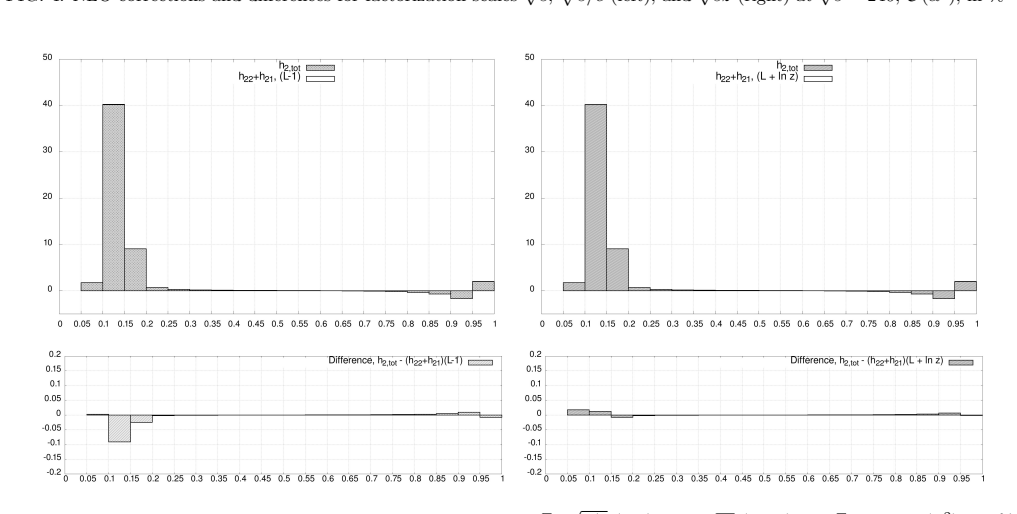


read the original abstract
The dependence of corrections due to the initial state radiation in $e^+ e^-$-annihilation processes on the choice of the factorization scale is investigated. Different prescriptions of the factorization scale choice are analyzed within the leading and next-to-leading logarithmic approximations. Comparisons with the known complete two-loop results are used to optimize the scale choice.
Editorial analysis
A structured set of objections, weighed in public.
Referee Report
Summary. The manuscript investigates the dependence of initial-state radiation corrections in e⁺e⁻ annihilation on the choice of factorization scale. It analyzes different prescriptions within leading-logarithmic (LL) and next-to-leading-logarithmic (NLL) approximations and optimizes the scale by comparing these approximations to known complete two-loop results.
Significance. If the optimized scale choice is robust and generalizes, the work could provide a practical method for improving the accuracy of LL/NLL approximations in QED Drell-Yan-like processes by leveraging exact higher-order benchmarks. This would be useful for precision phenomenology where full higher-order calculations remain computationally intensive.
major comments (1)
- [Optimization procedure (around the comparison to two-loop results)] The central optimization procedure selects the factorization scale by minimizing the difference between LL/NLL approximations and complete O(α²) results. This tuning assumes the dominant discrepancy pattern at two loops persists in a form that the same scale will suppress at O(α³) and in resummed series, but the manuscript provides no explicit decomposition of the two-loop residual into logarithmic versus constant terms nor any test at higher orders to support the extrapolation.
minor comments (2)
- [Abstract] The abstract and introduction could more explicitly list the specific kinematic cuts or observables (e.g., invariant mass range) used in the numerical comparisons.
- [Section 2 or 3] Notation for the factorization scale (often denoted μ_F or similar) should be introduced with a clear definition before the first numerical results are presented.
Simulated Author's Rebuttal
We thank the referee for the careful review of our manuscript and the constructive comments. We address the major comment below, providing clarification on our optimization approach while acknowledging its limitations based on currently available results.
read point-by-point responses
-
Referee: [Optimization procedure (around the comparison to two-loop results)] The central optimization procedure selects the factorization scale by minimizing the difference between LL/NLL approximations and complete O(α²) results. This tuning assumes the dominant discrepancy pattern at two loops persists in a form that the same scale will suppress at O(α³) and in resummed series, but the manuscript provides no explicit decomposition of the two-loop residual into logarithmic versus constant terms nor any test at higher orders to support the extrapolation.
Authors: We agree that our optimization relies on the available complete O(α²) results, as these represent the highest-order exact calculations for QED initial-state radiation corrections in e⁺e⁻ annihilation. This procedure follows standard practice in resummation techniques, where the scale is tuned to the highest known perturbative order to improve the approximation. The LL and NLL terms capture the dominant logarithmic enhancements, and the scale choice is intended to minimize the overall mismatch, including both logarithmic and constant contributions at two loops. We acknowledge that the original manuscript does not include an explicit decomposition of the two-loop residual. To address this point, we have added a brief discussion in the revised version explaining the structure of the corrections and the rationale for expecting the optimized scale to remain effective at higher orders due to the universality of collinear logarithms in QED. However, complete O(α³) results are not available in the literature, preventing direct numerical tests of the extrapolation at this stage. We have included a short paragraph on the expected behavior based on renormalization-group arguments. revision: partial
- Direct numerical validation of the scale choice at O(α³) or in fully resummed series is not possible at present due to the absence of complete higher-order exact results for this process.
Circularity Check
No circularity: scale choice calibrated to independent external two-loop benchmarks
full rationale
The paper explicitly uses known complete two-loop results as an external benchmark to optimize the factorization scale within LL and NLL approximations for ISR. This is a calibration step against independent higher-order calculations rather than any derivation that reduces to its own inputs by construction. No self-definitional loop, fitted prediction presented as first-principles result, or load-bearing self-citation chain appears in the abstract or described procedure. The two-loop results serve as an external reference, making the optimization self-contained against benchmarks. Any concern about whether the tuned scale remains optimal at yet higher orders is an extrapolation assumption, not circularity.
Axiom & Free-Parameter Ledger
axioms (1)
- domain assumption Complete two-loop results for the processes under study are known and can serve as an unbiased benchmark.
Lean theorems connected to this paper
-
IndisputableMonolith/Cost/FunctionalEquation.leanwashburn_uniqueness_aczel unclear?
unclearRelation between the paper passage and the cited Recognition theorem.
Comparisons with the known complete two-loop results are used to optimize the scale choice... L = ln μ_F² / μ_R² ... redistribution of contributions between terms with different powers of L
-
IndisputableMonolith/Foundation/BranchSelection.leanbranch_selection unclear?
unclearRelation between the paper passage and the cited Recognition theorem.
The optimal factorization scale for a particular order is located at the intersection of the LO and LO+NLO correction curves
What do these tags mean?
- matches
- The paper's claim is directly supported by a theorem in the formal canon.
- supports
- The theorem supports part of the paper's argument, but the paper may add assumptions or extra steps.
- extends
- The paper goes beyond the formal theorem; the theorem is a base layer rather than the whole result.
- uses
- The paper appears to rely on the theorem as machinery.
- contradicts
- The paper's claim conflicts with a theorem or certificate in the canon.
- unclear
- Pith found a possible connection, but the passage is too broad, indirect, or ambiguous to say the theorem truly supports the claim.
Reference graph
Works this paper leans on
-
[1]
A similar ap- proach was also proposed by N.V
exploits the notion of effective charges. A similar ap- proach was also proposed by N.V. Krasnikov [9]. The ba- sic idea is that an effective charge can be associated with a given physical quantity, and higher-order corrections to the quantity can be absorbed by renormalization of that charge, so that the LO-corrected expression is equal to the sum of the...
work page 2057
-
[2]
These functions are better to be called QED parton dis- tribution functions (QED PDFs)
-
[3]
E. A. Kuraev and V. S. Fadin, On Radiative Corrections to e+ e- Single Photon Annihilation at High-Energy, Sov. J. Nucl. Phys.41, 466 (1985)
work page 1985
- [4]
- [5]
-
[6]
Di Giustino,The Renormalization Scale Setting Prob- lem in QCD [Ph.D
L. Di Giustino,The Renormalization Scale Setting Prob- lem in QCD [Ph.D. Thesis], Ph.D. thesis, Insubria U., Como (2022), arXiv:2205.03689 [hep-ph]
-
[7]
High-precision QCD at hadron colliders: electroweak gauge boson rapidity distributions at NNLO
C. Anastasiou, L. J. Dixon, K. Melnikov, and F. Petriello, High precision QCD at hadron colliders: Electroweak gauge boson rapidity distributions at NNLO, Phys. Rev. D69, 094008 (2004), arXiv:hep-ph/0312266
work page internal anchor Pith review Pith/arXiv arXiv 2004
-
[8]
Muon Decay Spectrum: Leading Logarithmic Approximation
A. Arbuzov, A. Czarnecki, and A. Gaponenko, Muon de- cay spectrum: Leading logarithmic approximation, Phys. Rev. D65, 113006 (2002), arXiv:hep-ph/0202102
work page internal anchor Pith review Pith/arXiv arXiv 2002
-
[9]
Grunberg, Renormalization Scheme Independent QCD and QED: The Method of Effective Charges, Phys
G. Grunberg, Renormalization Scheme Independent QCD and QED: The Method of Effective Charges, Phys. Rev. D29, 2315 (1984)
work page 1984
-
[10]
N. V. Krasnikov, Analyticity and Renormalization Group, Nucl. Phys. B192, 497 (1981)
work page 1981
-
[11]
Renormalization scale uncertainty in tne DIS 2+1 jet cross-section
G. Ingelman and J. Rathsman, Renormalization scale un- certainty in the DIS (2+1) jet cross-section, Z. Phys. C 63, 589 (1994), arXiv:hep-ph/9405367
work page internal anchor Pith review Pith/arXiv arXiv 1994
-
[12]
S. J. Brodsky, G. P. Lepage, and P. B. Mackenzie, On the Elimination of Scale Ambiguities in Perturbative Quan- tum Chromodynamics, Phys. Rev. D28, 228 (1983)
work page 1983
-
[13]
S. J. Brodsky and L. Di Giustino, The Principle of Max- imum Conformality, inWorkshop on Precision Measure- ments of alpha S(2011)
work page 2011
- [14]
-
[15]
A. L. Kataev and S. V. Mikhailov, Generalization of the Brodsky-Lepage-Mackenzie optimization within the β-expansion and the principle of maximal conformality, Phys. Rev. D91, 014007 (2015), arXiv:1408.0122 [hep- ph]
work page internal anchor Pith review Pith/arXiv arXiv 2015
- [16]
-
[17]
P. M. Stevenson,Renormalized Perturbation Theory and its Optimization by the Principle of Minimal Sensitivity (World Scientific, 2022)
work page 2022
-
[18]
F. A. Berends, W. L. van Neerven, and G. J. H. Burg- ers, Higher Order Radiative Corrections at LEP Energies, Nucl. Phys. B297, 429 (1988), [Erratum: Nucl.Phys.B 304, 921 (1988)]
work page 1988
-
[19]
J. Bl¨ umlein, A. De Freitas, C. G. Raab, and K. Sch¨ onwald, TheO(α2) Initial State QED Corrections toe +e− Annihilation to a Neutral Vector Boson Revis- ited, Phys. Lett. B791, 206 (2019), arXiv:1901.08018 [hep-ph]
work page internal anchor Pith review Pith/arXiv arXiv 2019
-
[20]
J. Ablinger, J. Bl¨ umlein, A. De Freitas, and K. Sch¨ onwald, Subleading Logarithmic QED Initial State Corrections toe +e− →γ ∗/Z 0∗ toO(α 6L5), Nucl. Phys. B955, 115045 (2020), arXiv:2004.04287 [hep-ph]
-
[21]
Two-loop QED Operator Matrix Elements with Massive External Fermion Lines
J. Blumlein, A. De Freitas, and W. van Neerven, Two- loop QED Operator Matrix Elements with Massive Ex- ternal Fermion Lines, Nucl. Phys. B855, 508 (2012), arXiv:1107.4638 [hep-ph]
work page internal anchor Pith review Pith/arXiv arXiv 2012
-
[22]
V. S. Fadin, E. A. Kuraev, and L. N. Lipatov, On the Pomeranchuk Singularity in Asymptotically Free Theo- ries, Phys. Lett. B60, 50 (1975)
work page 1975
-
[23]
Physics and Detectors at CLIC: CLIC Conceptual Design Report (2012), arXiv:1202.5940 [physics.ins-det]
work page internal anchor Pith review Pith/arXiv arXiv 2012
-
[24]
Choosing the Factorization Scale in Perturbative QCD
F. Maltoni, T. McElmurry, R. Putman, and S. Willen- brock, Choosing the Factorization Scale in Perturbative QCD (2007), arXiv:hep-ph/0703156
work page internal anchor Pith review Pith/arXiv arXiv 2007
discussion (0)
Sign in with ORCID, Apple, or X to comment. Anyone can read and Pith papers without signing in.