Alternative treatment of relativistic effects in linear augmented plane wave (LAPW) method: application to Ac, Th, ThO2 and UO2
Pith reviewed 2026-05-18 01:58 UTC · model grok-4.3
The pith
Alternative relativistic radial functions and spin-orbit corrections in the LAPW method can change actinide lattice constants by up to 0.15 Å and reveal UO2 as a semimetal.
A machine-rendered reading of the paper's core claim, the machinery that carries it, and where it could break.
Core claim
The authors establish that by basing LAPW radial functions on two Dirac radial solutions for j=l-1/2 and j=l+1/2, weighting the 6p functions toward the j=l-1/2 solution, correcting the canonical matrix elements, and computing zeta(p) solely with the 6p-3/2 component, one obtains a more accurate treatment of relativistic effects in actinide compounds. This results in lattice constant variations up to 0.15 Å and elastic modulus changes up to 26 GPa across different treatments, and specifically shows that UO2 possesses a 0.2-0.4 eV gap at the Fermi level persisting for all k-vectors, classifying it as a semimetal. The band structure peculiarities of actinium cause overestimation of its lattice
What carries the argument
New radial dependencies for LAPW basis functions constructed from the two actual radial solutions of the Dirac equation for j = l-1/2 and j = l + 1/2 states, with preferential weighting of the 6p-1/2 solution, combined with using the 6p-3/2 component alone for the spin-orbit constant zeta(p).
If this is right
- Different relativistic treatments alter the equilibrium lattice constant of the studied compounds by as much as 0.15 Å.
- The elastic modulus can vary by up to 26 GPa depending on the relativistic approximation used.
- With full spin-orbit coupling, UO2 develops a small forbidden gap of 0.2-0.4 eV at the Fermi level for every k-vector.
- Actinium's electron band structure leads to an overestimation of its lattice constant in these calculations.
- UO2 should be classified as a semimetal rather than a conventional metal or insulator.
Where Pith is reading between the lines
- This method could allow more efficient computations for other heavy-element materials by reducing reliance on extra local orbitals.
- The semimetallic nature of UO2 may affect predictions of its transport and optical properties in applications like nuclear fuels.
- Similar Dirac-based radial weighting might improve relativistic accuracy in related band-structure methods such as APW or muffin-tin orbital approaches.
Load-bearing premise
That weighting the 6p radial functions toward the Dirac j=l-1/2 solution and calculating zeta(p) with only the 6p-3/2 component yields a realistic spin-orbit splitting for semicore states without requiring additional local orbitals or external validation.
What would settle it
Observation of no gap or a gap larger than 0.4 eV at the Fermi level in high-resolution spectroscopic measurements of UO2 across multiple momentum points would contradict the semimetal classification.
Figures


read the original abstract
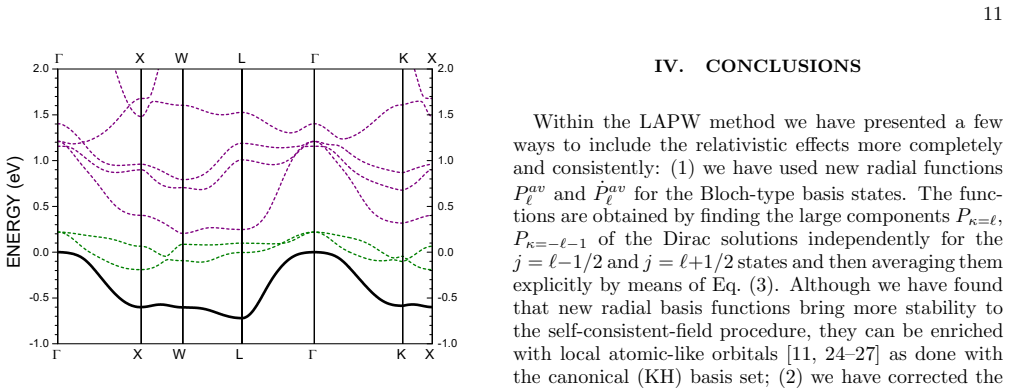
We examine the influence of the relativistic effects within the linear augmented plane wave method (LAPW) for solids and propose a few alternative ways to accurately take them into account: (1) we introduce new radial dependencies for LAPW (Bloch-type) basis functions, based on two actual radial solutions of the Dirac equation for j=l-1/2 and j=l+1/2 states. The proposed radial 6p functions receive more weight from the Dirac p-1/2 solution and, due to this, can on average correctly describe completely filled $6p$ bands even without the additional p-1/2 local atomic function, as is done in the LAPW+p-1/2 method; (2) the canonical LAPW matrix elements for the spherically symmetric component of the potential, assuming non-relativistic radial wave functions, should be corrected; (3) we argue that for a realistic spin-orbit (SO) energy splitting of the semicore 6p-states the spin-orbit interaction constant zeta(p) should be calculated with the 6p-3/2 radial component, because the value of zeta(p) obtained with the canonical mixing of the 6p-1/2 and 6p-3/2 components overestimates the SO splitting. Different ways of taking into account relativistic effects can change the equilibrium lattice constant up to 0.15 A and the elastic modulus up to 26 GPa. We find that in the full treatment of the spin-orbit coupling UO2 has a small gap of forbidden states (0.2-0.4 eV) at the Fermi level, which persists for all k-vectors and, therefore, UO2 should be classified as a semimetal. We also discuss the peculiarities of the electron band structure of actinium, which result in an overestimation of its lattice constant.
Editorial analysis
A structured set of objections, weighed in public.
Referee Report
Summary. The manuscript proposes alternative treatments of relativistic effects in the LAPW method: new radial dependencies for basis functions weighted toward Dirac j=l-1/2 and j=l+1/2 solutions (with emphasis on p-1/2 for 6p states), corrections to matrix elements for the spherical potential component, and use of only the 6p-3/2 radial function to compute the spin-orbit constant zeta(p). These are applied to Ac, Th, ThO2 and UO2, yielding shifts in equilibrium lattice constants up to 0.15 Å and elastic moduli up to 26 GPa. For UO2 under full spin-orbit coupling a 0.2-0.4 eV gap at the Fermi level is found that persists for all k-vectors, from which the authors conclude UO2 is a semimetal. Band-structure peculiarities of actinium are also discussed.
Significance. If the numerical results and the proposed radial weighting hold after validation, the approach could simplify accurate inclusion of relativistic effects for actinides in LAPW calculations by reducing reliance on extra local orbitals while still capturing realistic SO splittings for semicore states. The reported magnitudes of structural-property changes would be of practical interest for modeling heavy-element compounds.
major comments (2)
- [Abstract / UO2 electronic structure] Abstract and UO2 results: the description of a 0.2-0.4 eV gap of forbidden states at the Fermi level that persists for all k-vectors is incompatible with the classification of UO2 as a semimetal. A gap separating occupied and unoccupied bands throughout the Brillouin zone defines semiconducting or insulating behavior; semimetals require band overlap or touching at E_F. This internal inconsistency directly affects the interpretation of the full spin-orbit treatment.
- [Proposed radial functions and SO constant] Method for zeta(p) and radial weighting: the post-hoc choice to compute zeta(p) exclusively from the 6p-3/2 component (and to weight the 6p radial functions toward the Dirac j=l-1/2 solution) is presented without quantitative comparison to experimental SO splittings, all-electron Dirac calculations, or standard LAPW+LO results. Because this choice is load-bearing for the claim that the new treatment produces realistic semicore SO splitting without extra local orbitals, independent validation is required.
minor comments (2)
- [Abstract] The abstract states numerical changes without error bars or tabulated comparison to experiment or other codes; adding these in the results section would strengthen the presentation.
- [Method] Notation for the new radial functions (Bloch-type basis) could be clarified with an explicit equation showing the linear combination of the two Dirac solutions.
Simulated Author's Rebuttal
We thank the referee for the careful reading of our manuscript and the constructive comments. We address each major comment below and indicate the revisions we will make.
read point-by-point responses
-
Referee: [Abstract / UO2 electronic structure] Abstract and UO2 results: the description of a 0.2-0.4 eV gap of forbidden states at the Fermi level that persists for all k-vectors is incompatible with the classification of UO2 as a semimetal. A gap separating occupied and unoccupied bands throughout the Brillouin zone defines semiconducting or insulating behavior; semimetals require band overlap or touching at E_F. This internal inconsistency directly affects the interpretation of the full spin-orbit treatment.
Authors: We agree that the classification of UO2 as a semimetal is inconsistent with the reported gap. A gap of 0.2-0.4 eV persisting for all k-vectors indicates semiconducting (narrow-gap insulator) behavior rather than semimetallic character. In the revised manuscript we will correct the abstract and the UO2 discussion to remove the semimetal claim and accurately describe the electronic structure as gapped throughout the Brillouin zone. The numerical result of the gap itself is unchanged. revision: yes
-
Referee: [Proposed radial functions and SO constant] Method for zeta(p) and radial weighting: the post-hoc choice to compute zeta(p) exclusively from the 6p-3/2 component (and to weight the 6p radial functions toward the Dirac j=l-1/2 solution) is presented without quantitative comparison to experimental SO splittings, all-electron Dirac calculations, or standard LAPW+LO results. Because this choice is load-bearing for the claim that the new treatment produces realistic semicore SO splitting without extra local orbitals, independent validation is required.
Authors: The choice of the 6p-3/2 radial component for zeta(p) follows from the observation, stated in the manuscript, that canonical averaging of the 6p-1/2 and 6p-3/2 solutions overestimates the spin-orbit splitting for semicore states. The radial weighting toward the Dirac p-1/2 solution is introduced to allow filled 6p bands to be described without additional local orbitals. While the manuscript presents the physical rationale and the resulting changes in structural properties, we acknowledge that explicit numerical benchmarks against experiment, all-electron Dirac calculations, or standard LAPW+LO results are not provided. In the revision we will add such quantitative comparisons for the actinide systems considered. revision: yes
Circularity Check
No significant circularity; results from direct self-consistent calculations
full rationale
The paper introduces modified radial basis functions derived from Dirac solutions, a correction to matrix elements, and an argument for using the 6p-3/2 component in zeta(p). These are applied in LAPW calculations to obtain lattice constants, moduli, and the UO2 band gap. The reported numerical outcomes (0.15 Å shifts, 26 GPa modulus changes, 0.2-0.4 eV gap) are outputs of the self-consistent procedure rather than quantities fitted to or defined by the same observables. No load-bearing self-citation, ansatz smuggling, or self-definitional reduction is present in the abstract or described method; the chain remains independent of the target predictions.
Axiom & Free-Parameter Ledger
axioms (2)
- standard math The Dirac equation provides the correct radial solutions inside the muffin-tin spheres for the chosen atomic potential.
- domain assumption The spherical component of the potential can be treated with a simple correction to the non-relativistic matrix elements.
Lean theorems connected to this paper
-
IndisputableMonolith/Cost/FunctionalEquation.leanwashburn_uniqueness_aczel unclear?
unclearRelation between the paper passage and the cited Recognition theorem.
we introduce new radial dependencies for LAPW basis functions, based on two actual radial solutions of the Dirac equation for j=l-1/2 and j=l+1/2 states... ζ(p) should be calculated with the 6p-3/2 radial component
-
IndisputableMonolith/Foundation/AbsoluteFloorClosure.leanreality_from_one_distinction unclear?
unclearRelation between the paper passage and the cited Recognition theorem.
Different ways of taking into account relativistic effects can change the equilibrium lattice constant up to 0.15 A and the elastic modulus up to 26 GPa
What do these tags mean?
- matches
- The paper's claim is directly supported by a theorem in the formal canon.
- supports
- The theorem supports part of the paper's argument, but the paper may add assumptions or extra steps.
- extends
- The paper goes beyond the formal theorem; the theorem is a base layer rather than the whole result.
- uses
- The paper appears to rely on the theorem as machinery.
- contradicts
- The paper's claim conflicts with a theorem or certificate in the canon.
- unclear
- Pith found a possible connection, but the passage is too broad, indirect, or ambiguous to say the theorem truly supports the claim.
Reference graph
Works this paper leans on
-
[1]
[25] the method was extended to include other local relativistic functions and their combinations
only the p1/ 2 relativistic atomic functions were used, while in Ref. [25] the method was extended to include other local relativistic functions and their combinations. The proposed corrections [24, 25] through the relativis- tic local orbitals in the second variation step being highly effective in practice, are based on the idea to increase the convergenc...
-
[2]
Lejaeghere et al., Science 351, 1415 (2016)
K. Lejaeghere et al., Science 351, 1415 (2016)
work page 2016
-
[3]
P. S¨ oderlind, Theory of the crystal structures of ceriu m and the light actinides, Advances in Physics 47, 959 (1998)
work page 1998
- [4]
-
[5]
P. S¨ oderlind, O. Eriksson, J. M. Wills, and A. M. Boring, Elastic constants of cubic f-electron elements: Theory, Phys. Rev. B 48, 9306 (1993)
work page 1993
-
[6]
S. Li, R. Ahuja, B. Johansson, High pressure theoretical studies of actinide dioxides, High Pressure Research: An International Journal 22, 471 (2002)
work page 2002
-
[7]
M. D. Jones, J. C. Boettger, R. C. Albers, and D. J. Singh, Theoretical atomic volumes of the light actinides, Phys. Rev. B 61, 4644 (2000)
work page 2000
-
[8]
P´ enicaud, Calculated equilibrium properties, electr onic structures and structural stabilities of Th, Pa, U, Np and Pu, J. Phys.: Condens. Matter 12, 5819 (2000)
work page 2000
-
[9]
D. D. Koelling and G. O. Arbman, Use of energy deriva- tive of the radial solution in an augmented plane wave method: application to copper, J. Phys. F: Metal Phys., 5, 2041 (1975)
work page 2041
- [10]
-
[11]
D. J. Singh, L. Nordstr¨ om, Planewaves, Pseudopoten- tials, and the LAPW Method , 2nd ed. (Springer, New York, 2006)
work page 2006
-
[12]
A. V. Nikolaev, D. Lamoen, and B. Partoens, Exten- sion of the basis set of linearized augmented plane wave (LAPW) method by using supplemented tight binding basis functions, J. Chem. Phys. 145, 014101 (2016)
work page 2016
-
[13]
G. H. Lander, Sensing Electrons on the Edge, Science 301, 1057 (2003)
work page 2003
-
[14]
H. L. Skriver, O. K. Andersen, and B. Johansson, Calcu- lated Bulk Properties of the Actinide Metals, Phys. Rev. Lett. 41, 42 (1978)
work page 1978
-
[15]
J. L. Sarrao, L. A. Morales, J. D. Thompson, B. L. Scott, G. R. Stewart, F. Wastin, J. Rebizant, P. Boulet, E. Co- lineau and G. H. Lander, Plutonium-based superconduc- tivity with a transition temperature above 18 K Nature (London) 420, 297 (2002)
work page 2002
-
[16]
S. Heathman, R. G. Haire, T. Le Bihan, A. Lindbaum, M. Idiri, P. Normile, S. Li, R. Ahuja, B. Johansson, and G. H. Lander, A High-Pressure Structure in Curium Linked to Magnetism, Science 309, 110 (2005)
work page 2005
- [17]
-
[18]
P. A. Korzhavyi, L. Vitos, D. A. Andersson, and B. Jo- hansson, Oxidation of plutonium dioxide, Nat. Mater. 3, 225 (2004)
work page 2004
-
[19]
P. S¨ oderlind, O. Eriksson, B. Johansson, J. M. Wills, a nd A. M. Boring, A unified picture of the crystal structures of metals, Nature (London) 374, 524 (1995)
work page 1995
-
[20]
J. Noffsinger and M. L. Cohen, Electronic and structural properties of ununquadium from first principles. Phys. Rev. B 81, 073110 (2010)
work page 2010
-
[21]
J. Gyanchandani and S. K. Sikka, Physical properties of the 6d-series elements from density functional theory: Close similarity to lighter transition metals. Phys. Rev. B 83, 172101 (2011)
work page 2011
-
[22]
K. G. Dyall, K. Fægri, Jr., Introduction to Relativisti c Quantum Chemistry, (Oxford, University Press), 2007
work page 2007
-
[23]
D. D. Koelling and B. N. Harmon, A technique for rel- ativistic spin-polarised calculations, J. Phys. C: Solid State Phys., 10, 3107 (1977)
work page 1977
-
[24]
A. H. MacDonald, W. E. Pickett and D. D. Koelling, A linearised relativistic augmented-plane-wave method utilising approximate pure spin basis functions, J. Phys. C: Solid St. Phys., 13, 2675 (1980)
work page 1980
-
[25]
J. Kuneˇ s, P. Nov´ ak, R. Schmid, P. Blaha and K. Schwarz, Electronic structure of fcc Th: Spin-orbit calculation with 6 p1/ 2 local orbital extension, Phys. Rev. B 64, 153102 (2001)
work page 2001
-
[26]
C. Vona, S. Lubeck, H. Kleine, A. Gulans, and C. Draxl, Accurate and efficient treatment of spin-orbit coupling via second variation employing local orbitals, Phys. Rev. B 108, 235161 (2023)
work page 2023
-
[27]
G. Michalicek, M. Betzinger, C. Friedrich, S. Bl¨ ugel, Elimination of the linearization error and improved basis- set convergence within the FLAPW method. Comput. Phys. Commun. 184, 2670 (2013)
work page 2013
- [28]
-
[29]
C. J. Bradley and A. P. Cracknell, The Mathemati- cal Theory of Symmetry in Solids , (Clarendon, Oxford, 1972)
work page 1972
-
[30]
J. P. Perdew, K. Burke, and M. Ernzerhof, Generalized Gradient Approximation Made Simple, Phys. Rev. Lett. 77, 3865 (1996); erratum: Phys. Rev. Lett. 78, 1396 (1997)
work page 1996
-
[31]
A. V. Nikolaev, I. T. Zuraeva, G. V. Ionova, Spin- polarization and spin-orbit interactions in the LAPW method: application in description of 3d metals, and B. V. Andreev, Fizika Tverdogo Tela 35, 414 (1993). [trans- lation: Phys. Solid State 35, 213 (1993)]
work page 1993
-
[32]
G. Lehmann and M. Taut, On the numerical calculation of the density of states and related properties, Phys. Sta- tus Solidi B 54, 469 (1972)
work page 1972
-
[33]
J. P. Perdew, A. Ruzsinszky, G. I. Csonka, O. A. Vy- drov, G. E. Scuseria, L. A. Constantin, X. Zhou and K. Burke, Restoring the Density-Gradient Expansion for Exchange in Solids and Surfaces, Phys. Rev. Lett. 100, 136406 (2008); erratum: 102, 039902 (2009)
work page 2008
-
[34]
P. A. M. Dirac, Note on Exchange Phenomena in the Thomas Atom, Proc. Camb. Philos. Soc. 26, 376 (1930)
work page 1930
-
[35]
J. P. Perdew and Y. Wang, Accurate and simple ana- lytic representation of the electron-gas correlation ener gy, Phys. Rev. B 45, 13244 (1992); erratum: Phys. Rev. B 98, 079904 (2018)
work page 1992
-
[36]
J. Staun Olsen, L. Gerward, V. Kanchana, G. Vaitheeswaran, The bulk modulus of ThO 2 - an experi- mental and theoretical study, Journal of Alloys and Com- pounds 381, 37 (2004)
work page 2004
-
[37]
V. Kanchana, G. Vaitheeswaran, A. Svane and A. Delin, First-principles study of elastic properties of CeO 2, ThO 2 and PoO 2, J. Phys.: Condens. Matter 18, 9615 (2006)
work page 2006
- [38]
-
[39]
I.R. Shein, K.I. Shein, A.L. Ivanovskii, Elastic and el ec- tronic properties and stability of SrThO 3, SrZrO 3 and ThO2 from first principles, Journal of Nuclear Materials 361, 69 (2007)
work page 2007
- [40]
-
[41]
I. D. Prodan, G. E. Scuseria, and R. L. Martin, Cova- lency in the actinide dioxides: Systematic study of the electronic properties using screened hybrid density func- tional theory, Phys. Rev. B 76, 033101 (2007)
work page 2007
-
[42]
H. Shi, M. Chu, P. Zhang, Optical properties of UO 2 and PuO2, Journal of Nuclear Materials 400, 151 (2010)
work page 2010
-
[43]
A. J. Devey, First principles calculation of the elasti c con- stants and phonon modes of UO 2 using GGA + U with orbital occupancy control, Journal of Nuclear Materials 412, 301 (2011)
work page 2011
-
[44]
B.-T. Wang, P. Zhang, R. Liz´ arraga, I. Di Marco, and O. Eriksson, Phonon spectrum, thermodynamic proper- ties, and pressure-temperature phase diagram of uranium dioxide, Phys. Rev. B 88, 104107 (2013)
work page 2013
-
[45]
E. Vathonne, J. Wiktor, M. Freyss, G. Jomard and M. Bertolus, DFT + U investigation of charged point de- fects and clusters in UO 2, J. Phys.: Condens. Matter 26, 325501 (2014)
work page 2014
- [46]
-
[47]
F. Bruneval, M. Freyss, J.-P. Crocombette, Lattice con - stant in nonstoichiometric uranium dioxide from first principles, Phys. Rev. Mater. 2, 023801 (2018)
work page 2018
-
[48]
J. W. Arblaster, Selected Values of the Crystallograph ic Properties of the Elements. ASM International. Materials Park, Ohio (2018). p. 611
work page 2018
-
[49]
G. Bellussi, U. Benedict, W. B. Holzapfel, High pressur e x-ray diffraction of thorium to 30 GPa, J. Less-Common Met., 78, 147 (1981)
work page 1981
-
[50]
K. A. Gschneidner, Jr., Physical Properties and Interr ela- tionships of Metallic and Semimetallic Elements. Journal of Physics C: Solid State Physics, 16, 275 (1964)
work page 1964
- [51]
-
[52]
J. Durgavich, S. Sayed, D. Papaconstantopoulos, Exten - sion of the NRL tight-binding method to include f or- bitals and applications in Th, Ac, La and Yb, Computa- tional Materials Science, 112, 395 (2016)
work page 2016
-
[53]
Tinkham, Group Theory and Quantum Mechanics (McGraw-Hill, New York, 1964)
M. Tinkham, Group Theory and Quantum Mechanics (McGraw-Hill, New York, 1964)
work page 1964
- [54]
discussion (0)
Sign in with ORCID, Apple, or X to comment. Anyone can read and Pith papers without signing in.