Pressure-Driven Phase Evolution and Optoelectronic Properties of Lead-free Halide Perovskite Rb₂TeBr₆
Pith reviewed 2026-05-18 01:55 UTC · model grok-4.3
The pith
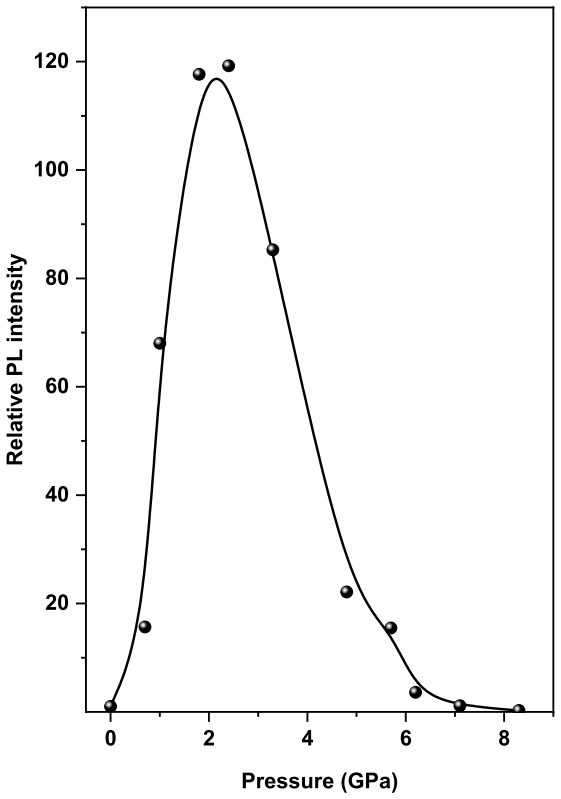
Subtle inter-octahedral rotations in Rb₂TeBr₆ boost photoluminescence intensity up to 2.4 GPa before nonradiative processes dominate.
A machine-rendered reading of the paper's core claim, the machinery that carries it, and where it could break.
Core claim
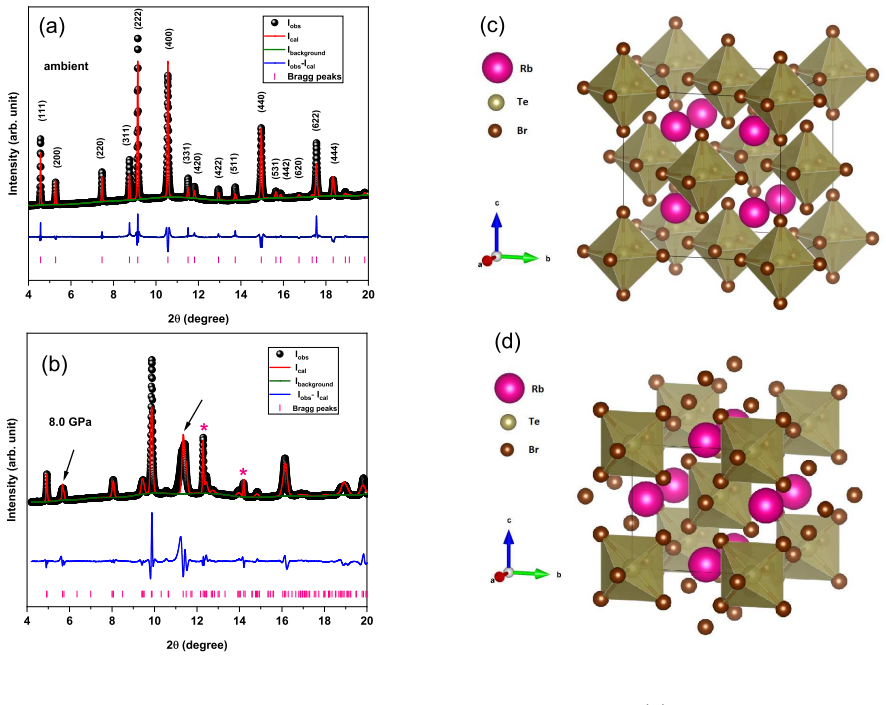
At ambient pressure Rb₂TeBr₆ adopts the cubic Fm-3m structure that remains stable to 8 GPa. Within this range subtle inter-octahedral rotations develop and produce a gradual, localized deviation from the ideal cubic framework; these rotations facilitate radiative recombination and drive a pronounced rise in photoluminescence intensity up to 2.4 GPa. Beyond 2.4 GPa nonradiative relaxation channels strengthen, causing gradual quenching of the emission. A weak external magnetic field further increases photoluminescence intensity. At higher pressures the material undergoes a transition to the orthorhombic Pnnm phase near 8 GPa, then to the monoclinic P2₁/m phase above 10.7 GPa, and becomes fully
What carries the argument
Pressure-induced subtle inter-octahedral rotations within the cubic phase that produce localized deviations from ideal cubic symmetry and thereby facilitate radiative recombination.
If this is right
- Photoluminescence intensity increases with pressure up to 2.4 GPa because the developing rotations promote radiative recombination.
- Beyond 2.4 GPa nonradiative relaxation channels strengthen and gradually quench the emission.
- The cubic structure transforms to orthorhombic Pnnm near 8 GPa and then to monoclinic P2₁/m above 10.7 GPa, with amorphization beyond 25.5 GPa.
- The optical band gap narrows continuously under compression.
- Application of a weak external magnetic field increases photoluminescence intensity.
Where Pith is reading between the lines
- Pressure may act as a continuous, reversible knob for optimizing emission efficiency in related lead-free halide perovskites without compositional changes.
- The sequence of phase transitions creates multiple distinct structural states that could each exhibit different electronic or optical characteristics.
- The observed magnetic-field response suggests an additional external handle for controlling recombination that warrants further exploration.
Load-bearing premise
The link between inter-octahedral rotations and the photoluminescence peak at 2.4 GPa assumes that these local structural changes are the dominant cause rather than other pressure-induced electronic or defect effects.
What would settle it
Observe whether the photoluminescence intensity still reaches a maximum at 2.4 GPa in a chemically modified sample or under conditions that suppress inter-octahedral rotations while preserving the cubic lattice.
Figures



read the original abstract
The structural, vibrational, and optical properties of Rb$_2$TeBr$_6$ have been investigated under high pressure using synchrotron X-ray diffraction, Raman spectroscopy, photoluminescence (PL), and optical absorption measurements. At ambient conditions, Rb$_2$TeBr$_6$ crystallizes in the cubic Fm-3m structure, which remains stable below 8.0 GPa. Within this pressure range, subtle inter-octahedral rotations develop, producing a gradual localized deviation from the ideal cubic framework. This local reorientation facilitates radiative recombination, leading to a pronounced enhancement of PL intensity with pressure up to 2.4 GPa. Beyond this pressure point, enhancement of nonradiative relaxation channels result in gradual PL quenching. Additionally, the PL intensity increases upon the application of an external weak magnetic field. A structural transition to the orthorhombic Pnnm phase occurs at around 8.0 GPa, followed by a monoclinic P$2_1/m$ phase above 10.7 GPa, and eventual amorphization beyond 25.5 GPa. Optical absorption spectra reveal continuous band-gap narrowing upon compression. These findings demonstrate the strong coupling among lattice dynamics, electronic structure, and optical response in Rb$_2$TeBr$_6$, underscoring its potential as a pressure-tunable optoelectronic material
Editorial analysis
A structured set of objections, weighed in public.
Referee Report
Summary. The manuscript presents a high-pressure investigation of the lead-free halide perovskite Rb₂TeBr₆ using synchrotron XRD, Raman spectroscopy, photoluminescence (PL), and optical absorption. It reports that the ambient cubic Fm-3m phase remains stable below 8 GPa, during which subtle inter-octahedral rotations develop and are linked to a PL intensity maximum at 2.4 GPa before quenching sets in; a transition to orthorhombic Pnnm occurs near 8 GPa, followed by monoclinic P2₁/m above 10.7 GPa and amorphization beyond 25.5 GPa. Continuous band-gap narrowing is observed with pressure, and PL intensity also rises under weak magnetic field. The work concludes that these results demonstrate strong coupling among lattice dynamics, electronic structure, and optical response, highlighting potential as a pressure-tunable optoelectronic material.
Significance. The multi-technique experimental dataset on phase stability, vibrational changes, and optical evolution under compression adds useful information on this vacancy-ordered perovskite. Complementary use of synchrotron XRD and Raman to track local structural deviations is a positive aspect. If the proposed mechanistic connection between inter-octahedral rotations and enhanced radiative recombination can be more firmly established, the findings would contribute to understanding structure–property relations in halide perovskites and support exploration of pressure as a tuning knob for optoelectronic behavior.
major comments (1)
- The central interpretation that subtle inter-octahedral rotations (inferred from Raman and XRD within the Fm-3m phase below 8 GPa) directly facilitate radiative recombination and produce the PL intensity peak at 2.4 GPa remains correlative. The manuscript reports continuous band-gap narrowing from absorption measurements and notes PL enhancement under weak magnetic field, yet does not quantitatively separate rotational effects from electronic or defect-mediated channels (e.g., via rate-equation modeling or defect-controlled samples). This assumption is load-bearing for the claim of strong lattice–optical coupling.
minor comments (2)
- The abstract and methods sections omit error bars on reported pressures and PL intensities, raw spectra, and explicit discussion of pressure calibration or hydrostaticity conditions; inclusion of these details (or reference to supplementary raw data) would improve experimental transparency and reproducibility.
- Figure captions and text should clarify how the onset of the PL maximum at 2.4 GPa is determined relative to the Raman/XRD indicators of octahedral rotation.
Simulated Author's Rebuttal
We thank the referee for the detailed and constructive review of our manuscript. The major comment has prompted us to clarify the strength of the proposed mechanistic link and to revise the presentation of our interpretation accordingly.
read point-by-point responses
-
Referee: The central interpretation that subtle inter-octahedral rotations (inferred from Raman and XRD within the Fm-3m phase below 8 GPa) directly facilitate radiative recombination and produce the PL intensity peak at 2.4 GPa remains correlative. The manuscript reports continuous band-gap narrowing from absorption measurements and notes PL enhancement under weak magnetic field, yet does not quantitatively separate rotational effects from electronic or defect-mediated channels (e.g., via rate-equation modeling or defect-controlled samples). This assumption is load-bearing for the claim of strong lattice–optical coupling.
Authors: We agree that the connection between the onset of subtle inter-octahedral rotations (evidenced by the pressure-dependent Raman mode shifts and the gradual deviation from ideal cubic symmetry in the XRD data) and the PL intensity maximum at 2.4 GPa is correlative rather than directly causal. In the revised manuscript we have expanded the discussion section to explicitly consider the possible roles of the observed continuous band-gap narrowing and the PL increase under weak magnetic field, which may point to spin-related or defect-assisted recombination pathways. We have also moderated the language in the abstract and conclusions to describe the rotations as one contributing factor supported by the structural and vibrational trends, rather than the sole facilitator of radiative recombination. A full quantitative separation of these channels would indeed require rate-equation modeling or measurements on defect-engineered samples, which are beyond the scope of the present experimental study. revision: partial
- Quantitative separation of rotational effects from electronic or defect-mediated channels via rate-equation modeling or defect-controlled samples cannot be performed with the current dataset.
Circularity Check
No circularity: purely experimental observations with correlative interpretation
full rationale
The paper reports direct synchrotron XRD, Raman, PL, and absorption data under pressure, with phase transitions and PL intensity trends described from measurements. The link between inter-octahedral rotations and PL enhancement at 2.4 GPa is presented as an inference from coinciding data trends rather than any equation, fitted model, or derivation. No self-citations, ansatzes, uniqueness theorems, or renamings of known results appear in load-bearing roles. The central claims rest on independent experimental evidence outside any self-referential reduction.
Axiom & Free-Parameter Ledger
axioms (2)
- domain assumption Synchrotron XRD patterns can be reliably indexed to space groups Fm-3m, Pnnm, and P2₁/m under non-hydrostatic or quasi-hydrostatic conditions
- domain assumption Raman peak shifts and broadening directly reflect inter-octahedral rotations and local symmetry breaking
Lean theorems connected to this paper
-
IndisputableMonolith/Cost/FunctionalEquation.leanwashburn_uniqueness_aczel unclear?
unclearRelation between the paper passage and the cited Recognition theorem.
subtle inter-octahedral rotations develop, producing a gradual localized deviation from the ideal cubic framework. This local reorientation facilitates radiative recombination, leading to a pronounced enhancement of PL intensity with pressure up to 2.4 GPa
-
IndisputableMonolith/Foundation/AlexanderDuality.leanalexander_duality_circle_linking unclear?
unclearRelation between the paper passage and the cited Recognition theorem.
structural transition to the orthorhombic Pnnm phase occurs at around 8.0 GPa, followed by a monoclinic P21/m phase above 10.7 GPa
What do these tags mean?
- matches
- The paper's claim is directly supported by a theorem in the formal canon.
- supports
- The theorem supports part of the paper's argument, but the paper may add assumptions or extra steps.
- extends
- The paper goes beyond the formal theorem; the theorem is a base layer rather than the whole result.
- uses
- The paper appears to rely on the theorem as machinery.
- contradicts
- The paper's claim conflicts with a theorem or certificate in the canon.
- unclear
- Pith found a possible connection, but the passage is too broad, indirect, or ambiguous to say the theorem truly supports the claim.
Reference graph
Works this paper leans on
- [1]
- [2]
- [3]
- [4]
-
[5]
A.E. Maughan, A. A. Paecklar and J. R. Neilson. J.Mater. C hem. C 6, 12095 (2018)
work page 2018
-
[6]
D. Ju, X. Zheng, J. Yin, Z. Qiu, B. Turedi, X. Liu, Y. Dang, B . Cao, O. F. Mohammed, O. M. Bakr, and X. Tao. ACS Energy Lett. 4, 228 (2019)
work page 2019
- [7]
-
[8]
W.Abriel. and J.Ihringer. Journal of solid state chemis try 52, 274 (1984)
work page 1984
- [9]
-
[10]
S. Mukherjee, D. Samanta, B. Mukherjee, K. Glazyrin, an d G.D. Mukherjee. Applied Physics Letters 126, 141901 (2025)
work page 2025
-
[11]
D. Samanta, S. Mukherjee, A Mishra, B. Giri, S. P. Chaudh ary, K. Glazyrin, S. Bhattacharyya, and G. D. Mukherjee. J. Appl. Phys. 138, 035902 (2025)
work page 2025
-
[12]
L. Wang, P. Yao, F. Wang, S. Li, Y. Chen, T. Xia, E. Guo, K. W ang, B. Zou, and H. Guo. Adv. Sci. 2020, 7, 1902900 (2020)
work page 2020
-
[13]
H. K. Mao, J. A. Xu, and P. M. Bell, J. Geophys. Res. Solid E arth 20, 4673 (1986)
work page 1986
-
[14]
B. Mukherjee, M. Sahu, D. Samanta, B.Ghosh, B.Joseph an d G.D.Mukherjee. J. Appl. Phys. 136 095903 (2024)
work page 2024
- [15]
-
[16]
B. H. Toby, J. Appl. Crystallogr. 34, 210 (2001)
work page 2001
-
[17]
J. G. Platas, M. Alvaro, F. Nestola, and R. Angel. J. Appl . Crystallogr. 49, 1377 (2016)
work page 2016
- [18]
-
[19]
W. Zhao, Z. Ma, Y. Shi, R. Fu, K. Wang, Y. Sui, G. Xiao and B. Zou. Cell Reports Physical Science 4, 101663 (2023)
work page 2023
- [20]
-
[21]
A. E. Maughan, A. M. Ganose, M. A. Almaker, D. O. Scanlon a nd J. R. Neilson. Chem. Mater. 30, 3909 (2018)
work page 2018
-
[22]
W.Abriel. Mat. Res. Bull. 18, 1419 (1983)
work page 1983
-
[23]
X. Lu, W. Yang, Q. Jia and H. Xu, Chem. Sci., 8, 6764 (2017)
work page 2017
-
[24]
W. H. Baur. Acta Crystallographica Section B. 30, 1195 (1974)
work page 1974
-
[25]
Q. Li, Y. Wang, W. Pan, W. Yang, B. Zou, J. Tang and Z. Quan. Angew.Chem., 56, 15969 (2017)
work page 2017
-
[26]
H. Shi, L. Chen, H. Moutaabbid, Z. Feng, G. Zhang, L. Wang , Y. Li, H. Guo, and C. Liu. Small. 20, 2405692 (2024)
work page 2024
- [27]
- [28]
-
[29]
R. Zhou, L. Sui, X. Liu, K. Liu, D. Guo, W. Zhao, S. Song, C. Lv, S. Chen, T. Jiang, Z. Cheng, S. Meng and C. Shan. Nat Commun 14,, 1310 (2023) 14 Table I Relative atomic positions Rb 2TeBr6 at ambient conditions after Rietveld refinement Atom Wyckoff position x/a y/b z/c Rb 8c 0.2500 0.2500 0.2500 Te 4a 0 0 0 Br 24e 0.25028 0 0 Table II Relative atomic pos...
work page 2023
discussion (0)
Sign in with ORCID, Apple, or X to comment. Anyone can read and Pith papers without signing in.