REVIEW 2 major objections 4 minor 13 references
This paper proves exact cutoffs on how many factors of the 144-periodic β₁-family multiply to nonzero elements in the 3-primary stable homotopy groups of spheres.
Reviewed by Pith at T0; open to challenge. T0 means a machine referee read the full paper against a public rubric. the ladder, T0–T4 →
T0 review · deepseek-v4-flash
2026-08-04 00:12 UTC pith:K7XX422Y
load-bearing objection Sharp new cutoffs for β1-multiplication on divided β-families, with a clean synthetic proof; the nonvanishing half rests on a chart-inspected completeness claim for the J2 ANSS that needs referee checking. the 2 major comments →
Revisiting the β₁-action on the 3-primary stable homotopy groups of spheres
The pith
A machine-rendered reading of the paper's core claim, the machinery that carries it, and where it could break.
Core claim
The central claim is that the classical pattern β₁⁵≠0 and β₁⁶=0 survives periodification: for every collection of nonnegative indices sᵢ, the product ∏ᵢ β_{1+9sᵢ} is nonzero exactly when at most five factors are taken, and zero when six are taken. The same sharp cutoff holds for multiplying β_{2+9t}, α₁β_{2+9t}, and [α₁β₃/3] against the family: at most 2, 2, and 1 factors, respectively. In addition, Theorem C constructs many nonzero products in the sphere spectrum that nevertheless die in TMF and in J₂, showing those spectra cannot see some height-2 classes. The paper obtains these results without a full computation of the stable stems, using BP-synthetic spectra to turn Adams–Novikov differ
What carries the argument
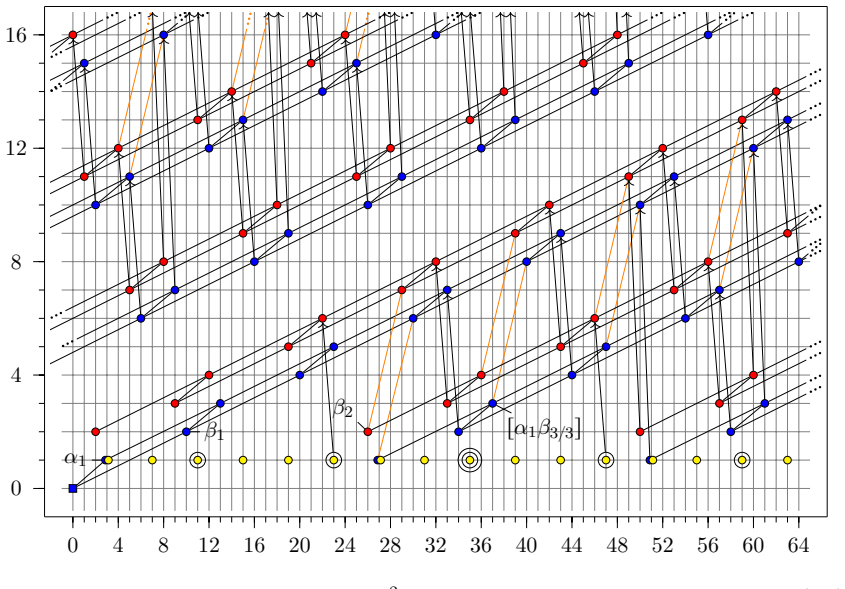
The argument runs through the modified Adams–Novikov spectral sequence for J₂, the equaliser of the Adams operation ψ² and the identity on the spectrum TMF of topological modular forms; this spectrum acts as a height-2 analogue of the image of J. The key lemma (Lemma 4.1) says that if a class maps to a nonzero element in J₂ that is τ^r-torsion but not τ^{r-1}-torsion for a suitable r, then the class in the synthetic sphere is τ-torsion-free and hence nonzero in the actual sphere. Vanishing is obtained by periodifying low-degree differentials using v₂⁹ self-maps of synthetic Moore spectra. The entire nonvanishing half depends on a chart (Figures 1–2) asserting the complete differential struct
Load-bearing premise
The load-bearing premise is the completeness of the modified Adams–Novikov chart for J₂: the assertion that the only differentials are those forced from TMF plus one exotic 3-extension, with no further differentials; if that chart is wrong, the deduced torsion orders and the nonvanishing conclusions could change.
What would settle it
Examine the J₂ signature spectral sequence at stems 50+144k and 130+144k, where the chart asserts specific torsion orders and no differentials; a single extra differential, a missing one, or a different torsion order in the ψ²-equaliser E₂-page would contradict Proposition 3.7 and invalidate the nonvanishing half of Theorem A and Theorem C.
If this is right
- Every sixfold product of β_{1+9s} elements vanishes, and every fivefold product is nonzero, for all choices of shifts; the old β₁⁵/β₁⁶ dichotomy becomes a special case of a uniform periodicity pattern.
- The same technique gives sharp cutoffs for multiplying by β_{2+9t}, α₁β_{2+9t}, and [α₁β₃/3], so the β₁-action on these height-2 families is now fully described by a few numbers.
- Theorem C provides many new nonzero products in the stable sphere that die in both TMF and J₂, so none of the current detection spectra sees them; they must be detected by finer chromatic methods.
- The vanishing results (Corollary B) give new infinite families of zero products, including α₁ times a fourfold β₁-product and β₅ times a fourfold β₁-product.
- The synthetic-spectra proof avoids subtle geometric boundary theorems and offers a uniform way to periodify low-degree differentials to arbitrary heights.
Where Pith is reading between the lines
- If the J₂ chart is complete, the same synthetic-spectra machine should settle the paper's open Question 2.10: whether the products in (2.9) vanish after one β₁ factor is removed, completing the classification of α₁β₁⁴-type products.
- The uniform cutoff pattern suggests a general conjecture: for any fixed height-2 class, the maximal number of β₁-family factors it can absorb is governed by a 'weight' function, and the same chart method might prove it for other families such as β₅ or β₆/3.
- The approach hints at analogous results at the prime 2 or at primes p≥5, where similar equaliser spectra exist; the use of ψ² is likely a convenience rather than an essential choice.
- A natural next step is computing the β₁-inverted synthetic sphere, analogous to the known η-inverted computation, which would organise all β₁-periodic Adams–Novikov phenomena in one object.
Editorial analysis
A structured set of objections, weighed in public.
Referee Report
Summary. The paper studies the multiplicative action of β1 on the 144-periodic divided β-family in the 3-local stable homotopy groups of spheres. Theorem A claims sharp cutoffs: products of up to five β_{1+9s_i} are nonzero, six-fold products vanish, and analogous cutoffs hold for β_{2+9t}, α1β_{2+9t}, and [α1β3/3]. Corollary B and Theorem C add further vanishing and nonvanishing statements, including classes that have zero image in TMF and J2 but are nonzero in π*S. The proofs combine BP-synthetic spectra with periodified classical ANSS differentials (for vanishing) and with the modified ANSS for the equaliser J2 = fibre(ψ2−1 on TMF) (for nonvanishing), building on [BP04], [BS23], and [CD24a].
Significance. If the chart computation in Prop. 3.7 is correct, the paper provides a clean and attractive proof of Shimomura's theorems and extends them to new families; the use of synthetic spectra to periodify differentials is elegant, and the results are benchmarked against Toda's classical β1^5≠0, β1^6=0. The paper is also transparent about the limitations of the J2/TMF method (e.g. β2^2=0 in J2 although β2^2≠0 in S). The main new nonvanishing statements are conditional on the completeness of the J2 modified Adams–Novikov chart, which is currently asserted rather than written out. Because of that, the significance is real but conditional.
major comments (2)
- [§3, Prop. 3.7, Figs. 1–2] The completeness of the signature spectral sequence for J2^BP is the load-bearing input for the nonvanishing half of Theorems A and C. The proof states that 'the differentials are clear, and once one projects and lifts as many differentials as are in TMF^BP, there is no more room for any more differentials', and that there is one exotic 3-extension, but no written-out verification is given. The subsequent applications use exact τ-torsion orders (e.g. five-fold β-products are τ^8-torsion but must be not τ^7-torsion for Lemma 4.1, and the τ^4/τ^8 orders in Prop. 4.4) and the τ-torsion-freeness in Prop. 3.8. A missed differential, a spurious differential, or an incorrect torsion order in the ψ^2-equaliser E2-page would change these orders and could invalidate the nonvanishing claims. Please supply a complete E2-page computation, an explicit differential analysis in the relevant range, and a
- [§4, Lemma 4.1, Prop. 4.3] Lemma 4.1 is a linchpin but its proof is too compressed. The statement needs a precise explanation of the relationship between τ-torsion orders in a synthetic spectrum and differentials in its signature spectral sequence, and of why a hypothetical τ^s-torsion in 1 would produce a d_{s+1} differential with source in filtration ≤1. The application in Prop. 4.3(1) also needs an explicit verification of the 'not τ^{r−1}-torsion' hypothesis for the five-fold products; the text only says 'τ^8-torsion'. This lower bound is a consequence of the J2 chart and should be stated and proved explicitly.
minor comments (4)
- [Throughout, §3–§4] The text repeatedly cites 'Equation (3.7)' and 'Equation (4.1)'–'(4.4)' for Proposition/Lemma numbers, but no displayed equation (3.7) exists. Please make cross-references consistent.
- [§4, Proof of Th.A] The proof says 'Combine Equation (2.7) with parts 2 and 6 of Equation (4.3)', but Prop. 4.3 has parts 1–4. Please correct the reference and also specify how the C=1 case of Th.A(3) is obtained, e.g. by citing [CD24a, Th.B] or by proving it here.
- [§2, Def. 2.1 and Lemma 2.2] Several bidegrees are typeset ambiguously (e.g. β_{1+9s} should be in bidegree (10+144s,2); the displayed exact sequence in Lemma 2.2 has confusing boundary degrees). Please double-check and display these gradings consistently.
- [§4, Lemma 4.2] The connective variant j2^BP is used in the proof but should be defined at first use. Also, the phrase 'in bidegrees (50+144k,2) and (130+144k,2)' should specify whether these are (s,f) coordinates or Adams–Novikov (t,s) coordinates.
Circularity Check
No circular derivation found; the main risk is the by-inspection completeness of the J2 modified ANSS (Prop. 3.7), which is an assumption rather than a hidden reuse of the conclusions.
full rationale
The derivation chain does not reduce to its inputs. The vanishing half of Th.A/Th.B uses Toda's classical beta_1^6=0 [Tod71], Ravenel's ANSS tables, and the Behrens-Pemmaraju v2^9 self-map [BP04] to periodify ANSS differentials; the s=0 input tau^8 beta_1^6=0 in 1 is explicitly external ('As tau^8 beta_1^6=0 in 1' in Lemma 2.2), not a conclusion derived in the paper, so no theorem assumption is being used to prove itself. The nonvanishing half depends on Prop. 3.7, the signature spectral sequence for J2^BP, whose completeness is asserted by inspection ('once one projects and lifts as many differentials as are in TMF^BP, there is no more room for any more differentials'). This is an unverified chart claim, a legitimate correctness risk, since Lemma 4.1 and Prop. 3.8 translate its tau-torsion orders into tau-torsion-freeness in the synthetic sphere, but it is not circular: the chart is computed from the psi^2-equaliser of TMF's ANSS, not fitted to Th.A. Detection in J2^BP (Prop. 3.8) is inherited from [BS23, Th.6.5] (external) and [CD24a, Th.A] (self), and the synthetic lifting uses the chart's torsion-freeness; neither source assumes the target theorems, and the products in Th.C are explicitly excluded from [CD24a, Th.B]. No uniqueness theorem is imported from the authors to force the choice of J2; no known result is renamed in new coordinates. The heavy self-citation is infrastructure (synthetic spectra, TMF ANSS, J2 equaliser) and is not load-bearing in a circular sense. Score 2 reflects the density of self-citations and the by-inspection completeness of Prop. 3.7, not a found circular step.
Axiom & Free-Parameter Ledger
axioms (8)
- domain assumption A v₂⁹ self-map of degree 144 exists on S/{3,v₁} at the prime 3 ([BP04]), giving synthetic self-maps v₂⁹: ¹^{144,0}/{3,v₁} → ¹/{3,v₁}.
- domain assumption The 3-local ANSS values used in Lemma 2.2 (π_{66,2}¹ = 0, π_{65,3}¹{3} ≅ F₃, π_{61,3}¹{3} = 0, π_{60,4}¹ = 0) are as stated in [Rav04].
- domain assumption The divided β-family elements of Table 1 exist in the stated degrees and, with the synthetic lifts fixed in §1, have nonzero image in π_{*,*}J₂^BP given by the formulas of Prop 3.8 ([BS23, Th.6.5], [CD24a, Th.A]).
- domain assumption The ANSS for 3-local TMF has E₂-page (3.1) and only multiplicative d₅, d₉ differentials: d₅(Δ) = ±αβ², d₉([αΔ]) = ±β⁵ ([CDvN24, §7.1]).
- domain assumption Adams operations ψᵏ on TMF^BP act on the E₂-page by ψᵏ(f) = k^d f on weight-d modular forms, fixing α and β ([Dav24, Cor.2.12]); ψ² is used throughout.
- domain assumption In the ANSS for the 3-local sphere all classes in filtration ≤ 1 are permanent cycles ([Nov69], invoked in Lemma 4.1).
- domain assumption The only potential classes in π_{50+144k,2}¹{τ} and π_{130+144k,2}¹{τ} are divided β-elements β^s_{3n/j} (j ≡ 23, 3 mod 36, n ≥ 24, 4), and these vanish in j₂^BP{τ} ([MRW77, Th.2.6], [CD24a, Lm.3.30]).
- standard math The BP-synthetic spectra framework of Pstragowski [Pst23] (stable symmetric monoidal ∞-category Syn, τ-inversion, signature functor σ identifying π_{*,*}νX with the ANSS of X) is sound.
read the original abstract
Let $\beta_1$ be the first $3$-torsion class in the stable homotopy groups of spheres in even degree. Toda showed that $\beta_1^5 \neq 0$, whilst $\beta_1^6 = 0$. Shimomura generalised this to the $144$-periodic family generated by $\beta_1$, written as $\{\beta_{1+9s}\}_{s\geq 0}$, and showed that any $5$-fold product $\prod_5 \beta_{1+9s} \neq 0$, whilst all $6$-fold products $\prod_6 \beta_{1+9s} = 0$. In this article, we give a simple proof of these results as well as some generalisations to other $144$-periodic families. Our tools include BP-synthetic spectra, and the well-known Adams--Novikov spectral sequence for the spectrum of topological modular forms at the prime $3$ as well as its Adams operations.
Figures

Reference graph
Works this paper leans on
-
[3]
Papers from the international conference on algebraic topology, Northwestern University, Evanston, IL, USA, March 24–28, 2002, pages 9–49
InHomotopy theory: relations with algebraic geometry, group cohomology, and algebraicK- theory. Papers from the international conference on algebraic topology, Northwestern University, Evanston, IL, USA, March 24–28, 2002, pages 9–49. Providence, RI: American Mathematical Society (AMS),
2002
-
[5]
[CD25] Christian Carrick and Jack Morgan Davies
accepted in Transactions of the American Mathematical Society. [CD25] Christian Carrick and Jack Morgan Davies. On periodic families in the stable stems of height two. Preprint, arXiv:2506.20507 [math.AT] (2025),
Pith/arXiv arXiv 2025
-
[6]
The descent spectral sequence for topo- logical modular forms
[CDvN24] Christian Carrick, Jack Morgan Davies, and Sven van Nigtevecht. The descent spectral sequence for topo- logical modular forms. Preprint, arXiv:2412.01640 [math.AT] (2024),
Pith/arXiv arXiv 2024
-
[7]
Descent spectral sequences through syn- thetic spectra.Int
[CDvN25] Christian Carrick, Jack Morgan Davies, and Sven van Nigtevecht. Descent spectral sequences through syn- thetic spectra.Int. Math. Res. Not., 2025(15):26,
2025
-
[24]
[Del75] P. Deligne. Courbes elliptiques: formulaire d’après J. Tate. InModular functions of one variable. IV. Proceedings of the international summer school, University of Antwerp, RUCA, July 17 – August 3, 1972, pages 53–73. Berlin: Springer,
1972
-
[1926]
Isaksen, Hana Jia Kong, Guchuan Li, Yangyang Ruan, and Heyi Zhu
[IKL`25] Daniel C. Isaksen, Hana Jia Kong, Guchuan Li, Yangyang Ruan, and Heyi Zhu. Exotic periodic phenomena in the cohomology of the moduli stack of1-dimensional formal group laws. Preprint, arXiv:2504.14383 [math.AT] (2025),
Pith/arXiv arXiv 2025
-
[1971]
An introduction to filtered and synthetic spectra
[vN25] Sven van Nigtevecht. An introduction to filtered and synthetic spectra. Preprint, arXiv:2509.21127 [math.AT] (2025),
arXiv 2025
-
[1975]
Douglas, John Francis, André G
[DFHH14] Christopher L. Douglas, John Francis, André G. Henriques, and Michael A. Hill, editors.Topological mod- ular forms. Based on the Talbot workshop, North Conway, NH, USA, March 25–31, 2007, volume
2007
-
[2014]
[Ghe17] Bogdan Gheorghe. Exotic Motivic Periodicities. Preprint, arXiv:1709.00915 [math.AT] (2017),
Pith/arXiv arXiv 2017
-
[2020]
Elliptic Cohomology II: Orientations
[Lur18] Jacob Lurie. Elliptic Cohomology II: Orientations. Available athttps://www.math.ias.edu/~lurie/, April 2018 version,
2018
-
[2023]
Slice spectral sequences through synthetic spectra
[Car25] Christian Carrick. Slice spectral sequences through synthetic spectra. Preprint, arXiv:2510.19501 [math.AT] (2025),
arXiv 2025
-
[2024]
A synthetic approach to detectingv1-periodic families
[CD24b] Christian Carrick and Jack Morgan Davies. A synthetic approach to detectingv1-periodic families. Preprint, arXiv:2401.16508 [math.AT] (2024),
arXiv 2024
-
[2025]
Nonvanishing of products inv2-periodic families at the prime3
[CD24a] Christian Carrick and Jack Morgan Davies. Nonvanishing of products inv2-periodic families at the prime3. Preprint, arXiv:2410.02564 [math.AT] (2024),
Pith/arXiv arXiv 2024
discussion (0)
Sign in with ORCID, Apple, or X to comment. Anyone can read and Pith papers without signing in.