Unifying Qubit Routing Across Diverse Quantum ISAs via Canonical Representation
Pith reviewed 2026-05-18 00:42 UTC · model grok-4.3
The pith
Canonical representations of two-qubit gates enable a single routing framework to optimize SWAP costs for many different quantum instruction sets.
A machine-rendered reading of the paper's core claim, the machinery that carries it, and where it could break.
Core claim
Canopus is a unified qubit mapping and routing framework that centers on the canonical representation of two-qubit gates and applies monodromy polytope theory to predict synthesis costs, enabling ISA-aware SWAP insertion and generalized commutativity optimizations that reduce overhead across backend ISAs and device topologies.
What carries the argument
The canonical representation of two-qubit gates, a standard mathematical form that captures all possible two-qubit interactions up to local operations, used together with monodromy polytope theory to calculate the minimal number of native gates needed for each SWAP during routing.
If this is right
- Routing overhead drops 15 to 35 percent relative to prior methods on multiple ISAs and topologies.
- A single framework supports co-optimization of program patterns, choice of ISA, and hardware connectivity.
- Commutation relations expressed in canonical form provide a general way to reorder gates without ISA-specific rules.
- The same modeling supplies concrete guidelines for hardware-software co-design decisions.
Where Pith is reading between the lines
- The method could be combined with pulse-level control to further reduce duration on devices where native gates have tunable parameters.
- Hardware designers might prioritize gate sets whose canonical forms allow low-cost SWAPs to minimize routing penalties.
- Extending the cost model to include error rates rather than just gate count would test whether the depth savings translate to higher final fidelity.
- The framework might serve as a test bed for exploring how program structure interacts with topology beyond the benchmarks already used.
Load-bearing premise
The canonical representation together with the monodromy polytope gives an accurate enough prediction of actual synthesis cost for SWAP insertion in every supported ISA that modeling error does not erase the observed gains.
What would settle it
Execute the routing algorithm on a concrete backend ISA, measure the resulting circuit depth or duration on hardware or by exact gate synthesis, and compare against the cost predicted by the monodromy polytope model; a large mismatch would show the model fails to predict real costs.
Figures




read the original abstract
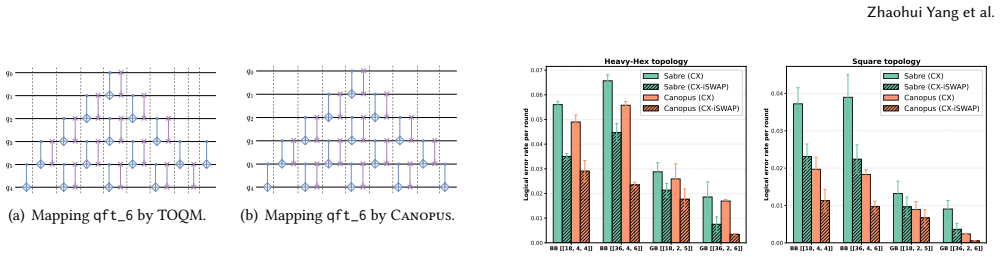
Qubit mapping/routing is a critical stage in compilation for both near-term and fault-tolerant quantum computers, yet existing scalable methods typically impose several times the routing overhead in terms of circuit depth or duration. This inefficiency stems from a fundamental disconnect: compilers rely on an abstract routing model (e.g., three-CX-unrolled SWAP insertion) that completely ignores the idiosyncrasies of native gates supported by physical devices. Recent hardware breakthroughs have enabled high-precision implementations of diverse instruction set architectures (ISAs) beyond standard CX-based gates. Advanced ISAs involving gates such as $\mathrm{\sqrt{iSWAP}}$ and $\mathrm{ZZ}(\theta)$ gates offer superior circuit synthesis capabilities and can be realized with higher fidelities. However, systematic compiler optimization strategies tailored to these advanced ISAs are lacking. To address this, we propose Canopus, a unified qubit mapping/routing framework applicable to diverse quantum ISAs. Built upon the canonical representation of two-qubit gates, Canopus centers on qubit routing to perform deep co-optimization in an ISA-aware approach. Canopus leverages the two-qubit canonical representation and the monodromy polytope theory to model the synthesis cost for more intelligent SWAP insertion during qubit routing. We also formalize the commutation relations between two-qubit gates through the canonical form, providing a generalized approach to commutativity-based optimization. Experiments show that Canopus consistently reduces routing overhead by 15%-35% compared to state-of-the-art methods across various backend ISAs and device topologies. More broadly, this work establishes a coherent method for co-exploration of program patterns, quantum ISAs, and hardware topologies, yielding concrete guidelines for hardware-software co-design.
Editorial analysis
A structured set of objections, weighed in public.
Referee Report
Summary. The paper proposes Canopus, a unified qubit mapping/routing framework for diverse quantum ISAs. It centers on the canonical representation of two-qubit gates combined with monodromy polytope theory to compute ISA-specific synthesis costs for SWAP insertion, while also formalizing commutation relations via the canonical form. Experiments are reported to show consistent 15-35% reductions in routing overhead versus prior methods across multiple backend ISAs and device topologies.
Significance. If the modeling assumptions hold without significant error, the work offers a principled, parameter-free route to ISA-aware routing that could meaningfully lower compilation overhead on hardware supporting advanced gates such as √iSWAP and ZZ(θ). The reliance on established monodromy polytope theory and the absence of fitted parameters are strengths that support broader hardware-software co-design exploration.
major comments (2)
- [Abstract] Abstract (modeling paragraph): The central claim that canonical-form plus monodromy polytope yields an accurate, ISA-specific synthesis cost for each SWAP candidate rests on an unvalidated modeling step. No quantitative comparison (e.g., predicted vs. actual native-gate decomposition lengths or depth tables) is supplied for non-CX gates such as √iSWAP or ZZ(θ), leaving open the possibility that modeling error offsets or inflates the reported 15-35% gains.
- [Abstract] Abstract (experiments paragraph): The headline performance numbers lack any description of benchmark selection criteria, circuit ensembles, error-bar reporting, or data-exclusion rules. Without these details the 15-35% overhead reduction cannot be independently assessed for statistical robustness or sensitivity to topology/ISA choice.
minor comments (1)
- [Abstract] The abstract refers to “deep co-optimization” without clarifying whether this includes gate scheduling, pulse-level effects, or only logical SWAP insertion; a brief sentence distinguishing these scopes would improve precision.
Simulated Author's Rebuttal
We thank the referee for the constructive and detailed comments. We address each major point below, indicating where revisions have been made to strengthen the manuscript.
read point-by-point responses
-
Referee: [Abstract] Abstract (modeling paragraph): The central claim that canonical-form plus monodromy polytope yields an accurate, ISA-specific synthesis cost for each SWAP candidate rests on an unvalidated modeling step. No quantitative comparison (e.g., predicted vs. actual native-gate decomposition lengths or depth tables) is supplied for non-CX gates such as √iSWAP or ZZ(θ), leaving open the possibility that modeling error offsets or inflates the reported 15-35% gains.
Authors: The synthesis-cost model is derived directly from the exact characterization of reachable unitaries given by monodromy polytope theory applied to the two-qubit canonical form; this yields the minimal native-gate count without approximation or fitted parameters. We nevertheless recognize that an explicit side-by-side numerical validation for non-CX gates would make the claim more immediately verifiable. We have therefore added a new appendix containing predicted versus actual decomposition lengths and depths for √iSWAP and ZZ(θ) families, together with the corresponding monodromy-polytope calculations. revision: yes
-
Referee: [Abstract] Abstract (experiments paragraph): The headline performance numbers lack any description of benchmark selection criteria, circuit ensembles, error-bar reporting, or data-exclusion rules. Without these details the 15-35% overhead reduction cannot be independently assessed for statistical robustness or sensitivity to topology/ISA choice.
Authors: We agree that the abstract should provide at least a concise indication of the experimental protocol. In the revised manuscript we have expanded the experiments paragraph of the abstract to state that results are reported on (i) random circuits of varying depth and (ii) standard application benchmarks drawn from the Qiskit and Cirq suites, averaged over 50 instances per configuration, with standard deviations shown in the main-text figures. Full selection criteria, topology sampling, and data-handling procedures remain detailed in Section 5; we have added an explicit cross-reference from the abstract to that section. revision: partial
Circularity Check
No significant circularity detected
full rationale
The paper's central modeling step invokes the established two-qubit canonical representation together with monodromy polytope theory to assign synthesis costs to candidate SWAP insertions. This step is presented as an application of prior mathematical machinery rather than a self-definitional loop, a fitted parameter renamed as a prediction, or a load-bearing self-citation. No equations in the abstract or description reduce the reported 15-35% overhead reduction to a tautology constructed from the routing results themselves; the experimental claims rest on external comparisons across ISAs and topologies. The derivation therefore remains self-contained against external benchmarks.
Axiom & Free-Parameter Ledger
axioms (1)
- domain assumption Canonical representation of two-qubit gates can be used to model synthesis cost for intelligent SWAP insertion during routing.
Reference graph
Works this paper leans on
-
[1]
Abanin, Laleh Aghababaie-Beni, Igor Aleiner, Trond I
Rajeev Acharya, Dmitry A. Abanin, Laleh Aghababaie-Beni, Igor Aleiner, Trond I. Andersen, Markus Ansmann, Frank Arute, Kunal Arya, Abraham Asfaw, Nikita Astrakhantsev, Juan Atalaya, Ryan Bab- bush, Dave Bacon, Brian Ballard, Joseph C. Bardin, Johannes Bausch, Andreas Bengtsson, Alexander Bilmes, Sam Blackwell, Sergio Boixo, Gina Bortoli, Alexander Boussas...
work page 2024
-
[2]
Alessandro Annechini, Marco Venere, Donatella Sciuto, and Marco Santambrogio. 2025. DDRoute: a Novel Depth-Driven Approach to the Qubit Routing Problem. InProceedings of the 62st ACM/IEEE Design Automation Conference
work page 2025
-
[3]
Bardin, Rami Barends, Rupak Biswas, Sergio Boixo, Fernando G
Frank Arute, Kunal Arya, Ryan Babbush, Dave Bacon, Joseph C. Bardin, Rami Barends, Rupak Biswas, Sergio Boixo, Fernando G. S. L. Bran- dao, David A. Buell, Brian Burkett, Yu Chen, Zijun Chen, Ben Chiaro, Roberto Collins, William Courtney, Andrew Dunsworth, Edward Farhi, Brooks Foxen, Austin Fowler, Craig Gidney, Marissa Giustina, Rob Graff, Keith Guerin, ...
work page 2019
-
[4]
Sergey Bravyi, Andrew W Cross, Jay M Gambetta, Dmitri Maslov, Patrick Rall, and Theodore J Yoder. 2024. High-threshold and low- overhead fault-tolerant quantum memory.Nature627, 8005 (2024), 778–782
work page 2024
-
[5]
Nikolas P Breuckmann and Jens Niklas Eberhardt. 2021. Quantum low-density parity-check codes.PRX Quantum2, 4 (2021), 040101
work page 2021
-
[6]
Colin D Bruzewicz, John Chiaverini, Robert McConnell, and Jeremy M Sage. 2019. Trapped-ion quantum computing: Progress and challenges. Applied Physics Reviews6, 2 (2019), 021314
work page 2019
-
[7]
Stephen S Bullock and Igor L Markov. 2003. An arbitrary two-qubit computation in 23 elementary gates or less. InProceedings of the 40th Annual Design Automation Conference. IEEE, Anaheim, CA, USA, 324– 329
work page 2003
-
[8]
Gregory J Chaitin. 1982. Register allocation & spilling via graph coloring.ACM Sigplan Notices17, 6 (1982), 98–101
work page 1982
-
[9]
Christopher Chamberland, Guanyu Zhu, Theodore J Yoder, Jared B Hertzberg, and Andrew W Cross. 2020. Topological and subsystem codes on low-degree graphs with flag qubits.Physical Review X10, 1 (2020), 011022
work page 2020
-
[10]
Jianxin Chen, Dawei Ding, Weiyuan Gong, Cupjin Huang, and Qi Ye
-
[11]
One Gate Scheme to Rule Them All: Introducing a Complex Yet Reduced Instruction Set for Quantum Computing. InProceedings of the 29th ACM International Conference on Architectural Support for Programming Languages and Operating Systems, Volume 2. ACM, La Jolla, CA, USA, 779–796
-
[12]
Zhen Chen, Weiyang Liu, Yanjun Ma, Weijie Sun, Ruixia Wang, He Wang, Huikai Xu, Guangming Xue, Haisheng Yan, Zhen Yang, Jiayu Ding, Yang Gao, Feiyu Li, Yujia Zhang, Zikang Zhang, Yirong Jin, Haifeng Yu, Jianxin Chen, and Fei Yan. 2025. Efficient implementation of arbitrary two-qubit gates using unified control.Nature Physics(15 Aug 2025). doi:10.1038/s415...
- [13]
-
[14]
Josep M Codina, Jesús Sánchez, and Antonio González. 2001. A unified modulo scheduling and register allocation technique for clustered processors. InProceedings 2001 International Conference on Parallel Architectures and Compilation Techniques. IEEE, 175–184
work page 2001
-
[15]
Gavin E Crooks. 2020. Gates, states, and circuits. Available athttps: //threeplusone.com/pubs/on-gates-v0-5/
work page 2020
-
[16]
Andrew W Cross, Lev S Bishop, Sarah Sheldon, Paul D Nation, and Jay M Gambetta. 2019. Validating quantum computers using random- ized model circuits.Physical Review A100, 3 (2019), 032328
work page 2019
- [17]
-
[18]
Warren, Jonathan Gross, Alex Opremcak, Nicholas Zobrist, Kevin C
Alec Eickbusch, Matt McEwen, Volodymyr Sivak, Alexandre Bourassa, Juan Atalaya, Jahan Claes, Dvir Kafri, Craig Gidney, Christopher W. Warren, Jonathan Gross, Alex Opremcak, Nicholas Zobrist, Kevin C. Miao, Gabrielle Roberts, Kevin J. Satzinger, Andreas Bengtsson, Matthew Neeley, William P. Livingston, Alex Greene, Rajeev Acharya, Laleh Aghababaie Beni, Ge...
work page 2025
-
[19]
Craig Gidney. 2021. Stim: a fast stabilizer circuit simulator.Quantum 5 (2021), 497.https://api.semanticscholar.org/CorpusID:232104816
work page 2021
-
[20]
Michael Goerz and Evan McKinney. 2024. weylchamber: Python package for analyzing two-qubit gates in the Weyl chamber.https: //pypi.org/project/weylchamber/. Python package
work page 2024
-
[21]
Google Quantum AI. 2025. Cirq API.https://quantumai.google/ reference/python/cirq/two_qubit_matrix_to_sqrt_iswap_operations
work page 2025
-
[22]
Aram W Harrow, Avinatan Hassidim, and Seth Lloyd. 2009. Quantum algorithm for linear systems of equations.Physical review letters103, 15 (2009), 150502
work page 2009
-
[23]
John L Hennessy and Thomas Gross. 1983. Postpass code optimization of pipeline constraints.ACM Transactions on Programming Languages and Systems (TOPLAS)5, 3 (1983), 422–448
work page 1983
- [24]
-
[25]
Cupjin Huang, Tenghui Wang, Feng Wu, Dawei Ding, Qi Ye, Linghang Kong, Fang Zhang, Xiaotong Ni, Zhijun Song, Yaoyun Shi, Hui-Hai Zhao, Chunqing Deng, and Jianxin Chen. 2023. Quantum Instruction Set Design for Performance.Physical Review Letters130 (Feb 2023), 070601. Issue 7. doi:10.1103/PhysRevLett.130.070601
-
[26]
IBM Quantum. 2024. New fractional gates reduce circuit depth for utility-scale workloads.https://www.ibm.com/quantum/blog/ fractional-gates. Accessed: Nov. 18, 2024
work page 2024
-
[27]
IBM Quantum. 2025. Qiskit API.https://quantum.cloud.ibm.com/ docs/en/api/qiskit/qiskit.synthesis.XXDecomposer
work page 2025
-
[28]
IonQ. 2023. Getting started with IonQ’s hardware-native gateset. https://docs.ionq.com/guides/getting-started-with-native-gates
work page 2023
-
[29]
Yuwei Jin, Xiangyu Gao, Minghao Guo, Henry Chen, Fei Hua, Chi Zhang, and Eddy Z Zhang. 2024. Optimizing quantum fourier trans- formation (qft) kernels for modern nisq and ft architectures. InSC24: International Conference for High Performance Computing, Networking, Storage and Analysis. IEEE, 1–15
work page 2024
-
[30]
Justin Kalloor, Mathias Weiden, Ed Younis, John Kubiatowicz, Bert De Jong, and Costin Iancu. 2024. Quantum hardware roofline: Evalu- ating the impact of gate expressivity on quantum processor design. In2024 IEEE International Conference on Quantum Computing and Engineering (QCE), Vol. 1. IEEE, 805–816
work page 2024
-
[31]
A Yu Kitaev. 1995. Quantum measurements and the Abelian stabilizer problem.arXiv preprint quant-ph/9511026(1995)
work page internal anchor Pith review Pith/arXiv arXiv 1995
-
[32]
Philip Krantz, Morten Kjaergaard, Fei Yan, Terry P Orlando, Simon Gustavsson, and William D Oliver. 2019. A quantum engineer’s guide to superconducting qubits.Applied Physics Reviews6, 2 (2019), 021318
work page 2019
-
[33]
Alon Kukliansky, Ed Younis, Lukasz Cincio, and Costin Iancu. 2023. QFactor: A Domain-Specific Optimizer for Quantum Circuit Instanti- ation. In2023 IEEE International Conference on Quantum Computing and Engineering (QCE), Vol. 1. IEEE, 814–824
work page 2023
-
[34]
Lingling Lao, Hans Van Someren, Imran Ashraf, and Carmen G Al- mudever. 2021. Timing and resource-aware mapping of quantum circuits to superconducting processors.IEEE Transactions on Computer- Aided Design of Integrated Circuits and Systems41, 2 (2021), 359–371
work page 2021
-
[35]
Chris Lattner and Vikram Adve. 2004. LLVM: A Compilation Frame- work for Lifelong Program Analysis & Transformation. InProceedings of the International Symposium on Code Generation and Optimiza- tion (CGO). IEEE Computer Society, Washington, DC, USA, 75–86. doi:10.1109/CGO.2004.1281665
-
[36]
Ang Li, Samuel Stein, Sriram Krishnamoorthy, and James Ang. 2023. Qasmbench: A low-level quantum benchmark suite for nisq evaluation and simulation.ACM Transactions on Quantum Computing4, 2 (2023), 1–26
work page 2023
-
[37]
Gushu Li, Yufei Ding, and Yuan Xie. 2019. Tackling the qubit map- ping problem for NISQ-era quantum devices. InProceedings of the twenty-fourth international conference on architectural support for pro- gramming languages and operating systems. 1001–1014
work page 2019
-
[38]
Ji Liu, Peiyi Li, and Huiyang Zhou. 2022. Not all swaps have the same cost: A case for optimization-aware qubit routing. In2022 IEEE International Symposium on High-Performance Computer Architecture (HPCA). IEEE, 709–725
work page 2022
-
[39]
Ji Liu, Ed Younis, Mathias Weiden, Paul Hovland, John Kubiatowicz, and Costin Iancu. 2023. Tackling the qubit mapping problem with permutation-aware synthesis. In2023 IEEE International Conference on Quantum Computing and Engineering (QCE), Vol. 1. IEEE, 745–756
work page 2023
-
[40]
Seth Lloyd. 1996. Universal quantum simulators.Science273, 5278 (1996), 1073–1078. 14 Qubit Mapping and Routing tailored to Advanced Quantum ISAs: Not as Costly as You Think
work page 1996
-
[41]
Dmitri Maslov. 2007. Linear depth stabilizer and quantum Fourier transformation circuits with no auxiliary qubits in finite-neighbor quantum architectures.Physical Review A—Atomic, Molecular, and Optical Physics76, 5 (2007), 052310
work page 2007
-
[42]
Matt McEwen, Dave Bacon, and Craig Gidney. 2023. Relaxing hard- ware requirements for surface code circuits using time-dynamics. Quantum7 (2023), 1172
work page 2023
-
[43]
Evan McKinney and Lev S Bishop. 2025. Two-Qubit Gate Synthesis via Linear Programming for Heterogeneous Instruction Sets.arXiv preprint arXiv:2505.00543(2025)
work page internal anchor Pith review Pith/arXiv arXiv 2025
-
[44]
Evan McKinney, Michael Hatridge, and Alex K Jones. 2024. Mirage: Quantum circuit decomposition and routing collaborative design using mirror gates. In2024 IEEE International Symposium on High- Performance Computer Architecture (HPCA). IEEE, 704–718
work page 2024
-
[45]
Long B Nguyen, Yosep Kim, Akel Hashim, Noah Goss, Brian Marinelli, Bibek Bhandari, Debmalya Das, Ravi K Naik, John Mark Kreikebaum, Andrew N Jordan, David I. Santiago, and Irfan Siddiqi. 2024. Pro- grammable Heisenberg interactions between Floquet qubits.Nature Physics20, 2 (2024), 240–246
work page 2024
-
[46]
2010.Quantum computation and quantum information
Michael A Nielsen and Isaac L Chuang. 2010.Quantum computation and quantum information. Cambridge university press
work page 2010
-
[47]
Pavel Panteleev and Gleb Kalachev. 2021. Degenerate quantum LDPC codes with good finite length performance.Quantum5 (2021), 585
work page 2021
-
[48]
Tirthak Patel, Ed Younis, Costin Iancu, Wibe de Jong, and Devesh Tiwari. 2022. Quest: systematically approximating quantum circuits for higher output fidelity. InProceedings of the 27th ACM International Conference on Architectural Support for Programming Languages and Operating Systems. 514–528
work page 2022
-
[49]
Eric C Peterson, Lev S Bishop, and Ali Javadi-Abhari. 2022. Optimal synthesis into fixed xx interactions.Quantum6 (2022), 696
work page 2022
-
[50]
Eric C Peterson, Gavin E Crooks, and Robert S Smith. 2020. Fixed- depth two-qubit circuits and the monodromy polytope.Quantum4 (2020), 247
work page 2020
-
[51]
Massimiliano Poletto and Vivek Sarkar. 1999. Linear scan register allocation.ACM Transactions on Programming Languages and Systems (TOPLAS)21, 5 (1999), 895–913
work page 1999
-
[52]
Timothy Proctor, Kenneth Rudinger, Kevin Young, Erik Nielsen, and Robin Blume-Kohout. 2022. Measuring the capabilities of quantum computers.Nature Physics18, 1 (2022), 75–79
work page 2022
-
[53]
Quantinuum. 2024. Native Arbitrary Angle Hardware Gates. https://docs.quantinuum.com/systems/trainings/getting_started/ arbitrary_angle_2_qubit_gates
work page 2024
-
[54]
Nils Quetschlich, Lukas Burgholzer, and Robert Wille. 2023. MQT Bench: Benchmarking software and design automation tools for quan- tum computing.Quantum7 (2023), 1062
work page 2023
-
[55]
Chad Rigetti and Michel Devoret. 2010. Fully microwave-tunable universal gates in superconducting qubits with linear couplings and fixed transition frequencies.Physical Review B—Condensed Matter and Materials Physics81, 13 (2010), 134507
work page 2010
-
[56]
Peter W Shor. 1994. Algorithms for quantum computation: discrete logarithms and factoring. InProceedings 35th annual symposium on foundations of computer science. Ieee, 124–134
work page 1994
-
[57]
Bochen Tan and Jason Cong. 2020. Optimal layout synthesis for quantum computing. InProceedings of the 39th International Conference on Computer-Aided Design. 1–9
work page 2020
- [58]
-
[59]
Robert R Tucci. 2005. An introduction to Cartan’s KAK decomposition for QC programmers. arXiv preprint quant-ph/0507171
work page internal anchor Pith review Pith/arXiv arXiv 2005
-
[60]
Ke Wang, Zhide Lu, Chuanyu Zhang, Gongyu Liu, Jiachen Chen, Yanzhe Wang, Yaozu Wu, Shibo Xu, Xuhao Zhu, Feitong Jin, Yu Gao, Ziqi Tan, Zhengyi Cui, Ning Wang, Yiren Zou, Aosai Zhang, Tingt- ing Li, Fanhao Shen, Jiarun Zhong, Zehang Bao, Zitian Zhu, Yihang Han, Yiyang He, Jiayuan Shen, Han Wang, Jia-Nan Yang, Zixuan Song, Jinfeng Deng, Hang Dong, Zheng-Zhi...
-
[61]
Demonstration of low-overhead quantum error correction codes
Demonstration of low-overhead quantum error correction codes. arXiv preprint arXiv:2505.09684(2025)
-
[62]
Ken Xuan Wei, Isaac Lauer, Emily Pritchett, William Shanks, David C McKay, and Ali Javadi-Abhari. 2024. Native two-qubit gates in fixed- coupling, fixed-frequency transmons beyond cross-resonance interac- tion.PRX Quantum5, 2 (2024), 020338
work page 2024
-
[63]
Xin-Chuan Wu, Marc Grau Davis, Frederic T Chong, and Costin Iancu
- [64]
-
[65]
Christopher G Yale, Ashlyn D Burch, Matthew NH Chow, Brandon P Ruzic, Daniel S Lobser, Brian K McFarland, Melissa C Revelle, and Susan M Clark. 2025. Realization and calibration of continuously parameterized two-qubit gates on a trapped-ion quantum processor. arXiv preprint arXiv:2504.06259(2025)
-
[66]
Christopher G Yale, Rich Rines, Victory Omole, Bharath Thotakura, Ashlyn D Burch, Matthew NH Chow, Megan Ivory, Daniel Lobser, Brian K McFarland, Melissa C Revelle, Susan M Clark, and Pranav Gokhale. 2024. Noise-Aware Circuit Compilations for a Continuously Parameterized Two-Qubit Gateset.arXiv preprint arXiv:2411.01094 (2024)
- [67]
-
[68]
Ed Younis, Costin C Iancu, Wim Lavrijsen, Marc Davis, and Ethan Smith. 2021. Berkeley Quantum Synthesis Toolkit (BQSKit). GitHub. doi:10.11578/dc.20210603.2
-
[69]
Ed Younis, Koushik Sen, Katherine Yelick, and Costin Iancu. 2021. Qfast: Conflating search and numerical optimization for scalable quan- tum circuit synthesis. In2021 IEEE International Conference on Quan- tum Computing and Engineering (QCE). IEEE, 232–243
work page 2021
-
[70]
Chi Zhang, Ari B Hayes, Longfei Qiu, Yuwei Jin, Yanhao Chen, and Eddy Z Zhang. 2021. Time-optimal qubit mapping. InProceedings of the 26th ACM International Conference on Architectural Support for Programming Languages and Operating Systems. 360–374
work page 2021
-
[71]
Jun Zhang, Jiri Vala, Shankar Sastry, and K Birgitta Whaley. 2003. Geometric theory of nonlocal two-qubit operations.Physical Review A67, 4 (2003), 042313
work page 2003
- [72]
- [73]
- [74]
-
[75]
Alwin Zulehner, Alexandru Paler, and Robert Wille. 2018. An efficient methodology for mapping quantum circuits to the IBM QX archi- tectures.IEEE Transactions on Computer-Aided Design of Integrated Circuits and Systems38, 7 (2018), 1226–1236
work page 2018
-
[76]
Alwin Zulehner and Robert Wille. 2019. Compiling SU (4) quantum circuits to IBM QX architectures. InProceedings of the 24th Asia and South Pacific Design Automation Conference. ACM New York, NY, USA, Tokyo, Japan, 185–190. 15 Zhaohui Yang et al. A Canonical gate and 2Q circuit synthesis In this section we show the basic mathematical properties of the cano...
work page 2019
-
[77]
OneCXgate is required to synthesize 2Q gates∼Can 1 2,0,0 , i.e.,CX-equivalent gates(𝑉 1 ⊗𝑉 2)CX(𝑉3 ⊗𝑉 4)
-
[78]
TwoCXgates are required to synthesize 2Q gates∼Can(𝑎, 𝑏,0), i.e.,(𝑉 1 ⊗𝑉 2)CX(𝑉3 ⊗𝑉 4)CX(𝑉5 ⊗𝑉 6)
-
[79]
We assume the cost of one CX gate is1 .0
ThreeCXgates are required to synthesize 2Q gates∼Can(𝑎, 𝑏, 𝑐), i.e.,(𝑉 1 ⊗𝑉 2)CX(𝑉3 ⊗𝑉 4)CX(𝑉5 ⊗𝑉 6)CX(𝑉7 ⊗𝑉 8). We assume the cost of one CX gate is1 .0. Polytopes in different colors denotes the minimal circuit cost (duration) for the coverage set if synthesized by CX and arbitrary 1Q gates. That is, on average, the number of CX gates required to synthe...
discussion (0)
Sign in with ORCID, Apple, or X to comment. Anyone can read and Pith papers without signing in.