REVIEW 4 major objections 5 minor 57 references
UniADC: A Unified Framework for Anomaly Detection and Classification
T0 review · 4 major / 5 minor · reviewed 2026-08-03 · deepseek-v4-flash
Pith's one-line read UniADC proposes that anomaly detection and classification should be a single task, and that both can be solved with only a few normal images by synthesizing defects with controllable inpainting and defining normal as the absence of every kn
desk verdict A credible one-model answer to zero/few-shot defect detection-plus-classification, worth refereeing, but the synthetic-to-real gap is under-analyzed and the 'consistently outperforms' claim over-reaches. read the letter →
The pith
A machine-rendered reading of the paper's core claim, the machinery that carries it, and where it could break.
The reading
What carries the argument
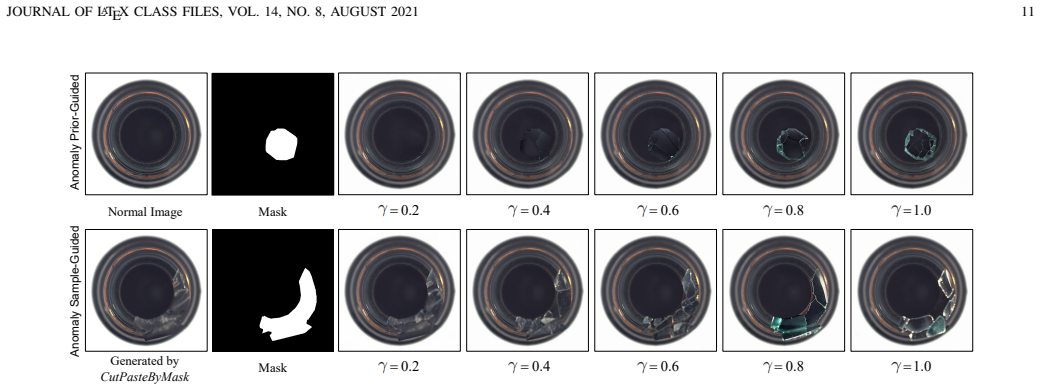
The load-bearing mechanism is a two-part pipeline. First, a geometric anomaly prototype library (GAP-Lib) generates candidate masks from eight shapes at three sizes; a latent diffusion model plus an inpainting control network repaints only the masked region under a text prompt, and a mask-conditioned vision-language model filters synthetic samples for category consistency. Second, the implicit-normal discriminator removes any explicit 'normal' class embedding, instead computing per-pixel similarity between fused visual features and each anomaly-category embedding, averaging those maps for detection, and taking the argmax above a threshold for classification. The exclusion-based normal defini
What would settle it
Measure the feature-space distance (e.g., maximum mean discrepancy) between synthetic anomaly crops and real anomaly crops using the same visual backbone, then train UniADC with real defect crops in place of synthetic ones and compare classification accuracy and mIoU on the same test sets; a large distance or a big performance gap would show the reported gains rest on unverified synthetic-to-real fidelity.
Extended reading notes
Core claim
The paper's central claim is that a generative-discriminative pair can jointly solve anomaly detection, localization, and classification under extreme data scarcity. A training-free controllable inpainting network synthesizes category-specific anomalies in two modes: zero-shot, guided by hand-specified shape, size, and text priors, and few-shot, by repainting pasted real defect crops for diversity. A category consistency selection step filters synthetic samples that do not match the target category. The implicit-normal discriminator then aligns fused fine-grained image features with anomaly-category text embeddings pixel-wise; the anomaly detection map is simply the average of all category m
Load-bearing premise
The load-bearing premise is that diffusion-inpainted synthetic defects live close enough to real defects in the vision-language feature space that training a discriminator on them teaches it real-world anomalies.
Editorial extensions
If this is right
- One model can flag defective regions and assign them to specific defect classes with no real defect samples at all, using only normal images and text/shape descriptions.
- With a single real anomaly example per category, the same model reaches classification accuracy and pixel-level mIoU far above current two-stage baselines, according to the reported tables.
- Adding the classification loss improves anomaly detection and localization rather than hurting them, so the two tasks reinforce each other.
- When all normal training samples are available, the model matches dedicated full-shot detection methods while still giving a large classification advantage.
- The framework can be adapted to open-set operation by training a class-agnostic anomaly embedding and routing unseen defect types to an 'Other' category while preserving seen-category classification.
Reading between the lines
- If the synthetic-to-real gap is as small as the paper suggests, defect-data collection across manufacturing lines could be replaced by writing a one-line text description of each defect and a rough shape, cutting deployment cost dramatically; a direct test would be deploying UniADC on a new production line with no defect history.
- The implicit-normal trick—defining normal as the absence of all known abnormality—is a general recipe for any dense prediction task with a dominant background class, so it could transfer to medical image segmentation or rare-event pixel labeling.
- Because the zero-shot prior list is hand-written per category, the method's practical ceiling depends on how verbalizable defects are; an extension worth testing is auto-generating descriptions and shapes from a defect taxonomy or a language model.
- The classification map averages all category scores, so overlapping or ambiguous defect categories could inflate detection; a testable refinement would be learning per-category thresholds or adding a calibrated uncertainty term.
Editorial analysis
A structured set of objections, weighed in public.
Referee Report
Summary. The paper introduces UniADC, a unified framework for anomaly detection and classification under zero-shot and few-shot settings. It combines a training-free controllable inpainting network (latent diffusion with BrushNet) that synthesizes category-specific anomalies from either text/shape/size priors or from few-shot anomaly examples, with an implicit-normal discriminator (IND) that aligns fine-grained visual features with anomaly-category text embeddings while treating 'normal' implicitly as the absence of all anomaly classes. The model is trained on synthetic anomalies filtered by category consistency selection (Eq. 2; SSIM-based in the few-shot case) and evaluated on MVTec-FS, MTD, and WFDD. Under both settings, UniADC reports substantial gains over existing two-stage baselines in image-level detection (I-AUC), localization (P-AUC/PRO), classification accuracy, and pixel-level mIoU. An open-set extension is also proposed.
Significance. If the reported results hold, UniADC makes a meaningful contribution: it is one of the first single models to jointly solve anomaly detection, localization, and fine-grained classification with zero or a few anomaly samples, and it outperforms prior work by a large margin on the classification metrics. The idea of an implicit normal class (IND) is a well-motivated answer to the pixel-distribution imbalance problem, and the use of a training-free, text-controllable inpainting network to generate training data is practical. The paper includes extensive ablations over components, priors, noise factor, mini-batch size, and sample count, and the code is available, which strengthens reproducibility. The open-set extension is a useful addition. However, the main claim of 'comprehensively outperforms' depends on the synthetic anomalies being representative of real defects, and this is not quantitatively established.
major comments (4)
- [§III-B/C, Eq. (2), Table V] Synthetic-to-real generalization is the load-bearing assumption. The discriminator is trained on 16 synthetic samples per category generated by latent diffusion and filtered by AlphaCLIP text alignment (Eq. 2). The CCS score measures alignment with the text prompt, not similarity to real defect appearance. The image-quality metrics in Table V (IS, IC-LPIPS) do not quantify the distance between synthetic and real anomaly distributions, and Fig. 8 is qualitative. Since all classification and most detection performance comes from training on these synthetic images, the reported Acc/mIoU gains could partly reflect the model recognizing prompt-rendered artifacts rather than real defects, especially for categories with highly specific hand-authored prompts (Table S1). Please provide a quantitative synthetic-to-real transfer analysis (e.g., train on synthetic and evaluate on real anomaly crops
- [Related Work, Sec. II-B; Table II] The closest zero-shot baseline, MultiADS [26], is absent from the experimental comparison. MultiADS is designed for zero-shot multi-type anomaly detection and classification, and the paper criticizes it in the Related Work; yet it is not included in Table II. To support 'comprehensively outperforms existing methods,' either add MultiADS to the comparison or justify its exclusion (e.g., if it requires training data not compatible with the protocol). This is particularly important for the zero-shot claims.
- [§IV-A.1, WFDD] The WFDD anomaly-type labels were created by the authors ('we reclassified the dataset by grouping identical defects'). No annotation protocol, label release, or inter-annotator agreement is provided. Consequently, the WFDD classification results are not comparable to any external benchmark, and the hand-crafted prior list in Table S1 may have been tuned to these self-defined categories. Please publish the labels and provide details on the grouping, or at least a comprehensive diagram showing all category assignments.
- [§IV, Tables II–V] No error bars or multiple seeds are reported in any table. Anomaly synthesis is stochastic (diffusion sampling, mask generation), and several hyperparameters (γ, B, τ, λ) are set by ablations. The paper reports single-run results. Given that some comparisons are close (e.g., few-shot Kn=2, Ka=2 MVTec Acc for UniADC(DINO) is 88.72 vs UniADC(CLIP) 89.88 in Table III), variance from random seeds would materially affect the conclusions. Please report mean±std over at least 3 seeds for the main tables and key ablations.
minor comments (5)
- [Abstract] The abstract states 'four anomaly detection and classification datasets, including MVTec-FS, MTD, WFDD and Real-IAD,' but the full text and all experiments use only three datasets (MVTec-FS, MTD, WFDD). Real-IAD is never evaluated. Correct this inconsistency.
- [§III-C, Table I] The claim of being the 'first method capable of synthesizing anomalies under both zero-shot and few-shot settings' should be qualified with a more exhaustive literature comparison. AnomalyPainter [29] and AnoMagic [36] are cited in Related Work and should be considered or discussed.
- [Eq. (2)] The Category Consistency Selection score in Eq. (2) normalizes over all anomaly categories, meaning the selection for a single category depends on the full closed-set label descriptions. This coupling should be stated explicitly, as it may affect datasets with a large number of categories.
- [§III-C] The SSIM-based consistency score for few-shot repainting is mentioned but not formalized (e.g., whether there is a threshold or whether the highest-scoring sample is simply kept). Provide a precise selection rule and the number of repainting candidates.
- [Eq. (5)] The anomaly score threshold τ is fixed at 0.5. Although Fig. 11 shows robustness, no guidance is given for selecting τ in a new domain. Consider describing a validation-free default or a simple calibration procedure.
Circularity Check
No significant circularity: predictions are evaluated on external real labels.
full rationale
I find no circular step in this paper. The claimed predictions (detection, localization, classification) are measured against real ground-truth labels on MVTec-FS, MTD, and WFDD that were not used to fit any parameter or to select synthetic data. The synthetic training data are generated by a pre-trained diffusion/inpainting pipeline conditioned on hand-authored text/shape priors (Sec. III-B/C, Table S1), and the Category Consistency Selection in Eq. (2) is a data-cleaning filter, not a fitted predictor. The final metrics are computed on independent real test images, so the model could fail; the reported numbers are not forced by construction. The fact that both the AlphaCLIP filter and the inference classifier use text-anchored embeddings reflects the label space of the task, not a reduction: the synthetic-to-real generalization gap flagged by the skeptic is a genuine empirical risk, but it is a correctness/robustness concern, not a circularity, because the test labels are external and the model is not guaranteed to succeed. Self-citations (e.g., RealNet, MedICLIP) appear only as baselines or related work and are not load-bearing; no uniqueness theorem or prior claim by the same authors is imported to force the design. The core derivation is self-contained and externally benchmarked, so the appropriate circularity score is 0.
Assumptions & free parameters
free parameters (6)
- Diffusion noise factor gamma =
uniform(0.4, 0.6)
- Category-consistency mini-batch size B =
32
- Number of synthetic anomaly samples per category =
16
- Anomaly score threshold tau =
0.5
- Classification loss weight lambda =
0.5
- Scaling temperature epsilon =
learned, not reported
assumptions (6)
- domain assumption Stable Diffusion v1.5 plus BrushNet inpainting yields category-consistent anomaly images from masks and text prompts without training.
- domain assumption Synthetic anomaly distribution is a sufficient proxy for real anomalies for training the discriminator.
- domain assumption AlphaCLIP matching score (Eq. 2) ranks category consistency correctly.
- ad hoc to paper For UniADC(DINO), a text encoder exists that maps anomaly category names into the same space as DINOv3 visual features.
- domain assumption The authors' regrouping of WFDD defects into anomaly categories is valid ground truth.
- domain assumption The per-category anomaly prior list (Table S1) is representative and does not encode test-label information beyond category names.
Cite this review
Pith. "Pith review of UniADC: A Unified Framework for Anomaly Detection and Classification." pith.science (2026). https://pith.science/paper/PJ4AICXA
@misc{pith2026251106644,
  author       = {Pith},
  title        = {Pith review of: UniADC: A Unified Framework for Anomaly Detection and Classification},
  year         = {2026},
  howpublished = {\url{https://pith.science/paper/PJ4AICXA}},
  note         = {Machine review of arXiv:2511.06644}
}
read the original abstract
In this paper, we introduce a novel task termed unified anomaly detection and classification, which aims to simultaneously detect anomalous regions in images and identify their specific categories. Existing methods typically treat anomaly detection and classification as separate tasks, thereby neglecting their inherent correlations and limiting information sharing, which results in suboptimal performance. To address this, we propose UniADC, a model designed to effectively perform both tasks with only a few or even no anomaly images. Specifically, UniADC consists of two key components: a training-free Controllable Inpainting Network and an Implicit-Normal Discriminator. The inpainting network can synthesize anomaly images of specific categories by repainting normal regions guided by anomaly priors, and can also repaint few-shot anomaly samples to augment the available anomaly data. The implicit-normal discriminator addresses the severe challenge of the imbalance between normal and anomalous pixel distributions by implicitly modeling the normal state, achieving precise anomaly detection and classification by aligning fine-grained image features with anomaly-category embeddings. We conduct extensive experiments on four anomaly detection and classification datasets, including MVTec-FS, MTD, WFDD and Real-IAD, and the results demonstrate that UniADC consistently outperforms existing methods in anomaly detection, localization, and classification. The code is available at https://github.com/cnulab/UniADC.
Figures


Figures from the paper (8 more)



Reference graph
Works this paper leans on
-
[54]
O. Sim ´eoni, H. V . V o, M. Seitzer, F. Baldassarre, M. Oquab, C. Jose, V . Khalidov, M. Szafraniec, S. Yi, M. Ramamonjisoaet al., “Dinov3,” arXiv preprint arXiv:2508.10104, 2025
arXiv 2025
-
[26]
Mul- tiads: Defect-aware supervision for multi-type anomaly detection and segmentation in zero-shot learning,
Y . Sadikaj, H. Zhou, L. Halilaj, S. Schmid, S. Staab, and C. Plant, “Mul- tiads: Defect-aware supervision for multi-type anomaly detection and segmentation in zero-shot learning,” inProceedings of the IEEE/CVF International Conference on Computer Vision, 2025, pp. 22 978–22 988
2025
-
[1]
Deep learning for unsupervised anomaly localization in industrial images: A survey,
X. Tao, X. Gong, X. Zhang, S. Yan, and C. Adak, “Deep learning for unsupervised anomaly localization in industrial images: A survey,”IEEE Transactions on Instrumentation and Measurement, vol. 71, pp. 1–21, 2022
2022
-
[2]
Gan-based anomaly detection: A review,
X. Xia, X. Pan, N. Li, X. He, L. Ma, X. Zhang, and N. Ding, “Gan-based anomaly detection: A review,”Neurocomputing, vol. 493, pp. 497–535, 2022
2022
-
[3]
A survey of methods for automated quality control based on images,
J. Diers and C. Pigorsch, “A survey of methods for automated quality control based on images,”International Journal of Computer Vision, vol. 131, no. 10, pp. 2553–2581, 2023
2023
-
[4]
Deep industrial image anomaly detection: A survey,
J. Liu, G. Xie, J. Wang, S. Li, C. Wang, F. Zheng, and Y . Jin, “Deep industrial image anomaly detection: A survey,”Machine Intelligence Research, vol. 21, no. 1, pp. 104–135, 2024
2024
-
[5]
Mvrec: A general few-shot defect classification model using multi-view region- context,
S. Lyu, R. Zhang, Z. Ma, F. Liao, D. Mo, and W. Wong, “Mvrec: A general few-shot defect classification model using multi-view region- context,” inProceedings of the AAAI Conference on Artificial Intelli- gence, vol. 39, no. 6, 2025, pp. 5937–5945
2025
-
[6]
Anomalyncd: Towards novel anomaly class discovery in industrial scenarios,
Z. Huang, X. Li, H. Liu, F. Xue, Y . Wang, and Y . Zhou, “Anomalyncd: Towards novel anomaly class discovery in industrial scenarios,” inPro- ceedings of the Computer Vision and Pattern Recognition Conference, 2025, pp. 4755–4765
2025
Show all 57 references
-
[7]
Winclip: Zero-/few-shot anomaly classification and segmentation,
J. Jeong, Y . Zou, T. Kim, D. Zhang, A. Ravichandran, and O. Dabeer, “Winclip: Zero-/few-shot anomaly classification and segmentation,” in Proceedings of the IEEE/CVF Conference on Computer Vision and Pattern Recognition, 2023, pp. 19 606–19 616
2023
-
[8]
Promptad: Learning prompts with only normal samples for few-shot anomaly detection,
X. Li, Z. Zhang, X. Tan, C. Chen, Y . Qu, Y . Xie, and L. Ma, “Promptad: Learning prompts with only normal samples for few-shot anomaly detection,” inProceedings of the IEEE/CVF Conference on Computer Vision and Pattern Recognition, 2024, pp. 16 838–16 848
2024
-
[9]
Anomalygpt: Detecting industrial anomalies using large vision-language models,
Z. Gu, B. Zhu, G. Zhu, Y . Chen, M. Tang, and J. Wang, “Anomalygpt: Detecting industrial anomalies using large vision-language models,” in Proceedings of the AAAI conference on artificial intelligence, vol. 38, no. 3, 2024, pp. 1932–1940
2024
-
[10]
Kernel-aware graph prompt learning for few-shot anomaly detection,
F. Tao, G.-S. Xie, F. Zhao, and X. Shu, “Kernel-aware graph prompt learning for few-shot anomaly detection,” inProceedings of the AAAI Conference on Artificial Intelligence, vol. 39, no. 7, 2025, pp. 7347– 7355
2025
-
[11]
Medi- clip: Adapting clip for few-shot medical image anomaly detection,
X. Zhang, M. Xu, D. Qiu, R. Yan, N. Lang, and X. Zhou, “Medi- clip: Adapting clip for few-shot medical image anomaly detection,” in International Conference on Medical Image Computing and Computer- Assisted Intervention. Springer, 2024, pp. 458–468
2024
-
[12]
Adapting visual-language models for generalizable anomaly detection in medical images,
C. Huang, A. Jiang, J. Feng, Y . Zhang, X. Wang, and Y . Wang, “Adapting visual-language models for generalizable anomaly detection in medical images,” inProceedings of the IEEE/CVF Conference on Computer Vision and Pattern Recognition, 2024, pp. 11 375–11 385
2024
-
[13]
High- resolution image synthesis with latent diffusion models,
R. Rombach, A. Blattmann, D. Lorenz, P. Esser, and B. Ommer, “High- resolution image synthesis with latent diffusion models,” inProceedings of the IEEE/CVF conference on computer vision and pattern recognition, 2022, pp. 10 684–10 695
2022
-
[14]
Adding conditional control to text-to-image diffusion models,
L. Zhang, A. Rao, and M. Agrawala, “Adding conditional control to text-to-image diffusion models,” inProceedings of the IEEE/CVF international conference on computer vision, 2023, pp. 3836–3847
2023
-
[15]
Surface defect saliency of magnetic tile,
Y . Huang, C. Qiu, and K. Yuan, “Surface defect saliency of magnetic tile,”The Visual Computer, vol. 36, no. 1, pp. 85–96, 2020
2020
-
[16]
A unified anomaly synthesis strategy with gradient ascent for industrial anomaly detection and localization,
Q. Chen, H. Luo, C. Lv, and Z. Zhang, “A unified anomaly synthesis strategy with gradient ascent for industrial anomaly detection and localization,” inEuropean Conference on Computer Vision. Springer, 2024, pp. 37–54
2024
-
[17]
Towards total recall in industrial anomaly detection,
K. Roth, L. Pemula, J. Zepeda, B. Sch ¨olkopf, T. Brox, and P. Gehler, “Towards total recall in industrial anomaly detection,” inProceedings of the IEEE/CVF conference on computer vision and pattern recognition, 2022, pp. 14 318–14 328
2022
-
[18]
Padim: a patch dis- tribution modeling framework for anomaly detection and localization,
T. Defard, A. Setkov, A. Loesch, and R. Audigier, “Padim: a patch dis- tribution modeling framework for anomaly detection and localization,” inInternational Conference on Pattern Recognition. Springer, 2021, pp. 475–489
2021
-
[19]
Anomaly detection and localization via reverse distillation with latent anomaly suppression,
G. Wang, Y . Zou, S. He, Y . Wang, and R. Dai, “Anomaly detection and localization via reverse distillation with latent anomaly suppression,” IEEE Transactions on Circuits and Systems for Video Technology, 2025
2025
-
[20]
Ura-net: Uncertainty-integrated anomaly perception and restoration attention network for unsupervised anomaly detection,
W. Luo, P. Xing, Y . Cao, H. Yao, W. Shen, and Z. Li, “Ura-net: Uncertainty-integrated anomaly perception and restoration attention network for unsupervised anomaly detection,”IEEE Transactions on Circuits and Systems for Video Technology, 2025
2025
-
[21]
Towards high-resolution industrial image anomaly detection,
X. Zhang, M. Xu, and X. Zhou, “Towards high-resolution industrial image anomaly detection,”arXiv preprint arXiv:2508.12931, 2025
2025 arXiv
-
[22]
Few-shot anomaly- driven generation for anomaly classification and segmentation,
G. Gui, B.-B. Gao, J. Liu, C. Wang, and Y . Wu, “Few-shot anomaly- driven generation for anomaly classification and segmentation,” in European Conference on Computer Vision. Springer, 2024, pp. 210– 226
2024
-
[23]
Explicit boundary guided semi-push-pull contrastive learning for supervised anomaly detection,
X. Yao, R. Li, J. Zhang, J. Sun, and C. Zhang, “Explicit boundary guided semi-push-pull contrastive learning for supervised anomaly detection,” inProceedings of the IEEE/CVF Conference on Computer Vision and Pattern Recognition, 2023, pp. 24 490–24 499
2023
-
[24]
Normal-abnormal guided generalist anomaly detection,
Y . Wang, X. Wang, Y . Gong, and J. XIAO, “Normal-abnormal guided generalist anomaly detection,” inThe Thirty-ninth Annual Conference on Neural Information Processing Systems, 2025
2025
-
[25]
Alpha-clip: A clip model focusing on wherever you want,
Z. Sun, Y . Fang, T. Wu, P. Zhang, Y . Zang, S. Kong, Y . Xiong, D. Lin, and J. Wang, “Alpha-clip: A clip model focusing on wherever you want,” inProceedings of the IEEE/CVF conference on computer vision and pattern recognition, 2024, pp. 13 019–13 029. JOURNAL OF LATEX CLASS ...
2024
-
[27]
A noise robust method based on completed local binary patterns for hot-rolled steel strip surface defects,
K. Song and Y . Yan, “A noise robust method based on completed local binary patterns for hot-rolled steel strip surface defects,”Applied Surface Science, vol. 285, pp. 858–864, 2013
2013
-
[28]
Fabric defect classification using proto- typical network of few-shot learning algorithm,
Z. Zhan, J. Zhou, and B. Xu, “Fabric defect classification using proto- typical network of few-shot learning algorithm,”Computers in Industry, vol. 138, p. 103628, 2022
2022
-
[29]
Anoma- lypainter: Vision-language-diffusion synergy for zero-shot realistic and diverse industrial anomaly synthesis,
Z. Lai, Y . Lu, X. Li, J. Lin, Y . Qu, L. Cao, M. Li, and R. Ji, “Anoma- lypainter: Vision-language-diffusion synergy for zero-shot realistic and diverse industrial anomaly synthesis,”arXiv preprint arXiv:2503.07253, 2025
2025 arXiv
-
[30]
Cutpaste: Self-supervised learning for anomaly detection and localization,
C.-L. Li, K. Sohn, J. Yoon, and T. Pfister, “Cutpaste: Self-supervised learning for anomaly detection and localization,” inProceedings of the IEEE/CVF conference on computer vision and pattern recognition, 2021, pp. 9664–9674
2021
-
[31]
Natural synthetic anomalies for self-supervised anomaly detection and localization,
H. M. Schl ¨uter, J. Tan, B. Hou, and B. Kainz, “Natural synthetic anomalies for self-supervised anomaly detection and localization,” in European Conference on Computer Vision. Springer, 2022, pp. 474– 489
2022
-
[32]
Normal image guided segmentation framework for unsupervised anomaly detection,
P. Xing, Y . Sun, D. Zeng, and Z. Li, “Normal image guided segmentation framework for unsupervised anomaly detection,”IEEE Transactions on Circuits and Systems for Video Technology, vol. 34, no. 6, pp. 4639– 4652, 2023
2023
-
[33]
Revisiting reverse distillation for anomaly detection,
T. D. Tien, A. T. Nguyen, N. H. Tran, T. D. Huy, S. Duong, C. D. T. Nguyen, and S. Q. Truong, “Revisiting reverse distillation for anomaly detection,” inProceedings of the IEEE/CVF conference on computer vision and pattern recognition, 2023, pp. 24 511–24 520
2023
-
[34]
Realnet: A feature selection network with realistic synthetic anomaly for anomaly detection,
X. Zhang, M. Xu, and X. Zhou, “Realnet: A feature selection network with realistic synthetic anomaly for anomaly detection,” inProceedings of the IEEE/CVF conference on computer vision and pattern recognition, 2024, pp. 16 699–16 708
2024
-
[35]
Unseen visual anomaly gener- ation,
H. Sun, Y . Cao, H. Dong, and O. Fink, “Unseen visual anomaly gener- ation,” inProceedings of the Computer Vision and Pattern Recognition Conference, 2025, pp. 25 508–25 517
2025
-
[36]
Anomagic: Crossmodal prompt-driven zero-shot anomaly generation,
Y . Jiang, W. Luo, H. Zhang, Q. Chen, H. Yao, W. Shen, and Y . Cao, “Anomagic: Crossmodal prompt-driven zero-shot anomaly generation,” arXiv preprint arXiv:2511.10020, 2025
2025
-
[37]
Few-shot defect image generation via defect-aware feature manipulation,
Y . Duan, Y . Hong, L. Niu, and L. Zhang, “Few-shot defect image generation via defect-aware feature manipulation,” inProceedings of the AAAI conference on artificial intelligence, vol. 37, no. 1, 2023, pp. 571–578
2023
-
[38]
Anomalydiffusion: Few-shot anomaly image generation with diffusion model,
T. Hu, J. Zhang, R. Yi, Y . Du, X. Chen, L. Liu, Y . Wang, and C. Wang, “Anomalydiffusion: Few-shot anomaly image generation with diffusion model,” inProceedings of the AAAI conference on artificial intelligence, vol. 38, no. 8, 2024, pp. 8526–8534
2024
-
[39]
Dual-interrelated diffusion model for few-shot anomaly image generation,
Y . Jin, J. Peng, Q. He, T. Hu, J. Wu, H. Chen, H. Wang, W. Zhu, M. Chi, J. Liuet al., “Dual-interrelated diffusion model for few-shot anomaly image generation,” inProceedings of the Computer Vision and Pattern Recognition Conference, 2025, pp. 30 420–30 429
2025
-
[40]
Defectfill: Realistic defect generation with inpainting diffusion model for visual inspection,
J. Song, D. Park, K. Baek, S. Lee, J. Choi, E. Kim, and S. Yoon, “Defectfill: Realistic defect generation with inpainting diffusion model for visual inspection,” inProceedings of the Computer Vision and Pattern Recognition Conference, 2025, pp. 18 718–18 727
2025
-
[41]
Brushnet: A plug-and-play image inpainting model with decomposed dual-branch diffusion,
X. Ju, X. Liu, X. Wang, Y . Bian, Y . Shan, and Q. Xu, “Brushnet: A plug-and-play image inpainting model with decomposed dual-branch diffusion,” inEuropean Conference on Computer Vision. Springer, 2024, pp. 150–168
2024
-
[42]
Image quality assessment: from error visibility to structural similarity,
Z. Wang, A. C. Bovik, H. R. Sheikh, and E. P. Simoncelli, “Image quality assessment: from error visibility to structural similarity,”IEEE transactions on image processing, vol. 13, no. 4, pp. 600–612, 2004
2004
-
[43]
Draem-a discriminatively trained reconstruction embedding for surface anomaly detection,
V . Zavrtanik, M. Kristan, and D. Sko ˇcaj, “Draem-a discriminatively trained reconstruction embedding for surface anomaly detection,” in Proceedings of the IEEE/CVF international conference on computer vision, 2021, pp. 8330–8339
2021
-
[44]
AnomalyCLIP: Object- agnostic prompt learning for zero-shot anomaly detection,
Q. Zhou, G. Pang, Y . Tian, S. He, and J. Chen, “AnomalyCLIP: Object- agnostic prompt learning for zero-shot anomaly detection,” inThe Twelfth International Conference on Learning Representations, 2024
2024
-
[45]
Focal loss for dense object detection,
T.-Y . Lin, P. Goyal, R. Girshick, K. He, and P. Doll ´ar, “Focal loss for dense object detection,” inProceedings of the IEEE international conference on computer vision, 2017, pp. 2980–2988
2017
-
[46]
V-net: Fully convolutional neural networks for volumetric medical image segmentation,
F. Milletari, N. Navab, and S.-A. Ahmadi, “V-net: Fully convolutional neural networks for volumetric medical image segmentation,” in2016 fourth international conference on 3D vision (3DV). Ieee, 2016, pp. 565–571
2016
-
[47]
Toward generalist anomaly detection via in-context residual learning with few-shot sample prompts,
J. Zhu and G. Pang, “Toward generalist anomaly detection via in-context residual learning with few-shot sample prompts,” inProceedings of the IEEE/CVF conference on computer vision and pattern recognition, 2024, pp. 17 826–17 836
2024
-
[48]
Anomalydino: Boosting patch-based few-shot anomaly detection with dinov2,
S. Damm, M. Laszkiewicz, J. Lederer, and A. Fischer, “Anomalydino: Boosting patch-based few-shot anomaly detection with dinov2,” in 2025 IEEE/CVF Winter Conference on Applications of Computer Vision (WACV). IEEE, 2025, pp. 1319–1329
2025
-
[49]
Mvtec-ad: A comprehensive real-world dataset for unsupervised anomaly detection,
P. Bergmann, M. Fauser, D. Sattlegger, and C. Steger, “Mvtec-ad: A comprehensive real-world dataset for unsupervised anomaly detection,” inProceedings of the IEEE/CVF conference on computer vision and pattern recognition, 2019, pp. 9592–9600
2019
-
[50]
Spot-the- difference self-supervised pre-training for anomaly detection and seg- mentation,
Y . Zou, J. Jeong, L. Pemula, D. Zhang, and O. Dabeer, “Spot-the- difference self-supervised pre-training for anomaly detection and seg- mentation,” inEuropean Conference on Computer Vision. Springer, 2022, pp. 392–408
2022
-
[51]
Denoising diffusion implicit models,
J. Song, C. Meng, and S. Ermon, “Denoising diffusion implicit models,” inInternational Conference on Learning Representations, 2021
2021
-
[52]
Bilateral reference for high-resolution dichotomous image segmentation,
P. Zheng, D. Gao, D.-P. Fan, L. Liu, J. Laaksonen, W. Ouyang, and N. Sebe, “Bilateral reference for high-resolution dichotomous image segmentation,”CAAI Artificial Intelligence Research, vol. 3, p. 9150038, 2024
2024
-
[53]
Learning transferable visual models from natural language supervision,
A. Radford, J. W. Kim, C. Hallacy, A. Ramesh, G. Goh, S. Agarwal, G. Sastry, A. Askell, P. Mishkin, J. Clarket al., “Learning transferable visual models from natural language supervision,” inInternational conference on machine learning. PmLR, 2021, pp. 8748–8763
2021
-
[55]
Uninformed students: Student-teacher anomaly detection with discriminative latent embeddings,
P. Bergmann, M. Fauser, D. Sattlegger, and C. Steger, “Uninformed students: Student-teacher anomaly detection with discriminative latent embeddings,” inProceedings of the IEEE/CVF conference on computer vision and pattern recognition, 2020, pp. 4183–4192
2020
-
[56]
Anomaly detection via reverse distillation from one-class embedding,
H. Deng and X. Li, “Anomaly detection via reverse distillation from one-class embedding,” inProceedings of the IEEE/CVF conference on computer vision and pattern recognition, 2022, pp. 9737–9746
2022
-
[57]
Catching both gray and black swans: Open-set supervised anomaly detection,
C. Ding, G. Pang, and C. Shen, “Catching both gray and black swans: Open-set supervised anomaly detection,” inProceedings of the IEEE/CVF conference on computer vision and pattern recognition, 2022, pp. 7388–7398. SUPPLEMENTARY MATERIAL 14 TABLE S1 ANOMALY PRIOR LIST PROVIDED ...
2022
Reviewed August 3, 2026 · model on record in the stance chip above.
Discussion (0). Sign in to comment.