REVIEW 2 major objections 4 minor 51 references
The Non-thermal Energy Window for Laser-Driven Nuclear Reactions
T0 review · 2 major / 4 minor · reviewed 2026-08-03 · deepseek-v4-flash
Pith's one-line read This paper derives a closed-form 'non-thermal Gamow window' for laser-accelerated ion beams, showing that fusion reactions in pitcher–catcher experiments peak at systematically lower energies than an effective-temperature description predic
desk verdict The analytic reactivity is neat, but the paper's E0 is the peak of the rate integrand, not the yield peak, so the central application to pitcher-catcher yields is not established. read the letter →
The pith
A machine-rendered reading of the paper's core claim, the machinery that carries it, and where it could break.
The reading
What carries the argument
The machinery is the self-similar TNSA ion energy distribution (Eq. 9), imported from the quasi-neutral one-dimensional plasma-expansion model, combined with the conventional separation of cross sections into S(E) and the Gamow penetration factor. The two derived formulas carry the argument: Eq. (13) gives the effective non-thermal reaction energy E0, and Eq. (14) gives the closed-form reactivity using K0. These replace the Maxwellian Gamow peak when the beam is non-thermal.
What would settle it
Measure D+D fusion yields from a TNSA deuteron beam on a catcher target as a function of laser intensity and compare the ratio of yields across the predicted optimum (around Iλ² ≈ 6.8×10^20 W cm⁻² μm²) and below it. If the yield does not peak near the predicted optimal electron temperature, or if the effective energy extracted from the yield's energy dependence disagrees with Eq. (13), the non-thermal window does not describe those experiments.
Extended reading notes
Core claim
The central discovery is that, once the TNSA ion spectrum is represented by the self-similar expansion solution (a normalized density per energy that decays as exp(-sqrt(2E/(Z k_B T_e)))/sqrt(E)), the integrand defining the fusion reactivity separates into the product of this distribution, the Coulomb-barrier penetration factor, and an S-factor. Maximizing that integrand yields a closed-form effective reaction energy E0, and integrating it yields a closed-form reactivity in terms of K0, the zeroth-order modified Bessel function of the second kind. The paper shows that E0 is not the Gamow peak energy computed from an effective temperature: for D+D it is about 1.6 times smaller. It also shows
Load-bearing premise
The central derivation rides on the validity of the quasi-neutral one-dimensional self-similar plasma-expansion spectrum for TNSA ions, which requires Maxwellian hot electrons, a planar foil, no cutoff in the ion spectrum, and ω_pi t_acc ≫ 1; if the real spectrum departs from this idealization, the computed E0 and reactivity inherit systematic errors.
Editorial extensions
If this is right
- Given laser intensity, wavelength, and target parameters, the effective reaction energy and reactivity can be computed without numerical integration.
- Measured fusion yields can be used to extract the astrophysical S-factor at low energies, where direct laboratory cross-section measurements are hardest.
- There is a finite optimum electron temperature (equivalently an optimum laser intensity) that maximizes the D+D reactivity, offering a design target for pitcher–catcher experiments.
- Resonant reactions can be treated within the same framework, with the reactivity given by a narrow-resonance formula once resonance parameters are specified.
- In the regime where the self-similar spectrum is valid, the analytic reactivity matches numerical integration; deviations appear for ultra-short-pulse conditions that violate the quasi-neutral assumption.
Reading between the lines
- If the downward shift of the effective energy is real, archival laser-fusion yield data interpreted with effective temperatures may have systematically overestimated the collision energy; re-analysis could change reported S-factor values.
- The existence of an optimal temperature suggests a practical tuning strategy: for a given reaction, adjust laser intensity to the predicted maximum, which might also serve as an indirect diagnostic of the hot-electron temperature.
- The same reduction—writing the reactivity as an integral of a non-thermal spectrum times the penetration factor—could be applied to other laser-acceleration mechanisms (e.g., radiation-pressure or shock acceleration) once their energy spectra are specified.
- Because E0 depends on the projectile charge Z_i, the non-thermal window could be exploited to select laser conditions that preferentially drive one nuclear channel over another in mixed-species targets.
Editorial analysis
A structured set of objections, weighed in public.
Referee Report
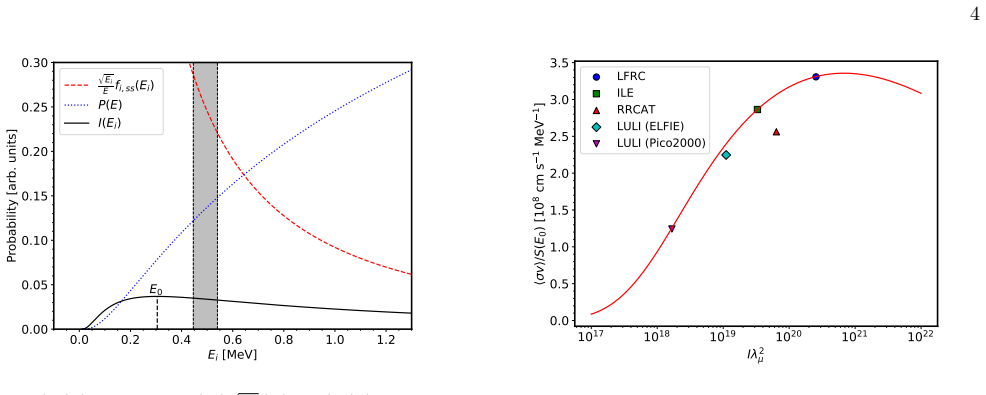
Summary. This manuscript develops an analytic non-thermal reaction-energy window for laser-driven TNSA ion beams. Starting from the 1D self-similar plasma-expansion spectrum of Mora (Eq. 8), the authors define a normalized beam distribution f_i,ss(E_i) (Eq. 9), assume a stationary target, and derive the peak energy E0 of the v-weighted reactivity integrand (Eq. 13), a closed-form reactivity in terms of a modified Bessel function (Eq. 14), and an optimal electron temperature maximizing ⟨σv⟩ (Eq. 15). The formalism is extended to narrow resonances (Eq. 18). The D+D example gives E0 = 0.305 MeV, differing from the Maxwellian Gamow-peak estimate of 0.494 MeV, and comparisons with numerical integrations for several laser facilities are presented, with discrepancies when ω_pi t_acc ≫ 1 is violated.
Significance. If valid, the closed-form expressions would provide a convenient analytic alternative to thermal Gamow-window estimates for laser-driven pitcher–catcher experiments and for possible low-energy S-factor extraction. The derivation is transparent and algebraically checkable, the assumptions are stated, and the authors are honest about the quasi-neutrality regime. However, the central physical application to single-pass yields is compromised by the v-weighted definition of E0 (see major comments). Once the reactivity/yield distinction is addressed, the framework could be genuinely useful; as it stands, the title's claim of an energy window for laser-driven nuclear reactions is not established for the experimental geometry discussed.
major comments (2)
- [Eqs. (10)–(14) and the S-factor extraction paragraph] The paper defines E0 by maximizing the v-weighted integrand I(E_i) in Eq. (12). For a single-pass pitcher–catcher interaction, however, the yield per pulse is Y = N_b n_t L_t ∫ f_i,ss(E_i) σ(E) dE_i; the |v_i| factor in Eq. (10) is appropriate for a rate in a plasma, not for a beam traversing a catcher once. Maximizing f_i,ss(E_i) σ(E) for the paper's D+D example (k_B T_e = 2.068 MeV) gives a yield peak near 0.17 MeV, a factor ~1.8 below the reported E0 = 0.305 MeV. Consequently Eq. (13) is the peak of the reactivity, not of the single-pass yield. Since the abstract and conclusion state that Eqs. (13)–(14) give the effective reaction-energy window and enable S(E0) extraction from measured yields, this is a load-bearing issue. I suggest deriving a separate yield-window peak: with a = sqrt(2/(Z_i k_B T_e)) and b = sqrt(m_i E_G/μ), the yield integrand satisfies a√E_i + 3√E_i? (should be a E
- [Eq. (18), narrow-resonance extension] The resonant reactivity expression inherits the same v-weighting problem. For a beam crossing a catcher once, a narrow resonance at E_R contributes a yield proportional to f_i,ss(E_R) (2π²/k_i²) ωγ, without the factor √(2E_R/m_i) appearing in Eq. (18). The present Eq. (18) describes a resonance contribution to the reactivity, not to a single-pass yield. The paper should either clarify this distinction or reformulate the resonant yield formula.
minor comments (4)
- [Fig. 4 and surrounding text] The numerical markers in Fig. 4 are obtained from the same model, not from measured reaction yields. The agreement therefore demonstrates algebraic consistency, not experimental validation. Please state this explicitly in the text and avoid the implication that the comparison validates the physics.
- [Title/concept] The paper repeatedly calls E0 the energy 'window,' but it only defines a peak energy, not a width. If the window concept is retained, an effective width (e.g., FWHM of the relevant integrand) should be given for both the reactivity and yield variants.
- [References] References [10] and [46] are the same paper (S. C. Wilks et al., Phys. Plasmas 8, 542 (2001)). This duplicate citation should be corrected.
- [Typographical] Before Eq. (13), 'analagous' should be 'analogous.' Throughout, the notation E_i, E, and E0 could be defined more consistently to avoid confusion between beam-frame and center-of-mass energies.
Circularity Check
No significant circularity; the derivation is a straightforward analytical consequence of an externally imported TNSA spectrum.
full rationale
The derivation chain is self-contained and non-circular. The central inputs are the self-similar TNSA ion spectrum (Eq. 9, imported from Mora's external model, Ref. [21]) and the ponderomotive electron temperature (Eq. 4, from Wilks et al., Ref. [27]), both of which are independent external results. The effective energy E0 (Eq. 13) is obtained by maximizing the reactivity integrand I(E_i) (Eq. 12), which is a definition of the peak energy of the assumed distribution, not a fitted quantity. The reactivity expression (Eq. 14) follows analytically from integration. The comparison with experiments uses independent parameters and does not tune any model parameter to reproduce the D+D result. The only self-citation (Ref. [40]) appears in the context of a p+11B example and is not load-bearing. The skeptic's objection that a single-pass catcher yield is proportional to ∫f(E)σ(E)dE rather than ⟨σv⟩ is a physics-correctness concern about the choice of the observable, not a circularity in the derivation; the paper consistently interprets Eq. (14) as a reactivity, and its application to yields is a modeling choice that does not reduce the derivation to its inputs.
Assumptions & free parameters
free parameters (2)
- Laser-to-hot-electron conversion efficiency f ≈ 1.2×10^-15 I^0.74 =
1.2×10^-15 I^0.74
- Acceleration time t_acc ≈ 1.3 τ_laser =
1.3 τ_laser
assumptions (6)
- domain assumption Ion energy spectrum from 1D isothermal self-similar plasma expansion (Mora) is Eq. (8)–(9)
- domain assumption Hot electrons are Maxwell-Boltzmann with Wilks ponderomotive temperature, Eqs. (3)–(4)
- domain assumption Target ions are stationary: v ≈ |v_i|
- standard math Astrophysical S-factor varies slowly and is evaluated at E0
- standard math Non-resonant cross section is S(E)/E exp(-sqrt(EG/E))
- standard math Narrow resonance can be replaced by a delta function (2π²/k²)ωγ
Cite this review
Pith. "Pith review of The Non-thermal Energy Window for Laser-Driven Nuclear Reactions." pith.science (2026). https://pith.science/paper/CFJ35UI3
@misc{pith2026251106657,
  author       = {Pith},
  title        = {Pith review of: The Non-thermal Energy Window for Laser-Driven Nuclear Reactions},
  year         = {2026},
  howpublished = {\url{https://pith.science/paper/CFJ35UI3}},
  note         = {Machine review of arXiv:2511.06657}
}
read the original abstract
Laser-driven nuclear reactions proceed in non-equilibrium plasma conditions, producing ion energy distributions that are not Maxwellian. Nevertheless, fusion yields in such experiments are often interpreted using effective thermal descriptions based on the conventional Gamow window. In this work, we develop an analytical framework for evaluating nuclear reaction rates for non-thermal ions accelerated by the Target Normal Sheath Acceleration (TNSA) mechanism. Using a self-similar plasma expansion model, we derive a closed form expression for an effective reaction energy window and the corresponding fusion reactivity. The resulting effective energies differ systematically from those predicted by thermal models, indicating limitations of interpretations based on the conventional Gamow window in laser-driven environments. This framework provides a quantitative basis for analyzing fusion yields and for designing laser-driven nuclear experiments.
Figures


Reference graph
Works this paper leans on
-
[1]
C. E. Rolfs and W. S. Rodney,Cauldrons in the Cos- mos: Nuclear Astrophysics(University of Chicago Press, Chicago, 1988)
1988
-
[2]
R. V. Wagoner, W. A. Fowler, and F. Hoyle, Astrophys. J.148, 3 (1967)
1967
-
[3]
Pitrou, A
C. Pitrou, A. Coc, J.-P. Uzan, and E. Vangioni, Phys. Rep.754, 1 (2018)
2018
-
[4]
Coc and E
A. Coc and E. Vangioni, Int. J. Mod. Phys. E26, 1741002 (2017)
2017
-
[5]
K¨ appeler, R
F. K¨ appeler, R. Gallino, S. Bisterzo, and W. Aoki, Rev. Mod. Phys.83, 157 (2011)
2011
-
[6]
S. E. Woosley, A. Heger, and T. A. Weaver, Rev. Mod. Phys.74, 1015 (2002)
2002
-
[7]
Arcones and F.-K
A. Arcones and F.-K. Thielemann, J. Phys. G: Nucl. Part. Phys.40, 013201 (2013)
2013
-
[8]
Gy¨ urkyet al., Eur
G. Gy¨ urkyet al., Eur. Phys. J. A27, 141 (2006)
2006
Show all 51 references
-
[9]
Hal´ aszet al., Phys
Z. Hal´ aszet al., Phys. Rev. C85, 025804 (2012)
2012
-
[10]
S. C. Wilks, A. B. Langdon, T. E. Cowan, M. Roth, M. Singh, S. Hatchett, M. H. Key, D. M. Pennington, A. MacKinnon, and R. A. Snavely, Phys. Plasmas8, 542 (2001)
2001
-
[11]
Ditmire, J
T. Ditmire, J. Zweiback, V. P. Yanovsky, T. E. Cowan, G. Hays, and K. B. Wharton, Nature398, 489 (1999)
1999
-
[12]
Fuchset al., Nat
J. Fuchset al., Nat. Phys.2, 48 (2006)
2006
-
[13]
Robsonet al., Nat
L. Robsonet al., Nat. Phys.3, 58 (2007)
2007
-
[14]
Barbuiet al., Phys
M. Barbuiet al., Phys. Rev. Lett.111, 082502 (2013)
2013
-
[15]
C. B. C. Stormet al., Phys. Plasmas20, 053106 (2013)
2013
-
[16]
Willingaleet al., Phys
L. Willingaleet al., Phys. Plasmas18, 083106 (2011)
2011
-
[17]
Negoitaet al., Romanian Reports in Physics68, S37 (2016)
F. Negoitaet al., Romanian Reports in Physics68, S37 (2016)
2016
-
[18]
Daido, M
H. Daido, M. Nishiuchi, and A. S. Pirozhkov, Rep. Prog. Phys.75, 056401 (2012)
2012
-
[19]
Macchi, M
A. Macchi, M. Borghesi, and M. Passoni, Rev. Mod. Phys.85, 751 (2013)
2013
-
[20]
Passoni, L
M. Passoni, L. Bertagna, and A. Zani, New J. Phys.12, 045012 (2010)
2010
-
[21]
Mora, Phys
P. Mora, Phys. Rev. Lett.90, 185002 (2003)
2003
-
[22]
Ter-Avetisyanet al., Phys
S. Ter-Avetisyanet al., Phys. Plasmas12, 012702 (2005). 6
2005
-
[23]
Anguloet al., Nucl
C. Anguloet al., Nucl. Phys. A656, 3 (1999)
1999
-
[24]
Arnould and S
M. Arnould and S. Goriely, Phys. Rep.384, 1 (2003)
2003
-
[25]
Iliadis,Nuclear Physics of Stars, 2nd ed
C. Iliadis,Nuclear Physics of Stars, 2nd ed. (Wiley-VCH, Weinheim, 2015)
2015
-
[26]
Rauscher, Phys
T. Rauscher, Phys. Rev. C81, 045807 (2010)
2010
-
[27]
S. C. Wilks, W. L. Kruer, M. Tabak, and A. B. Langdon, Phys. Rev. Lett.69, 1383 (1992)
1992
-
[28]
M. H. Key, M. D. Cable, T. E. Cowan, K. G. Es- tabrook, B. A. Hammel, S. P. Hatchett, E. A. Henry, D. E. Hinkel, J. D. Kilkenny, J. A. Koch, W. L. Kruer, A. B. Langdon, B. F. Lasinski, R. W. Lee, B. J. MacGowan, A. MacKinnon, J. D. Moody, M. J. Moran, A. A. Offenberger, D. M. ...
1966
-
[29]
Feurer, W
T. Feurer, W. Theobald, R. Sauerbrey, I. Uschmann, D. Altenbernd, U. Teubner, P. Gibbon, E. F¨ orster, G. Malka, and J. L. Miquel, Phys. Rev. E56, 4608 (1997)
1997
-
[30]
Fuchs, Y
J. Fuchs, Y. Sentoku, S. Karsch, J. Cobble, P. Audebert, A. Kemp, A. Nikroo, P. Antici, E. Brambrink, A. Blaze- vic, E. M. Campbell, J. C. Fern´ andez, J.-C. Gauthier, M. Geissel, M. Hegelich, H. P´ epin, H. Popescu, N. Renard-LeGalloudec, M. Roth, J. Schreiber, R. Stephens, a...
2005
-
[31]
Perego, A
C. Perego, A. Zani, D. Batani, and M. Passoni, Nuclear Instruments and Methods in Physics Research Section A: Accelerators, Spectrometers, Detectors and Associated Equipment653, 89 (2011), superstrong 2010
2011
-
[32]
Perego, D
C. Perego, D. Batani, A. Zani, and M. Passoni, Review of Scientific Instruments83, 02B502 (2012)
2012
-
[33]
Passoni, C
M. Passoni, C. Perego, A. Sgattoni, and D. Batani, Physics of Plasmas20, 060701 (2013), https://pubs.aip.org/aip/pop/article- pdf/doi/10.1063/1.4812708/14137762/060701 1 online.pdf
2013 doi
-
[34]
Wei, S.-Z
W.-Q. Wei, S.-Z. Zhang, Z.-G. Deng, W. Qi, H. Xu, L.- R. Liu, J.-L. Zhang, F.-F. Li, X. Xu, Z.-M. Hu, B.-Z. Chen, B.-B. Ma, J.-X. Li, X.-G. Ren, Z.-F. Xu, D. H. H. Hoffmann, Q.-P. Fan, W.-W. Wang, S.-Y. Wang, J. Teng, B. Cui, F. Lu, L. Yang, Y.-Q. Gu, Z.-Q. Zhao, R. Cheng, Z. ...
2023 arXiv
-
[35]
Margarone, A
D. Margarone, A. Morace, J. Bonvalet, Y. Abe, V. Kantarelou, D. Raffestin, L. Giuffrida, P. Nicolai, M. Tosca, A. Picciotto, G. Petringa, G. A. P. Cirrone, Y. Fukuda, Y. Kuramitsu, H. Habara, Y. Arikawa, S. Fu- jioka, E. D’Humieres, G. Korn, and D. Batani, Frontiers in Physics...
2020
-
[36]
Tayyab, S
M. Tayyab, S. Bagchi, A. Moorti, and J. A. Chakera, Plasma Physics and Controlled Fusion61, 115007 (2019)
2019
-
[37]
Baccou, S
C. Baccou, S. Depierreux, V. Yahia, C. Neuville, C. Goyon, R. De Angelis, F. Consoli, J. Ducret, G. Boutoux, J. Rafelski, and et al., Laser and Particle Beams33, 117–122 (2015)
2015
-
[38]
Labaune, C
C. Labaune, C. Baccou, S. Depierreux, C. Goyon, G. Loisel, V. Yahia, and J. Rafelski, Nat Commun4, 2506 (2013)
2013
-
[39]
Y. Xu, K. Takahashi, S. Goriely, M. Arnould, M. Ohta, and H. Utsunomiya, Nuclear Physics A918, 61 (2013)
2013
-
[40]
Hwang, M.-K
E. Hwang, M.-K. Cheoun, and D. Jang, Nuclear Fusion 65, 106015 (2025)
2025
-
[41]
J. S. Pearlman and R. L. Morse, Phys. Rev. Lett.40, 1652 (1978)
1978
-
[42]
Denavit, The Physics of Fluids22, 1384 (1979)
J. Denavit, The Physics of Fluids22, 1384 (1979)
1979
-
[43]
Kishimoto, K
Y. Kishimoto, K. Mima, T. Watanabe, and K. Nishikawa, The Physics of Fluids26, 2308 (1983)
1983
-
[44]
A. V. Gurevich and A. P. Meshcherkin, Sov. Phys. JETP 53, 937 (1981), translated from Zh. Eksp. Teor. Fiz. 80, 1810 (1981)
1981
-
[45]
R. A. Snavely, M. H. Key, S. P. Hatchett, T. E. Cowan, M. Roth, T. W. Phillips, M. A. Stoyer, E. A. Henry, T. C. Sangster, M. S. Singh, S. C. Wilks, A. MacKinnon, A. Of- fenberger, D. M. Pennington, K. Yasuike, A. B. Langdon, B. F. Lasinski, J. Johnson, M. D. Perry, and E. M. ...
2000
-
[46]
S. C. Wilks, A. B. Langdon, T. E. Cowan, M. Roth, M. Singh, S. Hatchett, M. H. Key, D. Pennington, A. MacKinnon, and R. A. Snavely, Physics of Plasmas 8, 542 (2001)
2001
-
[47]
E. L. Clark, K. Krushelnick, J. R. Davies, M. Zepf, M. Tatarakis, F. N. Beg, A. Machacek, P. A. Norreys, M. I. K. Santala, I. Watts, and A. E. Dangor, Phys. Rev. Lett.84, 670 (2000)
2000
-
[48]
Pukhov, Phys
A. Pukhov, Phys. Rev. Lett.86, 3562 (2001)
2001
-
[49]
A. J. Mackinnon, M. Borghesi, S. Hatchett, M. H. Key, P. K. Patel, H. Campbell, A. Schiavi, R. Snavely, S. C. Wilks, and O. Willi, Phys. Rev. Lett.86, 1769 (2001)
2001
-
[50]
M. Roth, A. Blazevic, M. Geissel, T. Schlegel, T. E. Cowan, M. Allen, J.-C. Gauthier, P. Audebert, J. Fuchs, J. Meyer-ter Vehn, M. Hegelich, S. Karsch, and A. Pukhov, Phys. Rev. ST Accel. Beams5, 061301 (2002)
2002
-
[51]
Hegelich, S
M. Hegelich, S. Karsch, G. Pretzler, D. Habs, K. Witte, W. Guenther, M. Allen, A. Blazevic, J. Fuchs, J. C. Gau- thier, M. Geissel, P. Audebert, T. Cowan, and M. Roth, Phys. Rev. Lett.89, 085002 (2002)
2002
Reviewed August 3, 2026 · model on record in the stance chip above.
Discussion (0). Continue with ORCID to comment.