Contact Wasserstein Geodesics for Non-Conservative Schr\"odinger Bridges
Pith reviewed 2026-05-17 23:52 UTC · model grok-4.3
The pith
The non-conservative Schrödinger bridge is solved by computing contact Wasserstein geodesics on a parameterized manifold using a ResNet.
A machine-rendered reading of the paper's core claim, the machinery that carries it, and where it could break.
Core claim
By reformulating the Schrödinger bridge problem with contact Hamiltonian mechanics, the non-conservative generalized Schrödinger bridge allows energy to vary, and this problem is solved by computing the contact Wasserstein geodesic on a finite-dimensional parameterization of the Wasserstein manifold, which is implemented non-iteratively with a ResNet and supports guided generation through a task-specific metric.
What carries the argument
The contact Wasserstein geodesic, obtained by lifting the non-conservative bridge to a geodesic computation on the parameterized Wasserstein manifold.
If this is right
- The framework captures richer intermediate dynamics than energy-conserving bridges.
- It enables guided generation by adjusting a task-specific distance metric.
- Computation runs with near-linear complexity instead of iterative optimization.
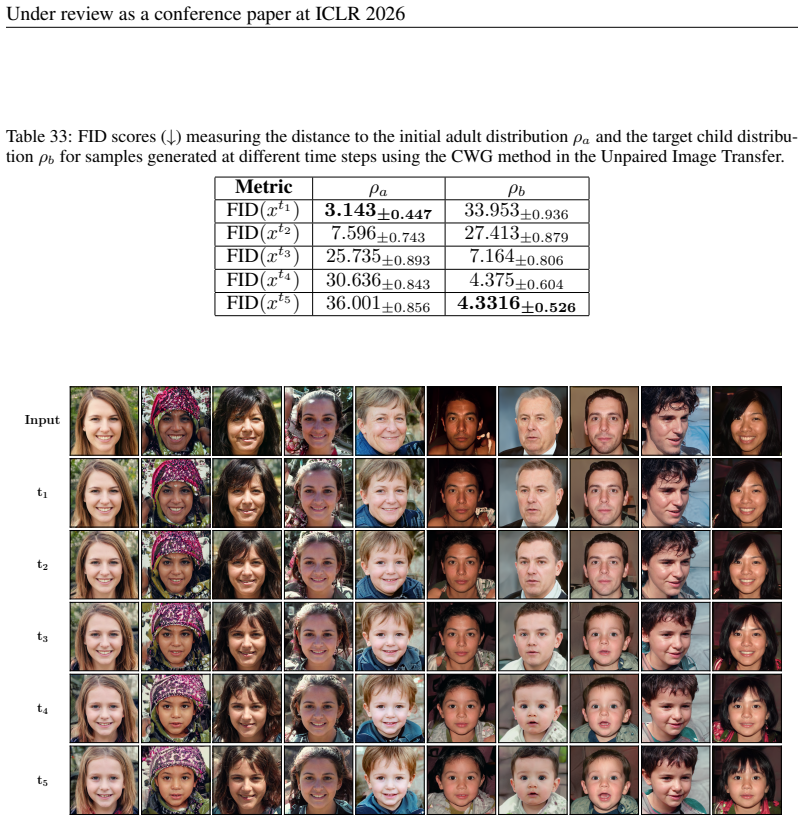
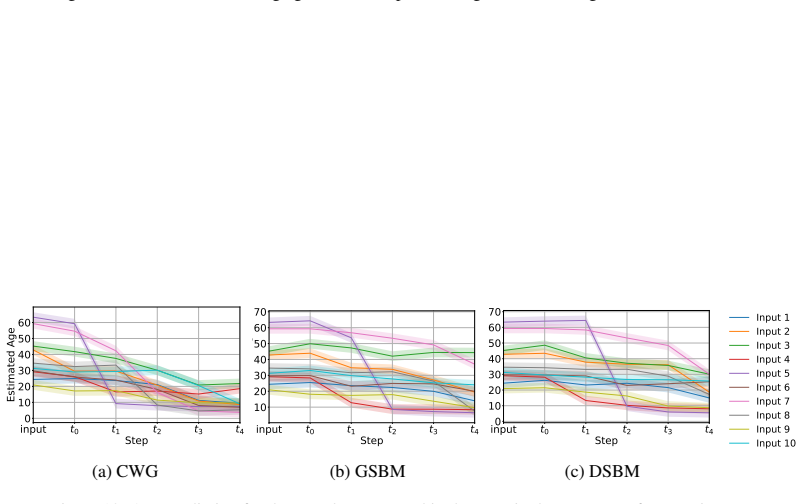
- It applies successfully to manifold navigation, molecular dynamics, and image generation tasks.
Where Pith is reading between the lines
- If the ResNet approximation holds, the same parameterization technique might apply to other optimal transport problems outside the bridge setting.
- Testing the method on physical systems with known energy variation profiles would reveal whether the contact dynamics match observed behavior.
- Extending the approach to higher-dimensional or structured data could broaden its use in generative modeling.
Load-bearing premise
The contact Hamiltonian reformulation must preserve the original probabilistic meaning of the Schrödinger bridge, and the ResNet must approximate the true geodesic closely enough to avoid large biases in the learned dynamics.
What would settle it
A direct comparison on a simple case where the conservative solution is known, showing that the non-conservative paths produce energy profiles inconsistent with the contact equations or fail to recover the conservative limit when energy is fixed.
Figures




read the original abstract
The Schr\"odinger Bridge provides a principled framework for modeling stochastic processes between distributions; however, existing methods are limited by energy-conservation assumptions, which constrains the bridge's shape preventing it from model varying-energy phenomena. To overcome this, we introduce the non-conservative generalized Schr\"odinger bridge (NCGSB), a novel, energy-varying reformulation based on contact Hamiltonian mechanics. By allowing energy to change over time, the NCGSB provides a broader class of real-world stochastic processes, capturing richer and more faithful intermediate dynamics. By parameterizing the Wasserstein manifold, we lift the bridge problem to a tractable geodesic computation in a finite-dimensional space. Unlike computationally expensive iterative solutions, our contact Wasserstein geodesic (CWG) is naturally implemented via a ResNet architecture and relies on a non-iterative solver with near-linear complexity. Furthermore, CWG supports guided generation by modulating a task-specific distance metric. We validate our framework on tasks including manifold navigation, molecular dynamics predictions, and image generation, demonstrating its practical benefits and versatility.
Editorial analysis
A structured set of objections, weighed in public.
Referee Report
Summary. The manuscript introduces the non-conservative generalized Schrödinger bridge (NCGSB) as an energy-varying reformulation of the Schrödinger bridge problem using contact Hamiltonian mechanics. It proposes to lift the problem to contact Wasserstein geodesics (CWG) in a parameterized finite-dimensional space, implemented efficiently with a ResNet architecture and a non-iterative solver, and applies the framework to manifold navigation, molecular dynamics predictions, and image generation.
Significance. Should the contact lift and ResNet approximation prove to accurately solve the marginal-constrained problem with varying energy, the approach would offer a computationally advantageous method for modeling non-conservative stochastic processes, potentially broadening the applicability of Schrödinger bridges in machine learning and scientific computing. The non-iterative solver and guided generation via distance metric modulation are potential strengths if validated.
major comments (2)
- Abstract: The abstract states the reformulation and ResNet implementation but provides no derivation steps, error analysis, or ablation results; therefore the central claim that the contact lift yields faithful varying-energy dynamics remains unverified from the given text.
- Abstract: The construction does not explicitly demonstrate that the contact Hamiltonian flow preserves the two-point marginal constraints while allowing energy variation; without this, the learned ResNet trajectories may constitute contact geodesics but not valid bridges satisfying the endpoint marginals.
minor comments (1)
- Abstract: Consider adding a brief quantitative comparison to existing iterative Schrödinger bridge methods to substantiate the claimed near-linear complexity.
Simulated Author's Rebuttal
We thank the referee for the constructive feedback and the recommendation for major revision. We address each major comment point by point below, with clear indications of the revisions we will make to strengthen the manuscript.
read point-by-point responses
-
Referee: Abstract: The abstract states the reformulation and ResNet implementation but provides no derivation steps, error analysis, or ablation results; therefore the central claim that the contact lift yields faithful varying-energy dynamics remains unverified from the given text.
Authors: We agree that the abstract is concise by design and does not include detailed derivations, error bounds, or ablation results. The full manuscript provides these elements: the derivation of the NCGSB via contact Hamiltonian mechanics appears in Section 2, the contact lift and geodesic formulation in Section 3, theoretical error analysis in Section 3.3, and ablation studies plus empirical validation of varying-energy dynamics in Section 4. These sections support the central claim. We will revise the abstract to include a brief reference to the theoretical guarantees and experimental verification of faithful varying-energy dynamics. revision: yes
-
Referee: Abstract: The construction does not explicitly demonstrate that the contact Hamiltonian flow preserves the two-point marginal constraints while allowing energy variation; without this, the learned ResNet trajectories may constitute contact geodesics but not valid bridges satisfying the endpoint marginals.
Authors: The manuscript constructs the contact Hamiltonian flow to preserve the two-point marginal constraints by design, extending the standard Schrödinger bridge while the contact structure permits energy variation without violating the endpoint marginals. This preservation is formalized in the NCGSB definition and established in Theorem 2.1 and the surrounding propositions in Section 2. The ResNet approximates the resulting geodesics, with marginal constraints enforced via the training objective. We acknowledge that the abstract does not explicitly state this property and will revise it to include a concise statement confirming that the contact Hamiltonian flow preserves the marginal constraints while allowing energy variation. revision: yes
Circularity Check
No significant circularity in derivation chain
full rationale
The paper introduces a novel non-conservative generalized Schrödinger bridge (NCGSB) reformulation via contact Hamiltonian mechanics, then parameterizes the Wasserstein manifold to recast the problem as a geodesic computation solved non-iteratively with a ResNet. No quoted equations or steps reduce a claimed prediction or first-principles result to the inputs by construction, nor do they rely on self-citation chains, imported uniqueness theorems, or ansatzes smuggled from prior author work. The ResNet serves as an implementation vehicle for the lifted geodesic rather than a fitted quantity renamed as output. The derivation remains self-contained with independent content from the new contact geometry and parameterization.
Axiom & Free-Parameter Ledger
free parameters (1)
- ResNet weights
axioms (1)
- domain assumption Contact Hamiltonian mechanics extends the conservative Schrödinger bridge to energy-varying processes without breaking the underlying stochastic interpretation.
invented entities (2)
-
Non-conservative generalized Schrödinger bridge (NCGSB)
no independent evidence
-
Contact Wasserstein geodesic (CWG)
no independent evidence
Reference graph
Works this paper leans on
-
[1]
11 Under review as a conference paper at ICLR 2026 Ricky T
URLhttps://arxiv.org/abs/2404.07771. 11 Under review as a conference paper at ICLR 2026 Ricky T. Q. Chen and Yaron Lipman. Flow matching on general geometries. InInternational Conference on Learning Representations (ICLR), 2024. URLhttps://openreview.net/ forum?id=g7ohDlTITL. Tianrong Chen, Guan-Horng Liu, and Evangelos Theodorou. Likelihood training of S...
-
[2]
Oxford Univer- sity Press (2018).https://doi.org/10.1093/oso/9780198814788.001.0001
URLhttps://proceedings.neurips.cc/paper_files/paper/2020/ file/4c5bcfec8584af0d967f1ab10179ca4b-Paper.pdf. 12 Under review as a conference paper at ICLR 2026 Peter Holderrieth and Ezra Erives. Introduction to flow matching and diffusion models, 2025. URL https://diffusion.csail.mit.edu/. Wanli Hong, Yuliang Shi, and Jonathan Niles-Weed. Trajectory inferen...
work page doi:10.1093/acprof:oso/9780198567264.001.0001 2020
-
[3]
URLhttps://doi.org/10.1038/srep04290. Solomon Kullback. Probability densities with given marginals.The Annals of Mathematical Statis- tics, 39(4):1236–1243, 1968. URLhttps://www.jstor.org/stable/2239692. Flavien L´eger and Wuchen Li. Hopf–cole transformation via generalized Schr ¨odinger bridge prob- lem.Journal of Differential Equations, 274:788–827, 202...
-
[4]
Lars Ruthotto, Stanley J Osher, Wuchen Li, Levon Nurbekyan, and Samy Wu Fung
URLhttps://openreview.net/forum?id=QwoGfQzuMa. Lars Ruthotto, Stanley J Osher, Wuchen Li, Levon Nurbekyan, and Samy Wu Fung. A machine learning framework for solving high-dimensional mean field game and mean field control prob- lems.Proceedings of the National Academy of Sciences, 117(17):9183–9193, 2020. URL https://doi.org/10.1073/pnas.1922204117. Erwin...
-
[5]
URLhttps://proceedings.mlr.press/v180/shi22a.html
PMLR, 2022. URLhttps://proceedings.mlr.press/v180/shi22a.html. Yuyang Shi, Valentin De Bortoli, Andrew Campbell, and Arnaud Doucet. Diffusion Schr ¨odinger bridge matching. InAdvances on Neural Information Processing Systems (NeurIPS), 2023. URL https://openreview.net/forum?id=qy07OHsJT5. Ana Cannas da Silva. Lectures on symplectic geometry.Lecture Notes ...
work page 2022
-
[6]
URLhttps://openreview.net/forum?id=00LViVLqkN. Jiaming Song, Qinsheng Zhang, Hongxu Yin, Morteza Mardani, Ming-Yu Liu, Jan Kautz, Yongxin Chen, and Arash Vahdat. Loss-guided diffusion models for plug-and-play controllable gen- eration. InInternational Conference on Machine Learning (ICML), 2023. URLhttps: //proceedings.mlr.press/v202/song23k.html. 14 Unde...
-
[7]
Panagiotis Theodoropoulos, Augustinos D Saravanos, Evangelos A Theodorou, and Guan-Horng Liu
URLhttps://openreview.net/forum?id=v2nQ1e78Rc. Panagiotis Theodoropoulos, Augustinos D Saravanos, Evangelos A Theodorou, and Guan-Horng Liu. Momentum multi-marginal Schr¨odinger bridge matching.arXiv preprint arXiv:2506.10168,
-
[8]
URLhttps://arxiv.org/abs/2506.10168. Sahand Tokasi and Peter Pickl. Symplectic reduction of classical mechanics on shape space.Foun- dations of Physics, 52(5):106, 2022. Alexander Tong, Jessie Huang, Guy Wolf, David Van Dijk, and Smita Krishnaswamy. Trajec- torynet: A dynamic optimal transport network for modeling cellular dynamics. InInterna- tional Conf...
-
[9]
so that samples corresponding to placements in undesired locations are discouraged, while those leading to desirable targets are favored. The centroid extraction is performed by applying morphological opening and closing operations from the OpenCV library to remove noise and refine object boundaries, followed by color-based masking to isolate the object o...
work page 2026
discussion (0)
Sign in with ORCID, Apple, or X to comment. Anyone can read and Pith papers without signing in.