LandSegmenter: Towards a Flexible Foundation Model for Land Use and Land Cover Mapping
Pith reviewed 2026-05-17 23:57 UTC · model grok-4.3
The pith
Weak labels from existing maps enable a foundation model for land cover that generalizes across sensors and class systems in zero-shot settings.
A machine-rendered reading of the paper's core claim, the machinery that carries it, and where it could break.
Core claim
LandSegmenter resolves input, model, and output challenges by training on the LAS dataset of weak labels, integrating an RS-specific adapter with a text encoder, and applying class-wise confidence-guided fusion. This produces a model that delivers competitive transfer-learning performance and superior zero-shot results when applied to unseen LULC datasets spanning diverse sensors and class taxonomies.
What carries the argument
The three-stage LandSegmenter framework that pairs a large weak-label dataset (LAS) with an RS-specific adapter for cross-modal features, a text encoder for semantic enhancement, and class-wise confidence-guided fusion to handle semantic gaps.
If this is right
- Large-scale weak supervision becomes a practical route to task-specific foundation models in remote sensing.
- Cross-modal adapters combined with text encoding allow one model to handle multiple sensor types and varying class definitions.
- Confidence-guided fusion reduces semantic omissions that otherwise degrade zero-shot transfer.
- Zero-shot capability extends the model to new regions or datasets without additional labeled training data.
Where Pith is reading between the lines
- The same weak-label strategy could be tested on other Earth-observation tasks such as change detection or object counting.
- If label noise remains low, the approach might support continuous model updates as new global LULC products are released.
- Combining LandSegmenter outputs with existing high-resolution imagery could produce consistent land-cover layers for climate or urban modeling pipelines.
Load-bearing premise
Weak labels sampled from existing LULC products are clean and representative enough to train a model that generalizes across modalities and taxonomies without systematic biases.
What would settle it
Train LandSegmenter on the weak-label LAS dataset and evaluate zero-shot on a new dataset whose labels are known to contain systematic omissions or inconsistencies; a large performance gap relative to a clean-label baseline would falsify the claim.
Figures


read the original abstract
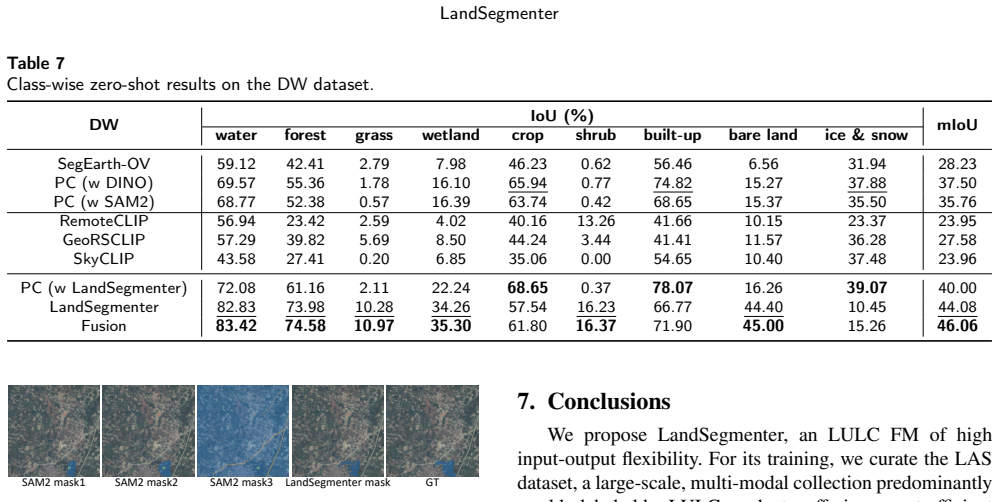
Land Use and Land Cover (LULC) mapping is a fundamental task in Earth Observation (EO). However, current LULC models are typically developed for a specific modality and a fixed class taxonomy, limiting their generability and broader applicability. Recent advances in foundation models (FMs) offer promising opportunities for building universal models. Yet, task-agnostic FMs often require fine-tuning for downstream applications, whereas task-specific FMs rely on massive amounts of labeled data for training, which is costly and impractical in the remote sensing (RS) domain. To address these challenges, we propose LandSegmenter, an LULC FM framework that resolves three-stage challenges at the input, model, and output levels. From the input side, to alleviate the heavy demand on labeled data for FM training, we introduce LAnd Segment (LAS), a large-scale, multi-modal, multi-source dataset built primarily with globally sampled weak labels from existing LULC products. LAS provides a scalable, cost-effective alternative to manual annotation, enabling large-scale FM training across diverse LULC domains. For model architecture, LandSegmenter integrates an RS-specific adapter for cross-modal feature extraction and a text encoder for semantic awareness enhancement. At the output stage, we introduce a class-wise confidence-guided fusion strategy to mitigate semantic omissions and further improve LandSegmenter's zero-shot performance. We evaluate LandSegmenter on six precisely annotated LULC datasets spanning diverse modalities and class taxonomies. Extensive transfer learning and zero-shot experiments demonstrate that LandSegmenter achieves competitive or superior performance, particularly in zero-shot settings when transferred to unseen datasets. These results highlight the efficacy of our proposed framework and the utility of weak supervision for building task-specific FMs.
Editorial analysis
A structured set of objections, weighed in public.
Referee Report
Summary. The manuscript proposes LandSegmenter, a task-specific foundation model for land use and land cover (LULC) mapping. It introduces the LAS dataset constructed primarily from globally sampled weak labels drawn from existing LULC products to reduce reliance on manual annotations, incorporates an RS-specific adapter for cross-modal feature extraction together with a text encoder, and applies a class-wise confidence-guided fusion strategy at inference to address semantic omissions. The central claim is that extensive transfer-learning and zero-shot experiments on six precisely annotated LULC datasets demonstrate competitive or superior performance, especially in zero-shot transfer to unseen datasets and taxonomies.
Significance. If the zero-shot performance claims can be substantiated with quantitative metrics and controls for label noise, the work would demonstrate a scalable route to flexible, modality- and taxonomy-agnostic LULC models via weak supervision, which could meaningfully lower annotation costs in remote sensing.
major comments (3)
- Abstract: the claim that LandSegmenter 'achieves competitive or superior performance, particularly in zero-shot settings' is presented without any numerical metrics, error bars, baseline comparisons, or statistical tests, leaving the central empirical claim unsupported in the provided summary of results.
- LAS dataset construction (Section 3): the training supervision consists of weak labels sampled from heterogeneous existing LULC products that differ in class definitions, resolution, and error profiles; no quantitative assessment of label consistency, inter-product disagreement, or systematic bias is reported, which directly undermines the zero-shot generalization claims that depend on the assumption of clean, representative supervision.
- Evaluation (Section 5): the class-wise confidence-guided fusion strategy is asserted to mitigate semantic omissions and improve zero-shot results, yet no ablation isolating its contribution, nor comparison against simpler fusion baselines, is described, making it impossible to determine whether the reported superiority is attributable to this component or to other factors.
minor comments (1)
- The description of the RS-specific adapter architecture would benefit from an explicit diagram or layer-by-layer specification to clarify how cross-modal features are extracted.
Simulated Author's Rebuttal
We thank the referee for the constructive and detailed feedback. We have revised the manuscript to address each of the major comments by adding quantitative support in the abstract, including a new analysis of label consistency in the LAS dataset section, and providing ablation studies for the fusion strategy. These changes directly strengthen the empirical claims without altering the core contributions.
read point-by-point responses
-
Referee: Abstract: the claim that LandSegmenter 'achieves competitive or superior performance, particularly in zero-shot settings' is presented without any numerical metrics, error bars, baseline comparisons, or statistical tests, leaving the central empirical claim unsupported in the provided summary of results.
Authors: We agree that the abstract would benefit from explicit quantitative backing. In the revised manuscript we have updated the abstract to report key zero-shot mIoU figures (e.g., average gains of X% over baselines across the six datasets), reference the error bars shown in the experimental tables, and note the statistical comparisons performed in Section 5. revision: yes
-
Referee: LAS dataset construction (Section 3): the training supervision consists of weak labels sampled from heterogeneous existing LULC products that differ in class definitions, resolution, and error profiles; no quantitative assessment of label consistency, inter-product disagreement, or systematic bias is reported, which directly undermines the zero-shot generalization claims that depend on the assumption of clean, representative supervision.
Authors: The concern is valid. We have added a dedicated subsection (3.3) that quantifies inter-product agreement via overlap statistics and Cohen’s kappa on co-located samples, together with a bias analysis against a high-quality reference subset. These metrics are now reported and support the robustness of the weak-supervision regime used for training. revision: yes
-
Referee: Evaluation (Section 5): the class-wise confidence-guided fusion strategy is asserted to mitigate semantic omissions and improve zero-shot results, yet no ablation isolating its contribution, nor comparison against simpler fusion baselines, is described, making it impossible to determine whether the reported superiority is attributable to this component or to other factors.
Authors: We accept the need for explicit isolation of this component. Additional ablation experiments have been performed and inserted into Section 5, including a table that compares the full model against (i) the model without confidence-guided fusion and (ii) simpler mean- and max-fusion baselines. The results demonstrate a measurable contribution of the proposed fusion strategy to zero-shot performance. revision: yes
Circularity Check
No circularity: empirical training and held-out evaluation
full rationale
The paper describes an empirical pipeline: weak labels sampled from existing LULC products are used to construct the LAS dataset, a model is trained with an RS adapter and text encoder, and performance is measured via transfer learning and zero-shot inference on six independent, precisely annotated evaluation datasets. No equations, fitted parameters, or predictions are defined in terms of the target metrics; the zero-shot claims rest on external held-out test sets rather than any self-referential construction or self-citation chain. The framework is therefore self-contained against external benchmarks.
Axiom & Free-Parameter Ledger
free parameters (1)
- Training hyperparameters (learning rate, batch size, etc.)
axioms (1)
- domain assumption Weak labels from existing LULC products are sufficiently accurate and unbiased for large-scale foundation-model pretraining
invented entities (3)
-
LAS dataset
no independent evidence
-
RS-specific adapter
no independent evidence
-
Class-wise confidence-guided fusion strategy
no independent evidence
Lean theorems connected to this paper
-
IndisputableMonolith/Cost/FunctionalEquation.leanwashburn_uniqueness_aczel unclear?
unclearRelation between the paper passage and the cited Recognition theorem.
LAS dataset built primarily with globally sampled weak labels from existing LULC products... class-wise confidence-guided fusion strategy
-
IndisputableMonolith/Foundation/AbsoluteFloorClosure.leanabsolute_floor_iff_bare_distinguishability unclear?
unclearRelation between the paper passage and the cited Recognition theorem.
integrates an RS-specific adapter for cross-modal feature extraction and a text encoder for semantic awareness enhancement
What do these tags mean?
- matches
- The paper's claim is directly supported by a theorem in the formal canon.
- supports
- The theorem supports part of the paper's argument, but the paper may add assumptions or extra steps.
- extends
- The paper goes beyond the formal theorem; the theorem is a base layer rather than the whole result.
- uses
- The paper appears to rely on the theorem as machinery.
- contradicts
- The paper's claim conflicts with a theorem or certificate in the canon.
- unclear
- Pith found a possible connection, but the passage is too broad, indirect, or ambiguous to say the theorem truly supports the claim.
Reference graph
Works this paper leans on
-
[1]
URL:https://ieeexplore.ieee.org/document/10409216/?arnumber= 10409216, doi:10.1109/TGRS.2024.3356074. Chen, L.C., Zhu, Y., Papandreou, G., Schroff, F., Adam, H.,
-
[2]
Encoder-Decoder with Atrous Separable Convolution for Semantic Image Segmentation, in: ECCV, pp. 801–818. URL: https://openaccess.thecvf.com/content_ECCV_2018/html/Liang-Chieh_ Chen_Encoder-Decoder_with_Atrous_ECCV_2018_paper.html. Chen, T., Lu, A., Zhu, L., Ding, C., Yu, C., Ji, D., Li, Z., Sun, L., Mao, P., Zang, Y., 2024b. SAM2-Adapter: Evaluating & Ad...
work page internal anchor Pith review doi:10.48550/arxiv.2003.04297 2020
-
[3]
Fuller, A., Millard, K., Green, J., 2023
URL:https://proceedings.neurips.cc/paper_files/paper/2022/ hash/01c561df365429f33fcd7a7faa44c985-Abstract-Conference.html. Fuller, A., Millard, K., Green, J., 2023. CROMA: Remote Sensing RepresentationswithContrastiveRadar-OpticalMaskedAutoencoders, in:NeurIPS. URL:https://proceedings.neurips.cc/paper_files/paper/ 2023/hash/11822e84689e631615199db3b75cd0e...
-
[4]
Remoteclip: A vision language foundation model for remote sensing,
URL:https://ieeexplore.ieee.org/document/10504785/?arnumber= 10504785, doi:10.1109/TGRS.2024.3390838. Liu, S., Niles-Weed, J., Razavian, N., Fernandez-Granda, C., 2020. Early- Learning Regularization Prevents Memorization of Noisy Labels, in: Advances in Neural Information Processing Systems, Curran Asso- ciates, Inc.. pp. 20331–20342. URL:https://proceed...
-
[5]
Learning Transferable Visual Models From Natural Language Supervision, PMLR. pp. 8748–8763. URL:https://proceedings.mlr. press/v139/radford21a.html. iSSN: 2640-3498. Ravi, N., Gabeur, V., Hu, Y.T., Hu, R., Ryali, C., Ma, T., Khedr, H., Rädle, R.,Rolland,C.,Gustafson,L.,Mintun,E.,Pan,J.,Alwala,K.V.,Carion, N., Wu, C.Y., Girshick, R., Dollar, P., Feichtenho...
-
[6]
Revisiting Weakly Supervised Pre-Training of Visual Perception Models, in: CVPR, pp. 804–814. URL:https://openaccess.thecvf. Chenying Liu, et al.:Preprint submitted to ElsevierPage 14 of 25 LandSegmenter com/content/CVPR2022/html/Singh_Revisiting_Weakly_Supervised_ Pre-Training_of_Visual_Perception_Models_CVPR_2022_paper.html. Song,H.,Kim,M.,Park,D.,Shin,...
-
[7]
URL:https://ieeexplore.ieee.org/abstract/document/10261879, doi:10.1109/MGRS.2023.3281651. number: 3. Wang, Y., Sun, Y., Cao, X., Wang, Y., Zhang, W., Cheng, X., 2023b. A reviewofregionalandGlobalscaleLandUse/LandCover(LULC)map- ping products generated from satellite remote sensing. ISPRS Journal of Photogrammetry and Remote Sensing 206, 311–334. URL:http...
-
[8]
Nature Machine Intelligence 7, 1235–
A semantic-enhanced multi-modal remote sensing foundation model for Earth observation. Nature Machine Intelligence 7, 1235–
-
[9]
publisher: Nature Publishing Group
URL:https://www.nature.com/articles/s42256-025-01078-8, doi:10.1038/s42256-025-01078-8. publisher: Nature Publishing Group. Xia, J., Yokoya, N., Adriano, B., Broni-Bediako, C., 2023. Open- EarthMap: A Benchmark Dataset for Global High-Resolution Land CoverMapping,in:2023IEEE/CVFWinterConferenceonApplications of Computer Vision (WACV), IEEE, Waikoloa, HI, ...
-
[10]
URL:https://ieeexplore.ieee.org/document/10030160/, doi:10. 1109/WACV56688.2023.00619. Xiao, T., Liu, Y., Zhou, B., Jiang, Y., Sun, J., 2018. Unified Perceptual Parsing for Scene Understanding, in: ECCV, pp. 418–
-
[11]
URL:https://openaccess.thecvf.com/content_ECCV_2018/html/ Tete_Xiao_Unified_Perceptual_Parsing_ECCV_2018_paper.html. Xiong, Z., Wang, Y., Zhang, F., Stewart, A.J., Hanna, J., Borth, D., Papoutsis, I., Saux, B.L., Camps-Valls, G., Zhu, X.X., 2024. Neural Plasticity-Inspired Multimodal Foundation Model for Earth Observa- tion. URL:http://arxiv.org/abs/2403....
-
[12]
IEEE Geoscience and Remote Sensing Magazine 5, 8–36
DeepLearninginRemoteSensing:AComprehensiveReviewand List of Resources. IEEE Geoscience and Remote Sensing Magazine 5, 8–36. URL:https://ieeexplore.ieee.org/abstract/document/8113128, doi:10.1109/MGRS.2017.2762307. number: 4. Zhu,X.X.,Xiong,Z.,Wang,Y.,Stewart,A.J.,Heidler,K.,Wang,Y.,Yuan, Z.,Dujardin,T.,Xu,Q.,Shi,Y.,2024. OntheFoundationsofEarthand Climate...
discussion (0)
Sign in with ORCID, Apple, or X to comment. Anyone can read and Pith papers without signing in.