REVIEW 2 major objections 6 minor 10 references
Bid Farewell to Seesaw: Towards Accurate Long-tail Session-based Recommendation via Dual Constraints of Hybrid Intents
T0 review · 2 major / 6 minor · reviewed 2026-08-03 · deepseek-v4-flash
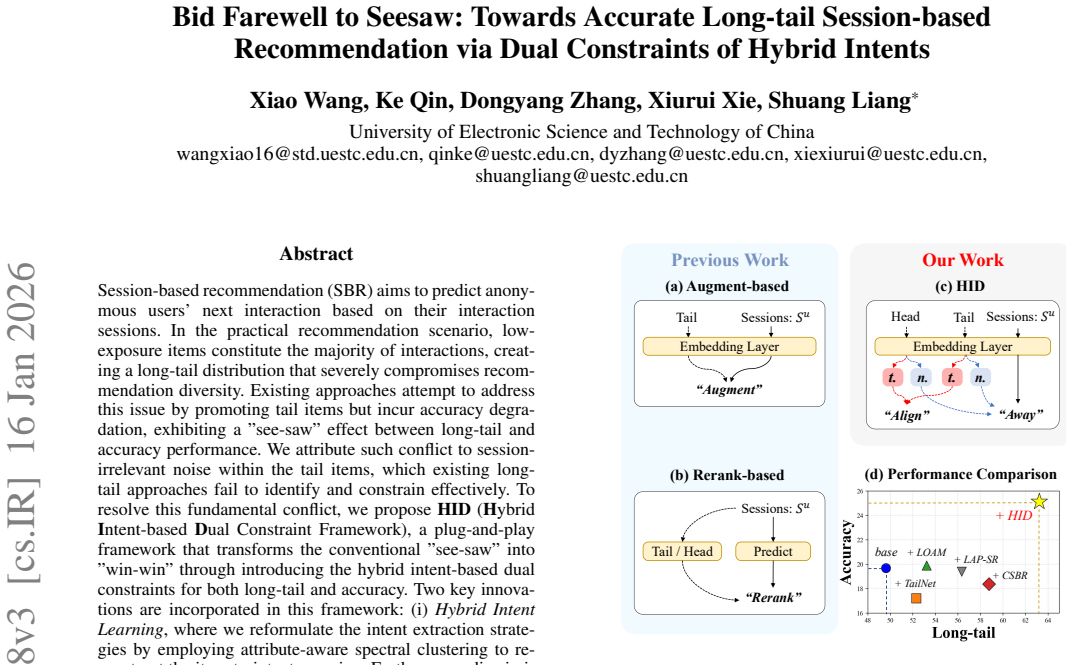
Pith's one-line read This paper claims that the long-tail versus accuracy trade-off in session-based recommendation is not inevitable: by assigning each session a target intent and noise intents, a single intent-constraint loss can pull session embeddings towar
desk verdict Empirically promising plug-and-play long-tail SBR with a genuinely new hybrid-intent construction, but the theoretical derivation behind the loss does not hold up and a hyperparameter inconsistency needs resolving. read the letter →
The pith
A machine-rendered reading of the paper's core claim, the machinery that carries it, and where it could break.
The reading
What carries the argument
The load-bearing mechanism is the hybrid intent plus the intent constraint loss (ICLoss). Hybrid intents are formed in two steps: first, items sharing an attribute form preliminary intents; second, attribute co-occurrence frequencies across all sessions build a graph, and spectral clustering merges attributes into hybrid intents (e.g., 'food' plus 'pot' becomes 'cooking'). Each session then has a target intent (the hybrid intent containing the ground-truth next item) and noise intents (target intents of other sessions in the batch). ICLoss combines a long-tail constraint—minimize distance from session embedding to the target-intent centroid, justified by Theorem 1 as a proxy for equalizing h
What would settle it
On a trained model, compute the quantity sum_{v_i in C_u} (S_u - v_i) / ||S_u - v_i|| for each session's target intent; if its average norm is not close to zero, Theorem 1's equivalence fails. A more direct test: train the same base SBR model twice—once with the full O(Nd) variance loss of Equation (6) and once with the centroid-distance approximation of Equation (7)—and compare tCov and HR; a significant gap would show the approximation is not sound.
Extended reading notes
Core claim
The central claim is that a single intent constraint loss, derived from a variance constraint on target-intent items and a mean-and-variance constraint on noise intents, can explicitly supervise both long-tail and accuracy objectives without conflict. Theorem 1 states that minimizing the variance of Euclidean distances from the session embedding to all items in the target intent is approximately equivalent, during optimization, to minimizing the distance to the target intent's centroid embedding. Theorem 2 shows the combined loss approximates a triplet loss with a fixed margin of 2, which the paper then makes adaptive via a temperature coefficient. Because target and noise intents are mutual
Load-bearing premise
Theorem 1's reduction assumes that the average unit vector from a session embedding to all items in the target intent is nearly zero (i.e., items are symmetrically distributed around the session), so that minimizing distance to the intent centroid is equivalent to minimizing the variance of session-item distances; if real embeddings violate this symmetry, the long-tail constraint no longer actually balances head and tail similarity.
Editorial extensions
If this is right
- If HID works as claimed, existing session-based recommender systems can gain both accuracy and long-tail coverage by adding a plug-and-play loss, without retraining the base encoder architecture.
- The see-saw that prior augment-based and rerank-based long-tail methods exhibit is attributed to unconstrained noise; HID's explicit noise-intent separation offers a principled way to avoid that trade-off.
- The theoretical reduction (Theorem 1) lowers the long-tail constraint's complexity from O(Nd) to O(d), making the framework practical for real-time training on large catalogs.
- The flexible temperature and variance penalty in ICLoss provide tunable knobs that let practitioners balance tail coverage against precision on a per-dataset basis, as shown in the hyperparameter studies.
Reading between the lines
- The centroid approximation in Theorem 1 assumes that item embeddings in the target intent are distributed approximately symmetrically around the session embedding; if real embeddings are skewed, the variance constraint may silently degrade into a simple mean-matching term, weakening the claimed head/tail equalization. This is an editorial concern, not the paper's claim.
- Because the target intent is defined using the ground-truth next item during training, HID effectively shapes the representation space during training and then relies on the base model's own inference-time ranking; a natural extension would be to also use intent information at inference to rerank, which the paper does not explore.
- The method's dependence on item attributes (e.g., categories) can be removed by semantic clustering of item embeddings, as the paper's appendix shows; this suggests the core ICLoss mechanism is transferable to domains where explicit attributes are unavailable.
Signed reviews
Editorial analysis
A structured set of objections, weighed in public.
Referee Report
Summary. The paper proposes HID (Hybrid Intent-based Dual Constraint Framework), a plug-and-play module for session-based recommendation (SBR) that targets the long-tail / accuracy trade-off. HID first constructs 'hybrid intents' by attribute-aware spectral clustering on item attributes and their co-occurrence, then assigns each session a target intent and a set of noise intents. An auxiliary loss (ICLoss) is added to the base SBR loss: it pulls the session embedding toward the target intent centroid, pushes it away from noise-intent centroids, and adds a variance penalty on noise-intent distances. Experiments with four SBR models (STAMP, GRU4Rec, SR-GNN, GCEGNN) and three datasets (Tmall, Diginetica, RetailRocket) report consistent improvements in both accuracy (HR/MRR) and long-tail metrics (tHR/tMRR/tCov/Tail) over the base models and four long-tail baselines. Ablations and hyperparameter studies are included.
Significance. The empirical contribution is potentially valuable: the reported gains are consistent across multiple base architectures and datasets, and the method is model-agnostic and simple enough to be reproduced. The paper also includes thoughtful ablations (hybrid intent vs. sliding-window intent, flexible temperature, semantic clusters in place of attributes) that strengthen the empirical case. However, the paper's central theoretical claim—that the intent constraint loss is a rigorous unification of the 'Constraint for Long-tail' and 'Constraint for Accuracy'—is not supported. The proof of Theorem 1 relies on a symmetry assumption that is essentially equivalent to the conclusion, and Theorem 2 uses uncontrolled small-x approximations. The hyperparameter section also contains a material internal inconsistency (n=300 in implementation vs. n=3–4 reported as optimal). If the theoretical framing is corrected or downgraded to a heuristic justification, the empirical results may still support publication; in its current form, the central mechanism is not established.
major comments (2)
- [§4.3, Eq. (9)–(15)] The derivation connecting the variance/mean constraints to the final loss is not rigorous. Theorem 2 (Appendix B) uses log(1+x)≈x and exp(y)≈1+y without specifying the regime in which these hold. With cosine similarities on the unit sphere and temperature σ=0.14, the arguments of exp are not necessarily small, so the approximations are not uniformly valid. Moreover, Eq. (9) is written with Euclidean distance d(·,·), while Eq. (12)/(15) use cosine similarity and the proof of Theorem 2 begins with dot products; the L2-normalization comment does not make exp(d) interchangeable with exp(cos). The resulting loss is a reasonable-looking contrastive objective, but it is not a mathematically derived equivalent of Definitions 3–4. Please state the approximations explicitly and treat Theorem 2 as a motivation rather than a proof.
- [§5.3 and §D.5] There is a direct internal inconsistency in the number of hybrid intents. The implementation details in Appendix D.5 state that the number of clusters n is set to 300, while the hyperparameter study in Section 5.3 reports that the optimal number of clusters is 4 for Tmall and RetailRocket and 3 for Diginetica (Figure 5). The reported results in Table 1 therefore may not use the claimed optimal setting, making the experimental protocol unclear. In the same subsection, the text says 'tuning the scaling parameter n from 0.1 to 0.9' and later 'as clusters n increases from 0 to 0.4' when discussing the balance between ICLoss and cross-entropy loss; this parameter is presumably ε, not n. Please clarify the variable names and reconcile the n used in the main experiments with the tuning study.
minor comments (6)
- [§4.1, Definitions 1–2 / Eq. (2)–(7)] Notation is confusing: C_u denotes a set of intents in Definitions 1–2, but c_u denotes an intent embedding in Eq. (7), and in Eq. (6) v_i are items 'belonging to the target intent C_u'. Please use distinct notation for the intent set, the intent embedding, and the items in the target intent.
- [§4.3, Eq. (8)] The proportionality E[d(S_u,c_v)] ∝ sum d(S_u,c_v) assumes a fixed number of noise intents per session (or a fixed batch size). If the number varies, the sum and the expectation differ by a per-session factor; please clarify the normalization.
- [Table 1, p-value row] The p-values are said to come from a two-sided t-test, but the number of independent runs, standard deviations, and the exact baseline being compared are not reported. Please add these details or state that the p-values are representative of a small number of runs.
- [Appendix D.6] The explanation that HID (w/o attr.) shows better long-tail performance because 'initial meaningless item embeddings' let it 'explore more item combinations' is speculative. The comparable results are interesting, but the mechanism is not demonstrated; please temper the claim or provide supporting evidence.
- [Throughout] There are several typos and duplicated references: 'hybird', 'co-occurance', 'centorid', 'i-that-tributes', and 'useage'. The references Choi et al. 2024a and 2024b are the same work, as are Liu and Zheng 2020a and 2020b. Please correct these before the final version.
- [§4.2, Eq. (5)] The claim that 'the equivalence of Euclidean distance and cosine similarity is ensured by the L2 normalization' is only true up to a monotone transformation; it does not preserve the exact expressions involving exp(d) in earlier equations. Please state the precise relationship (e.g., ||x-y||² = 2 - 2cos(x,y) after normalization).
Circularity Check
Theorem 1's 'optimizing equivalence' drops the term that distinguishes variance from centroid distance, so the long-tail constraint reduces to centroid matching by assumption.
-
self definitional
[Appendix A, Theorem 1 (Eqs. 16–19)]
"Considering that the second term P vi∈Cu Su−vi |Cu|·∥Su−vi∥ ∼0 when the sum of the unit vectors pointing from Su to each point vi is about 0, which can be satisfied when vi exhibit an approximately symmetric distribution around Su, indicating that Su is the centorid of all vi."
Theorem 1 claims min_{S} Var_{v_i∈C_u}[d(S_u,v_i)] ∼ min_S d(S_u,c_u). The proof's only move is to discard the term in Eq. (19) that separates the variance minimizer from the centroid, and it does so by assuming the unit vectors from S_u to all v_i sum to ∼0 — i.e., that S_u is already the centroid. The stationary-point equation itself shows S_u = centroid + (mean distance)·(mean unit vector); the extra term need not vanish in general. Hence the implemented ICLoss (Eq. 15, max cosine similarity to c_u) is centroid matching, not variance equalization; the 'Constraint for Long-tail' is identified with its own conclusion by construction.
full rationale
The empirical part of the paper is self-contained: HID is evaluated against independent long-tail baselines and base SBR models on three datasets, and the hybrid-intent clustering is not circular. No load-bearing self-citation or imported uniqueness theorem is present. However, the central theoretical derivation is circular at exactly the step that justifies the long-tail constraint. Definition 3 defines the Constraint for Long-tail as variance minimization over session–item distances, but Theorem 1 'proves' this is equivalent to minimizing distance to the intent centroid by assuming the session embedding is the centroid — the very conclusion needed. The final loss (Eq. 15) contains only the centroid-alignment term, so the paper's claim that ICLoss explicitly optimizes the variance-based long-tail objective is not derived from the objective; it is imposed by the proof's assumption. Because the experimental comparisons provide independent support, the paper is not wholly circular, but this load-bearing theoretical step warrants a mid-range score.
Assumptions & free parameters
free parameters (5)
- sigma (temperature) =
0.14
- epsilon (ICLoss scale) =
0.2
- eta (variance threshold) =
0.2
- lambda (penalty scale) =
0.3
- n (number of hybrid intents) =
300 (implementation), 3-4 (Figure 5 optimum)
assumptions (5)
- domain assumption Item attributes are available and define meaningful preliminary intents
- domain assumption Anonymous sessions are driven by a small set of cross-session intents revealed by attribute co-occurrence
- domain assumption Target intents can be identified from the ground-truth next item
- ad hoc to paper The sum of unit vectors from session embedding to target items is approximately zero (symmetry)
- ad hoc to paper log(1+x) ≈ x and exp(x) ≈ 1+x are valid in the training regime
invented entities (1)
-
Hybrid intent
independent evidence
Cite this review
Pith. "Pith review of Bid Farewell to Seesaw: Towards Accurate Long-tail Session-based Recommendation via Dual Constraints of Hybrid Intents." pith.science (2026). https://pith.science/paper/KZUA56XT
@misc{pith2026251108378,
  author       = {Pith},
  title        = {Pith review of: Bid Farewell to Seesaw: Towards Accurate Long-tail Session-based Recommendation via Dual Constraints of Hybrid Intents},
  year         = {2026},
  howpublished = {\url{https://pith.science/paper/KZUA56XT}},
  note         = {Machine review of arXiv:2511.08378}
}
read the original abstract
Session-based recommendation (SBR) aims to predict anonymous users' next interaction based on their interaction sessions. In the practical recommendation scenario, low-exposure items constitute the majority of interactions, creating a long-tail distribution that severely compromises recommendation diversity. Existing approaches attempt to address this issue by promoting tail items but incur accuracy degradation, exhibiting a "see-saw" effect between long-tail and accuracy performance. We attribute such conflict to session-irrelevant noise within the tail items, which existing long-tail approaches fail to identify and constrain effectively. To resolve this fundamental conflict, we propose \textbf{HID} (\textbf{H}ybrid \textbf{I}ntent-based \textbf{D}ual Constraint Framework), a plug-and-play framework that transforms the conventional "see-saw" into "win-win" through introducing the hybrid intent-based dual constraints for both long-tail and accuracy. Two key innovations are incorporated in this framework: (i) \textit{Hybrid Intent Learning}, where we reformulate the intent extraction strategies by employing attribute-aware spectral clustering to reconstruct the item-to-intent mapping. Furthermore, discrimination of session-irrelevant noise is achieved through the assignment of the target and noise intents to each session. (ii) \textit{Intent Constraint Loss}, which incorporates two novel constraint paradigms regarding the \textit{diversity} and \textit{accuracy} to regulate the representation learning process of both items and sessions. These two objectives are unified into a single training loss through rigorous theoretical derivation. Extensive experiments across multiple SBR models and datasets demonstrate that HID can enhance both long-tail performance and recommendation accuracy, establishing new state-of-the-art performance in long-tail recommender systems.
Figures


Figures from the paper (1 more)

Reference graph
Works this paper leans on
-
[2]
Gupta, P.; Garg, D.; Malhotra, P.; Vig, L.; and Shroff, G
Washington DC, USA: ACM. Gupta, P.; Garg, D.; Malhotra, P.; Vig, L.; and Shroff, G. M. 2019. NISER: normalized item and session rep- resentations with graph neural networks.arXiv preprint arXiv:1909.04276, 43: 128–134. Hidasi, B.; Karatzoglou, A.; Baltrunas, L.; and Tikk, D
arXiv 2019
-
[10]
, GUME (Lin et al. 2024), GALORE (Luo et al. 2023), and LLM-ESR (Liu et al. 2024) utilize collaborative signals from users, which are not available in session-based recom- mendation due to the anonymity, we have not included them in the competitors either. Table 4: The accuracy and long-tail comparison of HID and HID (w/o attr.) which replace attributes o...
arXiv 2024
-
[2016]
Session-based recommendations with recurrent neural networks. InICLR. San Juan, Puerto Rico: OpenReview.net. Hou, Y .; Hu, B.; Zhang, Z.; and Zhao, W. X. 2022. CORE: Simple and Effective Session-based Recommenda- tion within Consistent Representation Space. InSIGIR, 1796–1801. Madrid, Spain: ACM. Huang, Y .; Yang, Z.; Hu, W.; Xu, B.; and Zhang, Z. 2024. C...
2022
-
[2017]
In CIKM, 1419–1428
Neural Attentive Session-based Recommendation. In CIKM, 1419–1428. Singapore: ACM. Li, Z.; Yang, C.; Chen, Y .; Wang, X.; Chen, H.; Xu, G.; Yao, L.; and Sheng, M. 2025. Graph and Sequential Neural Net- works in Session-based Recommendation: A Survey.ACM Comput. Surv., 57(2): 40:1–40:37. Lin, G.; Meng, Z.; Wang, D.; Long, Q.; Zhou, Y .; and Xiao, M. 2024. ...
2025
-
[2019]
InAAAI, 346–353
Session-Based Recommendation with Graph Neu- ral Networks. InAAAI, 346–353. Honolulu, Hawaii, USA: AAAI Press. Xia, X.; Yin, H.; Yu, J.; Shao, Y .; and Cui, L. 2021a. Self- Supervised Graph Co-Training for Session-based Recom- mendation. InCIKM, 2180–2190. Queensland, Australia: ACM. Xia, X.; Yin, H.; Yu, J.; Wang, Q.; Cui, L.; and Zhang, X. 2021b. Self-S...
-
[2020]
InSIGIR, 169–178
Global Context Enhanced Graph Neural Networks for Session-based Recommendation. InSIGIR, 169–178. Vir- tual Event, China: ACM. Wei, W.; Ren, X.; Tang, J.; Wang, Q.; Su, L.; Cheng, S.; Wang, J.; Yin, D.; and Huang, C. 2024. LLMRec: Large Language Models with Graph Augmentation for Recom- mendation. InWSDM, 806–815. Merida, Mexico: ACM. Wu, S.; Tang, Y .; Z...
2024
-
[2021]
InAAAI, 4635–4643
Dual Sparse Attention Network For Session-based Recommendation. InAAAI, 4635–4643. Virtual Event: AAAI Press. Zhang, P.; Guo, J.; Li, C.; Xie, Y .; Kim, J.; Zhang, Y .; Xie, X.; Wang, H.; and Kim, S. 2023. Efficiently Leveraging Multi-level User Intent for Session-based Recommendation via Atten-Mixer Network. InWSDM, 168–176. Singapore: ACM. A Proof of Th...
2023
-
[2023]
InICDE, 3759–3760
Intention-aware Sequential Recommendation with Structured Intent Transition. InICDE, 3759–3760. Ana- heim, CA, USA: IEEE. Li, J.; Ren, P.; Chen, Z.; Ren, Z.; Lian, T.; and Ma, J
Show all 10 references
-
[2536]
Choi, M.; Kim, H.; Cho, H.; and Lee, J
Washington DC, USA: ACM. Choi, M.; Kim, H.; Cho, H.; and Lee, J. 2024b. Multi-intent- aware Session-based Recommendation. InSIGIR, 2532–
-
[4511]
Yang, H.; Choi, Y .; Kim, G.; and Lee, J
Virtual Event: AAAI Press. Yang, H.; Choi, Y .; Kim, G.; and Lee, J. 2023. LOAM: Improving Long-tail Session-based Recommendation via Niche Walk Augmentation and Tail Session Mixup. InSI- GIR, 527–536. Taipei,Taiwan: ACM. Yin, H.; Cui, B.; Li, J.; Yao, J.; and Chen, C. 2012. C...
2023
Reviewed August 3, 2026 · model on record in the stance chip above.
Discussion (0). Continue with ORCID to comment.