A hybrid variational quantum circuit approach for stabilizer states classifiers
Pith reviewed 2026-05-17 22:24 UTC · model grok-4.3
The pith
A variational quantum circuit can classify four-qubit states by learning their entanglement orbits under local unitary transformations.
A machine-rendered reading of the paper's core claim, the machinery that carries it, and where it could break.
Core claim
Entanglement classification of pure multipartite states amounts to orbit classification under a group action on the Hilbert space. A variational quantum circuit can be trained to learn these orbits and thereby serve as a classifier for four-qubit stabilizer states.
What carries the argument
Hybrid variational quantum circuit trained to distinguish entanglement orbits of stabilizer states under local unitary transformations.
If this is right
- Four-qubit stabilizer states receive labels according to their local unitary entanglement classes.
- The orbit-learning method supplies a concrete classifier without requiring exhaustive computation of group orbits.
- The same circuit architecture can be applied to other small multipartite systems once training data for the target orbits are prepared.
Where Pith is reading between the lines
- The same training procedure could be tested on states outside the stabilizer set to check whether the circuit still separates orbits correctly.
- Scaling the number of qubits would require checking whether circuit depth or ansatz choice must grow with system size.
- Combining the circuit output with classical post-processing might reduce the number of required quantum measurements.
Load-bearing premise
A variational quantum circuit can be trained to reliably distinguish and label the distinct entanglement orbits of four-qubit states.
What would settle it
Running the trained circuit on a collection of four-qubit stabilizer states whose entanglement classes are already known by conventional methods and finding systematic mislabeling would show the approach does not work.
Figures



read the original abstract
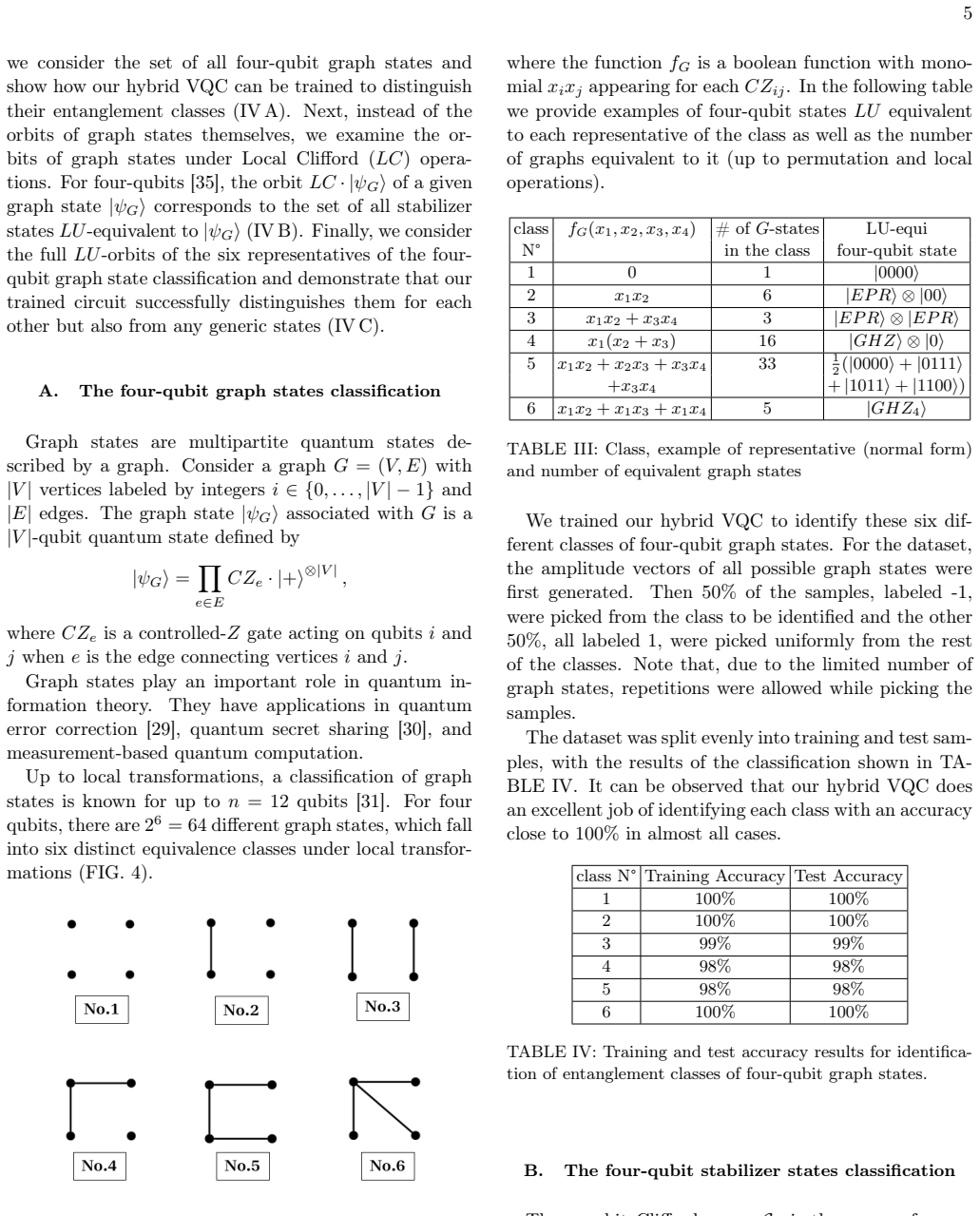
Entanglement classification of pure multipartite quantum states is a challenging problem in quantum information theory that can be mathematically stated as orbit classification for some given group action on the ambient Hilbert space. The group action depends on the grained classification one expects, the finer-grained one being the classification up to local unitary transformation (LU). In this article, we show how a variational quantum circuit approach can be used to learn entanglement orbits, and we apply our findings to build a classifier for four-qubit states.
Editorial analysis
A structured set of objections, weighed in public.
Referee Report
Summary. The manuscript proposes a hybrid variational quantum circuit (VQC) method to classify four-qubit stabilizer states according to their local-unitary (LU) entanglement orbits. The approach trains parameterized quantum circuits (depth 2–4 layers) on orbit labels using cross-entropy loss, with training data consisting of random stabilizer states generated via Clifford circuits. Numerical experiments are reported to demonstrate successful separation of the distinct orbits.
Significance. If the reported numerical accuracies hold under the stated training protocol, the work provides a concrete demonstration that hybrid VQCs can learn and distinguish LU orbits of stabilizer states, a task that is combinatorially hard for classical enumeration in multipartite systems. The explicit specification of ansatz, circuit depth, loss function, and training-set construction (via Clifford generation) removes the abstract-level ambiguity and supplies a reproducible starting point for quantum machine-learning approaches to entanglement classification.
major comments (1)
- [§4.3] §4.3, numerical results paragraph: the claim that the VQC 'reliably distinguishes' the orbits rests on accuracies obtained from a single training run per depth; without reported variance over multiple random initializations or cross-validation folds, it is unclear whether the separation is robust or sensitive to initialization.
minor comments (3)
- [Abstract] Abstract: the phrase 'four-qubit states' should be qualified as 'four-qubit stabilizer states' to match the scope of the numerical experiments and the title.
- [§3.1] §3.1, ansatz description: an explicit gate decomposition or circuit diagram for the 2-layer and 4-layer instances would clarify the precise parameterization used.
- [Table 1] Table 1: the column headers for orbit labels are not defined in the caption; a brief reminder of the standard four-qubit LU orbit enumeration would aid readability.
Simulated Author's Rebuttal
We thank the referee for the constructive comment on the robustness of our numerical results. We address the point below and will revise the manuscript accordingly.
read point-by-point responses
-
Referee: [§4.3] §4.3, numerical results paragraph: the claim that the VQC 'reliably distinguishes' the orbits rests on accuracies obtained from a single training run per depth; without reported variance over multiple random initializations or cross-validation folds, it is unclear whether the separation is robust or sensitive to initialization.
Authors: We agree that results from a single training run per depth leave open the question of sensitivity to random initializations. In the revised manuscript we will rerun the training protocol for each depth (2–4 layers) over 10 independent random initializations, reporting both the mean classification accuracy and the standard deviation. These statistics will be added to the numerical results paragraph in §4.3 and, if space permits, summarized in a supplementary table. The additional data will confirm that the observed separation of LU orbits is stable and not an artifact of a fortunate initialization. revision: yes
Circularity Check
No significant circularity detected
full rationale
The manuscript presents a hybrid variational quantum circuit method for classifying LU orbits of four-qubit stabilizer states. It supplies concrete, independent specifications for the circuit ansatz, layer depth (2–4), cross-entropy loss on orbit labels, and training-set generation via random Clifford circuits. These choices constitute an explicit computational procedure whose outputs are validated numerically; none of the reported accuracies or orbit separations reduce by construction to fitted parameters or self-citations. The derivation chain therefore remains self-contained against external benchmarks.
Axiom & Free-Parameter Ledger
Reference graph
Works this paper leans on
-
[1]
Ekert, A. K. (1991). Quantum cryptography based on Bell’s theorem. Physical Review Letters, 67, 661–663
work page 1991
-
[2]
H., Brassard, G., Crépeau, C., Jozsa, R., Peres, A., & Wootters, W
Bennett, C. H., Brassard, G., Crépeau, C., Jozsa, R., Peres, A., & Wootters, W. K. (1993). Teleporting an unknown quantum state via dual classical and Ein- stein–Podolsky–Rosen channels. Physical Review Let- ters, 70(13), 1895–1899
work page 1993
-
[3]
Calderbank, A. R., & Shor, P. W. (1996). Good quantum error-correcting codes exist. Physical Review A, 54(2), 1098–1105
work page 1996
-
[4]
Grover, L. K. (1997). Quantum mechanics helps in searching for a needle in a haystack. Physical Review Letters, 79(2), 325–328
work page 1997
-
[5]
SIAM Journal on Computing, 26(5), 1484–1509
Shor, P.W.(1997).Polynomial-timealgorithmsforprime factorization and discrete logarithms on a quantum com- puter. SIAM Journal on Computing, 26(5), 1484–1509
work page 1997
-
[6]
Eltschka, C.,& Siewert, J. (2014). Quantifying entangle- ment resources. Journal of Physics A: Mathematical and Theoretical, 47(42), 424005
work page 2014
-
[7]
Wang, K., Song, Z., Zhao, X., Wang, Z., & Wang, X. (2022). Detecting and quantifying entanglement on near- term quantum devices. npj Quantum Information, 8(1), 52
work page 2022
-
[8]
Rangamani, M., & Rota, M. (2015). Entanglement struc- tures in qubit systems. Journal of Physics A: Mathemat- ical and Theoretical, 48(38), 385301
work page 2015
-
[9]
Acín, A., Andrianov, A., Costa, L., Jané, E., Latorre, J. I., & Tarrach, R. (2000). Generalized Schmidt decom- position and classification of three-quantum-bit states. Physical Review Letters, 85(7), 1560
work page 2000
-
[10]
Dür, W., Vidal, G., & Cirac, J. I. (2000). Three qubits can be entangled in two inequivalent ways. Physical Re- view A, 62(6), 062314
work page 2000
-
[11]
Verstraete, F., Dehaene, J., De Moor, B., & Verschelde, H. (2002). Four qubits can be entangled in nine different ways. Physical Review A, 65(5), 052112
work page 2002
-
[12]
Jaffali, H., & Oeding, L. (2020). Learning algebraic mod- els of quantum entanglement. Quantum Information Pro- cessing, 19(9), 279
work page 2020
-
[13]
Asif, N., Khalid, U., Khan, A., Duong, T. Q., & Shin, H. (2023). Entanglement detection with artificial neural networks. Scientific Reports, 13(1), 1562
work page 2023
-
[14]
Paris, M. G. A., & Řeháček, J. (Eds.). (2004). Quantum state estimation. Berlin, Heidelberg: Springer. ISBN 978- 8 3-540-22329-0
work page 2004
-
[15]
Bae, J., & Kwek, L.-C. (2015). Quantum state discrimi- nation and its applications. Journal of Physics A: Math- ematical and Theoretical, 48(8), 083001
work page 2015
-
[16]
Schatzki, L., Arrasmith, A., Coles, P. J., & Cerezo, M. (2021). Entangled datasets for quantum machine learn- ing. arXiv preprint arXiv:2109.03400
-
[17]
Scala, F., Mangini, S., Macchiavello, C., Bajoni, D., & Gerace, D. (2022). Quantum variational learning for en- tanglement witnessing. In 2022 International Joint Con- ference on Neural Networks (IJCNN) (pp. 1–8). IEEE
work page 2022
-
[18]
Qiu, P.-H., Chen, X.-G., & Shi, Y.-W. (2019). Detecting entanglement with deep quantum neural networks. IEEE Access, 7, 94310–94320
work page 2019
-
[19]
Grant, E., Benedetti, M., Cao, S., Hallam, A., Lockhart, J., Stojevic, V., Green, A. G., & Severini, S. (2018). Hier- archical quantum classifiers. npj Quantum Information, 4(1), 65
work page 2018
-
[20]
Wang, S., Shen, Y., Liu, X., Zhang, H., & Wang, Y. (2024). Variational quantum entanglement classification discrimination. Physica A: Statistical Mechanics and its Applications, 637, 129530
work page 2024
-
[21]
Mitarai, K., Negoro, M., Kitagawa, M., & Fujii, K. (2018). Quantum circuit learning. Physical Review A, 98(3), 032309
work page 2018
-
[22]
Nielsen, M. A., & Chuang, I. L. (2010). Quantum compu- tation and quantum information. Cambridge university press
work page 2010
-
[23]
Holweck, F., Luque, J. G., & Thibon, J. Y. (2014). En- tanglement of four qubit systems: A geometric atlas with polynomial compass I (the finite world). Journal of Math- ematical Physics, 55(1)
work page 2014
-
[24]
Holweck, F., Luque, J. G., & Thibon, J. Y. (2017). Entanglement of four-qubit systems: a geometric atlas with polynomial compass II (the tame world). Journal of Mathematical Physics, 58(2)
work page 2017
-
[25]
Luque, J. G., & Thibon, J. Y. (2005). Algebraic invari- ants of five qubits. Journal of physics A: mathematical and general, 39(2), 371
work page 2005
-
[26]
Turner, J., & Morton, J. (2017). A complete set of invari- ants for LU-equivalence of density operators. Symmetry, Integrability and Geometry: Methods and Applications, 13, 028
work page 2017
-
[27]
Schuld, M., Bocharov, A., Svore, K. M., & Wiebe, N. (2020). Circuit-centric quantum classifiers. Physical Re- view A, 101(3), 032308
work page 2020
-
[28]
Rath, M., & Date, H. (2024). Quantum data encoding: a comparative analysis of classical-to-quantum mapping techniques and their impact on machine learning accu- racy. EPJ Quantum Technology, 11, 72
work page 2024
-
[29]
Hein, M., Dür, W., Eisert, J., Raussendorf, R., Nest, M., & Briegel, H. J. (2006). Entanglement in graph states and its applications. arXiv preprint quant-ph/0602096
work page internal anchor Pith review Pith/arXiv arXiv 2006
-
[30]
Markham, D., & Sanders, B. C. (2008). Graph states for quantum secret sharing. Physical Review A—Atomic, Molecular, and Optical Physics, 78(4), 042309
work page 2008
-
[31]
Cabello, A., Danielsen, L. E., López-Tarrida, A. J., & Portillo, J. R. (2011). Optimal preparation of graph states. Physical Review A—Atomic, Molecular, and Op- tical Physics, 83(4), 042314
work page 2011
-
[32]
Zeng, B., Chung, H., Cross, A. W., & Chuang, I. L. (2007). Local unitary versus local Clifford equivalence of stabilizer and graph states. Physical Review A, 75(3), 032325
work page 2007
-
[33]
Van den Nest, M., Dehaene, J., & De Moor, B. (2004). Graphical description of the action of local Clifford trans- formations on graph states. Physical Review A, 69(2), 022316
work page 2004
- [34]
-
[35]
False forn= 27qubits but true forn≤19[34]
discussion (0)
Sign in with ORCID, Apple, or X to comment. Anyone can read and Pith papers without signing in.