Quantum Artificial Intelligence for Mission-Critical Systems: Foundations, Architectural Elements, and Future Directions
Pith reviewed 2026-05-21 18:53 UTC · model grok-4.3
The pith
Quantum artificial intelligence can potentially deliver the robustness, timing, explainability, and safety that classical AI struggles to provide in mission-critical systems.
A machine-rendered reading of the paper's core claim, the machinery that carries it, and where it could break.
Core claim
The paper claims that QAI can potentially provide transformative solutions to the challenges faced by classical ML models in meeting the stringent constraints of robustness, timing, explainability, and safety in mission-critical domains. This is supported by a systematic survey of QAI methods analyzed through the lens of certification, robustness, and timing; a conceptual quantum cloud resource management and scheduling framework with deployment assumptions, complexity analysis, and failure-mode discussion; and an identification of gaps including trainability limits, data access bottlenecks, verification of quantum components, and adversarial threats, along with future directions toward safe
What carries the argument
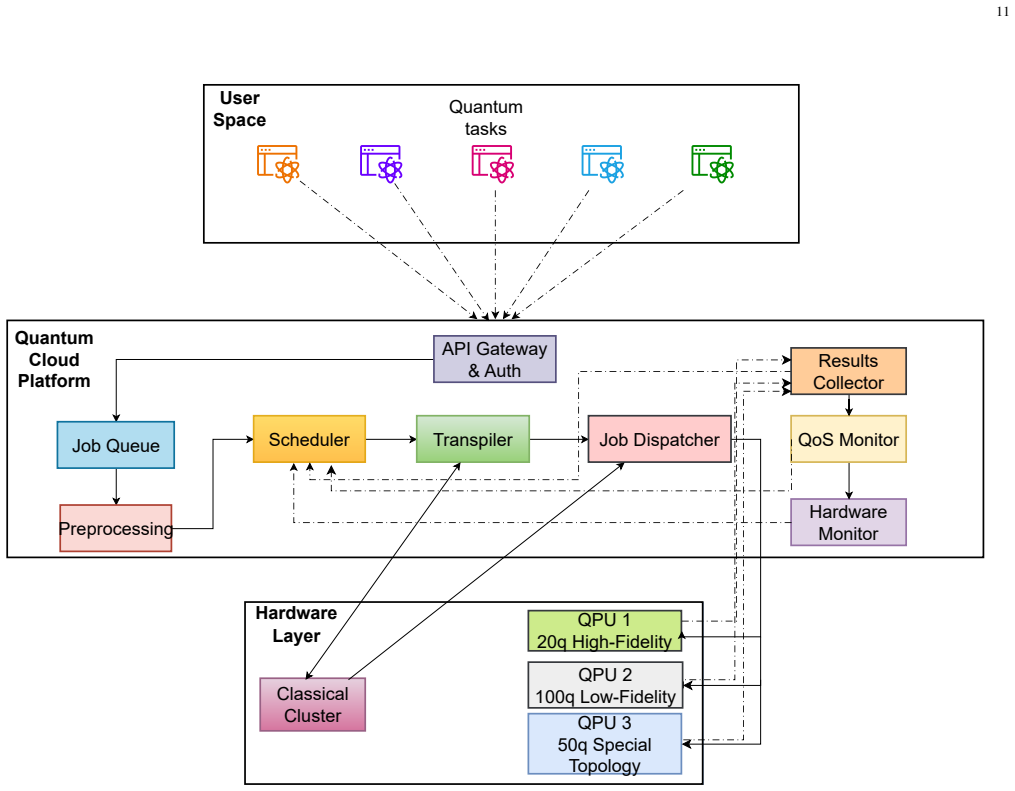
The conceptual quantum cloud resource management and scheduling framework that allocates quantum resources according to timeliness constraints while incorporating deployment assumptions, complexity analysis, and failure-mode discussion.
If this is right
- QAI methods can be systematically evaluated for suitability in mission-critical domains by checking robustness, explainability, and timing performance.
- The scheduling framework enables allocation of quantum resources to applications while respecting strict timeliness constraints and handling potential failure modes.
- Identified challenges such as verification of quantum components and adversarial QAI attacks require targeted safeguards before deployment in cybersecurity or defense settings.
- Future work on interpretable and scalable QAI models would directly address the gaps between present capabilities and mission-critical system requirements.
Where Pith is reading between the lines
- The scheduling framework could be extended to hybrid classical-quantum pipelines that fall back to classical methods when quantum timing guarantees are not met.
- Empirical benchmarks on near-term simulators using real mission-critical data sets would reveal data-loading bottlenecks not fully quantified in the conceptual analysis.
- Linking the proposed resource management approach to existing quantum error-mitigation techniques might improve determinism without requiring fault-tolerant hardware.
Load-bearing premise
The surveyed QAI methods and the proposed conceptual scheduling framework can be realized on near-term quantum hardware while satisfying the determinism and certification demands of mission-critical systems.
What would settle it
Implementation of one of the surveyed QAI optimization routines on a current quantum device for a sample aerospace control task that fails to produce certified outputs within the required latency bound would directly test the feasibility claim.
Figures



read the original abstract
Mission critical (MC) applications such as defense operations, energy management, cybersecurity, and aerospace control require reliable, deterministic, and low-latency decision making under uncertainty. Although the classical Artificial Intelligence (AI) approaches are effective, they often struggle to meet the stringent constraints of robustness, timing, explainability, and safety in the MC domains. Quantum Artificial Intelligence (QAI), the fusion of artificial intelligence and quantum computing (QC), can potentially provide transformative solutions to the challenges faced by classical ML models. QAI is a broader umbrella than Quantum Machine Learning (QML) and additionally includes quantum optimization, search, and reasoning; we use QAI throughout the paper for the field at large, and QML only for learning-specific subroutines. The principal contributions of this work are: (i) a systematic survey of QAI methods analyzed through the lens of MC requirements like certification, robustness, and timing; (ii) a conceptual quantum cloud resource management and scheduling framework with deployment assumptions, complexity analysis, and failure-mode discussion; and (iii) an identification of the gaps between current QAI capabilities and MC systems requirements. We also propose a conceptual model for management of quantum resources and scheduling of applications driven by timeliness constraints. We discuss multiple challenges, including trainability limits, data access, and loading bottlenecks, verification of quantum components, and adversarial QAI. Finally, we outline future research directions toward achieving interpretable, scalable, and hardware-feasible QAI models for MC application deployment.
Editorial analysis
A structured set of objections, weighed in public.
Referee Report
Summary. The paper conducts a systematic survey of Quantum Artificial Intelligence (QAI) methods, evaluated against mission-critical (MC) requirements including certification, robustness, timing, explainability, and safety. It proposes a conceptual quantum cloud resource management and scheduling framework with deployment assumptions, high-level complexity analysis, and failure-mode discussion; identifies gaps between current QAI capabilities and MC demands; discusses challenges such as trainability limits, data access bottlenecks, quantum component verification, and adversarial QAI; and outlines future research directions for interpretable and hardware-feasible QAI in domains like defense, energy, cybersecurity, and aerospace.
Significance. If the surveyed QAI techniques and the proposed scheduling framework can be realized on near-term NISQ hardware while satisfying determinism and certification standards, the work would provide a valuable roadmap for integrating quantum methods into high-stakes systems where classical AI struggles with robustness and latency. The gap analysis and challenge enumeration are useful for directing research, though the conceptual nature means immediate practical impact is limited without empirical or formal validation.
major comments (2)
- [Contributions (ii) and conceptual scheduling framework] Contributions section (ii) and the proposed conceptual model: the complexity analysis and failure-mode discussion provide only high-level treatment of quantum resource scheduling under timeliness constraints, without concrete latency bounds, certification protocols, or quantitative comparison to classical real-time schedulers. This is load-bearing for the central claim that the framework can deliver certified, low-latency, deterministic behavior on hardware available in the next 5–10 years.
- [Abstract and challenges section] Abstract and challenges discussion: the assertion that QAI 'can potentially provide transformative solutions' to MC constraints rests on the untested assumption that NISQ-era noise, data-loading overhead, and verification costs can be controlled to MC standards. The manuscript offers no side-by-side quantitative assessment or prototype results to support this.
minor comments (2)
- [Introduction] The distinction between QAI (broader umbrella) and QML (learning-specific) is stated in the abstract but would benefit from an explicit early definition or table in the introduction to aid readers unfamiliar with the terminology.
- [Survey section] The survey would be strengthened by adding a table summarizing key QAI methods against specific MC criteria (e.g., certification readiness, latency estimates) rather than narrative only.
Simulated Author's Rebuttal
We thank the referee for the constructive and detailed feedback on our survey paper. We have addressed each major comment below, clarifying the conceptual scope of the work while making targeted revisions to better articulate limitations and future needs.
read point-by-point responses
-
Referee: Contributions (ii) and conceptual scheduling framework: the complexity analysis and failure-mode discussion provide only high-level treatment of quantum resource scheduling under timeliness constraints, without concrete latency bounds, certification protocols, or quantitative comparison to classical real-time schedulers. This is load-bearing for the central claim that the framework can deliver certified, low-latency, deterministic behavior on hardware available in the next 5–10 years.
Authors: We agree the treatment is high-level because the contribution is explicitly a conceptual framework within a survey paper, not an empirical implementation study. The framework illustrates resource management principles and identifies timeliness challenges rather than claiming deployable certified performance on near-term hardware. Concrete latency bounds and certification protocols would necessitate hardware-specific experiments and formal methods that lie outside the survey's scope; we have revised the relevant section to include an expanded limitations paragraph and a qualitative comparison to classical approaches such as earliest-deadline-first scheduling, highlighting additional quantum-specific overheads. This revision underscores that the framework serves as a research roadmap. revision: partial
-
Referee: Abstract and challenges section: the assertion that QAI 'can potentially provide transformative solutions' to MC constraints rests on the untested assumption that NISQ-era noise, data-loading overhead, and verification costs can be controlled to MC standards. The manuscript offers no side-by-side quantitative assessment or prototype results to support this.
Authors: We acknowledge the absence of quantitative assessments or prototypes, consistent with the paper being a systematic survey and gap analysis rather than an experimental contribution. The wording 'can potentially provide' is deliberately qualified and is supported by the surveyed literature on theoretical advantages, while the challenges section already enumerates NISQ limitations including noise and verification. We have revised the abstract to further emphasize the conceptual nature of the proposals and the requirement for future empirical validation against mission-critical standards, and we have added cross-references in the challenges discussion to recent NISQ benchmarking studies. revision: yes
Circularity Check
Survey plus conceptual model exhibits no circularity in derivations
full rationale
The paper is a literature survey of QAI methods analyzed against mission-critical requirements together with a high-level conceptual scheduling framework. It presents no equations, fitted parameters, predictions, or first-principles derivations that could reduce to their own inputs by construction. Contributions are limited to systematic review, complexity discussion, failure-mode enumeration, and gap identification; all rest on external literature and stated assumptions rather than self-referential definitions or self-citation chains. The work is therefore self-contained as a descriptive survey and does not trigger any of the enumerated circularity patterns.
Axiom & Free-Parameter Ledger
axioms (1)
- domain assumption Quantum computing can supply advantages in optimization, search, and reasoning that address limitations of classical AI in robustness and timing for mission-critical applications.
Lean theorems connected to this paper
-
IndisputableMonolith/Foundation/RealityFromDistinction.leanreality_from_one_distinction unclear?
unclearRelation between the paper passage and the cited Recognition theorem.
We also propose a model for management of quantum resources and scheduling of applications driven by timeliness constraints... shortest job first... best-fit fidelity
-
IndisputableMonolith/Cost/FunctionalEquation.leanwashburn_uniqueness_aczel unclear?
unclearRelation between the paper passage and the cited Recognition theorem.
Variational quantum algorithms... barren plateaus... zero-noise extrapolation
What do these tags mean?
- matches
- The paper's claim is directly supported by a theorem in the formal canon.
- supports
- The theorem supports part of the paper's argument, but the paper may add assumptions or extra steps.
- extends
- The paper goes beyond the formal theorem; the theorem is a base layer rather than the whole result.
- uses
- The paper appears to rely on the theorem as machinery.
- contradicts
- The paper's claim conflicts with a theorem or certificate in the canon.
- unclear
- Pith found a possible connection, but the passage is too broad, indirect, or ambiguous to say the theorem truly supports the claim.
Reference graph
Works this paper leans on
-
[1]
Basic concepts and taxonomy of dependable and secure computing,
A. Avizienis, J.-C. Laprie, B. Randell, and C. Landwehr, “Basic concepts and taxonomy of dependable and secure computing,”IEEE Transactions on Dependable and Secure Computing, vol. 1, no. 1, pp. 11–33, 2004
work page 2004
-
[2]
A survey on adversarial attacks and defences,
A. Chakraborty, M. Alam, V . Dey, A. Chattopadhyay, and D. Mukhopadhyay, “A survey on adversarial attacks and defences,” CAAI Transactions on Intelligence Technology, vol. 6, no. 1, pp. 25–45, 2021
work page 2021
-
[3]
The physical implementation of quantum computation,
D. P. DiVincenzo, “The physical implementation of quantum computation,”Fortschritte der Physik: Progress of Physics, vol. 48, no. 9-11, pp. 771–783, 2000
work page 2000
-
[4]
Interactive Proofs for Quantum Computations
D. Aharonov, M. Ben-Or, E. Eban, and U. Mahadev, “Interactive proofs for quantum computations,”arXiv:1704.04487, 2017
work page internal anchor Pith review Pith/arXiv arXiv 2017
-
[5]
Surface codes: Towards practical large-scale quantum computation,
A. G. Fowler, M. Mariantoni, J. M. Martinis, and A. N. Cleland, “Surface codes: Towards practical large-scale quantum computation,”Physical Review A—Atomic, Molecular, and Optical Physics, vol. 86, no. 3, p. 032324, 2012
work page 2012
-
[6]
Superconducting qubits: Current state of play,
M. Kjaergaard, M. E. Schwartz, J. Braumüller, P. Krantz, J. I.-J. Wang, S. Gustavsson, and W. D. Oliver, “Superconducting qubits: Current state of play,”Annual Review of Condensed Matter Physics, vol. 11, no. 1, pp. 369–395, 2020
work page 2020
-
[7]
Trapped-ion quantum computing: Progress and challenges,
C. D. Bruzewicz, J. Chiaverini, R. McConnell, and J. M. Sage, “Trapped-ion quantum computing: Progress and challenges,”Applied Physics Reviews, vol. 6, no. 2, 2019
work page 2019
-
[8]
Quantum computing with atomic qubits and rydberg interactions: progress and challenges,
M. Saffman, “Quantum computing with atomic qubits and rydberg interactions: progress and challenges,”Journal of Physics B: Atomic, Molecular and Optical Physics, vol. 49, no. 20, p. 202001, 2016
work page 2016
-
[9]
Photonic quantum information processing: a review,
F. Flamini, N. Spagnolo, and F. Sciarrino, “Photonic quantum information processing: a review,”Reports on Progress in Physics, vol. 82, no. 1, p. 016001, 2018
work page 2018
-
[10]
F. A. Zwanenburg, A. S. Dzurak, A. Morello, M. Y . Simmons, L. C. Hollenberg, G. Klimeck, S. Rogge, S. N. Coppersmith, and M. A. Eriksson, “Silicon quantum electronics,”Reviews of Modern Physics, vol. 85, no. 3, pp. 961–1019, 2013
work page 2013
-
[11]
J. Biamonte, P. Wittek, N. Pancotti, P. Rebentrost, N. Wiebe, and S. Lloyd, “Quantum machine learning,”Nature, vol. 549, no. 7671, pp. 195–202, 2017
work page 2017
-
[12]
Quantum machine learning in feature hilbert spaces,
M. Schuld and N. Killoran, “Quantum machine learning in feature hilbert spaces,”Physical Review Letters, vol. 122, no. 4, p. 040504, 2019
work page 2019
-
[13]
Supervised learning with 14 quantum-enhanced feature spaces,
V . Havlí ˇcek, A. D. Córcoles, K. Temme, A. W. Harrow, A. Kandala, J. M. Chow, and J. M. Gambetta, “Supervised learning with 14 quantum-enhanced feature spaces,”Nature, vol. 567, no. 7747, pp. 209–212, 2019
work page 2019
-
[14]
Quantum advantage in learning from experiments,
H.-Y . Huang, M. Broughton, J. Cotler, S. Chen, J. Li, M. Mohseni, H. Neven, R. Babbush, R. Kueng, J. Preskillet al., “Quantum advantage in learning from experiments,”Science, vol. 376, no. 6598, pp. 1182–1186, 2022
work page 2022
-
[15]
Variational quantum algorithms,
M. Cerezo, A. Arrasmith, R. Babbush, S. C. Benjamin, S. Endo, K. Fujii, J. R. McClean, K. Mitarai, X. Yuan, L. Cincioet al., “Variational quantum algorithms,”Nature Reviews Physics, vol. 3, no. 9, pp. 625–644, 2021
work page 2021
-
[16]
Quantum generative adversarial learning,
S. Lloyd and C. Weedbrook, “Quantum generative adversarial learning,” Physical Review Letters, vol. 121, no. 4, p. 040502, 2018
work page 2018
-
[17]
Quantum enhancements for deep reinforcement learning in large spaces,
S. Jerbi, L. M. Trenkwalder, H. Poulsen Nautrup, H. J. Briegel, and V . Dunjko, “Quantum enhancements for deep reinforcement learning in large spaces,”PRX Quantum, vol. 2, no. 1, p. 010328, 2021
work page 2021
-
[18]
Evaluating analytic gradients on quantum hardware,
M. Schuld, V . Bergholm, C. Gogolin, J. Izaac, and N. Killoran, “Evaluating analytic gradients on quantum hardware,”Physical Review A, vol. 99, no. 3, p. 032331, 2019
work page 2019
-
[19]
Quantum convolutional neural networks,
I. Cong, S. Choi, and M. D. Lukin, “Quantum convolutional neural networks,”Nature Physics, vol. 15, no. 12, pp. 1273–1278, 2019
work page 2019
-
[20]
Generalization in quantum machine learning: A quantum information standpoint,
L. Banchi, J. Pereira, and S. Pirandola, “Generalization in quantum machine learning: A quantum information standpoint,”PRX Quantum, vol. 2, no. 4, p. 040321, 2021
work page 2021
-
[21]
Error mitigation for short-depth quantum circuits,
K. Temme, S. Bravyi, and J. M. Gambetta, “Error mitigation for short-depth quantum circuits,”Physical Review Letters, vol. 119, no. 18, p. 180509, 2017
work page 2017
-
[22]
J. Stokes, J. Izaac, N. Killoran, and G. Carleo, “Quantum natural gradient,”Quantum, vol. 4, p. 269, 2020
work page 2020
-
[23]
Data re-uploading for a universal quantum classifier,
A. Pérez-Salinas, A. Cervera-Lierta, E. Gil-Fuster, and J. I. Latorre, “Data re-uploading for a universal quantum classifier,”Quantum, vol. 4, p. 226, 2020
work page 2020
-
[24]
Quantum conformal prediction for reliable uncertainty quantification in quantum machine learning,
S. Park and O. Simeone, “Quantum conformal prediction for reliable uncertainty quantification in quantum machine learning,”IEEE Transactions on Quantum Engineering, vol. 5, pp. 1–24, 2023
work page 2023
-
[25]
Ensemble-learning error mitigation for variational quantum shallow-circuit classifiers,
Q. Li, Y . Huang, X. Hou, Y . Li, X. Wang, and A. Bayat, “Ensemble-learning error mitigation for variational quantum shallow-circuit classifiers,”Physical Review Research, vol. 6, no. 1, p. 013027, 2024
work page 2024
-
[26]
Certified robustness of quantum classifiers against adversarial examples through quantum noise,
J.-C. Huang, Y .-L. Tsai, C.-H. H. Yang, C.-F. Su, C.-M. Yu, P.-Y . Chen, and S.-Y . Kuo, “Certified robustness of quantum classifiers against adversarial examples through quantum noise,” inProceedings of the IEEE International Conference on Acoustics, Speech and Signal Processing (ICASSP 2023). IEEE, pp. 1–5, 2023
work page 2023
-
[27]
Veriqr: A robustness verification tool for quantum machine learning models,
Y . Lin, J. Guan, W. Fang, M. Ying, and Z. Su, “Veriqr: A robustness verification tool for quantum machine learning models,” arXiv:2407.13533, 2024
-
[28]
Classical verification of quantum learning,
M. C. Caro, M. Hinsche, M. Ioannou, A. Nietner, and R. Sweke, “Classical verification of quantum learning,”arXiv:2306.04843, 2023
-
[29]
Exqual: an explainable quantum machine learning classifier,
K. Kadian, S. Garhwal, and A. Kumar, “Exqual: an explainable quantum machine learning classifier,”Applied Intelligence, vol. 55, no. 13, pp. 1–21, 2025
work page 2025
-
[30]
Explaining quantum circuits with shapley values: Towards explainable quantum machine learning,
R. Heese, T. Gerlach, S. Mücke, S. Müller, M. Jakobs, and N. Piatkowski, “Explaining quantum circuits with shapley values: Towards explainable quantum machine learning,”Quantum Machine Intelligence, vol. 7, no. 1, pp. 1–33, 2025
work page 2025
-
[31]
Qrlaxai: quantum representation learning and explainable ai,
A. Kottahachchi Kankanamge Don and I. Khalil, “Qrlaxai: quantum representation learning and explainable ai,”Quantum Machine Intelligence, vol. 7, no. 1, pp. 1–22, 2025
work page 2025
-
[32]
Quantum annealing applied to de-conflicting optimal trajectories for air traffic management,
T. Stollenwerk, B. O’Gorman, D. Venturelli, S. Mandra, O. Rodionova, H. Ng, B. Sridhar, E. G. Rieffel, and R. Biswas, “Quantum annealing applied to de-conflicting optimal trajectories for air traffic management,” IEEE Transactions on Intelligent Transportation Systems, vol. 21, no. 1, pp. 285–297, 2019
work page 2019
-
[33]
Transcription and optimization of an interplanetary trajectory through quantum annealing,
F. De Grossi, A. Carbone, D. Spiller, D. Ottaviani, R. Mengoni, and C. Circi, “Transcription and optimization of an interplanetary trajectory through quantum annealing,”Astrodynamics, pp. 1–21, 2025
work page 2025
-
[34]
Quantum computing applications for flight trajectory optimization,
H. Makhanov, K. Setia, J. Liu, V . Gomez-Gonzalez, and G. Jenaro-Rabadan, “Quantum computing applications for flight trajectory optimization,” in2024 International Conference on Quantum Communications, Networking, and Computing (QCNC). IEEE, pp. 65–74, 2024
work page 2024
-
[35]
Quantum anomaly detection with density estimation and multivariate gaussian distribution,
J.-M. Liang, S.-Q. Shen, M. Li, and L. Li, “Quantum anomaly detection with density estimation and multivariate gaussian distribution,”Physical Review A, vol. 99, no. 5, p. 052310, 2019
work page 2019
-
[36]
Qmarl: A quantum multi-agent reinforcement learning framework for swarm robots navigation,
W. Chen, J. Wan, F. Ye, R. Wang, and C. Xu, “Qmarl: A quantum multi-agent reinforcement learning framework for swarm robots navigation,” in2024 IEEE International Conference on Acoustics, Speech, and Signal Processing Workshops (ICASSPW). IEEE, 2024, pp. 388–392
work page 2024
-
[37]
J. Sun, Y . Meng, J. Huang, F. Liu, and S. Li, “Distributed cooperative control with collision avoidance for spacecraft swarm reconfiguration via reinforcement learning,”Acta Astronautica, vol. 205, pp. 95–109, 2023
work page 2023
-
[38]
Online stochastic uav mission planning with time windows and time-sensitive targets,
L. Evers, A. I. Barros, H. Monsuur, and A. Wagelmans, “Online stochastic uav mission planning with time windows and time-sensitive targets,”European Journal of Operational Research, vol. 238, no. 1, pp. 348–362, 2014
work page 2014
-
[39]
Quantum annealing for the adjuster routing problem,
N. Mori and S. Furukawa, “Quantum annealing for the adjuster routing problem,”Frontiers in Physics, vol. 11, p. 1129594, 2023
work page 2023
-
[40]
Nav-q: quantum deep reinforcement learning for collision-free navigation of self-driving cars,
A. Sinha, A. Macaluso, and M. Klusch, “Nav-q: quantum deep reinforcement learning for collision-free navigation of self-driving cars,” Quantum Machine Intelligence, vol. 7, no. 1, p. 19, 2025
work page 2025
-
[41]
Noisy quantum kernel machines,
V . Heyraud, Z. Li, Z. Denis, A. Le Boité, and C. Ciuti, “Noisy quantum kernel machines,”Physical Review A, vol. 106, no. 5, p. 052421, 2022
work page 2022
-
[42]
Authentication of smart grid communications using quantum key distribution,
M. Alshowkan, P. G. Evans, M. Starke, D. Earl, and N. A. Peters, “Authentication of smart grid communications using quantum key distribution,”Scientific Reports, vol. 12, no. 1, p. 12731, 2022
work page 2022
-
[43]
Quids: A quantum support vector machine-based intrusion detection system for iot networks,
R. Kumar and M. Swarnkar, “Quids: A quantum support vector machine-based intrusion detection system for iot networks,”Journal of Network and Computer Applications, vol. 234, p. 104072, 2025
work page 2025
-
[44]
Security intrusion detection using quantum machine learning techniques,
M. Kalinin and V . Krundyshev, “Security intrusion detection using quantum machine learning techniques,”Journal of Computer Virology and Hacking Techniques, vol. 19, no. 1, pp. 125–136, 2023
work page 2023
-
[45]
Quantum delegated and federated learning via quantum homomorphic encryption,
W. Li and D.-L. Deng, “Quantum delegated and federated learning via quantum homomorphic encryption,”Research Directions: Quantum Technologies, vol. 3, p. 3, 2025
work page 2025
-
[46]
Strong np-hardness of ac power flows feasibility,
D. Bienstock and A. Verma, “Strong np-hardness of ac power flows feasibility,”Operations Research Letters, vol. 47, no. 6, pp. 494–501, 2019
work page 2019
-
[47]
What the duck curve tells us about managing a green grid,
“What the duck curve tells us about managing a green grid,” [accessed 2025-10-17]. [Online]. Available: https://www.caiso.com/documents/ flexibleresourceshelprenewables_fastfacts.pdf
work page 2025
-
[48]
Quantum-enhanced reinforcement learning for power grid security assessment,
B. M. Peter and M. Korkali, “Quantum-enhanced reinforcement learning for power grid security assessment,”arXiv:2504.14412, 2025
-
[49]
A hybrid classical-quantum approach to highly constrained unit commitment problems,
B. Salgado, A. Sequeira, and L. P. Santos, “A hybrid classical-quantum approach to highly constrained unit commitment problems,” arXiv:2412.11312, 2024
-
[50]
Quantum computing based hybrid deep learning for fault diagnosis in electrical power systems,
A. Ajagekar and F. You, “Quantum computing based hybrid deep learning for fault diagnosis in electrical power systems,”Applied Energy, vol. 303, p. 117628, 2021
work page 2021
-
[51]
K. A. Islam, D. Q. Chen, M. Marathe, H. Mortveit, S. Swarup, and A. Vullikanti, “Simulation-assisted optimization for large-scale evacuation planning with congestion-dependent delays,” arXiv:2209.01535, 2022
-
[52]
Performance evaluation of tsunami evacuation route planning on multiple annealing machines,
Y . Liu, K. Komatsu, M. Kumagai, M. Sato, and H. Kobayashi, “Performance evaluation of tsunami evacuation route planning on multiple annealing machines,” inProceedings of the 20th ACM International Conference on Computing Frontiers, pp. 185–188, 2023
work page 2023
-
[53]
W. Fu, H. Xie, H. Zhu, H. Wang, L. Jiang, C. Chen, and Z. Bie, “Coordinated post-disaster restoration for resilient urban distribution systems: A hybrid quantum-classical approach,”Energy, vol. 284, p. 129314, 2023
work page 2023
-
[54]
V . Sankaradass, M. Tholkapiyan, S. Sudhakar, and R. Devasenan, “Leveraging quantum machine learning for early warning systems in sudden environmental disaster prediction,”Quantum Information Processing, vol. 24, no. 9, pp. 1–14, 2025
work page 2025
-
[55]
R&D of a quantum-annealing assisted next generation hpc infrastructure and its killer applications,
H. Kobayashi, “R&D of a quantum-annealing assisted next generation hpc infrastructure and its killer applications,” inProceedings of the Joint Workshops on Sustained Simulation Performance 2018 and 2019. Springer, pp. 3–12, 2020
work page 2018
-
[56]
Sandboxaq completes major aqnav milestones with the usaf | sandboxaq,
“Sandboxaq completes major aqnav milestones with the usaf | sandboxaq,” 4 2025, [accessed 2025-10-21]. [Online]. Available: https://www.sandboxaq.com/post/sandboxaq- completes-major-aqnav-milestones-with-the-usaf
work page 2025
-
[57]
Quantum technologies | airbus,
“Quantum technologies | airbus,” 12 2024, [accessed 2025-10-21]. [Online]. Available: https://www.airbus.com/en/innovation/digital- transformation/quantum-technologies
work page 2024
-
[58]
“News | ibm and raytheon technologies to collaborate on artificial intelligence, cryptography and quantum technologies | rtx,” [accessed 2025-10-21]. [Online]. Available: https://www.rtx.com/news/2021/10/ 11/ibm-raytheon-technologies-to-collaborate
work page 2025
-
[59]
Enhancing solar power forecasting with hybrid quantum models: New study on cutting-edge methods,
“Enhancing solar power forecasting with hybrid quantum models: New study on cutting-edge methods,” [accessed 2025-10-21]. [Online]. Available: https://terraquantum.swiss/news/new-study-by- 15 terra-quantum-shows-quantum-models-outperform-classical-methods- for-solar-power-forecasting/
work page 2025
-
[60]
Quantum quants and tno:electrical grid optimization powered by quantum computing,
“Quantum quants and tno:electrical grid optimization powered by quantum computing,” [accessed 2025-10-21]. [Online]. Available: https://www.dwavequantum.com/media/5q3l3uno/ tnoqq_electrical-grid-optimization_case_study_2-0.pdf
work page 2025
-
[61]
“Ionq and hyundai motor company expand quantum computing partnership, continuing pursuit of automotive innovation,” [accessed 2025-10-21]. [Online]. Available: https://ionq.com/news/ionq-and- hyundai-motor-company-expand-quantum-computing-partnership
work page 2025
-
[62]
Speed-accuracy trade-off relations in quantum measurements and computations,
S. Nakajima and H. Tajima, “Speed-accuracy trade-off relations in quantum measurements and computations,”arXiv preprint arXiv:2405.15291, 2024
-
[63]
Random access quantum information processors
R. Naik, N. Leung, S. Chakram, P. Groszkowski, Y . Lu, N. Earnest, D. McKay, J. Koch, and D. Schuster, “Random access quantum information processors,”arXiv:1705.00579, 2017
work page internal anchor Pith review Pith/arXiv arXiv 2017
-
[64]
Combining quantum processors with real-time classical communication,
A. Carrera Vazquez, C. Tornow, D. Riste, S. Woerner, M. Takita, and D. J. Egger, “Combining quantum processors with real-time classical communication,”Nature, vol. 636, no. 8041, pp. 75–79, 2024
work page 2024
-
[65]
Noise-induced barren plateaus in variational quantum algorithms,
S. Wang, E. Fontana, M. Cerezo, K. Sharma, A. Sone, L. Cincio, and P. J. Coles, “Noise-induced barren plateaus in variational quantum algorithms,”Nature communications, vol. 12, no. 1, p. 6961, 2021
work page 2021
-
[66]
V . Giovannetti, S. Lloyd, and L. Maccone, “Quantum random access memory,”Physical Review Letters, vol. 100, no. 16, p. 160501, 2008
work page 2008
-
[67]
QCEC: A JKQ tool for quantum circuit equivalence checking,
L. Burgholzer and R. Wille, “QCEC: A JKQ tool for quantum circuit equivalence checking,”Software Impacts, vol. 7, p. 100051, 2021
work page 2021
-
[68]
Universal adversarial examples and perturbations for quantum classifiers,
W. Gong and D.-L. Deng, “Universal adversarial examples and perturbations for quantum classifiers,”National Science Review, vol. 9, no. 6, 2022
work page 2022
discussion (0)
Sign in with ORCID, Apple, or X to comment. Anyone can read and Pith papers without signing in.