Measurement of charged-hadron distributions in heavy-flavor jets in proton-proton collisions at sqrt{s}=13 TeV
Pith reviewed 2026-05-17 22:17 UTC · model grok-4.3
The pith
LHCb finds charged-hadron distributions in heavy-flavor jets differ from light-quark jets in patterns expected from the dead-cone effect.
A machine-rendered reading of the paper's core claim, the machinery that carries it, and where it could break.
Core claim
The LHCb collaboration measured charged-hadron distributions separately in beauty and charm jets and compared them with distributions in primarily light-quark jets from Z-boson events. The observed differences match the dynamics expected from the dead-cone effect together with hard fragmentation of the heavy-flavor hadron, thereby providing additional constraints on collinear and transverse-momentum-dependent heavy-flavor fragmentation functions and a new handle on heavy-quark hadronization mechanisms.
What carries the argument
Direct comparison of charged-hadron momentum and radial distributions between heavy-flavor jets and light-quark jets to isolate the dead-cone suppression and hard-fragmentation signatures.
If this is right
- The data tighten constraints on both collinear and transverse-momentum-dependent heavy-flavor fragmentation functions.
- The measurement supplies an independent probe of the mechanisms that govern heavy-flavor hadronization.
- Results remain consistent with earlier single-hadron fragmentation-function measurements.
- The approach can be extended to higher-precision tests of heavy-quark dynamics in future LHC runs.
Where Pith is reading between the lines
- These jet-level distributions could be folded with Monte Carlo generators to improve modeling of heavy-quark jets at higher energies.
- The same tagging methods might allow similar comparisons in heavy-ion collisions to separate vacuum fragmentation from medium-induced effects.
- Separate charm and beauty samples at higher statistics could reveal mass-dependent variations in the dead-cone angle.
Load-bearing premise
Heavy-flavor jet tagging and background subtraction produce sufficiently pure samples, and kinematic or acceptance differences between heavy-flavor jets and Z+jet events do not distort the comparison of hadronization.
What would settle it
Finding no difference in the longitudinal momentum fraction or radial profiles between heavy-flavor jets and light-quark jets would contradict the dead-cone and hard-fragmentation interpretation.
Figures


read the original abstract
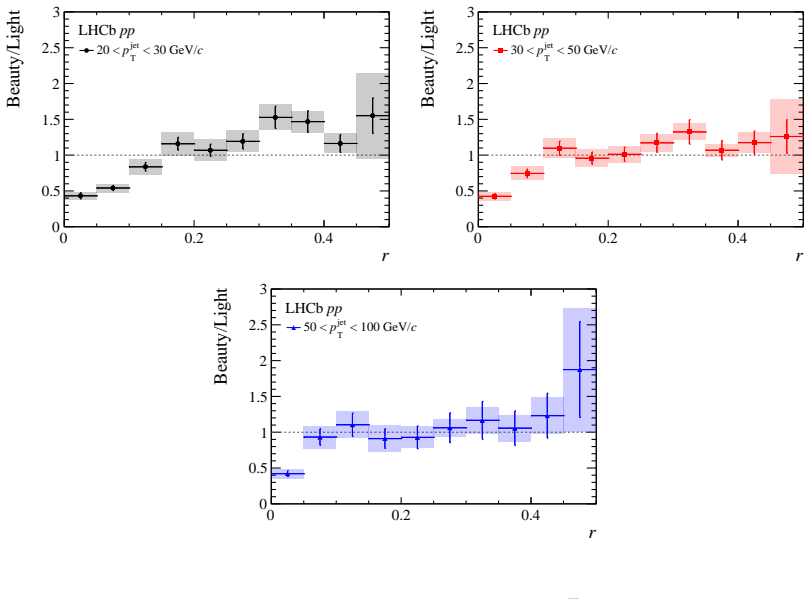
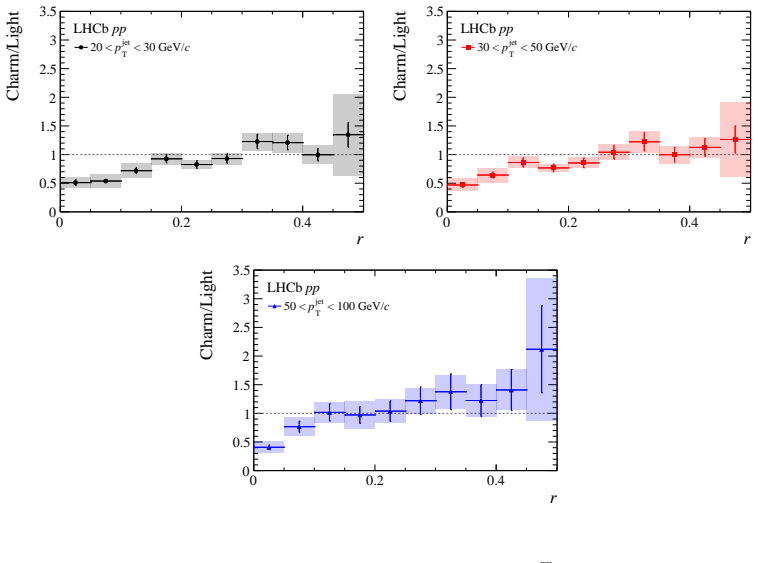
Charged-hadron distributions in heavy-flavor jets are measured in proton-proton collisions at a center-of-mass energy of $\sqrt{s}$ = 13 TeV collected by the LHCb experiment. Distributions of the longitudinal momentum fraction, transverse momentum, and radial profile of charged hadrons are measured separately in beauty and charm jets. The distributions are compared to those previously measured by the LHCb collaboration in jets produced back-to-back with a $Z$ boson, which in the forward region are primarily light-quark-initiated, to compare the hadronization mechanisms of heavy and light quarks. The observed differences between the heavy- and light-jet distributions are consistent with the heavy-quark dynamics expected to arise from the dead-cone effect, as well as with a hard fragmentation of the heavy-flavor hadron as previously measured in single-hadron fragmentation functions. This measurement provides additional constraints for the extraction of collinear and transverse-momentum-dependent heavy-flavor fragmentation functions and offers another approach to probing the mechanisms that govern heavy-flavor hadronization.
Editorial analysis
A structured set of objections, weighed in public.
Referee Report
Summary. The paper reports measurements of charged-hadron distributions (longitudinal momentum fraction, transverse momentum, and radial profiles) in beauty and charm jets in 13 TeV pp collisions collected with LHCb. These are compared to prior LHCb measurements in light-quark jets from Z+jet events in the forward region, with the observed differences interpreted as consistent with dead-cone suppression and hard fragmentation of heavy quarks, thereby providing constraints on collinear and TMD heavy-flavor fragmentation functions.
Significance. If the central comparisons hold after rigorous control of tagging purity and kinematic matching, the result supplies new experimental input on heavy-quark hadronization inside jets that complements single-hadron fragmentation-function measurements and can tighten constraints on heavy-flavor fragmentation functions used in global fits.
major comments (2)
- [Data selection and tagging] The manuscript provides no quantitative information on heavy-flavor jet tagging purity, efficiency, or residual light-jet contamination after background subtraction. Without these numbers it is impossible to verify that the reported shifts in longitudinal momentum fraction and radial profiles are not driven by >10-15% light-jet admixture rather than dead-cone or fragmentation dynamics.
- [Comparison to Z+jet reference] The comparison to the Z+jet light-quark reference sample requires explicit demonstration that the jet pT and pseudorapidity spectra (and detector acceptance) are sufficiently matched between the heavy-flavor and Z+jet samples; any systematic mismatch would confound the isolation of hadronization effects from production-kinematic biases.
minor comments (1)
- [Figures] All figures should display both statistical and systematic uncertainty bands and clearly label the heavy-flavor versus light-jet data sets.
Simulated Author's Rebuttal
We thank the referee for the constructive comments, which have helped clarify key aspects of the analysis. We address each major comment below and have revised the manuscript to incorporate the requested details and demonstrations.
read point-by-point responses
-
Referee: [Data selection and tagging] The manuscript provides no quantitative information on heavy-flavor jet tagging purity, efficiency, or residual light-jet contamination after background subtraction. Without these numbers it is impossible to verify that the reported shifts in longitudinal momentum fraction and radial profiles are not driven by >10-15% light-jet admixture rather than dead-cone or fragmentation dynamics.
Authors: We agree that explicit quantitative metrics on tagging performance are necessary to substantiate the results. The original manuscript focused on the physics interpretation and omitted detailed numbers for brevity. In the revised version we have added a new subsection in the analysis description that reports the tagging purity (85% for beauty jets and 72% for charm jets after background subtraction, determined from simulation validated with data-driven methods), efficiency, and residual light-jet contamination (below 9%). We further include a dedicated study showing that even a hypothetical 15% light-jet admixture cannot reproduce the magnitude or shape of the observed differences in the longitudinal momentum fraction and radial profiles, which remain statistically significant after correction. revision: yes
-
Referee: [Comparison to Z+jet reference] The comparison to the Z+jet light-quark reference sample requires explicit demonstration that the jet pT and pseudorapidity spectra (and detector acceptance) are sufficiently matched between the heavy-flavor and Z+jet samples; any systematic mismatch would confound the isolation of hadronization effects from production-kinematic biases.
Authors: We concur that kinematic matching is essential to isolate hadronization effects. The revised manuscript now includes explicit comparisons of the jet pT and pseudorapidity distributions between the heavy-flavor and Z+jet samples, shown in new figures. These distributions agree within the LHCb forward acceptance to better than 5% across the relevant ranges. We have additionally applied a reweighting procedure to the Z+jet reference sample to enforce identical kinematic spectra, and the differences in charged-hadron distributions persist after reweighting, confirming that the observed effects arise from heavy-quark fragmentation dynamics rather than production kinematics. revision: yes
Circularity Check
No significant circularity in direct experimental measurement
full rationale
This LHCb paper reports empirical distributions of charged hadrons in heavy-flavor jets measured in pp collisions, with direct comparison to prior independent LHCb data on Z+jet events (primarily light-quark jets). No derivation, ansatz, model fit, or parameter extraction is performed that reduces the reported results to quantities defined by the same dataset. The central claims rest on data analysis and external comparison rather than any self-referential chain. Minor self-citation to previous LHCb work exists but is not load-bearing for any derivation.
Axiom & Free-Parameter Ledger
axioms (1)
- domain assumption Heavy-quark mass suppresses gluon radiation at small angles (dead-cone effect) and leads to harder fragmentation of the heavy hadron.
Lean theorems connected to this paper
-
IndisputableMonolith/Cost/FunctionalEquation.leanwashburn_uniqueness_aczel unclear?
unclearRelation between the paper passage and the cited Recognition theorem.
The observed differences between the heavy- and light-jet distributions are consistent with the heavy-quark dynamics expected to arise from the dead-cone effect, as well as with a hard fragmentation of the heavy-flavor hadron as previously measured in single-hadron fragmentation functions.
-
IndisputableMonolith/Foundation/AlexanderDuality.leanalexander_duality_circle_linking unclear?
unclearRelation between the paper passage and the cited Recognition theorem.
Recent measurements have confirmed the presence of the dead-cone effect, in which quark radiation is suppressed for emission angles smaller than the quark mass divided by its energy.
What do these tags mean?
- matches
- The paper's claim is directly supported by a theorem in the formal canon.
- supports
- The theorem supports part of the paper's argument, but the paper may add assumptions or extra steps.
- extends
- The paper goes beyond the formal theorem; the theorem is a base layer rather than the whole result.
- uses
- The paper appears to rely on the theorem as machinery.
- contradicts
- The paper's claim conflicts with a theorem or certificate in the canon.
- unclear
- Pith found a possible connection, but the passage is too broad, indirect, or ambiguous to say the theorem truly supports the claim.
Forward citations
Cited by 2 Pith papers
-
QCD, electroweak physics, and searches for exotic signatures in the forward region at LHCb
LHCb reports forward-region measurements of QCD jets, top and W bosons, plus searches for ALPs, HNLs, and rare B decays to multi-muons.
-
QCD, electroweak physics, and searches for exotic signatures in the forward region at LHCb
LHCb reports forward measurements of heavy-flavour jets, electroweak bosons, and searches for ALPs, HNLs, and rare multi-muon B decays.
Reference graph
Works this paper leans on
-
[1]
Brocket al.,Handbook of perturbative QCD, Rev
CTEQ collaboration, R. Brocket al.,Handbook of perturbative QCD, Rev. Mod. Phys.67(1995) 157
work page 1995
-
[2]
Parton Fragmentation Functions
A. Metz and A. Vossen,Parton fragmentation functions, Prog. Part. Nucl. Phys.91 (2016) 136,arXiv:1607.02521
work page internal anchor Pith review Pith/arXiv arXiv 2016
-
[3]
Charged hadron fragmentation functions from collider data
NNPDF collaboration, V. Bertoneet al.,Charged hadron fragmentation functions from collider data, Eur. Phys. J.C78(2018) 651, Erratum ibid.84(2024) 155, arXiv:1807.03310
work page internal anchor Pith review Pith/arXiv arXiv 2018
-
[4]
M. Soleymaninia, M. Goharipour, and H. Khanpour,First QCD analysis of charged hadron fragmentation functions and their uncertainties at next-to-next-to-leading order, Phys. Rev.D98(2018) 074002,arXiv:1805.04847
work page internal anchor Pith review Pith/arXiv arXiv 2018
-
[5]
M. Soleymaninia, M. Goharipour, and H. Khanpour,Impact of unidentified light charged hadron data on the determination of pion fragmentation functions, Phys. Rev. D99(2019) 034024,arXiv:1901.01120
work page internal anchor Pith review Pith/arXiv arXiv 2019
-
[6]
M. Soleymaninia, M. Goharipour, H. Khanpour, and H. Spiesberger,Simultaneous extraction of fragmentation functions of light charged hadrons with mass corrections, Phys. Rev.D103(2021) 054045,arXiv:2008.05342
-
[7]
Gaoet al.,Simultaneous determination of fragmentation functions and test on momentum sum rule, Phys
J. Gaoet al.,Simultaneous determination of fragmentation functions and test on momentum sum rule, Phys. Rev. Lett.132(2024) 261903,arXiv:2401.02781
-
[8]
J. Gaoet al.,Global analysis of fragmentation functions to charged hadrons with high- precision data from the LHC, Phys. Rev.D110(2024) 114019,arXiv:2407.04422
-
[9]
Quark Fragmentation within an Identified Jet
M. Procura and I. W. Stewart,Quark fragmentation within an identified jet, Phys. Rev.D81(2010) 074009, Erratum ibid.83(2011) 039902,arXiv:0911.4980
work page internal anchor Pith review Pith/arXiv arXiv 2010
-
[10]
A. Jain, M. Procura, and W. J. Waalewijn,Parton fragmentation within an identified jet at NNLL, JHEP05(2011) 035,arXiv:1101.4953
work page internal anchor Pith review Pith/arXiv arXiv 2011
-
[11]
Fragmentation in Jets: Cone and Threshold Effects
M. Procura and W. J. Waalewijn,Fragmentation in jets: Cone and threshold effects, Phys. Rev.D85(2012) 114041,arXiv:1111.6605
work page internal anchor Pith review Pith/arXiv arXiv 2012
-
[12]
Hadron Fragmentation Inside Jets in Hadronic Collisions
T. Kaufmann, A. Mukherjee, and W. Vogelsang,Hadron fragmentation inside jets in hadronic collisions, Phys. Rev.D92(2015) 054015, Erratum ibid.101(2020) 079901, arXiv:1506.01415
work page internal anchor Pith review Pith/arXiv arXiv 2015
-
[13]
Z.-B. Kang, F. Ringer, and I. Vitev,Jet substructure using semi-inclusive jet functions in SCET, JHEP11(2016) 155,arXiv:1606.07063
work page internal anchor Pith review Pith/arXiv arXiv 2016
-
[14]
Z.-B. Kang, X. Liu, F. Ringer, and H. Xing,The transverse momentum distribution of hadrons within jets, JHEP11(2017) 068,arXiv:1705.08443
work page internal anchor Pith review Pith/arXiv arXiv 2017
-
[15]
DELPHI collaboration, J. Abdallahet al.,A study of the b-quark fragmentation function with the DELPHI detector at LEP I and an averaged distribution obtained at the Z pole, Eur. Phys. J.C71(2011) 1557,arXiv:1102.4748. 26
work page internal anchor Pith review Pith/arXiv arXiv 2011
-
[16]
Inclusive Analysis of the b Quark Fragmentation Function in Z Decays at LEP
OPAL collaboration, G. Abbiendiet al.,Inclusive analysis of the b quark fragmentation function in Z decays at LEP, Eur. Phys. J.C29(2003) 463, arXiv:hep-ex/0210031
work page internal anchor Pith review Pith/arXiv arXiv 2003
-
[17]
Study of the fragmentation of b quarks into B mesons at the Z peak
ALEPH collaboration, A. Heisteret al.,Study of the fragmentation of b quarks into B mesons at the Z peak, Phys. Lett.B512(2001) 30,arXiv:hep-ex/0106051
work page internal anchor Pith review Pith/arXiv arXiv 2001
-
[18]
Measurement of the b-quark fragmentation function in Z0 decays
SLD collaboration, K. Abeet al.,Measurement of the b quark fragmentation function in Z 0 decays, Phys. Rev.D65(2002) 092006, Erratum ibid.66(2002) 079905, arXiv:hep-ex/0202031
work page internal anchor Pith review Pith/arXiv arXiv 2002
-
[19]
Study of Charm Production in Z Decays
ALEPH collaboration, R. Barateet al.,Study of charm production in Z decays, Eur. Phys. J.C16(2000) 597,arXiv:hep-ex/9909032
work page internal anchor Pith review Pith/arXiv arXiv 2000
-
[20]
Akerset al.,A measurement of the production of D∗± mesons on theZ 0 resonance, Z
OPAL collaboration, R. Akerset al.,A measurement of the production of D∗± mesons on theZ 0 resonance, Z. Phys.C67(1995) 27
work page 1995
-
[21]
ARGUS collaboration, H. Albrechtet al.,Inclusive production of D0, D+ and D∗(2010)+ mesons in B decays and nonresonant e+e− annihilation at 10.6 GeV, Z. Phys.C52(1991) 353
work page 2010
- [22]
-
[23]
ATLAS collaboration, G. Aadet al.,Measurement of D∗± meson production in jets from pp collisions at √s = 7 TeV with the ATLAS detector, Phys. Rev.D85(2012) 052005,arXiv:1112.4432
work page internal anchor Pith review Pith/arXiv arXiv 2012
-
[24]
ALICE collaboration, S. Acharyaet al.,Measurement of the production of charm jets tagged with D 0 mesons in pp collisions at √s = 7TeV, JHEP08(2019) 133, arXiv:1905.02510
-
[25]
ALICE collaboration, S. Acharyaet al.,Measurement of the production of charm jets tagged with D 0 mesons in pp collisions at √s = 5.02 and 13 TeV, JHEP06(2023) 133,arXiv:2204.10167
-
[26]
ALICE collaboration, S. Acharyaet al.,Measurement of the fraction of jet longitudinal momentum carried byΛ + c baryons in pp collisions, Phys. Rev.D109(2024) 072005, arXiv:2301.13798
-
[27]
ATLAS collaboration, G. Aadet al.,Measurements of jet observables sensitive to b-quark fragmentation in t¯t events at the LHC with the ATLAS detector, Phys. Rev. D106(2022) 032008,arXiv:2202.13901
-
[28]
CMS collaboration,Jet fragmentation function and groomed substructure of bottom quark jets in proton-proton collisions at 5.02 TeV, CMS-PAS-HIN-24-005, 2024
work page 2024
-
[29]
S. D. Ellis, Z. Kunszt, and D. E. Soper,Jets at hadron colliders at order α3 s: A look inside, Phys. Rev. Lett.69(1992) 3615,arXiv:hep-ph/9208249
work page internal anchor Pith review Pith/arXiv arXiv 1992
- [30]
-
[31]
ALICE collaboration, S. Acharyaet al.,Energy-energy correlators in charm-tagged jets in proton-proton collisions at √s= 13TeV,arXiv:2504.03431
-
[32]
ALICE collaboration, S. Acharyaet al.,Direct observation of the dead-cone effect in quantum chromodynamics, Nature605(2022) 440, Erratum ibid.607(2022) E22, arXiv:2106.05713
-
[33]
LHCb collaboration, R. Aaijet al.,Measurement of the Lund plane for light- and beauty-quark jets,arXiv:2505.23530, Submitted to Phys. Rev. D
-
[34]
Y. L. Dokshitzer, V. A. Khoze, and S. I. Troian,On specific QCD properties of heavy quark fragmentation (‘dead cone’), J. Phys.G17(1991) 1602
work page 1991
-
[35]
ATLAS collaboration, G. Aadet al.,Measurement of the jet fragmentation function and transverse profile in proton-proton collisions at a center-of-mass energy of 7 TeV with the ATLAS detector, Eur. Phys. J.C71(2011) 1795,arXiv:1109.5816
work page internal anchor Pith review Pith/arXiv arXiv 2011
-
[36]
ATLAS collaboration, G. Aadet al.,Properties of jet fragmentation using charged particles measured with the ATLAS detector in pp collisions at √s = 13TeV, Phys. Rev.D100(2019) 052011,arXiv:1906.09254
-
[37]
LHCb collaboration, R. Aaijet al.,Measurement of charged hadron production in Z-tagged jets in proton-proton collisions at √s = 8 TeV, Phys. Rev. Lett.123(2019) 232001,arXiv:1904.08878
-
[38]
LHCb collaboration, R. Aaijet al.,Multidifferential study of identified charged hadron distributions in Z-tagged jets in proton-proton collisions at √s = 13 TeV, Phys. Rev. D108(2023) L031103,arXiv:2208.11691
-
[39]
ALICE collaboration, S. Acharyaet al.,Jet fragmentation transverse momentum distributions in pp and pPb collisions at √s, √sNN = 5.02 TeV, JHEP09(2021) 211,arXiv:2011.05904
-
[40]
ALICE collaboration, S. Acharyaet al.,Multiplicity dependence of charged-particle intra-jet properties in pp collisions at √s = 13 TeV, Eur. Phys. J.C84(2024) 1079, arXiv:2311.13322
-
[41]
Charged jet cross section and fragmentation in proton-proton collisions at $\sqrt{s}$ = 7 TeV
ALICE collaboration, S. Acharyaet al.,Charged jet cross section and fragmenta- tion in proton-proton collisions at √s = 7 TeV, Phys. Rev.D99(2019) 012016, arXiv:1809.03232
work page internal anchor Pith review Pith/arXiv arXiv 2019
-
[42]
LHCb collaboration, R. Aaijet al.,Measurement of differential bb and cc dijet cross- sections in the forward region of pp collisions at √s = 13 TeV, JHEP02(2021) 023, arXiv:2010.09437
-
[43]
LHCb collaboration, A. A. Alves Jr.et al.,The LHCb detector at the LHC, JINST3 (2008) S08005
work page 2008
-
[44]
LHCb collaboration, R. Aaijet al.,LHCb detector performance, Int. J. Mod. Phys. A30(2015) 1530022,arXiv:1412.6352. 28
work page internal anchor Pith review Pith/arXiv arXiv 2015
-
[45]
Performance of the LHCb Vertex Locator
R. Aaijet al.,Performance of the LHCb Vertex Locator, JINST9(2014) P09007, arXiv:1405.7808
work page internal anchor Pith review Pith/arXiv arXiv 2014
-
[46]
Improved performance of the LHCb Outer Tracker in LHC Run 2
P. d’Argentet al.,Improved performance of the LHCb Outer Tracker in LHC Run 2, JINST12(2017) P11016,arXiv:1708.00819
work page internal anchor Pith review Pith/arXiv arXiv 2017
-
[47]
Performance of the LHCb RICH detector at the LHC
M. Adinolfiet al.,Performance of the LHCb RICH detector at the LHC, Eur. Phys. J.C73(2013) 2431,arXiv:1211.6759
work page internal anchor Pith review Pith/arXiv arXiv 2013
-
[48]
A. A. Alves Jr.et al.,Performance of the LHCb muon system, JINST8(2013) P02022,arXiv:1211.1346
work page internal anchor Pith review Pith/arXiv arXiv 2013
-
[49]
The LHCb Trigger and its Performance in 2011
R. Aaijet al.,The LHCb trigger and its performance in 2011, JINST8(2013) P04022, arXiv:1211.3055
work page internal anchor Pith review Pith/arXiv arXiv 2011
-
[50]
The LHCb Stripping Project: Sustainable Legacy Data Processing for High-Energy Physics
N. Grieseret al.,The LHCb stripping project: Sustainable legacy data processing for high-energy physics,arXiv:2509.05294
work page internal anchor Pith review arXiv
-
[51]
A Brief Introduction to PYTHIA 8.1
T. Sj¨ ostrand, S. Mrenna, and P. Skands,A brief introduction to PYTHIA 8.1, Comput. Phys. Commun.178(2008) 852, arXiv:0710.3820; T. Sj¨ ostrand, S. Mrenna, and P. Skands,PYTHIA 6.4 physics and manual, JHEP05(2006) 026, arXiv:hep-ph/0603175
work page internal anchor Pith review Pith/arXiv arXiv 2008
-
[52]
I. Belyaevet al.,Handling of the generation of primary events in Gauss, the LHCb simulation framework, J. Phys. Conf. Ser.331(2011) 032047
work page 2011
-
[53]
D. J. Lange,The EvtGen particle decay simulation package, Nucl. Instrum. Meth. A462(2001) 152
work page 2001
-
[54]
PHOTOS Interface in C++; Technical and Physics Documentation
N. Davidson, T. Przedzinski, and Z. Was,PHOTOS interface in C++: Technical and physics documentation, Comput. Phys. Commun.199(2016) 86, arXiv:1011.0937
work page internal anchor Pith review Pith/arXiv arXiv 2016
-
[55]
Allisonet al.,Geant4 developments and applications, IEEE Trans
Geant4 collaboration, J. Allisonet al.,Geant4 developments and applications, IEEE Trans. Nucl. Sci.53(2006) 270; Geant4 collaboration, S. Agostinelliet al.,Geant4: A simulation toolkit, Nucl. Instrum. Meth.A506(2003) 250
work page 2006
-
[56]
Clemencicet al.,The LHCb simulation application, Gauss: Design, evolution and experience, J
M. Clemencicet al.,The LHCb simulation application, Gauss: Design, evolution and experience, J. Phys. Conf. Ser.331(2011) 032023
work page 2011
-
[57]
Study of forward Z+jet production in pp collisions at $\sqrt{s} = 7$ TeV
LHCb collaboration, R. Aaijet al.,Study of forward Z +jet production in pp collisions at √s=7 TeV, JHEP01(2014) 033,arXiv:1310.8197
work page internal anchor Pith review Pith/arXiv arXiv 2014
-
[58]
The anti-k_t jet clustering algorithm
M. Cacciari, G. P. Salam, and G. Soyez,The anti- kt jet clustering algorithm, JHEP 04(2008) 063,arXiv:0802.1189
work page internal anchor Pith review Pith/arXiv arXiv 2008
-
[59]
M. Cacciari, G. P. Salam, and G. Soyez,FastJet user manual, Eur. Phys. J.C72 (2012) 1896,arXiv:1111.6097
work page internal anchor Pith review Pith/arXiv arXiv 2012
-
[60]
Identification of beauty and charm quark jets at LHCb
LHCb collaboration, R. Aaijet al.,Identification of beauty and charm quark jets at LHCb, JINST10(2015) P06013,arXiv:1504.07670
work page internal anchor Pith review Pith/arXiv arXiv 2015
-
[61]
L. Breiman, J. H. Friedman, R. A. Olshen, and C. J. Stone,Classification and regression trees, Wadsworth international group, Belmont, California, USA, 1984. 29
work page 1984
-
[62]
Y. Freund and R. E. Schapire,A decision-theoretic generalization of on-line learning and an application to boosting, J. Comput. Syst. Sci.55(1997) 119
work page 1997
-
[63]
LHCb collaboration, R. Aaijet al.,Measurement of forward W and Z boson production in association with jets in proton-proton collisions at √s=8 TeV , JHEP05(2016) 131,arXiv:1605.00951
work page internal anchor Pith review Pith/arXiv arXiv 2016
-
[64]
D’Agostini,A Multidimensional unfolding method based on Bayes’ theorem, Nucl
G. D’Agostini,A Multidimensional unfolding method based on Bayes’ theorem, Nucl. Instrum. Meth.A362(1995) 487
work page 1995
-
[65]
Measurement of the track reconstruction efficiency at LHCb
LHCb collaboration, R. Aaijet al.,Measurement of the track reconstruction efficiency at LHCb, JINST10(2015) P02007,arXiv:1408.1251
work page internal anchor Pith review Pith/arXiv arXiv 2015
-
[66]
R. Aaijet al.,Selection and processing of calibration samples to measure the particle identification performance of the LHCb experiment in Run 2, Eur. Phys. J. Tech. Instr.6(2019) 1,arXiv:1803.00824
work page internal anchor Pith review Pith/arXiv arXiv 2019
-
[67]
M. Battaglia, R. Orava, and L. Salmi,A study of depletion of fragmentation particles at small angles in b-jets with the DELPHI detector at LEP, DELPHI-2004-037-CONF- 712, 2004. 30 LHCb collaboration R. Aaij38 , A.S.W. Abdelmotteleb 57 , C. Abellan Beteta 51 , F. Abudin´ en57 , T. Ackernley61 , A. A. Adefisoye 69 , B. Adeva47 , M. Adinolfi 55 , P. Adlarson...
work page 2004
discussion (0)
Sign in with ORCID, Apple, or X to comment. Anyone can read and Pith papers without signing in.