The High W Challenge: Robust Neutrino Energy Estimators for LArTPCs
Pith reviewed 2026-05-17 22:39 UTC · model grok-4.3
The pith
A new W²-based neutrino energy estimator using hadronic invariant mass shows the smallest bias and greatest stability against mismodelling in LArTPCs.
A machine-rendered reading of the paper's core claim, the machinery that carries it, and where it could break.
Core claim
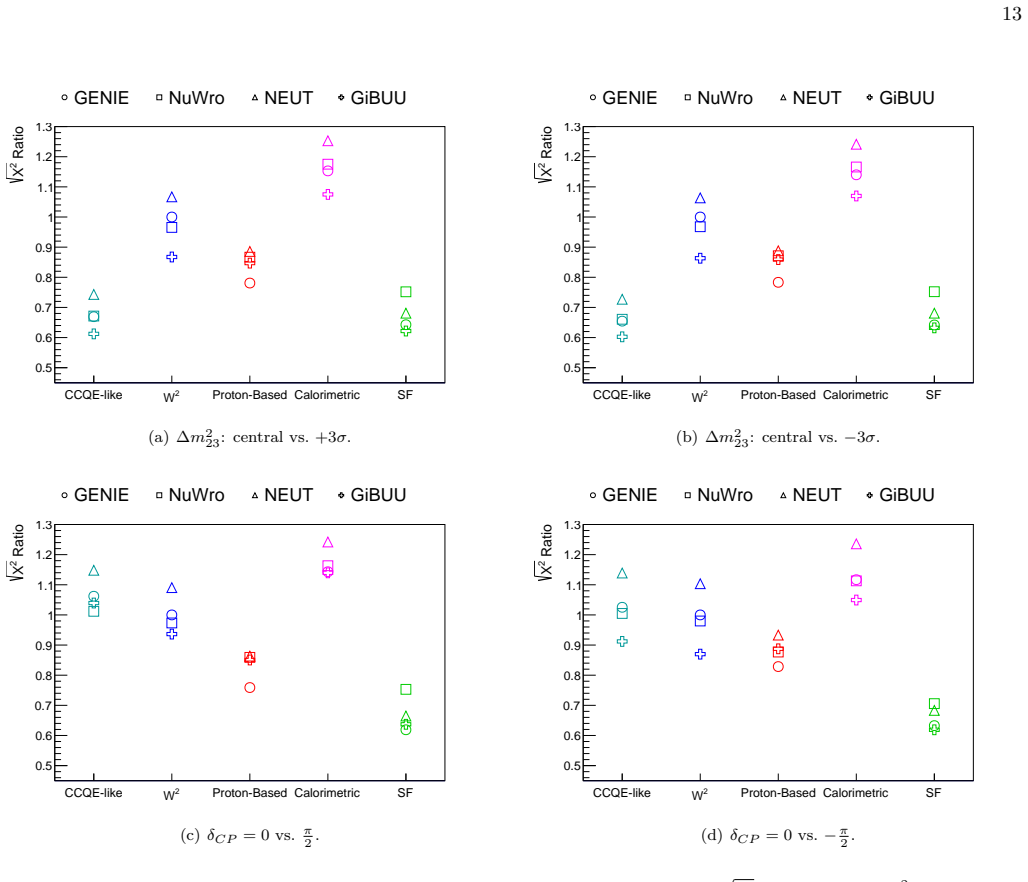
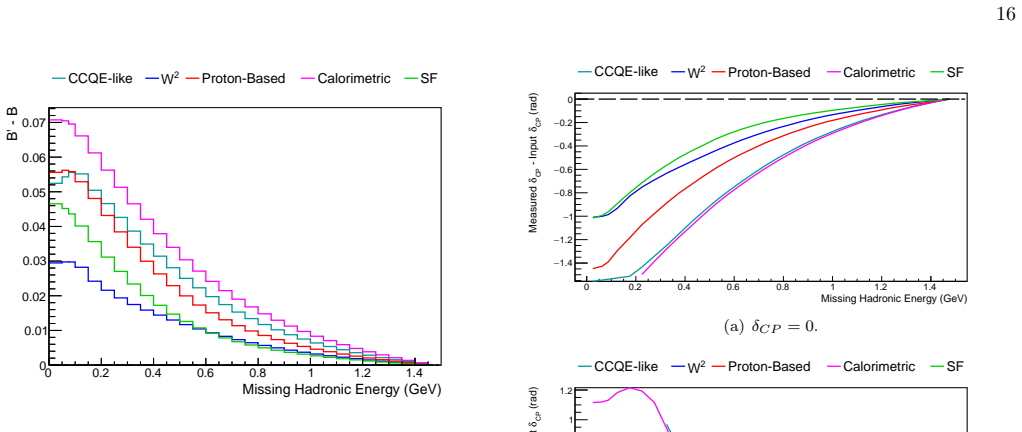
The W²-based estimator shows the smallest bias as a function of true neutrino energy and is particularly stable against the mismodelling of lepton scattering angle and momentum, missing energy, hadronic invariant mass and final state interactions, though this comes with somewhat worse energy resolution when perfect modeling is assumed.
What carries the argument
The W²-based estimator, which reconstructs neutrino energy from the measured final-state hadronic invariant mass for inclusive events containing at least one proton and any number of pions.
If this is right
- Choice of energy estimator directly affects the extracted values of δ_CP and Δm²_23 in long-baseline oscillation measurements.
- An inclusive estimator valid for events with protons and pions can be combined with exclusive methods to cover different event classes.
- Detailed comparison of bias and resolution across estimators informs which to use or combine in future LArTPC analyses.
Where Pith is reading between the lines
- Pairing the W² estimator with high-resolution exclusive techniques could improve both bias control and overall precision in a single analysis.
- Application to actual detector data with varied beam conditions would test stability beyond the toy mismodelling scenarios used here.
- The invariant-mass approach may extend to other neutrino detectors operating in similar energy ranges where model uncertainties dominate.
Load-bearing premise
The toy long-baseline oscillation analysis and the assumed mismodelling scenarios sufficiently capture the dominant uncertainties present in real LArTPC data taking and reconstruction.
What would settle it
A test that applies all five estimators to real LArTPC data from a neutrino beam where true energy can be inferred independently, such as from a near detector with known flux, and checks whether the W² estimator retains the smallest bias.
Figures






read the original abstract
Accurate determination of the neutrino energy is central to precision oscillation measurements. In this work, we introduce the W$^2$-based estimator, a new neutrino energy estimator based on the measurement of the final-state hadronic invariant mass. This estimator is particularly designed to be employed in liquid-argon time-projection chambers exposed to broadband beams that span the challenging transition region between shallow inelastic scattering and deep inelastic scattering. The performance of the W$^2$-based estimator is compared to four other commonly used estimators. The impact of the estimator choice is evaluated by performing measurements of $\delta_{CP}$ and $\Delta m^2_{23}$ in a toy long-baseline oscillation analysis. We find that the W$^2$-based estimator shows the smallest bias as a function of true neutrino energy and it is particularly stable against the mismodelling of lepton scattering angle and momentum, missing energy, hadronic invariant mass and final state interactions. However, studies of the resolution of each estimator as a function of true neutrino energy show this is somewhat offset by worse energy resolution when perfect modeling of these quantities is assumed. This estimator is valid for events with at least one proton and any number of pions; an inclusive channel that complements the strength of more exclusive methods that optimize the energy resolution. By providing a detailed analysis of the strengths, weaknesses and domain of applicability of each estimator, this work informs the combined use of energy estimators in any future LArTPC-based oscillation analysis.
Editorial analysis
A structured set of objections, weighed in public.
Referee Report
Summary. The manuscript introduces the W²-based neutrino energy estimator, derived from the final-state hadronic invariant mass, for use in LArTPCs with broadband beams spanning the shallow-to-deep inelastic scattering transition. It compares performance against four other common estimators in terms of bias versus true neutrino energy, resolution, and stability under mismodelling of lepton kinematics, missing energy, hadronic invariant mass, and final state interactions. These properties are assessed via their impact on δ_CP and Δm²_23 extraction in a toy long-baseline oscillation analysis; the W² estimator is reported to exhibit the smallest bias and greatest stability, at the cost of somewhat worse resolution, for an inclusive selection requiring at least one proton and any number of pions.
Significance. If the reported robustness to mismodelling holds under more realistic conditions, the W² estimator would provide a useful inclusive complement to exclusive methods that optimize resolution, informing combined-estimator strategies for precision oscillation analyses in experiments such as DUNE. The explicit trade-off analysis between bias stability and resolution is a constructive contribution to the field.
major comments (1)
- [Toy oscillation analysis and mismodelling description] Toy long-baseline oscillation analysis and mismodelling implementation: the stability claims rest on independent parameter variations for lepton scattering angle/momentum, missing energy, hadronic invariant mass, and FSI. This does not incorporate realistic correlations (e.g., between hadronic energy scale and lepton kinematics arising from recombination, space charge, or PID inefficiencies in LArTPCs). Because the central robustness result is demonstrated only within this toy framework, the generalizability of the smallest-bias and stability conclusions requires either additional correlated-mismodelling tests or explicit justification that the independent variations suffice.
minor comments (2)
- [Abstract] The abstract refers to 'four other commonly used estimators' without naming them; listing the specific alternatives (e.g., calorimetric, kinematic, etc.) would improve immediate clarity for readers.
- [Results figures] Ensure that all plots of bias and resolution versus true neutrino energy include explicit statements of the event selection and the exact definition of the W² estimator (including any cuts on hadronic invariant mass) in the figure captions or accompanying text.
Simulated Author's Rebuttal
We appreciate the referee's thoughtful review and positive comments on the significance of our manuscript. We address the major comment regarding the toy oscillation analysis and mismodelling implementation below.
read point-by-point responses
-
Referee: Toy long-baseline oscillation analysis and mismodelling implementation: the stability claims rest on independent parameter variations for lepton scattering angle/momentum, missing energy, hadronic invariant mass, and FSI. This does not incorporate realistic correlations (e.g., between hadronic energy scale and lepton kinematics arising from recombination, space charge, or PID inefficiencies in LArTPCs). Because the central robustness result is demonstrated only within this toy framework, the generalizability of the smallest-bias and stability conclusions requires either additional correlated-mismodelling tests or explicit justification that the independent variations suffice.
Authors: We thank the referee for highlighting this important aspect of our analysis. Our toy long-baseline oscillation study indeed relies on independent variations of the mismodelling parameters to assess the stability of the estimators. This methodology enables us to evaluate the effect of each mismodelling source in isolation, providing clear insights into which aspects the W²-based estimator is particularly robust against. We acknowledge that realistic correlations between these parameters, arising from detector effects in LArTPCs, are not included in the current implementation. To address this, we will add an explicit discussion in the revised manuscript justifying the use of independent variations for the purposes of this study and noting the limitations regarding generalizability to fully correlated scenarios. We believe that this approach still supports our conclusions about the relative performance of the estimators, as the independent variations represent a conservative test of robustness. revision: partial
Circularity Check
No circularity in estimator definition or validation
full rationale
The W²-based estimator is defined directly from the physical observable of final-state hadronic invariant mass for events with at least one proton. Performance claims (smallest bias as function of true neutrino energy, stability under mismodelling of lepton kinematics, missing energy, hadronic mass, and FSI) are obtained by explicit comparison against four other estimators inside an independent toy long-baseline oscillation analysis that uses separate Monte Carlo samples. No step equates a derived quantity to its own fitting procedure, no load-bearing self-citation supplies a uniqueness theorem, and the central results are externally falsifiable against the toy benchmarks rather than being tautological.
Axiom & Free-Parameter Ledger
axioms (1)
- domain assumption The toy long-baseline oscillation analysis accurately represents the dominant experimental uncertainties and reconstruction effects in real LArTPC data.
Lean theorems connected to this paper
-
IndisputableMonolith/Cost/FunctionalEquation.leanwashburn_uniqueness_aczel unclear?
unclearRelation between the paper passage and the cited Recognition theorem.
EW²_est = W_vis² − n_p²(m_n − E_b)² − m_l² + 2 n_p (m_n − E_b) E_l / [2(n_p m_n − n_p E_b − E_l + p_l cos θ)]
What do these tags mean?
- matches
- The paper's claim is directly supported by a theorem in the formal canon.
- supports
- The theorem supports part of the paper's argument, but the paper may add assumptions or extra steps.
- extends
- The paper goes beyond the formal theorem; the theorem is a base layer rather than the whole result.
- uses
- The paper appears to rely on the theorem as machinery.
- contradicts
- The paper's claim conflicts with a theorem or certificate in the canon.
- unclear
- Pith found a possible connection, but the passage is too broad, indirect, or ambiguous to say the theorem truly supports the claim.
Reference graph
Works this paper leans on
- [1]
- [2]
- [3]
- [4]
-
[5]
A. P. Furmanski and J. T. Sobczyk, Neutrino energy re- construction from one muon and one proton events, Phys. Rev. C95, 065501 (2017), arXiv:1609.03530 [hep-ex]
work page internal anchor Pith review Pith/arXiv arXiv 2017
- [6]
-
[7]
The GENIE Neutrino Monte Carlo Generator
C. Andreopouloset al., The GENIE Neutrino Monte Carlo Generator, Nucl. Instrum. Meth. A614, 87 (2010), arXiv:0905.2517 [hep-ph]
work page internal anchor Pith review Pith/arXiv arXiv 2010
-
[8]
J. Sobczyk, A. Ankowski, K. Graczyk, C. Juszczak, K. Niewczas, R. Banerjee, H. Prasad,et al., NuWro: Monte Carlo Neutrino Event Generator User’s Guide,https://nuwro.github.io/user-guide/(2024), accessed 2025
work page 2024
- [9]
-
[10]
O. Buss, T. Gaitanos, K. Gallmeister, H. van Hees, M. Kaskulov, O. Lalakulich, A. Larionov, T. Leupold, J. Weil, and U. Mosel, Transport-theoretical Description of Nuclear Reactions, Phys. Rept.512, 1 (2012)
work page 2012
-
[11]
Understanding the energy resolution of liquid argon neutrino detectors
A. Friedland and S. W. Li, Understanding the energy resolution of liquid argon neutrino detectors, Phys. Rev. D99, 036009 (2019), arXiv:1811.06159 [hep-ph]
work page internal anchor Pith review Pith/arXiv arXiv 2019
-
[12]
P. Abratenkoet al.(MicroBooNE), Measurement of sin- gle charged pion production in charged-currentν µ-Ar interactions with the MicroBooNE detector, (2025), arXiv:2509.03628 [hep-ex]
- [13]
-
[14]
P. Abratenkoet al.(MicroBooNE), First study of neu- trino angle reconstruction using quasielasticlike interac- tions in MicroBooNE, Phys. Rev. D111, 113007 (2025), arXiv:2504.17758 [hep-ex]
-
[15]
P. Abratenkoet al.(MicroBooNE), Differential Cross Section Measurement of Charged Currentνe Interac- tions Without Pions in MicroBooNE, Phys. Rev. D106, L051102 (2022), arXiv:2208.02348 [hep-ex]
- [16]
-
[17]
P. Abratenkoet al.(MicroBooNE), Search for an anoma- lous excess of charged-currentνe interactions without pi- ons in the final state with the MicroBooNE experiment, Phys. Rev. D105, 112004 (2022), arXiv:2110.14065 [hep- 19 ex]
- [18]
-
[19]
See Supplemental Material
-
[20]
Navaset al.(Particle Data Group), Review of particle physics, Phys
S. Navaset al.(Particle Data Group), Review of particle physics, Phys. Rev. D110, 030001 (2024)
work page 2024
discussion (0)
Sign in with ORCID, Apple, or X to comment. Anyone can read and Pith papers without signing in.