Automated Side-Channel Analysis of Cryptographic Protocol Implementations
Pith reviewed 2026-05-17 22:09 UTC · model grok-4.3
The pith
A toolchain lifts real cryptographic binaries to symbolic models and checks them for leaks under explicit constant-time and speculative observation contracts.
A machine-rendered reading of the paper's core claim, the machinery that carries it, and where it could break.
Core claim
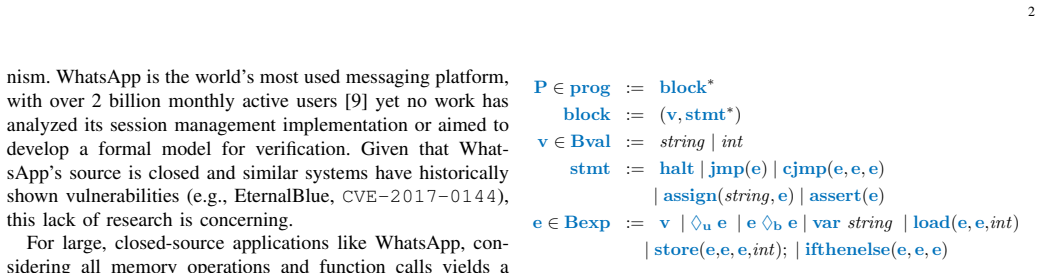
Starting from a selected binary region, the toolchain lifts machine code to an intermediate representation, instruments it with leakage contracts, symbolically executes the instrumented code to obtain event and observation traces, and translates the traces into Sapic for analysis with Tamarin, ProVerif, and DeepSec. Case studies extract models of WhatsApp Desktop session-management and double-ratchet components to analyze forward secrecy and post-compromise security under state-cloning compromise, and examine the Basic Access Control protocol and WhatsApp session establishment under microarchitectural observations, identifying an instruction-cache side channel and reproducing unlinkability l
What carries the argument
The toolchain that lifts machine code to an IR, instruments it with leakage contracts for constant-time and Spectre-PHT observations, generates traces via symbolic execution, and translates them into Sapic for formal protocol analysis.
If this is right
- Forward secrecy and post-compromise security properties can be checked for WhatsApp's double-ratchet implementation even when an adversary can clone protocol state and observe microarchitectural leaks.
- An instruction-cache side channel in WhatsApp Desktop allows inference of the social graph under the modeled observation contracts.
- The BAC protocol in e-passports exhibits known unlinkability violations once microarchitectural observations are included in the analysis.
Where Pith is reading between the lines
- The same lifting-and-contract approach could be applied to other cryptographic libraries to check side-channel resilience before deployment.
- Extending the leakage contracts to additional microarchitectural effects such as cache-timing or branch-predictor state would broaden the class of detectable leaks.
- Combining the extracted models with hardware-specific simulators could provide more precise bounds on the practical impact of the identified side channels.
Load-bearing premise
The binary lifting step together with the chosen leakage contracts must accurately capture the microarchitectural observations that would occur on real hardware without introducing spurious leaks or missing real ones.
What would settle it
Direct measurement of instruction-cache timing or speculative execution behavior on the actual WhatsApp Desktop binary running on target hardware, checking whether the leaks predicted by the toolchain match the observed side-channel behavior.
Figures


read the original abstract
Formal verification of cryptographic protocols typically relies on symbolic models that abstract away compiled code and microarchitectural side channels, leaving a gap between verified specifications and deployed executables. We present a toolchain that extracts protocol-relevant models from real binaries and analyzes them under explicit leakage contracts for constant-time and Spectre-PHT-style speculative observations. Starting from a selected binary region, we lift machine code to an intermediate representation, instrument it with leakage contracts, symbolically execute it to obtain event/observation traces, and translate these traces into Sapic for analysis with Tamarin, ProVerif, and DeepSec. As case studies, we extract models of WhatsApp Desktop's session-management and double-ratchet components from its binary and analyze forward secrecy and post-compromise security under a state-cloning compromise. For side-channel analysis, we study the Basic Access Control (BAC) protocol used in e-passports and WhatsApp's session establishment. Under our observation models, we identify an instruction-cache side channel in WhatsApp Desktop enabling social-graph inference, and we reproduce known unlinkability issues in BAC under microarchitectural observations.
Editorial analysis
A structured set of objections, weighed in public.
Referee Report
Summary. The paper presents a toolchain that lifts selected regions of machine code from binaries to an IR, instruments the IR with explicit leakage contracts for constant-time and Spectre-PHT-style speculative observations, symbolically executes to obtain event/observation traces, and translates the traces into Sapic for analysis with Tamarin, ProVerif, and DeepSec. Case studies extract models of WhatsApp Desktop session-management and double-ratchet components to analyze forward secrecy and post-compromise security under state-cloning, and analyze the BAC protocol, reporting discovery of an instruction-cache side channel in WhatsApp enabling social-graph inference plus reproduction of known unlinkability issues in BAC.
Significance. If the lifting and contract fidelity hold, the work would meaningfully advance automated analysis of microarchitectural side channels in real cryptographic protocol binaries, bridging the gap between symbolic protocol models and deployed implementations. The WhatsApp and BAC case studies provide concrete demonstrations of both new leak discovery and reproduction of known issues under explicit observation models.
major comments (1)
- [Section 4 and Section 5] Section 4 (lifting and instrumentation) and Section 5 (case studies): the central claims that the extracted traces enable sound side-channel analysis of forward secrecy, post-compromise security, and the reported instruction-cache channel rest on the unvalidated assumption that the chosen lifting rules and leakage contracts neither fabricate nor omit microarchitectural observations that would occur on real hardware. No direct comparison of generated traces against hardware measurements (cache-timing, branch-predictor state, or standard side-channel benchmarks) on the same binaries is provided.
minor comments (1)
- [Abstract] The abstract states that known unlinkability issues in BAC are reproduced but does not cite the specific prior results being reproduced.
Simulated Author's Rebuttal
We thank the referee for the constructive review and for identifying an important aspect of our presentation. The major comment concerns the validation of lifting rules and leakage contracts. We respond to this point below and describe the revisions we will make to improve clarity around our modeling assumptions.
read point-by-point responses
-
Referee: [Section 4 and Section 5] Section 4 (lifting and instrumentation) and Section 5 (case studies): the central claims that the extracted traces enable sound side-channel analysis of forward secrecy, post-compromise security, and the reported instruction-cache channel rest on the unvalidated assumption that the chosen lifting rules and leakage contracts neither fabricate nor omit microarchitectural observations that would occur on real hardware. No direct comparison of generated traces against hardware measurements (cache-timing, branch-predictor state, or standard side-channel benchmarks) on the same binaries is provided.
Authors: We acknowledge that the manuscript does not contain direct empirical comparisons of the generated traces against hardware measurements on the analyzed binaries. Our central claims are conditioned on the explicit leakage contracts we instrument; the soundness of the subsequent symbolic analysis (forward secrecy, post-compromise security, and the reported instruction-cache channel) holds relative to those contracts rather than to an unstated claim of exact hardware fidelity. The contracts themselves are drawn from standard models in the constant-time and speculative-execution literature. To address the concern, we will revise Section 4 to add a subsection that (i) details the lifting rules and their correspondence to observable microarchitectural events and (ii) cites prior validation efforts on similar binary-lifting techniques. We will also insert a limitations paragraph in Section 5 that explicitly states the absence of hardware trace comparisons and discusses how discrepancies could arise. These changes will make the scope of our claims and the underlying assumptions transparent to readers. revision: partial
Circularity Check
No circularity: systems tooling paper with independent pipeline implementation
full rationale
This is a systems and tooling paper whose central contribution is an implemented pipeline for binary lifting to IR, leakage contract instrumentation, symbolic execution to traces, and export to Sapic/Tamarin/ProVerif/DeepSec. No equations, fitted parameters, or self-referential definitions appear in the described derivation chain. The analyses of WhatsApp components and BAC protocol follow directly from applying the toolchain to selected binary regions under explicitly chosen observation models; results are not forced by construction from the inputs. Concerns about hardware fidelity of the lifted IR and contracts are correctness risks, not circularity. The paper is self-contained against external benchmarks via case studies on real binaries.
Axiom & Free-Parameter Ledger
axioms (1)
- domain assumption The chosen intermediate representation and symbolic execution semantics preserve the leakage-relevant behavior of the original machine code.
Lean theorems connected to this paper
-
IndisputableMonolith/Cost/FunctionalEquationwashburn_uniqueness_aczel unclear?
unclearRelation between the paper passage and the cited Recognition theorem.
We lift machine code to an intermediate representation, instrument it with leakage contracts, symbolically execute it to obtain event/observation traces, and translate these traces into Sapic for analysis with Tamarin, ProVerif, and DeepSec.
-
IndisputableMonolith/Foundation/AbsoluteFloorClosurereality_from_one_distinction unclear?
unclearRelation between the paper passage and the cited Recognition theorem.
We adopt established observational models from the Scam-V platform... M_ct formalizes the constant-time policy... M_spec... for speculative execution.
What do these tags mean?
- matches
- The paper's claim is directly supported by a theorem in the formal canon.
- supports
- The theorem supports part of the paper's argument, but the paper may add assumptions or extra steps.
- extends
- The paper goes beyond the formal theorem; the theorem is a base layer rather than the whole result.
- uses
- The paper appears to rely on the theorem as machinery.
- contradicts
- The paper's claim conflicts with a theorem or certificate in the canon.
- unclear
- Pith found a possible connection, but the passage is too broad, indirect, or ambiguous to say the theorem truly supports the claim.
Reference graph
Works this paper leans on
-
[1]
This poodle bites: exploiting the ssl 3.0 fallback,
M. Bodo, T. Duong, and K. Kotowicz, “This poodle bites: exploiting the ssl 3.0 fallback,” inSecurity Advisory 21, 2014, pp. 34–58
work page 2014
-
[2]
Cryptobap: A binary analysis platform for cryptographic protocols,
F. Nasrabadi, R. K ¨unnemann, and H. Nemati, “Cryptobap: A binary analysis platform for cryptographic protocols,” inProceedings of the 2023 ACM SIGSAC Conference on Computer and Communications Security (CCS ’23), November 26–30, 2023, Copenhagen, Denmark, 2023, pp. 1362–1376. [Online]. Available: https://doi.org/10.1145/ 3576915.3623090
-
[3]
Symbolic parallel composition for multi-language protocol verification,
——, “Symbolic parallel composition for multi-language protocol verification,”to appear in the 38th IEEE Computer Security Foundations Symposium (CSF), 2025. [Online]. Available: https: //arxiv.org/abs/2504.06833
-
[4]
Binsec: Binary code analysis with low-level regions,
A. Djoudi and S. Bardin, “Binsec: Binary code analysis with low-level regions,” inProceedings of the 21st International Conference on Tools and Algorithms for the Construction and Analysis of Systems - Volume
-
[5]
Berlin, Heidelberg: Springer-Verlag, 2015, p. 212–217. [Online]. Available: https://doi.org/10.1007/978-3-662-46681-0 17
-
[6]
BAP: A binary analysis platform,
D. Brumley, I. Jager, T. Avgerinos, and E. J. Schwartz, “BAP: A binary analysis platform,” inComputer Aided Verification, 2011, pp. 463–469
work page 2011
-
[7]
Val- idation of abstract side-channel models for computer architectures,
H. Nemati, P. Buiras, A. Lindner, R. Guanciale, and S. Jacobs, “Val- idation of abstract side-channel models for computer architectures,” in Computer Aided Verification, S. K. Lahiri and C. Wang, Eds. Cham: Springer International Publishing, 2020, pp. 225–248
work page 2020
-
[8]
Validation of side-channel models via observation refinement,
P. Buiras, H. Nemati, A. Lindner, and R. Guanciale, “Validation of side-channel models via observation refinement,” inMICRO, 2021. [Online]. Available: https://doi.org/10.1145/3466752.3480130
-
[9]
Hardware-software contracts for secure speculation,
M. Guarnieri, B. K ¨opf, J. Reineke, and P. Vila, “Hardware-software contracts for secure speculation,” in2021 IEEE Symposium on Security and Privacy (SP). IEEE, 2021, pp. 1868–1883
work page 2021
-
[10]
Most Popular Messaging Apps In 2025
“Most Popular Messaging Apps In 2025.” [Online]. Available: https: //www.similarweb.com/blog/research/apps/worldwide-messaging-apps/
work page 2025
-
[11]
C. Cremers, C. Jacomme, and A. Naska, “Formal Analysis of Session- Handling in Secure Messaging: Lifting Security from Sessions to Conversations,” in32nd USENIX Security Symposium (USENIX Security 23), 2023, pp. 1235–1252. [Online]. Available: https://www.usenix.org/ conference/usenixsecurity23/presentation/cremers-session-handling
work page 2023
-
[12]
Membership Inference Attacks From First Principles
S. Cauligi, C. Disselkoen, D. Moghimi, G. Barthe, and D. Stefan, “Sok: Practical foundations for software spectre defenses,” in43rd IEEE Symposium on Security and Privacy, SP 2022, San Francisco, CA, USA, May 22-26, 2022. IEEE, 2022, pp. 666–680. [Online]. Available: https://doi.org/10.1109/SP46214.2022.9833707
-
[13]
Trabin: Trustworthy analyses of binaries,
A. Lindner, R. Guanciale, and R. Metere, “Trabin: Trustworthy analyses of binaries,”Sci. Comput. Program., vol. 174, pp. 72–89,
-
[14]
Available: https://doi.org/10.1016/j.scico.2019.01.001
[Online]. Available: https://doi.org/10.1016/j.scico.2019.01.001
-
[15]
Hol interactive theorem prover,
H. development team, “Hol interactive theorem prover,” 2022. [Online]. Available: https://hol-theorem-prover.org/
work page 2022
-
[16]
L3: A Specification Language for Instruction Set Architectures
A. Fox, “L3: A Specification Language for Instruction Set Architectures.” [Online]. Available: https://acjf3.github.io/l3
-
[17]
Proof-producing symbolic execution for binary code verification,
A. Lindner, R. Guanciale, and M. Dam, “Proof-producing symbolic execution for binary code verification,” 2023. [Online]. Available: https://arxiv.org/abs/2304.08848
-
[18]
Proving noninterference and functional correctness using traces
J. McLean, “Proving noninterference and functional correctness using traces,”J. Comput. Secur., vol. 1, no. 1, pp. 37–58, 1992. [Online]. Available: https://doi.org/10.3233/JCS-1992-1103
-
[19]
On the security of public key protocols (extended abstract),
D. Dolev and A. C. Yao, “On the security of public key protocols (extended abstract),” in22nd Annual Symposium on Foundations of Computer Science, Nashville, Tennessee, USA, 28-30 October 1981. IEEE Computer Society, 1981, pp. 350–357. [Online]. Available: https://doi.org/10.1109/SFCS.1981.32
-
[20]
The tamarin prover for the symbolic analysis of security protocols,
S. Meier, B. Schmidt, C. Cremers, and D. Basin, “The tamarin prover for the symbolic analysis of security protocols,” inComputer Aided Verification: 25th International Conference, CAV 2013, Saint Petersburg, Russia, July 13-19, 2013. Proceedings 25. Springer, 2013, pp. 696–701
work page 2013
-
[21]
An efficient cryptographic protocol verifier based on prolog rules
B. Blanchetet al., “An efficient cryptographic protocol verifier based on prolog rules.” in14th IEEE Computer Security Foundations Workshop (CSFW-14), vol. 1, 2001, pp. 82–96
work page 2001
-
[22]
Deepsec: deciding equiva- lence properties in security protocols theory and practice,
V . Cheval, S. Kremer, and I. Rakotonirina, “Deepsec: deciding equiva- lence properties in security protocols theory and practice,” in2018 IEEE symposium on security and privacy (SP). IEEE, 2018, pp. 529–546
work page 2018
-
[23]
Automated analysis of security protocols with global state,
S. Kremer and R. K ¨unnemann, “Automated analysis of security protocols with global state,”Journal of Computer Security, vol. 24, no. 5, pp. 583– 616, 2016
work page 2016
-
[24]
Cryptanalysis of DES implemented on computers with cache,
Y . Tsunoo, T. Saito, T. Suzaki, and M. Shigeri, “Cryptanalysis of DES implemented on computers with cache,” inProceedings of the Workshop on Cryptographic Hardware and Embedded Systems, ser. CHES’03, LNCS. Springer, 2003, pp. 62–76
work page 2003
-
[25]
Trace-driven Cache Attacks on AES (Short Paper),
O. Acıic ¸mez and C ¸ . K. Koc ¸, “Trace-driven Cache Attacks on AES (Short Paper),” inProceedings of the 8th International Conference on Information and Communications Security, ser. ICICS. Springer-Verlag, 2006, pp. 112–121
work page 2006
-
[26]
Advances on access-driven cache attacks on AES,
M. Neve and J.-P. Seifert, “Advances on access-driven cache attacks on AES,” inProceedings of the 13th International Conference on Selected Areas in Cryptography, ser. SAC’06. Springer-Verlag, 2007, pp. 147– 162
work page 2007
-
[27]
Efficient cache attacks on AES, and countermeasures,
E. Tromer, D. A. Osvik, and A. Shamir, “Efficient cache attacks on AES, and countermeasures,”J. Cryptol., vol. 23, no. 2, pp. 37–71, Jan. 2010
work page 2010
-
[28]
Cache Missing for Fun and Profit,
C. Percival, “Cache Missing for Fun and Profit,” inBSDCan, 2005
work page 2005
-
[29]
Inspectre: Breaking and fixing microarchitectural vulnerabilities by formal analysis,
R. Guanciale, M. Balliu, and M. Dam, “Inspectre: Breaking and fixing microarchitectural vulnerabilities by formal analysis,” inProceedings of the 2020 ACM SIGSAC Conference on Computer and Communications Security, 2020, pp. 1853–1869. 14
work page 2020
-
[30]
System- level non-interference for constant-time cryptography,
G. Barthe, G. Betarte, J. Campo, C. Luna, and D. Pichardie, “System- level non-interference for constant-time cryptography,” inProceedings of the 2014 ACM SIGSAC Conference on Computer and Communications Security, 2014, pp. 1267–1279
work page 2014
-
[31]
P. Kocher, J. Horn, A. Fogh, and D. Genkin, “Daniel gruss, werner haas, mike hamburg, moritz lipp, stefan mangard, thomas prescher, michael schwarz, and yuval yarom. spectre attacks: Exploiting speculative exe- cution,” in40th IEEE Symposium on Security and Privacy (S&P’19), 2019
work page 2019
-
[32]
Automated side-channel analysis of cryptographic protocol implementations-source code,
F. Nasrabadi, R. K ¨unnemann, and H. Nemati, “Automated side-channel analysis of cryptographic protocol implementations-source code,” 2025. [Online]. Available: https://github.com/FMSecure/CryptoBAP
work page 2025
-
[33]
A. David,Ghidra Software Reverse Engineering for Beginners: Analyze, identify, and avoid malicious code and potential threats in your networks and systems. Packt Publishing Ltd, 2021
work page 2021
-
[34]
Pki for machine readable travel documents offering icc read-only access,
P. T. Force, “Pki for machine readable travel documents offering icc read-only access,”Technical report, International Civil Aviation Orga- nization, 2004
work page 2004
-
[35]
C. Meijer, V . Moonsamy, and J. Wetzels, “Where’s crypto?: Automated identification and classification of proprietary cryptographic primitives in binary code,” in30th USENIX Security Symposium (USENIX Security 21), 2021, pp. 555–572
work page 2021
-
[36]
Val- idation of abstract side-channel models for computer architectures,
H. Nemati, P. Buiras, A. Lindner, R. Guanciale, and S. Jacobs, “Val- idation of abstract side-channel models for computer architectures,” inComputer Aided Verification: 32nd International Conference, CAV 2020, Los Angeles, CA, USA, July 21–24, 2020, Proceedings, Part I 32. Springer, 2020, pp. 225–248
work page 2020
-
[37]
Klee: unassisted and automatic generation of high-coverage tests for complex systems programs
C. Cadar, D. Dunbaret al., “Klee: unassisted and automatic generation of high-coverage tests for complex systems programs.”
-
[38]
A. V . Hoe, R. Sethi, and J. D. Ullman,Compilers-principles, techniques, and tools. Pearson Addison Wesley Longman Boston, 1986
work page 1986
-
[40]
S. Inc., Tech. Rep., Latest Version Updated on 2025. [Online]. Available: https://signal.org/docs/
work page 2025
-
[41]
SAPIC+: Protocol verifiers of the world, unite!
V . Cheval, C. Jacomme, S. Kremer, U. de Lorraine, I. Nancy, and R. K ¨unnemann, “SAPIC+: Protocol verifiers of the world, unite!”
-
[42]
An Algebra for Symbolic Diffie-Hellman Protocol Analysis,
D. J. Dougherty and J. D. Guttman, “An Algebra for Symbolic Diffie-Hellman Protocol Analysis,” inTrustworthy Global Computing, D. Hutchison, T. Kanade, J. Kittler, J. M. Kleinberg, F. Mattern, J. C. Mitchell, M. Naor, O. Nierstrasz, C. Pandu Rangan, B. Steffen, M. Sudan, D. Terzopoulos, D. Tygar, M. Y . Vardi, G. Weikum, C. Palamidessi, and M. D. Ryan, Ed...
-
[43]
Enumerable sets are diophantine,
Y . Matiyaseviˇc, “Enumerable sets are diophantine,”Mathematical logic in the 20th century, pp. 269–273, 2003
work page 2003
-
[44]
WhatsApp Inc. / Meta Platforms, “WhatsApp Encryption Overview,” Tech. Rep., Version 8 Updated August 19, 2024
work page 2024
-
[45]
Practical eavesdropping and skimming attacks on high- frequency rfid tokens,
G. P. Hancke, “Practical eavesdropping and skimming attacks on high- frequency rfid tokens,”Journal of Computer Security, vol. 19, no. 2, pp. 259–288, 2011
work page 2011
-
[46]
A survey of security and privacy issues in epassport protocols,
G. Avoine, A. Beaujeant, J. Hernandez-Castro, L. Demay, and P. Teuwen, “A survey of security and privacy issues in epassport protocols,”ACM Computing Surveys (CSUR), vol. 48, no. 3, pp. 1–37, 2016
work page 2016
-
[47]
Analysing unlinka- bility and anonymity using the applied pi calculus,
M. Arapinis, T. Chothia, E. Ritter, and M. Ryan, “Analysing unlinka- bility and anonymity using the applied pi calculus,” in2010 23rd IEEE computer security foundations symposium. IEEE, 2010, pp. 107–121
work page 2010
-
[48]
A traceability attack against e-passports,
T. Chothia and V . Smirnov, “A traceability attack against e-passports,” in International Conference on Financial Cryptography and Data Security. Springer, 2010, pp. 20–34
work page 2010
-
[49]
DEEPSEC: Deciding Equivalence Properties in Security Protocols Theory and Practice,
V . Cheval, S. Kremer, and I. Rakotonirina, “DEEPSEC: Deciding Equivalence Properties in Security Protocols Theory and Practice,” in2018 IEEE Symposium on Security and Privacy (SP). San Francisco, CA: IEEE, May 2018, pp. 529–546. [Online]. Available: https://ieeexplore.ieee.org/document/8418623/
-
[50]
Putin launches spy app to keep russians in ‘digi- tal gulag’,
M. Bennetts, “Putin launches spy app to keep russians in ‘digi- tal gulag’,” https://www.thetimes.com/world/russia-ukraine-war/article/ putin-moscow-whatsapp-ban-plan-max-app-launch-b789tt6ts
- [51]
-
[52]
“Absher,” https://en.wikipedia.org/wiki/Absher %28application%29
-
[53]
Singpass singapore’s national digital identity (factsheet),
“Singpass singapore’s national digital identity (factsheet),” https://www. mddi.gov.sg/newsroom/singpass-factsheet-02032022
-
[54]
M. Bennetts, “E-government in europe,” https://en.wikipedia.org/wiki/ E-government in Europe
-
[55]
K. Owens, A. Alem, F. Roesner, and T. Kohno, “Electronic monitoring smartphone apps: An analysis of risks from technical, Human-Centered, and legal perspectives,” in31st USENIX Security Symposium (USENIX Security 22). Boston, MA: USENIX Association, Aug. 2022, pp. 4077–4094. [Online]. Available: https://www.usenix.org/conference/ usenixsecurity22/presenta...
work page 2022
- [56]
-
[57]
An attack on the Needham-Schroeder public- key authentication protocol,
G. Lowe, “An attack on the Needham-Schroeder public- key authentication protocol,”Information Processing Letters, vol. 56, no. 3, pp. 131–133, Nov. 1995. [Online]. Available: https://linkinghub.elsevier.com/retrieve/pii/0020019095001442
-
[58]
The inductive approach to verifying cryptographic protocols,
L. C. Paulson, “The inductive approach to verifying cryptographic protocols,”Journal of Computer Security, vol. 6, no. 1-2, pp. 85–128, Jan. 1998. [Online]. Available: https://journals.sagepub.com/ action/showAbstract
work page 1998
-
[59]
Abstract modeling of system communication in constructive cryptography using crypthol,
D. Basin, A. Lochbihler, U. Maurer, and S. R. Sefidgar, “Abstract modeling of system communication in constructive cryptography using crypthol,” in2021 IEEE 34th Computer Security Foundations Sympo- sium (CSF). IEEE, 2021, pp. 1–16
work page 2021
-
[60]
Model Checking Security Protocols,
D. Basin, C. Cremers, and C. Meadows, “Model Checking Security Protocols,” inHandbook of Model Checking, E. M. Clarke, T. A. Henzinger, H. Veith, and R. Bloem, Eds. Cham: Springer International Publishing, 2018, pp. 727–762. [Online]. Available: https://doi.org/10. 1007/978-3-319-10575-8 22
work page 2018
-
[61]
The Security Protocol Verifier ProVerif and its Horn Clause Resolution Algorithm,
B. Blanchet, “The Security Protocol Verifier ProVerif and its Horn Clause Resolution Algorithm,”Electronic Proceedings in Theoretical Computer Science, vol. 373, pp. 14–22, Nov. 2022. [Online]. Available: http://arxiv.org/abs/2211.12227v1
-
[62]
The TAMARIN Prover for the Symbolic Analysis of Security Protocols,
S. Meier, B. Schmidt, C. Cremers, and D. Basin, “The TAMARIN Prover for the Symbolic Analysis of Security Protocols,” inComputer Aided Verification, D. Hutchison, T. Kanade, J. Kittler, J. M. Kleinberg, F. Mattern, J. C. Mitchell, M. Naor, O. Nierstrasz, C. Pandu Rangan, B. Steffen, M. Sudan, D. Terzopoulos, D. Tygar, M. Y . Vardi, G. Weikum, N. Sharygina...
-
[63]
Meltdown: Reading kernel memory from user space,
M. Lipp, M. Schwarz, D. Gruss, T. Prescher, W. Haas, J. Horn, S. Mangard, P. Kocher, D. Genkin, Y . Yaromet al., “Meltdown: Reading kernel memory from user space,”Communications of the ACM, vol. 63, no. 6, pp. 46–56, 2020
work page 2020
-
[64]
Spectre attacks: Exploit- ing speculative execution,
P. Kocher, J. Horn, A. Fogh, D. Genkin, D. Gruss, W. Haas, M. Ham- burg, M. Lipp, S. Mangard, T. Prescheret al., “Spectre attacks: Exploit- ing speculative execution,”Communications of the ACM, vol. 63, no. 7, pp. 93–101, 2020
work page 2020
-
[65]
Security flaws caused by compiler optimizations,
H. Sidhpurwala, “Security flaws caused by compiler optimizations,”Red Hat Blog, 2019
work page 2019
-
[66]
What you get is what you c: Controlling side effects in mainstream c compilers,
L. Simon, D. Chisnall, and R. Anderson, “What you get is what you c: Controlling side effects in mainstream c compilers,” in2018 IEEE European Symposium on Security and Privacy (EuroS&P). IEEE, 2018, pp. 1–15
work page 2018
-
[67]
Coverage-based grey- box fuzzing as markov chain,
M. B ¨ohme, V .-T. Pham, and A. Roychoudhury, “Coverage-based grey- box fuzzing as markov chain,” inProceedings of the 2016 ACM SIGSAC Conference on Computer and Communications Security, 2016, pp. 1032–1043
work page 2016
-
[68]
Dy fuzzing: formal dolev- yao models meet cryptographic protocol fuzz testing,
M. Ammann, L. Hirschi, and S. Kremer, “Dy fuzzing: formal dolev- yao models meet cryptographic protocol fuzz testing,” in2024 IEEE Symposium on Security and Privacy (SP). IEEE, 2024, pp. 1481–1499
work page 2024
-
[69]
Differential testing for software,
W. M. McKeeman, “Differential testing for software,”Digital Technical Journal, vol. 10, no. 1, pp. 100–107, 1998
work page 1998
-
[70]
Verifying cryptographic security implementations in c using automated model extraction,
M. Aizatulin, “Verifying cryptographic security implementations in c using automated model extraction,” Ph.D. dissertation, The Open University, 2015. [Online]. Available: http://arxiv.org/abs/2001.00806
-
[71]
From computationally-proved protocol speci- fications to implementations,
D. Cad ´e and B. Blanchet, “From computationally-proved protocol speci- fications to implementations,” in2012 Seventh International Conference on Availability, Reliability and Security. IEEE, 2012, pp. 65–74
work page 2012
-
[72]
Secure Synthesis of Distributed Cryptographic Applications,
C. Acay, J. Gancher, R. Recto, and A. C. Myers, “Secure Synthesis of Distributed Cryptographic Applications,” in2024 IEEE 37th Computer Security Foundations Symposium (CSF). IEEE Computer Society, Jul. 2024, pp. 433–448. [Online]. Available: https://www.computer.org/csdl/ proceedings-article/csf/2024/620300a315/1W0eVQN43Kw
work page 2024
-
[73]
Verus: A Practical Foundation for Systems Verification,
A. Lattuada, T. Hance, J. Bosamiya, M. Brun, C. Cho, H. LeBlanc, P. Srinivasan, R. Achermann, T. Chajed, C. Hawblitzel, J. Howell, J. R. Lorch, O. Padon, and B. Parno, “Verus: A Practical Foundation for Systems Verification,” inProceedings of the ACM SIGOPS 30th Symposium on Operating Systems Principles, ser. SOSP ’24. New York, NY , USA: Association for ...
-
[74]
L. Arquint, F. A. Wolf, J. Lallemand, R. Sasse, C. Sprenger, S. N. Wiesner, D. Basin, and P. M ¨uller, “Sound Verification of Security Protocols: From Design to Interoperable Implementations (extended version),” Dec. 2022. [Online]. Available: http://arxiv.org/abs/2212. 04171
work page 2022
-
[75]
Modular verification of security protocol code by typing,
K. Bhargavan, C. Fournet, and A. D. Gordon, “Modular verification of security protocol code by typing,”ACM Sigplan Notices, vol. 45, no. 1, pp. 445–456, 2010
work page 2010
-
[76]
miTLS: Verifying protocol implementations against real-world attacks,
K. Bhargavan, C. Fournet, and M. Kohlweiss, “miTLS: Verifying protocol implementations against real-world attacks,”IEEE Security & Privacy, vol. 14, no. 6, pp. 18–25, 2016. [Online]. Available: https://doi.org/10.1109/MSP.2016.123
-
[77]
Verified reference implementations of ws-security protocols,
K. Bhargavan, C. Fournet, and A. D. Gordon, “Verified reference implementations of ws-security protocols,” inInternational Workshop on Web Services and Formal Methods. Springer, 2006, pp. 88–106
work page 2006
-
[78]
Computationally sound verifi- cation of source code,
M. Backes, M. Maffei, and D. Unruh, “Computationally sound verifi- cation of source code,” inProceedings of the 17th ACM conference on Computer and communications security, 2010, pp. 387–398
work page 2010
-
[79]
Verified models and reference implementations for the tls 1.3 standard candidate,
K. Bhargavan, B. Blanchet, and N. Kobeissi, “Verified models and reference implementations for the tls 1.3 standard candidate,” in2017 IEEE Symposium on Security and Privacy (SP). IEEE, 2017, pp. 483– 502
work page 2017
-
[80]
Using elyjah to analyse java implementations of cryp- tographic protocols,
N. O’Shea, “Using elyjah to analyse java implementations of cryp- tographic protocols,” inJoint Workshop on Foundations of Computer Security, Automated Reasoning for Security Protocol Analysis and Issues in the Theory of Security (FCS-ARSPA-WITS-2008), 2008
work page 2008
-
[81]
Automated security verification for crypto protocol imple- mentations: Verifying the jessie project,
J. J ¨urjens, “Automated security verification for crypto protocol imple- mentations: Verifying the jessie project,”Electronic Notes in Theoretical Computer Science, vol. 250, no. 1, pp. 123–136, 2009
work page 2009
discussion (0)
Sign in with ORCID, Apple, or X to comment. Anyone can read and Pith papers without signing in.