REVIEW 3 major objections 5 minor 64 references
Visible and Terahertz Nonlinear Responses in the Topological Noble Metal Dichalcogenide PdTe2
T0 review · 3 major / 5 minor · reviewed 2026-08-03 · deepseek-v4-flash
Pith's one-line read The centrosymmetric semimetal PdTe2 shows strong second- and third-order nonlinear optical responses in both visible and terahertz light: second-harmonic generation peaks near 2.9 eV via topological surface states, while terahertz gain come
desk verdict Solid visible NLO characterization of PdTe2, but the THz chi2/chi3 extraction is underdetermined by the authors' own admission—abstract overclaims. read the letter →
The pith
A machine-rendered reading of the paper's core claim, the machinery that carries it, and where it could break.
The reading
What carries the argument
The key analytical objects are (i) the radiative photocurrent model, which writes the emitted terahertz field as proportional to the time derivative of a current j = σ(1)*E + σ(2)*E^2 + σ(3)*E^3, and through the power-dependence relation |E_rad|^2 = |χ1 P^{1/2} + χ2 P + χ3 P^{3/2}|^2 yields linear, second-order, and third-order coefficients at each frequency; (ii) injection- and shift-current response kernels with finite lifetimes, used to reproduce the near-DC THz peak and identify the second-order mechanism as an injection current; and (iii) for the visible data, the computed joint density of states of PdTe2, which locates the SHG resonance near 2.9 eV, complemented by C3v surface point-gr
What would settle it
Re-measure the THz power dependence with a narrowband or frequency-tunable source at a few discrete frequencies; if the radiated intensity in the 'gain' bands does not scale separately as P^2 and P^3, the claimed fingerprints of both second- and third-order processes would be falsified. Alternatively, a helicity-dependent photocurrent measurement that fails to show the predicted injection-current response would refute the near-DC mechanism.
Extended reading notes
Core claim
On its own terms, the paper establishes that PdTe2 hosts measurable second- and third-order nonlinear optical responses in two widely separated spectral bands, despite its centrosymmetric 1T structure. Visible second-harmonic generation obeys the C3v surface point group, scales quadratically with pump power, and reaches maximum efficiency near 2.8–2.95 eV, matching a joint-density-of-states calculation and the energy separation between the topological surface-state Dirac points. Degenerate four-wave mixing confirms a third-order process with cubic power scaling and the expected polarization symmetry. In the terahertz regime, reflection measurements show the radiated spectrum exceeding the re
Load-bearing premise
The THz assignment of spectral gain to third-harmonic generation versus a second-order process assumes the quadratic and cubic terms in the power-dependence fit are separable, but the paper notes they become nearly collinear with the dominant linear response over the available power range, so the fit can converge to one higher-order term rather than distributing weight across both.
Editorial extensions
If this is right
- A single material could perform frequency upconversion and rectification across the visible-to-THz range, enabling compact THz sources and detectors without cryogenic or transmission-geometry constraints.
- The SHG resonance tied to topological surface-state Dirac points suggests that electrostatic gating or thickness control could tune the nonlinear response, since the surface states can be modified.
- THz reflection geometry, open to air, works for nonlinear spectroscopy of materials where transmission is impossible, expanding the range of candidate materials.
- The near-DC second-order signal implies low-energy photocurrent generation, making PdTe2 a candidate for THz photodetection and nonlinear Hall effect studies.
- Because THG is the sister process of fundamental enhancement, PdTe2 may be usable for self-focusing or refocusing of THz pulses.
Reading between the lines
- The acknowledged collinearity between the quadratic and cubic terms in the THz power fit makes the quantitative split between SHG and THG coefficients fragile; a narrowband THz source would test whether the gain bands independently scale as P^2 and P^3.
- The JDOS match is a phenomenological proxy; a first-principles calculation of the full χ(2) tensor would determine whether the 2.9 eV resonance is genuinely driven by surface states or by bulk interband contributions.
- If the near-DC response is an injection current, helicity-dependent photocurrent measurements—which the authors propose—could confirm the mechanism and measure its lifetime directly.
- Since the THz spot is much larger than the visible one, the THz second-order signal may include contributions from defects and edges; comparing exfoliated monolayer or patterned samples would isolate the intrinsic surface response.
Editorial analysis
A structured set of objections, weighed in public.
Referee Report
Summary. The manuscript reports nonlinear optical measurements on single-crystal PdTe2 in two spectral regimes. In the visible, it presents SHG with quadratic power dependence and C3v-compatible six-fold polarization symmetry, with a resonant enhancement near 2.9 eV attributed to topological surface states; it also presents degenerate four-wave mixing with the expected quadratic-in-pump/linear-in-probe scaling. In the THz regime, it reports reflected-pulse spectra showing spectral gain in certain bands and fits the power dependence to a sum of linear, second-order, and third-order terms (Eq. 4). The authors then interpret the THz response within a radiative-photocurrent framework, using injection/shift-current kernels with adjustable lifetimes, and conclude that they have extracted fingerprints of both second- and third-order THz processes, with an injection-current lifetime of about 100 fs.
Significance. If the THz claims were fully supported, the paper would be a valuable demonstration of broadband second- and third-order nonlinear activity in a centrosymmetric type-II Dirac semimetal, with potential relevance for THz frequency mixing and rectification. The visible SHG/FWM measurements are a solid contribution: the power scalings and polarization patterns are internally consistent, the JDOS comparison is plausible, and the resonant-enhancement interpretation is well motivated. The paper also benefits from a clear presentation of the photocurrent framework. However, the central abstract claim to have 'extracted fingerprints of both second- and third-order processes in the THz regime' is not established by the current analysis. The paper itself admits that the quadratic and cubic terms are nearly collinear over the available power range, and no identifiability analysis is provided. The THz interpretation therefore needs substantial strengthening before the central claim can be accepted.
major comments (3)
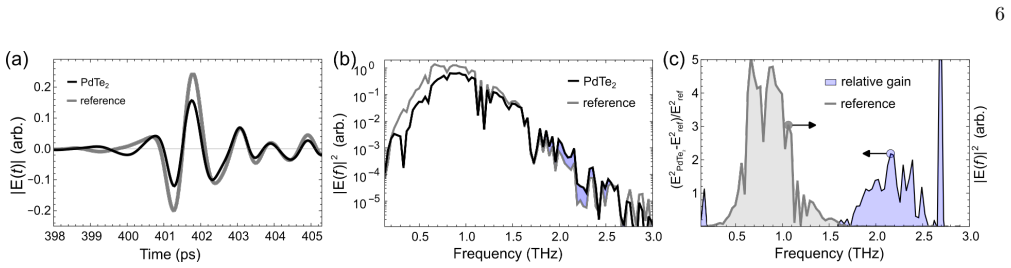
- [Sec. IV, Eq. (4), Fig. 5] The central THz claim rests on the fit of |E_rad(f,P)|^2 = |chi1 P^{1/2} + chi2 P + chi3 P^{3/2}|^2. The authors explicitly concede in Sec. IV that 'over the limited available power range with dominant linear response they become nearly collinear. Consequently, the fit converges to the dominant higher-order term rather than distributing weight across both.' This is a model-identifiability failure. With only real-valued intensity data and three complex coefficients per frequency, the near-collinearity means chi2 and chi3 cannot be uniquely extracted. No error bars, confidence ellipses, or covariance estimates are reported, so the apparent separation in Fig. 5(b) may be an artifact of the fitting procedure. To support the claim of extracting both second- and third-order fingerprints, the authors need to demonstrate simultaneous identifiability, e.g., by reporting parameter uncertainties, p
- [Sec. IV, Fig. 6 and Appendix B/C] The interpretation of the near-DC second-order response as an injection current with tau_inj ~ 100 fs is circular. The model contains free parameters (tau_inj, tau_sh, sigma_inj, sigma_sh), and the authors select tau ~ 100 fs because it 'more closely matches the data in Fig. 5' — the same power-dependence data used to identify the nonlinear orders. This does not independently validate the injection-current mechanism; it only shows that the model family is flexible enough to reproduce the measured spectra. An independent test is required, such as helicity-dependent photocurrent measurements, a different pump-pulse duration, or direct time-resolved current detection. The conclusion's statement that the authors 'extracted both second and third order NLO processes' is therefore overstated.
- [Sec. IV, Eq. (6)] Eq. (6) assumes the nonlinear response kernels are constant over the incoming THz spectrum. However, the later analysis in Fig. 6 introduces strongly frequency- and lifetime-dependent kernels for injection and shift currents. Using the constant-kernel approximation to compute 'theoretical' second- and third-order spectra, then comparing them qualitatively with the power-dependence results, conflates two different models. In addition, the atmospheric-transmission correction is applied to the theoretical spectra but not consistently to the experimental spectra, making the comparison of peak positions (e.g., 1.75 THz vs. 1.5 THz) ambiguous. The authors should state explicitly which model is being tested and should apply the same transfer function to both experiment and theory.
minor comments (5)
- [Sec. III.B heading] The heading 'F our-W ave Mixing' contains a formatting typo; it should read 'Four-Wave Mixing'.
- [Fig. 1 caption] The caption says 'Se atoms shown in blue' but the compound is PdTe2; this should be Te atoms.
- [Sec. III.A] The sentence 'Figure 2(c) next presents the the spectra' has a duplicated 'the'.
- [Sec. IV, Fig. 6 discussion] The text refers to a 'SHG peak at ~1.75 eV' in the THz context; these are THz frequencies, so the label should be 'second-order response peak at ~1.75 THz' rather than 'SHG peak at ~1.75 eV'.
- [Appendix C] The phrase 'the reected and incoming pulses' is missing an 'f' in 'reflected'.
Circularity Check
No significant circularity; THz chi2/chi3 decomposition is underdetermined but not a circular derivation.
full rationale
The visible SHG/FWM results are self-contained: quadratic/cubic power scaling and six-fold C3v polarization patterns are independent experimental checks, and the JDOS overlay is a comparative sketch rather than a derivation that presumes the conclusion. The THz analysis uses Eq. (4), |E_rad|^2 = |chi1 P^1/2 + chi2 P + chi3 P^3/2|^2, as a phenomenological decomposition; the paper itself warns (Section IV) that over the available power range the quadratic and cubic terms are 'nearly collinear' and the fit 'converges to the dominant higher-order term rather than distributing weight across both.' That is an identifiability/overclaim problem, not a circularity: the fitted chi2/chi3 coefficients are not renamed as independent predictions, and the later theoretical spectra (Eq. 6) are computed from the measured input pulse, then compared to the same data after post hoc choice of tau_inj ~ 100 fs. This is model fitting with an acknowledged degeneracy, not a reduction of the output to the input by construction. The self-citations (refs. 6, 9, 36) are not load-bearing; no uniqueness theorem or ansatz is imported from the authors' prior work. I could not exhibit any equation that equals its input by construction, so the circularity score is 0.
Assumptions & free parameters
free parameters (3)
- chi^(n) coefficients in THz power fit (per frequency) =
not tabulated; extracted from fits to |E_rad(P)|^2
- tau_inj and tau_sh (injection/shift current lifetimes) =
varied 0.05, 0.1, 0.2, 0.5 ps; ~100 fs chosen as best match
- sigma_inj/sigma_sh amplitudes =
not given; implicitly scaled to match
assumptions (4)
- ad hoc to paper Radiated THz field is proportional to the time-derivative of the total photocurrent, E_rad ∝ -∂_t j (Eq. 5 and Appendix B)
- ad hoc to paper Nonlinear response kernels σ^(n) are approximately constant over the incoming THz spectrum (Eq. 6)
- domain assumption PdTe2 hosts topological surface Dirac states near the Fermi level with separation ~2.9 eV driving the SHG resonance
- standard math Bulk 1T PdTe2 is centrosymmetric (D3d) and SHG arises from the C3v surface with local symmetry breaking
Cite this review
Pith. "Pith review of Visible and Terahertz Nonlinear Responses in the Topological Noble Metal Dichalcogenide PdTe2." pith.science (2026). https://pith.science/paper/O4OUILRU
@misc{pith2026251111493,
  author       = {Pith},
  title        = {Pith review of: Visible and Terahertz Nonlinear Responses in the Topological Noble Metal Dichalcogenide PdTe2},
  year         = {2026},
  howpublished = {\url{https://pith.science/paper/O4OUILRU}},
  note         = {Machine review of arXiv:2511.11493}
}
abstract
Nonlinear processes can offer pathways to next-generation sensors and frequency mixing devices to overcome modern imaging, detection, and communication challenges. In this article, we report on strong second and third-order nonlinear optical responses in visible and terahertz (THz) light in single crystals of the noble metal dichalcogenide PdTe$_2$. We find that buried conduction and valence topological surface states of PdTe$_2$ lead to resonant optical second-harmonic generation. On the other hand, although the nonlinear responses obtained with THz excitation are not close to this resonance, they can be clearly observed in reflection geometry, even in the presence of broadband excitation, where optical filters are not necessary to observe the enhanced odd-order higher harmonic output. By carefully considering the radiative photocurrent framework of stimulated THz emission, we are able to extract fingerprints of both second- and third-order processes in the THz regime, and show that PdTe$_2$ is a promising material candidate for radio frequency rectification, frequency mixing, and beam focusing.
Figures


Figures from the paper (3 more)


Reference graph
Works this paper leans on
-
[1]
Orenstein, J
J. Orenstein, J. Moore, T. Morimoto, D. Torchinsky, J. Harter, and D. Hsieh, Annual Review of Condensed Matter Physics12, 247 (2021)
2021
-
[2]
J. Shi, H. Xu, C. Heide, C. HuangFu, C. Xia, F. de Que- sada, H. Shen, T. Zhang, L. Yu, A. Johnson, F. Liu, E. Shi, L. Jiao, T. Heinz, S. Ghimire, J. Li, J. Kong, Y. Guo, and A. M. Lindenberg, Nature Communications 14, 10.1038/s41467-023-40373-z (2023)
-
[3]
I. Sodemann and L. Fu, Physical Review Letters115, 10.1103/physrevlett.115.216806 (2015)
-
[4]
Onishi and L
Y. Onishi and L. Fu, Phys. Rev. B110, 075122 (2024)
2024
-
[5]
H. Wu, Y. Wang, Y. Xu, P. K. Sivakumar, C. Pasco, U. Filippozzi, S. S. P. Parkin, Y.-J. Zeng, T. McQueen, and M. N. Ali, Nature604, 653–656 (2022)
2022
-
[6]
P. K. Sivakumar, M. T. Ahari, J.-K. Kim, Y. Wu, A. Dixit, G. J. de Coster, A. K. Pandeya, M. J. Gilbert, and S. S. P. Parkin, Communications Physics 7, 10.1038/s42005-024-01825-0 (2024)
-
[7]
Liu and Q
Y. Liu and Q. Shao, ACS Nano14, 9389–9407 (2020)
2020
-
[8]
J. Hidding, K. M¨ ertiri, F. Mujid, C. Liang, J. Park, and M. H. D. Guimar˜ aes, Physical Review B108, 10.1103/physrevb.108.064419 (2023). 9
Show all 64 references
-
[9]
B. C. Connelly, P. J. Taylor, and G. J. de Coster, Proceedings of the National Academy of Sciences121, 10.1073/pnas.2307425121 (2024)
2024 doi
-
[10]
Plank, J
H. Plank, J. Pernul, S. Gebert, S. N. Danilov, J. K¨ onig- Otto, S. Winnerl, M. Lanius, J. Kampmeier, G. Mus- sler, I. Aguilera, D. Gr¨ utzmacher, and S. D. Ganichev, Physical Review Materials2, 10.1103/physrevmateri- als.2.024202 (2018)
2018 doi
-
[11]
Xie and N
Y.-M. Xie and N. Nagaosa, Proceedings of the National Academy of Sciences122, 10.1073/pnas.2424294122 (2025)
2025 doi
-
[12]
Hemmat, S
M. Hemmat, S. Ayari, M. Miˇcica, H. Vergnet, S. Guo, M. Arfaoui, X. Yu, D. Vala, A. Wright, K. Postava, J. Mangeney, F. Carosella, S. Jaziri, Q. J. Wang, Z. Liu, J. Tignon, R. Ferreira, E. Baudin, and S. Dhillon, Info- Mat5, 10.1002/inf2.12468 (2023)
2023 doi
-
[13]
Pan, Q.-Z
Y. Pan, Q.-Z. Wang, A. L. Yeats, T. Pillsbury, T. C. Flanagan, A. Richardella, H. Zhang, D. D. Awschalom, C.-X. Liu, and N. Samarth, Nature Communications8, 10.1038/s41467-017-00711-4 (2017)
2017 doi
-
[14]
F. Hu, P. Zhao, L. Yang, S. Zhao, J. Lei, W. Li, J. Lai, Z. Yu, H. Park, C. Wong, R. Sharma, G. Eda, S. A. Yang, X. Xu, F. Wang, and H. Yang, Nature Nanotechnology 10.1038/s41565-025-01993-2 (2025)
2025 doi
-
[15]
Zhang and L
Y. Zhang and L. Fu, Proceedings of the National Academy of Sciences118, 10.1073/pnas.2100736118 (2021)
2021 doi
-
[16]
C. Yim, K. Lee, N. McEvoy, M. O’Brien, S. Riazimehr, N. C. Berner, C. P. Cullen, J. Kotakoski, J. C. Meyer, M. C. Lemme, and G. S. Duesberg, ACS Nano10, 9550–9558 (2016)
2016
-
[17]
J. B. Mc Manus, D. V. Horvath, M. P. Browne, C. P. Cullen, G. Cunningham, T. Hallam, K. Zhussupbekov, D. Mullarkey, C. ´O Coile´ ain, I. V. Shvets, M. Pumera, G. S. Duesberg, and N. McEvoy, Nanotechnology31, 375601 (2020)
2020
-
[18]
Zheng, R
W. Zheng, R. Sch¨ onemann, N. Aryal, Q. Zhou, D. Rhodes, Y.-C. Chiu, K.-W. Chen, E. Kampert, T. F¨ orster, T. J. Martin, G. T. McCandless, J. Y. Chan, E. Manousakis, and L. Balicas, Phys. Rev. B97, 235154 (2018)
2018
-
[19]
O. J. Clark, M. J. Neat, K. Okawa, L. Bawden, I. Markovi´ c, F. Mazzola, J. Feng, V. Sunko, J. M. Ri- ley, W. Meevasana, J. Fujii, I. Vobornik, T. K. Kim, M. Hoesch, T. Sasagawa, P. Wahl, M. S. Bahramy, and P. D. C. King, Phys. Rev. Lett.120, 156401 (2018)
2018
-
[20]
M. N. Ali, L. M. Schoop, and et al., Scientic Reports8, 15383 (2018)
2018
-
[21]
P. Das, R. V. Chopdekar, and et al., Scientic Reports 6, 31554 (2016)
2016
-
[22]
Zhussupbekov, L
K. Zhussupbekov, L. Ansari, J. B. McManus, A. Zhus- supbekova, I. V. Shvets, G. S. Duesberg, P. K. Hurley, F. Gity, C. Coile´ ain, and N. McEvoy, npj 2D Materials and Applications5, 10.1038/s41699-020-00196-8 (2021)
2021 doi
-
[23]
Zheng, R
W. Zheng, R. Sch¨ onemann, N. Aryal, Q. Zhou, D. Rhodes, Y.-C. Chiu, K.-W. Chen, E. Kampert, T. F¨ orster, T. J. Martin, G. T. McCandless, J. Y. Chan, E. Manousakis, and L. Balicas, arXiv (2018), reports large, non-saturating MR and mobilities∼ 103–104 cm2V−1s−1, 1805.00087
2018 arXiv
-
[24]
L. Zhao, Y. Wang, and et al., Physical Review Letters 124, 036402 (2020)
2020
-
[25]
Gao, H.-P
Q. Gao, H.-P. Komsa, A. V. Krasheninnikov, and et al., ACS Nano15, 12968 (2021)
2021
-
[26]
Huang, K
Z. Huang, K. Zhang, and et al., Materials Today Physics 11, 100161 (2019)
2019
-
[27]
S. M. Faizanuddin, C.-H. Chien, Y.-J. Chan, S.-T. Liu, C.-N. Kuo, C. S. Lue, and Y.-C. Wen, Surface second har- monic generation from topological dirac semimetal pdte 2 (2023)
2023
-
[28]
G. Wang, K. Wang, N. McEvoy, Z. Bai, C. P. Cullen, C. N. Murphy, J. B. McManus, J. J. Magan, C. M. Smith, G. S. Duesberg, I. Kaminer, J. Wang, and W. J. Blau, Small15, 10.1002/smll.201902728 (2019)
2019 doi
-
[29]
H. Wang, C. Zhang, and F. Rana, Nano Letters15, 8204–8210 (2015)
2015
-
[30]
L. Chu, Z. Li, H. Zhu, H. Lv, and F. Chen, Nanophotonics 13, 3457 (2024)
2024
-
[31]
C. Guo, Y. Hu, G. Chen, D. Wei, L. Zhang, Z. Chen, W. Guo, H. Xu, C.-N. Kuo, C. S. Lue, X. Bo, X. Wan, L. Wang, A. Politano, X. Chen, and W. Lu, Science Advances6, eabb6500 (2020), https://www.science.org/doi/pdf/10.1126/sciadv.abb6500
2020 doi
-
[32]
C. Yim, V. Passi, M. C. Lemme, G. S. Duesberg, C. ´O Coile´ ain, E. Pallecchi, D. Fadil, and N. McEvoy, npj 2D Materials and Applications2, 10.1038/s41699- 018-0051-9 (2018)
2018 doi
-
[33]
Z. Peng, X. Chen, Y. Fan, D. J. Srolovitz, and D. Lei, Light: Science and Applications9, 10.1038/s41377-020- 00421-5 (2020)
2020 doi
-
[34]
X. Ge, X. Zhou, D. Sun, and X. Chen, ACS Omega8, 5715–5721 (2023)
2023
-
[35]
M. Cai, J. Zhang, Y. Chen, L. Hong, J. Fu, X. Zheng, Y. Yao, S. Zhang, Y. Liu, B. Dong, S. Chen, P. Li, G. You, J. Zhang, X. Guo, Y. Zhu, and S. Zhuang, Sci- ence Advances11, 10.1126/sciadv.adv0768 (2025)
2025 doi
-
[36]
Heiserer, N
S. Heiserer, N. Galfe, M. Loibl, M. Wagner, O. Hartwig, S. Schlosser, S. Boche, W. Thornley, N. Clark, K. Lee, T. Stimpel-Lindner, C. ´O Coile´ ain, J. Kiendl, S. J. Haigh, G. J. de Coster, G. S. Duesberg, and P. Seifert, Advanced Materials 10.1002/adma.202412564 (2025)
2025 doi
-
[37]
L. M. Malard, T. V. Alencar, A. P. M. Barboza, K. F. Mak, and A. M. de Paula, Phys. Rev. B87, 201401 (2013)
2013
-
[38]
Y. Li, Y. Rao, K. F. Mak, Y. You, S. Wang, C. R. Dean, and T. F. Heinz, Nano Lett.13, 3329 (2013)
2013
-
[39]
Lafeta, S
L. Lafeta, S. Hartmann, B. Rosa, S. Reitzenstein, L. M. Malard, and A. Hartschuh, ACS Photonics12, 357 (2025)
2025
-
[40]
Lafeta, A
L. Lafeta, A. Corradi, T. Zhang, E. Kahn, I. Bilgin, B. R. Carvalho, S. Kar, M. Terrones, and L. M. Malard, 2D Materials8, 35010 (2021)
2021
-
[41]
R. W. Boyd, inNonlinear Optics (Third Edition), edited by R. W. Boyd (Academic Press, Burlington, 2008) pp. 1–67
2008
-
[42]
Hsieh, J
D. Hsieh, J. W. McIver, D. H. Torchinsky, D. R. Gardner, Y. S. Lee, and N. Gedik, Physical Review Letters106, 10.1103/physrevlett.106.057401 (2011)
2011 doi
-
[43]
J. W. McIver, D. Hsieh, S. G. Drapcho, D. H. Torchinsky, D. R. Gardner, Y. S. Lee, and N. Gedik, Physical Review B86, 10.1103/physrevb.86.035327 (2012)
2012 doi
-
[44]
Y. R. Shen,The principles of nonlinear optics(J. Wiley, New York, 1984)
1984
-
[45]
J. Yu, X. Kuang, J. Li, J. Zhong, C. Zeng, L. Cao, Z. Liu, Z. Zeng, Z. Luo, T. He, A. Pan, and Y. Liu, Nature Com- munications12, 10.1038/s41467-021-21267-4 (2021)
2021 doi
-
[46]
S. M. Faizanuddin, C.-H. Chien, Y.-J. Chan, S.-T. Liu, 10 C.-N. Kuo, C. S. Lue, and Y.-C. Wen, Surface second har- monic generation from topological dirac semimetal pdte 2 (2024), arXiv:2308.09053 [cond-mat.mtrl-sci]
2024 arXiv
-
[47]
Virga, C
A. Virga, C. Ferrante, G. Batignani, D. De Fazio, A. D. G. Nunn, A. C. Ferrari, G. Cerullo, and T. Scopigno, Nature Communications10, 10.1038/s41467-019-11165-1 (2019)
2019 doi
-
[48]
Gordeev, L
G. Gordeev, L. Lafeta, B. S. Flavel, A. Jorio, and L. M. Malard, The Journal of Physical Chemistry C127, 20438 (2023), https://doi.org/10.1021/acs.jpcc.3c05696
2023 doi
-
[49]
Lafeta, A
L. Lafeta, A. R. Cadore, T. G. Mendes-de Sa, K. Watanabe, T. Taniguchi, L. C. Campos, A. Jo- rio, and L. M. Malard, Nano Letters17, 3447 (2017), https://doi.org/10.1021/acs.nanolett.7b00329
2017 doi
-
[50]
Lange, K
L. Lange, K. Wang, S. Bange, L. Lafeta, B. Rosa, S. Reitzenstein, J. M. Lupton, and A. Hartschuh, ACS Photonics11, 3112 (2024), https://doi.org/10.1021/acsphotonics.4c00388
2024 doi
-
[51]
X. Wen, Z. Gong, and D. Li, InfoMat1, 317 (2019), https://onlinelibrary.wiley.com/doi/pdf/10.1002/inf2.12024
2019 doi
-
[52]
Autere, H
A. Autere, H. Jussila, Y. Dai, Y. Wang, H. Lipsanen, and Z. Sun, Adv. Mater.30, 1705963 (2018)
2018
-
[53]
M. S. Mrudul and G. Dixit, Physical Review B103, 10.1103/physrevb.103.094308 (2021)
2021 doi
-
[54]
W. Mao, A. Rubio, and S. A. Sato, Physical Review B 109, 10.1103/physrevb.109.045421 (2024)
2024 doi
-
[55]
S. A. Mikhailov, Physical Review B90, 10.1103/phys- revb.90.241301 (2014)
2014 doi
-
[56]
H. A. Hafez, S. Kovalev, J.-C. Deinert, Z. Mics, B. Green, N. Awari, M. Chen, S. Germanskiy, U. Lehnert, J. Te- ichert, Z. Wang, K.-J. Tielrooij, Z. Liu, Z. Chen, A. Narita, K. M¨ ullen, M. Bonn, M. Gensch, and D. Turchinovich, Nature561, 507–511 (2018)
2018
-
[57]
Tielrooij, A
K.-J. Tielrooij, A. Principi, D. S. Reig, A. Block, S. Varghese, S. Schreyeck, K. Brunner, G. Karczewski, I. Ilyakov, O. Ponomaryov, T. V. A. G. de Oliveira, M. Chen, J.-C. Deinert, C. G. Carbonell, S. O. Valen- zuela, L. W. Molenkamp, T. Kiessling, G. V. Astakhov, and S. Kova...
2022 doi
-
[58]
Soavi, G
G. Soavi, G. Wang, H. Rostami, D. G. Purdie, D. De Fazio, T. Ma, B. Luo, J. Wang, A. K. Ott, D. Yoon, S. A. Bourelle, J. E. Muench, I. Goykhman, S. Dal Conte, M. Celebrano, A. Tomadin, M. Polini, G. Cerullo, and A. C. Ferrari, Nature Nanotechnology 13, 583–588 (2018)
2018
-
[59]
L. Wu, M. Brahlek, R. Vald´ es Aguilar, A. V. Stier, C. M. Morris, Y. Lubashevsky, L. S. Bilbro, N. Bansal, S. Oh, and N. P. Armitage, Nature Physics9, 410–414 (2013)
2013
-
[60]
Braun, G
L. Braun, G. Mussler, A. Hruban, M. Konczykowski, T. Schumann, M. Wolf, M. M¨ unzenberg, L. Per- fetti, and T. Kampfrath, Nature Communications7, 10.1038/ncomms13259 (2016)
2016 doi
-
[61]
Pettine, P
J. Pettine, P. Padmanabhan, N. Sirica, R. P. Prasanku- mar, A. J. Taylor, and H.-T. Chen, Light: Science and Applications12, 10.1038/s41377-023-01163-w (2023)
2023 doi
-
[62]
Avdoshkin, V
A. Avdoshkin, V. Kozii, and J. E. Moore, Phys. Rev. Lett.124, 196603 (2020)
2020
-
[63]
D. E. Parker, T. Morimoto, J. Orenstein, and J. E. Moore, Phys. Rev. B99, 045121 (2019)
2019
-
[64]
Orenstein and J
J. Orenstein and J. S. Dodge, Phys. Rev. B92, 134507 (2015)
2015
Reviewed August 3, 2026 · model on record in the stance chip above.
Discussion (0). Continue with ORCID to comment.