REVIEW 1 major objections 3 minor 1 cited by
Compound Selection Decisions: An Almost SURE Approach
T0 review · 1 major / 3 minor · reviewed 2026-08-03 · deepseek-v4-flash
Pith's one-line read This paper introduces ASSURE, an almost unbiased estimator of compound selection welfare, and proves that optimizing it over a class of threshold rules achieves regret O((log n)/√n) in general and O((log n)^5/n) under a margin condition—mat
desk verdict A genuine new estimator with a real minimax regret theory; the Gaussian known-sigma assumption is load-bearing and the empirical sections are thin, but the core is sound. read the letter →
The pith
A machine-rendered reading of the paper's core claim, the machinery that carries it, and where it could break.
The reading
What carries the argument
The ASSURE estimator (Eq. 2.5–2.6) is w_h(Y_i; Z_i, beta) = (Y_i - K_i) Csinc((Y_i - delta(Z_i;beta))/(sigma_i h)) - (sigma_i/h) sinc((Y_i - delta(Z_i;beta))/(sigma_i h)) with h = 1/sqrt(2 log n). The sinc kernel acts as a low-pass filter in Fourier space: convolving the Gaussian density with it leaves the target probability essentially unchanged, which drives the exponential bias decay in Proposition 1. Stein's identity supplies the derivative correction that makes the estimator almost unbiased, and the Gaussian Poincare inequality plus empirical process theory for independent but non-identically distributed data yield uniform control of the estimation error over the decision class.
What would settle it
Simulate n large with heavy-tailed errors, e.g., Y_i = mu_i + sigma_i t_5, holding sigma_i known. If ASSURE's pointwise bias exceeds C/(n log n) or its regret does not vanish at the predicted rate relative to the infeasible optimum, the Gaussian anchor of Proposition 1 is contradicted.
Extended reading notes
Core claim
The central claim is that compound selection decisions can be tuned nearly as well as if the true means were known. Proposition 1 constructs an estimator of the compound welfare W(beta) = (1/n) sum (mu_i - K_i) Phi((mu_i - delta_i)/sigma_i) from a sinc-kernel smoothing of the Heaviside function, with bandwidth h = 1/sqrt(2 log n); its bias decays like O(|mu-K| h^2 exp(-1/(2h^2))) = O(|mu-K|/(n log n)). Theorems 1 and 3 bound the regret—the gap between the welfare of the ASSURE-tuned rule and the best infeasible rule in a VC-subgraph class—by O(log n / sqrt(n)) and, under a curvature and margin assumption, O((log n)^5 / n). Theorems 2 and 4 give matching Omega(1/sqrt(n)) and Omega(1/n) lower
Load-bearing premise
The guarantees require that each estimate is exactly Gaussian with known variance; if the estimates are materially heavy-tailed or the standard errors are misspecified, the stated bias and regret bounds do not apply.
Editorial extensions
If this is right
- ASSURE-tuned decisions are asymptotically no worse than the best infeasible threshold rule in the chosen class.
- The O(log n / sqrt(n)) regret is minimax optimal up to logs: no decision rule can guarantee better than 1/sqrt(n) in the worst case.
- Under a margin/curvature condition, regret improves to O((log n)^5 / n), and a matching lower bound shows this is essentially the best possible rate.
- The welfare estimates can certify status-quo rules: in the A/B testing application, the industry-standard p<0.05 rule is shown to be conservative relative to the ASSURE optimum when costs are zero.
- The same construction gives an exactly unbiased estimator for Poisson observations, with the same sqrt(n) minimax rate.
Reading between the lines
- The paper's formal guarantees rest on exact Gaussianity; the heavy-tailed simulations are encouraging, but the formal analysis of misspecification is deferred. An extension would be to prove the regret bound under approximate Gaussianity via Stein-type discrepancies.
- The ensemble construction (Section 4.2) suggests a general recipe: any collection of monotone decision scores can be combined and tuned with ASSURE under stability conditions—this could make ASSURE a drop-in selection-aware tuner for off-the-shelf empirical Bayes and machine learning models.
- The low-bias kernel idea likely transfers to other functionals of a Gaussian mean that are not unbiasedly estimable (e.g., probabilities of non-monotone events), offering a route for decision problems beyond threshold rules.
Editorial analysis
A structured set of objections, weighed in public.
Referee Report
Summary. The paper studies compound selection decisions in a Gaussian sequence model Y_i ~ N(μ_i, σ_i^2) with known σ_i. A decision maker selects a subset of units to maximize average utility (1/n) Σ a_i (μ_i − K_i). The paper introduces ASSURE, an almost unbiased estimator of the welfare W(β) based on sinc-kernel smoothing (Definition 1), and proposes choosing β by maximizing this estimated welfare over a pre-specified VC-subgraph class of threshold rules. Theorem 1 establishes regret O(m_1/(n log n) + M log n/√n), and Theorem 2 gives a matching Ω(1/√n) lower bound. Under a curvature/margin assumption (Assumption 1), Theorem 3 gives a fast rate O((log n)^5/n) and Theorem 4 gives a matching Ω(1/n) lower bound. The paper also provides a Poisson-data extension, a leave-one-out extension to nonseparable decision rules, calibrated simulations, and three empirical applications. Proofs are in an extensive appendix, including i.n.i.d. empirical-process bounds and Gaussian Poincaré variance bounds.
Significance. If the bounds are correct, this is a valuable contribution to compound decision theory and empirical welfare maximization. The estimator is new, and the analysis is nonstandard: the exponential bias control via Fourier truncation (Proposition 1), the in-sample/infeasible-oracle regret decomposition, and the matching lower bounds are genuine contributions. The paper is careful about the distinction between in-sample utility and expected welfare, and the leave-one-out stability argument for fast rates is substantial. The Poisson and ensembling extensions broaden the applicability. The formal theory is strongest in the exact Gaussian, known-σ case; robustness outside that case is demonstrated only by simulation and explicitly deferred, which is the main scope limitation.
major comments (1)
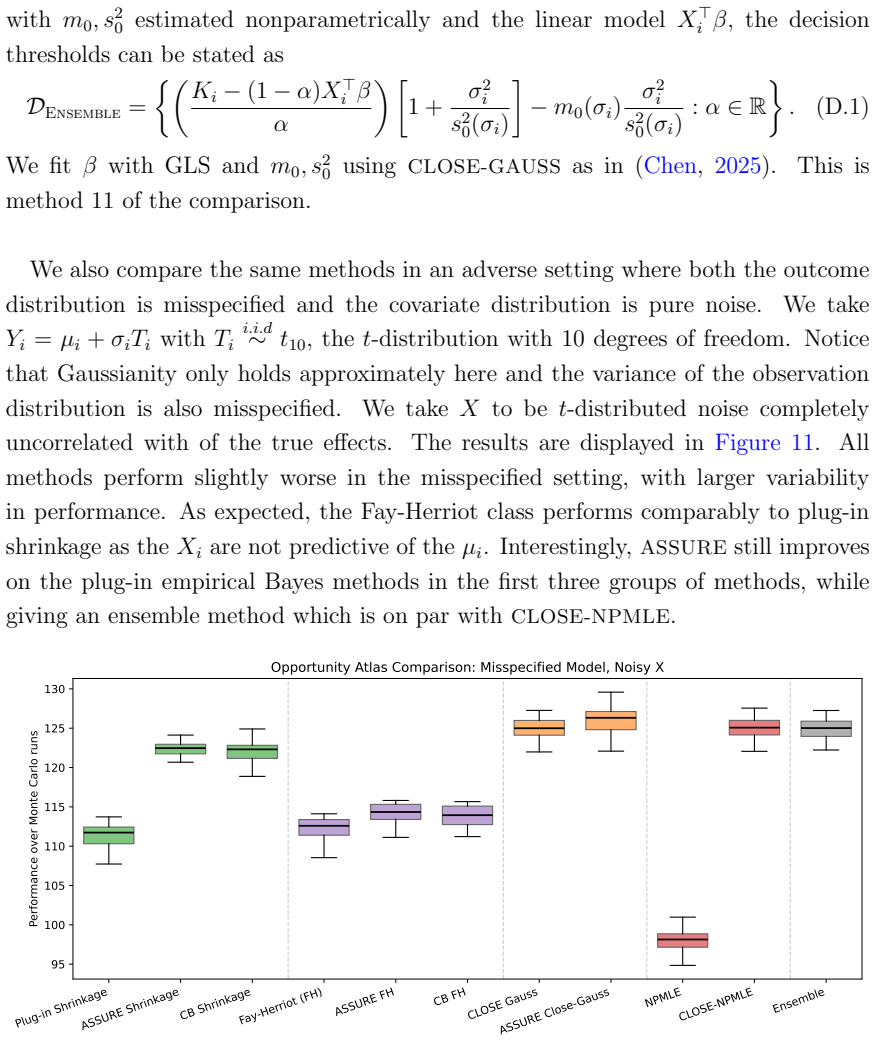
- [§2.2, §2.3, §5, §6] The formal regret guarantees (Theorems 1 and 3) assume exact Gaussianity and known σ_i. The paper explicitly defers non-Gaussian analysis (Section 2.2: 'we leave a formal analysis to future work') and the Le Cam–Hajek justification (Section 2.3). Yet the abstract and empirical sections present ASSURE as broadly applicable, and the applications use CLT-based normality plus estimated standard errors. A t_10 simulation (Figure 11) does not transfer the theorems to heavy tails or estimated σ. Please qualify the headline claims in the abstract and introduction, or add a formal robustness result under an explicit perturbation model.
minor comments (3)
- [Theorem 1 and proof] The bias term in Theorem 1 is displayed as 'm1 nlogn'; Proposition 1 implies m_1/(n log n). The proof has a related inconsistent string ('m1 n2 logn'). Please correct the notation.
- [Theorem 4 proof, Appendix B.6] The displayed bound c*_{G0} ≥ (1/2) ln(1 + 8h/√n) ≥ 2/√n is not implied by the choice h=1/4; the correct scale is O(1/√n), which is sufficient for the Ω(1/n) conclusion. Also, the sentence that min(p_G0, p_G1) is 'bounded above' appears to need 'bounded below' for the displayed inequality to hold.
- [Theorem 1, definition of M] The definition of M includes '(E∥D∥_n + (E∥D∥_{4,n}^2)^{1/2})'. Please clarify the second term, presumably (E[∥D∥_{4,n}^2])^{1/2}, to avoid ambiguity.
Circularity Check
No significant circularity: ASSURE regret bounds are derived from Gaussian Fourier/sinc identities and matching lower bounds; self-citations are benchmark-only.
full rationale
The derivation chain is self-contained. ASSURE is defined by the sinc-kernel weights in Eqs. (2.5)-(2.6); Proposition 1 derives the bias bound from the Gaussian Fourier identity (Lemma A.1) and a Mills-ratio tail bound, and the variance bound from the Gaussian Poincare inequality. The main regret bound (Theorem 1) uses the standard ERM decomposition Regret ≤ 2E sup|W_hat−W| + 2E sup|u−W| plus empirical-process bounds over a VC class; no fitted parameter or target quantity is reused as an input. Theorems 2 and 4 provide independent minimax lower bounds via two-point/Le Cam arguments, so the rates are not artifacts of ASSURE's construction. Self-citations to Chen (2025) concern the CLOSE-GAUSS decision class and simulation benchmarks, not the regret theorems, and are not load-bearing. The Gaussian/known-σ assumption is an explicit modeling assumption with non-Gaussian analysis deferred ('we leave a formal analysis to future work'; 'remains important future work'), which is a scope limitation, not circularity. The cost calibrations in the applications are illustrative choices of the decision primitive K and do not feed back into the regret derivation.
Assumptions & free parameters
free parameters (3)
- bandwidth h_n =
1/sqrt(2 log n)
- investigation cost K (discrimination application) =
0.025
- cost K (Opportunity Atlas application) =
0.361
assumptions (7)
- domain assumption Gaussian sequence model: Y_i | mu_i, sigma_i, X_i ~ N(mu_i, sigma_i^2), mutually independent, sigma_i known
- domain assumption Decisions restricted to separable threshold rules delta(Z_i; beta) in a pre-specified class D
- standard math D is a VC subgraph class with index V(D) and envelope D; derivatives form VC classes for the fast-rate theorem
- ad hoc to paper Assumption 1 (A1)-(A4): boundedness, unimodality of W, curvature W''(beta*) < -kappa, well-separated maximizer
- domain assumption Boundedness of mu_i, sigma_i, sigma_i^{-1}, K_i (Corollary 1)
- standard math Monotone likelihood ratio implies optimal decisions are threshold rules (Karlin-Rubin; formal Lemma E.1)
- standard math No exactly unbiased estimator exists for the welfare functional (Stefanski 1989, Prop. E.1)
invented entities (1)
-
ASSURE welfare estimator W_hat(beta) = (1/n) sum_i w_h(Y_i; Z_i, beta)
independent evidence
Cite this review
Pith. "Pith review of Compound Selection Decisions: An Almost SURE Approach." pith.science (2026). https://pith.science/paper/JIDZGZY3
@misc{pith2026251111862,
  author       = {Pith},
  title        = {Pith review of: Compound Selection Decisions: An Almost SURE Approach},
  year         = {2026},
  howpublished = {\url{https://pith.science/paper/JIDZGZY3}},
  note         = {Machine review of arXiv:2511.11862}
}
abstract
This paper proposes methods for producing compound selection decisions in a Gaussian sequence model. Given unknown, fixed parameters $\mu_ {1:n}$ and known $\sigma_{1:n}$ with observations $Y_i \sim \textsf{N}(\mu_i, \sigma_i^2)$, the decision maker would like to select a subset of indices $S$ so as to maximize utility $\frac{1}{n}\sum_{i\in S} (\mu_i - K_i)$, for known costs $K_i$. Inspired by Stein's unbiased risk estimate (SURE), we introduce an almost unbiased estimator, called ASSURE, for the expected utility of a proposed decision rule. ASSURE allows a user to choose a welfare-maximizing rule from a pre-specified class by optimizing the estimated welfare, thereby producing selection decisions that borrow strength across noisy estimates. We show that ASSURE produces decision rules that are asymptotically no worse than the optimal but infeasible decision rule in the pre-specified class. We apply ASSURE to the selection of Census tracts for economic opportunity, the identification of discriminating firms, and the analysis of $p$-value decision procedures in A/B testing.
Figures


Figures from the paper (9 more)



Forward citations
Cited by 1 Pith paper
-
Assumption-Lean Shrinkage and Model Averaging for Spatial Parameters
SURE-based selection and averaging of flexible spatial shrinkage rules performs nearly as well as the best candidate and cuts estimated MSE by 27% versus non-spatial empirical Bayes in Opportunity Atlas mobility data.
Reference graph
Works this paper leans on
-
[1]
2, 5, 28, 29, 79 Bergman, P.,Chetty, R.,DeLuca, S.,Hendren, N.,Katz, L. F.and Palmer, C.(2024). Creating moves to opportunity: Experimental evidence on barriers to neighborhood choice.American Economic Review,114(5), 1281–1337. 2, 5, 22, 25, 26, 89 Berman, R.andV an den Bulte, C.(2022). False discovery in a/b testing.Man- agement Science,68(9), 6762–6782....
arXiv 2024
-
[2013]
Z ηn 0 s 1 + logN ϵ Cλ 3 n(λn +B) ,D,L 2(Pn) dϵ # +E
and (Van den Dries, 1998) for a textbook reference on this topic. Consider the decision class in (3.5) as functions of the costkand log standard deviationℓ: fβ(k, ℓ) =k+e 2ℓe−b1−b2ℓ(k−a 1 −a 2eℓ) indexed byβ= (a 1, a2, b1, b2).The subgraph sets Sβ := (k, ℓ, t) :t < k+e2ℓe−b1−b2ℓ(k−a 1 −a 2eℓ) are defined by a first-order formula in the structure (R,+,·,0,...
1998
-
[2036]
2, 5, 30, 31 Kline, P. M.,Rose, E. K.andW alters, C. R.(2024). Discrimination report cards: An empirical bayes ranking approach. 4, 5, 11 Koenker, R.andGu, J.(2017). Rebayes: an r package for empirical bayes mixture methods.Journal of Statistical Software,82, 1–26. 86 —and—(2024). Empirical bayes for the reluctant frequentist.arXiv preprint arXiv:2404.034...
arXiv 2024
-
[2632]
invidious comparisons: Ranking and selection as compound decisions
2 Chou, W.,Gray, C.,Kallus, N.,Bibaut, A.andEjdemyr, S.(2025). Eval- uating decision rules across many weak experiments. InProceedings of the 31st ACM SIGKDD Conference on Knowledge Discovery and Data Mining V. 2, pp. 4365–4374. 28 Crippa, F.(2025). Regret analysis in threshold policy design.Journal of Economet- rics,249, 105998. 4, 15, 18 Dano, K.,Honor ...
arXiv 2025
Reviewed August 3, 2026 · model on record in the stance chip above.
Discussion (0). Continue with ORCID to comment.