Measurement-Based Quantum Computation Using the Spin-1 XXZ Model with Uniaxial Anisotropy
Pith reviewed 2026-05-17 22:13 UTC · model grok-4.3
The pith
The ground state of a spin-1 XXZ chain in the Haldane phase serves as a resource for measurement-based quantum computation with single-qubit gate fidelities over 0.99 when anisotropies are tuned.
A machine-rendered reading of the paper's core claim, the machinery that carries it, and where it could break.
Core claim
The ground state of the spin-1 XXZ chain with uniaxial anisotropies D and J within the Haldane phase can serve as a resource state for MBQC implementing single-qubit gates. Gate fidelity exceeds 0.99 when D or J is tuned, and an analytic expression shows that fidelity is determined by postmeasurement spin-spin correlation function and failure probability under the assumption that the state is in the Z2×Z2-protected Haldane phase. The enhancement originates from strengthening of AFM correlations near the AFM phase suppressing failure states.
What carries the argument
The Z₂×Z₂-protected Haldane phase of the spin-1 XXZ chain with single-ion anisotropy D and Ising-like anisotropy J, which provides the symmetry-protected topological order enabling its use as an MBQC resource state.
If this is right
- Single-qubit rotation gates about x, y, and z axes can be implemented with high fidelity using measurements on the chain.
- General single-qubit unitary gates composed from those rotations achieve fidelities above 0.99.
- The analytic fidelity expression holds as long as the system remains in the Z2×Z2-protected Haldane phase.
- Stronger antiferromagnetic correlations near the AFM phase boundary lead to lower failure probabilities and higher gate fidelities.
Where Pith is reading between the lines
- This suggests that similar tuning of anisotropies in other one-dimensional spin models could yield improved resource states for MBQC.
- Experimental platforms realizing spin-1 chains, such as certain magnetic materials, could be tested for these high-fidelity gates.
- Extending to two-dimensional lattices or other phases might allow for universal quantum computation beyond single-qubit gates.
Load-bearing premise
That the ground state remains within the Z2×Z2-protected Haldane phase, allowing the derivation of the fidelity from correlations and failure probability.
What would settle it
Measuring a rotation gate fidelity significantly below 0.99 after tuning D or J to place the system deep in the Haldane phase with strong AFM correlations.
Figures




read the original abstract
We demonstrate that the ground state of a spin-1 $XXZ$ chain with uniaxial anisotropies, single-ion anisotropy $D$ and Ising-like anisotropy $J$, within the Haldane phase can serve as a resource state for measurement-based quantum computation implementing single-qubit gates. The gate fidelity of both elementary rotation gates and general single-qubit unitary gates composed of rotations about the $x$, $y$, and $z$ axes is evaluated, and is found to exceed 0.99 when $D$ or $J$ is appropriately tuned. Furthermore, we derive an analytic expression for the rotation-gate fidelity under the assumption that the state lies within the $\mathbb Z_2\times \mathbb Z_2$-protected Haldane phase, showing that it is determined by the postmeasurement spin-spin correlation function and the failure probability. The observed enhancement of gate fidelity in the spin-1 $XXZ$ chain originates from the strengthening of antiferromagnetic (AFM) correlations near the AFM phase, which effectively suppresses failure states.
Editorial analysis
A structured set of objections, weighed in public.
Referee Report
Summary. The manuscript demonstrates that the ground state of a spin-1 XXZ chain with single-ion anisotropy D and Ising-like anisotropy J, when prepared in the Haldane phase, can serve as a resource state for measurement-based quantum computation of single-qubit gates. Gate fidelities for elementary rotation gates and general single-qubit unitaries are reported to exceed 0.99 upon appropriate tuning of D or J. An analytic expression for the rotation-gate fidelity is derived under the assumption of Z2×Z2 protection in the Haldane phase, expressed in terms of the postmeasurement spin-spin correlation function and failure probability. The fidelity enhancement is attributed to strengthened antiferromagnetic correlations near the AFM phase boundary.
Significance. If the phase assumption and derivation hold, the work provides a tunable many-body resource for MBQC with a direct analytic link between gate fidelity and spin correlations. The derivation of the closed-form fidelity expression is a clear strength, as it offers theoretical insight beyond pure numerics and connects condensed-matter order parameters to quantum-computational performance. This could guide the search for other phase-protected resources and highlight the role of AFM correlations in suppressing failure states.
major comments (1)
- [analytic derivation section] The analytic fidelity formula (derived in the section presenting the rotation-gate expression) is valid only inside the Z2×Z2-protected Haldane phase. The reported high fidelities (>0.99) occur when D or J is tuned to strengthen AFM correlations near the AFM boundary; however, no explicit verification of the phase (e.g., via the string order parameter or other indicator) at the exact tuned parameter values used for the fidelity plots is provided. This verification is load-bearing for the central claim that the analytic expression applies and that the observed fidelities are protected by the Haldane phase.
minor comments (2)
- Clarify the precise numerical method (e.g., DMRG bond dimension, system size, and extrapolation) used to extract the correlation functions and failure probabilities that enter the analytic fidelity formula.
- Add a brief discussion or reference to how the composed general single-qubit unitaries are constructed from the elementary rotations and whether error accumulation was accounted for in the reported fidelities.
Simulated Author's Rebuttal
We thank the referee for their careful reading and constructive feedback, which highlights an important aspect of our central claim. We address the major comment below and have revised the manuscript to strengthen the presentation.
read point-by-point responses
-
Referee: [analytic derivation section] The analytic fidelity formula (derived in the section presenting the rotation-gate expression) is valid only inside the Z2×Z2-protected Haldane phase. The reported high fidelities (>0.99) occur when D or J is tuned to strengthen AFM correlations near the AFM boundary; however, no explicit verification of the phase (e.g., via the string order parameter or other indicator) at the exact tuned parameter values used for the fidelity plots is provided. This verification is load-bearing for the central claim that the analytic expression applies and that the observed fidelities are protected by the Haldane phase.
Authors: We agree that explicit verification of the phase at the tuned parameter values is necessary to rigorously support the applicability of the analytic fidelity formula. In the revised manuscript we have added calculations of the string order parameter evaluated at the precise values of D and J used in the fidelity plots. These calculations confirm that the string order parameter remains finite and non-vanishing, placing the system firmly inside the Z2×Z2-protected Haldane phase. We have inserted a new paragraph and accompanying data in the analytic derivation section that directly link these order-parameter values to the validity of the closed-form expression and to the suppression of failure states by enhanced AFM correlations. This revision removes any ambiguity regarding the phase assumption while preserving the original numerical and analytic results. revision: yes
Circularity Check
No significant circularity in derivation chain
full rationale
The paper derives an analytic expression for rotation-gate fidelity under the explicit assumption that the ground state lies in the Z2×Z2-protected Haldane phase, expressing it in terms of post-measurement spin-spin correlations and failure probability. These quantities are then evaluated numerically for the specific spin-1 XXZ Hamiltonian at tuned D and J values. This is a standard model-specific computation applying general MBQC theory to a concrete resource state, not a reduction of the result to its inputs by construction. No self-citation load-bearing step, fitted parameter renamed as prediction, or ansatz smuggling is evident from the provided text. The central claim remains independent content: numerical demonstration of high fidelity (>0.99) when AFM correlations strengthen near the phase boundary, subject to the stated phase assumption.
Axiom & Free-Parameter Ledger
free parameters (1)
- D or J tuning parameter
axioms (1)
- domain assumption The ground state lies within the Z2×Z2-protected Haldane phase
Lean theorems connected to this paper
-
IndisputableMonolith/Cost/FunctionalEquation.leanwashburn_uniqueness_aczel unclear?
unclearRelation between the paper passage and the cited Recognition theorem.
we derive an analytic expression for the rotation-gate fidelity under the assumption that the state lies within the Z2×Z2-protected Haldane phase, showing that it is determined by the postmeasurement spin-spin correlation function and the failure probability
-
IndisputableMonolith/Foundation/RealityFromDistinction.leanreality_from_one_distinction unclear?
unclearRelation between the paper passage and the cited Recognition theorem.
The observed enhancement of gate fidelity in the spin-1 XXZ chain originates from the strengthening of antiferromagnetic (AFM) correlations near the AFM phase
What do these tags mean?
- matches
- The paper's claim is directly supported by a theorem in the formal canon.
- supports
- The theorem supports part of the paper's argument, but the paper may add assumptions or extra steps.
- extends
- The paper goes beyond the formal theorem; the theorem is a base layer rather than the whole result.
- uses
- The paper appears to rely on the theorem as machinery.
- contradicts
- The paper's claim conflicts with a theorem or certificate in the canon.
- unclear
- Pith found a possible connection, but the passage is too broad, indirect, or ambiguous to say the theorem truly supports the claim.
Reference graph
Works this paper leans on
-
[1]
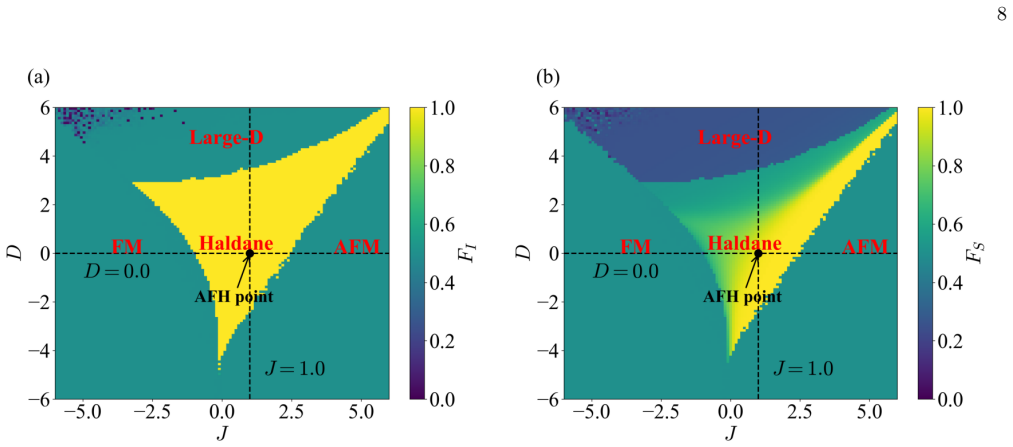
Since achieving high gate fidelity requiresg corr → −1 andg fail →0, the ground state in the Haldane phase near the AFM phase yields high gate fidelity, as shown in Figs. 5 (a) and (b) and 6 (a) and (b). However, in- troducing the uniaxial anisotropy along thez-axis nega- tively affects the implementation of rotation gates about 9 FIG. 7. The post-measure...
-
[2]
MBQC protocol We now consider a many-body state ofL+ 2Nspin-1s and two spin-1/2s at left and right ends, which serves as a resource state implementing the unitary gate in Eq. (43). Here, blocks A, B, and C correspond to the spin-1 sites 1≤a≤L/3,L/3 +N+ 1≤b≤2L/3 +Nand 2L/3 + 2N+ 1≤c≤L+ 2N, respectively. The junction blocks L and R correspond to the spin-1 ...
-
[3]
Gate fidelity We now consider the gate fidelity of the above protocol. Similarly to Appendix A, the ideal state can be written as follows: |ψU ⟩in,out⟨ψU |= IinIout +Z inUoutZoutU † out 2 ! IinIout +X inUoutXoutU † out 2 ! .(C6) Then, the gate fidelity can be written as FU = 1 4 + 1 4 Trin,out[ρU XinUoutXoutU † out]− 1 4 Trin,out[ρU YinUoutYoutU † out] + ...
-
[4]
M. A. Nielsen and I. L. Chuang,Quantum Computa- tion and Quantum Information: 10th Anniversary Edi- tion(Cambridge University Press, 2011)
work page 2011
-
[5]
Deutsch, Quantum computational networks, Proceed- ings of the Royal Society of London
D. Deutsch, Quantum computational networks, Proceed- ings of the Royal Society of London. Series A, Mathemat- ical and Physical Sciences425, 73 (1989)
work page 1989
-
[6]
R. Raussendorf and H. J. Briegel, A one-way quantum computer, Phys. Rev. Lett.86, 5188 (2001)
work page 2001
-
[7]
G. K. Brennen and A. Miyake, Measurement-based quan- tum computer in the gapped ground state of a two-body hamiltonian, Phys. Rev. Lett.101, 010502 (2008)
work page 2008
-
[8]
Miyake, Quantum computation on the edge of a symmetry-protected topological order, Phys
A. Miyake, Quantum computation on the edge of a symmetry-protected topological order, Phys. Rev. Lett. 105, 040501 (2010)
work page 2010
-
[9]
A. Barenco, C. H. Bennett, R. Cleve, D. P. DiVincenzo, N. Margolus, P. Shor, T. Sleator, J. A. Smolin, and 16 H. Weinfurter, Elementary gates for quantum computa- tion, Phys. Rev. A52, 3457 (1995)
work page 1995
-
[10]
H. J. Briegel and R. Raussendorf, Persistent entangle- ment in arrays of interacting particles, Phys. Rev. Lett. 86, 910 (2001)
work page 2001
-
[11]
I. Affleck, T. Kennedy, E. H. Lieb, and H. Tasaki, Rig- orous results on valence-bond ground states in antiferro- magnets, Phys. Rev. Lett.59, 799 (1987)
work page 1987
-
[12]
I. Affleck, T. Kennedy, E. H. Lieb, and H. Tasaki, Valence bond ground states in isotropic quantum antiferromag- nets, Communications in Mathematical Physics115, 477 (1988)
work page 1988
-
[13]
R. Raussendorf, D. E. Browne, and H. J. Briegel, Measurement-based quantum computation on cluster states, Phys. Rev. A68, 022312 (2003)
work page 2003
-
[14]
T.-C. Wei, I. Affleck, and R. Raussendorf, Affleck- kennedy-lieb-tasaki state on a honeycomb lattice is a uni- versal quantum computational resource, Phys. Rev. Lett. 106, 070501 (2011)
work page 2011
-
[15]
X. Chen, Z.-C. Gu, Z.-X. Liu, and X.-G. Wen, Symmetry protected topological orders and the group cohomology of their symmetry group, Phys. Rev. B87, 155114 (2013)
work page 2013
-
[16]
Wen, Colloquium: Zoo of quantum-topological phases of matter, Rev
X.-G. Wen, Colloquium: Zoo of quantum-topological phases of matter, Rev. Mod. Phys.89, 041004 (2017)
work page 2017
-
[17]
F. Pollmann, A. M. Turner, E. Berg, and M. Oshikawa, Entanglement spectrum of a topological phase in one di- mension, Phys. Rev. B81, 064439 (2010)
work page 2010
-
[18]
X. Chen, Z.-C. Gu, and X.-G. Wen, Local unitary trans- formation, long-range quantum entanglement, wave func- tion renormalization, and topological order, Phys. Rev. B82, 155138 (2010)
work page 2010
-
[19]
M. Hagiwara, K. Katsumata, I. Affleck, B. I. Halperin, and J. P. Renard, Observation of s=1/2 degrees of free- dom in an s=1 linear-chain Heisenberg antiferromagnet, Phys. Rev. Lett.65, 3181 (1990)
work page 1990
-
[20]
T. Kennedy, Exact diagonalisations of open spin-1 chains, Journal of Physics: Condensed Matter2, 5737 (1990)
work page 1990
-
[21]
S. H. Glarum, S. Geschwind, K. M. Lee, M. L. Kaplan, and J. Michel, Observation of fractional spin s=1/2 on open ends of s=1 linear antiferromagnetic chains: Non- magnetic doping, Phys. Rev. Lett.67, 1614 (1991)
work page 1991
-
[22]
R. Raussendorf, D.-S. Wang, A. Prakash, T.-C. Wei, and D. T. Stephen, Symmetry-protected topological phases with uniform computational power in one dimension, Phys. Rev. A96, 012302 (2017)
work page 2017
-
[23]
R. Raussendorf, W. Yang, and A. Adhikary, Measurement-based quantum computation in finite one-dimensional systems: string order implies computa- tional power, Quantum7, 1215 (2023)
work page 2023
-
[24]
D. V. Else, I. Schwarz, S. D. Bartlett, and A. C. Doherty, Symmetry-protected phases for measurement- based quantum computation, Phys. Rev. Lett.108, 240505 (2012)
work page 2012
- [25]
-
[26]
S. D. Bartlett, G. K. Brennen, A. Miyake, and J. M. Renes, Quantum computational renormalization in the Haldane phase, Phys. Rev. Lett.105, 110502 (2010)
work page 2010
-
[27]
F. Verstraete, M. M. Wolf, D. Perez-Garcia, and J. I. Cirac, Criticality, the area law, and the computational power of projected entangled pair states, Phys. Rev. Lett. 96, 220601 (2006)
work page 2006
-
[28]
J. Miller and A. Miyake, Resource quality of a symmetry- protected topologically ordered phase for quantum com- putation, Phys. Rev. Lett.114, 120506 (2015)
work page 2015
-
[29]
D. T. Stephen, D.-S. Wang, A. Prakash, T.-C. Wei, and R. Raussendorf, Computational power of symmetry- protected topological phases, Phys. Rev. Lett.119, 010504 (2017)
work page 2017
-
[30]
A. C. Doherty and S. D. Bartlett, Identifying phases of quantum many-body systems that are universal for quan- tum computation, Phys. Rev. Lett.103, 020506 (2009)
work page 2009
-
[31]
F. D. M. Haldane, Nonlinear field theory of large-spin heisenberg antiferromagnets: Semiclassically quantized solitons of the one-dimensional easy-axis n´ eel state, Phys. Rev. Lett.50, 1153 (1983)
work page 1983
-
[32]
F. Haldane, Continuum dynamics of the 1-d heisenberg antiferromagnet: Identification with the o(3) nonlinear sigma model, Physics Letters A93, 464 (1983)
work page 1983
-
[33]
F. Pollmann, E. Berg, A. M. Turner, and M. Os- hikawa, Symmetry protection of topological phases in one-dimensional quantum spin systems, Phys. Rev. B85, 075125 (2012)
work page 2012
-
[34]
S. R. White and D. A. Huse, Numerical renormalization- group study of low-lying eigenstates of the antiferro- magnetic s=1 Heisenberg chain, Phys. Rev. B48, 3844 (1993)
work page 1993
-
[35]
T. Kennedy and H. Tasaki, Hidden z 2×z2 symmetry breaking in Haldane-gap antiferromagnets, Phys. Rev. B 45, 304 (1992)
work page 1992
-
[36]
R. Masui and K. Totsuka, Computational characteriza- tion of symmetry-protected topological phases in open quantum systems, Phys. Rev. B112, 085108 (2025)
work page 2025
-
[37]
W. Chen, K. Hida, and B. C. Sanctuary, Ground-state phase diagram ofs= 1 XXZ chains with uniaxial single- ion-type anisotropy, Phys. Rev. B67, 104401 (2003)
work page 2003
- [38]
-
[39]
U. Schollw¨ ock, The density-matrix renormalization group in the age of matrix product states, Annals of Physics 326, 96 (2011), january 2011 Special Issue
work page 2011
-
[40]
D. Perez-Garcia, F. Verstraete, M. M. Wolf, and J. I. Cirac, Matrix product state representations, Quant. Inf. Comput.7, 401 (2007)
work page 2007
-
[41]
J. I. Cirac, D. P´ erez-Garc´ ıa, N. Schuch, and F. Ver- straete, Matrix product states and projected entangled pair states: Concepts, symmetries, theorems, Rev. Mod. Phys.93, 045003 (2021)
work page 2021
-
[42]
X. Chen, Z.-C. Gu, and X.-G. Wen, Classification of gapped symmetric phases in one-dimensional spin sys- tems, Phys. Rev. B83, 035107 (2011)
work page 2011
- [43]
-
[44]
H. Tasaki, Quantum liquid in antiferromagnetic chains: A stochastic geometric approach to the Haldane gap, Phys. Rev. Lett.66, 798 (1991)
work page 1991
-
[45]
M. den Nijs and K. Rommelse, Preroughening transitions in crystal surfaces and valence-bond phases in quantum spin chains, Phys. Rev. B40, 4709 (1989)
work page 1989
-
[46]
D. P´ erez-Garc´ ıa, M. M. Wolf, M. Sanz, F. Verstraete, and J. I. Cirac, String order and symmetries in quantum spin lattices, Phys. Rev. Lett.100, 167202 (2008)
work page 2008
-
[47]
Measurement-based quantum computation cannot avoid byproducts
T. Morimae, Measurement-based quantum computation 17 cannot avoid byproducts (2012), arXiv:1208.5714 [quant- ph]
work page internal anchor Pith review Pith/arXiv arXiv 2012
-
[48]
C. H. Bennett, G. Brassard, C. Cr´ epeau, R. Jozsa, A. Peres, and W. K. Wootters, Teleporting an unknown quantum state via dual classical and Einstein-Podolsky- Rosen channels, Phys. Rev. Lett.70, 1895 (1993)
work page 1993
-
[49]
D. Gottesman and I. L. Chuang, Demonstrating the via- bility of universal quantum computation using teleporta- tion and single-qubit operations, Nature (London)402, 390 (1999)
work page 1999
- [50]
-
[51]
J. Wang, D. Zhong, L. Mu, and H. Fan, Fidelity of measurement-based quantum computation in a bosonic environment, Phys. Rev. A90, 052306 (2014)
work page 2014
-
[52]
U. Schollw¨ ock, T. Jolicœur, and T. Garel, Onset of in- commensurability at the valence-bond-solid point in the s=1 quantum spin chain, Phys. Rev. B53, 3304 (1996)
work page 1996
-
[53]
S. R. White, Density matrix formulation for quantum renormalization groups, Phys. Rev. Lett.69, 2863 (1992)
work page 1992
-
[54]
S. ¨Ostlund and S. Rommer, Thermodynamic limit of den- sity matrix renormalization, Phys. Rev. Lett.75, 3537 (1995)
work page 1995
-
[55]
M. Fishman, S. R. White, and E. M. Stoudenmire, The ITensor Software Library for Tensor Network Calcula- tions, SciPost Phys. Codebases , 4 (2022)
work page 2022
-
[56]
H. J. Schulz, Phase diagrams and correlation exponents for quantum spin chains of arbitrary spin quantum num- ber, Phys. Rev. B34, 6372 (1986)
work page 1986
-
[57]
J. M¨ ogerle, K. Brechtelsbauer, A. Gea-Caballero, J. Prior, G. Emperauger, G. Bornet, C. Chen, T. La- haye, A. Browaeys, and H. B¨ uchler, Spin-1 Haldane phase in a chain of Rydberg atoms, PRX Quantum6, 020332 (2025)
work page 2025
-
[58]
K. Brechtelsbauer, J. M¨ ogerle, and H. P. B¨ uchler, Quan- tum simulation of spin-1 XXZ Heisenberg models and the Haldane phase with dysprosium, Phys. Rev. A111, 032621 (2025)
work page 2025
-
[59]
D. E. Deutsch, A. Barenco, and A. Ekert, Universality in quantum computation, Proceedings of the Royal Society of London. Series A: Mathematical and Physical Sciences 449, 669 (1995)
work page 1995
-
[60]
The Heisenberg Representation of Quantum Computers
D. Gottesman, The Heisenberg representation of quan- tum computers (1998), arXiv:quant-ph/9807006 [quant- ph]
work page internal anchor Pith review Pith/arXiv arXiv 1998
discussion (0)
Sign in with ORCID, Apple, or X to comment. Anyone can read and Pith papers without signing in.