On the Interaction Between Chicken Swarm Rejuvenation and KLD-Adaptive Sampling in Particle Filters
Pith reviewed 2026-05-17 21:49 UTC · model grok-4.3
The pith
CSO-enhanced particle filters require a lower expected particle count than standard ones for the same statistical error bound under KLD sampling.
A machine-rendered reading of the paper's core claim, the machinery that carries it, and where it could break.
Core claim
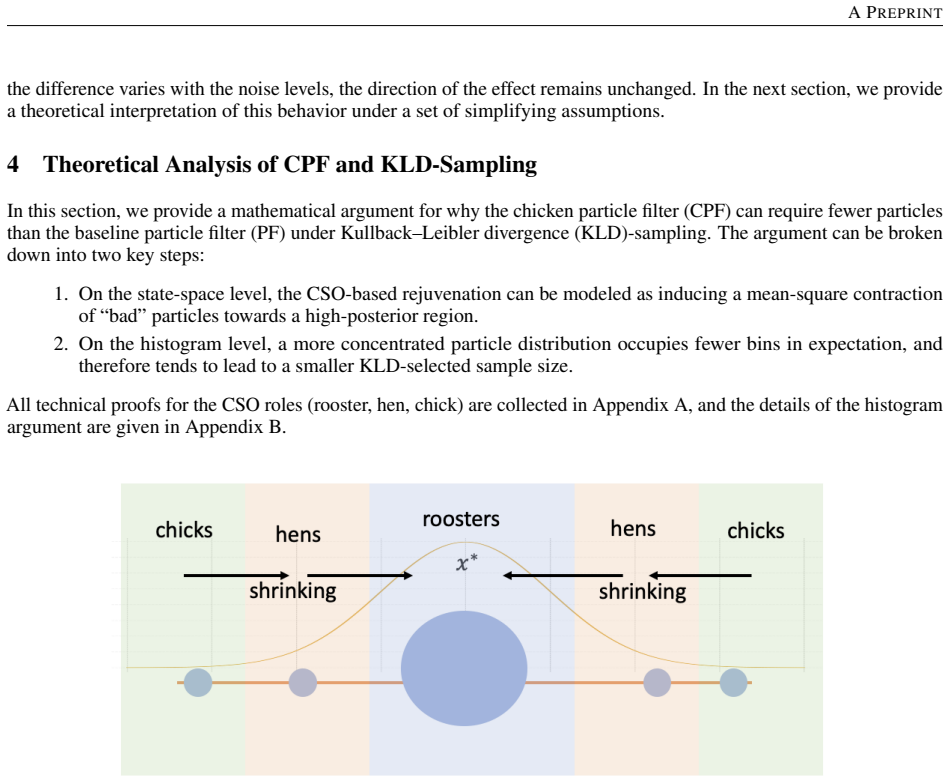
Under the stated assumptions in a simplified modeling framework, the fitness-driven updates in CSO can be approximated as a mean-square contraction. This produces a particle distribution that is more concentrated than that of a baseline PF, or more peaked in a majorization sense. Applying Karamata's inequality to the concave function that governs expected bin occupancy in KLD-sampling indicates that the CSO-enhanced PF is expected to require a lower expected particle count than the standard PF to satisfy the same statistical error bound.
What carries the argument
Mean-square contraction approximation of CSO rejuvenation, which yields a majorization-more-peaked particle distribution, combined with Karamata's inequality applied to the concave bin-occupancy function in KLD sampling.
If this is right
- The CSO-enhanced PF (CPF) requires fewer expected particles than standard PF for equivalent error bounds.
- This offers a tractable framework to interpret why SI-PF combinations show computational efficiency.
- The more concentrated distribution from CSO affects the adaptive sampling to lower particle requirements.
- Provides a starting point for designing more efficient adaptive filters.
Where Pith is reading between the lines
- This framework might apply to other swarm intelligence methods that induce similar contractions in particle distributions.
- Simulations could test whether real CSO updates produce the predicted reduction in required particle counts.
- Future designs could adjust KLD parameters based on the strength of the rejuvenation contraction.
Load-bearing premise
The fitness-driven updates inherent in CSO can be approximated as a form of mean-square contraction that produces a more concentrated particle distribution than baseline PF in a majorization sense.
What would settle it
A direct computation or simulation showing that the particle distribution after CSO rejuvenation is not more concentrated in the majorization sense, or that the expected particle count for CPF is not lower under KLD sampling.
Figures
read the original abstract
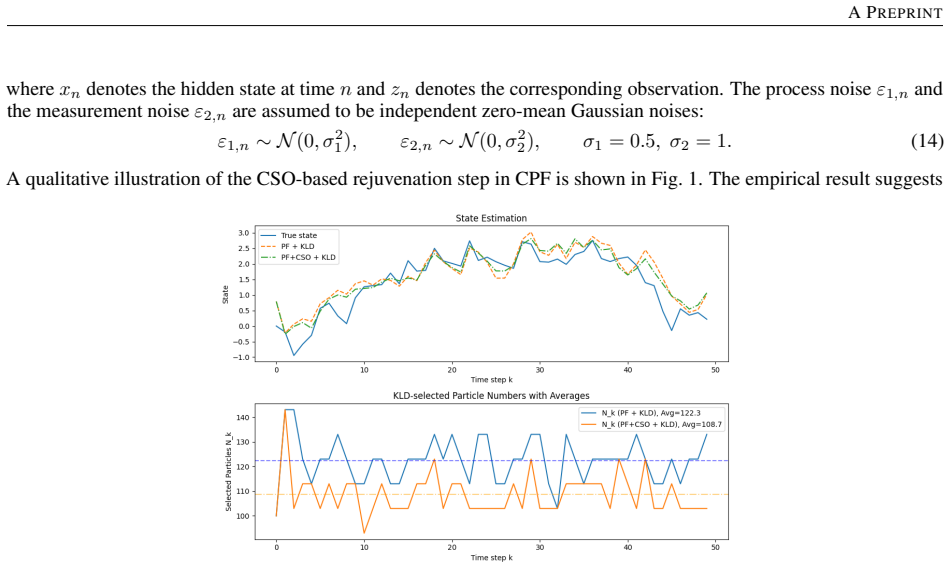
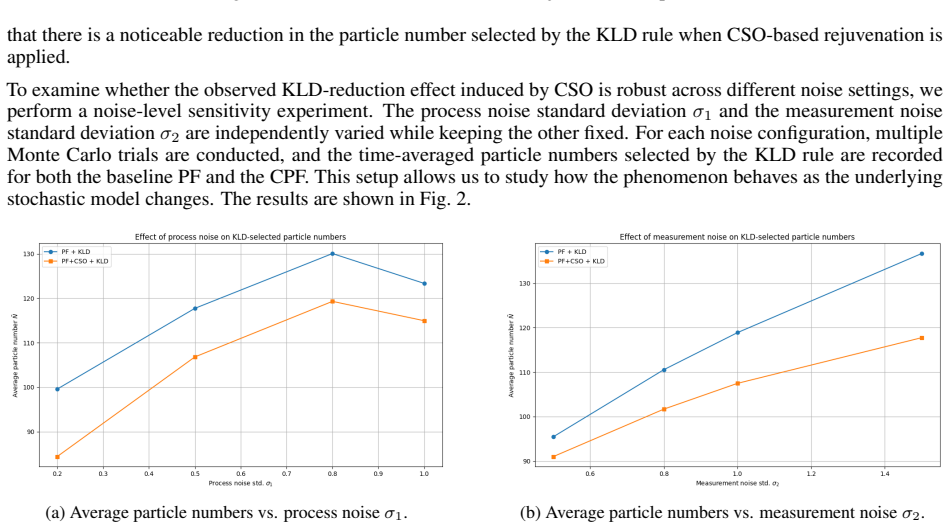
Particle filters (PFs) are often combined with swarm intelligence (SI) algorithms, such as Chicken Swarm Optimization (CSO), for particle rejuvenation. Separately, Kullback--Leibler divergence (KLD) sampling is a common strategy for adaptively sizing the particle set. However, the theoretical interaction between SI-based rejuvenation kernels and KLD-based adaptive sampling is not yet fully understood. This paper investigates this specific interaction. We analyze, under a simplified modeling framework, the effect of the CSO rejuvenation step on the particle set distribution. We propose that the fitness-driven updates inherent in CSO can be approximated as a form of mean-square contraction. This contraction tends to produce a particle distribution that is more concentrated than that of a baseline PF, or in mathematical terms, a distribution that is plausibly more ``peaked'' in a majorization sense. By applying Karamata's inequality to the concave function that governs the expected bin occupancy in KLD-sampling, our analysis suggests a connection: under the stated assumptions, the CSO-enhanced PF (CPF) is expected to require a lower \emph{expected} particle count than the standard PF to satisfy the same statistical error bound. The goal of this study is not to provide a fully general proof, but rather to offer a tractable theoretical framework that helps to interpret the computational efficiency empirically observed when combining these techniques, and to provide a starting point for designing more efficient adaptive filters.
Editorial analysis
A structured set of objections, weighed in public.
Referee Report
Summary. The manuscript analyzes the interaction between Chicken Swarm Optimization (CSO) for particle rejuvenation in particle filters and Kullback-Leibler divergence (KLD) adaptive sampling. Under a simplified modeling framework, it approximates the fitness-driven CSO updates as a mean-square contraction that yields a particle distribution more concentrated than baseline PF in the majorization sense. Applying Karamata's inequality to the concave bin-occupancy function, the analysis suggests that the CSO-enhanced PF (CPF) is expected to require a lower expected particle count than the standard PF to meet the same statistical error bound. The authors state that the goal is not a fully general proof but rather a tractable interpretive framework for empirically observed efficiency gains.
Significance. If the stated approximation and majorization ordering are accepted, the work supplies a useful theoretical explanation for why SI-based rejuvenation can improve the efficiency of KLD-adaptive particle filters. The explicit linkage of mean-square contraction to majorization and then to Karamata's inequality on the concave occupancy function provides a clean interpretive tool. The manuscript is transparent about its simplified assumptions and limited scope, which is a strength; this positions the contribution as a starting point for designing more efficient adaptive filters rather than a completed theorem.
major comments (1)
- Simplified Modeling Framework (as described in the abstract): the central step approximating fitness-driven CSO updates as mean-square contraction that produces a majorization-ordered distribution is presented as plausible within the framework but lacks a detailed derivation or verification of the contraction property; because this approximation directly supports the subsequent application of Karamata's inequality and the claim of reduced expected particle count, additional justification or a concrete test of the contraction assumption would strengthen the load-bearing link.
minor comments (2)
- The abstract introduces the acronym CPF without an explicit definition on first use; expanding it at the point of introduction would improve immediate readability.
- A concise enumerated list of the 'stated assumptions' referenced in the abstract and conclusion would help readers quickly assess the scope of the framework.
Simulated Author's Rebuttal
We thank the referee for the positive assessment of the manuscript and the recommendation for minor revision. The single major comment is addressed point by point below.
read point-by-point responses
-
Referee: Simplified Modeling Framework (as described in the abstract): the central step approximating fitness-driven CSO updates as mean-square contraction that produces a majorization-ordered distribution is presented as plausible within the framework but lacks a detailed derivation or verification of the contraction property; because this approximation directly supports the subsequent application of Karamata's inequality and the claim of reduced expected particle count, additional justification or a concrete test of the contraction assumption would strengthen the load-bearing link.
Authors: We agree that the mean-square contraction step is the load-bearing link in the argument and that the current presentation leaves room for additional justification. In the revised manuscript we will expand the modeling section to include a short derivation showing how the CSO fitness-driven position updates reduce the second-moment spread of the particle set under the stated simplifications (uniform fitness landscape and bounded step size). We will also add a brief numerical illustration on a low-dimensional synthetic example that verifies the contraction in mean-square sense and the resulting majorization ordering. These additions remain within the paper's declared scope as an interpretive framework rather than a general theorem. revision: yes
Circularity Check
No significant circularity detected
full rationale
The paper explicitly frames its analysis as an interpretive framework under simplified modeling assumptions rather than a completed derivation or general theorem. It proposes an approximation of CSO updates as mean-square contraction, then applies standard tools (Karamata's inequality on a concave bin-occupancy function) to suggest a majorization-based efficiency link. This chain does not reduce any target quantity to a fitted parameter, self-referential definition, or load-bearing self-citation; the central claim remains suggestive and externally falsifiable via empirical particle-count comparisons. No equations or steps in the provided text exhibit the enumerated circularity patterns.
Axiom & Free-Parameter Ledger
axioms (2)
- domain assumption CSO rejuvenation updates can be approximated as mean-square contraction under the simplified modeling framework
- standard math The expected bin occupancy function in KLD sampling is concave
Lean theorems connected to this paper
-
IndisputableMonolith/Cost/FunctionalEquation.leanwashburn_uniqueness_aczel unclear?
unclearRelation between the paper passage and the cited Recognition theorem.
fitness-driven updates ... approximated as a form of mean-square contraction ... more 'peaked' in a majorization sense ... Karamata’s inequality to the concave function that governs the expected bin occupancy
-
IndisputableMonolith/Foundation/AlexanderDuality.leanalexander_duality_circle_linking unclear?
unclearRelation between the paper passage and the cited Recognition theorem.
E[K(µ,N)] = sum f_N(p_j(µ)) with f_N strictly concave ... p_CPF ≻ p_PF implies E[K_CPF] ≤ E[K_PF]
What do these tags mean?
- matches
- The paper's claim is directly supported by a theorem in the formal canon.
- supports
- The theorem supports part of the paper's argument, but the paper may add assumptions or extra steps.
- extends
- The paper goes beyond the formal theorem; the theorem is a base layer rather than the whole result.
- uses
- The paper appears to rely on the theorem as machinery.
- contradicts
- The paper's claim conflicts with a theorem or certificate in the canon.
- unclear
- Pith found a possible connection, but the passage is too broad, indirect, or ambiguous to say the theorem truly supports the claim.
Reference graph
Works this paper leans on
-
[1]
Speech emotion recognition systems and their security aspects,
doi:10.1007/s10462-024- 10786-3. Tiancheng Li, Shudong Sun, Tariq Pervez Sattar, and Juan Manuel Corchado. Fight sample degeneracy and impover- ishment in particle filters: A review of intelligent approaches.Expert Systems with Applications, 41(8):3944–3954,
-
[2]
doi:https://doi.org/10.1016/j.eswa.2013.12.031
ISSN 0957-4174. doi:https://doi.org/10.1016/j.eswa.2013.12.031. URL https://www.sciencedirect. com/science/article/pii/S0957417413010063. Dieter Fox. Adapting the sample size in particle filters through kld-sampling.The International Journal of Robotics Research, 22(12):985–1003,
-
[3]
Yuanchao Shu, Cheng Bo, Guobin Shen, Chunshui Zhao, Liqun Li, and Feng Zhao
doi:10.1177/0278364903022012001. Yuanchao Shu, Cheng Bo, Guobin Shen, Chunshui Zhao, Liqun Li, and Feng Zhao. Magicol: Indoor localization using pervasive magnetic field and opportunistic wifi sensing.IEEE Journal on Selected Areas in Communications, 33(7): 1443–1457,
-
[4]
Jie Cao, Zhen-ying Wang, and Wei Li
doi:10.1109/JSAC.2015.2430274. Jie Cao, Zhen-ying Wang, and Wei Li. Anti-occlusion particle filter target tracking method based on chicken swarm optimization.Microelectronics & Computer, 36(6):40–44,
-
[5]
doi:10.19304/j.cnki.issn1000-7180.2019.06.009. in Chinese. J. Chen, S. Song, Y . Gong, Q. Tang, Y . Wang, and X. Zhu. An indoor fusion navigation algorithm using hv-derivative dynamic time warping and the chicken particle filter.Satellite Navigation, 3:13,
work page doi:10.19304/j.cnki.issn1000-7180.2019.06.009 2019
-
[6]
Xianbing Meng, Yu Liu, Xiaozhi Gao, and Hengzhen Zhang
doi:10.1186/s43020-022- 00073-3. Xianbing Meng, Yu Liu, Xiaozhi Gao, and Hengzhen Zhang. A new bio-inspired algorithm: Chicken swarm optimiza- tion. InNeural Information Processing. ICONIP 2014, volume 8834 ofLecture Notes in Computer Science, pages 86–94. Springer, Cham,
-
[7]
doi:10.1007/978-3-319-12637-1_11. A Detailed Proofs of CSO Roles In this appendix, we provide the detailed proofs for the contraction properties of the rooster, hen, and chick roles in the Chicken Swarm Optimization (CSO) algorithm. These properties are used in the main text to motivate why CPF, which leverages CSO rejuvenation, can require fewer particle...
discussion (0)
Sign in with ORCID, Apple, or X to comment. Anyone can read and Pith papers without signing in.