REVIEW 2 major objections 2 minor 1 cited by
Principal Component Analysis of Competing Correlations in Quarter-Filled Hubbard Models
T0 review · 2 major / 2 minor · reviewed 2026-05-17 · grok-4.3
Pith's one-line read Principal component analysis of correlation matrices from exact diagonalization data identifies charge-dominated, spin-dominated and pairing-dominated regimes in quarter-filled Hubbard models without assuming order parameters in advance.
desk verdict PCA on small-cluster ED data picks out charge-spin-pairing crossovers in quarter-filled Hubbard models without preset order parameters, though finite-size effects on 3x4 and 4x4 cylinders need direct checks. read the letter →
The pith
A machine-rendered reading of the paper's core claim, the machinery that carries it, and where it could break.
The reading
What carries the argument
Principal component analysis performed on matrices whose entries are different two-point correlation functions; the leading eigenvectors condense the total variance and thereby label which correlation channel dominates at given interaction strength.
What would settle it
Repeating the identical PCA procedure on larger clusters or on clusters with different boundary conditions and checking whether the same sequence of charge-spin-pairing crossovers appears.
Extended reading notes
Core claim
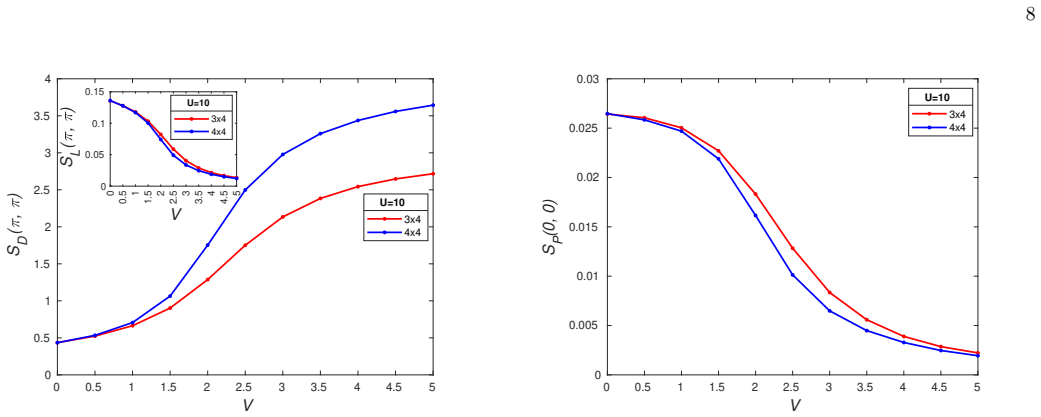
We present an unsupervised learning analysis of correlation hierarchies in the quarter-filled simple and extended Hubbard models by applying principal component analysis to exact-diagonalization data on 3x4 and 4x4 cylindrical clusters. While the non-interacting limit provides a finite-size reference, increasing on-site repulsion induces localization and reorganizes the low-energy spectrum. For the extended model at moderate and strong coupling, PCA of the corresponding correlation matrices captures the familiar crossovers directly from the data by identifying charge-dominated, spin-dominated and pairing-dominated regimes through variance condensation into leading components.
Load-bearing premise
The leading principal components extracted from correlation matrices on small finite clusters faithfully reflect the physical hierarchy of competing correlations rather than finite-size artifacts or the particular choice of functions included in the matrix.
Editorial extensions
If this is right
- In the extended Hubbard model at U=4 and U=10 the leading components cleanly separate the three regimes already known from structure-factor analysis.
- The approach supplies a transparent bridge between exact-diagonalization spectra and modern unsupervised diagnostics for strongly correlated systems.
- No predefined order parameter is required; the data themselves determine which correlation channel carries the largest variance.
- The same workflow can be applied to any set of correlation functions computed on finite clusters, making it portable across different Hubbard variants.
Reading between the lines
- One could test whether including longer-range or higher-order correlation functions alters the ordering of the leading components or merely redistributes variance among sub-dominant ones.
- The method may prove useful for mapping out crossovers in other fillings or geometries where conventional order parameters are harder to guess.
- If the identified regimes remain stable under modest changes in cluster size, the technique could serve as a quick pre-screening step before more expensive calculations.
Signed reviews
Editorial analysis
A structured set of objections, weighed in public.
Referee Report
Summary. The manuscript applies principal component analysis (PCA) to correlation matrices constructed from exact-diagonalization (ED) data on 3×4 and 4×4 cylindrical clusters for the quarter-filled simple and extended Hubbard models. It reports that increasing on-site repulsion U induces localization and reorganizes the spectrum, and that PCA identifies charge-dominated, spin-dominated, and pairing-dominated regimes through variance condensation into leading components, without assuming predefined order parameters. The approach is benchmarked against conventional structure factors in the extended model at moderate (U=4) and strong (U=10) coupling and is presented as a model-agnostic framework bridging ED and machine-learning diagnostics for competing correlations in finite clusters.
Significance. If the central claim is substantiated, the work demonstrates that unsupervised PCA applied directly to raw ED correlation data can recover known crossovers among charge, spin, and pairing channels in Hubbard models. This provides a transparent, parameter-free diagnostic that complements traditional order-parameter analyses and may be useful for exploring regimes where multiple instabilities compete. The use of exact ED input data on small clusters and the explicit comparison to structure-factor results constitute clear strengths.
major comments (2)
- [Results for the extended Hubbard model (U=4 and U=10)] The central claim that PCA captures the crossovers 'directly from the data' and identifies regimes via variance condensation requires that the leading components reflect the physical hierarchy rather than the restricted set of operators or finite-size truncation. The manuscript performs the analysis exclusively on 3×4 and 4×4 cylinders; without explicit checks (e.g., comparison of leading eigenvectors or explained-variance ratios when the operator set is enlarged or when periodic versus open boundaries are swapped), the mapping from PCA output to charge-/spin-/pairing-dominated regimes remains vulnerable to artifacts from the limited Hilbert space and momentum sampling.
- [Comparison with conventional structure factors] The abstract states that 'conventional structure factors reveal familiar crossovers' that PCA then captures, yet the manuscript does not report quantitative agreement metrics (e.g., overlap between PCA regime boundaries and structure-factor crossover points, or tables of leading-component weights for charge, spin, and pairing channels). This quantitative link is load-bearing for the assertion that PCA reproduces the known hierarchy without predefined order parameters.
minor comments (2)
- [Methods] The precise construction of the correlation matrix—i.e., the list of two-point operators, distances, and directions included for each channel—should be stated explicitly (ideally in a table or appendix) to ensure reproducibility.
- [PCA implementation] Figure captions or text should clarify whether the PCA is performed on the full covariance matrix or on a normalized correlation matrix, and whether any centering or scaling is applied before decomposition.
Simulated Author's Rebuttal
We thank the referee for their careful reading of the manuscript and for the constructive comments. We address each major comment in turn below, indicating where revisions will be made to improve clarity and strengthen the presentation.
read point-by-point responses
-
Referee: [Results for the extended Hubbard model (U=4 and U=10)] The central claim that PCA captures the crossovers 'directly from the data' and identifies regimes via variance condensation requires that the leading components reflect the physical hierarchy rather than the restricted set of operators or finite-size truncation. The manuscript performs the analysis exclusively on 3×4 and 4×4 cylinders; without explicit checks (e.g., comparison of leading eigenvectors or explained-variance ratios when the operator set is enlarged or when periodic versus open boundaries are swapped), the mapping from PCA output to charge-/spin-/pairing-dominated regimes remains vulnerable to artifacts from the limited Hilbert space and momentum sampling.
Authors: We agree that the restricted cluster sizes and operator basis inherent to ED calculations on small cylinders represent a limitation that must be discussed explicitly. The manuscript already compares results across the two available cluster geometries (3×4 and 4×4) and finds consistent identification of the charge-, spin-, and pairing-dominated regimes. In the revised version we will add a dedicated paragraph in the discussion section that quantifies the stability of the leading eigenvectors and explained-variance ratios when additional longer-range correlation operators are included in the matrix. We will also note that the cylindrical (open-boundary in one direction) geometry is the standard choice for these system sizes to minimize momentum discretization artifacts, and we will state the computational constraints that preclude immediate checks on larger or fully periodic clusters. These additions will make the robustness arguments more transparent without altering the central claims. revision: partial
-
Referee: [Comparison with conventional structure factors] The abstract states that 'conventional structure factors reveal familiar crossovers' that PCA then captures, yet the manuscript does not report quantitative agreement metrics (e.g., overlap between PCA regime boundaries and structure-factor crossover points, or tables of leading-component weights for charge, spin, and pairing channels). This quantitative link is load-bearing for the assertion that PCA reproduces the known hierarchy without predefined order parameters.
Authors: The original text presents the alignment between PCA regimes and structure-factor crossovers through direct visual comparison in the figures for U = 4 and U = 10. We recognize that explicit quantitative measures would make this correspondence more rigorous. Accordingly, the revised manuscript will include a new table that reports the projection weights of the leading principal components onto the charge, spin, and local-pairing channels at the two coupling strengths. We will also define regime boundaries from the points where the leading-component variance exceeds a chosen threshold and tabulate the numerical agreement with the structure-factor crossover locations. These additions will furnish the quantitative link requested while preserving the model-agnostic character of the PCA approach. revision: yes
Circularity Check
No significant circularity; PCA analysis is unsupervised and data-driven
full rationale
The paper constructs correlation matrices from exact diagonalization data on 3x4 and 4x4 clusters and applies standard PCA to extract leading components that identify charge-, spin-, and pairing-dominated regimes. This process uses raw computed correlations without predefined order parameters, fitted parameters renamed as predictions, or load-bearing self-citations. No equations reduce the claimed crossovers to inputs by construction, and the method is presented as model-agnostic exploratory analysis rather than a derived prediction. The derivation chain remains self-contained against the ED data and conventional structure-factor comparisons mentioned in the abstract.
Assumptions & free parameters
assumptions (2)
- domain assumption Variance captured by leading principal components corresponds to physically relevant correlation hierarchies.
- domain assumption Exact diagonalization on 3x4 and 4x4 cylindrical clusters yields representative low-energy correlation data.
Cite this review
Pith. "Pith review of Principal Component Analysis of Competing Correlations in Quarter-Filled Hubbard Models." pith.science (2026). https://pith.science/paper/2511.12551
@misc{pith2026251112551,
  author       = {Pith},
  title        = {Pith review of: Principal Component Analysis of Competing Correlations in Quarter-Filled Hubbard Models},
  year         = {2026},
  howpublished = {\url{https://pith.science/paper/2511.12551}},
  note         = {Machine review of arXiv:2511.12551}
}
read the original abstract
We present an unsupervised learning analysis of correlation hierarchies in the quarter-filled simple and extended Hubbard models by applying principal component analysis (PCA) to exact-diagonalization (ED) data on 3x4 and 4x4 cylindrical clusters. While the non-interacting limit (U=0) provides a finite-size reference, increasing on-site repulsion U induces localization and reorganizes the low-energy spectrum. For the extended model, we examine moderate (U=4) and strong (U=10) coupling regimes, where conventional structure factors reveal familiar crossovers among charge, spin and local-pairing correlations. PCA of the corresponding correlation matrices captures these crossovers directly from the data, without assuming predefined order parameters by identifying charge-dominated, spin-dominated and pairing-dominated regimes through variance condensation into leading components. This establishes PCA as a transparent, model-agnostic framework for uncovering the hierarchy and competition of correlation channels in finite Hubbard clusters, providing a bridge between exact diagonalization and modern machine-learning diagnostics in strongly correlated systems.
Figures


Figures from the paper (12 more)




Lean theorems connected to this paper
-
IndisputableMonolith/Cost/FunctionalEquation.leanwashburn_uniqueness_aczel unclear?
unclearRelation between the paper passage and the cited Recognition theorem.
PCA of the corresponding correlation matrices captures these crossovers directly from the data, without assuming predefined order parameters by identifying charge-dominated, spin-dominated and pairing-dominated regimes through variance condensation into leading components.
What do these tags mean?
- matches
- The paper's claim is directly supported by a theorem in the formal canon.
- supports
- The theorem supports part of the paper's argument, but the paper may add assumptions or extra steps.
- extends
- The paper goes beyond the formal theorem; the theorem is a base layer rather than the whole result.
- uses
- The paper appears to rely on the theorem as machinery.
- contradicts
- The paper's claim conflicts with a theorem or certificate in the canon.
- unclear
- Pith found a possible connection, but the passage is too broad, indirect, or ambiguous to say the theorem truly supports the claim.
Forward citations
Cited by 1 Pith paper
-
Emergence of correlation-driven altermagnetism in Hubbard model on geometrically frustrated lattice-clusters
On a doped 3x3 frustrated Hubbard cluster, a hand-defined staggered spin-correlation measure grows with on-site repulsion and is claimed to indicate altermagnetism, but the diagnostic and abstract claims are incomplete.
Reference graph
Works this paper leans on
-
[1]
Despite their modest size, these clusters retain all correlation chan- nels and permit exact evaluation of observables. Applying PCA to the resulting correlation matrices enables a unified visualization of how correlation modes reconfigure with in- teraction strength, bridging conventional ED analysis with data-centric learning approaches. The remainder of ...
work page Pith review arXiv 2025
-
[2]
For 4 × 4, this degeneracy is lifted, leaving a finite single-particle spacing ∆ ǫ ≃ 0
For 3 × 4, the highest occupied and the lowest unoccupied levels are degenerate at ǫk = − √ 2, so the many-body gap vanishes at U = 0. For 4 × 4, this degeneracy is lifted, leaving a finite single-particle spacing ∆ ǫ ≃ 0. 236t, consistent with the finite ∆ E seen in Fig. 2. Hence, the initial difference between the clusters originates from finite-size geomet...
-
[3]
4) with the emergence of nearly degenerate low-energy spin states for U ≳ 7
and the strengthening of AFM cor- relations (Fig. 4) with the emergence of nearly degenerate low-energy spin states for U ≳ 7. While structure factors summarize ordering tendencies, they compress the full correlation landscape into a few num- bers. To expose how different correlation channels reor- ganize collectively, we apply principal component analysis...
-
[4]
Ground-state energy and excitation gap Figure 8 shows the ground-state energy per site E0/M and the excitation gap ∆ E = E1 − E0 (inset) as func- tions of V . For both lattices, E0/M rises monotonically as V increases, reflecting the positive energy cost of placing electrons on neighboring sites. The 3 × 4 system retains a nearly constant finite gap (∆ E ≃ ...
-
[5]
Local observables: double occupancy and local moment The microscopic evolution of double occupancy ¯d and lo- cal moment ¯m with V is summarized in Fig
-
[6]
For the 3 × 4 lattice, ¯d increases slightly (from 0 . 085 to 0. 10) as V grows, while ¯m decreases marginally, indicating that mod- erate nonlocal repulsion weakens spin polarization by pro- moting charge segregation. In contrast, the 4 × 4 lattice displays a nonmonotonic evolution: ¯d initially decreases up to V ≈ 0. 4, suggesting enhanced localization,...
-
[7]
Charge and spin correlations The evolution of the charge and spin structure factors, SD(π,π ) andSL(π,π ), is shown in Fig
-
[8]
With increasing V , SD(π,π ) rises sharply in both clusters, demonstrating the strengthening of charge-density-wave (CDW) tenden- cies. The growth is steeper in the 4 × 4 lattice, consis- tent with its larger number of nearest-neighbor pairs and with the observed gap collapse. Meanwhile, SL(π,π ) (inset) decreases monotonically, signaling suppression of a...
Show all 37 references
-
[9]
Local-singlet pairing correlations To assess potential superconducting tendencies, we com- pute the local-singlet pairing structure factor SP (0, 0), shown in Fig. 11. For the 3 × 4 cluster, SP (0, 0) increases slightly up to V ≃ 1. 4 before saturating, suggesting that moderat...
-
[10]
Fig- ure 12 displays the 3 × 4 results
PCA of charge, spin and pairing correlations To unify these observations, we analyze the correlation matrices via PCA for both cluster sizes at U = 4. Fig- ure 12 displays the 3 × 4 results. In the charge sector, the leading variance ˜λ 1 increases from 0 . 18 at V = 0 . 2 to ...
-
[11]
30), implying coexistence of competing local pairing fluc- tuations. The PCA maps show that charge organization strengthens continuously with V , while spin and pairing channels remain diffuse, confirming that intersite repulsion primarily drives charge ordering at the expense of...
-
[12]
Ground-state energy and excitation gap Figure 14 shows the ground-state energy per site E0/M and the excitation gap ∆ E =E1 − E0 (inset) as functions of V . In both clusters, E0/M increases monotonically with V , reflecting the additional Coulomb energy cost of adjacent 0 0.5 1...
-
[13]
15, which shows the average double occupancy ¯d and local moment ¯ m
Local observables: double occupancy and local moment The suppression of charge fluctuations is further evident in Fig. 15, which shows the average double occupancy ¯d and local moment ¯ m. At U = 10, ¯d is already small (≈ 0. 03) and decreases steadily with V , while ¯m increas...
-
[14]
Charge and spin structure factors The interplay between charge and spin ordering is sum- marized in Fig. 16. The charge structure factor SD(π,π ) increases sharply with V , revealing the progressive estab- lishment of charge-density-wave (CDW) order. In contrast, the spin stru...
-
[15]
Local-singlet pairing correlations The evolution of local-singlet pairing correlations, quan- tified bySP (0, 0), is shown in Fig
-
[16]
As V increases,SP (0, 0) decreases mono- tonically, indicating that intersite repulsion penalizes vir- tual hopping processes and suppresses any residual pairing tendency
At small V , moderate pairing correlations persist due to superexchange-mediated singlet formation. As V increases,SP (0, 0) decreases mono- tonically, indicating that intersite repulsion penalizes vir- tual hopping processes and suppresses any residual pairing tendency. This ...
-
[17]
0 0.5 1 1.5 2 2.5 3 3.5 4 4.5 5 V 0 0.005 0.01 0.015 0.02 0.025 0.03 SP(0, 0) 3x4 4x4 U=10 FIG
PCA of charge, spin and pairing correlations To provide a unified statistical perspective, we again ap- ply PCA to the site-resolved charge, spin and local-pairing correlation matrices for both clusters. 0 0.5 1 1.5 2 2.5 3 3.5 4 4.5 5 V 0 0.005 0.01 0.015 0.02 0.025 0.03 SP(0,...
-
[18]
Summary of the strong-coupling regime In the strong-coupling regime ( U = 10), the PCA anal- ysis reveals a clear hierarchy among the competing fluc- tuation channels. The charge sector undergoes a pro- nounced dimensional reduction of its variance spectrum, with the leading co...
-
[19]
H. Seo, J. Merino, H. Yoshioka, and M. Ogata, Theoret- ical aspects of charge ordering in molecular conductors, Journal of the Physical Society of Japan 75, 051009 (2006) , 14 https://doi.org/10.1143/JPSJ.75.051009
2006 doi
-
[20]
Mikhail and S
D. Mikhail and S. Rachel, Su-schrieffer-heeger-hubbard model at quarter filling: Effects of magnetic field and non- local interactions, Phys. Rev. B 110, 205106 (2024)
2024
-
[21]
Clay and S
R. Clay and S. Mazumdar, From charge- and spin-ordering to superconductivity in the organic charge-transfer solid s, Physics Reports 788, 1 (2019)
2019
-
[22]
R. T. Clay and B. A. Thompson, Density ma- trix renormalization group study of superconduct- ing pairing near the quarter-filled wigner crystal, Phys. Rev. B 111, 155108 (2025)
2025
-
[23]
Merino and R
J. Merino and R. H. McKenzie, Superconductivity medi- ated by charge fluctuations in layered molecular crystals, Phys. Rev. Lett. 87, 237002 (2001)
2001
-
[24]
Yakushi, Infrared and raman studies of charge order- ing in organic conductors, bedt-ttf salts with quarter-fill ed bands, Crystals 2, 1291 (2012)
K. Yakushi, Infrared and raman studies of charge order- ing in organic conductors, bedt-ttf salts with quarter-fill ed bands, Crystals 2, 1291 (2012)
2012
-
[25]
W. F. Lee and H. Q. Lin, Quarter-filled ex- tended hubbard model at strong coupling, International Journal of Modern Physics B 17, 3339 (2003) , https://doi.org/10.1142/S0217979203020946
2003 doi
-
[26]
Calandra, J
M. Calandra, J. Merino, and R. H. McKenzie, Metal-insulator transition and charge ordering in the extended hubbard model at one-quarter filling, Phys. Rev. B 66, 195102 (2002)
2002
-
[27]
Girlando, M
A. Girlando, M. Masino, J. A. Schlueter, N. Drichko, S. Kaiser, and M. Dressel, Charge-order fluctuations and superconductivity in two-dimensional organic metals, Phys. Rev. B 89, 174503 (2014)
2014
-
[28]
M. F. Equbal, S. R. Hassan, and M. A. H. Ahsan, Exact diagonalization study of ground state properties and level statistics in simple and extended hubbard lattice cluster, Physica Scripta 100, 035964 (2025)
2025
-
[29]
Wang, Discovering phase transitions with unsupervised learning, Phys
L. Wang, Discovering phase transitions with unsupervised learning, Phys. Rev. B 94, 195105 (2016)
2016
-
[30]
N. C. Costa, W. Hu, Z. J. Bai, R. T. Scalettar, and R. R. P. Singh, Principal component analysis for fermionic critica l points, Phys. Rev. B 96, 195138 (2017)
2017
-
[31]
Kiwata, Deriving the order parameters of a spin- glass model using principal component analysis, Phys
H. Kiwata, Deriving the order parameters of a spin- glass model using principal component analysis, Phys. Rev. E 99, 063304 (2019)
2019
-
[32]
Khatami, Principal component analysis of the magnetic transition in the three-dimensional fermi-hubbard model, Journal of Physics: Conference Series 1290, 012006 (2019)
E. Khatami, Principal component analysis of the magnetic transition in the three-dimensional fermi-hubbard model, Journal of Physics: Conference Series 1290, 012006 (2019)
2019
-
[33]
Greene-Diniz, D
G. Greene-Diniz, D. Z. Manrique, K. Yamamoto, E. Plekhanov, N. Fitzpatrick, M. Krompiec, R. Sakuma, and D. M. Ramo, Quantum Computed Green’s Func- tions using a Cumulant Expansion of the Lanczos Method, Quantum 8, 1383 (2024)
2024
-
[34]
W. Y. Hu, Yuting, Entanglement entropy, quantum fluc- tuations, and thermal entropy in topological phases, Journal of High Energy Physics 5, 110 (2019)
2019
-
[35]
Arsenault, T
A. Arsenault, T. Imai, P. M. Singer, K. M. Suzuki, and M. Fujita, Magnetic inhomogeneity in charge- ordered La 1.885Sr 0.115CuO 4 studied by nmr, Phys. Rev. B 101, 184505 (2020)
2020
-
[36]
Micnas, J
R. Micnas, J. Ranninger, and S. Robaszkiewicz, Supercon- ductivity in narrow-band systems with local nonretarded attractive interactions, Rev. Mod. Phys. 62, 113 (1990)
1990
-
[37]
C. R. Sarma and M. A. H. Ahsan, Elec- tron correlation studies: Rumer basis approach, International Journal of Quantum Chemistry 60, 147 (1996)
1996
Reviewed May 17, 2026 · model on record in the stance chip above.
Discussion (0). Continue with ORCID to comment.