Topological enhancement of a PT-symmetric Su-Schrieffer-Heeger quantum battery
Pith reviewed 2026-05-17 22:38 UTC · model grok-4.3
The pith
Topology in a PT-symmetric SSH lattice creates an edge exceptional point at lower gain-loss strength that improves quantum battery charging performance.
A machine-rendered reading of the paper's core claim, the machinery that carries it, and where it could break.
Core claim
In the topological phase of the PT-symmetric SSH quantum battery an edge-state exceptional point emerges at smaller gain-loss strength than the bulk thresholds, producing an additional edge-broken regime absent in the trivial configuration; this spectral feature yields more favorable transient and long-time charging dynamics, an advantage that persists when the same gain-loss processes are described by unconditional Lindblad evolution.
What carries the argument
The edge-state exceptional point that appears in the topological SSH lattice under the alternating gain-loss PT-symmetric charging protocol.
Load-bearing premise
The non-Hermitian PT-symmetric model accurately captures the conditional no-jump dynamics of the underlying gain-loss processes and its spectral features directly control the observed charging metrics.
What would settle it
Measure the stored energy or extractable work as a function of gain-loss strength and check whether a clear performance jump occurs exactly when parameters cross the predicted edge-state exceptional point in the topological configuration but not in the trivial one.
Figures


read the original abstract
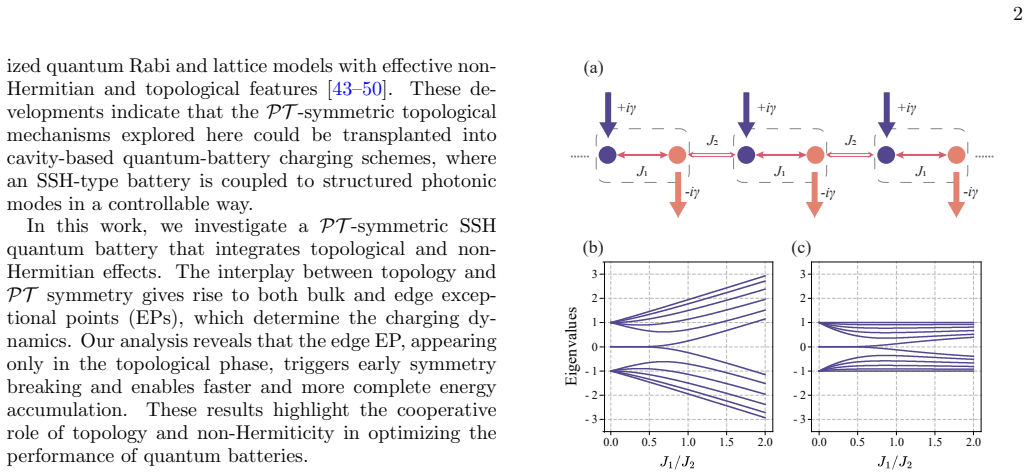
We investigate a non-Hermitian quantum battery based on the Su-Schrieffer-Heeger (SSH) lattice, charged through a parity-time (PT)-symmetric protocol that alternates gain and loss between the two sublattices. The interplay between lattice topology and non-Hermiticity gives rise to both bulk and edge exceptional points (EPs), which govern the charging dynamics. In the topological regime, an edge-state EP appears at a smaller gain-loss strength than the bulk thresholds and gives rise to an additional edge-broken regime absent in the trivial configuration. This topology-specific spectral structure is reflected in the charging dynamics, where the topological phase exhibits more favorable transient and long-time performance in the representative non-Hermitian regimes considered here. We further examine the corresponding Lindblad dynamics, identifying the non-Hermitian model as the conditional no-jump description of the same gain-loss processes. The Lindblad results show that the topological advantage remains visible at the level of stored energy, extractable work, and extractable fraction under unconditional open-system evolution. These findings demonstrate that topology constitutes a genuine physical resource for enhancing the performance of quantum batteries.
Editorial analysis
A structured set of objections, weighed in public.
Referee Report
Summary. The manuscript studies a PT-symmetric non-Hermitian Su-Schrieffer-Heeger (SSH) chain as a quantum battery charged by alternating gain and loss on the two sublattices. It reports that the topological phase supports an edge-state exceptional point (EP) at smaller gain-loss strength than the bulk EPs, producing an additional edge-broken regime absent in the trivial phase. This spectral feature is claimed to yield improved transient and long-time charging performance (stored energy, extractable work, extractable fraction) relative to the trivial configuration, with the advantage persisting under the corresponding Lindblad evolution that treats the non-Hermitian Hamiltonian as the no-jump conditional dynamics.
Significance. If the central claims hold, the work provides a concrete example in which lattice topology supplies a genuine resource for non-Hermitian quantum batteries, extending beyond generic non-Hermitian spectra or localization effects. The explicit mapping to Lindblad dynamics and the comparison of topological versus trivial regimes strengthen the case that edge EPs can be engineered to enhance both closed and open-system charging metrics.
major comments (2)
- [§4.1 and Fig. 4] §4.1 and Fig. 4: the manuscript asserts that the edge EP threshold directly governs the improved charging dynamics, yet no explicit isolation is performed (e.g., fixing all other parameters and comparing evolution immediately below versus above the reported edge-EP value of γ while holding topology fixed). Without this, it remains possible that the observed advantage arises from generic features of the non-Hermitian spectrum or the charging protocol rather than the topology-specific edge EP.
- [§5.2] §5.2, Lindblad section: the unconditional open-system results are presented as confirming the topological advantage, but the paper does not report the number of quantum trajectories, time-step convergence, or statistical error bars on the stored-energy and extractable-work curves; this weakens the quantitative claim that the advantage “remains visible” under full Lindblad evolution.
minor comments (2)
- [Eq. (2)] Eq. (2): the explicit time-dependent form of the charging protocol (alternating gain/loss intervals) is only sketched; a compact mathematical definition or a supplementary diagram would remove ambiguity about the driving period and phase.
- [Notation] Notation throughout: the gain-loss parameter is denoted both γ and λ in different figures and text passages; adopting a single symbol would improve readability.
Simulated Author's Rebuttal
We thank the referee for the careful reading of our manuscript and the constructive comments. We address each major point below and have revised the manuscript to incorporate additional analysis and numerical details as suggested.
read point-by-point responses
-
Referee: [§4.1 and Fig. 4] §4.1 and Fig. 4: the manuscript asserts that the edge EP threshold directly governs the improved charging dynamics, yet no explicit isolation is performed (e.g., fixing all other parameters and comparing evolution immediately below versus above the reported edge-EP value of γ while holding topology fixed). Without this, it remains possible that the observed advantage arises from generic features of the non-Hermitian spectrum or the charging protocol rather than the topology-specific edge EP.
Authors: We agree that a direct comparison holding topology fixed and crossing the edge EP threshold would provide stronger evidence for its specific role. In the revised manuscript we add this analysis to §4.1: with all other parameters fixed in the topological phase, we compare the full charging dynamics (stored energy, extractable work, and extractable fraction) for γ values immediately below and above the reported edge-EP location. The results show a clear improvement in both transient and long-time metrics precisely when the edge EP is crossed, while the same parameter sweep in the trivial phase (which lacks the edge EP) exhibits no such feature. This isolates the topology-specific edge EP from generic non-Hermitian spectral effects. revision: yes
-
Referee: [§5.2] §5.2, Lindblad section: the unconditional open-system results are presented as confirming the topological advantage, but the paper does not report the number of quantum trajectories, time-step convergence, or statistical error bars on the stored-energy and extractable-work curves; this weakens the quantitative claim that the advantage “remains visible” under full Lindblad evolution.
Authors: We acknowledge that these numerical details were omitted. In the revised §5.2 we now report that the Lindblad results are obtained by averaging over 10^4 quantum trajectories, that a time step of 0.001 (in units of the hopping) was used with explicit convergence checks against smaller steps, and that statistical error bars (standard error of the mean) are added to all stored-energy, extractable-work, and extractable-fraction curves. With these controls the topological advantage remains visible within the reported uncertainties. revision: yes
Circularity Check
No circularity: claims follow from direct spectral and dynamical calculations
full rationale
The paper computes the PT-symmetric non-Hermitian SSH Hamiltonian spectrum to locate bulk and edge exceptional points, then evolves the charging observables under the resulting time-dependent protocol. These steps are standard matrix diagonalization and Schrödinger/Lindblad integration applied to explicitly constructed operators; no quantity is defined in terms of another that is later called a prediction, no parameters are fitted to a subset and renamed, and no load-bearing premise reduces to a self-citation or imported ansatz. The topological advantage is demonstrated by direct comparison of regimes, remaining self-contained against the model's own equations.
Axiom & Free-Parameter Ledger
free parameters (1)
- gain-loss strength
axioms (1)
- standard math The Su-Schrieffer-Heeger chain possesses distinct topological and trivial phases depending on the ratio of intra-cell to inter-cell hopping amplitudes.
Lean theorems connected to this paper
-
IndisputableMonolith/Foundation/AlexanderDuality.leanalexander_duality_circle_linking unclear?
unclearRelation between the paper passage and the cited Recognition theorem.
We investigate a non-Hermitian quantum battery based on the Su-Schrieffer-Heeger (SSH) lattice, charged through a PT-symmetric protocol... edge-state EP appears at a smaller gain-loss strength than the bulk thresholds
What do these tags mean?
- matches
- The paper's claim is directly supported by a theorem in the formal canon.
- supports
- The theorem supports part of the paper's argument, but the paper may add assumptions or extra steps.
- extends
- The paper goes beyond the formal theorem; the theorem is a base layer rather than the whole result.
- uses
- The paper appears to rely on the theorem as machinery.
- contradicts
- The paper's claim conflicts with a theorem or certificate in the canon.
- unclear
- Pith found a possible connection, but the passage is too broad, indirect, or ambiguous to say the theorem truly supports the claim.
Reference graph
Works this paper leans on
-
[1]
F. Campaioli, S. Gherardini, J. Q. Quach, M. Polini, and G. M. Andolina,Colloquium: Quantum batteries, Rev. Mod. Phys.96, 031001 (2024)
work page 2024
-
[2]
S. Pokhrel and J. Gea-Banacloche, Large Collective Power Enhancement in Dissipative Charging of a Quan- tum Battery, Phys. Rev. Lett.134, 130401 (2025)
work page 2025
-
[3]
R. P. A. Simon, J. Anders, and K. V. Hovhannisyan, Correlations Enable Lossless Ergotropy Transport, Phys. Rev. Lett.134, 010408 (2025)
work page 2025
-
[4]
J.-Y. Gyhm and U. R. Fischer, Beneficial and detrimental entanglement for quantum battery charging, AVS Quan- tum Science6, 012001 (2024). 11
work page 2024
-
[5]
F. Mayo and A. J. Roncaglia, Collective effects and quan- tum coherence in dissipative charging of quantum batter- ies, Phys. Rev. A105, 062203 (2022)
work page 2022
-
[6]
Y. F. Li, S. R. He, P. H. Ouyang, X. N. Feng, and L. F. Wei, Switchable coherent quantum batteries with large ergotropy, Phys. Rev. A112, 022217 (2025)
work page 2025
-
[7]
H.-L. Shi, S. Ding, Q.-K. Wan, X.-H. Wang, and W.-L. Yang, Entanglement, Coherence, and Extractable Work in Quantum Batteries, Phys. Rev. Lett.129, 130602 (2022)
work page 2022
-
[8]
R. Alicki and M. Fannes, Entanglement boost for ex- tractable work from ensembles of quantum batteries, Phys. Rev. E87, 042123 (2013)
work page 2013
-
[9]
F. Campaioli, F. A. Pollock, F. C. Binder, L. C´ eleri, J. Goold, S. Vinjanampathy, and K. Modi, Enhancing the charging power of quantum batteries, Phys. Rev. Lett. 118, 150601 (2017)
work page 2017
-
[10]
D. Ferraro, M. Campisi, G. M. Andolina, V. Pellegrini, and M. Polini, High-Power Collective Charging of a Solid- State Quantum Battery, Phys. Rev. Lett.120, 117702 (2018)
work page 2018
-
[11]
S. S. Seidov and S. I. Mukhin, Quantum Dicke battery supercharging in the bound-luminosity state, Phys. Rev. A109, 022210 (2024)
work page 2024
- [12]
- [13]
-
[14]
A. Crescente, M. Carrega, M. Sassetti, and D. Ferraro, Ultrafast charging in a two-photon Dicke quantum bat- tery, Phys. Rev. B102, 245407 (2020)
work page 2020
-
[15]
G. M. Andolina, M. Keck, A. Mari, V. Giovannetti, and M. Polini, Quantum versus classical many-body batter- ies, Phys. Rev. B99, 205437 (2019)
work page 2019
- [16]
-
[17]
Y. Su, W. Lu, and H.-L. Shi, Quantum metrology en- hanced by thexyspin interaction in a generalized tavis- cummings model, Phys. Rev. A109, 042614 (2024)
work page 2024
- [18]
-
[19]
M. Z. Hasan and C. L. Kane, Colloquium: Topological insulators, Rev. Mod. Phys.82, 3045 (2010)
work page 2010
-
[20]
J. K. Asb´ oth, L. Oroszl´ any, and A. P´ alyi,A Short Course on Topological Insulators, Lecture Notes in Physics, Vol. 919 (Springer International Publishing, Cham, 2016)
work page 2016
-
[21]
W. P. Su, J. R. Schrieffer, and A. J. Heeger, Solitons in Polyacetylene, Phys. Rev. Lett.42, 1698 (1979)
work page 1979
-
[22]
F. Zhao, F.-Q. Dou, and Q. Zhao, Charging performance of the Su-Schrieffer-Heeger quantum battery, Phys. Rev. Research4, 013172 (2022)
work page 2022
-
[23]
Z.-G. Lu, G. Tian, X.-Y. L¨ u, and C. Shang, Topological Quantum Batteries, Phys. Rev. Lett.134, 180401 (2025)
work page 2025
-
[24]
Y. Guo, L. Cao, and J. Zhao, Nonreciprocal open quan- tum battery network in a photonic waveguide array, Phys. Rev. A111, 063520 (2025)
work page 2025
-
[25]
J. Carrasco, J. R. Maze, C. Hermann-Avigliano, and F. Barra, Collective enhancement in dissipative quantum batteries, Phys. Rev. E105, 064119 (2022)
work page 2022
-
[26]
C.-Y. Zhang and J. Jing, Dissipative qutrit-mediated sta- ble charging, Phys. Rev. A112, 032206 (2025)
work page 2025
-
[27]
F. Zhao, F.-Q. Dou, and Q. Zhao, Quantum battery of interacting spins with environmental noise, Phys. Rev. A 103, 033715 (2021)
work page 2021
- [28]
-
[29]
J. Q. Quach and W. J. Munro, Using Dark States to Charge and Stabilize Open Quantum Batteries, Phys. Rev. Applied14, 024092 (2020)
work page 2020
-
[30]
K. V. Hovhannisyan, F. Barra, and A. Imparato, Charg- ing assisted by thermalization, Phys. Rev. Research2, 033413 (2020)
work page 2020
-
[31]
Manzano, A short introduction to the Lindblad master equation, AIP Advances10, 025106 (2020)
D. Manzano, A short introduction to the Lindblad master equation, AIP Advances10, 025106 (2020)
work page 2020
-
[32]
K. Wilma, C.-C. Shu, U. Scherf, and R. Hildner, Visu- alizing hidden ultrafast processes in individual molecules by single-pulse coherent control, Journal of the American Chemical Society140, 15329 (2018)
work page 2018
-
[33]
R. El-Ganainy, K. G. Makris, M. Khajavikhan, Z. H. Musslimani, S. Rotter, and D. N. Christodoulides, Non- hermitian physics and PT symmetry, Nature Physics14, 11 (2018)
work page 2018
- [34]
- [35]
-
[36]
T. K. Konar, L. G. C. Lakkaraju, and A. Sen (De), Quan- tum battery with non-Hermitian charging, Phys. Rev. A 109, 042207 (2024)
work page 2024
-
[37]
C. M. Bender, Introduction to PT-symmetric quantum theory, Contemp. Phys.46, 277 (2005)
work page 2005
- [38]
- [39]
-
[40]
B. Zhu, R. L¨ u, and S. Chen, PT symmetry in the non-Hermitian Su-Schrieffer-Heeger model with complex boundary potentials, Phys. Rev. A89, 062102 (2014)
work page 2014
-
[41]
S ¸. K.¨Ozdemir, S. Rotter, F. Nori, and L. Yang, Parity– time symmetry and exceptional points in photonics, Nat. Mater.18, 783 (2019)
work page 2019
-
[42]
J. M. Zeuner, M. C. Rechtsman, Y. Plotnik, Y. Lumer, S. Nolte, M. S. Rudner, M. Segev, and A. Szameit, Ob- servation of a topological transition in the bulk of a non- hermitian system, Phys. Rev. Lett.115, 040402 (2015)
work page 2015
-
[43]
Braak, Integrability of the Rabi model, Phys
D. Braak, Integrability of the Rabi model, Phys. Rev. Lett.107, 100401 (2011)
work page 2011
- [44]
- [45]
-
[46]
Q. Xie, H. Zhong, M. T. Batchelor, and C. Lee, The quantum Rabi model: Solution and dynamics, J. Phys. A: Math. Theor.50, 113001 (2017). 12
work page 2017
- [47]
-
[48]
Q.-T. Xie, S. Cui, J.-P. Cao, L. Amico, and H. Fan, Anisotropic Rabi model, Phys. Rev. X4, 021046 (2014)
work page 2014
-
[49]
X. Lu, H. Li, J.-K. Shi, L.-B. Fan, V. Mangazeev, Z.-M. Li, and M. T. Batchelor, PT-symmetric quantum Rabi model, Phys. Rev. A108, 053712 (2023)
work page 2023
- [50]
-
[51]
A. F. Tzortzakakis, A. Katsaris, N. E. Palaiodimopou- los, P. A. Kalozoumis, G. Theocharis, F. K. Diakonos, and D. Petrosyan, Topological edge states of thePT- symmetric su-schrieffer-heeger model: An effective two- state description, Phys. Rev. A106, 023513 (2022)
work page 2022
-
[52]
T. K. Konar, L. G. C. Lakkaraju, S. Ghosh, and A. Sen(De), Quantum battery with ultracold atoms: Bosons versus fermions, Phys. Rev. A106, 022618 (2022)
work page 2022
-
[53]
S. Ghosh and A. Sen(De), Dimensional enhancements in a quantum battery with imperfections, Phys. Rev. A105, 022628 (2022)
work page 2022
-
[54]
D. Dast, D. Haag, H. Cartarius, and G. Wunner, Quan- tum master equation with balanced gain and loss, Phys. Rev. A90, 052120 (2014)
work page 2014
-
[55]
Y. Nakanishi and T. Sasamoto, PT phase transition in open quantum systems with Lindblad dynamics, Phys. Rev. A105, 022219 (2022)
work page 2022
- [56]
- [57]
-
[58]
F. Mei, G. Chen, L. Tian, S.-L. Zhu, and S. Jia, Ro- bust quantum state transfer via topological edge states in superconducting qubit chains, Phys. Rev. A98, 012331 (2018)
work page 2018
-
[59]
S. Lin, L. Zhang, T. Tian, C.-K. Duan, and J. Du, Dynamic observation of topological soliton states in a programmable nanomechanical lattice, Nano Letters21, 1025 (2021)
work page 2021
-
[60]
A. E. Allahverdyan, R. Balian, and T. M. Nieuwenhuizen, Maximal work extraction from finite quantum systems, Europhys. Lett.67, 565 (2004)
work page 2004
-
[61]
X. Yang, Y.-H. Yang, M. Alimuddin, R. Salvia, S.-M. Fei, L.-M. Zhao, S. Nimmrichter, and M.-X. Luo, Battery capacity of energy-storing quantum systems, Phys. Rev. Lett.131, 030402 (2023)
work page 2023
discussion (0)
Sign in with ORCID, Apple, or X to comment. Anyone can read and Pith papers without signing in.