REVIEW 4 major objections 5 minor 71 references
A deep learning approach for predicting multiple observables in Au+Au collisions at RHIC
T0 review · 4 major / 5 minor · reviewed 2026-08-03 · deepseek-v4-flash
Pith's one-line read A single neural network, designed to mirror the stages of a heavy-ion collision and trained exclusively on existing experimental data, can reproduce and predict three bulk observables in Au+Au collisions across RHIC energies.
desk verdict A promising physics-guided multi-observable surrogate for RHIC, but the held-out tests leak energy information across observables, so the headline generalization to unseen energies is not actually demonstrated. read the letter →
The pith
A machine-rendered reading of the paper's core claim, the machinery that carries it, and where it could break.
The reading
What carries the argument
The load-bearing mechanism is the locally connected spherical-layer stack: neurons in the quark-gluon plasma, chemical freeze-out, and kinetic freeze-out layers are distributed on spheres of increasing radius by the Fibonacci grid, and each neuron connects to its seven nearest neighbours on the neighbouring sphere, creating a sparse, physically motivated connectivity that suppresses long-range correlations and regularizes the network. The complementary mechanism is the split dual input: one input carries the collision system's parameters (masses, energy, centrality range), the other carries the final-particle kinematic coordinate (pseudorapidity or transverse momentum, with a categorical mar
What would settle it
Compare the network's predicted dN/dη, v2(pT), and pT spectra at 54.4 GeV Au+Au (or another energy the paper treats as unmeasured) against newly published high-statistics data from the same accelerator: systematic disagreement beyond the claimed ~10% error band would falsify the surrogate claim. A second, more targeted falsifier: if a random sparse graph with the same degree distribution as the Fibonacci-sphere network achieves the same test loss on the test set, then the claim that the physics prior causes the improvement is falsified.
Extended reading notes
Core claim
The central discovery is that a single physics-structured network can simultaneously learn the mapping from collision parameters (nucleon masses, collision energy, centrality) and final-particle kinematics (pseudorapidity or transverse momentum, with a categorical marker for the kinematic bin) to three distinct observables, using only real experimental data, and can interpolate to collision energies that were not part of the training set. The architecture mirrors the collision timeline: layers corresponding to the quark-gluon plasma, chemical freeze-out, kinetic freeze-out, and detector, with each hidden layer's neurons placed on a sphere of increasing radius using a Fibonacci grid and conne
Load-bearing premise
That the geometric prior of a uniformly expanding fireball—encoded as seven-nearest-neighbour connections on Fibonacci-grid spheres of increasing radius—matches the actual correlation structure of the data; if it does not, the ablation results only show that a sparse structured network outperforms the baselines, not that physics guidance is responsible.
Editorial extensions
If this is right
- The trained network can act as a fast, experiment-only surrogate for generating pseudorapidity density, transverse-momentum spectra, and elliptic flow at RHIC energies where data are sparse or absent, without invoking a specific microscopic model.
- Because the network was trained without model-generated synthetic data, its success shows that a well-structured network can learn directly from experimental measurements, bypassing the need for hydrodynamic simulations in interpolation tasks.
- The physics-motivated architecture (local connections plus split input) is the reason for the performance gain; replacing these with Dropout or removing them degrades results, so the design template matters.
- The predictions are consistent with a viscous hydrodynamic calculation and with the global energy dependence of total charged-particle multiplicity per participant pair, supporting the reliability of the surrogate.
- The network's ability to reproduce multiple bulk observables suggests an effective universality—bulk particle production appears governed by a few macroscopic parameters even though the network never receives those parameters explicitly.
Reading between the lines
- A decisive control experiment is missing from the paper's ablations: replacing the Fibonacci-sphere seven-nearest-neighbour adjacency with a random sparse graph of the same degree. If the random graph matches the test loss, the specific fireball geometry is not the cause of the improvement; if it degrades, the physics prior is doing genuine work.
- Surrogate validation would be stronger if it used an observable outside the training family, such as identified-particle ratios or femtoscopic radii, since the current checks (multiplicity systematics and a hydrodynamic model) are anchored to multiplicities and spectra that the network already sees.
- A natural stress test for the interpolation claim is to query the network across a domain boundary, e.g., train on RHIC Au+Au energies and ask for predictions at LHC energies or at very low energies; a graceful extrapolation would support the low-dimensional universality reading, while a sharp failure would delineate the surrogate's valid range.
- Beyond prediction, the same architecture could be inverted: replace the observed kinematics in the input with the latent layer activations and use the trained network as a learned summary statistic to constrain QGP properties (shear viscosity, initial conditions) from experimental data, which the paper only gestures at as 'fast emulators'.
Editorial analysis
A structured set of objections, weighed in public.
Referee Report
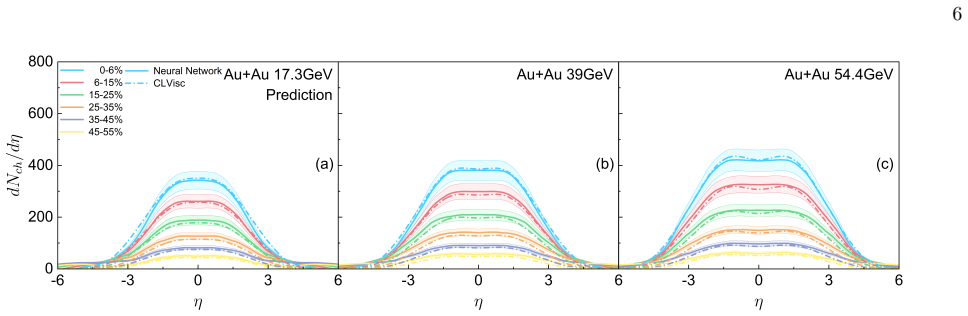
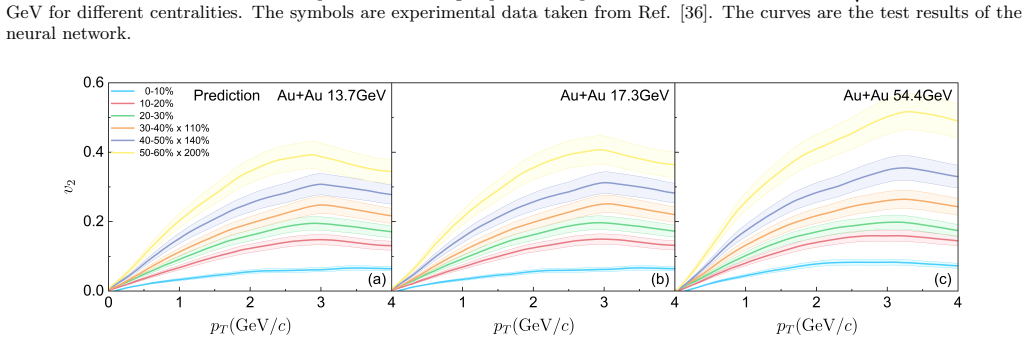
Summary. The paper presents a physics-inspired neural network trained exclusively on experimental Au+Au data at RHIC to reproduce and predict three bulk observables: charged-particle pseudorapidity density dN/dη, elliptic flow v2(pT), and transverse-momentum spectra dN/(2πpTdpTdη). The architecture uses a stage-inspired layering (QGP, chemical freeze-out, kinetic freeze-out, detector) with locally connected Fibonacci-sphere hidden layers and a dual-input design. After training on multiple energies and centralities, the authors report low held-out test losses, show that the structured architecture outperforms fully connected and Dropout baselines, and make predictions for energies they describe as unexplored (17.3, 54.4, 13.7, and 9.2 GeV). These predictions are checked against CLVisc hydrodynamic calculations and against the global energy dependence of total charged-particle multiplicity per participant pair.
Significance. If the generalization claim were fully established, the paper would provide a useful fast empirical surrogate for bulk heavy-ion observables and an interesting demonstration that physically motivated inductive biases can improve multi-task ML performance in nuclear physics. The architecture-ablation results (Table II) are suggestive, and the decision to train only on experimental data is a strength. However, the quantitative evaluation does not actually test the claimed extrapolation to unseen collision energies, and the external validation is partly calibrated to the same observables used for training. The paper's own concluding caveat that it is 'an empirical interpolator' is appropriate, but the central predictive claim is currently stronger than the evidence supports.
major comments (4)
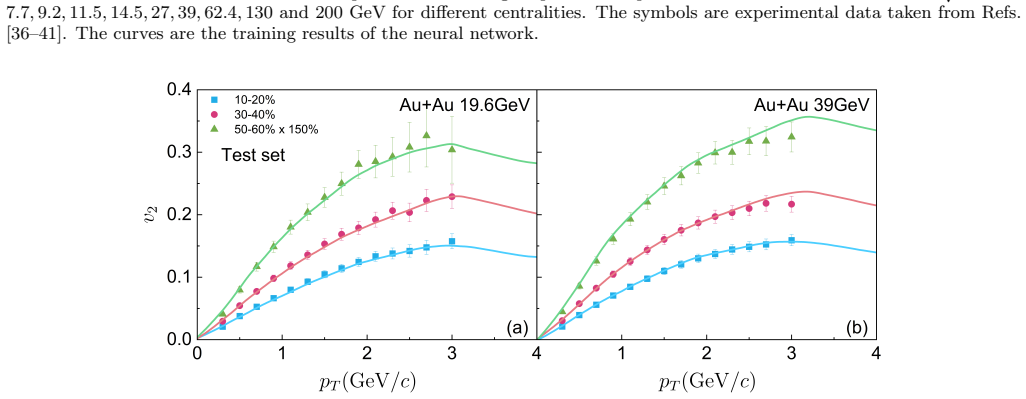
- [Table I; §II (shared layers); §III] The held-out test set does not test generalization to unseen collision energies. Every test energy appears in the training set through at least one other observable: dN/dη is tested at 130 GeV while v2 at 130 GeV is trained; v2 is tested at 19.6 and 39 GeV while dN/dη at 19.6 and pT spectra at 39 GeV are trained; pT spectra are tested at 19.6 and 130 GeV while dN/dη at 19.6 and v2 at 130 GeV are trained. Since collision energy is an input and all outputs share hidden representations, training at energy E for one task gives the network usable information about E for the other tasks. Thus Table II and Figs. 4, 9, and 12 demonstrate cross-observable transfer at already represented energies, not energy generalization. The true target energies (17.3, 54.4, 13.7, 9.2) never appear as held-out tests. An energy-exclusive split (removing all observables at test energies from training) is needed t
- [§III, Figs. 5–7; Appendix A] The external validation is not independent. The CLVisc parameters in Table III are tuned to reproduce the most-central charged-particle dN/dη, which is one of the three trained observables, so agreement between the NN and CLVisc partly reflects consistency with the same training family. Likewise, the multiplicity-per-participant fit in Fig. 6 uses exactly the dN/dη/multiplicity data family on which the network was trained. These checks therefore confirm smoothness and consistency rather than genuine predictive power at unmeasured energies. The authors should either validate on observables absent from the training set (e.g., identified-particle spectra, higher-order harmonics, or independent model constraints) or explicitly label Figs. 5–7 as consistency checks rather than validation.
- [Table II; §III] The architecture-improvement claim is not quantified robustly. Table II reports a single 'best' training and test loss with no standard deviation across random seeds and no explicit model-selection rule. If the test loss is used to select the epoch or architecture, the comparison is partially fitted to the test set. In addition, the causal interpretation of the local-connectivity improvement is underdetermined: a sparse structured network may outperform fully connected and Dropout baselines because of the regularization induced by sparsity, not because the Fibonacci-sphere geometry encodes the collision dynamics. Please provide repeated-run statistics, a validation-based selection protocol, and an ablation against an equally sparse but non-physical connectivity pattern.
- [§III, Figs. 5, 10, 13] The 10% error band used for all predictions is ad hoc and not derived from the model or from data coverage. Adding a fixed 10% band does not quantify extrapolation uncertainty, especially at energies and kinematic regions far from the training distribution. For a paper whose central claim is filling data gaps at RHIC, some form of uncertainty quantification — for example, ensemble/Bayesian methods or propagation of training-density-dependent variance — is required before 'accuracy' of the 13.7, 17.3, 54.4, and 9.2 GeV predictions can be assessed.
minor comments (5)
- [General; reproducibility] No code, trained weights, or processed dataset are provided, and the preprocessing, centrality binning, and random seed are not fully specified. Given the ML-focused contribution, releasing the code and data pipeline would be essential for reproducibility.
- [Captions for Figs. 5, 10, 13] The captions say 'the bands are the error bars,' but the bands are the fixed 10% uncertainty added to the NN predictions, not experimental error bars. Please rephrase to avoid implying they are measured uncertainties.
- [Abstract and Section IV] The phrase 'collision energies not yet explored experimentally at RHIC' is overstated. For example, 9.2 GeV appears in the v2 training set, and 39 GeV appears in the pT-spectra training set. The predictions are for observables at energies not yet measured for that observable; the text should say so explicitly.
- [Eq. (1); §II] The Fibonacci-grid formula is given with a somewhat loose notation for x_n and y_n (the square-root factor should be parenthesized consistently), and the reader is not told how the seven-nearest-neighbour connections are computed once the sphere points are projected. Please specify the adjacency criterion precisely.
- [Section IV] The concluding claim that the network's success suggests 'an empirical indication of underlying universality' is speculative. The training and test sets are all from one collision system and one observable family; this statement should be removed or heavily qualified.
Circularity Check
No significant circularity: the network is a genuinely trained empirical interpolator; validation anchors are imperfectly independent but not definitional inputs to the model.
full rationale
The central derivation—train on experimental dN/dη, v2, and pT spectra over some RHIC energies and then output the same three observables at energies absent from the whole training set (17.3, 13.7, 54.4, 9.2 GeV)—does not reduce to its inputs by construction. Table I shows the split: the held-out tests are for one observable at an energy where another observable is in training (e.g., dN/dη at 130 GeV is tested while v2 at 130 GeV is trained), so the test losses measure cross-observable transfer at known energies rather than truly unseen-energy generalization; this is a generalization-evidence caveat, not self-definition, because the target labels are not seen. The physics-inspired Fibonacci/local-connection architecture is an empirical design choice tested by ablations (Table II), not derived from the outputs. The CLVisc comparison in Fig. 5 is weakened by the paper's own admission that "The CLVisc model parameters are tuned based on the charged particle pseudorapidity density distributions in the most central collision" (Appendix A: the parameters "are tuned to match the charged particle pseudorapidity density distributions in the most central collisions"), and the multiplicity-per-participant validation uses fits over the same dN/dη observable family; however, these are external benchmarks, and the neural network is not defined in terms of CLVisc parameters or the fit line. The paper itself disclaims more than empirical interpolation in the Summary. Hence no circular step meets the evidentiary bar; the weaknesses are validation-independence and generalization-validity risks, not circularity.
Assumptions & free parameters
free parameters (5)
- Neural network weights and biases (all layers) =
~[200-300-400-400-404-304-204 neurons], trained to minimize Huber loss
- CLVisc initial-condition parameters (K, eta_flat, eta_gw, tau0, C_eta_v) =
K=45/42/40, eta_flat=2.5/2.2/1.8, eta_gw=0.1/0.07/0.04, tau0=0.6 fm, C_eta_v=0.08
- NN inelastic cross-section parametrization coefficients =
17.2031, 0.1641, 23.8981, -0.5783 (Eq. A1)
- Arbitrary error band =
10% added to all NN predictions
- Architecture hyperparameters (layer radii R, learning rate, epochs, batch size) =
not stated
assumptions (5)
- domain assumption Heavy-ion collision stage ordering (QGP → chemical freeze-out → kinetic freeze-out → detector) maps to a feedforward network, and local correlations follow an expanding-sphere adjacency (Fibonacci grid, Eq. 1).
- domain assumption Experimental datasets from different collaborations and centrality classes are mutually consistent and can be jointly trained after per-category standardization.
- domain assumption Observables vary smoothly in energy, centrality, and kinematic variables, so a finite training set generalizes to unmeasured energies and centralities.
- standard math Adam, Huber loss, Leaky ReLU, and standard backpropagation perform as intended.
- domain assumption TRENTo participant counting and CLVisc hydrodynamics with the HotQCD equation of state are reliable references for validation.
Cite this review
Pith. "Pith review of A deep learning approach for predicting multiple observables in Au+Au collisions at RHIC." pith.science (2026). https://pith.science/paper/LN6NEC5M
@misc{pith2026251113163,
  author       = {Pith},
  title        = {Pith review of: A deep learning approach for predicting multiple observables in Au+Au collisions at RHIC},
  year         = {2026},
  howpublished = {\url{https://pith.science/paper/LN6NEC5M}},
  note         = {Machine review of arXiv:2511.13163}
}
read the original abstract
We develop a neural network model, based on the processes of high-energy heavy-ion collisions, to study and predict several experimental observables in Au+Au collisions. We present a data-driven deep learning framework for predicting multiple bulk observables in Au+Au collisions at RHIC energies. A single neural network is trained exclusively on experimental measurements of charged-particle pseudorapidity density distributions, transverse-momentum spectra and elliptic flow coefficients over a broad range of collision energies and centralities. The network architecture is inspired by the stages of a heavy-ion collision, from the quark-gluon plasma to chemical and kinetic freeze-out, and employs locally connected hidden layers and a structured input design that encodes basic geometric and kinematic features of the system. We demonstrate that these physics-motivated choices significantly improve test performance compared to purely fully connected baselines. The trained model is then used to predict the above observables at collision energies not yet explored experimentally at RHIC, and the results are validated using the energy dependence of the total charged-particle multiplicity per participant pair as well as comparisons to a CLVisc hydrodynamic calculation with TRENTo initial conditions. Our findings indicate that such physics-guided neural networks can serve as efficient surrogates to fill critical data gaps at RHIC and to support further phenomenological studies of QGP properties.
Figures


Figures from the paper (11 more)





Reference graph
Works this paper leans on
-
[1]
However, TRENTo requires the nucleon-nucleon collision inelastic cross-section
Initial condition TRENTo is a model for the initial conditions of high-energy nuclear collisions and can generate realis- tic Monte Carlo initial entropy profiles without assum- ing specific physical mechanisms for entropy production, pre-equilibrium dynamics or thermalization. However, TRENTo requires the nucleon-nucleon collision inelastic cross-section...
-
[2]
Hydrodynamic evolution After obtaining the initial condition generated from the TRENTo, the CL Visc model is used to simulate the hydrodynamic evolution of the collision system through the following energy momentum conservation equation, ∇µT µν = 0,(A4) whereT µν is the energy-momentum tensor which is de- fined as follows, T µν =εu µuν −p∆ µν +π µν,(A5) w...
-
[3]
Z.-W. Lin, C. M. Ko, B.-A. Li, B. Zhang, and S. Pal, Phys. Rev. C72, 064901 (2005)
2005
-
[4]
Wang and M
X.-N. Wang and M. Gyulassy, Phys. Rev. D44, 3501 (1991)
1991
-
[5]
Pierog, I
T. Pierog, I. Karpenko, J. M. Katzy, E. Yatsenko, and K. Werner, Phys. Rev. C92, 034906 (2015)
2015
-
[6]
Xie, A.-K
Z. Xie, A.-K. Lei, H. Zheng, W. Zhang, D.-M. Zhou, Z.-L. She, Y.-L. Yan, and B.-H. Sa, Phys. Rev. C112, 014908 (2025)
2025
-
[7]
Wang, J.-H
H. Wang, J.-H. Chen, Y.-G. Ma, and S. Zhang, Nuclear Science and Techniques30, 185 (2019)
2019
-
[8]
Lei, Z.-L
A.-K. Lei, Z.-L. She, Y.-L. Yan, D.-M. Zhou, L. Zheng, W.-C. Zhang, H. Zheng, L. V. Bravina, E. E. Zabrodin, and B.-H. Sa, Computer Physics Communications310, 109520 (2025)
2025
Show all 71 references
-
[9]
L.-G. Pang, H. Petersen, and X.-N. Wang, Phys. Rev. C 97, 064918 (2018)
2018
-
[10]
Li, Y.-Z
B.-C. Li, Y.-Z. Wang, F.-H. Liu, X.-J. Wen, and Y.-E. Dong, Phys. Rev. D89, 054014 (2014)
2014
-
[11]
Sun, C.-X
J.-X. Sun, C.-X. Tian, E.-Q. Wang, and F.-H. Liu, Chi- nese Physics Letters30, 022501 (2013)
2013
-
[12]
Jiang, X.-Y
Z.-F. Jiang, X.-Y. Wu, S. Cao, and B.-W. Zhang, Phys. Rev. C107, 034904 (2023)
2023
-
[13]
Wu, G.-Y
X.-Y. Wu, G.-Y. Qin, L.-G. Pang, and X.-N. Wang, Phys. Rev. C105, 034909 (2022)
2022
-
[14]
Jiang, X.-Y
Z.-F. Jiang, X.-Y. Wu, S. Cao, and B.-W. Zhang, Phys. Rev. C108, 064904 (2023)
2023
-
[15]
de Oliveira, M
L. de Oliveira, M. Paganini, and B. Nachman, Comput- ing and Software for Big Science1, 4 (2017)
2017
-
[16]
K. Zhou, L. Wang, L.-G. Pang, and S. Shi, Progress in Particle and Nuclear Physics135, 104084 (2024)
2024
-
[17]
He, Y.-G
W.-B. He, Y.-G. Ma, L.-G. Pang, H.-C. Song, and K. Zhou, Nuclear Science and Techniques34, 88 (2023)
2023
-
[18]
Mallick, S
N. Mallick, S. Prasad, A. N. Mishra, R. Sahoo, and G. G. Barnaf¨ oldi, Phys. Rev. D107, 094001 (2023)
2023
-
[19]
Steinheimer, L.-G
J. Steinheimer, L.-G. Pang, K. Zhou, V. Koch, J. Ran- drup, and H. Stoecker, Journal of High Energy Physics 2019, 122 (2019)
2019
-
[20]
Huang, L.-G
Y.-G. Huang, L.-G. Pang, X.-F. Luo, and X.-N. Wang, Physics Letters B827, 137001 (2022)
2022
-
[21]
Mengel, P
T. Mengel, P. Steffanic, C. Hughes, A. C. O. da Silva, and C. Nattrass, Phys. Rev. C108, L021901 (2023)
2023
-
[22]
Omana Kuttan, J
M. Omana Kuttan, J. Steinheimer, K. Zhou, A. Redel- bach, and H. Stoecker, Physics Letters B811, 135872 (2020)
2020
-
[23]
L.-G. Pang, K. Zhou, and X.-N. Wang,Interpretable deep learning for nuclear deformation in heavy ion collisions (2019), 1906.06429
2019 arXiv
-
[24]
Paganini, L
M. Paganini, L. de Oliveira, and B. Nachman, Phys. Rev. Lett.120, 042003 (2018)
2018
-
[25]
R. Guo, Y. Li, and B. Chen, Entropy25(2023)
2023
-
[26]
J.-A. Sun, L. Yan, C. Gale, and S. Jeon,An end-to-end generative diffusion model for heavy-ion collisions(2024), 2410.13069
2024
-
[27]
Cao, J.-Y
Y.-Y. Cao, J.-Y. Guo, and B. Zhou, Nuclear Science and Techniques34, 152 (2023)
2023
-
[28]
Q.-K. Sun, Y. Zhang, Z.-R. Hao, H.-W. Wang, G.-T. Fan, H.-H. Xu, L.-X. Liu, S. Jin, Y.-X. Yang, K.-J. Chen, et al., Nuclear Science and Techniques36, 52 (2025)
2025
-
[29]
Gao, Y.-J
Z.-P. Gao, Y.-J. Wang, H.-L. L¨ u, Q.-F. Li, C.-W. Shen, and L. Liu, Nuclear Science and Techniques32, 109 (2021)
2021
-
[30]
M. O. Kuttan, K. Zhou, J. Steinheimer, A. Redelbach, and H. Stocker, Journal of High Energy Physics2021, 184 (2021)
2021
-
[31]
M. R. Mumpower, T. M. Sprouse, A. E. Lovell, and A. T. Mohan, Phys. Rev. C106, L021301 (2022)
2022
-
[32]
Y.-L. Du, K. Zhou, J. Steinheimer, L.-G. Pang, A. Mo- tornenko, H.-S. Zong, X.-N. Wang, and H. St¨ ocker, Eu- ropean Physical Journal C80, 516 (2020)
2020
-
[33]
B. B. Back et al. (PHOBOS Collaboration), Phys. Rev. Lett.91, 052303 (2003)
2003
-
[34]
Y.-S. Zhao, L. Wang, K. Zhou, and X.-G. Huang, Phys. Rev. C106, L051901 (2022)
2022
-
[35]
Omana Kuttan, J
M. Omana Kuttan, J. Steinheimer, K. Zhou, and H. Stoecker, Phys. Rev. Lett.131, 202303 (2023)
2023
-
[36]
Adamczyk et al
L. Adamczyk et al. (STAR Collaboration), Phys. Rev. C 86, 054908 (2012)
2012
-
[37]
B. B. Back et al. (PHOBOS Collaboration), Phys. Rev. C74, 021901 (2006)
2006
-
[38]
Alver et al
B. Alver et al. (PHOBOS Collaboration), Phys. Rev. C 83, 024913 (2011)
2011
-
[39]
B. I. Abelev et al. (STAR Collaboration), Phys. Rev. C 81, 024911 (2010)
2010
-
[40]
Adler et al
C. Adler et al. (STAR Collaboration), Phys. Rev. C66, 034904 (2002)
2002
-
[41]
Adare et al
A. Adare et al. (PHENIX Collaboration), Phys. Rev. Lett.105, 062301 (2010)
2010
-
[42]
Adamczyk et al
L. Adamczyk et al. (STAR Collaboration), Phys. Rev. Lett.121, 032301 (2018)
2018
-
[43]
Adam et al
J. Adam et al. (STAR Collaboration), Phys. Rev. C101, 024905 (2020)
2020
-
[44]
B. I. Abelev et al. (STAR Collaboration), Phys. Rev. C 75, 054906 (2007)
2007
-
[45]
Paszke, S
A. Paszke, S. Gross, F. Massa, A. Lerer, J. Bradbury, G. Chanan, T. Killeen, Z. Lin, N. Gimelshein, L. Antiga, et al.,Pytorch: An imperative style, high-performance deep learning library(2019), 1912.01703
2019 arXiv
-
[46]
is used as the activation function for the hidden lay- ers, while no activation function is applied to the output layer. The model is optimized using the ADAM optimizer [47], and Huber loss is used as the loss function, L(y−ˆy) = ( 1 2 (y−ˆy)2,if|y−ˆy| ≤1 |y−ˆy| −1 2 ,if|y−ˆy|...
-
[47]
Adams et al
J. Adams et al. (STAR Collaboration), Phys. Rev. Lett. 91, 172302 (2003)
2003
-
[48]
Adler et al
C. Adler et al. (STAR Collaboration), Phys. Rev. Lett. 89, 202301 (2002)
2002
-
[49]
A. L. Maas, A. Y. Hannun, and A. Y. Ng, inProc. icml (Atlanta, GA, 2013), vol. 30, p. 3
2013
-
[50]
D. P. Kingma and J. Ba,Adam: A method for stochastic optimization(2017), 1412.6980
2017 arXiv
-
[51]
J. L. Klay et al. (E895 Collaboration), Phys. Rev. C68, 054905 (2003)
2003
-
[52]
Ahle et al
L. Ahle et al. (E-802 Collaboration), Phys. Rev. C57, R466 (1998)
1998
-
[53]
S. V. Afanasiev et al. (NA49 Collaboration), Phys. Rev. C66, 054902 (2002)
2002
-
[54]
Abreu et al
M. Abreu et al. (NA50 Collaboration), Physics Letters B 530, 43 (2002)
2002
-
[55]
Abbas et al
E. Abbas et al. (ALICE Collaboration), Physics Letters B726, 610 (2013)
2013
-
[56]
Adam et al
J. Adam et al. (ALICE Collaboration), Physics Letters B772, 567 (2017)
2017
-
[57]
Acharya et al
S. Acharya et al. (ALICE Collaboration), Physics Letters B790, 35 (2019)
2019
-
[58]
G. A. Wildenberg, M. R. Rosen, J. Lundell, D. Paukner, D. J. Freedman, and N. Kasthuri, Cell Reports36, 12 109709 (2021)
2021
-
[59]
Udvary, P
D. Udvary, P. Harth, J. H. Macke, H.-C. Hege, C. P. de Kock, B. Sakmann, and M. Oberlaender, Cell Reports 39, 110677 (2022)
2022
-
[60]
Y. Gao, H. Zheng, L. L. Zhu, and A. Bonasera, European Physical Journal A53, 197 (2017)
2017
-
[61]
J. Q. Tao, M. Wang, H. Zheng, W. C. Zhang, L. L. Zhu, and A. Bonasera, Journal of Physics G: Nuclear and Par- ticle Physics48, 105102 (2021)
2021
-
[62]
Tao, H.-B
J.-Q. Tao, H.-B. He, H. Zheng, W.-C. Zhang, X.-Q. Liu, L.-L. Zhu, and A. Bonasera, Nuclear Science and Tech- niques34, 172 (2023)
2023
-
[63]
Wang, J.-Q
M. Wang, J.-Q. Tao, H. Zheng, W.-C. Zhang, L.-L. Zhu, and A. Bonasera, Nuclear Science and Techniques33, 37 (2022)
2022
-
[64]
J. S. Moreland, J. E. Bernhard, and S. A. Bass, Phys. Rev. C92, 011901 (2015)
2015
-
[65]
Donnachie and P
A. Donnachie and P. Landshoff, Physics Letters B296, 227 (1992)
1992
-
[66]
Adare et al
A. Adare et al. (PHENIX Collaboration), Phys. Rev. C 93, 024901 (2016)
2016
-
[67]
Aad et al
G. Aad et al. (ATLAS Collaboration), Physics Letters B 710, 363 (2012)
2012
-
[68]
Abelev et al
B. Abelev et al. (ALICE Collaboration), Phys. Rev. Lett. 110, 032301 (2013)
2013
-
[69]
Abelev et al
B. Abelev et al. (ALICE Collaboration), European Phys- ical Journal C73, 2456 (2013)
2013
-
[70]
Zhu, X.-Y
J. Zhu, X.-Y. Wu, and G.-Y. Qin, Chinese Physics C49, 044103 (2025)
2025
-
[71]
Bazavov et al
A. Bazavov et al. (HotQCD Collaboration), Phys. Rev. D90, 094503 (2014)
2014
Reviewed August 3, 2026 · model on record in the stance chip above.
Discussion (0). Continue with ORCID to comment.