K-shell ionization and characteristic x-ray radiation by high-energy electrons and positrons in oriented silicon crystals
Pith reviewed 2026-05-17 21:09 UTC · model grok-4.3
The pith
The angular distribution of characteristic x-rays from electrons and positrons in oriented silicon crystals evolves non-monotonically with incidence angle and energy from 1 to 1000 GeV.
A machine-rendered reading of the paper's core claim, the machinery that carries it, and where it could break.
Core claim
Computer simulations reveal that the angular distribution of characteristic x-ray radiation emitted from the upstream surface of oriented silicon crystals by electrons and positrons changes non-monotonically when the angle between the incident momentum and the <100> axis or (100) plane is varied, and likewise when particle energy is changed from 1 GeV to 1000 GeV. The non-monotonic evolution stems from the interplay of K-shell ionization, particle channeling and dechanneling, and radiation processes, with dechanneling exerting a pronounced influence on the electron case.
What carries the argument
A detailed computer simulation that follows the full trajectory of each particle while accounting for K-shell ionization, channeling, dechanneling, and characteristic x-ray emission inside the crystal lattice.
If this is right
- Optimal angles for maximum CXR yield must be identified individually rather than assumed to follow a simple increasing or decreasing trend.
- Dechanneling reduces CXR output from electrons at intermediate angles and energies.
- Positrons exhibit different non-monotonic patterns because they experience less channeling than electrons.
- Crystal orientation and thickness can be chosen to tune the radiation pattern for specific high-energy applications.
Where Pith is reading between the lines
- The same simulation framework could be applied to other crystal materials such as germanium to predict similar non-monotonic behavior.
- These results suggest that dechanneling length measurements might be refined by observing CXR angular distributions at several energies.
- The non-monotonic dependence may influence background estimates in experiments that use crystal targets for particle identification or radiation generation.
Load-bearing premise
The simulation correctly captures the combined effects of ionization, channeling, dechanneling, and radiation across the full energy range without major missing pieces.
What would settle it
Measurements that show the angular distribution of CXR changing strictly monotonically with angle or energy over the 1-1000 GeV range in silicon would falsify the central claim.
Figures

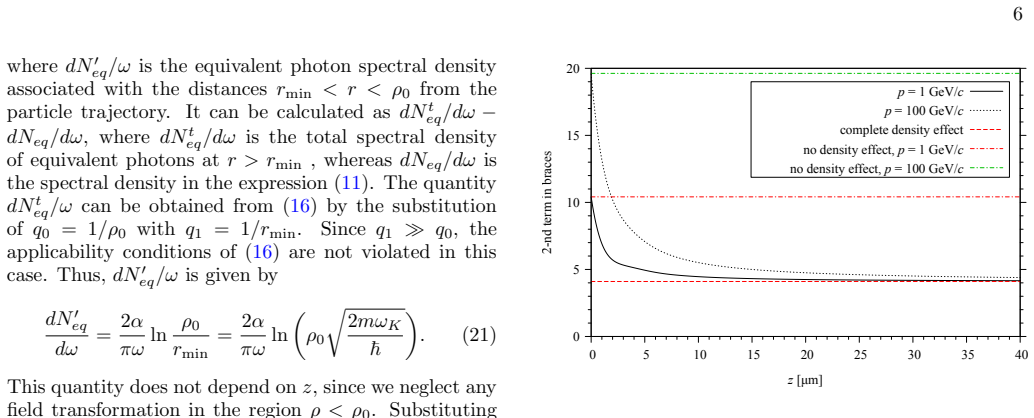


read the original abstract
K-shell ionization and characteristic x-ray radiation (CXR) by high-energy electrons and positrons in oriented silicon crystals are studied using computer simulation. A method for this simulation has been developed and is described in detail. The evolution of the angular distribution of CXR from the upstream surface of the crystal with changes in the angle between the incident particle momentum and the crystal <100> axis or (100) plane, as well as with changes in particle energy over a wide range (1-1000 GeV), is investigated. It is shown that in most cases this evolution is non-monotonic. The physical mechanisms underlying this behavior are discussed. In particular, the impact of the dechanneling process on CXR produced by electrons is analyzed.
Editorial analysis
A structured set of objections, weighed in public.
Referee Report
Summary. The paper develops and describes in detail a computer simulation method for studying K-shell ionization and characteristic x-ray radiation (CXR) by high-energy electrons and positrons in oriented silicon crystals. It investigates the evolution of the angular distribution of CXR from the upstream crystal surface as a function of the angle between the incident particle momentum and the <100> axis or (100) plane, as well as particle energy over 1-1000 GeV. The central finding is that this evolution is non-monotonic in most cases, with discussion of underlying mechanisms and specific analysis of dechanneling's impact on electron-produced CXR.
Significance. If the simulation accurately captures the interplay of ionization, channeling, dechanneling, and radiation, the work would provide useful insights into non-monotonic angular distributions of CXR at ultra-relativistic energies and the role of dechanneling for electrons. The broad energy range and focus on oriented crystals represent a strength for potential applications in high-energy physics or radiation studies, though the absence of validation benchmarks limits the current significance.
major comments (2)
- [simulation method] The simulation method section: no quantitative validation is provided, such as direct comparisons of simulated dechanneling lengths or CXR yields against experimental data at GeV energies or against standard analytic models (e.g., Lindhard theory) and Monte Carlo codes. This is load-bearing for the central claim, as the reported non-monotonic evolution of CXR angular distributions with angle and energy depends on the fidelity of the dechanneling modeling for electrons.
- [results] Results on angular distributions (1-1000 GeV range): the non-monotonic features are presented without sensitivity tests on key model parameters such as scattering cross-sections or dechanneling rates. This raises the risk that observed behaviors stem from untested numerical choices rather than the discussed physical mechanisms.
minor comments (2)
- [abstract] The abstract mentions investigation 'with changes in the angle' but does not specify the angular range studied; adding this would improve clarity.
- [introduction] Notation for crystal orientations (<100> axis vs. (100) plane) is used consistently but could benefit from a brief reminder of the distinction in the introduction for readers less familiar with channeling.
Simulated Author's Rebuttal
We thank the referee for their careful reading of the manuscript and for the constructive comments, which have helped us improve the presentation of the simulation method and results. We address the major comments point by point below.
read point-by-point responses
-
Referee: The simulation method section: no quantitative validation is provided, such as direct comparisons of simulated dechanneling lengths or CXR yields against experimental data at GeV energies or against standard analytic models (e.g., Lindhard theory) and Monte Carlo codes. This is load-bearing for the central claim, as the reported non-monotonic evolution of CXR angular distributions with angle and energy depends on the fidelity of the dechanneling modeling for electrons.
Authors: We agree that explicit quantitative validation strengthens the credibility of the simulation results. The method combines the binary collision approximation for particle trajectories with standard K-shell ionization cross sections. In the revised manuscript we have added comparisons of computed dechanneling lengths for 1–100 GeV electrons in silicon against Lindhard theory predictions and against published outputs from other Monte Carlo channeling codes. For CXR yields we now include a benchmark against the analytic expectation for a random (non-oriented) crystal orientation. Direct experimental data at GeV energies remain scarce, but the added model-to-model comparisons support the reliability of the dechanneling treatment that underlies the reported non-monotonic angular distributions. revision: yes
-
Referee: Results on angular distributions (1-1000 GeV range): the non-monotonic features are presented without sensitivity tests on key model parameters such as scattering cross-sections or dechanneling rates. This raises the risk that observed behaviors stem from untested numerical choices rather than the discussed physical mechanisms.
Authors: We concur that sensitivity tests are necessary to confirm that the non-monotonic behavior is physically robust. The revised manuscript now contains an additional subsection and supplementary figures in which the scattering cross-section and dechanneling-rate parameters are varied by ±20 % around their nominal values. Across these variations the non-monotonic dependence of the CXR angular distribution on incidence angle and beam energy persists, indicating that the reported features arise from the interplay of channeling, dechanneling, and ionization rather than from particular numerical settings. revision: yes
Circularity Check
Forward simulation of CXR with no derivation chain that reduces to inputs
full rationale
The paper develops and applies a computer simulation to model K-shell ionization and characteristic x-ray radiation by electrons and positrons in oriented silicon crystals. It examines the evolution of angular distributions over angles and energies (1-1000 GeV) and discusses mechanisms such as dechanneling. No algebraic derivations, fitted parameters presented as independent predictions, or self-citation chains are indicated in the provided text. The results emerge from the simulation outputs rather than by construction from the method's own inputs or prior self-referential claims. This is a standard forward-modeling study; the absence of load-bearing self-referential steps or renamings of known results keeps the circularity score at zero.
Axiom & Free-Parameter Ledger
Lean theorems connected to this paper
-
IndisputableMonolith/Cost/FunctionalEquation.leanwashburn_uniqueness_aczel unclear?
unclearRelation between the paper passage and the cited Recognition theorem.
A method for this simulation has been developed... numerical solution of the equation of motion in the realistic potential of crystalline planes and atomic strings... evolution of the electromagnetic field... formation of TR... dechanneling process on CXR produced by electrons
-
IndisputableMonolith/Foundation/DimensionForcing.leanalexander_duality_circle_linking unclear?
unclearRelation between the paper passage and the cited Recognition theorem.
The evolution of the angular distribution of CXR... is non-monotonic... impact of the dechanneling process
What do these tags mean?
- matches
- The paper's claim is directly supported by a theorem in the formal canon.
- supports
- The theorem supports part of the paper's argument, but the paper may add assumptions or extra steps.
- extends
- The paper goes beyond the formal theorem; the theorem is a base layer rather than the whole result.
- uses
- The paper appears to rely on the theorem as machinery.
- contradicts
- The paper's claim conflicts with a theorem or certificate in the canon.
- unclear
- Pith found a possible connection, but the passage is too broad, indirect, or ambiguous to say the theorem truly supports the claim.
Reference graph
Works this paper leans on
-
[1]
A. I. Akhiezer and N. F. Shul’ga,High Energy Electro- dynamics in Matter(Gordon and Breach Publ., Amster- dam, 1996)
work page 1996
-
[2]
Sigmund,Particle Penetration and Radiation Effects (Springer-Verlag, Berlin, Heidelberg, 2006)
P. Sigmund,Particle Penetration and Radiation Effects (Springer-Verlag, Berlin, Heidelberg, 2006)
work page 2006
-
[3]
C. W. Fabjan and H. Schopper, eds.,Particle Physics Reference Library, V. 2: Detectors for Particles and Ra- diation(Springer, Cham, 2020)
work page 2020
-
[4]
V. L. Ginzburg and V. N. Tsytovich,Transition radiation and transition scattering(Adam Hilger, Bristol, 1984)
work page 1984
-
[5]
J. F. Bak, F. E. Meyer, J. B. B. Petersen,et al., Phys. Rev. Lett.51, 1163 (1983)
work page 1983
-
[6]
S. V. Trofymenko, Phys. Rev. A102, 062804 (2020)
work page 2020
-
[7]
R. O. M¨ uller,Spectrochemical Analysis by X-Ray Fluo- rescence(Springer, New York, 1972)
work page 1972
-
[8]
I. Chaikovska, R. Chehab, X. Artru, and A. V. Shcha- gin, Nucl. Instrum. Methods Phys. Res., Sect. B402, 75 (2017)
work page 2017
-
[9]
R. M. Nazhmudinov, A. S. Kubankin, P. V. Karataev, et al., J. Instrum.13, P12012 (2018)
work page 2018
-
[10]
L. M. Middleman, R. L. Ford, and R. Hofstadter, Phys. Rev. A2, 1429 (1970)
work page 1970
-
[11]
G. R. Dangerfield and B. M. Spicer, J. Phys. B8, 1744 (1975)
work page 1975
- [12]
-
[13]
D. H. H. Hoffmann, C. Brendel, H. Genz,et al., Z. Phys. A293, 187 (1979)
work page 1979
- [14]
-
[15]
H. Genz, C. Brendel, P. Eschwey,et al., Z. Phys. A305, 9 (1982)
work page 1982
-
[16]
J. F. Bak, J. B. B. Petersen, E. Uggerhøj,et al., Phys. Scr.33, 147 [480(Err.)] (1986)
work page 1986
-
[17]
W. E. Meyerhof, D. G. Jensen, D. M. Kawall,et al., Phys. Rev. Lett.68, 2293 (1992)
work page 1992
-
[18]
D. W. Spooner, W. E. Meyerhof, J. J. Kuffner,et al., Z. Phys. D29, 265 (1994)
work page 1994
-
[19]
A. V. Shchagin, V. I. Pristupa, and N. A. Khizhnyak, Nucl. Instrum. Methods Phys. Res., Sect. B84, 9 (1994)
work page 1994
-
[20]
R. M. Nazhmudinov, A. V. Shchagin, S. V. Trofymenko, et al., J. Phys. B: At. Mol. Opt. Phys.54, 045201 (2021)
work page 2021
- [21]
- [22]
- [23]
-
[24]
P. A. Amundsen and K. Aashamar, J. Phys. B: Atom. Mol. Phys.14, 4047 (1981)
work page 1981
-
[25]
A. H. Sørensen and E. Uggerhøj, Comments At. Mol. Phys.17, 285 (1986)
work page 1986
-
[26]
V. K. Ermilova and V. A. Chechin, Sov. Phys. JETP Lett.45, 676 (1987)
work page 1987
-
[27]
A. H. Sørensen, Phys. Rev. A36, 3125 (1987)
work page 1987
-
[28]
V. A. Chechin and V. K. Ermilova, Z. Phys. D13, 33 (1989)
work page 1989
- [29]
-
[30]
R. M. Sternheimer, M. J. Berger, and S. M. Seltzer, Atom. Dat. and Nucl. Dat. Tabl.30, 261 (1984)
work page 1984
- [31]
-
[32]
V. N. Baier, V. M. Katkov, and V. V. Strakhovenko,Elec- tromagnetic processes at high energies in oriented single crystals(World Scientific Publ., Singapore, 1998)
work page 1998
-
[33]
U. I. Uggerhøj, Rev. Mod. Phys.77, 1131 (2005)
work page 2005
-
[34]
O. Fich, J. A. Golovchenko, K. O. Nielsen,et al., Phys. Rev. Lett.36, 1245 (1976)
work page 1976
-
[35]
H. Esbensen, O. Fich, J. A. Golovchenko,et al., Nucl. Phys. B127, 281 (1977)
work page 1977
-
[36]
H. Esbensen, O. Fich, J. A. Golovchenko,et al., Phys. Rev. B18, 1039 (1978)
work page 1978
-
[37]
D. I. Adejshvili, G. L. Bochek, V. I. Vit’ko,et al., Rad. Eff.71, 185 (1983)
work page 1983
-
[38]
S. P. Møller, V. Biryukov, S. Datz,et al., Phys. Rev. A 64, 032902 (2001)
work page 2001
-
[39]
L. D. Landau, J. Phys. USSR8, 201 (1944)
work page 1944
-
[40]
S. V. Trofymenko and I. V. Kyryllin, Eur. Phys. J. C84, 1207 (2024)
work page 2024
-
[41]
S. V. Trofymenko and I. V. Kyryllin, Eur. Phys. J. C85, 682 (2025)
work page 2025
- [42]
-
[43]
J. M. Khan, D. L. Potter, R. D. Worley,et al., Phys. Rev.148, 413 (1966)
work page 1966
-
[44]
A. I. Kosse, F. G. Neshov, A. A. Pusanov,et al., Rad. Eff.77, 205 (1983)
work page 1983
-
[45]
C. R. Hall, Proc. R. Soc. A295, 140 (1966)
work page 1966
-
[46]
B. D. Grachev, A. P. Komar, Y. S. Korobochko, and V. I. Mineev, JETP Lett.4, 163 (1966)
work page 1966
-
[47]
J. F. Bak, G. Melchart, E. Uggerhøj,et al., Phys. Rev. A25, 1334 (1982)
work page 1982
-
[48]
A. N. Aleinik, Y. N. Adishev, S. A. Vorobiev,et al., Pis’ma v Zh. Tekh. Fiz.13, 1367 (1987)
work page 1987
-
[49]
M. Andreyashkin, M. Inoue, H. Nakagawa,et al., Nucl. Instrum. Methods Phys. Res., Sect. B173, 142 (2001)
work page 2001
- [50]
-
[51]
I. V. Kyryllin and N. F. Shul’ga, Eur. Phys. J. C83, 34 (2023)
work page 2023
-
[52]
S. M. Darbinian and K. A. Ispirian, Rad. Eff.62, 207 (1982)
work page 1982
-
[53]
L. D. Landau and E. M. Lifshitz,Quantum Mechanics: Non-Relativistic Theory(Butterworth-Heinemann, Ox- ford, 1981)
work page 1981
-
[54]
S. V. Trofymenko, Phys. Rev. A98, 023813 (2018). [55]https://henke.lbl.gov/optical_constants/atten2. html(2010)
work page 2018
-
[55]
J. F. Bak, A. Burenkov, J. B. B. Petersen,et al., Nucl. Phys. B288, 681 (1987)
work page 1987
-
[56]
P. A. Doyle and P. S. Turner, Acta Crystallogr. A24, 390 (1968)
work page 1968
-
[57]
I. V. Kyryllin and N. F. Shul’ga, J. Instrum.13(02), C02020
-
[58]
I. S. Gradshteyn and I. M. Ryzhik,Table of Integrals, Series, and Products, 7th ed.(London: Academic Press, 2007)
work page 2007
-
[59]
N. F. Shul’ga, I. V. Kirillin,et al., J. Surf. Investig.7, 398 (2013)
work page 2013
discussion (0)
Sign in with ORCID, Apple, or X to comment. Anyone can read and Pith papers without signing in.