REVIEW 6 major objections 5 minor 53 references
VOPE: Revisiting Hallucination of Vision-Language Models in Voluntary Imagination Task
T0 review · 6 major / 5 minor · reviewed 2026-08-03 · deepseek-v4-flash
Pith's one-line read A vision-language model hallucinates when it misjudges the presence of the objects it mentions, not when it invents them.
desk verdict VOPE has a genuinely useful idea—separating imagination from hallucination by rechecking the model's own presence judgments—but the headline numbers are not trustworthy until the recheck question is pinned down and the object-extraction/ground-truth pipeline is public. read the letter →
The pith
A machine-rendered reading of the paper's core claim, the machinery that carries it, and where it could break.
The reading
What carries the argument
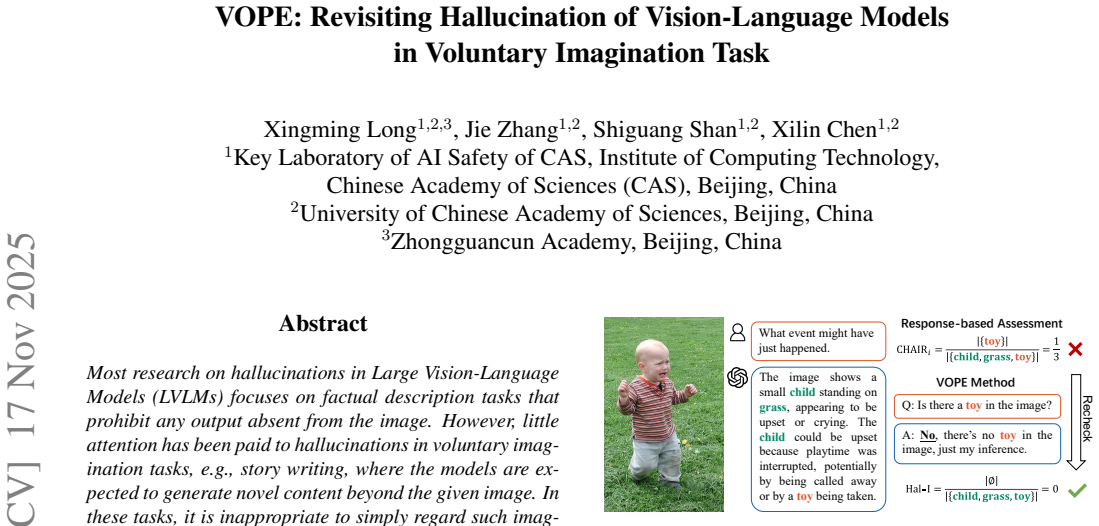
The recheck-based presence evaluation. After a model generates text, each mentioned object is queried with 'Is there a X in the image?' and the model's answers sort the output into factual description (object claimed present) and voluntary imagination (object claimed absent). Ground-truth labels then classify each as true or hallucinated, producing Hal-D = |D_H|/(|D_T|+|D_H|) and Hal-I = |I_H|/(|I_T|+|I_H|). The key move is using the model's own interpretation as the boundary between description and imagination, so invented content is not penalized unless the model is wrong about it.
What would settle it
Give the VOPE recheck to human storytellers on the same set of images; if humans also produce high Hal-I scores, then the metric is systematically mislabeling valid imagination as hallucination, collapsing the paper's central measure.
Extended reading notes
Core claim
On its own terms, the paper's central claim is that hallucination in generative vision-language tasks should be defined by the consistency between a model's presence judgments and the image, not by overlap between the generated text and a list of visible objects. VOPE extracts the objects a model mentions, rechecks each with a presence question, and splits the output into factual description (model says present) and voluntary imagination (model says absent). Comparing these judgments against ground-truth labels yields two rates: Hal-D for factual description and Hal-I for voluntary imagination. The reported empirical finding is that most models have low Hal-D but high Hal-I, and that the mod
Load-bearing premise
The benchmark treats the dataset's predefined object list as the complete ground truth for what exists in an image, and trusts the model's yes/no presence answer as a faithful statement of what it believes.
Editorial extensions
If this is right
- A model can look strong on factual captioning benchmarks while being unreliable about the objects it invents in open-ended writing.
- Counting every object that is not in the image as a hallucination (the CHAIR-style approach) is invalid for imaginative tasks and can rank better models as worse.
- Hallucination mitigation methods developed for factual description do not transfer; none of the tested methods reduced Hal-I, and some increased it.
- The proportion of imagined content (Exp) can be adjusted via contrastive decoding without changing hallucination rates, suggesting expressive tendency and grounding are separable.
Reading between the lines
- If Hal-I is a true signal, then story-length outputs from current models are not reliably grounded in the visual scene, which matters for any application where the narrative should respect image content (e.g., children's books from a single picture).
- The recheck design is gameable: a model that systematically denies every object's presence will appear to have perfect true imagination, so the metric should be paired with a separate check on whether the model's denial matches its initial mention.
- The benchmark's dependence on a predefined 80-class taxonomy may be too coarse; extending to a larger or open-vocabulary detection system could change both Hal-I magnitudes and model rankings.
- A direct test: run the same presence recheck on human storytellers; if human Hal-I is not near zero, the metric is biased against imagination.
Editorial analysis
A structured set of objections, weighed in public.
Referee Report
Summary. The paper introduces VOPE, a recheck-based protocol for evaluating hallucination in LVLMs during tasks that invite voluntary imagination, such as story writing. Objects are extracted from a model-generated response, the model is asked a yes/no presence question about each object, and the answers are compared with image ground truth. Objects the model says are present are scored by a factual-description metric Hal-D; objects the model says are absent are scored by a voluntary-imagination metric Hal-I, with an additional Exp metric measuring the fraction of imagined objects. Experiments on MSCOCO with eight LVLMs across captioning, reasoning, and writing report that while Hal-D is low, Hal-I is high across models, and that several existing hallucination-mitigation methods do not reduce Hal-I. The paper also adds an MLLM-based relevance assessment of imagined objects and a small attention analysis on LLaVA1.5.
Significance. The core idea is timely and useful: existing hallucination metrics penalize any object not in the image and therefore conflate genuine hallucination with legitimate creative imagination. Distinguishing factual description from voluntary imagination and rechecking the model's own interpretation of its output is a sensible operationalization. The paper also provides a human evaluation of its relevance judge (weighted kappa 0.45), which is a useful validation step. If the headline numbers are correct, the finding that current mitigation methods do not improve Hal-I is practically important. However, the evidence currently rests on an unstated object-extraction pipeline, an underspecified ground-truth mapping, and an assumption about what a "No" answer means in the presence recheck; these issues directly affect the magnitude and even the existence of the main empirical claims.
major comments (6)
- [Sec. 3.2 / Fig. 2 / Sec. 4.1] The object-extraction step is never described, yet every metric is defined over the extracted object set. The paper does not state whether extraction is done by a parser, an LLM, a detector, or human annotators, how plurals/synonyms are resolved to canonical categories, or whether counts are per mention or per unique object. Without this, the numbers in Tables 1–3 are not reproducible.
- [Sec. 4.1 / Fig. 2] Ground-truth presence is said to come from MSCOCO, but MSCOCO annotations cover only 80 categories. Several objects used as examples in the paper, e.g., "sun", "forest", "man", "rack" in Fig. 2, and "books", "television" in Figs. 4 and 6, do not map cleanly to those 80 categories. The paper does not explain how such objects are labeled. If an object is present in the image but not in the COCO category list, a model's correct "No" is counted as true imagination and an incorrect "Yes" is counted as a factual-description hallucination; this can bias Hal-D upward and Hal-I downward, and it makes the exact magnitudes and model rankings unreliable.
- [Sec. 3.2, Eq. (2); Table 1] The Hal-I metric counts as hallucination any object the model mentions and then denies in the recheck question when the object is present per ground truth. In a story-writing context, the model's "No" may refer to the specific fictional instance it generated, not to the category as a whole. For example, a story that places "a few books" on a windowsill can be followed by "No, there is no book visible in the image" because the imagined books are not the image books, even if another book appears in the image. The recheck question is underspecified relative to the generative task, and no control experiments are provided to show that "No" responses correspond to failures to recognize the object rather than to intentional reference to an imagined instance. Since IH is the numerator of Hal-I, this ambiguity directly threatens the central claim that most LVLMs hallucinate heavily during volunta
- [Tables 1–3] All reported metrics are point estimates without sample sizes, confidence intervals, or significance tests. Differences of a few percentage points are used to support substantive conclusions (e.g., the claim that Hal-I remains "largely unchanged" under mitigation or that models rank differently). The paper should report per-task numbers of images and objects, bootstrap intervals across images, and multiple decoding seeds for open models; API-based models should be evaluated with temperature settings reported.
- [Sec. 4.7, Table 3] The second key finding, that existing hallucination-mitigation methods are ineffective in voluntary imagination tasks, is supported only for LLaVA1.5 with greedy decoding on this benchmark. VCD, OPERA, HALC, and VTI are decoding-time interventions whose behavior can depend on the base model; one base model is too narrow to support the general statement in the abstract and conclusion. The scope should either be restricted to LLaVA1.5 or the experiments extended to at least one additional model. The large Hal-I increase for VTI also needs explanation rather than being grouped under "unchanged or even increases."
- [Sec. 4.4, Table 2] The claim that expressive tendency can be controlled "without impacting the hallucination rate" is not fully supported by the reported numbers. The delta notation in Table 2 is not defined, and the deltas are not negligible: e.g., for Qwen2.5-VL, Hal-I changes by +5.1 points at alpha=-1 relative to alpha=0, and Exp changes by -14.1 points. This is a secondary finding, but the current presentation overstates the invariance.
minor comments (5)
- [Abstract / Sec. 1] The text says "open-source models, such as Gemini2.0", but Gemini2.0 is a closed-source model. This is a factual error.
- [Sec. 4.1 / Table 1] The captioning task is described as requiring "factual descriptions without voluntary imagination", yet Table 1 reports positive Exp values for captioning (e.g., LLaVA1.5 13.6). The text should clarify that Exp measures actual behavior, not the task's intended level of imagination.
- [Appendix E, Fig. 13] A weighted kappa of 0.45 between GPT-4o and human annotators is moderate agreement; the statement that this is "sufficient to demonstrate a clear tendency" is overstrong. Report confidence intervals and treat the relevance assessment as approximate.
- [Sec. 4.6, Fig. 9] The attention-weight calculation is described only in prose. Please specify the layer, head, aggregation over tokens, and how objects are aligned with token spans, so the analysis is reproducible.
- [Sec. 2.1] The related-work section mentions NOPE but does not discuss the relationship between NOPE and the proposed presence-evaluation design, despite the similarity in the acronym and task. A brief comparison would help position the contribution.
Circularity Check
No significant circularity: VOPE's metrics are operational definitions evaluated against external COCO ground truth, and the paper's empirical findings are not forced by construction.
full rationale
The paper's load-bearing claims are empirical measurements, not derivations from fitted parameters or self-referential definitions. Hal-D and Hal-I are defined as ratios of hallucinated objects to relevant object sets (Eqs. 1–2), where object presence is judged against external MSCOCO ground-truth annotations, not against the model's own outputs alone. The categories 'Factual Description' and 'Voluntary Imagination' are partitioned by the model's presence answers, but the hallucination labels within each category are then compared to image ground truth, so the metric does not reduce to its input by construction. The comparison with CHAIR_i (Eq. 4) is a faithful algebraic restatement of an existing metric, not a renamed or reproduced result. The mitigation-method finding (Table 3) is a direct application of the same external-ground-truth-based metric to standard decoding methods; it is an evaluation result, not a prediction enabled by a prior fit. There are no load-bearing self-citations: the reference list contains no work by the present authors on which the central argument depends. The relevance assessment is validated against human annotators (Appendix E), providing independent support rather than circular justification. Concerns about COCO's 80-category incompleteness or about the underspecification of recheck questions are validity/threats-to-construct concerns, not circularity: they do not show that any predicted quantity is identical to an input by definition or by fitting. The benchmark is self-contained and externally grounded, so the appropriate circularity score is 0.
Assumptions & free parameters
free parameters (1)
- Contrastive decoding hyperparameter α =
-1, -0.5, 0, 0.5, 1 (Table 2)
assumptions (3)
- domain assumption COCO category annotations are a complete ground truth for object presence in the image.
- domain assumption The model's presence-evaluation answers accurately reflect its internal interpretation of its own output.
- domain assumption GPT-4o's relevance scores agree sufficiently with human judgment to support the relevance-based conclusions.
Cite this review
Pith. "Pith review of VOPE: Revisiting Hallucination of Vision-Language Models in Voluntary Imagination Task." pith.science (2026). https://pith.science/paper/FOJLKYMW
@misc{pith2026251113420,
  author       = {Pith},
  title        = {Pith review of: VOPE: Revisiting Hallucination of Vision-Language Models in Voluntary Imagination Task},
  year         = {2026},
  howpublished = {\url{https://pith.science/paper/FOJLKYMW}},
  note         = {Machine review of arXiv:2511.13420}
}
read the original abstract
Most research on hallucinations in Large Vision-Language Models (LVLMs) focuses on factual description tasks that prohibit any output absent from the image. However, little attention has been paid to hallucinations in voluntary imagination tasks, such as story writing, despite this human-like cognitive ability being essential for real-world generative applications. To address this limitation, we introduce Voluntary-imagined Object Presence Evaluation (VOPE) -- a recheck-based evaluation benchmark for assessing LVLMs' grounding behavior in voluntary imagination tasks. Specifically, VOPE poses recheck-based questions to evaluate how an LVLM interprets the presence of the imagined objects in its own response. Rather than penalizing the imagined content itself, VOPE identifies hallucinations based on the correctness of the model's presence judgments for the generated objects. Built on this idea, we construct a dataset covering captioning, reasoning, and writing tasks with different levels of voluntary imagination. We apply VOPE to several mainstream LVLMs and hallucination mitigation methods, revealing two key findings: (1) most LVLMs hallucinate heavily during voluntary imagination, and their performance in presence evaluation is notably poor on imagined objects; (2) existing hallucination mitigation methods show limited effect in voluntary imagination tasks, making this an important direction for future research.
Figures


Figures from the paper (8 more)


Reference graph
Works this paper leans on
-
[1]
Gpt-4 technical report.arXiv preprint arXiv:2303.08774,
Josh Achiam, Steven Adler, Sandhini Agarwal, Lama Ah- mad, Ilge Akkaya, Florencia Leoni Aleman, Diogo Almeida, Janko Altenschmidt, Sam Altman, Shyamal Anadkat, et al. Gpt-4 technical report.arXiv preprint arXiv:2303.08774,
-
[2]
Jinze Bai, Shuai Bai, Shusheng Yang, Shijie Wang, Sinan Tan, Peng Wang, Junyang Lin, Chang Zhou, and Jingren Zhou. Qwen-vl: A versatile vision-language model for un- derstanding, localization, text reading, and beyond.arXiv preprint arXiv:2308.12966, 2023. 1, 2
arXiv 2023
-
[3]
Ict: Image-object cross-level trusted intervention for mitigating object halluci- nation in large vision-language models
Junzhe Chen, Tianshu Zhang, Shiyu Huang, Yuwei Niu, Lin- feng Zhang, Lijie Wen, and Xuming Hu. Ict: Image-object cross-level trusted intervention for mitigating object halluci- nation in large vision-language models. InIEEE Conf. Com- put. Vis. Pattern Recog. (CVPR), pages 4209–4221, 2025. 3
2025
-
[4]
Internvl: Scaling up vision foundation mod- els and aligning for generic visual-linguistic tasks
Zhe Chen, Jiannan Wu, Wenhai Wang, Weijie Su, Guo Chen, Sen Xing, Muyan Zhong, Qinglong Zhang, Xizhou Zhu, Lewei Lu, et al. Internvl: Scaling up vision foundation mod- els and aligning for generic visual-linguistic tasks. InIEEE Conf. Comput. Vis. Pattern Recog. (CVPR), pages 24185– 24198, 2024. 4, 5, 1, 2
2024
-
[5]
Halc: Object hallucination reduc- tion via adaptive focal-contrast decoding.Int
Zhaorun Chen, Zhuokai Zhao, Hongyin Luo, Huaxiu Yao, Bo Li, and Jiawei Zhou. Halc: Object hallucination reduc- tion via adaptive focal-contrast decoding.Int. Conf. Mach. Learn. (ICML), 2024. 8
2024
-
[6]
Dola: Decoding by con- trasting layers improves factuality in large language models
Yung-Sung Chuang, Yujia Xie, Hongyin Luo, Yoon Kim, James Glass, and Pengcheng He. Dola: Decoding by con- trasting layers improves factuality in large language models. Int. Conf. Learn. Represent. (ICLR), 2024. 8
2024
-
[7]
Instructblip: Towards general- purpose vision-language models with instruction tuning,
Wenliang Dai, Junnan Li, Dongxu Li, Anthony Meng Huat Tiong, Junqi Zhao, Weisheng Wang, Boyang Li, Pascale Fung, and Steven Hoi. Instructblip: Towards general- purpose vision-language models with instruction tuning,
-
[8]
Deepseek-r1: Incentivizing reasoning capa- bility in llms via reinforcement learning, 2025
DeepSeek-AI. Deepseek-r1: Incentivizing reasoning capa- bility in llms via reinforcement learning, 2025. 1
2025
Show all 53 references
-
[9]
Truthprint: Mitigating large vision- language models object hallucination via latent truthful- guided pre-intervention
Jinhao Duan, Fei Kong, Hao Cheng, James Diffenderfer, Bhavya Kailkhura, Lichao Sun, Xiaofeng Zhu, Xiaoshuang Shi, and Kaidi Xu. Truthprint: Mitigating large vision- language models object hallucination via latent truthful- guided pre-intervention. InIEEE Int. Conf. Comput. Vis...
2025
-
[10]
Creation-mmbench: Assessing context-aware creative intelligence in mllm.IEEE Int
Xinyu Fang, Zhijian Chen, Kai Lan, Lixin Ma, Shengyuan Ding, Yingji Liang, Xiangyu Zhao, Farong Wen, Zicheng Zhang, Guofeng Zhang, et al. Creation-mmbench: Assessing context-aware creative intelligence in mllm.IEEE Int. Conf. Comput. Vis. (ICCV), 2025. 1
2025
-
[11]
Multi-modal hal- lucination control by visual information grounding
Alessandro Favero, Luca Zancato, Matthew Trager, Sid- dharth Choudhary, Pramuditha Perera, Alessandro Achille, Ashwin Swaminathan, and Stefano Soatto. Multi-modal hal- lucination control by visual information grounding. InIEEE Conf. Comput. Vis. Pattern Recog. (CVPR), pages 14...
2024
-
[12]
The llama 3 herd of models.arXiv preprint arXiv:2407.21783, 2024
Aaron Grattafiori, Abhimanyu Dubey, Abhinav Jauhri, Ab- hinav Pandey, Abhishek Kadian, Ahmad Al-Dahle, Aiesha Letman, Akhil Mathur, Alan Schelten, Alex Vaughan, et al. The llama 3 herd of models.arXiv preprint arXiv:2407.21783, 2024. 1, 4, 5, 2
2024 arXiv
-
[13]
Hallusionbench: an advanced diagnostic suite for entangled language hallucination and visual illusion in large vision-language models
Tianrui Guan, Fuxiao Liu, Xiyang Wu, Ruiqi Xian, Zongxia Li, Xiaoyu Liu, Xijun Wang, Lichang Chen, Furong Huang, Yaser Yacoob, et al. Hallusionbench: an advanced diagnostic suite for entangled language hallucination and visual illusion in large vision-language models. InIEEE C...
2024
-
[14]
Detecting and preventing hallucinations in large vision language models
Anisha Gunjal, Jihan Yin, and Erhan Bas. Detecting and preventing hallucinations in large vision language models. InConf. Artif. Intell. (AAAI), pages 18135–18143, 2024. 2
2024
-
[15]
Ciem: Contrastive instruction evaluation method for better instruction tuning.arXiv preprint arXiv:2309.02301, 2023
Hongyu Hu, Jiyuan Zhang, Minyi Zhao, and Zhenbang Sun. Ciem: Contrastive instruction evaluation method for better instruction tuning.arXiv preprint arXiv:2309.02301, 2023. 1, 2
2023 arXiv
-
[16]
Opera: Alleviating hallucination in multi- modal large language models via over-trust penalty and retrospection-allocation
Qidong Huang, Xiaoyi Dong, Pan Zhang, Bin Wang, Con- ghui He, Jiaqi Wang, Dahua Lin, Weiming Zhang, and Nenghai Yu. Opera: Alleviating hallucination in multi- modal large language models via over-trust penalty and retrospection-allocation. InIEEE Conf. Comput. Vis. Pattern Rec...
2024
-
[17]
Devils in middle layers of large vision- language models: Interpreting, detecting and mitigating ob- ject hallucinations via attention lens
Zhangqi Jiang, Junkai Chen, Beier Zhu, Tingjin Luo, Yankun Shen, and Xu Yang. Devils in middle layers of large vision- language models: Interpreting, detecting and mitigating ob- ject hallucinations via attention lens. InIEEE Conf. Comput. Vis. Pattern Recog. (CVPR), pages 250...
2025
-
[18]
Faith- score: Fine-grained evaluations of hallucinations in large vision-language models
Liqiang Jing, Ruosen Li, Yunmo Chen, and Xinya Du. Faith- score: Fine-grained evaluations of hallucinations in large vision-language models. InConf. Empir. Methods Nat. Lang. Process. (EMNLP), pages 5042–5063, 2024. 2
2024
-
[19]
Mitigating object hal- lucinations in large vision-language models through visual contrastive decoding
Sicong Leng, Hang Zhang, Guanzheng Chen, Xin Li, Shijian Lu, Chunyan Miao, and Lidong Bing. Mitigating object hal- lucinations in large vision-language models through visual contrastive decoding. InIEEE Conf. Comput. Vis. Pattern Recog. (CVPR), pages 13872–13882, 2024. 1, 3, 8
2024
-
[20]
Evaluating object hallucination in large vision-language models.Conf
Yifan Li, Yifan Du, Kun Zhou, Jinpeng Wang, Wayne Xin Zhao, and Ji-Rong Wen. Evaluating object hallucination in large vision-language models.Conf. Empir. Methods Nat. Lang. Process. (EMNLP), 2023. 1, 2, 7
2023
-
[21]
Lawrence Zitnick, and Piotr Doll ´ar
Tsung-Yi Lin, Michael Maire, Serge Belongie, Lubomir Bourdev, Ross Girshick, James Hays, Pietro Perona, Deva Ramanan, C. Lawrence Zitnick, and Piotr Doll ´ar. Microsoft coco: Common objects in context. InEur. Conf. Comput. Vis. (ECCV), pages 740–755, 2014. 4
2014
-
[22]
The brain’s voices: comparing nonclinical auditory hal- lucinations and imagery.Cerebral Cortex, 21(2):330–337,
David EJ Linden, Katy Thornton, Carissa N Kuswanto, Stephen J Johnston, Vincent van de Ven, and Michael C Jack- son. The brain’s voices: comparing nonclinical auditory hal- lucinations and imagery.Cerebral Cortex, 21(2):330–337,
-
[23]
Visual instruction tuning.Adv
Haotian Liu, Chunyuan Li, Qingyang Wu, and Yong Jae Lee. Visual instruction tuning.Adv. Neural Inform. Process. Syst. (NIPS), 36:34892–34916, 2023. 1, 8
2023
-
[24]
Improved baselines with visual instruction tuning
Haotian Liu, Chunyuan Li, Yuheng Li, and Yong Jae Lee. Improved baselines with visual instruction tuning. InIEEE Conf. Comput. Vis. Pattern Recog. (CVPR), pages 26296– 26306, 2024. 1, 2, 4, 5
2024
-
[25]
9 A survey on hallucination in large vision-language models
Hanchao Liu, Wenyuan Xue, Yifei Chen, Dapeng Chen, Xiu- tian Zhao, Ke Wang, Liping Hou, Rongjun Li, and Wei Peng. 9 A survey on hallucination in large vision-language models. arXiv preprint arXiv:2402.00253, 2024. 1, 2
2024 arXiv
-
[26]
Phd: A chatgpt-prompted visual hallucination evaluation dataset
Jiazhen Liu, Yuhan Fu, Ruobing Xie, Runquan Xie, Xingwu Sun, Fengzong Lian, Zhanhui Kang, and Xirong Li. Phd: A chatgpt-prompted visual hallucination evaluation dataset. InIEEE Conf. Comput. Vis. Pattern Recog. (CVPR), pages 19857–19866, 2025. 1, 2
2025
-
[27]
Reduc- ing hallucinations in vision-language models via latent space steering.Int
Sheng Liu, Haotian Ye, Lei Xing, and James Zou. Reduc- ing hallucinations in vision-language models via latent space steering.Int. Conf. Learn. Represent. (ICLR), 2025. 1, 3, 8
2025
-
[28]
Mitigating hallucination through theory-consistent symmetric multimodal preference optimization.Adv
Wenqi Liu, Xuemeng Song, Jiaxi Li, Yinwei Wei, Na Zheng, Jianhua Yin, and Liqiang Nie. Mitigating hallucination through theory-consistent symmetric multimodal preference optimization.Adv. Neural Inform. Process. Syst. (NIPS),
-
[29]
Negative object presence evaluation (nope) to measure object hallucination in vision-language models
Holy Lovenia, Wenliang Dai, Samuel Cahyawijaya, Ziwei Ji, and Pascale Fung. Negative object presence evaluation (nope) to measure object hallucination in vision-language models. InAdv. Lang. Vis. Res. (ALVR), pages 37–58, 2024. 2
2024
-
[30]
A character-centric creative story generation via imagination
Kyeongman Park, Minbeom Kim, and Kyomin Jung. A character-centric creative story generation via imagination. arXiv preprint arXiv:2409.16667, 2024. 1
2024 arXiv
-
[31]
Second: Mitigating perceptual hallucination in vision- language models via selective and contrastive decoding
Woohyeon Park, Woojin Kim, Jaeik Kim, and Jaeyoung Do. Second: Mitigating perceptual hallucination in vision- language models via selective and contrastive decoding. In Int. Conf. Mach. Learn. (ICML). PMLR, 2025. 3
2025
-
[32]
Mitigating object hallucinations via sentence-level early in- tervention
Shangpin Peng, Senqiao Yang, Li Jiang, and Zhuotao Tian. Mitigating object hallucinations via sentence-level early in- tervention. InIEEE Int. Conf. Comput. Vis. (ICCV), pages 635–646, 2025. 2
2025
-
[33]
Intervene-all-paths: Unified mitigation of lvlm hallucina- tions across alignment formats.Adv
Jiaye Qian, Ge Zheng, Yuchen Zhu, and Sibei Yang. Intervene-all-paths: Unified mitigation of lvlm hallucina- tions across alignment formats.Adv. Neural Inform. Process. Syst. (NIPS), 2025. 3
2025
-
[34]
Object hallucination in im- age captioning.Conf
Anna Rohrbach, Lisa Anne Hendricks, Kaylee Burns, Trevor Darrell, and Kate Saenko. Object hallucination in im- age captioning.Conf. Empir. Methods Nat. Lang. Process. (EMNLP), 2018. 2
2018
-
[35]
Aligning large multi- modal models with factually augmented rlhf.arXiv preprint arXiv:2309.14525, 2023
Zhiqing Sun, Sheng Shen, Shengcao Cao, Haotian Liu, Chunyuan Li, Yikang Shen, Chuang Gan, Liang-Yan Gui, Yu-Xiong Wang, Yiming Yang, et al. Aligning large multi- modal models with factually augmented rlhf.arXiv preprint arXiv:2309.14525, 2023. 2
2023 arXiv
-
[36]
Octopus: Alleviating hal- lucination via dynamic contrastive decoding
Wei Suo, Lijun Zhang, Mengyang Sun, Lin Yuanbo Wu, Peng Wang, and Yanning Zhang. Octopus: Alleviating hal- lucination via dynamic contrastive decoding. InIEEE Conf. Comput. Vis. Pattern Recog. (CVPR), pages 29904–29914,
-
[37]
Seeing far and clearly: Mitigat- ing hallucinations in mllms with attention causal decoding
Feilong Tang, Chengzhi Liu, Zhongxing Xu, Ming Hu, Zile Huang, Haochen Xue, Ziyang Chen, Zelin Peng, Zhiwei Yang, Sijin Zhou, et al. Seeing far and clearly: Mitigat- ing hallucinations in mllms with attention causal decoding. InIEEE Conf. Comput. Vis. Pattern Recog. (CVPR), pa...
2025
-
[38]
Gemma Team. Gemma 3. 2025. 4, 5, 1, 2
2025
-
[39]
Gemini: a family of highly capable multimodal models.arXiv preprint arXiv:2312.11805, 2023
Gemini Team, Rohan Anil, Sebastian Borgeaud, Jean- Baptiste Alayrac, Jiahui Yu, Radu Soricut, Johan Schalkwyk, Andrew M Dai, Anja Hauth, Katie Millican, et al. Gemini: a family of highly capable multimodal models.arXiv preprint arXiv:2312.11805, 2023. 1, 2, 4, 5
2023 arXiv
-
[40]
Qwen2.5-vl, 2025
Qwen Team. Qwen2.5-vl, 2025. 4, 5, 1, 2
2025
-
[41]
Qwen3, 2025
Qwen Team. Qwen3, 2025. 1
2025
-
[42]
Andrey Vyshedskiy. V oluntary and involuntary imagination: neurological mechanisms, developmental path, clinical im- plications, and evolutionary trajectory.Evolutionary Studies in Imaginative Culture, 4(2):1–18, 2020. 1
2020
-
[43]
Only: One-layer intervention suf- ficiently mitigates hallucinations in large vision-language models
Zifu Wan, Ce Zhang, Silong Yong, Martin Q Ma, Simon Stepputtis, Louis-Philippe Morency, Deva Ramanan, Katia Sycara, and Yaqi Xie. Only: One-layer intervention suf- ficiently mitigates hallucinations in large vision-language models. InIEEE Int. Conf. Comput. Vis. (ICCV), 2025. 3
2025
-
[44]
Amber: An llm-free multi-dimensional bench- mark for mllms hallucination evaluation.arXiv preprint arXiv:2311.07397, 2023
Junyang Wang, Yuhang Wang, Guohai Xu, Jing Zhang, Yukai Gu, Haitao Jia, Jiaqi Wang, Haiyang Xu, Ming Yan, Ji Zhang, et al. Amber: An llm-free multi-dimensional bench- mark for mllms hallucination evaluation.arXiv preprint arXiv:2311.07397, 2023. 1, 2
2023 arXiv
-
[45]
The generative ai para- dox:” what it can create, it may not understand”.Int
Peter West, Ximing Lu, Nouha Dziri, Faeze Brahman, Lin- jie Li, Jena D Hwang, Liwei Jiang, Jillian Fisher, Abhilasha Ravichander, Khyathi Chandu, et al. The generative ai para- dox:” what it can create, it may not understand”.Int. Conf. Learn. Represent. (ICLR), 2024. 2
2024
-
[46]
Generate, but verify: Reducing hallucination in vision-language models with ret- rospective resampling.Adv
Tsung-Han Wu, Heekyung Lee, Jiaxin Ge, Joseph E Gonza- lez, Trevor Darrell, and David M Chan. Generate, but verify: Reducing hallucination in vision-language models with ret- rospective resampling.Adv. Neural Inform. Process. Syst. (NIPS), 2025. 3
2025
-
[47]
Nullu: Mitigating object hallucinations in large vision-language models via halluspace projection
Le Yang, Ziwei Zheng, Boxu Chen, Zhengyu Zhao, Chenhao Lin, and Chao Shen. Nullu: Mitigating object hallucinations in large vision-language models via halluspace projection. InIEEE Conf. Comput. Vis. Pattern Recog. (CVPR), pages 14635–14645, 2025. 3
2025
-
[48]
Mitigating hallucinations in large vision- language models via dpo: On-policy data hold the key
Zhihe Yang, Xufang Luo, Dongqi Han, Yunjian Xu, and Dongsheng Li. Mitigating hallucinations in large vision- language models via dpo: On-policy data hold the key. InIEEE Conf. Comput. Vis. Pattern Recog. (CVPR), pages 10610–10620, 2025. 1, 2
2025
-
[49]
Minicpm-v: A gpt-4v level mllm on your phone.arXiv preprint arXiv:2408.01800, 2024
Yuan Yao, Tianyu Yu, Ao Zhang, Chongyi Wang, Junbo Cui, Hongji Zhu, Tianchi Cai, Haoyu Li, Weilin Zhao, Zhihui He, et al. Minicpm-v: A gpt-4v level mllm on your phone.arXiv preprint arXiv:2408.01800, 2024. 4, 5, 1, 2
2024 arXiv
-
[50]
Clearsight: Vi- sual signal enhancement for object hallucination mitigation in multimodal large language models
Hao Yin, Guangzong Si, and Zilei Wang. Clearsight: Vi- sual signal enhancement for object hallucination mitigation in multimodal large language models. InIEEE Conf. Com- put. Vis. Pattern Recog. (CVPR), pages 14625–14634, 2025. 3
2025
-
[51]
Mitigating object hallucination in large vision-language models via image-grounded guidance.Int
Linxi Zhao, Yihe Deng, Weitong Zhang, and Quanquan Gu. Mitigating object hallucination in large vision-language models via image-grounded guidance.Int. Conf. Mach. Learn. (ICML), 2025. 3
2025
-
[52]
Why lvlms are more prone to hallucinations in longer responses: The role of context
Ge Zheng, Jiaye Qian, Jiajin Tang, and Sibei Yang. Why lvlms are more prone to hallucinations in longer responses: The role of context. InIEEE Int. Conf. Comput. Vis. (ICCV), pages 4101–4113, 2025. 3
2025
-
[53]
Describe this image
Deyao Zhu, Jun Chen, Xiaoqian Shen, Xiang Li, and Mo- hamed Elhoseiny. Minigpt-4: Enhancing vision-language 10 understanding with advanced large language models.arXiv preprint arXiv:2304.10592, 2023. 1 11 VOPE: Revisiting Hallucination of Vision-Language Models in V oluntary I...
2023 arXiv
Reviewed August 3, 2026 · model on record in the stance chip above.
Discussion (0). Sign in to comment.