REVIEW 3 major objections 5 minor 3 cited by
A scalable hierarchical analysis of 800 simulated lensed AGN forecasts a dark-energy figure of merit of 6.7 in a w0waCDM cosmology.
Reviewed by Pith at T0; open to challenge. T0 means a machine referee read the full paper against a public rubric. the ladder, T0–T4 →
T0 review · deepseek-v4-flash
2026-08-03 21:43 UTC pith:OUHABJ7M
load-bearing objection The framework and honest caveats are welcome, but the headline DE FOM is a favorable seed selected for ground-truth alignment, not the expected constraining power. the 3 major comments →
Investigating the Dark Energy Constraint from Strongly Lensed AGN at LSST-Scale
The pith
A machine-rendered reading of the paper's core claim, the machinery that carries it, and where it could break.
Core claim
Using a two-stage hierarchical Bayesian framework in which each lens is reduced to static data vectors—posterior samples over Fermat-potential differences, a Jeans-model quantity, orbital anisotropy, and external convergence, together with Gaussian summaries of time-delay and velocity-dispersion measurements—the authors evaluate the cosmological likelihood for hundreds of lenses simultaneously. With a baseline mix of 10 JWST-grade, 40 VLT-grade, and 750 LSST-grade lenses, fully marginalizing over mass-sheet and mass-anisotropy degeneracies, they forecast σ(H0)=1.7 km/s/Mpc and a dark-energy figure of merit of 6.7. Growing the sample from 50 to 800 lenses improves the DE FOM from 2.4 to 6.7.
What carries the argument
The central object is a vectorized hierarchical likelihood (the paper's fasttdc code) that evaluates the joint cosmological likelihood over hundreds of lenses at once. Each lens contributes importance samples from emulated posteriors, and the likelihood integral is evaluated by importance sampling over Fermat potential, Jeans model, anisotropy, mass-sheet, and external convergence; keeping Fermat potentials and kinematics correlated sample-by-sample is what lets the mass-sheet and mass-anisotropy degeneracies be constrained at the population level.
Load-bearing premise
The forecast depends on the assumption that the emulated mass-model posteriors, Gaussian time-delay errors (5-day baseline), and kinematic uncertainties accurately represent what LSST will actually measure, particularly that time-delay errors are independent Gaussians and that the neural mass-model posteriors reproduce image positions.
What would settle it
Run the same hierarchical inference on a simulation where time-delay measurements are produced by realistic LSST light-curve modeling (with cadence, seeing, and correlated systematic errors) rather than assigned Gaussian errors; if the resulting w0–wa posterior widens by more than roughly 50% relative to the forecast, the DE FOM claim fails. Alternatively, ray-trace samples from the paper's neural mass-model posteriors and check whether the image positions are reproduced within astrometric tolerance; if not, the Fermat-potential posteriors are overconfident.
If this is right
- If correct, time-delay cosmography from LSST-scale samples delivers a dark-energy figure of merit of about 6.7 in w0waCDM, an independent late-universe probe that does not rely on CMB or distance-ladder assumptions.
- The same sample yields a simultaneous ~2.5% Hubble-constant constraint, so a single lens population can anchor both H0 and dark-energy parameters.
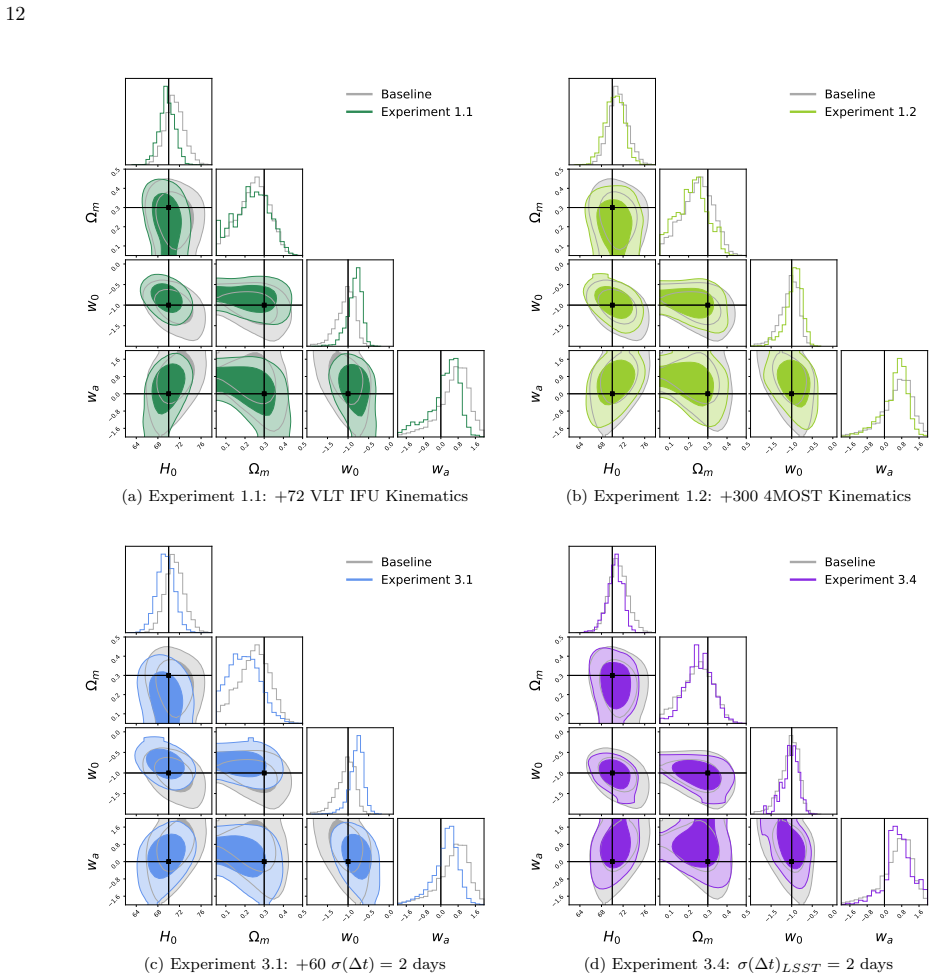
- Follow-up strategy guidance: IFU kinematics on a small sample and aperture kinematics on many lenses are roughly equivalent for the DE FOM, while time-delay precision below ~2 days is the strongest lever identified.
- Lens redshift is the dominant redshift variable; prioritizing low-redshift deflectors improves the DE and H0 constraints, whereas source redshift has a negligible effect.
- Because the likelihood is built from static per-lens summaries, the framework can scale to thousands of lenses, and an analytic Gaussian limit (already derived) would make the evaluation even faster.
Where Pith is reading between the lines
- The same vectorized, data-vector-based likelihood could be adapted to other cosmological probes with correlated per-object summaries (e.g., cluster strong lenses or supernova distances), potentially accelerating joint population inference across surveys.
- The two-day time-delay precision threshold is a concrete target for multi-band light-curve modeling: effort spent improving LSST delay measurements from ~5 days to ~2 days is forecast to have more cosmological payoff than improving mass-model precision at the assumed kinematics quality.
- The redshift-configuration result suggests a discovery and follow-up strategy that preferentially targets low-redshift deflectors, although a wide redshift range may still be needed to constrain wa or to break degeneracies when combining with other probes.
- The framework's modularity—separating modeling posteriors from cosmology—makes it well suited for a 'round-trip' systematics test, where simulated images are processed through the full pipeline to validate calibration before real LSST data arrive.
Editorial analysis
A structured set of objections, weighed in public.
Referee Report
Summary. The paper introduces fasttdc, a scalable hierarchical Bayesian likelihood code for time-delay cosmography, and uses it to forecast dark-energy constraints from a simulated LSST sample of 800 strongly lensed AGN. Individual lens observables (image-based mass models, time delays, stellar kinematics, external convergence) are emulated at various fidelities, and the joint inference marginalizes over mass-sheet and anisotropy population parameters. In a fiducial w0waCDM analysis, the authors report σ(H0)=1.7 km/s/Mpc (~2.5%) and a dark-energy figure of merit (DE FOM) of 6.7, roughly triple the DE FOM from a 50-lens IFU sample. Additional experiments compare follow-up strategies (IFU vs aperture kinematics, space-based imaging, forward modeling, improved time-delay precision) and redshift configurations.
Significance. If the quantitative forecasts are robust, this work would provide a valuable public tool (fasttdc is released) and a useful planning benchmark for LSST follow-up programs. The paper is careful to include several real physical degeneracies, uses a forward-modeling test from the OM10 catalog, and explicitly explores random-seed fluctuations in Appendix D. These are genuine strengths. However, the headline numbers are not robust because they are drawn from a single, selected random seed, and several key measurement errors are imposed rather than simulated. The qualitative conclusion that larger samples of lower-precision lenses add constraining power is plausible, but the specific DE FOM values and the 'factor of ~3' improvement should not be treated as established expectations.
major comments (3)
- [Appendix D / Fig. 6b / Table 6 / Abstract] The headline DE FOM=6.7 and the factor-of-~3 improvement over the 50-lens sample are reported from a single random seed chosen, as Appendix D states, 'whose central values align with the ground truth ΛCDM values usually assumed when using the DE FOM metric.' Figure 6b shows that DE FOM across ten seeds spans roughly 2.5 to 20 and is correlated with the median w0 of each realization. Because the DE FOM is a nonlinear functional of the posterior and the seed is selected on posterior medians, 6.7 is a favorable draw, not an expectation or median. This affects every experiment comparison in Table 6 and the conclusions drawn from them. I request that all headline numbers and Table 6 comparisons be recomputed over a fixed set of seeds and reported as medians with scatter, or that an alternative seed-independent metric be used.
- [Section 4.2 / Section 6.5 / Table 4] The mass-model emulation relies on NPE posteriors whose covariance is rescaled to emulate HST-FM and JWST-FM precision. Section 6.5 concedes that samples from these posteriors 'are not guaranteed to produce lensing configurations where the lens model and source position reproduce the image positions exactly.' The conclusions from Experiments 2.1-2.3, including the claim in Section 5.3 that 'the mass model precision is not a limiting factor,' depend on this unvalidated emulation. If the rescaling factors or the NPE covariance shapes are not representative of true forward modeling, the error budget changes. Please either validate the emulation against a small set of full forward models or explicitly frame the quantitative results as conditional on this approximation, including in the abstract.
- [Section 4.3 / Section 5.4 / Section 6.2] Time-delay measurement precision is assigned directly as a Gaussian error (5-day baseline, 3% for monitored lenses, and 2-day upgrades) without simulating light curves or accounting for correlated errors, seasonal gaps, or the fraction of lenses that yield usable delays. The paper's strongest follow-up recommendation — that a 2-day LSST time-delay precision produces significant gains (Experiment 3.4, DE FOM=10.1) while 3- and 4-day precisions do not — is therefore driven by the assumed error model. Correlated or non-Gaussian time-delay errors, or a reduced yield of measurable delays, could materially weaken this threshold. Please test sensitivity to correlated errors and detection yield, or temper the recommendation accordingly.
minor comments (5)
- [Section 5.4] Typo: 'the the importance' should read 'the importance' in the sentence 'This again demonstrates the the importance of assessing constraining power across all parameters simultaneously.'
- [Sections 5.2, 5.4, 6.2] The phrase 'improving off of the baseline' should be 'improving on the baseline' (appears in Experiment 1.1 discussion and elsewhere).
- [Appendix A.1] Typo: 'futher work' should be 'further work' in the sentence 'Exploration of photometric redshifts is left for futher work.'
- [Table 6] The reported DE FOM values are approximate and fluctuate with seed, as the authors note in Appendix D; this caveat should appear directly in the Table 6 caption to avoid the appearance of fixed, reproducible numbers.
- [Abstract / Section 7] Given the seed-dependence documented in Appendix D, the abstract and conclusion should state that the quoted DE FOM values are from one illustrative realization, not a guaranteed expectation, until the multi-seed analysis is incorporated.
Circularity Check
Headline DE FOM=6.7 is post-selected from a favorable noise seed; otherwise the forward-model derivation is not circular.
specific steps
-
fitted input called prediction
[Appendix D, Figure 6; used for baseline result in Table 6]
"When assessing the DE FOM across these 10 seeds, we noticed a large range of values. The DE FOM is correlated with the median values of w0 and wa in each posterior... To account for this effect, we choose a baseline seed for our experiments (brown) whose central values align with the ground truth ΛCDM values usually assumed when using the DE FOM metric."
The paper presents DE FOM = 6.7 as the baseline forecast and as the basis for the 'factor of ~3' improvement from 2.4 to 6.7. But the measurement-noise seed was not drawn at random for that headline: it was explicitly selected so that the posterior median (w0, wa) matches the ΛCDM ground truth that the DE FOM metric assumes. The paper's own Figure 6b shows that the FOM fluctuates widely with seed, roughly 2.5 to 20, and that these fluctuations are correlated with the posterior central values. Thus the headline FOM is partly an input/selection choice rather than an expected value of the stochastic simulation. This is postselection bias rather than full construction-level circularity, because the same-seed comparisons between experiments and the ground-truth recovery tests remain informative
full rationale
The paper is a forward-modeling forecast: it generates a simulated LSST lens population, emulates measurements under a stated ΛCDM ground truth, runs the hierarchical likelihood of Equations 13-14, and checks whether the inference recovers the input cosmology. The likelihood derivation is self-contained and follows from Bayes' theorem and standard time-delay cosmography equations; it is not defined in terms of the cosmological answer. The claimed 'predictions' are precision forecasts, so they naturally depend on assumed measurement precisions, but that is the normal content of a forecast rather than circular reduction. The main legitimate concern is the baseline seed choice in Appendix D: the DE FOM=6.7 headline is from a seed selected because its posterior central values align with the ground truth, and the FOM is strongly correlated with those central values, so the reported number is a favorable realization, not the expected value. There are also self-citations (TDCOSMO25 for the λint/βani population scatter and time-delay precision; Erickson et al. 2025 for NPE mass models; Venkatraman et al. 2025 for catalog preparation), and Section 6.5 concedes that the NPE mass-model posteriors are not guaranteed to reproduce image positions. These are real limitations and correctness risks, but they are input assumptions with stated motivations rather than load-bearing arguments that make the output equal to the input by construction. The central derivation and the qualitative conclusions about sample-growth and follow-up strategies survive even if the exact FOM is seed-dependent. Hence no significant construction-level circularity; the score reflects the post-selection of the headline seed.
Axiom & Free-Parameter Ledger
free parameters (7)
- Population scatter σ(λ_int)=0.1 =
0.1
- Population scatter σ(β_ani)=0.1 =
0.1
- External convergence uncertainty σ(κ_ext) =
0.05
- LSST time-delay precision =
5 days
- Monitored time-delay precision =
3%
- Kinematic precision / bin structure =
5% per bin; 10 bins JWST, 3 bins MUSE
- Fermat potential precision per imaging tier =
2% (JWST-FM), 4% (HST-FM), 11% (HST-NPE), 18% (LSST-NPE)
axioms (7)
- domain assumption Gaussian likelihoods for time delays, kinematics, and lens-model posteriors (normal distributions in Eqs. A22–A23)
- domain assumption Flat w0waCDM with Chevallier-Polarski-Linder parameterization, flat spatial geometry
- domain assumption OM10 catalog redshifts/velocities are representative of LSST's lensed AGN population, with random selection across the catalog except for stated selection cuts
- domain assumption Gaussian population distributions for λ_int and β_ani (normal hyperparameters in Eq. 8)
- ad hoc to paper The NPE mass-model posteriors are unbiased and their sample spread is a valid uncertainty estimate, with covariance re-scaling faithfully emulating dedicated forward modeling
- domain assumption Perfect spectroscopic redshifts for all 800 lenses
- standard math Independent lenses with independent measurement errors (Eq. A5)
read the original abstract
Strongly lensed Active Galactic Nuclei (AGN) with an observable time delay can be used to constrain the expansion history of the Universe through time-delay cosmography (TDC). As the sample of time-delay lenses grows to statistical size, with $\mathcal{O}$(1000) lensed AGN forecast to be observed by the Vera C. Rubin Observatory Legacy Survey of Space and Time (LSST), there is an emerging opportunity to use TDC as an independent probe of dark energy. To take advantage of this statistical sample, we implement a scalable hierarchical inference tool which computes the cosmological likelihood for hundreds of strong lenses simultaneously. With this new technique, we investigate the cosmological constraining power from a simulation of the full LSST sample. We start from individual lenses, and emulate the full joint hierarchical TDC analysis, including image-based modeling, time-delay measurement, velocity dispersion measurement, and external convergence prediction. We fully account for the mass-sheet and mass-anisotropy degeneracies. We assume a sample of 800 lenses, with varying levels of follow-up fidelity based on existing campaigns. With our baseline assumptions, within a flexible $w_0w_a$CDM cosmology, we simultaneously forecast a $\sim$2.5% constraint on H0 and a dark energy figure of merit (DE FOM) of 6.7. We show that by expanding the sample from 50 lenses with IFU kinematics to include 750 lenses with plausible LSST time-delay measurements, we improve the forecasted DE FOM by nearly a factor of 3, demonstrating the value of incorporating this portion of the sample. We also investigate different follow-up campaign strategies, and find significant improvements in the DE FOM with additional stellar kinematics measurements and higher-precision time-delay measurements. We also demonstrate how the redshift configuration of time-delay lenses impacts constraining power in $w_0w_a$CDM.
Figures




Forward citations
Cited by 3 Pith papers
-
Strong Lensing Tomography: Double and pseudo multi-source plane strong gravitational lensing to constrain dark energy
Pseudo double-source plane lenses enable statistical strong lensing tomography that forecasts σ(w0) ~ 0.45 from the LSST 10-year photometric sample in flat w0waCDM cosmology.
-
LSST Strong Lensing Systems Dark Matter Sensitivity Analysis with Neural Ratio Estimators
Simulations indicate that 2500 LSST strong lenses can exclude 74% and 36% of the prior volume on halo mass function parameters at 3σ and 5σ, with sensitivity from both high- and low-mass halos plus line-of-sight contr...
-
Disentangling the dark and stellar mass through precise lens modelling of the JWST observation of lensed quasar WFI2033--4723
Composite time-delay lens modelling of JWST WFI2033–4723 yields intermediate stellar IMF normalisation and a steep gNFW inner slope γ_in≃1.3 that is robust to the choice of external cosmology.
Reference graph
Works this paper leans on
-
[1]
, " * write output.state after.block = add.period write newline
ENTRY address archivePrefix author booktitle chapter doi edition editor eprint howpublished institution journal key month number organization pages publisher school series title misctitle type volume year version url label extra.label sort.label short.list INTEGERS output.state before.all mid.sentence after.sentence after.block FUNCTION init.state.consts ...
-
[2]
write newline
" write newline "" before.all 'output.state := FUNCTION format.url url empty "" new.block "" url * "" * if FUNCTION format.eprint eprint empty "" archivePrefix empty "" archivePrefix "arXiv" = new.block " " eprint * " " * new.block " " eprint * " " * if if if FUNCTION format.doi doi empty "" " " doi * " " * if FUNCTION format.pid doi empty eprint empty ur...
-
[3]
s.? PN\8.Ԯ G ӘǀK u C== vHp>[v S -' `U ` A z\ ν[ s8 [r#57)P ^N 1QUXU y ѓP 1wjGN:aeo(b ?P rpcU ȏ c ӷQ N msKdWd] Fs̻
thebibliography [1] 20pt to REFERENCES 6pt =0pt -12pt 10pt plus 3pt =0pt =0pt =1pt plus 1pt =0pt =0pt -12pt =13pt plus 1pt =20pt =13pt plus 1pt \@M =10000 =-1.0em =0pt =0pt 0pt =0pt =1.0em @enumiv\@empty 10000 10000 `\.\@m \@noitemerr \@latex@warning Empty `thebibliography' environment \@ifnextchar \@reference \@latexerr Missing key on reference command E...
2021
-
[4]
T., Oguri , M., Birrer , S., et al
Abe , K. T., Oguri , M., Birrer , S., et al. 2025, The Open Journal of Astrophysics, 8, 8, 10.33232/001c.128482
-
[5]
2006, arXiv e-prints, astro, 10.48550/arXiv.astro-ph/0609591
Albrecht , A., Bernstein , G., Cahn , R., et al. 2006, arXiv e-prints, astro, 10.48550/arXiv.astro-ph/0609591
-
[6]
E., Lira , P., Anguita , T., et al
Bauer , F. E., Lira , P., Anguita , T., et al. 2023, The Messenger, 190, 34, 10.18727/0722-6691/5309
-
[7]
Binney , J., & Mamon , G. A. 1982, , 200, 361, 10.1093/mnras/200.2.361
-
[8]
2018, Lenstronomy: multi-purpose gravitational lens modelling software package
Birrer, S., & Amara, A. 2018, Lenstronomy: multi-purpose gravitational lens modelling software package. 1803.09746
Pith/arXiv arXiv 2018
-
[9]
2016, , 2016, 020, 10.1088/1475-7516/2016/08/020
Birrer , S., Amara , A., & Refregier , A. 2016, , 2016, 020, 10.1088/1475-7516/2016/08/020
-
[10]
2021, , 649, A61, 10.1051/0004-6361/202039179
Birrer , S., & Treu , T. 2021, , 649, A61, 10.1051/0004-6361/202039179
-
[11]
Birrer , S., Treu , T., Rusu , C. E., et al. 2019, , 484, 4726, 10.1093/mnras/stz200
-
[12]
Birrer , S., Shajib , A. J., Galan , A., et al. 2020, , 643, A165, 10.1051/0004-6361/202038861
-
[13]
Birrer, S., Shajib, A. J., Gilman, D., et al. 2021, arXiv preprint arXiv:2106.05976
Pith/arXiv arXiv 2021
-
[14]
2024, , 220, 48, 10.1007/s11214-024-01079-w
Birrer , S., Millon , M., Sluse , D., et al. 2024, , 220, 48, 10.1007/s11214-024-01079-w
-
[15]
2025, Early-Type Galaxies: Elliptical and S0 Galaxies, or Fast and Slow Rotators
Cappellari, M. 2025, Early-Type Galaxies: Elliptical and S0 Galaxies, or Fast and Slow Rotators. 2503.02746
arXiv 2025
-
[16]
2007, , 379, 418, 10.1111/j.1365-2966.2007.11963.x
Cappellari , M., Emsellem , E., Bacon , R., et al. 2007, , 379, 418, 10.1111/j.1365-2966.2007.11963.x
arXiv 2007
-
[17]
2001, International Journal of Modern Physics D, 10, 213, 10.1142/S0218271801000822
Chevallier , M., & Polarski , D. 2001, International Journal of Modern Physics D, 10, 213, 10.1142/S0218271801000822
-
[18]
Coe , D., & Moustakas , L. A. 2009, , 706, 45, 10.1088/0004-637X/706/1/45
-
[19]
2025, arXiv e-prints, arXiv:2503.14738, 10.48550/arXiv.2503.14738
DESI Collaboration . 2025, arXiv e-prints, arXiv:2503.14738, 10.48550/arXiv.2503.14738
-
[20]
2021, , 503, 1096, 10.1093/mnras/stab484
Ding , X., Treu , T., Birrer , S., et al. 2021, , 503, 1096, 10.1093/mnras/stab484
-
[21]
2025, arXiv e-prints, arXiv:2504.02932, 10.48550/arXiv.2504.02932
Dux , F., Millon , M., Galan , A., et al. 2025, arXiv e-prints, arXiv:2504.02932, 10.48550/arXiv.2504.02932
-
[22]
2025, , 170, 44, 10.3847/1538-3881/add99f
Erickson , S., Wagner-Carena , S., Marshall , P., et al. 2025, , 170, 44, 10.3847/1538-3881/add99f
-
[23]
Falco , E. E., Gorenstein , M. V., & Shapiro , I. I. 1985, , 289, L1, 10.1086/184422
doi:10.1086/184422 1985
-
[24]
Foreman-Mackey , D., Hogg , D. W., Lang , D., & Goodman , J. 2013, PASP, 125, 306, 10.1086/670067
doi:10.1086/670067 2013
-
[25]
Hogg , N. B. 2024, , 529, L95, 10.1093/mnrasl/slae005
-
[26]
Knabel , S., Mozumdar , P., Shajib , A. J., et al. 2025, arXiv e-prints, arXiv:2502.16034, 10.48550/arXiv.2502.16034
-
[27]
Lange , J. U. 2023, , 525, 3181, 10.1093/mnras/stad2441
-
[28]
2024, , 220, 23, 10.1007/s11214-024-01042-9
Lemon , C., Courbin , F., More , A., et al. 2024, , 220, 23, 10.1007/s11214-024-01042-9
-
[29]
2025, arXiv e-prints, arXiv:2509.18078, 10.48550/arXiv.2509.18078
Lin , E., Toro Bertolla , I., Cikota , A., et al. 2025, arXiv e-prints, arXiv:2509.18078, 10.48550/arXiv.2509.18078
-
[30]
Linder , E. V. 2003, , 90, 091301, 10.1103/PhysRevLett.90.091301
-
[31]
2020, , 640, A105, 10.1051/0004-6361/202037740
Millon , M., Courbin , F., Bonvin , V., et al. 2020, , 640, A105, 10.1051/0004-6361/202037740
-
[32]
LTDE: The Lens Time Delay Experiment I. From pixels to light curves
Neira , F., Courbin , F., Dux , F., & Vernardos , G. 2025, arXiv e-prints, arXiv:2504.16249, 10.48550/arXiv.2504.16249
work page internal anchor Pith review Pith/arXiv arXiv doi:10.48550/arxiv.2504.16249 2025
-
[33]
Oguri , M., & Marshall , P. J. 2010, , 405, 2579, 10.1111/j.1365-2966.2010.16639.x
arXiv 2010
-
[34]
1964, Monthly Notices of the Royal Astronomical Society, 10.1093/mnras/128.4.307
Refsdal, S. 1964, Monthly Notices of the Royal Astronomical Society, 10.1093/mnras/128.4.307
-
[35]
Rusu , C. E., Fassnacht , C. D., Sluse , D., et al. 2017, , 467, 4220, 10.1093/mnras/stx285
-
[36]
2023, , 518, 1260, 10.1093/mnras/stac2235
Schmidt , T., Treu , T., Birrer , S., et al. 2023, , 518, 1260, 10.1093/mnras/stac2235
-
[37]
2013, , 559, A37, 10.1051/0004-6361/201321882
Schneider , P., & Sluse , D. 2013, , 559, A37, 10.1051/0004-6361/201321882
-
[38]
Shajib , A. J., & Frieman , J. A. 2025, arXiv e-prints, arXiv:2502.06929, 10.48550/arXiv.2502.06929
-
[39]
Shajib , A. J., Nihal , N. S., Tan , C. Y., et al. 2025 a , arXiv e-prints, arXiv:2503.22657, 10.48550/arXiv.2503.22657
work page internal anchor Pith review Pith/arXiv arXiv doi:10.48550/arxiv.2503.22657 2025
-
[40]
Shajib , A. J., Smith , G. P., Birrer , S., et al. 2025 b , Philosophical Transactions of the Royal Society of London Series A, 383, 20240117, 10.1098/rsta.2024.0117
arXiv 2025
-
[41]
Shajib , A. J., Treu , T., Suyu , S. H., et al. 2025 c , arXiv e-prints, arXiv:2506.21665, 10.48550/arXiv.2506.21665
-
[42]
Taak , Y. C., & Treu , T. 2023, , 524, 5446, 10.1093/mnras/stad2201
-
[43]
TDCOSMO Collaboration , Birrer , S., Buckley-Geer , E. J., et al. 2025, arXiv e-prints, arXiv:2506.03023, 10.48550/arXiv.2506.03023
-
[44]
2018, arXiv e-prints, arXiv:1809.01669, 10.48550/arXiv.1809.01669
The LSST Dark Energy Science Collaboration , Mandelbaum , R., Eifler , T., et al. 2018, arXiv e-prints, arXiv:1809.01669, 10.48550/arXiv.1809.01669
-
[45]
2025, arXiv e-prints, arXiv:2510.20778, 10.48550/arXiv.2510.20778
Venkatraman , P., Erickson , S., Marshall , P., et al. 2025, arXiv e-prints, arXiv:2510.20778, 10.48550/arXiv.2510.20778
-
[46]
2023, The Astrophysical Journal, 942, 75, 10.3847/1538-4357/aca525
Wagner-Carena, S., Aalbers, J., Birrer, S., et al. 2023, The Astrophysical Journal, 942, 75, 10.3847/1538-4357/aca525
-
[47]
GPU-Accelerated Gravitational Lensing & Dynamical (GLaD) Modeling for Cosmology and Galaxies
Wang , H., Suyu , S. H., Galan , A., et al. 2025, arXiv e-prints, arXiv:2504.01302, 10.48550/arXiv.2504.01302
work page internal anchor Pith review Pith/arXiv arXiv doi:10.48550/arxiv.2504.01302 2025
-
[48]
Wells , P., Fassnacht , C. D., & Rusu , C. E. 2023, , 676, A95, 10.1051/0004-6361/202346093
-
[49]
Wells, P. R., Fassnacht, C. D., Birrer, S., & Williams, D. 2024, Astronomy &; Astrophysics, 689, A87, 10.1051/0004-6361/202450002
-
[50]
M., Treu , T., Birrer , S., et al
Williams , D. M., Treu , T., Birrer , S., et al. 2025, arXiv e-prints, arXiv:2503.00099, 10.48550/arXiv.2503.00099
-
[51]
2022, , 163, 139, 10.3847/1538-3881/ac4cb0
Yue , M., Fan , X., Yang , J., & Wang , F. 2022, , 163, 139, 10.3847/1538-3881/ac4cb0
discussion (0)
Sign in with ORCID, Apple, or X to comment. Anyone can read and Pith papers without signing in.