REVIEW 3 major objections 4 minor 1 cited by
Self-consistent ferromagnetic fluctuations near a van Hove singularity split the electronic spectrum and expand the Fermi surface without symmetry breaking.
Reviewed by Pith at T0; open to challenge. T0 means a machine referee read the full paper against a public rubric. the ladder, T0–T4 →
T0 review · deepseek-v4-flash
2026-08-03 21:33 UTC pith:RTOMYOEZ
load-bearing objection Plausible D-TRILEX prediction of fluctuation-induced Fermi-surface expansion and spectral splitting in the van Hove Hubbard model, but the two-band structure is only as solid as the MaxEnt continuation that produced it. the 3 major comments →
Non-Fermi-liquid behaviour and Fermi-surface expansion induced by van Hove-driven ferromagnetic fluctuations: the D-TRILEX analysis
The pith
A machine-rendered reading of the paper's core claim, the machinery that carries it, and where it could break.
Core claim
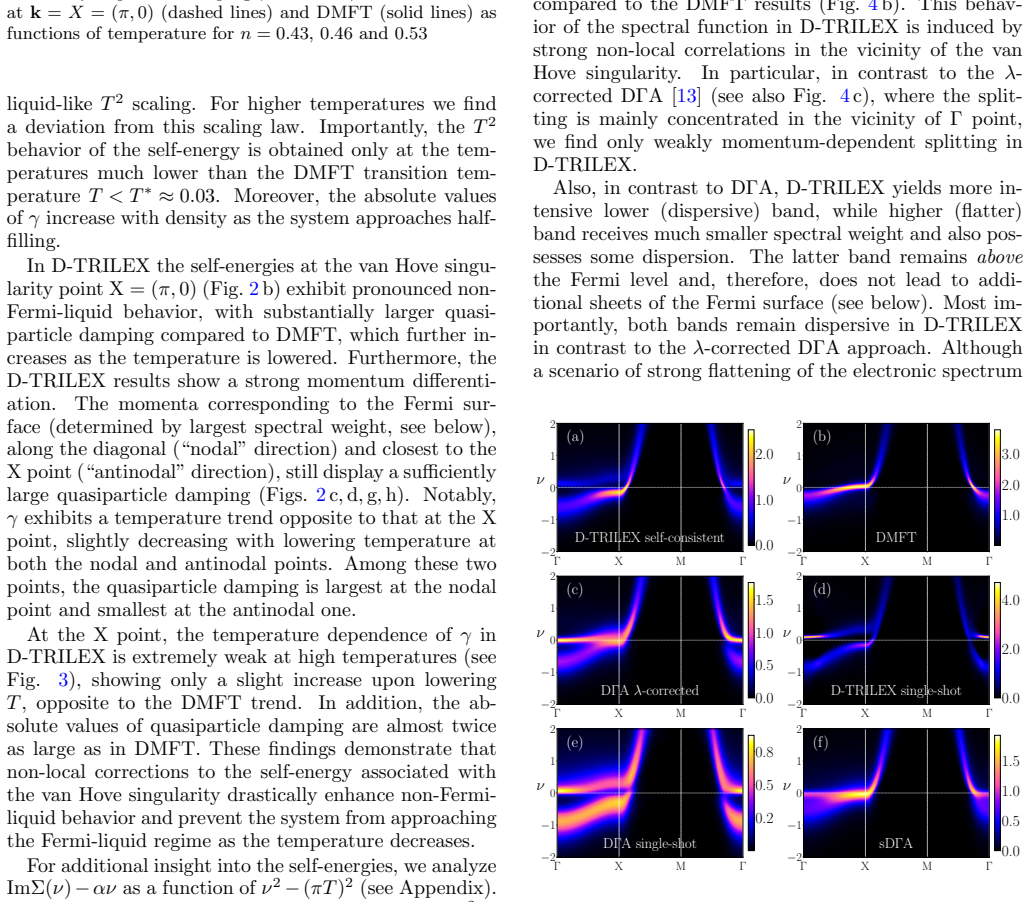
Within D-TRILEX – an approach that adds self-consistent nonlocal self-energy and vertex corrections on top of the local dynamical mean field theory – the authors compute the spectral function of the Hubbard model at t'/t = −0.45, U = 4t, fillings n = 0.43 and 0.52, and temperatures T = 0.05–0.1t above the ferromagnetic crossover. They find that the quasiparticle band splits with a weak momentum dependence: a lower, dispersive band crosses the Fermi level, while an upper, weakly dispersive band stays entirely above it. As a result, the Fermi surface is not split but its area is larger than the non-interacting value for the given density, a violation of the Luttinger theorem that the authors i
What carries the argument
the D-TRILEX (dual triply irreducible local expansion) method, a diagrammatic extension of dynamical mean field theory. It generates the nonlocal self-energy and the polarization operator from three-leg (triangular) vertex functions of the DMFT impurity problem, and dresses them self-consistently with dual Green's functions and bosonic propagators in the charge and spin channels. The essential role of this machinery is to capture momentum-dependent ferromagnetic fluctuations near the van Hove singularity and to let their feedback into the electronic propagators build up self-consistently; the split bands and expanded Fermi surface emerge only when this feedback is fully iterated.
Load-bearing premise
The split-band and Fermi-surface maps are produced by maximum-entropy analytic continuation of Matsubara Green's functions, which has no built-in error bars; if that continuation artificially splits single-peaked spectra, the central claim collapses.
What would settle it
Apply an alternative analytic continuation (e.g., stochastic optimization or Padé) to the D-TRILEX Matsubara self-energy and Green's function at T = 0.05, n = 0.43, k = X = (π,0), and check whether the two-peak structure persists and whether the upper band remains above the Fermi level. A negative answer – or a result from exact diagonalization on a 4×4 cluster at the same parameters showing a single peak – would falsify the claimed splitting and Fermi-surface expansion.
If this is right
- A non-Fermi-liquid regime with roughly constant (or even increasing) quasiparticle damping at the van Hove point appears above the magnetic crossover temperature, over a wide temperature window.
- The spectral splitting and the Fermi-surface expansion occur in the paramagnetic state, so they are pure fluctuation effects requiring no symmetry breaking.
- The nodal–antinodal dichotomy is reversed relative to the antiferromagnetic case: more spectral weight sits near the nodal direction and excitations are more coherent at the antinode – a potential fingerprint for ferromagnetic-fluctuation physics.
- Among the theories considered, only the self-consistent D-TRILEX gives a dispersive upper band with small spectral weight; the flat upper band seen in some DΓA variants is likely an artifact of the λ-correction.
- The expanded Fermi surface implies a Luttinger violation that must be compensated by partial occupancy of the upper band, tying the phenomenon to the emergence of a 'hidden' band in the paramagnetic phase.
Where Pith is reading between the lines
- If the split and expanded Fermi surface survive a real-frequency benchmark, the mechanism could explain the band-splitting observations in materials such as CrTe2 and doped Sr2RuO4 without invoking magnetic order.
- The weakly momentum-dependent splitting suggests a minimal effective model of two coupled bands at low energy; deriving such a model from the D-TRILEX self-energy could yield transport and optical predictions, e.g., a low-frequency optical conductivity deficit.
- Because the claim rests on MaxEnt continuation, the cleanest confirmation would come from a method with controlled error on the real axis, or from cluster exact diagonalization at the same parameters.
- The finding that vertex corrections are essential suggests that simpler self-energy approximations (e.g., bosonization without three-leg vertices) may misjudge the size of the non-Fermi-liquid region in the phase diagram.
Editorial analysis
A structured set of objections, weighed in public.
Referee Report
Summary. This paper studies the single-band Hubbard model on a square lattice with t'/t=-0.45 near a van Hove singularity, at densities n=0.43–0.52 and temperatures T=0.05–0.1, using DMFT and the D-TRILEX method. The central claim is that self-consistent inclusion of non-local ferromagnetic fluctuations splits the electronic spectral function into a lower dispersive band that crosses the Fermi level and an upper weakly dispersive band that remains above it, so the Fermi surface remains unsplit but expands, with an associated violation of Luttinger's theorem. The authors also report quasiparticle damping γ≈const(T) at the X point, a nodal–antinodal dichotomy opposite to the antiferromagnetic case, and a comparison with DΓA variants that is used to argue that the flat upper band in λ-corrected DΓA is an artifact. A phase diagram for ferromagnetic and incommensurate ordering is presented. The main evidence for the non-Fermi-liquid behavior and Fermi-surface expansion is obtained from MaxEnt analytic continuation of Matsubara Green's functions and from polynomial extrapolation of the imaginary part of the self-energy to zero frequency.
Significance. If the spectral splitting and Fermi-surface expansion are genuine, this is a clear and interesting demonstration that van Hove-driven ferromagnetic fluctuations alone can produce non-Fermi-liquid behavior in a symmetry-unbroken paramagnet, with potential implications for Sr2RuO4 and CrTe2. The paper has several strengths: no parameter is fitted to produce the splitting or the Fermi-surface expansion; the internal comparisons between DMFT, single-shot and self-consistent D-TRILEX, and DΓA variants are coherent and useful; and the phase diagram contextualizes the temperature range. The central quantitative claims, however, rest on two numerical inversions — maximum-entropy analytic continuation for spectra and polynomial extrapolation for γ — neither of which is cross-checked or supplied with error bars. These are load-bearing gaps because the two-band structure and the Fermi-surface maps are read directly from the MaxEnt output.
major comments (3)
- [§II; Figs. 4–6] All momentum-resolved spectral functions A(k,ω) and Fermi-surface maps A(k,0), including the split two-band structure and the Fermi-surface expansion, are obtained from Matsubara data by maximum-entropy continuation using the ana_cont package. MaxEnt is a regularized inversion whose output depends on the default model and on the noise estimate; it is known to be able to produce spurious peak splitting as well as over-smoothing. The manuscript provides no independent real-frequency solver, no default-model sensitivity scan, and no synthetic-data tests. Because the central claim (only the lower band crosses E_F, the upper band stays above E_F, and the Fermi-surface area increases) is read directly from these MaxEnt spectra, this is a load-bearing gap rather than a presentational issue. Please validate the continuation, for example with a second method (Padé, stochastic analytic continuatio
- [§III.B.1; Fig. 2 caption; Fig. 3] The quasiparticle damping γ = -ImΣ_{k,ν=0} is obtained by polynomial extrapolation of ImΣ(iν_n) to zero frequency. The manuscript does not state the polynomial order, the number of low-frequency Matsubara points included, the fit range, or the statistical error. The non-Fermi-liquid conclusion — γ≈const(T) at the X point and the opposite temperature trends between the X point and the nodal/antinodal points — is based on these extrapolated values. Please show the raw Matsubara data with the fitted curve, provide error bars, and give an alternative extrapolation (e.g., Padé or a linear fit excluding the first Matsubara point) to demonstrate that the γ(T) trends are not fit artifacts.
- [§III.B.2; Figs. 4, 6; Conclusion] The Fermi-surface expansion and the claimed Luttinger-theorem violation are inferred from the positions and weights of maxima of MaxEnt A(k,0), together with the statement that the upper band lies above E_F. At T=0.05 the spectra are broad, so the 'Fermi surface' is not sharply defined; an apparent expansion can result from the contour or peak-height criterion rather than from a true change in the Luttinger volume. Furthermore, Luttinger's theorem is a zero-temperature statement about the volume enclosed by the zeros of the single-particle Green's function; in a finite-temperature, symmetry-unbroken paramagnet one needs a precise definition (e.g., the Re G=0 locus or the momentum distribution). I ask for a direct quantitative check: compute the occupied density from the interacting Green's function and compare it with the area enclosed by the apparent Fermi surface, and locate any zeros
minor comments (4)
- [Fig. 3 caption] The caption says n=0.43, 0.46 and 0.53, while the text and Fig. 2 use n=0.43 and 0.52. Please make the notation consistent.
- [Fig. A1 caption] The caption says 'n=0.52 (e-f)', but panels (e)–(h) are shown. Correct to (e–h).
- [Fig. 6] The Brillouin-zone axes are not clearly labeled. Please add k_x/k_y axes or an explicit Γ–X–M path to make the Fermi-surface maps self-contained.
- [Fig. 4] The DΓA labels appear as 'D□A' in the figure. Fix the typography so that Γ is rendered correctly.
Circularity Check
No circularity found: the spectral splitting and Fermi-surface expansion are emergent outputs of the self-consistent D-TRILEX calculation, not fits or self-cited inputs.
full rationale
The paper's central results—the splitting of the spectral function, the weak momentum dependence of that splitting, and the Fermi-surface expansion—are obtained by solving the D-TRILEX self-consistency equations (Eqs. 2–5) with DMFT-impurity vertex inputs and then analytically continuing the resulting Matsubara Green's functions. No parameter is tuned to reproduce the claimed splitting or Fermi-surface area, and the comparison with DMFT and DΓA is a genuine computational contrast, not a reduction of the output to an input. The D-TRILEX method itself is cited from prior work of the authors, but that is a normal methodological dependence: the method is an independent computational framework and the cited papers do not contain the specific prediction of Fermi-surface expansion for this model. The only load-bearing numerical step that could be questioned is the maximum-entropy analytic continuation (Sec. II, 'obtained from the Matsubara Green's function G(k, iν) via analytic continuation using the maximum entropy method'), but MaxEnt is a standard inversion technique, not an input that by construction produces the two-band structure; any concern about its reliability is a correctness/robustness issue, not circularity. The paper itself even flags method-dependence of the splitting ('we find that the features of this splitting and the dichotomy are method-dependent'), which further indicates the result is not definitionally tied to a single fitted input. Thus no circular step can be exhibited, and the appropriate score is 0.
Axiom & Free-Parameter Ledger
axioms (3)
- domain assumption D-TRILEX partially bosonized vertex approximation (three-point vertices connected by bosonic propagators) is quantitatively reliable for the Hubbard model near the van Hove singularity.
- domain assumption Maximum-entropy analytic continuation of finite Matsubara data resolves the two bands and the ν=0 Fermi-surface maps without uncontrolled bias.
- domain assumption The chosen model parameters (U=4t, t'/t=-0.45, n≈0.43–0.52) place the system in a regime where ferromagnetic van Hove fluctuations dominate, and conclusions are representative of that regime.
Cite this review
Pith. "Pith review of Non-Fermi-liquid behaviour and Fermi-surface expansion induced by van Hove-driven ferromagnetic fluctuations: the D-TRILEX analysis." pith.science (2026). https://pith.science/paper/RTOMYOEZ
@misc{pith2026251114614,
  author       = {Pith},
  title        = {Pith review of: Non-Fermi-liquid behaviour and Fermi-surface expansion induced by van Hove-driven ferromagnetic fluctuations: the D-TRILEX analysis},
  year         = {2026},
  howpublished = {\url{https://pith.science/paper/RTOMYOEZ}},
  note         = {Machine review of arXiv:2511.14614}
}
read the original abstract
We consider the electronic and magnetic properties of the Hubbard model on a square lattice with the Fermi level near van Hove singularity and the ratio of the next-nearest-neighbor and nearest-neighbor hoppings $t'/t=-0.45$, which favours the ferromagnetic instability. We find, that a self-consistent consideration of the ferromagnetic fluctuations within the D-TRILEX approach results in the splitting of the electronic spectral function at low temperatures. This splitting exhibits only a weak momentum dependence, and only one of the split bands crosses the Fermi level. As a result, the Fermi surface itself remains unsplit, but its area increases, reflecting the presence of non-Fermi-liquid electronic excitations. We show that both the self-consistent account of the non-local contributions to the electronic self-energy and the proper treatment of electron interaction vertices in D-TRILEX are important to obtain this behaviour.
Figures




Forward citations
Cited by 1 Pith paper
-
Co-operating multiorbital and nonlocal correlations in bilayer nickelate
In a three-orbital model of bilayer nickelate, nonlocal correlations produce spin-polaron shadow bands below the Fermi level when the gamma quasiparticle band crosses it, depending on interorbital interaction strength.
Reference graph
Works this paper leans on
-
[1]
nodal” direction) and closest to the X point (“antinodal
Self-energies We next consider the local self-energies obtained within DMFT and D-TRILEX for 0.05t < T <0.1t, i.e., above the transition temperature, and for fillings n= 0.43 andn= 0.52 close to the van Hove singularity. The corresponding result is shown in Fig. 2. In DMFT we find that the quasiparticle dampingγ k =−ImΣ k,ν=0, shown in Fig. 3, decreases w...
-
[2]
single shot
Spectral functions In Fig. 4 we show spectral functions along the Γ–X–M– Γ path in the Brillouin zone. In agreement with previous considerations [11, 12], the non-local self-energy correc- tions within D-TRILEX lead to a characteristic splitting of the quasiparticle band near the Fermi level along the Γ–X and M–Γ high-symmetry directions (see Fig. 4 a), c...
-
[3]
A. V. Chubukov, D. Pines, and B. P. Stojkovi´ c, Temper- ature crossovers in cuprates, J. Phys.: Condens. Matter 8, 10017 (1996)
1996
-
[4]
B. P. Stojkovi´ c and D. Pines, Theory of the optical con- ductivity in the cuprate superconductors, Phys. Rev. B 56, 11931 (1997)
1997
-
[5]
Pines, Nearly antiferromagnetic Fermi liquids: a progress report, Z
D. Pines, Nearly antiferromagnetic Fermi liquids: a progress report, Z. Phys. B103, 129 (1997)
1997
-
[6]
Y. M. Vilk and A.-M. S. Tremblay, Non-perturbative many-body approach to the Hubbard model and single- particle pseudogap, J. Phys. I France7, 1309 (1997)
1997
-
[7]
Schmalian, D
J. Schmalian, D. Pines, and B. Stojkovi´ c, Microscopic theory of weak pseudogap behavior in the underdoped cuprate superconductors: General theory and quasipar- ticle properties, Phys. Rev. B60, 667 (1999)
1999
-
[8]
Gunnarsson, T
O. Gunnarsson, T. Sch¨ afer, J. P. F. LeBlanc, E. Gull, J. Merino, G. Sangiovanni, G. Rohringer, and A. Toschi, Fluctuation diagnostics of the electron self-energy: Ori- gin of the pseudogap physics, Phys. Rev. Lett.114, 236402 (2015)
2015
-
[9]
Krien, P
F. Krien, P. Worm, P. Chalupa, A. Toschi, and K. Held, Explaining the pseudogap through damping and anti- damping on the Fermi surface by imaginary spin scat- tering, Commun. Phys.5, 336 (2022)
2022
-
[10]
Chatzieleftheriou, S
M. Chatzieleftheriou, S. Biermann, and E. A. Stepanov, Local and non-local electronic correlations at the metal- insulator transition in the two-dimensional Hubbard model, Phys. Rev. Lett.132, 236504 (2024)
2024
-
[11]
Y. Yu, S. Iskakov, E. Gull, K. Held, F. Krien, Unambigu- ous fluctuation decomposition of the self-energy: pseu- dogap physics beyond spin fluctuations, Phys. Rev. Lett. 132, 216501 (2024)
2024
-
[12]
J.-M. Lihm, Dominik Kiese, S.-S. B. Lee, F. B. Kugler, The finite-difference parquet method: En- hanced electron-paramagnon scattering opens a pseudo- gap, ArXiv:2505.20116
-
[13]
A. A. Katanin, A. P. Kampf, and V. Yu. Irkhin, Anoma- lous self-energy and Fermi surface quasi-splitting in the vicinity of a ferromagnetic instability, Phys. Rev. B71, 085105 (2005)
2005
-
[14]
A. A. Katanin, Electronic self-energy and triplet pairing fluctuations in the vicinity of a ferromagnetic instability in 2D systems: the quasistatic approach, Phys. Rev. B 72, 035111 (2005)
2005
-
[15]
M. Kitatani, Y. Nomura, S. Sakai, and R. Arita, Lut- tinger surface and exchange splitting induced by ferro- magnetic fluctuations, ArXiv:2509.21034
-
[16]
Nomura, S
Y. Nomura, S. Sakai, and R. Arita, Fermi Surface Expan- sion above Critical Temperature in a Hund Ferromagnet, Phys. Rev. Lett.128, 206401 (2022)
2022
-
[17]
Liebsch and A
A. Liebsch and A. Lichtenstein, Photoemission Quasi- particle Spectra of Sr 2RuO4, Phys. Rev. Lett.84, 1591 (2000)
2000
-
[18]
V. B. Zabolotnyy, D. V. Evtushinsky, A. A. Kordyuk, T. K. Kim, E. Carleschi, B. P. Doyle, R. Fittipaldi, M. Cuoco, A. Vecchione, and S. V. Borisenko, Renor- malized Band Structure of Sr 2RuO4: A Quasiparticle Tight-Binding Approach, J. Electron Spectrosc. Relat. Phenom.191, 48 (2013)
2013
-
[19]
E. A. Stepanov, Y. Nomura, A. I. Lichtenstein, and S. Biermann, Orbital isotropy of magnetic fluctuations in correlated electron materials induced by Hund’s exchange coupling, Phys. Rev. Lett.127, 207205 (2021)
2021
-
[20]
Chatzieleftheriou, A
M. Chatzieleftheriou, A. N. Rudenko, Y. Sidis, S. Bier- mann, and E. A. Stepanov, Nature of momentum- and orbital-dependent magnetic fluctuations in Sr2RuO4, Phys. Rev. B112, 195118 (2025)
2025
-
[21]
T. Imai, A. W. Hunt, K. R. Thurber, and F. C. Chou, 17O NMR Evidence for Orbital Dependent Ferromag- netic Correlations in Sr2RuO4, Phys. Rev. Lett.81, 3006 (1998)
1998
-
[22]
Steffens, Y
P. Steffens, Y. Sidis, J. Kulda, Z. Q. Mao, Y. Maeno, I. I. Mazin, and M. Braden, Spin fluctuations in Sr 2RuO4 from polarized neutron scattering: implications for su- perconductivity, Phys. Rev. Lett.122, 047004 (2019)
2019
-
[23]
Kikugawa, C
N. Kikugawa, C. Bergemann, A. P. Mackenzie, and Y. Maeno, Band-selective modification of the magnetic fluc- tuations in Sr 2RuO4: A study of substitution effects, Phys. Rev. B70, 134520 (2004)
2004
-
[24]
Mravlje, M
J. Mravlje, M. Aichhorn, T. Miyake, K. Haule, G. Kotliar, and A. Georges, Coherence-Incoherence Crossover and the Mass-Renormalization Puzzles in Sr2RuO4, Phys. Rev. Lett.106, 096401 (2011)
2011
-
[25]
F. B. Kugler, M. Zingl, H. U. R. Strand, S.-S. B. Lee, J. von Delft, and A. Georges, Strongly Correlated Materials from a Numerical Renormalization Group Perspective: How the Fermi-Liquid State of Sr 2RuO4 Emerges, Phys. Rev. Lett.124, 016401 (2020)
2020
-
[26]
Park, J.-E
K. Park, J.-E. Lee, D. Kim, Y. Zhong, C. Farhang, H. Lee, H. Im, W. Choi, S. Lee, S. Mun, et. al., Unusual Ferromagnetic Band Evolution and High Curie Tempera- ture in Monolayer 1T-CrTe2 on Bilayer Graphene, Small, e06671 (2025)
2025
-
[27]
Wilhelm, F
A. Wilhelm, F. Lechermann, H. Hafermann, M. I. Kat- snelson, and A. I. Lichtenstein, From Hubbard bands to spin-polaron excitations in the doped Mott material NaxCoO2, Phys. Rev. B91, 155114 (2015)
2015
-
[28]
A. A. Katanin, Splitting of electronic spectrum in para- magnetic phase of itinerant ferromagnets and altermag- nets, ArXiv:2509.23396
-
[29]
E. A. Stepanov, V. Harkov, and A. I. Lichtenstein, Con- sistent partial bosonization of the extended Hubbard model, Phys. Rev. B100, 205115 (2019)
2019
-
[30]
Harkov, M
V. Harkov, M. Vandelli, S. Brener, A. I. Lichtenstein, and E. A. Stepanov, Impact of partially bosonized collective fluctuations on electronic degrees of freedom, Phys. Rev. B103, 245123 (2021)
2021
-
[31]
Vandelli, J
M. Vandelli, J. Kaufmann, M. El-Nabulsi, V. Harkov, A. I. Lichtenstein, and E. A. Stepanov, Multi-band D- TRILEX approach to materials with strong electronic correlations, SciPost Phys.13, 036 (2022)
2022
-
[32]
Toschi, A
A. Toschi, A. A. Katanin, and K. Held, Dynamical ver- tex approximation: A step beyond dynamical mean-field theory, Phys. Rev. B75, 045118 (2007)
2007
-
[33]
A. A. Katanin, A. Toschi, K. Held, Comparing perti- nent effects of antiferromagnetic fluctuations in the two and three dimensional Hubbard model, Phys. Rev. B80, 075104 (2009)
2009
-
[34]
Kaufmann, C
J. Kaufmann, C. Eckhardt, M. Pickem, M. Kitatani, A. Kauch, and K. Held, Self-consistent ladder DΓA ap- proach, Phys. Rev. B103, 035120 (2021). 8
2021
-
[35]
A. N. Rubtsov, M. I. Katsnelson, and A. I. Lichtenstein, Dual fermion approach to nonlocal correlations in the Hubbard model, Phys. Rev. B77, 033101 (2008)
2008
-
[36]
Brener, E
S. Brener, E. A. Stepanov, A. N. Rubtsov, M. I. Katsnel- son, and A. I. Lichtenstein, Dual fermion method as a prototype of generic reference-system approach for cor- related fermions, Ann. Phys.422, 168310 (2020)
2020
-
[37]
A. N. Rubtsov, M. I. Katsnelson, and A. I. Lichtenstein, Dual boson approach to collective excitations in corre- lated fermionic systems, Ann. Phys.327, 1320 (2012)
2012
-
[38]
E. G. C. P. van Loon, A. I. Lichtenstein, M. I. Kat- snelson, O. Parcollet, and Hartmut Hafermann, Beyond extended dynamical mean-field theory: Dual boson ap- proach to the two-dimensional extended Hubbard model, Phys. Rev. B90, 235135 (2014)
2014
-
[39]
E. A. Stepanov, E. G. C. P. van Loon, A. A. Katanin, A. I. Lichtenstein, M. I. Katsnelson, and A. N. Rubtsov, Self-consistent dual boson approach to single-particle and collective excitations in correlated systems, Phys. Rev. B 93, 045107 (2016)
2016
-
[40]
Peters, E
L. Peters, E. G. C. P. van Loon, A. N. Rubtsov, A. I. Lichtenstein, M. I. Katsnelson, and E. A. Stepanov, Dual boson approach with instantaneous interaction, Phys. Rev. B100, 165128 (2019)
2019
-
[41]
E. A. Stepanov, Y. Nomura, A. I. Lichtenstein, and S. Biermann, Orbital Isotropy of Magnetic Fluctuations in Correlated Electron Materials Induced by Hund’s Ex- change Coupling, Phys. Rev. Lett.127, 207205 (2021)
2021
-
[42]
E. A. Stepanov, V. Harkov, M. R¨ osner, A. I. Lichtenstein, M. I. Katsnelson, and A. N. Rudenko, Coexisting charge density wave and ferromagnetic instabilities in monolayer InSe, npj Comput. Mater.8, 118 (2022)
2022
-
[43]
E. A. Stepanov, Eliminating Orbital Selectivity from the Metal-Insulator Transition by Strong Magnetic Fluctua- tions, Phys. Rev. Lett.129, 096404 (2022)
2022
-
[44]
Vandelli, J
M. Vandelli, J. Kaufmann, V. Harkov, A. I. Lichten- stein, K. Held, and E. A. Stepanov, Extended regime of metastable metallic and insulating phases in a two-orbital electronic system, Phys. Rev. Res.5, L022016 (2023)
2023
-
[45]
E. A. Stepanov and S. Biermann, Can Orbital-Selective N´ eel Transitions Survive Strong Nonlocal Electronic Cor- relations?, Phys. Rev. Lett.132, 226501 (2024)
2024
-
[46]
E. A. Stepanov, M. Chatzieleftheriou, N. Wagner, and Giorgio Sangiovanni, Interconnected renormalization of Hubbard bands and Green’s function zeros in Mott in- sulators induced by strong magnetic fluctuations, Phys. Rev. B110, L161106 (2024)
2024
-
[47]
E. A. Stepanov, M. Vandelli, A. I. Lichtenstein, and F. Lechermann, Charge Density Wave Ordering in NdNiO2: Effects of Multiorbital Nonlocal Correlations, npj Com- put. Mater.10, 108 (2024)
2024
-
[48]
E. A. Stepanov, Fingerprints of a charge ice state in the doped Mott insulator Nb 3Cl8, Phys. Rev. B112, 045131 (2025)
2025
-
[49]
E. A. Stepanov, S. Iskakov, M. I. Katsnelson, and A. I. Lichtenstein, Superconductivity of Bad Fermions: Origin of Two Gaps in HTSC Cuprates, ArXiv:2502.08635
-
[50]
A. N. Rubtsov, V. V. Savkin, and A. I. Lichten- stein, Continuous-time quantum Monte Carlo method for fermions, Phys. Rev. B72, 035122 (2005)
2005
-
[51]
Werner, A
P. Werner, A. Comanac, L. de Medici, M. Troyer, and A. J. Millis, Continuous-Time Solver for Quantum Impurity Models, Phys. Rev. Lett.97, 076405 (2006)
2006
-
[52]
Wang, Zi Yang Meng, L
Li Huang, Y. Wang, Zi Yang Meng, L. Du, P. Werner, and Xi Dai, iQIST: An open source continuous-time quantum Monte Carlo impurity solver toolkit, Comp. Phys. Comm.195, 140 (2015); Li Huang, iQIST v0.7: An open source continuous-time quantum Monte Carlo impurity solver toolkit, Comp. Phys. Comm.221, 423 (2017)
2015
-
[53]
Kaufmann and K
J. Kaufmann and K. Held, ana cont: Python package for analytic continuation, Comput. Phys. Commun.282, 108519 (2023)
2023
-
[54]
A. A. Katanin, H. Yamase, and V. Yu. Irkhin, Ferro- magnetic instability and finite-temperature properties of two-dimensional electron systems with van Hove singu- larities, J. Phys. Soc. Jpn.80, 063702 (2011)
2011
-
[55]
A. A. Katanin, Improved treatment of fermion-boson ver- tices and Bethe-Salpeter equations in non-local exten- sions of dynamical mean field theory, Phys. Rev. B101, 035110 (2020)
2020
-
[56]
A. V. Chubukov and D. L. Maslov, First-Matsubara- frequency rule in a Fermi liquid. I. Fermionic self-energy, Phys. Rev. B86, 155136 (2012)
2012
-
[57]
V. A. Khodel and V. R. Shaginyan, Superfluidity in system with fermion condensate, JETP Lett.51, 553 (1990); G. E. Volovik, A new class of normal Fermi liq- uids, JETP Lett.53, 222 (1991); M. V. Zverev and M. Baldo, The multi-connected momentum distribution and fermion condensation, J. Phys.: Condens. Matter11, 2059 (1999)
1990
-
[58]
I. E. Dzyaloshinskii, Extended Van-Hove Singularity and Related Non-Fermi Liquids, J. Phys. I (France)6, 119 (1996)
1996
-
[59]
V. Yu. Irkhin, A. A. Katanin, and M. I. Katsnelson, Ro- bustness of the van Hove scenario for high-Tc supercon- ductors, Phys. Rev. Lett.89, 076401 (2002)
2002
discussion (0)
Sign in with ORCID, Apple, or X to comment. Anyone can read and Pith papers without signing in.