REVIEW 3 major objections 5 minor 34 references
On the Theory of Bulk Viscosity of Cold Plasmas and Thermodynamics of Alkali-Noble Gas Cocktails
T0 review · 3 major / 5 minor · reviewed 2026-08-03 · deepseek-v4-flash
Pith's one-line read Cold plasmas have a single-relaxation-time bulk viscosity: exact for pure hydrogen, about 2% accurate for six-element chromospheric mixtures.
desk verdict Solid kinetic derivation of cold-plasma bulk viscosity with ML exactness proven for hydrogen — but the abstract overclaims the multi-species case. read the letter →
The pith
A machine-rendered reading of the paper's core claim, the machinery that carries it, and where it could break.
The reading
What carries the argument
The engine of the derivation is the complex generalized polytropic index γ̂(ω) ≡ δp̂/δρ̂ / c_N², the frequency-dependent pressure-to-density response of the plasma; its imaginary part is directly proportional to bulk viscosity. The machinery is a set of linearized kinetic equations for the first-ionization fractions α_a of each element, with a near-threshold electron-impact ionization rate σ ∝ (ε/I − 1)^w (w ≈ 1.18) used to compute the relaxation rates, plus the energy-conservation and charge-neutrality constraints that determine the accompanying temperature and electron-density oscillations. Solving this linear system gives γ̂(ω), from which the bulk viscosity and sound damping are obtained
What would settle it
A laboratory measurement of the frequency dependence of sound absorption in a cold partially ionized gas, for instance a sodium–neon cocktail, should reproduce the predicted semicircular plot of the complex polytropic index and the relation between the low-frequency slope of its imaginary part and the location of the absorption peak; a deviation beyond the few-percent level would rule out the exact single-relaxation-time claim. A direct re-measurement of the hydrogen near-threshold ionization cross-section that disagrees with σ ∝ (ε/I − 1)^1.18 and a coefficient near 2.7 would also undermine t
Extended reading notes
Core claim
For a cold plasma (T much less than the first ionization potentials), the paper claims that the frequency-dependent bulk viscosity is exactly described by the single-relaxation-time formula: a complex generalized polytropic index γ̂(ω) whose real part rises from the equilibrium thermodynamic value γ0 to the monatomic value 5/3 and whose imaginary part traces a semicircle in the complex plane. The relaxation time is not fitted but derived from the linearized kinetic equations for the ionization fractions, coupled to temperature and electron-density oscillations through energy conservation and charge neutrality. For pure hydrogen the derivation is closed, making the single-relaxation-time form
Load-bearing premise
The load-bearing premise is that the near-threshold electron-impact ionization rate, with its power-law form and coefficients taken from a single hydrogen measurement, accurately describes every element in the cocktail and that only the first ionization state participates; if this rate is wrong or higher ionization steps or radiative recombination matter, the predicted relaxation time and bulk viscosity shift.
Editorial extensions
If this is right
- In the chromospheric model, bulk viscosity dominates sound-wave damping below a critical frequency of about 35 mHz, so realistic acoustic-heating models must include it or they miss the dominant dissipation channel.
- The high-frequency damping rate becomes frequency-independent, meaning the acoustic heating power is directly proportional to the wave spectral density in that band.
- The closed formula ζ0 = τ p (γ∞ − γ0), with τ derived from the ionization kinetics, gives a parameter-free prediction for sound absorption in alkali–noble-gas mixtures such as sodium–neon, testable in laboratory plasmas.
- For pure hydrogen plasma, the single-relaxation-time description is exact, so no multi-relaxation-time corrections are needed in cold hydrogen plasmas.
- The same thermodynamic and kinetic framework yields an explicit expression for the convective-instability criterion, connecting bulk viscosity to models of convection in partially ionized atmospheres.
Reading between the lines
- A natural extension is to regard any reversible internal degree of freedom that equilibrates through a single bottleneck rate—vibrational relaxation in molecular gases, dissociation-recombination, or chemical reactions—as producing a similar Debye-like bulk-viscosity peak; the paper does not make this broader claim.
- The computed long relaxation time at chromospheric conditions shifts most of the acoustic spectrum into the dispersionless absorption band, so chromospheric heating models could be simplified from a frequency convolution to a local heating rate, an implication the authors only sketch.
- The 2% agreement between the full kinetic calculation and the single-relaxation-time fit could be used as a quantitative probe: deviations should grow as multiple ionization stages or species with very different ionization potentials contribute significantly, and a deliberate test with a two-species laboratory mixture would map that boundary.
- One could invert the paper's logic and use observed chromospheric wave damping as a remote constraint on the near-threshold ionization cross-sections of minor elements like magnesium, silicon, and iron, which are less well measured than hydrogen.
Editorial analysis
A structured set of objections, weighed in public.
Referee Report
Summary. The paper derives the complex polytropic index and frequency-dependent bulk viscosity for a cold plasma (T much smaller than the first ionization potentials) from a linearized kinetic equation for electron-impact ionization/recombination. The ionization rates are based on the Wannier near-threshold cross-section, and the resulting matrix system (Eq. (81)) is solved for a six-species H/He/C/Mg/Si/Fe cocktail representing the solar chromosphere at a chosen height. The result is compared with the Mandelstam-Leontovich (ML) single-relaxation-time formula. For pure hydrogen and, more generally, for a single ionizable species with neutral noble-gas diluent, the ML form is shown to be exact (Sec. VI). For the chromospheric cocktail, the Argand plot of the complex polytropic index agrees with the ML fit to about 2% in the extracted relaxation time. The paper also presents thermodynamic formulas for alkali-noble-gas cocktails and discusses implications for acoustic heating of the solar chromosphere. Source code and data are deposited on Zenodo.
Significance. If the derivation is correct, the paper gives a rare first-principles calculation of a kinetic coefficient—bulk viscosity of cold plasmas—expressed in terms of Saha equilibrium, the Wannier cross-section, and a matrix inversion. The microscopic derivation of the phenomenological Mandelstam-Leontovich/Drude form is conceptually valuable, and the explicit hydrogen/noble-gas solution (Eq. (154)) is a clean, testable result. The availability of the code on Zenodo is a further strength. The main limitation is that the exact ML statement is proven only for a single dominant ionizable species; for a general multi-species cold plasma, the matrix equation (81) generically yields multiple relaxation modes, so the unqualified abstract claim overstates the result.
major comments (3)
- [Abstract; Sec. V.B; Sec. VI] The abstract claims that the Mandelstam-Leontovich approximation is 'actually an exact solution in the case of cold plasmas.' This is too broad. Exact single-relaxation-time behavior is established only for a single ionizable species (Sec. VI, Eqs. (151)-(163)), and for the chromospheric cocktail the conclusion is numerical, with the text itself attributing the agreement to the fact that 'the number of a single type ions dominates' (Sec. V). For arbitrary cold plasmas with several comparable ionizable species, Eq. (81) is a matrix equation with species-dependent relaxation times tau_a, and its solution generically contains multiple relaxation poles, not a single ML pole. The abstract and the summarizing sentence in Sec. V.B should be qualified, e.g., by stating that the ML form is exact when one ionizable species dominates and is an excellent approximation for hydrogen-dominated mixtures
- [Sec. IV.B, Eq. (70)] The central linearized kinetic equation (70) is introduced after the sentence 'Omitting the complete derivation.' This is a load-bearing step: Eqs. (69)-(71) and (81) all follow from it, and the accuracy of all later results depends on it. As written, the reader cannot verify the signs, the treatment of the Saha-density derivative (65), or the temperature-oscillation relation (69). The full derivation should be supplied in an appendix (or a referenced companion paper) before the manuscript is published.
- [Sec. III, Eq. (39)] The ionization rate (39) is obtained by integrating the Wannier near-threshold cross-section (37) with parameters w≈1.18 and C_W≈2.7 taken from a single early experimental study of H(1s) (McGowan & Clarke 1968). The same Wannier parameters are then applied to all elements in the chromospheric cocktail (He, C, Mg, Si, Fe). The sensitivity of the extracted relaxation time and bulk viscosity to these parameters is not quantified, and the neglect of radiative recombination and multi-step ionization is not justified for the chromospheric conditions. Since the solar application is a headline result, a sensitivity analysis, or at least a careful discussion of why these processes are negligible at the chosen height in the AL08 profile, is needed.
minor comments (5)
- [Eq. (88)] In the definition of the matrix \hat M_B, the last displayed row appears as 'D_{a_max} L_B', missing the prefactor \hat\Gamma_{a_max} that appears in all other rows. Please correct the typo.
- [Sec. IV.C, Eq. (81)] The quantity c_e is used in Eq. (81) (in the term (\iota_a + c_v + 1/c_e)) before it is defined in Eq. (95). Please move the definition earlier or add a note at first use.
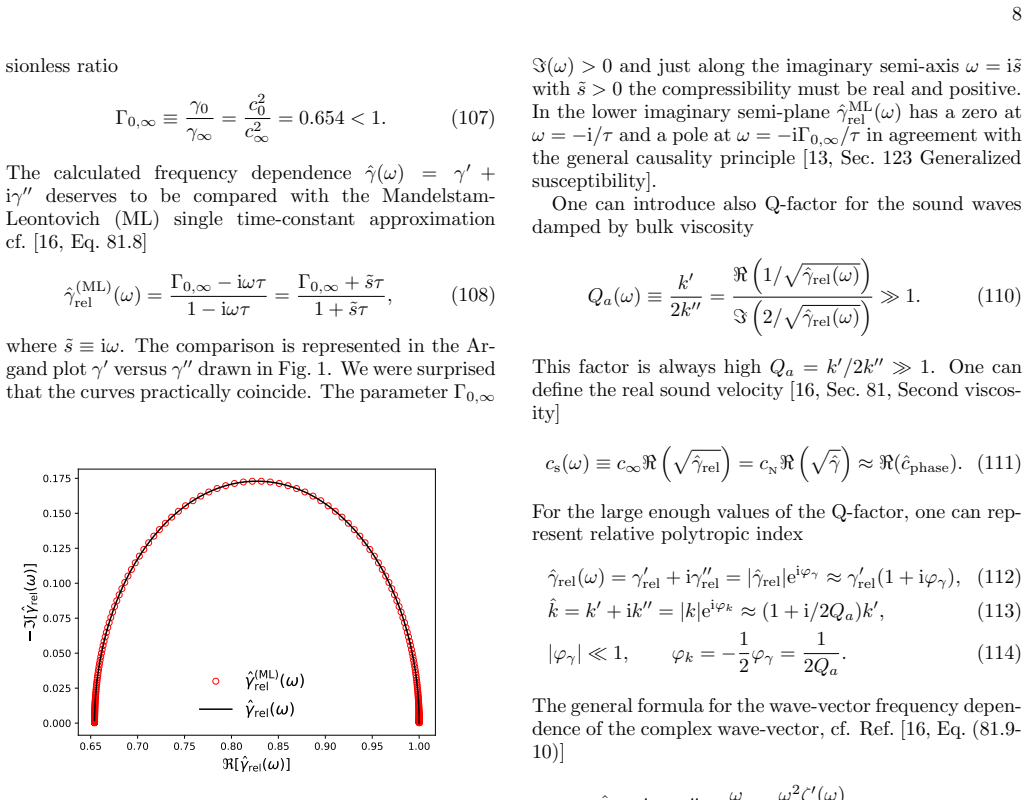
- [Fig. 1 caption] The caption says 'ML fit with fitting parameter \Gamma_{0,\infty}=0.654', but \Gamma_{0,\infty} is computed thermodynamically (Eq. (107)), not fitted. In the Argand plot, the fitting parameter is actually \tau, and \tau cancels in the dimensionless plot. Please clarify what is fitted in the figure.
- [Abstract; Sec. VII] The abstract states that magnetic diffusivity, heat conductivity, shear viscosity, and bulk viscosity 'all play an almost equally important part' in wave damping. No calculation of magnetic diffusivity or heat conductivity is presented in this paper; the analysis in Sec. VII compares only bulk and shear viscosity. Please either remove the statement or cite the companion work where the other coefficients are computed.
- [General] There are several typos and duplicated words, e.g., 'according according' in Sec. V.B, 'Naval nozzle' (should probably be 'de Laval nozzle') in Sec. VII.A, and the duplicated line p=Re(\hat p) in Eqs. (52)-(53). A careful proofread is recommended.
Circularity Check
No circular steps: the ML/exact-solution agreement is a derived one-pole result and a consistency test, not a fitted rename; the abstract's 'cold plasmas' generalization is a scope overstatement, not circularity.
full rationale
The derivation chain is not circular. The paper starts from the Wannier near-threshold ionization cross-section (Eq. (37), with constants from the external experimental study [20]) and the linearized kinetic equation for ionization-recombination (Eq. (81)); it then solves for the ionization oscillations and computes the complex polytropic index γ̂(ω) via Eq. (102) and the bulk viscosity via Eq. (128). The Mandelstam-Leontovich formula (Eq. (108)) is introduced after this exact calculation and compared with it. The parameter Γ0,∞ is not fitted to the response curve but is taken from the thermodynamic low-frequency limit γ0/γ∞ (Eq. (107)), and τ is read off independently from the exact Q-factor maximum (Eqs. (119)-(120)) or from the zero-frequency slope (Eq. (135)). The 2% agreement between τ0 and τmax is therefore a genuine one-pole consistency test, not a parameter forced by construction. For pure hydrogen, the analytic solution (Eqs. (151)-(154)) reduces to γ∞ - B/(A - iωT), which is exactly the one-pole ML rational form; the exactness claim is derived, not assumed. The only self-citations (Eqs. (24) and (28), citing Refs. [11,14,15]) concern the low-frequency thermodynamic polytropic index, but Section VI reproduces this limit as the ω→0 limit of the kinetic solution, so these citations are not load-bearing. The main caveat is a scope overstatement rather than circularity: the abstract's phrase 'actually an exact solution in the case of cold plasmas' is broader than what is shown. The paper itself qualifies the exactness to the single-ion-dominated case: 'Agreement within several percent accuracy is a simple consequence that at low temperature plasma, the number of a single type ions dominates... for pure hydrogen, plasma ML approximation is actually the exact solution.' Equation (81) is generically a multi-mode matrix equation, so the unqualified cold-plasma claim is unsupported for arbitrary multi-species cocktails; this is a correctness/scope risk, not a circular reduction.
Assumptions & free parameters
free parameters (3)
- Wannier cross-section exponent w =
1.18
- Wannier cross-section coefficient C_W =
2.7
- Solar chromosphere composition parameters (abundances a_a, density n_rho, temperature T) =
From AL08 model at h=1894 km
assumptions (6)
- domain assumption Cold plasma approximation: T << I_a, so only the first ionization state is relevant (Eq. (40)-(42))
- domain assumption Ideal gas equation of state (Eq. (3))
- domain assumption Ionization-recombination kinetics described by single-impact ionization and three-body recombination (Eq. (43)-(46))
- domain assumption Wannier near-threshold cross-section (Eq. (37)) is accurate for the relevant energy range
- domain assumption Local thermodynamic equilibrium for background quantities; density oscillations linearized (Eq. (49)-(50))
- standard math The Saha equation is valid for equilibrium ionization (Eq. (12))
Cite this review
Pith. "Pith review of On the Theory of Bulk Viscosity of Cold Plasmas and Thermodynamics of Alkali-Noble Gas Cocktails." pith.science (2026). https://pith.science/paper/MGUKRWOU
@misc{pith2026251114790,
  author       = {Pith},
  title        = {Pith review of: On the Theory of Bulk Viscosity of Cold Plasmas and Thermodynamics of Alkali-Noble Gas Cocktails},
  year         = {2026},
  howpublished = {\url{https://pith.science/paper/MGUKRWOU}},
  note         = {Machine review of arXiv:2511.14790}
}
read the original abstract
By solving the kinetic equation for ionization-recombination processes in cold plasmas for temperatures much lower than the first ionization potentials, we derive an explicit expression for the complex polytropic index, as well as bulk viscosity. The obtained result for the ionization-recombination relaxation time reveals that the Mandelstam-Leontovich approximation for the frequency dependence of the bulk viscosity is actually an exact solution in the case of cold plasmas. We systemize also explicit general formulae for the thermodynamics of the alkali-noble cocktails in the same low temperature plasma approximation, allowing the Schwarzschild criterion on convectional instability to be derived, too. All these general results are applicable for cold stellar, interstellar and laboratory plasmas. Additionally, the wave heating of the inner solar atmosphere up to the solar transition region is studied thoroughly, and it is found that the magnetic diffusivity, heat conductivity, shear- and bulk viscosities all play an almost equally important part in the wave damping, therefore none of them can be omitted in realistic considerations of heating of the solar atmosphere.
Figures


Figures from the paper (3 more)


Reference graph
Works this paper leans on
-
[1]
Let us introduce X a =β a(T) n0.a ne (62) and take into account that n0,a = nρ aa (1− αa), nρ = ρ/M∗, ne = nρ N e.(63)
-
[2]
(49), for the time derivatives, following Heaviside, we introduce the imaginary variable D =−iω,d t ˆn1,a = D ˆn1,a,d t ˆnρ = D ˆnρ,
As we suppose that density fluctuations are sinusoidal Eq. (49), for the time derivatives, following Heaviside, we introduce the imaginary variable D =−iω,d t ˆn1,a = D ˆn1,a,d t ˆnρ = D ˆnρ, . . . . (64)
-
[3]
For the oscillations of the Saha densities ˜n1,a(T(t)) we have to take in the beginning that δ ˆT ′ d˜n1,a dT = (cv +ι 1,a) ˜n1,aˆϵT ,ˆϵ T ≡ δ ˆT T .(65)
-
[4]
polytropic
For the calculations of the temperature oscillationsδ ˆT we have to take into account the energy conservation. Let εbe the internal energy per unit mass, we take the gen- eral expression which takes all possible ionization degrees Eq. (18). For the general case, the set of kinetic equations for ni,a is completed by the equation from the temperature variat...
1953
-
[5]
B. V. Gudiksen and ˚A. Nordlund, An Ab Initio Approach to the Solar Coronal Heating Problem, ApJ618, 1020 (2005), arXiv:astro-ph/0407266 [astro-ph]
arXiv 2005
-
[6]
Carlsson, B
M. Carlsson, B. De Pontieu, and V. H. Hansteen, New View of the Solar Chromosphere, ARA&A57, 189 (2019)
2019
-
[7]
M. Pelekhata, K. Murawski, and S. Poedts, Generation of solar chromosphere heating and coronal outflows by two-fluid waves, A&A669, A47 (2023), arXiv:2211.12898 [astro-ph.SR]
arXiv 2023
-
[8]
V. M. Vasyli¯ unas, Alfv´ en Wave Heating of Solar Chro- mosphere Reexamined, ApJ991, 18 (2025)
2025
Show all 34 references
-
[9]
E. R. Udnæs and T. M. D. Pereira, Characteristics of acoustic-wave heating in simulations of the quiet Sun chromosphere, A&A699, A25 (2025), arXiv:2505.21047 [astro-ph.SR]
2025 arXiv
-
[10]
E. H. Avrett and R. Loeser, Models of the Solar Chromo- sphere and Transition Region from SUMER and HRTS Observations: Formation of the Extreme-Ultraviolet Spectrum of Hydrogen, Carbon, and Oxygen, ApJS175, 229 (2008)
2008
-
[11]
G. J. Hooyman, P. Mazur, and S. R. de Groot, Coeffi- cients of viscosity for a fluid in a magnetic field or in a rotating system, Physica21, 355 (1954)
1954
-
[12]
LeVan and S
J. LeVan and S. D. Baalrud, Foundations of magnetohy- drodynamics, PoP32, 070901 (2025), arXiv:2504.13352 [physics.plasm-ph]
2025 arXiv
-
[13]
LeVan, M
J. LeVan, M. D. Acciarri, and S. D. Baalrud, Bulk viscos- ity of the rigid rotor one-component plasma, PRE110, 015208 (2024), arXiv:2405.18175 [physics.plasm-ph]
2024 arXiv
-
[14]
LeVan and S
J. LeVan and S. D. Baalrud, Intrinsic bulk viscosity of the one-component plasma, PRE111, 015202 (2025), arXiv:2410.14813 [physics.plasm-ph]
2025 arXiv
-
[15]
A. M. Varonov and T. M. Mishonov, Influence of ion- ization on the polytropic index of the solar atmosphere within local thermodynamic equilibrium approximation, ApJ963, 35 (2024), arXiv:2312.14759 [astro-ph.SR]
2024 arXiv
-
[16]
M. N. Saha, On a physical theory of stellar spectra, Proc. R. Soc. Lond. A99, 135 (1921)
1921
-
[17]
L. D. Landau and E. M. Lifshitz,Statistical Physics. Part 1, Course of Theoretical Physics, Vol. 5 (Butterworth- Heineman, Oxford, 1980)
1980
-
[18]
T. M. Mishonov, I. M. Dimitrova, and A. M. Varonov, Sound absorption in partially ionized hydrogen plasma and heating mechanism of solar chromosphere, PhyA 563, 125442 (2021a)
-
[19]
T. M. Mishonov, I. M. Dimitrova, and A. M. Varonov, On the Influence of the Ionization-Recombination Processes on the Hydrogen Plasma Polytropic Index, ApJ916, 18 (2021b), arXiv:2008.03565 [astro-ph.SR]
2008 arXiv
-
[20]
L. D. Landau and E. M. Lifshitz,Fluid Mechanics, Course of Theoretical Physics, Vol. 6 (Pergamon, New York, 1988)
1988
-
[21]
G. H. Wannier, The Threshold Law for Single Ionization of Atoms or Ions by Electrons, Phys. Rev.90, 817 (1953)
1953
-
[22]
F. H. Read, A new class of atomic states: the ‘Wannier- ridge’ resonances, AuJPh35, 475 (1982)
1982
-
[23]
L. D. Landau and E. M. Lifshitz,Quantum Mechanics: Non-Relativistic Theory, 3rd ed., Course of Theoretical Physics, Vol. 3 (Pergamon, New York, 1977)
1977
-
[24]
J. W. McGowan and E. M. Clarke, Ionization of H(1s) near Threshold, Phys. Rev.167, 43 (1968)
1968
-
[25]
K. S. Cole and R. H. Cole, Dispersion and Absorption in Dielectrics I. Alternating Current Characteristics, J. Chem. Phys.9, 341 (1941)
1941
-
[26]
O. V. Rudenko and S. I. Soluyan,Theoretical foundations of nonlinear acoustics, edited by O. V. Rudenko, Studies in Soviet Science (Springer, Berlin, 1977)
1977
-
[27]
J. P. Trelles, Fluid modeling of low-temperature plasmas, PoP32, 090901 (2025)
2025
-
[28]
E. M. Lifshitz and L. P. Pitaevskii,Physical Kinetics, Course of Theoretical Physics, Vol. 10 (Pergamon, New York, 1980)
1980
-
[29]
T. M. Mishonov, M. V. Stoev, and Y. G. Maneva, On the origin of solar wind. Alfv´ en waves induced jump of coronal temperature, Eur. Phys. J. D44, 533 (2007), arXiv:astro-ph/0701908 [astro-ph]
2007 arXiv
-
[30]
T. M. Mishonov, Y. G. Maneva, M. V. Stoev, and A. M. Varonov, Heating of the solar corona by Alfv´ en waves: magnetohydrodynamic calculation of the height tempera- ture profile of the transition region, MHD55, 295 (2019)
2019
-
[31]
L. I. Mandelstam and M. A. Leontovitch, J. Exp. Theor. Phys.6, 561 (1936), in Russian
1936
-
[32]
L. I. Mandelstam and M. A. Leontovitch, J. Exp. Theor. Phys.7, 438 (1937), in Russian
1937
-
[33]
Drude, Zur Elektronentheorie der Metalle, Annalen der Physik306, 566 (1900), (in German)
P. Drude, Zur Elektronentheorie der Metalle, Annalen der Physik306, 566 (1900), (in German)
1900
-
[34]
Varonov and T
A. Varonov and T. Mishonov, Contents for: On the The- ory of Bulk Viscosity of Cold Plasmas (2025), Zenodo
2025
Reviewed August 3, 2026 · model on record in the stance chip above.
Discussion (0). Sign in to comment.