FRIENDS GUI: A graphical user interface for data collection and visualization of vaping behavior from a passive vaping monitor
Pith reviewed 2026-05-17 21:26 UTC · model grok-4.3
The pith
A Python graphical user interface extracts, decodes, and visualizes 24-hour puffing data from the FRIENDS vaping monitor device.
A machine-rendered reading of the paper's core claim, the machinery that carries it, and where it could break.
Core claim
The FRIENDS GUI is an open-source Python tool designed to extract, decode, and visualize 24-hour puffing data recorded by the FRIENDS device attached to ENDS products. Through validation on experimental 24-hour data, the GUI demonstrated accurate timestamp conversion, reliable event decoding, and effective visualization of vaping behavior.
What carries the argument
The graphical user interface that converts raw device data into interpretable visual displays of puffing topography including duration, intervals, and counts.
If this is right
- Puffing topography data becomes more accessible for researchers studying electronic nicotine delivery systems.
- Behavioral visualizations aid in evaluating patterns of use and potential toxicant exposure.
- Open availability of the tool encourages wider adoption in data collection for regulatory purposes.
- The validation supports confidence in using the GUI for analyzing real vaping sessions.
Where Pith is reading between the lines
- Extending the GUI to real-time processing could allow immediate feedback during monitoring sessions.
- Combining outputs with other sensor data might reveal correlations between vaping and other behaviors.
- The approach could apply to similar monitoring devices in other health behavior studies.
Load-bearing premise
The 24-hour experimental data used to test the GUI represents typical real-world vaping and the FRIENDS hardware captures every puff and touch event correctly.
What would settle it
Running the GUI on data from a session with a precisely known number and timing of puffs and touches, then verifying that the output matches the known sequence without discrepancies.
Figures


read the original abstract
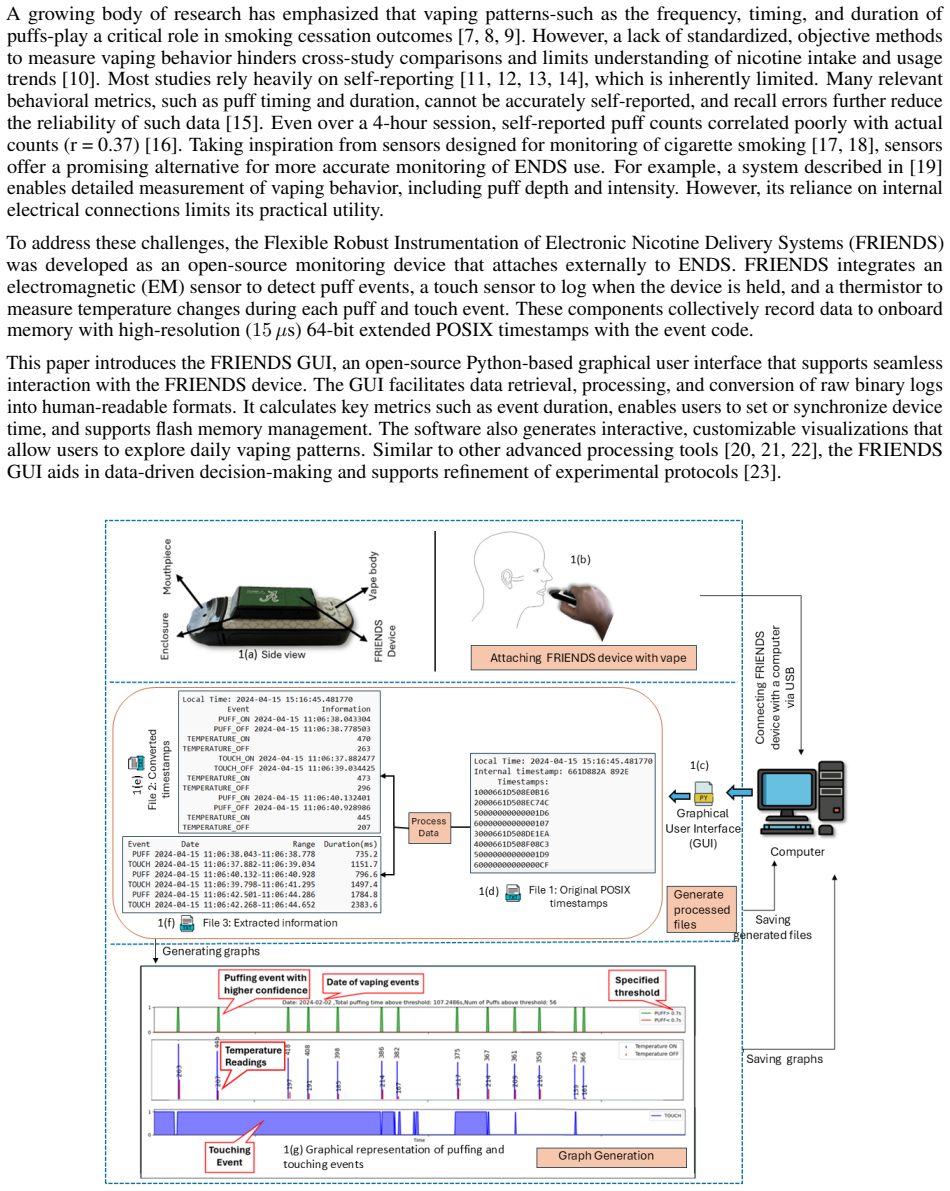
Understanding puffing topography (PT), which includes puff duration, intra-puff interval, and puff count per session, is critical for evaluating Electronic Nicotine Delivery Systems (ENDS) use, toxicant exposure, and informing regulatory decisions. We developed FRIENDS (Flexible Robust Instrumentation of ENDS), an open-source device that can be attached to ENDS and records puffing and touching events. This paper introduces the FRIENDS graphical user interface (GUI) that improves accessibility and interpretability of data collected by FRIENDS. The GUI is a Python-based opensource tool that extracts, decodes, and visualizes 24-hour puffing data from the FRIENDS device. Validation using 24-hour experimental data confirmed accurate timestamp conversion, reliable event decoding, and effective behavioral visualization. The software is freely available on GitHub for public use.
Editorial analysis
A structured set of objections, weighed in public.
Referee Report
Summary. The paper presents FRIENDS GUI, a Python-based open-source graphical user interface for extracting, decoding, and visualizing 24-hour puffing and touching event data collected by the FRIENDS passive vaping monitor device attached to ENDS. The central claim is that validation on 24-hour experimental data confirmed accurate timestamp conversion, reliable event decoding, and effective behavioral visualization, with the tool made freely available on GitHub to improve accessibility for studying puffing topography.
Significance. If the validation claims hold, the GUI would meaningfully lower the barrier to analyzing data from the open-source FRIENDS device, supporting research on ENDS use patterns, toxicant exposure, and regulatory questions. The explicit open-source release and focus on 24-hour data handling are strengths that aid reproducibility.
major comments (1)
- Validation section: the statement that validation 'confirmed accurate timestamp conversion, reliable event decoding, and effective behavioral visualization' is supported only by a qualitative description with no quantitative error metrics (e.g., timestamp MAE, event detection precision/recall), no exclusion criteria for the 24-hour sessions, and no comparison to independent ground truth such as manual annotation or synchronized video. This directly weakens the central claim that the GUI performs reliably for its intended use.
minor comments (1)
- The abstract and methods could clarify the exact data format output by the FRIENDS hardware and the specific decoding rules implemented in the GUI to allow readers to assess edge-case handling without running the code.
Simulated Author's Rebuttal
Thank you for the constructive review and for recognizing the potential significance of the FRIENDS GUI in supporting research on ENDS use patterns. We have addressed the major comment on the validation section below and will incorporate the necessary revisions to strengthen the manuscript.
read point-by-point responses
-
Referee: Validation section: the statement that validation 'confirmed accurate timestamp conversion, reliable event decoding, and effective behavioral visualization' is supported only by a qualitative description with no quantitative error metrics (e.g., timestamp MAE, event detection precision/recall), no exclusion criteria for the 24-hour sessions, and no comparison to independent ground truth such as manual annotation or synchronized video. This directly weakens the central claim that the GUI performs reliably for its intended use.
Authors: We agree that the validation section would benefit from greater quantitative rigor and explicit details on methodology. In the revised manuscript we will expand this section to report specific error metrics, including mean absolute error for timestamp conversion derived from the 24-hour experimental sessions, as well as precision and recall figures for event decoding based on comparison against the known experimental puffing sequences. We will also document the exclusion criteria applied to the sessions and provide a clearer description of how ground truth was established through the controlled laboratory setup in which puffing and touching events were predefined and directly observed. These additions will be made without altering the original experimental data or claims. revision: yes
Circularity Check
No circularity detected in derivation or validation chain
full rationale
The manuscript describes a Python GUI tool that extracts, decodes, and visualizes 24-hour puffing data from the FRIENDS hardware device. Its central claims rest on validation performed against separate 24-hour experimental sessions rather than on any fitted parameters, self-defined quantities, or prior self-citations that would make the reported accuracy equivalent to the inputs by construction. No equations, ansatzes, uniqueness theorems, or renaming of known results appear; the validation is presented as an independent check on timestamp conversion and event decoding. The derivation chain is therefore self-contained against external experimental data.
Axiom & Free-Parameter Ledger
Lean theorems connected to this paper
-
IndisputableMonolith/Foundation/RealityFromDistinction.leanreality_from_one_distinction unclear?
unclearRelation between the paper passage and the cited Recognition theorem.
Validation using 24-hour experimental data confirmed accurate timestamp conversion, reliable event decoding, and effective behavioral visualization.
-
IndisputableMonolith/Cost/FunctionalEquation.leanwashburn_uniqueness_aczel unclear?
unclearRelation between the paper passage and the cited Recognition theorem.
Algorithm 2 converts 64-bit extended POSIX timestamps into local time.
What do these tags mean?
- matches
- The paper's claim is directly supported by a theorem in the formal canon.
- supports
- The theorem supports part of the paper's argument, but the paper may add assumptions or extra steps.
- extends
- The paper goes beyond the formal theorem; the theorem is a base layer rather than the whole result.
- uses
- The paper appears to rely on the theorem as machinery.
- contradicts
- The paper's claim conflicts with a theorem or certificate in the canon.
- unclear
- Pith found a possible connection, but the passage is too broad, indirect, or ambiguous to say the theorem truly supports the claim.
Reference graph
Works this paper leans on
-
[1]
Melis Selamoglu, Bircan Erbas, Karthika Kasiviswanathan, and Chris Barton. General practitioners’ knowledge, attitudes, beliefs and practices surrounding the prescription of e-cigarettes for smoking cessation: a mixed-methods systematic review.BMC Public Health, 22(1):2415, 2022
work page 2022
-
[2]
Estimation of the global number of e-cigarette users in 2020.Harm reduction journal, 18(1):109, 2021
Tomasz Jerzy´nski, Gerry V Stimson, Harry Shapiro, and Grzegorz Król. Estimation of the global number of e-cigarette users in 2020.Harm reduction journal, 18(1):109, 2021
work page 2020
-
[3]
Mohammed M Alqahtani, Zachary B Massey, Robert T Fairman, Victoria Churchill, David L Ashley, and Lucy Popova. General and device-specific reasons for ends use: a qualitative study with adult ends users.International journal of environmental research and public health, 19(11):6822, 2022
work page 2022
-
[4]
Yu-Hsueh Wu and Chun-Pin Chiang. Adverse effects of electronic cigarettes on human health.Journal of Dental Sciences, 19(4):1919–1923, 2024
work page 1919
-
[5]
Aldehyde detection in electronic cigarette aerosols.ACS omega, 2(3):1207–1214, 2017
Mumiye A Ogunwale, Mingxiao Li, Mandapati V Ramakrishnam Raju, Yizheng Chen, Michael H Nantz, Daniel J Conklin, and Xiao-An Fu. Aldehyde detection in electronic cigarette aerosols.ACS omega, 2(3):1207–1214, 2017
work page 2017
-
[6]
Pasquale Caponnetto. Well-being and harm reduction, the consolidated reality of electronic cigarettes ten years later from this emerging phenomenon: a narrative review.Health Psychology Research, 8(3):9463, 2021. 7
work page 2021
-
[7]
Alyssa F Harlow, Andrew C Stokes, Daniel R Brooks, Emelia J Benjamin, Adam M Leventhal, Rob S McConnell, Jessica L Barrington-Trimis, and Craig S Ross. Prospective association between e-cigarette use frequency patterns and cigarette smoking abstinence among adult cigarette smokers in the united states.Addiction, 117(12):3129– 3139, 2022
work page 2022
-
[8]
David T Levy, Zhe Yuan, Yuying Luo, and David B Abrams. The relationship of e-cigarette use to cigarette quit attempts and cessation: insights from a large, nationally representative us survey.Nicotine and Tobacco Research, 20(8):931–939, 2018
work page 2018
-
[9]
Sarah E Jackson, Sharon Cox, Lion Shahab, and Jamie Brown. Trends and patterns of dual use of combustible tobacco and e-cigarettes among adults in england: A population study, 2016–2024.Addiction, 120(4):608–619, 2025
work page 2016
-
[10]
Neal Doran, Samantha Hurst, Jie Liu, Omar El-Shahawy, Mark Myers, and Paul Krebs. Protocol for the develop- ment of a vaping cessation intervention for young adult veterans.Contemporary Clinical Trials Communications, 39:101309, 2024
work page 2024
-
[11]
Interventions for tobacco smoking.Annual Review of Clinical Psychology, 9(1):675–702, 2013
Tanya R Schlam and Timothy B Baker. Interventions for tobacco smoking.Annual Review of Clinical Psychology, 9(1):675–702, 2013
work page 2013
-
[12]
Catherine Chamberlain, Alison O’Mara-Eves, Jessie Porter, Tim Coleman, Susan M Perlen, James Thomas, and Joanne E McKenzie. Psychosocial interventions for supporting women to stop smoking in pregnancy.Cochrane database of systematic reviews, (2), 2017
work page 2017
-
[13]
Health benefits and cost-effectiveness of brief clinician tobacco counseling for youth and adults
Michael V Maciosek, Amy B LaFrance, Steven P Dehmer, Dana A McGree, Zack Xu, Thomas J Flottemesch, and Leif I Solberg. Health benefits and cost-effectiveness of brief clinician tobacco counseling for youth and adults. The Annals of Family Medicine, 15(1):37–47, 2017
work page 2017
-
[14]
Kathrin Schuck, Roy Otten, Marloes Kleinjan, Jonathan B Bricker, and Rutger CME Engels. Effectiveness of proactive telephone counselling for smoking cessation in parents: study protocol of a randomized controlled trial. BMC Public Health, 11(1):732, 2011
work page 2011
-
[15]
Immediate antecedents of cigarette smoking: an analysis from ecological momentary assessment
Saul Shiffman, Chad J Gwaltney, Mark H Balabanis, Kenneth S Liu, Jean A Paty, Jon D Kassel, Mary Hickcox, and Maryann Gnys. Immediate antecedents of cigarette smoking: an analysis from ecological momentary assessment. 2009
work page 2009
-
[16]
Ashley N Dowd, Lovina John, Jennifer M Betts, Prajakta Belsare, Edward Sazonov, and Stephen T Tiffany. An examination of objective and self-report measures of ad libitum electronic cigarette use: identifying patterns of puffing behavior and evaluating self-report items.Nicotine & Tobacco Research, 25(7):1391–1399, 2023
work page 2023
-
[17]
Paulo Lopez-Meyer, Stephen Tiffany, Yogendra Patil, and Edward Sazonov. Monitoring of cigarette smoking using wearable sensors and support vector machines.IEEE Transactions on Biomedical Engineering, 60(7):1867–1872, 2013
work page 2013
-
[18]
Rf hand gesture sensor for monitoring of cigarette smoking
Edward Sazonov, Kristopher Metcalfe, Paulo Lopez-Meyer, and Stephen Tiffany. Rf hand gesture sensor for monitoring of cigarette smoking. In2011 Fifth International Conference on Sensing Technology, pages 426–430. IEEE, 2011
work page 2011
-
[19]
Alexander T Adams, Ilan Mandel, Anna Shats, Alina Robin, and Tanzeem Choudhury. Puffpacket: A platform for unobtrusively tracking the fine-grained consumption patterns of e-cigarette users. InProceedings of the 2020 CHI Conference on Human Factors in Computing Systems, pages 1–12, 2020
work page 2020
-
[20]
Juan Soto-Perdomo, Juan Morales-Guerra, Juan David Arango, Sebastian Montoya Villada, Pedro Torres, and Erick Reyes-Vera. Optigui datacollector: A graphical user interface for automating the data collecting process in optical and photonics labs.SoftwareX, 24:101521, 2023
work page 2023
-
[21]
George S Evans, Joseph M Watkins, Thomas F Fuerst, Chase N Taylor, and Masashi Shimada. Hypat: A gui for high-throughput gas-driven hydrogen permeation data analysis.SoftwareX, 21:101284, 2023
work page 2023
-
[22]
Max Spencer, Shohreh Sheiati, and Xiao Chen. Aquada gui: A graphical user interface for automated quantification of damages in composite structures under fatigue loading using computer vision and thermography.SoftwareX, 22:101392, 2023
work page 2023
-
[23]
Junjun Guo, Aijun Ye, Xiaowei Wang, and Zhongguo Guan. Openseespyview: Python programming-based visualization and post-processing tool for openseespy.SoftwareX, 21:101278, 2023. 8 APPENDIX Algorithm 1Pseudo-code for processing raw data Input:A text file with extended POSIX timestamps and temperature readings Output:A dataframe with processed data and exte...
work page 2023
discussion (0)
Sign in with ORCID, Apple, or X to comment. Anyone can read and Pith papers without signing in.